1 Introduction
Apologies are important to the maintaining of human relationships. They are used to acknowledge an offense when one has been committed and to try to mend the relationship, including by offering repair, by taking responsibility, or by explaining how the offense happened. In Leech’s (1983) terms, an apology is a convivial speech act, that is, a speech act intended to repair or maintain a relationship.
However, apologies are complex. Speakers have a variety of strategies to choose from, which can be used in different
A Preliminary Corpus-Based Study of Japanese Learners’ Apologies in English
S. Kathleen KITAO
Abstract
I used a concordancing program to search for “sorry” in a corpus of interviews with Japanese learners of English for the Standard Speaking Test along with a parallel corpus of interviews with native English speakers in order to identify apologies. I analyzed the apologies I found using an adapted version of Cohen and Olshtain’s (1981) typology of apology strategies and compared the Japanese speakers with the native English speakers. In addition, I compared the strategies that the two groups used in a role play that required an apology.
〈論文〉
combinations. Also, making an apology downgrades the speaker’s face and requires him/her to concede a mistake, while the lack of apology might threaten the interlocutor’s face and threaten the relationship between the two (Wipprecht, 2004; Salago, 2011).
2 Literature Review 2.1 Apology Strategies
Among the first researchers to study apologies were Cohen and Olstain (1981), who developed a typology of apology strategies based on the results of research with Discourse Completion Tests (DCTs). This typology has been adapted by Hitomi Abe (personal communication, March 5, 2012) and Kitao (2012) (see Appendix).
The typology includes the Illocutionary Force Indicating Device, or IFID, which uses a performative word such as “sorry” or “forgive;”
a statement of the situation (a statement of what the speaker is
apologizing for); an explanation for how the offense happened or
why the speaker committed the offense; repetition (saying the IFID
more than once); an acknowledgement of responsibility; an offer of
repair; an expression of lack of intent; a statement of an
alternative; a promise of non-reoccurrence; an emotional expression
or an expression of embarrassment (e.g., “Oh, no!”); a suggestion
for avoiding the situation in the future; gratitude; self-justification,
request for understanding; and verbal avoidance, some of which
are divided into subcategories. The typology also includes adjuncts
to apologies, such as using intensifiers (e.g., so, very, or really),
minimizing the offense, using an expression of reluctance, and
expressing concern for the interlocutor.
Studies of apologies have primarily used Discourse Completion Tests (Demeter, 2012), which do not involve interaction. Two studies that used corpus methods (Demeter, 2012; Kitao, 2012) identified the following subtypes of apologies, some of which involve interaction.
1. Co-constructed apologies: apologies where two or more speakers participate, when more than one person were involved in the offense (e.g., “I’m sorry we forgot your birthday.” “Yeah, we’ll make it up to you next year.”)
2. Repair apologies: apologies used when a speaker makes a correction or otherwise repairs an error (e.g., “The deadline is June 12, sorry, I mean July 12.”).
3. Apologies in advance: apologies where a speaker apologizes for something that he/she is about to do (e.g., I’m sorry to do this, but. . . )
4. Reciprocal apologies: apologies where two interlocutors apologize to each other (e.g., “I’m sorry.” “No, I’m sorry.”) because each committed an offense
5. Conditional apologies: apologies that make use of a conditional form (e.g., “I’m sorry if I was mistaken.”)
2.2 Issues Related to Gathering Data to Study Speech Acts
One of the difficulties with research on speech acts is the issue of gathering data in order to describe how speech acts are used.
Each method of gathering data has its advantages and
disadvantages. There are four major methods of gathering data to
study speech acts.
2.2.1 Naturally occurring data. While naturally occurring data is considered the “gold standard” for speech act research (Demeter, 2012), it is not often used. Naturally occurring data does tell us how speakers actually use speech acts in real conversation, but it is difficult to gather such data. Researchers just have to wait for the speech act to occur, and they cannot manipulate variables such as the relationship between the speakers. Also, the researchers may not find enough examples to compare variables (Beebe & Takahashi, 1989). In addition, there are privacy issues with recording people in natural situations, even if permission is requested.
2.2.2 Discourse Completion Tests (DCTs). In a DCT, participants respond to a prompt with what they would say. The main advantages of DCTs are that researchers can gather a great deal of data in a relatively short period of time and that they can manipulate the variables, for example, by changing the severity of the offense in the descriptions. However, DCTs involve what the participants believe they would say rather than what they would actually say, and they do not involve any interaction or negotiation. DCTs are traditionally written, but they can also be oral.
2.2.3 Role plays. Role plays involve giving the participant and a confederate a situation to act out. Role plays involve interaction, they are expected to be natural, and variables can be manipulated.
However, they depend on the training of the confederate to be
consistent across many repetitions of the role play. In addition,
judging from role play transcripts that I have read, they may not
be as natural as they are intended to be. For example, the confederate might draw out the role play in a way that might not happen in a natural conversation in order to maximize the sample of language from the participant.
2.2.4 Spoken corpora. Spoken corpora are usually compiled from transcripts of recordings of conversations, speeches, interviews, etc., though they can also be compiled from subtitles or scripts from movies and television programs. (Some researchers distinguish spoken corpora, which are corpora made up of transcriptions of spoken language, from speech corpora, which are corpora made up of recordings of spoken language, though the distinction is not universal.) While the speech acts that can be studied using speech corpora are limited, there are some where corpora are useful.
Apologies are one speech act in which spoken corpora are useful, because most apologies make use of forms of one or more of five performatives: sorry, excuse, pardon, forgive, and apologize (Kitao, 2012). Their usefulness also depends on the purposes of the research and the composition of the corpus. For example, a spoken corpus made up of lectures, interviews, etc., would not be of use to a researcher who is interested in a speech act in natural conversation.
2.3 Research Questions
In this paper, we will look at the following research questions:
1. What strategies do Japanese learners of English use in
apologizing?
2. How do the apology strategies Japanese learners of English compare with those of native English speakers?
3 Methodology 3.1 Overview
In this study, I analyzed apologies in English by Japanese speakers from the Corpus of Learner English. In this preliminary study, I used approximately the first 600 examples of “sorry,”
which yielded 234 apologies. I categorized apology strategies based on Cohen and Olstain’s (1981) typology of apology strategies, adapted by Hitomi Abe (personal communication, March 5, 2012) and Kitao (2012). In addition, we searched for “sorry” in a parallel corpus of 20 American native English speakers and compared the results to those of the Japanese speakers.
3.2 Materials
For this study, I used the Corpus of Learner English (CLE) (Izumi, Uchimoto, & Isahara, 2004). This spoken corpus was compiled from transcripts of 1281 interviews of native Japanese speakers for the Standard Speaking Test (SST). The interviews were entirely in English and lasted from 15 to 20 minutes. The interviews included general conversation, role plays, description of pictures, and storytelling based on a series of pictures. Based on the interviews, the interviewees’ spoken proficiency in English was rated on a scale of 1 to 9.
I searched for “sorry” and had 2342 hits, of which I analyzed
the first 591. From this, I eliminated non-apologies and apologies
by the interviewer, and I found 234 apologies.
Izumi, Uchimoto, and Isahara (2004) also compiled a corpus of native English speakers taking the SST. They were 20 US university students in Japan. By searching for “sorry” and eliminating the non-apologies and apologies by the interviewer, I found 25 apologies.
3.3 Participants
I analyzed apologies by 116 female and 118 male Japanese speakers. They ranged in age from their teens to their 60s. Many of them had been overseas for between one month and one year.
Their mean STT score was 5.59, with a range of 2 to 9.
From the native English speaker corpus, I analyzed the apologies from 25 American university students in Japan. They were all of university age and included 6 females and 19 males.
3.4 Procedure
Using AntConc, I did lemmatized searches of the CLE and its parallel native English speaker corpus for five apology performatives: “sorry,” “pardon,” “excuse,” “forgive,” and “apologize.”
For the purpose of this preliminary study, I analyzed the first 591 hits for “sorry.” I eliminated the non-apologies and apologies by the interviewer. I did a lemmitized search for “sorry” in the native English speaker corpus and had 65 hits for “sorry” from which I eliminated non-apologies and uses of “sorry” by the interviewer.
In addition, there was one particular role play which required
the interviewee to apologize over the telephone for having missed
a party at which he/she was to be the guest of honor. I separated these role plays from the rest of the data and analyzed them separately, counting the strategies and comparing the strategies used by Japanese speakers and English speakers.
4 Results
In the first 591 occurrences of “sorry” in the Japanese speakers’
transcripts, there were a total of 234 apologies. Of these, 120 of the apologies occurred in the informal conversation section, 79 as part of role plays, and 35 as part of picture descriptions or storytelling.
I found a total of 56 occurrences of “sorry” from the native English speakers’ data. From these, I found a total of 25 apologies on the part of the interviewees. Ten of these were part of the information conversation, 13 were part of role plays, and 2 were part of picture descriptions or storytelling.
4.1 Strategies for All Apologies
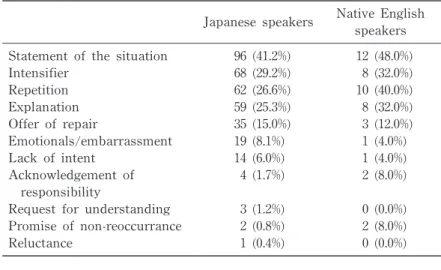
Table 1 shows the number of apology strategies in each category and the percentage of all apologies that they represent.
The differences of the frequency in which the Japanese speakers and native English speakers use the strategies do not vary greatly.
The biggest differences are in repetition, explanation, promise of non-reoccurrence, and acknowledgement of responsibility, all of which the native English speakers use more. However, due to the small number of native English speakers, it is difficult to draw firm conclusions.
Among the subcategories (collaborative, conditional, advance,
mutual, and repair), only the repair apology was used frequently, with 56 occurrences (24.0% of all apologies) among the Japanese speakers and 3 occurrences (12.0%) among the native English speakers. In addition, there was 1 occurrence (4.0%) of an apology in advance among the native English speakers. Considering that the corpus is compiled from an oral test, it is not surprising that there would be a relatively large number of repair apologies but few or none in the other subcategories.
4.2 Strategies for the Role Play
Among the Japanese speakers, the role play in which the interviewee was asked to talk to the host of a party in the
Table 1 Occurrence and Frequency of Apologies
Japanese speakers Native English speakers Statement of the situation 96 (41.2%) 12 (48.0%)
Intensifier 68 (29.2%) 8 (32.0%)
Repetition 62 (26.6%) 10 (40.0%)
Explanation 59 (25.3%) 8 (32.0%)
Offer of repair 35 (15.0%) 3 (12.0%)
Emotionals/embarrassment 19 (8.1%) 1 (4.0%)
Lack of intent 14 (6.0%) 1 (4.0%)
Acknowledgement of responsibility
4 (1.7%) 2 (8.0%)
Request for understanding 3 (1.2%) 0 (0.0%)
Promise of non-reoccurrance 2 (0.8%) 2 (8.0%)
Reluctance 1 (0.4%) 0 (0.0%)
(Note: The total of the strategies is greater than the number of apologies identified, since some apologies used more than one strategy.)
interviewee’s honor which he/she had failed to attend was used 46 times, with 34 females and 12 males. Because it was used only with more advanced learners, the mean STT score was 7.15.
Among the interviewees for whom there was information about their overseas experience, 26 had been overseas for a month and 2 had been overseas for a year. Among the native English speakers, there were four role plays, all with males.
Again, it is difficult to draw conclusions with such a small number of apologies from native English speakers. However, the Japanese speakers used intensifiers, repetition, and emotionals/
expression of embarrassment more frequently and the native English speakers used an offer of repair and acknowledgement of responsibility more frequently.
Of the 46 Japanese speakers, only two apologized explicitly for
Table 2 Strategies Used in Role Play
Japanese speakers Native English speakers
Intensifier 55 (119.6%) 4 (100.0%)
Explanation 45 (97.8%) 4 (100.0%)
Statement of the situation 44 (95.7%) 4 (100.0%)
Repetition 43 (93.4%) 3 (75.0%)
Offer of repair 30 (65.2%) 3 (75.0%)
Emotionals/embarrassment 18 (39.1%) 1 (25.0%)
Lack of intent 12 (26.1%) 1 (25.0%)
Acknowledgement of responsibility
4 (8.7%) 2 (50.0%)
Request for understanding 2 (4.3%) 0 (0.0%)
Promise of non-reoccurrance 2 (4.3%) 2 (50.0%)
Reluctance 2 (2.2%) 0 (0.0%)
not having called sooner. In contrast, all four of the native English speakers apologized explicitly for not having called.
Another difference between the role plays with the Japanese speakers and those with the native English speakers was that the Japanese speakers tended to repeat the IFID more often (3.58 times for each of the apologies for missing the party), while the native English speakers tended to be more explicit and detailed in explaining why they had missed the party but used the IFID less often (2.0 times for each of the apologies for missing the party.)
4.3 Analysis of Examples
The following two examples demonstrate the contrast in the justification for missing the party and the use if the IFID. The first role play is with a 24-year-old male university student who is a native English speaker.
(Note: A is the interviewer; B is being interviewed.) A: Hello? This is A here.
B: Hi, A. This is B. How are you?
A: B.
B: Yes. I know, A. Er, really sorry I- I- I couldn’t show up at at your dinner party this past weekend. Un- unfortunately, I- I just had some things come up a- a- at the last minute.
A: They were so important.
B: Erm. Uh A, erm eh a- a- as much as I wanted to go to your to your
dinner party, erm my brother-in-law called me er before I walked out the
door er to let me know that that er his grandfather had died. Erm he
was very close to his grandfather. And since my sister er is married to
him, I- I- I went over there to to talk to them. Erm and they were just very upset and they need someone to talk to. Er
A: Well yeah. I’m sorry to hear that. Erm I just wondered though, I mean your sister’s just close by. I- that’s- we’re on the way I know we’re on the way. You could have popped in.
B: Y- y- y- you know, y- y- you’re right. Erm but sometimes, er circumstances happen. And you just go with your got feeling on how to react to such situations a- a- and you just react to them that way. Erm and, you know, looking back at it, you know, I could have stopped at your at your party which er I- I probably should have should have done.
Erm but nonetheless, I- I- I made I made a decision that at the time, I felt very comfortable with. Erm I feel that family obligations are are are the utmost importance. Erm and um so, you know, nonetheless, I- I- I would appreciate, you know, if you could include me er in your future future plans.
A: Sure. I mean that isn’t a problem. I do understand the situation. But I just wonder did you didn’t even call?
B: Yeah. Yyy you know, i- it that that was that was wrong of me to do.
Erm I- I- I- I should have called. You are right. Er I mean uh uh er I mean you’ve been a very good friend to me, A.
A:
[Laughter]B: Erm and it’s and for me, not to call is i- is uh it’s it’s kind of a a bad thing to do it’s a- to such good friend. But, you know, I mean I’ll I’ll I’ll I’ll I’ll I’ll try to do better in the future, you know.
A: Well, don’t worry about it. We’re gonna have another party soon. So, B: Yeah.
A: Please come.
B: Please. Thank you very much.
A: OK. Thank you very much.
In this role play, the person who missed the party only uses the IFID once, with no repetition. However, he elaborates on his explanation for having missed the party because his brother-in- law’s grandfather had died by saying that his brother-in-law had been close to the grandfather and that his sister and brother-in- law had been very upset. He also states a principle (the importance of family) to further justify his choice. In response to the question about why he didn’t call, B takes responsibility and promises non-reoccurrence.
In the following role play, the Japanese speaker is a 22-year-old female who has been overseas for one year. Her SST score was 7, and she had a TOEIC score of 890.
(Note: A is the interviewer; B is a Japanese speaker being interviewed.)
A: Hello?
B: Is A there?
A: Oh. Speaking.
B: Hi. This is B.
A: Oh, B, what’s up?
B: Ah, ah, thank you for inviting the party, but you know, I had a mm trouble in my school, and I can’t go there.
A: Oh. But your friends are already here.
B: I know. I failed the test, and I have to take the test again, so I’m sorry. I’m
taking test in five minutes so I can’t go.
A: Hum B: I’m sorry.
A: Oh really? But it’s your birthday party.
B: I know. I studied a lot, but I failed, and I- If I don’t take the test today, I can’t graduate. So, I’m sorry.
A: Oh. That’s too bad. Hum. Err will the test take long time?
B: About three hours, I guess.
A: Three hours?
B: Hu-huh
A: Hum. OK. Err we have a party err until late at night.
B: About what time?
A: Oh. OK. Maybe tomorrow morning?
B: Tomorrow morning?
A: Yes.
B: I’m sorry, but I have a tennis a game tomorrow morning, so I can’t stay up late.
A: Oh. OK. I see. How can I tell the guests about that?
B: Err ah te- tell them that I really wanted to go, but I have to take the test to graduate, so can you tell me that can you tell them that?
A: Oh. OK.
B: Thanks.
A: I see.. All right. Thank you.
In this role play, the Japanese speaker uses the IFID three times
and justifies the offense in less detail than the native English
speaker does.
5 Conclusion
As a group, the Japanese speakers used a range of apology strategies and at a frequency similar to those of the native English speakers, though it is difficult to draw conclusions when the number of native English speakers is so small. In the role play, the Japanese speakers used repetition of the IFID more than the native English speakers did, which may be an example of transfer from their native language.
5.1 Limitations of the Study
This study dealt only with apologies that included an IFID with
“sorry.” It did not include apologies that included IFIDs with other performatives (for example, “apologize,” “forgive,” “pardon,” or
“excuse”) or with no performative.
In addition, the situations in which apologies might be appropriate or necessary are relatively limited, compared to everyday life. In the everyday conversation section of the interview, the interaction is small talk with a stranger. Some of the role plays do involve situations that require apologies or where apologies are appropriate. However, given the limitations on gathering natural conversations by Japanese speakers in English, this resource can be useful.
The native English speaker corpus was small, with only 20
interviews, only four of which included the role play that was
analyzed.
5.2 Suggestions for Future Research
In the future, it would be useful to continue the study by looking at apologies using IFID with other performatives. It would also be useful to take appropriateness into consideration and not just the quantity of the strategies used, as well as comparing the Japanese speakers’ apologies with the native English speakers’
apologies on a qualitative as well as quantitative basis. Another approach would be to compare students with higher proficiency and lower proficiency and/or a longer time and shorter time overseas.
A larger native English speaker corpus would be helpful, or at least more examples of the missed party role play.
In addition, it would be interesting to see the extent to which their cultural background and apology strategies in Japanese influenced the choice of apology strategies, for example, the repetition of the IFID.
References
Beebe, L. M., and Takahashi, T. (1989). Sociolinguistic variation in face- threatening speech acts: Chastisement and disagreement. In M.
Eiselstein (Ed), The dynamic interlanguage: Emperican studies in school language variation (pp.199-218). New York: Springer.
Cohen, A. D., and Olshtain, E. (1981). Developing a measure of socio- cultural competence: The case of apology. Language Learning, 31, 113- 134.
Demeter, G. (2012, February). Co-constructed and negotiated apologies.
Contributions of corpus linguistics to the study of speech acts. Paper presented at the Asia Pacific Corpus Linguistics Conference, Auckland, New Zealand.
Izumi, E., Uchimoto, K., and Isahara, H. (2004). SST speech corpus of Japanese learners’ English and automatic detection of learners’ errors.
ICAME Journal, No.28, 31-48.
Kitao, S. K. (2012). Using a spoken corpus compiled from subtitles to study apologies. Asphodel, 47, 50-77.
Leech, G. (1983). Principles of pragmatics. New York: Longman Publishing Group.
Salago, E. F. (2011). The pragmatics of requests and apologies: Developmental patterns of Mexican students. Amsterdam: John Benjamins. Retrieved on November 1, 2012 from http://tinyurl.com/pvyljc5
Wipprecht, C. (2004). The speech act of apology in an American soap opera and the German equivalent. Munich: GRIN Verlag.
Appendix
This apology strategies typology was developed by Cohen and Olshtain (1981) and adapted by Hitomi Abe (personal communication, March 5, 2012) and Kitao (2012).
-Expression of apology: Use of an expression which contains a relevant performative verb. e.g., “I’m sorry”; “I apologize”; “Excuse me”; “Forgive me”; “Pardon me.”
-Explanation: An explanation or an account of situation which caused the apologizer to commit the offense
-Statement of the situation: A description of the situation that led to the need for apology, e.g., “I dropped your camera and broke it.”
-Acknowledgment of responsibility: A recognition by the apologizer of his or her fault in causing the offense. This semantic formula can be subcategorized into:
1. Implicit acknowledgment, e.g., “I should have called you before.”
2. Explicit acknowledgment, e.g., “It completely slipped my mind.”
3. Expression of reluctance, e.g., “I hesitate to say this, but it is true.”
4. Expression of lack of intent, e.g., “I didn’t mean to.”
5. Expression of self-deficiency, e.g., “You know I am bad at remembering things.”
6. Expression of embarrassment, e.g., “I feel so bad about it.”
7. Request for understanding: asking the interlocutor to understand the speaker’s situation, e.g., “I hope you understand.”
-Offer of repair: An offer made by the apologizer to provide payment for some kind of damage caused by his or her infraction, which can be specific or non-specific.
1. Non-specific offer of repair, e.g., “I’ll see what I can do.”
2. Specific offer of repair, e.g., “I will do extra work over the weekend.”
-Suggesting a repair: Suggesting something that the interlocutor rather than the apologizer could do. e.g., “Do you want to come with me?”
-Statement of alternative 1. I can do X instead of Y
e.g., “I’d rather. . . ”
2. Why don’t we X instead of Y e.g., “Let’s do…instead”
-Promise of non-recurrence: A commitment made by the apologizer not to have the offense happen again. e.g., “It won’t happen again.”
-Suggestion for avoiding the situation: e.g., “Let’s put it in writing next time.”
-Verbal avoidance 1. Topic switch 2. Joke
3. Finding a silver lining: Referring to something good that came out of the apologizer’s mistake, e.g., “You have a lead on a new job.”
4. Laugh
Adjuncts to apologies
1. Intensity of apology: e.g., “really,” “very,” “so,” “terribly,” “awfully,” “truly,”
“please”;
2. Repetitions, e.g., “I’m sorry, I’m sorry.”
3. Minimizing offense: e.g., “It’s O.K. No harm done.”
4. Self-justification: explaining why the action was justified, e.g., “I’m sorry I laughed at you, but in my defense - look at you!”
5. Emotionals: e.g., “Oh!” “Oops!” “God!”
6. Gratitude: e.g., “Thank you.”, “I appreciate it.”
7. Wishing the best after apologizing: e.g., “I hope you enjoy yourselves.”
8. Concern for the interlocutor: e.g., “Are you okay?”, “Have you been waiting long?”
9. Feedback: e.g., “This book was interesting.”
10. Adjunct to the offer of repair: e.g., “Please wait.” “Just a moment.”
11. Introduction of an apology: e.g., “I need to apologize.”
12. Clarification: when the interlocutor misunderstands exactly what the speaker is apologizing for, the speaker clarifies, e.g., “I’m not sorry I did it, but I’m sorry I didn’t tell you sooner.”
Other
1. utterances related to apology: e.g., “Believe me.” “What’s wrong?”
2. utterances not related to apology: e.g., “Let’s go.”