A Survey on the Instruction of Relative Clauses in the Revised High School Textbooks
NAGAI Makoto1)
Abstract: This paper reports the results of a survey on the teaching approaches in the revised MEXT-censored English textbooks for junior and senior high schools focusing on whether there are any hints that can contribute to coping with the difficult relative clause types. The results suggest that the types of relative clauses that are difficult for learners will remain difficult unless each instructor (1) keeps a balance among the sentences to present to the learners, and (2) gives them some additional exercises to help them understand the relative clause as a module in the main sentence which can be used both in the subject and object positions.
Keywords: Teaching approaches, MEXT-censored textbooks, Relative pronoun, Relative adverb
1. Introduction
Preceding studies have clarified that some relative clause structures are more difficult for ESL learners to acquire than others, although they superficially look similar to each other. There have been some studies about the order of difficulty in the category of the relative pronoun clauses only. Nagai (2012), the present researcher, summarized those studies as follows.
Kawauchi (1988) and Itoh (2001) examined the order of difficulty among the four types of relative pronoun clause structures; types called “SS,” “SO,” “OS,” and “OO” (explained later). They reported almost the same order: OS is the easiest and SS and SO are more difficult than the others.
In order to clarify the acquisition of relative clauses in general, Nagai (2010) then added two relative adverb clause structures called “SA” and “OA” (explained later), and studied the order of difficulty among the six types of relative clauses.
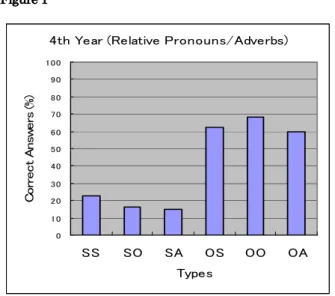
The results of the study suggest that it is more significant to divide those types into two groups containing three easy types and three difficult ones, rather than determining the order.
It was because there was a clear gap between the two groups, and also each group had something in common.
As Nagai (2010) pointed out, the common feature of the types in the difficult group was relative clauses that function as the subjects of the main structures, whereas the easier group had relative clauses in the object position. Figure 1Figure 1Figure 1Figure 1 from NAGAI (2010) shows the learners’ achievement in uncontrolled word order arrangement tests. It is clear that there is a clear gap between the two groups: the easy and
1) 東京都立産業技術高等専門学校 ものづくり工学科 一般科目
the difficult types.
This paper reports the results of the survey on the teaching approaches in the revised MEXT-censored English textbooks for junior and senior high schools focusing on whether there are any hints that can contribute to coping with the difficult relative clause types.
Figure 1 Figure 1 Figure 1 Figure 1
(NAGAI, 2010)
2. The Target Structures of the Present Study The target structures discussed in the present study are as follows; the same six types as in NAGAI (2010).
Types of Relative Clause Structures:
SS SSSS
SS: The subject of the sentence is an NP relativized by a subjective relative pronoun.
4th Year (Relative Pronouns/Adverbs)
0 10 20 30 40 50 60 70 80 90 100
SS SO SA OS OO OA
Types
Correct Answers (%)
e.g. The man who speaks English doesn’t speak Japanese.
OSOSOS
OS: The object of the sentence is an NP relativized by a subjective relative pronoun.
e.g. I know the man who speaks English.
SO SOSO
SO: The subject of the sentence is an NP relativized by an objective relative pronoun.
e.g. The letter that John wrote was long.
OO OOOO
OO: The object of the sentence is an NP relativized by an objective relative pronoun.
e.g. I read the letter that John wrote.
SA SASA
SA: The subject of the sentence is an NP relativized by a relative adverb.
e.g. The office where my father works is near here.
OA OAOA
OA: The object of the sentence is an NP relativized by a relative adverb.
e.g. I visited the office where my father works.
(NAGAI, 2010)
3. The Method
The four relative pronoun structures were examined in the six “English Ⅲ” textbooks for junior high schools revised in 2011, and the two relative adverb structures were examined in the seventeen “English Expressions I” textbooks for senior high schools revised in 2012.
For both relative pronouns and adverbs, the check points were the same; (1) types of example sentences when they are first introduced to the learners, (2) types of exercises when the learners are asked to produce sentences including relative pronouns or adverbs. The seven types of exercises in point (2) are as follows.
Types of Exercises for Productive Skills JETJETJET
JET (Japanese to English Translation)
e.g. “Translate the Japanese sentences into English.”
UWOUWOUWO
UWO (Uncontrolled Word Order Arrangement)
e.g. “Arrange the word order so that the sentence means the same as the Japanese sentence.”
CWO CWOCWO
CWO (Controlled Word Order Arrangement)
e.g. “Arrange the word order of the underlined part so that the sentence means the same as the Japanese sentence.”
USCUSCUSC
USC (Uncontrolled Sentence Connection)
e.g. “Connect the two sentences using the relative pronoun/adverb.”
CSC CSCCSC
CSC (Controlled Sentence Connection)
e.g. “Complete the latter half of the sentence using the
relative pronoun/adverb.”
RPAC RPACRPAC
RPAC (Relative Pronoun/Adverb Choice)
e.g. “Choose the relative pronoun/adverb that fits the blank.”
MCMCMC
MC (Module-conscious)
e.g.(1) “Make up a relative clause first, then put it in the appropriate position in the main sentence.”
e.g.(2) “Use the same relative clause as in the example sentence in a different position in the new sentence.”
The last type, module-conscious, is the one the present writer expects to be effective in coping with the learners’
difficulty.
4. The Results of the Survey 4.1 Types of Example Sentences
Figure 2 Figure 2 Figure 2
Figure 2 shows the number of the different types of example sentences for relative pronouns, and Figure 3Figure 3Figure 3Figure 3 for relative adverbs.
Figure 2 Figure 2 Figure 2 Figure 2
Types of Example Sentences for Relative Pronouns
SSSSSSSS SOSOSOSO OSOSOSOS OOOO OOOO
N 10 6 13 7
Figure 3 Figure 3 Figure 3 Figure 3
Types of Example Sentences for Relative Adverbs
SASA SASA OAOAOAOA
N 3 47474747
As Figure 2 shows, example sentences for the relative pronouns in the junior high school textbooks are balanced well enough. However, there is an extreme difference between the numbers of the two types in the senior high school textbooks as Figure 3Figure 3Figure 3Figure 3 shows.
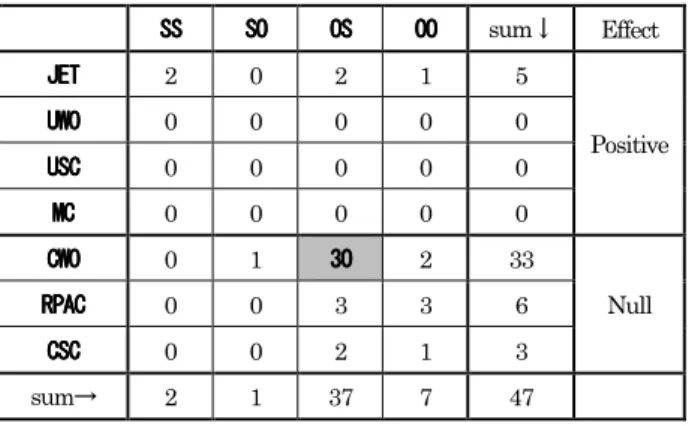
4.2 Types of Exercises Figure 4
Figure 4 Figure 4
Figure 4 shows the number of the different types of exercises for productive skills for relative pronouns, and Figure 5
Figure 5 Figure 5
Figure 5 for relative adverbs.
As Figure 4Figure 4Figure 4Figure 4 shows, there are very many exercises in only one type, which is, controlled word order arrangement exercises in the sentences where the object of the main sentence includes a relative pronoun in the subjective case.
Figure 5Figure 5Figure 5Figure 5 shows that there are many more exercises for relative clauses in the object position than in the subject
position, and that the types of exercises can be divided clearly into two groups in terms of the number; the four types in the upper half and the three types in the lower half.
Figure 4 Figure 4 Figure 4 Figure 4
Types of Exercises for Relative Pronouns SS
SS SS
SS SOSO SOSO OSOSOSOS OOOO OOOO sum↓ Effect JET
JETJET
JET 2 0 2 1 5
Positive UWOUWOUWO
UWO 0 0 0 0 0
USCUSCUSC
USC 0 0 0 0 0
MCMC
MCMC 0 0 0 0 0
CWOCWOCWO
CWO 0 1 30303030 2 33
Null RPACRPACRPAC
RPAC 0 0 3 3 6
CSCCSCCSC
CSC 0 0 2 1 3
sum→ 2 1 37 7 47
Figure 5 Figure 5 Figure 5 Figure 5
Types of Exercises for Relative Adverbs SA
SA SA
SA OAOAOAOA sum↓ Effect JET
JET JET
JET 1 2 3
Positive UWO
UWO UWO
UWO 0 0 0
USC USC USC
USC 1 0 1
MC MCMC
MC 0 0 0
CWO CWO CWO
CWO 2 42424242 44
Null RPAC
RPAC RPAC
RPAC 2 29292929 31 CSC
CSC CSC
CSC 0 14141414 14
sum→ 6 87 93
5. Conclusion
The types of relative clauses that are difficult for learners will remain difficult unless each instructor (1) keeps a balance among the sentences to be presented to the learners, and (2) gives them some additional exercises to help them understand the relative clause as a module in the main sentence which can be used both in the subject and object positions. There are two reasons as follows.
First, there are a lot fewer exercises for the three difficult types of relative clauses shown in Figure 1Figure 1Figure 1Figure 1 (SS, SO, SA) in the revised textbooks.
Second, there are a lot fewer exercises in the types in the upper half of the figure. The four types in the upper half of Figures 4Figures 4Figures 4Figures 4 and 555 are expected to have a positive effect in 5 coping with the learners’ difficulty because they require the understanding of the basic structure of the main sentence;
the learners have to understand the scope and the position of the subject part, which is not required in the three types in the lower half of the figures.
6. References
[1] 伊藤彰浩:『共時的アプローチによる英語関係節の習得研究』. 東京:リーベル出版. 101-113. 2001.
[2] Kawauchi, C.:Universal Processing of Relative Clauses by Adult Learners of English. JACET Bulletin. No.19. 19-36, 1988.
[3] Keenan, E. L. and Bernard Comrie.:Noun Phrase Accessibility and Universal Grammar. Linguistic Inquiry, Volume 8, Number I. 63-99, 1977.
[4] Kidd, E.(ed) :The Acquisition of Relative Clauses, Amsterdam/Philadelphia: John Benjamins, 2011.
[5] Kuno, S.:The Position of Relative Clauses and
Conjunctions. Linguistic Inquiry, Volume 5, Number I.
117-136, 1974.
[6] Nagai, M.:How Can We Cope with the Order of Difficulty in the Acquisition of Relative Clause Structures? 全国高 等専門学校英語教育学会「研究論集」第29号. 91-100, 2010.
[7] Nagai, M.:Acquisition of Two-clause Structures by Japanese ESL Learners: What Factors Make Some Structures More Difficult to Acquire than Others? 東京 都立産業技術高等専門学校研究紀要第6号.(ファイル13 ), 2012.
[8] 大関浩美:「なにが関係詞節習得の難易を決めるのか ― 研 究の動向及び日本語習得研究への示唆 ― 」日本言語文化学 研究会『言語文化と日本語教育2003年11月増刊特集号. 第 二言語習得・教育の研究最前線 -2003年版- 』32-49, 2003.
[9] 齋藤(大関)浩美: 「連体修飾詞の習得に関する研究の動 向」日本言語文化学研究会『言語文化と日本語教育2002年 5月増刊特集号. 第二言語習得・教育の研究最前線:あすの 日本語教育への道しるべ 』45-69, 2002.
[10] Schuman, J. H.: The Acquisition of English Relative Clauses by Second Language Learners. In Scarcella, Robin C. and Stephen D. Krashen(Eds) Research in Second Language Acquisition, Mass: Newbury House, 118-131, 1980.
[11] Sheldon, A.:On the Role of Parallel Function in the Acquisition of Relative Clauses in English. Journal of Verbal Learning and Verbal Behavior, 13, 272-81, 1974.
[12] Slobin, D.:Cognitive Prerequisites for the Development of Grammar. In Furgason, C.A. and D. Slobin(Eds) Studies of Child Language Development. NY: Hoit, Rinehart and Winston, 175-208, 1973.