• 検索結果がありません。

Key processes to understand spatial and temporal variations of sea ice in the Arctic Ocean

N/A
N/A
Protected

Academic year: 2021

シェア "Key processes to understand spatial and temporal variations of sea ice in the Arctic Ocean "

Copied!
2
0
0

読み込み中.... (全文を見る)

全文

(1)

Key processes to understand spatial and temporal variations of sea ice in the Arctic Ocean

Koji Shimada

1

and Eri Yoshizawa

1

1

Tokyo University of Marine Science and Technology

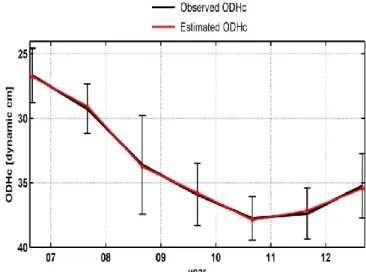
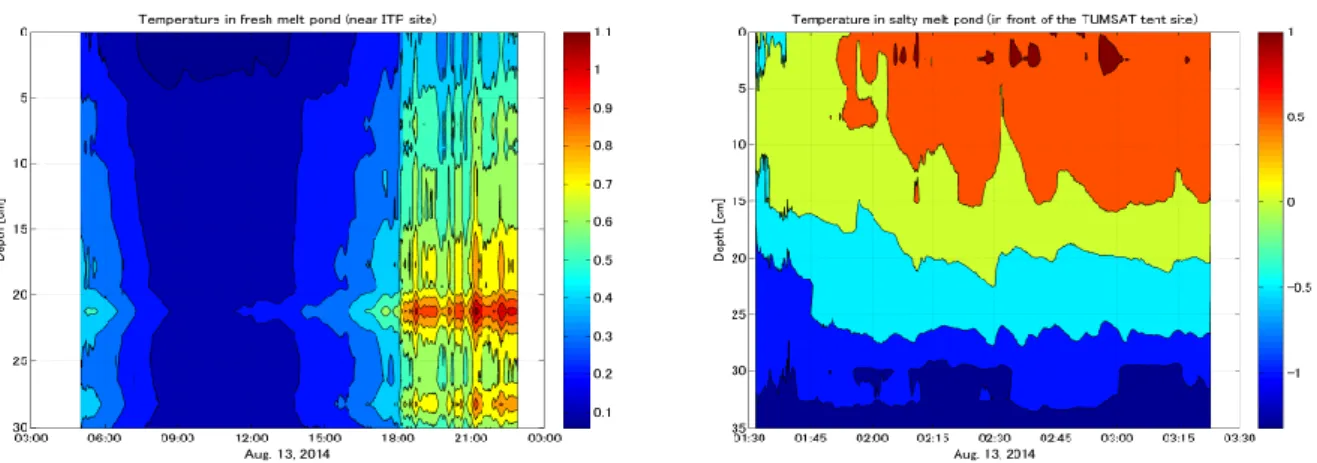
Here we introduce four key processes affecting the variations of sea ice in the Arctic Ocean. The first is the strength of upper ocean circulation caused by the effective momentum penetration from atmosphere into the ocean via sea ice. The upper ocean circulation delivered huge amount of heat within the Pacific Water layer into the Arctic Basin. The warming of the upper ocean resulted in less sea ice formation there. An imbalance between sea ice growth in winter and melt in summer caused total sea ice reduction (Fig. 1). The strength of upper ocean circulation is a central issue to detect the variation of upper oceanic heat and associated sea ice cover. The retarded response of the ocean is a key to understand the state of the ocean affecting sea ice cover. We succeed to identify the strength of upper ocean circulation based on standard geophysical fluid dynamics using just sea ice motion derived passive microwave satellite data, without any in-situ oceanic data (Fig. 2). The second is the upward heat flux from the Pacific Summer Water layer. We introduce a critical condition of the anomalous heat flux associated with the sea ice motions (Fig. 3). The third is the local ridding and rafting of sea ice near the coast and in the shelf region. This local process is quite important to detect thick ice distributions and their lifetime. The fourth is changes in development of melt pond dependent on the sea ice property. When the Arctic Ocean covered by multi-year ice, maximum temperature was observed near the bottom of the melt pond, so the sea ice melt was dominant at the bottom of the melt pond. Recently, major sea ice type has been replaced by first year ice, which has channels that enable to leak seawater into melt pond, and the ponds are characterized by salinity stratification. In this case, sea ice melt occurred at the size rim of the melt pond, and the size of the melt pond significantly is increased by effective accelerations of ice-albedo feedback (Fig. 4).

Figure 1. Upper ocean heat content (20-150m, 74- 78N, 150-160W)and sea ice concentration (74- 78N, 150-170W ) in the western Canada Basin.

After 2007, major sea ice type has been replaced by first-year ice, sea ice cover in summer has been governed by the ocean heat. This suggests winter sea ice growth is important for the fate of first-year ice in the following summer.

Figure 2. Observed and estimated ocean dynamic heights

at 50 dbar (reference 800dbar) near the center of Oceanic

Beaufort Gyre. Upper ocean circulation driven mainly

my sea ice motion. The upper ocean circulation respond

to the surface forcing with time lag. We clarified the

time lag and developed a method to identify the volume

transportation of upper ocean circulation just using sea

ice motion. Yoshizawa et al. (2015).

(2)

Figure 3. (left) Trajectory of ice camp. (right) Richardson number in upper 40m.

Figure 4 . Time series of temperature in melt pond. (left) freshwater pond, (right) salt pond.

Figure 1. Upper ocean heat content  (20-150m, 74- 74-78N, 150-160W)and sea ice concentration   (74-78N, 150-170W ) in the western Canada Basin
Figure 4 . Time series of temperature in melt pond. (left) freshwater pond, (right) salt pond

参照

関連したドキュメント

Kilbas; Conditions of the existence of a classical solution of a Cauchy type problem for the diffusion equation with the Riemann-Liouville partial derivative, Differential Equations,

Then it follows immediately from a suitable version of “Hensel’s Lemma” [cf., e.g., the argument of [4], Lemma 2.1] that S may be obtained, as the notation suggests, as the m A

Going back to the packing property or more gener- ally to the λ-packing property, it is of interest to answer the following question: Given a graph embedding G and a positive number

This paper presents an investigation into the mechanics of this specific problem and develops an analytical approach that accounts for the effects of geometrical and material data on

The proof of the existence theorem is based on the method of successive approximations, in which an iteration scheme, based on solving a linearized version of the equations, is

While conducting an experiment regarding fetal move- ments as a result of Pulsed Wave Doppler (PWD) ultrasound, [8] we encountered the severe artifacts in the acquired image2.

In section 4 we use this coupling to show the uniqueness of the stationary interface, and then finish the proof of theorem 1.. Stochastic compactness for the width of the interface

In the proofs of these assertions, we write down rather explicit expressions for the bounds in order to have some qualitative idea how to achieve a good numerical control of the