Communal Connectedness among Tibetans in Toronto
著者(英) Takako Yamada
journal or
publication title
Senri Ethnological Studies
volume 93
page range 241‑273
year 2016‑08‑31
URL http://doi.org/10.15021/00006089
241
Edited by Takako Yamada and Toko Fujimoto
Leadership and Empathy in the Remaking of
Communal Connectedness among Tibetans in Toronto
Takako Yamada
Kyoto University
1. Introduction
Since the 1990s, I have worked on the dynamics of cultures and identities among a variety of populations: the Ainu, the Sakha-Yakut, the Yaeyama Islanders in the Ryukyu Islands, the Ladakhi, Tibetan refugees in India and western countries, as well as Tibetans in Tibet after the implementation of “Open Policy” by the Beijing government. My studies, for example among the Ainu and the Sakha, reveal that the revitalization or vitalization of religion and tradition is closely linked with the reconstruction of ethnic and micro-regional identities, which are underlain by the continuity of traditional cultures and a philosophy of symbiosis with nature (Yamada 2000, 2004, 2007).
Other case studies among Tibetans and Tibetan refugees demonstrate that the vitalization of religion and tradition has not only forged the formation and keeping of a sense of pan-Tibetan belonging beyond regional differences, but has also strengthened a micro-regional sense of belonging rooted in the locality, such as the three major divisions of Utsan (Central & Western Tibet),
Kham (Southeastern Tibet), and Amdo (NortheasternTibet) and/or more local divisions including Nyaron and Kanze in Kham region (Yamada 2008, 2010a, 2011b, 2012b). Among Tibetan refugees especially, the making of a trans- regional network has been indispensable to maintaining their Tibetan identity (Yamada 2011c). Moreover, case studies among the Ladakhi reveals that Tibetan Buddhism and shamanistic tradition have been the core of their identity and have maintained their communal community (Yamada 2010b, 2012a, 2014). The value of local cultures and religions is reappraised to keep a sense of communal connectedness.
These findings suggest that, against the myth of modernity and globalization, societies have been confronted with endangered identities under contemporary transnational circumstances and have sought their identities within the multicultural/
ethnic landscape. In reality, as Robertson (1995) has proposed through the idea of glocalization, modernity has resulted in the localization of global phenomena rather than universal and uniform globalization. In various contemporary societies and cultures under the influence of globalization, the continuity of tradition against global uniformity can be strikingly observed (Yamada 2011a; Yamada and Irimoto 2011).
Looking back over my studies so far and following the theme and purposes of the
international workshop held in 2014, this paper aims to clarify the mechanisms whereby culturally endangered populations—that is, minority and marginal groups within larger societies—remake connectedness among members in modern multicultural landscapes in terms of historicity, identity, and religious/secular leadership as agency. Here, as is defined in the introduction to this volume, the term “connectedness” signifies “face-to face relationships in a socio-cultural milieu of a group that forge a sense of community and sharing of values and ideas” (Yamada 2014: 10).
How do members of a culture recreate connectedness among themselves in order to form communities both within and extending beyond national borders? What strategies or forms of leadership are employed to remake the dynamics between a marginal community and the dominant culture in order to facilitate fruitful symbiosis? Here, the term
“leadership” is defined based on its original meaning of “the action of leading a group of people or an organization or the ability to do this” given in the Oxford Dictionary of English (Oxford University Press 2003) and signifies the action of taking the initiative in carrying out action plans to lead a group of people or an organization.
In an attempt to answer the questions posed above, this paper explores and discusses the remaking of micro-regional/ethnic connectedness on the basis of a case study of Tibetans in Toronto, by focusing on the strategies and leadership that were involved in the process of establishing the Canadian Tibetan Association of Ontario (CTAO) and the shift to opening the Tibetan Canadian Cultural Center (TCCC), as well as the involvement of the 14th Dalai Lama in the Tibetan community in Toronto. Hess’ study on Tibetans in India and the United States (Hess 2009) aptly revealed that globalization has made geographic proximity irrelevant to many Tibetans: by becoming citizens of powerful states, Tibetans can act as “immigrant ambassadors” for their lost homeland.
However, little is known about how Tibetans in Western countries have struggled to remake communal connectedness in order to preserve their identity and culture in host countries. As the history of the Tibetan community in Canada shows, Tibetans have engaged in a series of efforts to remake connectedness among them, to maintain Tibetan culture, and to forge an identity as Tibetan Canadians. This paper will shed light on how religious and secular leadership as well as empathy within the community operated within the process of remodeling connectedness, by investigating the establishment of the CTAO and the TCCC.
2. General Background of Tibetans in the Diaspora
2.1 Contemporary circumstances surrounding Tibetan refugeesAs a consequence of the invasion of Tibet by the Chinese Liberation Army in 1959 and the subsequent exodus of the Dalai Lama to India, about 60,000 80,000
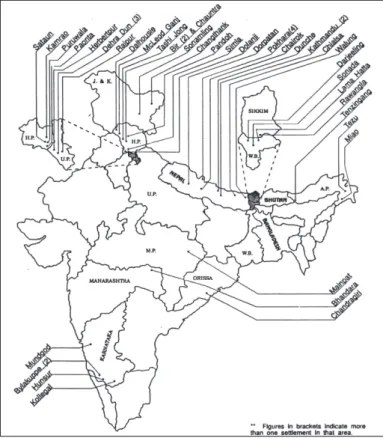
1)Tibetans settled as refugees in India from different parts of Tibet (Fig. 1). By 1966, they lived in about 38 different settlements in India, Nepal, and Bhutan (Avedon 1979: 90; Fig. 2).
The number of Tibetan refugees in 1998 had nearly doubled to about 122,078,
including those in India (85,147), Nepal (13,720), Bhutan (1,584), Switzerland (1,538),
and North America (7,000) (Planning Commission, CTA 1999: 7, 34 38). According to
Figure 1 Places in Tibet from which Tibetan refugees emigrated
Source: Bureau of H. H. the Dalai Lama, 1969, Tibetans in Exile 1959 1969: A report of ten years of rehabilitation in India. Dharamsala, India: Bureau of H. H. the Dalai Lama, back cover. [Reprinted with kind permission from the Bureau of H. H. the Dalai Lama, New Delhi, India.]
Figure 2 Map of Tibetan settlements in India and Nepal
Source: Planning Council, CTA, 1994, Tibetan Refugee Community Integrated Development Plan –II 1995 2000 Summary. Dharamsala, India: Central Tibetan Administration of His Holiness the Dalai Lama, p. v. Reprinted with kind permission from the Planning Council, CTA.
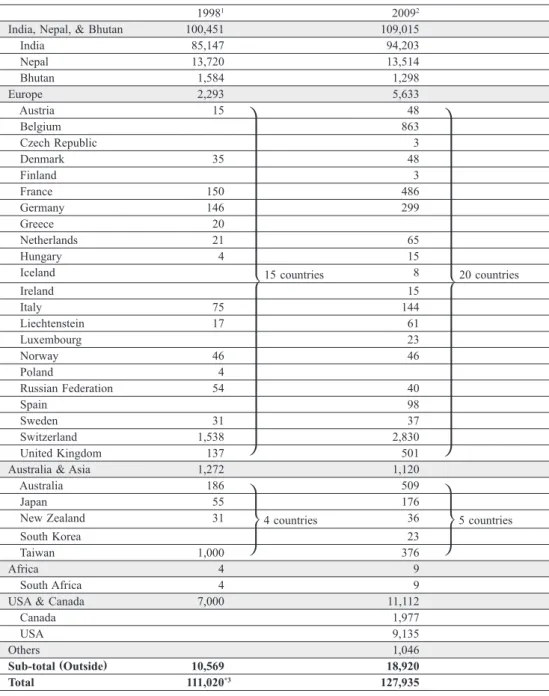
an announcement in 2010 by the Central Tibetan Administration (CTA), the number of Tibetan refugees in 2009 had risen slightly to 127,935: 94,203 in India, 13,514 in Nepal, 1,298 in Bhutan, and 18,920 in 28 other countries including Switzerland, England, the United States, and Canada (Planning Commission, CTA 2010: 13, 60; Table 1).
The worldwide expansion of Tibetan refugees’ settlements has been facilitated by farsighted collaborative schemes with Western countries launched under the leadership of the 14th Dalai Lama. A variety of projects have been carried out: young Tibetans were dispatched as students to Western countries and Japan, and projects to resettle Tibetan refugees in Switzerland and Canada were implemented during the 1960s and 1970s; in addition, one project resettled 1,000 Tibetans in the United States in 1990. Although few Tibetans have settled in Japan, Pema Gyalpo, who was received by a Japanese professor as the first Tibetan student studying at Asia University in 1965, has contributed greatly to disseminating Tibetan culture and promoting friendship between Japan and Tibet by establishing the Tibetan Culture Center in Tokyo.
The CTA, also known as the Tibetan Government in Exile, was established by the 14th Dalai Lama in Mussoorie on April 29, 1959, shortly after his exile from Tibet, as the sole legitimate government of Tibet in order to “rehabilitate Tibetan refugees and to restore freedom and happiness in Tibet.” Because the head offices of the CTA were moved from Mussoorie to Dharamsala in May 1960, Dharamsala has developed as a center for all Tibetan affairs (Photos 1a, 1b, 2a, 2b).
Under the leadership of the 14th Dalai Lama, the CTA has introduced, step by step, democracy into its political structure. A parliament, originally known as the Commission of Tibetan People’s Deputies, was inaugurated in 1960 (Photos 3, 4). The parliament gradually matured into a full-fledged legislative body and became known as the Tibetan Parliament in Exile (TPIE) in 2006. Furthermore, on the advice of the 14th Dalai Lama, the Tibetan Parliament amended its charter to provide for the direct election of the Kalon Tripa (the highest executive authority) by the exile populace. Tibetans in exile directly elected Dr. Lobsang Sangay as the third Kalon Tripa in 2011. In August 2011, the political authority of the 14th Dalai Lama was completely transferred to the third Kalon Tripa.
The establishment of the Tibetan Government in Exile in Dharamsala, together with
memories and tales of journeys of escape and of living in refugee camps, have thus
combined to create a new perception of “Tibetanness” that has superseded the former
characteristic regionalism of Tibetans, which was based primarily on regional divisions
between, for example, U-tsan, Amdo, and Kham, or mere localities such as Delge, Karze,
and Repgon. In the more than half a century since 1959, having established a more stable
economic footing, some Tibetan refugees have begun to acquire citizenship in their host
countries. At the same time, the increasingly open policies of the Chinese government
since 1979 have permitted increasing communication between Tibetan refugees and their
home communities. Tibetan refugees, supported by economic success in their host
countries, have reestablished connectedness with their places of origin through a variety
of networks and media.
Table 1 Tibetans living in exile
19981 20092
India, Nepal, & Bhutan 100,451 109,015
India 85,147 94,203
Nepal 13,720 13,514
Bhutan 1,584 1,298
Europe 2,293 5,633
Austria 15 48
Belgium 863
Czech Republic 3
Denmark 35 48
Finland 3
France 150 486
Germany 146 299
Greece 20
Netherlands 21 65
Hungary 4 15
Iceland 15 countries 8 20 countries
Ireland 15
Italy 75 144
Liechtenstein 17 61
Luxembourg 23
Norway 46 46
Poland 4
Russian Federation 54 40
Spain 98
Sweden 31 37
Switzerland 1,538 2,830
United Kingdom 137 501
Australia & Asia 1,272 1,120
Australia 186 509
Japan 55 176
New Zealand 31 4 countries 36 5 countries
South Korea 23
Taiwan 1,000 376
Africa 4 9
South Africa 4 9
USA & Canada 7,000 11,112
Canada 1,977
USA 9,135
Others 1,046
Sub-total (Outside) 10,569 18,920
Total 111,020*3 127,935
Note: The exile Tibetan population is said to have reached 122,078 on June 12, 1998 (Planning Council, CTA 1999: 7), but according to Tables 12 and 13 in the same volume, the total population of Tibetans in exile is estimated at 111,020 (Planning Council, CTA 1999: 34 38).
1: Source: Planning Council, CTA, 1999, Tibetan Demographic Survey, Dharamsala: Planning Council, CTA, pp.7, 34 38.
2: Source: Planning Commission, CTA, 2010, Demographic Survey of Tibetans in Exile 2009, Dharamsala: Planning Commission, CTA, pp.13, 60.
Photo 2a A stupa on the main street in Mclead Ganji in 1983. Photo 2b The stupa is invisible from the outside in 2013, being enshrined in the three-storied shrine.
1a
Photo 1 Shops on the main street in Mclead Ganj, Dharamsala in 1983 (Photo 1a) and in 2013 (Photo 1b).
1b
2.2 Trans-regional solidarity sustained by religion and education
As became known worldwide from the uprising in Lhasa in 1987 and the worldwide political movements for a “Free Tibet” in 2008, Tibetans have struggled to restore freedom and happiness in Tibet. In this process of struggle, they have forged a strong sense of who “Tibetans” are, which has transcended their former regionalism. It has often been stated that Tibetan refugees began to mold a Tibetan identity following the establishment of the Tibetan Government in Exile (Goldstein 1997). The formation of a trans-regional sense of belonging is inseparable from the spread of pan-Tibetan solidarity among Tibetan refugees; this solidarity has helped Tibetans to cope and live as a minority
Photo 3 Assembly of Tibetan People’s Deputies, Tibetan Government in Exile (Dharamsala, 2004).
Photo 4 KASHAG (Central Tibetan Administration) (Dharamsala, 2004).
group in majority societies.
The key role that the 14th Dalai Lama has played in the formation of comprehensive Tibetan identity cannot be overlooked. From the founding of the CTA, its rehabilitation agenda has included three important programs: 1) promoting education among the exile population, 2) building a firm culture of democracy, and 3) paving the way for self- esteem. As Noguchi writes, “Tibet was a country where religion was the most important thing” (Noguchi 2011:72 73). Education based on Tibetan Buddhist philosophy has an essential role in fulfilling this agenda.
Since the establishment of the Tibetan Government in Exile, the education of refugee children has been considered a key issue to maintaining Tibetan culture in preparation for the refugees’ future return to Tibet. In 2005, approximately 45 years after the Dalai Lama went into exile, the Tibetan Government in Exile established a unified education philosophy—the Basic Education Policy
2).
The Basic Education Policy details the Government in Exile’s basic attitude toward education, namely, the meaning of education, the purpose of education, sources of learning, the aim of providing education, the educational system, the structure of basic education, subjects of study, syllabi and the duration of study, examinations, teachers, educational administration, and the right to education. The underlying principle is, essentially, that the meaning and purpose of education in general must be based on the spirit of Tibetan Buddhism; the policy clearly states the necessity of education for the Tibetan people, the foundation of traditional Tibetan education, and the aim to which education should be provided.
The policy conceptualizes the necessity of education for the Tibetan people as a responsibility the Tibetan people have toward the world community to preserve and promote the unique wealth of Tibetan culture and traditions, which are of great value to all of humanity. Another responsibility the Tibetan people have to the world is to promote and widely propagate the noble principle of “universal responsibility” as introduced and initiated by the Dalai Lama. It is considered imperative that they foster those responsibilities in the hearts and minds of the Tibetan people.
The Basic Education Policy for Tibetans in Exile clearly states that education should be based on Tibetan religious traditions. Moreover, equal emphasis is attached to Tibetan Buddhism and the Bon Religion as traditional religions, and the unification of the Tibetan people by transcending the local identities of the three Tibetan regions is also upheld as one of the ultimate goals of education. In the policy, it is possible to discern that the need for the Tibetan people to cultivate a new identity that transcends religious schools and regionalism is underscored as one of the goals of education. The announcement of this education policy thus encouraged every Tibetan refugee community to promote solidarity and an identity as Tibetans among members.
3. The History of Tibetans in Toronto
3.1 Migration from India to TorontoBy the end of the 1960s, projects to resettle Tibetans could no longer be dealt with solely
by the Indian government; resettlement became a serious problem that warranted discussion among Western countries and the United Nations High Commission for Refugees (UNHCR). In 1960, the first group of Tibetan children was received by Pestalozzi Children’s Village in Switzerland, and in 1963, 1,000 Tibetans were welcomed as the first non-European refugees in Switzerland by the Swiss government (SWI 2010).
In 1966, the UNHCR began to discuss resettlement with the Canadian government under Prime Minister Lester B. Pearson. In July 1970, the Canadian government under Prime Minister Pierre E. Trudeau agreed to the resettlement of 240 Tibetans in Canada (Raska 2013)
3); this was reported in a newspaper article in the Toronto Star in September 1970 (Toronto Star, September 16, 1970).
The history of Tibetan immigration to Toronto began at the end of the 1960s following negotiations and discussions on resettlement during the early 1960s. Around 1969, the first Tibetan to immigrate, an elderly man named Ngawang Lungtok, settled in Belleville, near Toronto. He was followed in October 1970 by two young Tibetans, Tsering Wangkhang and Jampa Drongotsang, who were received by the Bata shoe company to work in its factory in the Batawa area of northwest Belleville (Toronto Star, February 5, 1971; Yeshe Wangkhang, September 20, 2013). Later, 240 Tibetans were resettled in Canada at the end of March 1971 by the Canadian government.
The Canadian government took initiative in the process of selecting Tibetans for immigration. Applications submitted to the Canadian Embassy in Delhi were sorted for selection on the basis of the applicant’s religious order: Gelug, Nyingma, Kagyu, or Sakya. Upon this basis, Tibetans were assigned to be resettled in various locations:
Tibetans belonging to the Kagyu and Nyingma religious orders were to be resettled in Ontario; those belonging to the Gelug religious order, in Montreal; and those belonging to the Sakya religious order, in Alberta. Although the resettlement of 240 Tibetan refugees was planned, the actual number of Tibetan immigrants was 228. They arrived in Canada in March 1971 and headed separately for 11 municipalities.
Their arrival in Toronto was reported by the Toronto Star. The first article was headlined “23 refugees from Tibet to be brought to Cobourg” (Toronto Star, March 11, 1971):
Twenty-three Tibetans will arrive in Cobourg in late March as part of a Canadian government program to assist refugees. They are part of a group of 240 being brought to Canada as a result of long-term negotiations between the Dalai Lama, spiritual leader of Tibet, and former prime minister [sic] Lester B. Pearson and Prime Minister Pierre Trudeau. Doug Tan of the federal manpower department said the group coming to Cobourg consists of eight workers and 15 dependants. “I don’t know whether they speak English or if any of them are skilled in trades at all” he said. “We hope to get them employed in local industry.” Tan said the Tibetans will receive schooling at Sir Standard College in Peterborough to help them learn the language and money system. They are expected to arrive on March 23. Another group of 20 will settle at Lindsay, 35 miles northeast of Cobourg.
It is clearly stated that the program was to be implemented as a result of negotiations between the Dalai Lama and two prime ministers of Canada. In addition, the Canadian government was prepared to provide English-learning programs for Tibetans.
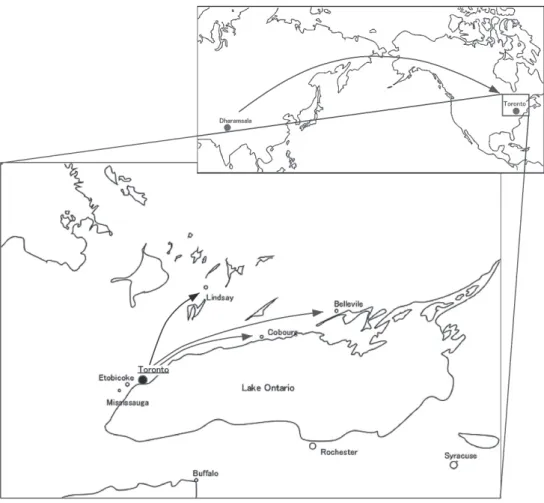
On March 31, 1971, the Toronto Star reported that 43 Tibetans had arrived at Toronto International Airport on March 30, 1971 and were headed for hotels in Lindsay and Cobourg (Toronto Star, March 31, 1971). This was the very start of the Tibetans’
resettlement in Toronto (Fig. 3).
Their personal histories of migration from Tibet to India and to Toronto were different from person to person. Tenpa, for example, who was originally from Phari in U-Tsan region located on the border with India and Bhutan, fled from Tibet with his family in 1962. After staying first at Buxa refugee camp in West Bengal for about eight months, they were sent to Kulu in Himachal Pradesh together with other Tibetans to work as road construction laborers. Fortunately, in 1965 he and his wife were appointed foster parents by the Tibetan Homes Foundation School, a boarding school in Mussoorie,
Figure 3 Migration of Tibetans from India to Toronto
and his family moved to live there (Photos 5a, 5b). When the resettlement project for 240 Tibetans in Canada was announced, Tenpa decided to submit his application as he was so concerned about the future of his four children because they had no financial means to meet their future needs. Thus, he came to Toronto with his family in 1971 (Lektsog 206: 109, 119, 126, 129).
Lobsang, who was born at Dzongar in Ngari region located near the Nepal border, fled from Tibet to the border area of Nepal and married there. After moving to Dharamsala, the couple was also sent to Kulu to work as road construction laborers.
They later settled in Mussoorie, running a small business until they came to Toronto
Photo 5a, 5b Tibetan Homes Foundation & SOS Children’s Village in Mussoorie (2009).
5a
5b
(Lobsang Mentuh, November 29, 2012).
Two other examples concern Tibetans who were originally sent to other cities under the resettlement project. Yeshe was sent to Lethbridge in Alberta in 1971, but in 1972 he moved to Belleville in Ontario, where his brother Tsering had already resettled. He was born in Gyantse in U-Tsan region and sent to a monastery in his childhood. He fled from Tibet in 1959 with his family to a refugee camp in Mussoorie and from there was sent to Bomdila in Arunachal Pradesh to work as a road construction laborer. With the outbreak of the Sino-India Border Conflict in 1962, his family resettled in Mussoorie again. After finishing his training in basic electrical wiring at the training center in Clement Town in Himachal Pradesh, he worked for a paper factory and a printing press in Bhopal, then as a manager of Kham Khatok Tibetan Settlement in Sataun near Dehra Dun, and after that he worked for the American Embassy in New Delhi. His next move was to Canada (Yeshe Wangkhang, September 20, 2013).
Geleg was also one of the first Tibetan refugees to arrive in Canada under the resettlement project, who was 17 years old when he came to Canada with his family. His father, Tsering, who was from Chone in the Amdo region of Tibet, had served for the Government of Tibet in Lhasa since his 30s. From 1963 to 1972 his father served as a high ranking official for the Tibetan Government in Exile in Dharamsala, namely, the Deputy Minister of Home Affairs and the first Minister of Finance. However, seriously concerned about his children’s education, his father decided to apply for the project. In 1972 his family came to Saskatoon in Saskatchewan under the resettlement project of 240 Tibetans in Canada. After graduating from Manitoba University in 1979, Geleg came to Toronto in 1980 and helped to prepare the plan for the CTAO to invite the Dalai Lama to Toronto in 1980. Since then he has lived in Toronto, working for Xerox (Geleg Gyalthong, September 17, 2013).
Although the above are just a few examples of personal histories of the first generation of Tibetan immigrants to Canada, they show the divergent backgrounds of Tibetans who settled in Toronto.
3.2 Rehabilitation in Toronto
Forty-three Tibetans in total were received by the Ontario Provincial Government and
were divided into three groups: six families belonging to the Kagyu religious order were
taken to Lindsay, another six families from the Nyingma religious order were taken to
Cobourg, and the remaining six families from the Nyingma religious order were taken to
Belleville. Families settled in Lindsay stayed in a hotel for two months, during which
time they were taught the basics on surviving in Canada. The families were then moved
into a large house with two separate kitchens that were shared by three families each. For
about 10 months, they received basic classes in English and were enrolled in training
programs (Lektsog 2006: 134; Lobsang Mentuh, November 25, 2012; Toronto Star April
2, 1971). The Canadian government provided them a monthly allowance as well as free
food and clothing during this period. The Tibetans were given one year of assistance,
after which they were expected to subsist on their own. The Canada Manpower
Department helped them to find jobs.
Lobsang chose to work in a furniture-making factory, where he was a probationer for three months, a trainee for another three months, and then became employed and a member of the union. He worked there for 33 years until his retirement at the age of 65.
Moreover, he said, after working in the factory from eight in the morning until four in the afternoon, he worked washing dishes or sweeping floors for two or three hours (Lobsang Mentuh, November 25, 2012).
The factory was the biggest private company in Lindsay at the time and employed approximately 500 people. Men worked in the furniture-making department, whereas women worked in the knitting and weaving department. Lobsang was the first person to become employed there and, through him, many Tibetan men and women came to work there. He said that, in retrospect, the owner of the company had a very good impression of Tibetans because they were hardworking and efficient.
Tenpa was first given work at a cable TV company. Although he had never worked in such a company before, helped and guided by his coworkers and supervisors, he steadily gained experience. After about two years, he had mastered his work to the satisfaction of his supervisors and the owner (Lektsog 2006: 136 137).
Most Tibetan refugees who came to Canada under the resettlement project succeeded in settling in Toronto. They obtained the right to apply for Canadian citizenship after four or five years. In applying for Canadian citizenship, many experienced emotional turmoil.
As Lektsog explains, they sought the advice of the Tibetan Government in Exile (Lektsog 2006: 140):
Since I could not decide this myself, I sought advice from our exile Home department.
They informed us that although Tibetan refugees could become citizens of their host country, they could not do so since they came into exile on political grounds and not for any other reasons. However, if any Tibetans wanted to become a citizen of a host country for their own benefit, the exile Tibetan government had no objection. I had to take into account the needs of my family and especially my children. If we did not become Canadian citizens, then we would enjoy few privileges, such as unemployment benefits, old age pensions and so forth and would face particular difficulties in travelling to other places and countries; then our efforts at pressuring the Canadian government, political parties and politicians to work for the Tibetan cause would yield very little result. In the light of these drawbacks and after much inquiring, we learned finally that under one of the provisions of Canadian constitution, immigrants could become Canadian citizens without renouncing their original country roots.
Thus, every Tibetan chose to obtain Canadian citizenship in five years. Regardless of their citizenship, all Tibetans hope for the prosperity of their homeland and keep their identity as Tibetans deep in their hearts.
Although some of the Tibetan first-generation immigrants had achieved at least a
stable livelihood in refugee society in India, they submitted their applications for the
Canadian resettlement project. As mentioned above, Mr. and Mrs. Lektsog worked as
foster parents for a Tibetan boarding school. While Ngawang was a principal at an
Indian-Tibetan school, Tsering had a job at the Tibet Office in Delhi and, after working at the Bata Company for two years in Canada, entered Loyalist College in Belleville.
Moreover, Geleg’s father held an important post in the Tibetan Government in Exile. His son explains that because of the weak finances of the Tibetan Government in Exile in the 1960s, his father’s job as a government officer offered insufficient pay to enable him to give his children a good education.
Thus, most Tibetans in Toronto say that they chose to come to Canada for their children’s education and that, backed by this motive, they engaged in different jobs in which they had no previous experience in India or Tibet. Furthermore, many Tibetans intended to contribute to Tibetan society or to the Tibetan Government in Exile once they had attained a stable livelihood.
3.3 Increasing numbers of Tibetans in Toronto
The number of Tibetans in Toronto has gradually increased due to family reunification and an influx from other areas in Canada. The number of Tibetans in Canada started to shift in the late 1990s: since 1998, a great number of Tibetans have immigrated to Canada from the United States. An article in the Toronto Star on August 18, 1999 entitled, “Tibetan refugees fear backlash,” reported the following:
The Tibetans from the United States, mostly single men in their 20s and 30s, expressed fears of a backlash yesterday over media reports that there will be a large influx of Tibetan refugee claimants coming to Canada… Since August 1, 123 Tibetans have crossed the Peace Bridge at Fort Erie, said Giovanna Gatti of Citizenship and Immigration Canada.
In response to the enforcement of the Immigration Act of 1990, which eventually came to include Section 134, Tibetan Provisions, the Tibetan US Resettlement Project (TUSRP) started in the 1990s: 1,000 immigrant visas were allowed for “qualified displaced aliens,” or natives of Tibet. Accordingly, during the early 1990s, 929 Tibetan immigrants resettled in the United States thanks to TUSRP (Hess 2009: 105 106, 166).
By 1998, the Tibetan population in the United States had risen to 5,500 according to a CTA census, mainly due to family reunification. The 2000 US census found a similar number (5,147) of people reporting Tibetan ancestry (MacPherson, Bentz, & Ghoso 2008). However, as MacPherson, Bentz, and Ghoso (2008) write, in the late 1990s and early 2000s, many Tibetans in the United States sought refugee status in Canada because Canada offered more citizenship protections and rights, including full access to social services. Most Tibetans say that a snowball effect then occurred: once a few Tibetans moved to Canada, others followed. They came to Canada because it was easier to apply for refugee status in Canada than in the United States, in particular following 9/11 in 2001
4).
Thus, since 1990, the population of Tibetans in Canada has been increasing.
According to the Canadian census, the number of those who reported Tibetan ancestry
was 4,275 in 2006, increasing to 5,820 in 2011 (Statistics Canada 2006, 2011). According
to the Canadian census of 2011, 3,965 people in Ontario speak Tibetan as their mother
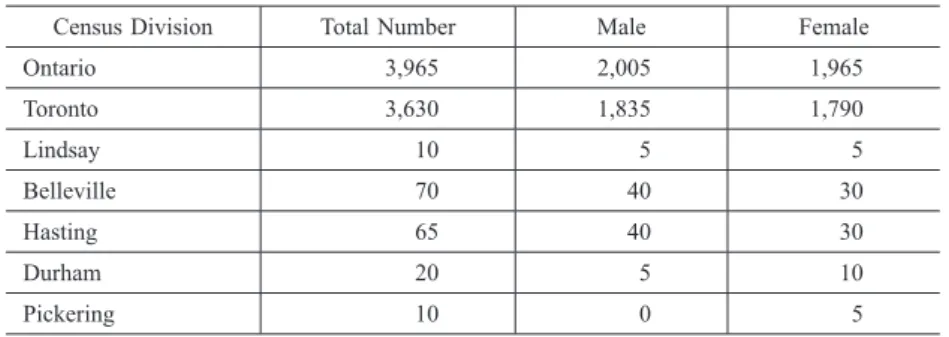
tongue (2,005 men and 1,965 women). The number of Tibetans in various areas of Ontario is shown in Table 2 (Statistics Canada 2012a, b, c). No Tibetans lived in Cobourg in 2011, where the first Tibetans in Ontario had settled.
Table 2 Population of Tibetans in Ontario in 2011*1
Census Division Total Number Male Female
Ontario 3,965 2,005 1,965
Toronto 3,630 1,835 1,790
Lindsay 10 5 5
Belleville 70 40 30
Hasting 65 40 30
Durham 20 5 10
Pickering 10 0 5
Note *1: The numbers indicated in the chart refer to the number of people who reported Tibetan as their mother tongue (Statistics Canada 2012a, b, c).
Today, an increasing number of Tibetans have settled in Toronto, and newcomers now account for the majority of the Tibetan community there. It is estimated that around 5,000 Tibetans, including temporary residents, lived in Toronto in 2012, making it the largest Tibetan community in North America (Kunzan Tanzin, November 24, 2012).
Although Tibetans generally say they would like to live dispersed rather than gathered in one area, the corner of Queen St. West and King St. West in Toronto is like a Little Tibet, with a temple, Tibetan restaurants, and shops selling Tibetan goods (Photos 6a, 6b).
When I visited Tibetan settlements in southern India in 2004 and 2008, the conspicuously large houses in the settlements attracted my attention. The prevailing notion was that these houses had been built with money received from family members working in North America. Among Tibetan refugees in India, the dream of moving to North America to work and becoming successful seems to have gained traction.
Moreover, in the 2000s in India, it became extremely difficult for young Tibetan refugees who had graduated from university to find good jobs suitable for building a career in Indian society. Thus, it has become a trend among young Tibetans in India to immigrate to work in North America; at the same time, few who are not elderly remain in Tibetan settlements in India and young people return only over the New Year period.
4. A Path to Remaking Communal Connectedness
4.1 Establishing the Canadian Tibetan Association of OntarioThe Canadian Tibetan Association of Ontario (CTAO) was established by the first
generation of Tibetans in Toronto in 1978. Later on, in 1987, the Canada Tibet
Committee (CTC), an independent NGO, was established. Fourteen Tibetans and non-Tibetans comprise the CTC, which aims to end the ongoing destruction of Tibetan culture, to alleviate the suffering of the Tibetan people, and to restore Tibet to its status as an independent state. While the CTAO is an association for Tibetans only, the CTC aimed from the start to involve not only Tibetans but also non-Tibetans in their programs for action and it has stipulated that of the president and vice-president of each CTC
Photo 6a Karma Kagyu Monastery on Laxton Avenue (2013).
Photo 6b The corner where Tibetans live in Parkadale, Toronto (2010).
branch, one must be Tibetan and the other non-Tibetan
5). This section focuses in particular on the process of establishing the CTAO.
By the late 1970s, 60 to 70 Tibetans lived in Lindsay, Belleville, and Cobourg. They started to gather and discuss the establishment and incorporation of an association for Tibetans. Among them, three Tibetans took the initiative in preparing documents to submit to the Ontario Provincial Government: Ngawang Lungtok, Tsering Wangkhang, and Tenpa Lektsog. Ngawang and Tsering were already fluent in English. Taking their share of the responsibility, they hired a lawyer from Belleville and drew up all of the necessary documents, including those concerning the organization’s provisions and aims.
With unanimous agreement among Tibetans, the CTAO
6)was established in 1978; an application to the Ontario Provincial Government (Lektsog 2006: 168) was submitted, and in 1980, the CTAO was officially and legally registered as a charitable corporation by the Ontario Cooperation Act (Tenpa Lektsog, September 19, 2013; Lobsang Mentuh, November 29, 2012) with five executive members: Ngawang as Chairman, Tsering as President, Tenpa as Secretary, Kunchok as Treasurer, and Lobsang as Treasurer’s Assistant
7).
Tenpa recounts that there were two motives that drove them to establish the CTAO (Lektsog, September 19, 2013). The first motive was the necessity of a sustainable, communal “space” for their children to learn Tibetan culture and language. Although they held Sunday school in Lindsay for their children and obtained the assistance of Canadians in preparing books and school supplies, some of their Canadian supporters advised them to apply to become a charitable corporation to enable Canadians to donate more easily.
The other motive was rather political. Tenpa says that the Canadian Embassy in Delhi told them that they would resettle more Tibetans in Canada if the first group of Tibetans were able to settle without difficulty in Canadian society. However, not one Tibetan came after them. If they had an association, they thought they could do something regarding this matter. Moreover, some Tibetans were exasperated that their passports listed their place of birth not as Tibet but as China. Rather than working as individuals alone, they believed they would be much more effective under the banner of an association (Lektsog 2006: 167 168).
The objectives and regulations of the CTAO were sent to the Private Office of His Holiness the Dalai Lama, the exile cabinet and exile parliament in Dharamsala, and the representative office in Washington, DC. They all expressed their approval and encouraged them to continue working in the same direction. However, with some sub-divisions and disagreements over the action plans for the Free Tibet movement among members, there was a threat that the small Tibetan community in Ontario would become fragmented into two or three groups. The association decided to invite His Holiness the Dalai Lama in 1980 to visit all the places where Tibetans resided in order to unite everyone (Lektsog 2006: 168 169).
Geleg has been a board member of the CTAO several times and recounted his busy days in 1980 as follows (Geleg Gyalthon, September 17, 2013):
I graduated from the University of Manitoba in 1979 and was asked to assist in arranging
for His Holiness the Dalai Lama’s visit to Toronto in 1980. Thus, I came to settle in Toronto in June 1980, since His Holiness was to come in October. I accepted the post of Secretary for the CTAO. Therefore, I didn’t immediately find a job in Toronto; I was fully occupied with arrangements for hosting the Dalai Lama between May and September of that year. After he left, I started looking for a job. I applied and am working for the same company today, Xerox. We hosted His Holiness for the formal Inauguration Ceremony and received his blessing to form the CTAO.
Tenpa also recollected the difficulties that the CTAO faced before His Holiness’s visit in October 1980 (Tenpa Lektsog, September 19, 2013):
He arrived in Toronto in October. At that time, Tibetans participated in the association, but some were members and some were not. We sent an invitation to H. H. the Dalai Lama to come. We had to have all of our Tibetan members present because we didn’t have many at that time—fewer than 100 people. We said what we would do if we encountered difficulties. With the Dalai Lama coming here in October, we’re going to ask him whether the association is a good thing and whether we should continue—if not, we would stop.
Thus, the CTAO welcomed His Holiness on his visit to Toronto.
On the arrival of His Holiness, all of the members of CTAO had a chance to meet with him. They presented a complete report on the background and objectives of the association to His Holiness and also informed him that they would dissolve the association if it could not be proven that it was useful to the common Tibetan cause. His Holiness replied, “It is good of us to set up this association for the good of the community, and there are bound to be differences but they should be cleared openly and frankly and not in the manner of street rumors.” He stressed the importance of the association’s continuation and told everyone to work sincerely (Lektsog 2006: 169).
A few days after their meeting with His Holiness, they got a call from his secretary and received a signed letter from him, which included the following (Tenpa Lektsog, September 9, 2013):
Ontario Tibetans and the people of Ontario aim to preserve Tibetan culture for the future and for the present. The good work has started and as aimed will continue into the future as well. The work will prosper; you must do your best to continue (Tenzin Gyatso, 14th Dalai Lama October 15, 1980).
This letter is now framed on the wall of the TCCC office.
As Tibetans in Toronto struggled to build a sustainable financial base for their livelihoods, it was not easy for them to unify their communities. The plan to invite His Holiness to Toronto aptly shows that his presence is of great significance for solidarity and unity among the Tibetan community; his visit enabled the CTAO to make progress and continue its activities.
However, the CTAO faced difficulties remaining a charitable corporation registered
by the Ontario Provincial Government. Because the executive members were changed after three years and the association did not have a fixed office, the executive members failed to submit an annual returns report to the government by the due date, which was the condition for retaining registration. The CTAO lost its status as a charitable organization and was faced with another serious difficulty: they lost tax-free advantages for any kind of funds they had received. It became financially difficult to continue any activities in the name of the association. They started to search for a way out of this financial difficulty by applying to register another charitable organization (Lobsang Mentuh, November 25, 2012).
4.2 Shifting to the idea of establishing the Tibetan Canadian Cultural Center
Living as Canadian citizens, Tibetans in Toronto have to abide by the rules and laws of Canada. However, they have the right to preserve and enhance their Tibetan cultural heritage as multiculturalism in Canada has been assured by the constitution and by law since the early 1980s. In reality, on the issue of multicultural heritage, article 27 of Canadian Charter of Rights and Freedoms of the Constitution Act, 1982 clearly states the charter shall be interpreted in a manner consistent with the preservation and enhancement of the multicultural heritage of Canadians (Justice Laws Website, 2015)
8). Later, in 1988, the Act for the Preservation and Enhancement of Multiculturalism in Canada, the Canadian Multiculturalism Act, was enacted by the Prime Minister, Martin Brian Mulroney (Mizoue 2003: 19).
It had been a dream for Tibetans in Toronto to have a community center where they could freely gather and hold a variety of meetings. However, this desire had long gone unrealized because of the small size of their community. Such political and social circumstances backed by the multiculturalism of Canada might have also made Tibetans in Toronto push forward their dream to be fulfilled. Moreover, a turning point was reached. With the rapid increase in the number of Tibetan immigrants to Toronto after 1998, Toronto’s Tibetan population became the largest in Canada; the CTAO moved its office from Lindsay to Toronto in 2000. Its executive members began to consider ways to register the association as a charitable organization. This time, they incorporated the possibility of building a community center in Toronto in their plans to ensure that future problems in regard to the loss of charitable advantages could be avoided.
The opening of the TCCC on October 17, 2007 realized the dream for Tibetans in Toronto. Furthermore, this realization of the TCCC cannot be described without mentioning the compassionate involvement of His Holiness the Dalai Lama. After his first visit to Toronto in 1980, His Holiness was invited to visit Toronto in 1990 and 1997.
During his fourth visit to Toronto in 2004, the CTAO planned to hold a Kalachakra
Initiation by His Holiness (Geleg Gyalthong, September 17, 2013). The Kalachakra
Initiation, which empowers disciples to obtain perfect Buddhahood in the form of Shri
Kalachakra, had already been performed by His Holiness 28 times since 1954
9). It was
this project to hold the Kalachakra Initiation in Toronto that enabled the TCCC to be
established.
4.3 Project to hold the Kalachakra Initiation in Toronto
This section sheds light on how the CTAO planned and arranged to hold the Kalachakra Initiation, a path toward Tibetans’ having a community center. What is notable here is their continuous efforts to divert the opportunity of holding the Kalachakra Initiation into an opportunity for fundraising in order to get their community center.
It was Tenpa that first came to have the idea to hold the Kalachakra Initiation in Toronto in 1997. He had participated in the Kalachakra Initiation, held in Bodh Gaya, in 1985 and again in 1992. In 1997, when he was elected as a board member of the CTAO, he proposed to hold the Kalachakra Initiation in Toronto by offering a donation of
$3,000. He again proposed this plan during his term as a member of the ninth board of the CTAO, although there were no further discussions of the plan during his term. Once again, in 2000, when he was reelected as a board member, he proposed the plan at the very first meeting and emphasized that it needed to be made a reality during their term.
The president of the association at that time sought unanimity from other members and the proposal was unanimously accepted (Lektsog 2006: 171 173, 187 188).
The members of the tenth board of the CTAO decided to hold the initiation in the hope that it would clear the way for establishing a Tibetan cultural center in Toronto.
After discussing the proposal with the Tibetan Representative Office in Washington, DC, in December 2000, on the anniversary of the award of the Nobel Peace Prize to His Holiness, they informed people about their proposal and asked for their opinions. All were extremely delighted and showed their appreciation. Subsequently, they wrote to the Private Office regarding their proposal (Lektsog 2006: 188).
Geleg, who was involved in formulating the project plan, recollected how they were able to succeed in realizing it (Geleg Gyalthong, September 17, 2013):
We wanted to obtain the blessings of the Kalachakra. However, the ultimate motive was to try and make some money from the Kalachakra event to build a community center. We wrote a project plan and sent it to His Holiness, maybe in 2001 or 2002.
It was a huge event. It was very difficult. We tried to hold the Kalachakra event to make it revenue-neutral. We benchmarked all Kalachakra events in the last two years in the States and wherever else. We knew exactly how they did it, what the ticket price was going to be, how many people would be attending. We did all the legwork. From there, we did our own projections here in Canada and we said that our intent was not to make money, but in the event that we did make money, we wanted to do three things: donate one-third of the profits to His Holiness’s charity, donate another one-third of the profits to the Tibetan Government in Exile because nobody gives money to them, and use the remaining one-third of the profits for a small community center in Toronto.
After making an initial project plan in which we projected a profit of $250,000, we re-estimated the plan to project a profit of $200,000. We sent the project plan to the Private Office but were told that we would not be able to make money. We had to redo our plan. I wrote back, with all due respect, we have no idea how many people are going to show up. We’ve done our best benchmarking based on Austria, New York, Philadelphia, and Wisconsin, and based on what they’ve done, we’re projecting a modest profit.
However, we were told “no.”
We had to go back and reduce the ticket price and show that we would be revenue- neutral: no profit, no loss. But I specified in the plan that, in the event that we did make money, we would allocate it according to the previous formula. The second time around, they approved it. We thought we would get roughly, at the most, 3,200 people attending the cultural programs. But we did so well that we attracted 6,500 people10).
So, on April 21, 2004, the day he arrived at the airport, we had already made a
$900,000 profit and were set to make more money once the programs started. We had to explain His Holiness how it had happened. We were in the limousine from the airport to the hotel trying to explain to him how we had gone from zero, no profit, to $900,000, close to a million dollars in profit.
We explained to him that we had not intended to make a profit. At the end of the day we made a fairly good profit, around $4.2 million. We split it into three: a third went to His Holiness’ charity fund, a third went to the Government in Exile, and a third was kept as the CTAO’s seed money to start the TCCC.
On the final day of the Kalachakra Initiation ceremony, members of the CTAO and the Kalachakra Organizing Committee were given a special audience with His Holiness the Dalai Lama, during which he advised them on a future course of action and asked whether they really planned to set up a Tibetan cultural center. When everyone unanimously replied in the positive, His Holiness returned what he had earlier been offered during the long-life offering ceremony for the Tibetan cultural center and also directed the US Tibetan representative to extend further support. He gave them a thangka painting of the three Buddhist protector deities and suggested the name Gangjong
Chodenling (gans ljong chos ldanling), meaning “Spiritual Abode of the Snow Country,Tibet,” for the Tibetan Cultural Center (Lektsog 2006: 190 191; Lhakpa Tsering, November 24, 2012).
4.4 Registering as a charity and starting the renovation project
Once the Kalachakra Initiation was over, in 2004, the CTAO began preparing applications to submit to the Canadian Revenue Agency (CRA) to register the TCCC as a charitable organization. The Canadian government has determined what constitutes “charitable”: the term has not been defined in the Income Tax Act but in common law (court decisions).
The courts have identified four categories of charity: for the relief of poverty, the advancement of education, the advancement of religion, and certain other purposes that benefit the community in a way the courts have said is charitable (Government of Canada 2009a)
11). The vision and mission of the TCCC are to preserve, to foster, and to share the distinct Tibetan culture in Canada as a community-based organization; this precisely corresponds to the definition of a charitable organization.
Moreover, organizations that are registered as charitable by the CRA gain not only
credibility in the community but also a variety of advantages. First, registration enables
charities to issue official donation receipts for gifts they receive that can be used to
reduce individuals’ income tax payable. Second, registration exempts charities from
paying tax under Part 1 of the Income Tax Act. Third, registered charities are permitted to receive gifts from other registered charities. Fourth, many goods and services provided by registered charities are exempt from the goods and services tax and the harmonized sales tax (Government of Canada 2009b)
12). For the TCCC and its activities to preserve Tibetan culture and language, registration as a charity has been indispensable to strengthening its financial base.
The project to open the TCCC took a step forward when a large warehouse located on Titan Street in the West End of Toronto (Fig. 4) was purchased in 2007 with the money donated by His Holiness and gathered through fundraising within the community.
The TCCC was consecrated by His Holiness on October 31, 2007 during his return
Figure 4 Distribution of Tibetan settlements in the Toronto area
Photo 7 A letter by the CRA confi rming registration as a charity (2013).
visit
13)and the TCCC finally received a certificate confirming its registration status as a charitable organization from the CRA on February 2, 2009 (Photo 7).
In 2007, when the TCCC opened, it had only land and a huge warehouse that needed renovating. Lhakpa recounted that by 2009 there had been no progress in the renovations (Lhakpa Tsering, November 24, 2012); as this huge project remained untouched, it came to seem like a pipe dream. However, the project was jumpstarted once the TCCC was registered as a charity in 2009. The renovation project came to receive assistance from the Canadian government as a community center renovation under its Economic Action Plan and received a matching grant of 6.6 million Canadian dollars in the 2009 2010 fiscal year. Because it was a matching grant, the Tibetan community had to raise 3.3 million Canadian dollars to finish the renovation. This was a significant challenge because of the Tibetan community was small, and initially only 1,000,000 Canadian dollars was collected and the government provided a grant of only 500,000 Canadian dollars (Geleg Gyalthong, September 17, 2013).
Once the TCCC was approved as a charitable organization by the government of Canada, the CTAO invited His Holiness to Toronto for his fifth visit in 2010. When I visited Toronto in August 2010, I had a chance to see how the renovation project was progressing in preparation to welcome His Holiness (Photos 8a, 8b). Although the renovation was not yet complete, His Holiness presided at a formal inauguration ceremony for the center on October 23, 2010
14).
Because the grant from the government was a matching grant, the renovation project
has faced financial problems from the very beginning; abandoning efforts to open the TCCC at the selected location was even considered. However, because the land was consecrated by His Holiness, the CTAO decided against this. Fortunately, His Holiness donated one million dollars to the Tibetan community in Toronto; subsequently, the renovation project has made progress little by little (Lhakpa Tsering, November 24, 2012) (Photos 9a, 9b).
Even in 2013, the renovation of the TCCC building remains incomplete and the community continues to face financial problems. However, every Sunday, they hold Buddhist philosophy classes for adults and Tibetan language programs for children over 5 years old; in the afternoon, they hold performing arts classes for children over 5 years old. Many children and adults participate in these programs. For example, on the morning of November 15, 2012, eight Tibetan language classes were being held, each with about 25 children, for 200 children in total. In one Buddhist philosophy class being held, about
Photo 8a, 8b TCCC under renovation by the Action Plan of Canadian Government (2010).
8a 8b
9a 9b
Photo 9a, 9b TCCC in 2013.
35 Tibetans listened to a lecture. Occasionally, wedding ceremonies and music concerts have been held in its main hall (Photos 10a, 10b).
Women over 70 years old voluntarily come and provide tea and lunch for those who attend the classes. TCCC has become a place where people feel happy to be and where they can meet and talk with other members. As a community center, the TCCC functions to remake and strengthen communal and ethnic connectedness among its members.
5. Leadership in the Tibetan Community in Toronto and the Role of the Dalai Lama
5.1 The ability to take the initiative
Tibetans who came to Canada under the Canadian government’s Tibetan resettlement project in the 1970s are the first generation of Tibetan immigrants in Toronto. They say that before leaving India, they were advised by officials of the home department of the Tibetan Government in Exile and its representatives in Delhi to be good citizens observant of Canadian laws and to maintain Tibetan culture and language. Tibetans in Toronto have chosen to obtain Canadian citizenship, to retain their identity as Tibetans, and to live as Tibetan Canadians in Canada’s multicultural and multiethnic society. It is common among immigrant populations who are a minority in their host countries to organize associations based on shared provincial or national origins. Similarly, Tibetans in Toronto organized the CTAO in 1978 as their population increased thanks to family reunification projects. They desired an organized, structured body to press their political and cultural demands in Canadian society. The establishment of the CTAO in 1978 was
Photo 10a, 10b Wedding held at TCCC (2013).
10a 10b
the first step toward organizing a group inclusive of all Tibetans and remaking communal connectedness among Tibetans.
How is it possible to organize and structure groups with people from different areas?
In organizing such groups, discussions and negotiations among potential members are prerequisite; this is particularly true of immigrant groups. People who are able to assume a leadership role and people who can deal with business matters when applying to register the association in the host country must be selected.
When Tibetans established the CTAO in Toronto, three key people led the organizing efforts: Ngawang and Tsering were extremely capable in English, whereas Tenpa, who was experienced as a trader in Tibet (Lektsog 2006: 38 55), was highly capable at handling business matters. Moreover, the assistance of a Canadian lawyer who advised them on all legislative and official matters required for the application was critical.
As already mentioned in Section 2, both Ngawang and Tsering came to settle in Ontario before the start of resettlement project. Ngawang was a former principal of an Indian-Tibetan school in India, while Tsering, who had a job at the Tibet Office in Delhi and came to Canada at a young age, studied at Loyalist College in Belleville after working at Bata for a couple of years. After graduating from college, together with his friends, Tsering started a magazine rooted in Toronto’s multiculturalism. He was political and involved in establishing the Tibetan Youth Congress (TYC) in Belleville in 1980, the first TYC to be held in North America (Yeshe Wangkhang, September 20, 2013). The five founding and very capable members of the CTAO, listed on its webpage
15), undertook leadership efforts and engaged in painstaking voluntary work to push forward the integration of the Tibetan community and enable the retention of Tibetan identity.
Moreover, everyone interviewed said that once the foundation of their livelihood was established, they would willingly and voluntarily serve for the CTA.
5.2 Involvement of the Dalai Lama in the Tibetan Community in Toronto
The support of the Tibetan Government in Exile and the involvement of His Holiness also facilitated integration of the Tibetan community in Toronto. The Tibetan Government in Exile dispatched a former principal of an Indian-Tibetan school and a functionary of Tibet House in Delhi to Canada in advance, before starting the implementation of the resettlement project. As was shown by the grouping of Tibetans on the basis of religious orders and by the plan to settle them separately in different areas, the Tibetan Government in Exile originally intended to facilitate the integration of Tibetan immigrants on the basis of religious orders.
However, Tibetans in Toronto come from a variety of religious orders; they are a mixture of people who came to India as refugees from various parts of Tibet.
Furthermore, although Tibetan refugees share a historical memory and empathy arising
from the fact that they were compelled to flee from their country as well as hardships
and poverty that they have had to overcome to survive in remarkably different
circumstances, they differ in terms of their political and cultural background. Thus, the
Tibetan community in Toronto has from the very beginning faced difficulties in
integration and in remaking communal connectedness.
To resolve these problems, as Lektsog describes (2006), the CTAO requested that His Holiness the Dalai Lama visit Toronto for the first time. By giving a speech and being present in Toronto, His Holiness, the embodiment of Avalokitesvara (the Boddhisattava of Compassion), facilitated the fading away of disagreements and disharmony among members and the remaking of the community’s solidarity. His Holiness’ spirituality played a substantial role in remaking connectedness and solidarity among Tibetans.
Looking back further, the development of the Tibetan community in Toronto—from the establishment of the CTAO, to its restructuring, to the opening of the TCCC—the visits of His Holiness have been indispensable to the community’s integration, stability, and continuity. By 2013, His Holiness had visited Toronto at least six times: in 1980, 1990, 1997, 2004, 2007, and 2010. Not all of his visits were designed to strengthen the stability of the Toronto community; for example, the visits in 1990 and 1997 were considered to relate more to political issues pertaining to Tibet. His visit in October 1990 was just over a year after the uprising in Lhasa in March 1989 and after he received the Nobel Peace Prize in December 1989. It can be said that this visit was not only to celebrate his award, but also to share the deep sorrow that Tibetans in Tibet were experiencing as a result of the oppression exerted by the Chinese government after the uprising and to spread calm among the Tibetan refugee communities.
The visit in 1997 was related to issues pertaining to Tibet caused by the Panchen Rinpoche controversy. In May 1995, His Holiness publicly recognized a young boy from Nagchu in northwest Tibet, Gedhun Choekyi Nyima, as the reincarnation of the 10th Panchen Rinpoche. Shortly after his announcement, the child selected by the Dalai Lama disappeared and a dispute over the recognition of the Panchen Rinpoche created an irreconcilable gulf between the Chinese authorities and the Dalai Lama (Shakya 1997:
440 447). His visit to Toronto in 1997 was intended to demonstrate to his people his firm, strong commitment to Tibetan issues.
By contrast, his visits in 1980, 2004, 2007, and 2010 took place at times when the community was facing threats of breakup. In 2007 and 2010, the CTAO, confronting large financial problems in promoting the renovation of the TCCC, was in danger of splitting. The Dalai Lama appealed to Tibetans in Toronto about the importance of unity among the community for the future of Tibet and Tibetan culture. He thus played a significant role in maintaining connectedness among them. His involvement was not confined to spiritualistic aspects but extended to materialistic aspects: he contributed financially to the community. The Dalai Lama himself not only became donors, but also increased the chances that people would donate by donating himself.
The history of the remaking and sustaining of the Tibetan community in Toronto
exemplifies both how the involvement and visits of the Dalai Lama to various
communities has served to integrate Tibetans in the diaspora and how capable and
talented individuals who are able to take the initiative in voluntarily serving their
communities can facilitate the remaking of stability and connectedness in these
communities. Furthermore, the strong empathy among Tibetans derived from a shared
historical memory and Buddhist philosophy links the Dalai Lama and Tibetans as
individuals. Thus, micro-level leadership at the community level has successfully operated through resonance with the macro-level leadership of the Dalai Lama.
6. Conclusion: Leadership and Empathy in the Remaking of Connectedness Needless to say, the requirements of remaking ethnic and micro-regional connectedness differ between populations, depending on whether the groups involved are minority, immigrant, refugee, or diaspora groups. The process might depend on their political, social, and cultural background. This case study suggests that, for Tibetans in Toronto, remaking connectedness is deeply connected with their history as refugees, to the government in exile, to the spiritual/transcendental leadership of His Holiness the Dalai Lama, to their religion in common, and to their hope of returning to Tibet in the future.
Among refugees that have been displaced from their home countries, the Tibetans are a special case: they are people who have been stateless since their country was deprived of its independence by China. Accordingly, maintaining Tibetan identity in refugee societies wherever they are in the world is pivotal to pursuing the destiny of Tibet and Tibetans—to gain their ultimate goal of a free Tibet and enable their return to the country. The remaking and retention of connectedness in Tibetan refugee society in host countries is essentially prerequisite for preserving culture and language, fostering solidarity, and maintaining a sense of belongingness. As is shown in the process of establishing the CTAO in Toronto, the remaking of connectedness in the Toronto’s Tibetan community was a matter of serious concern for the Tibetan Government in Exile, and Tibetans advanced their plans while keeping in close contact with the government in exile in Dharamsala. When the community was threatened, their leaders strategically asked for the help of His Holiness the Dalai Lama.
Moreover, it is suggested that the Tibetan Government in Exile might have been tacitly involved in the selection of Tibetans for the Canadian resettlement project. It is known that the US resettlement project was concerned with balancing two factors: on the one hand, including people from the echelons of Tibetan society with leadership abilities, and on the other hand, including “the poorest of the poor, the destitute” (Hess 2009:
106). Tibetans might have been selected for the Canadian resettlement project in consideration of these two factors, as illustrated by the case of the Tibetan leaders of the Toronto community. The existence of individuals who can take leadership in a community is essential for keeping it firm and stable.
This case study also determined that a deeper understanding of the remaking of connectedness among immigrant and minority populations in host countries can be achieved by focusing on the following results. First, the spirit of working for the public good has facilitated the leadership of individuals in the Toronto’s Tibetan community.
Members of the community such as Lektsog, Geleg, and Mentuh voluntarily devoted
themselves to community work in their spare time. Because their devotion was voluntary,
they were fully trusted by its members. Second, Tibetan Buddhist philosophy and ethics
back this spirit of working for the public good. Doing community work out of love and
compassion can be a practice to accumulate merit; His Holiness refers to this as an
essential and fundamental idea in Tibetan Buddhism. His Holiness himself embodies this idea: for example, by his action of returning the donation given to him to the community, as well as in his speeches and teachings. Leadership in Tibetan communities, as displayed by His Holiness at the macro-level and by local leaders at the micro-level, is underpinned by this idea of love and compassion and the shared empathy it engenders. It is empathy premised on the basis of Tibetan Buddhist philosophy and religion, shared among individual members, that serves to motivate the remaking of connectedness in this community.
Lastly, it should be mentioned that Tibetans in Toronto owe their success in remaking communal connectedness largely to Canada’s policy of multiculturalism. As Tibetan Canadians, they are guaranteed the right and freedom to preserve and enhance Tibetan culture as one of the multicultural heritages of Canada. They have made the most of the Canadian citizenship they acquired and live in symbiosis with other Canadians while maintaining their culture and language.
Acknowledgments
The author gratefully acknowledges that this paper is the result of research funded by JSPS KAKENHI Grant Number JP2431018.
Notes
1) Grunfeld estimates the number of Tibetans who fled from Tibet in 1959 as between 50,000 and 55,000 (Grunfeld 1994 [1987]: 272).
2) The first committee on education was formed in 1991. Following 15 revisions, the CTA cabinet officially announced the “Basic Education Policy for Tibetans in Exile” on May 14, 2005 (Tibetan Children’s Education & Welfare Fund 2005). On March 6, 2004, the homepage of the CTA Ministry of Education posted the second draft of the “Basic Education Policy for Tibetans in Exile” (Tibetan Computing Resource Center: 2000 2003). The Tibetan version of the “Basic Education Policy for Tibetans in Exile” explains how the Basic Education Policy has been devised (Tibetan Children’s Education and Welfare Fund 2005).
3) Since the announcement of a “Multiculturalism Policy” in 1971 by the Trudeau government, the Canadian government has pushed forward a multicultural policy, by enacting the Charter of Rights and Freedoms under the Constitution Act, 1982 under the leadership of Prime Minister Pierre Trudeau and by passing the Canadian Multiculturalism Act in 1988 under the leadership of Prime Minister Brian Mulroney (Matsui 2012; Mizoue 2003).
4) http://www.thestar.com/news/gta/article/425587, September 7, 2011; http://www.insidetoronto.
com/news/local/article/869028, September 7, 2011.
5) The CTC works to achieve its goal by compiling and distributing information about Tibet;
advocating on behalf of the Tibetan people through outreach campaigns to the government, the public, and the media; hosting seminars and speaking tours, organizing cultural events, and publishing reports; and building the CTC into a cross-Canada network. A branch office of the CTC is located in Toronto and at its monthly meeting it welcomes others to learn about and get involved in the cause of Tibet (http://www.tibet.ca/en/toronto, October 27, 2011).