Effects of Learning English in Elementary School Days on the Proficiency of, and the Attitude towards, the Language in High School Years (III)
SHIZUKA Tetsuhito
Kansai University
Abstract
This study examined the relationship between English learning experiences in
elementary school days and English proficiency and attitude toward learning it in high school years. Participants were 630 students learning at either of the two courses at a SELHi, one regular and the other English-focused. They took a survey on
pre-junior-high English learning experiences and current drive to learn the
language. They also sat for an ACE battery test with listening, reading, grammar, and vocabulary components. T-tests indicated significantly higher means for those with the early learning experience, in motivation, listening, and reading, but not in grammar or vocabulary. The effects on motivation, listening, and reading were significant even after the influences of sex, school course and year were partialed out by multiple regression. There was also some evidence that early English learning had a greater impact on motivation if the student entered an English-focused, rather than regular, high school course, and the effects on proficiency was stronger if early English learning had continued for three or more, than for two or fewer, years.
Key words: early English learning high school years proficiency attitude
1. Introduction
In October 2005, the author was contacted by SELHi committee members of Nagano High School, a prefectural school in Osaka, and was asked to assist with analyzing the data they were collecting as part of their SELHi research. Their main research question was whether or not students who had learned English prior to entering junior high school still retained the head-start advantage over those who had not, even after entering high school.
Arguably one of the most divisive issues related to English education in Japan today is whether or not we should start formal instruction of the language at public elementary schools. Whether we eventually decide to, or not to, do so, the conclusion should be reached based upon reason and sound judgment (Otsu, 2007). For that purpose, accumulation of more hard data concerning effects of learning English in elementary school days is in order. That is what this paper aims to help with.
Provided to the author were motivation-focused questionnaire responses and test battery scores (reading, listening, vocabulary and grammar) of all the students enrolled at the time of data collection. Data were collected three times over three consecutive years—once prior to, and twice posterior to, the above mentioned contact by the SELHigh committee members—in December of 2004, 2005, and 2006, resulting in three data sets with an identical structure, the only difference being the cases The analysis of the 2004 data set was described elsewhere (Shizuka, 2007). The present paper reports on the results concerning the 2005 data.
2. Review of Previous Studies 2.1. Effects on receptive proficiency
Among numerous studies that have examined the effects of learning English in elementary school years on subsequent proficiency development, directly related to the present paper are those that focused on students’ listening, reading, vocabulary, and/or grammar skills/knowledge. Probably the most well-known of them is the study series conducted by the JASTEC Project Team (1988; 1989). They compared students who had and had not experienced learning English at elementary schools (EXs and NonEXs, respectively, hereafter) at three subsequent stages: year 1 of junior high school (J1), year 3 of junior high school (J3), and year 2 of senior high school (S2). The 1988 study found that EXs significantly outperformed NonEXs in listening, at all the three stages at the two schools to which the participants belonged, except for stage J3 at one school. With respect to reading, on the other hand, the advantage of EXs was less pronounced, with significant differences favoring EXs found only at S2 stages at both schools and at stage J1 at one school. The 1989 study looked into their writing skills including grammar and vocabulary aspects, and found no significant differences between EXs and NonEXs with regard to vocabulary or grammar scores.
Building on Higuchi et al’s 1988 study, Megumi et al (1996) examined listening and reading performance of EXs and NonEXs in years 2 and 3 at junior high school and year 1 at senior high school. The results indicated that EXs significantly
outperformed NonEXs at all the three stages in listening, but that differences were not significant in reading.
Although, at this point, the findings seem to converge in that EXs usually
outperform NonEXs in listening, but not always so in reading, and rarely so, if ever, in vocabulary and grammar, there are reports that challenge such
generalizations. Comparing EXs with NonEXs both at stage J1, Shirahata (2002) found virtually no difference in their phoneme perception abilities. Takada (2004), who examined listening abilities of EXs and NonEXs also at the J1 stage (private school), found no significant difference between the two groups. As mentioned in the Introduction above, the present author analyzed the 2004 data set of the Nagano High School’s three-year SELHi project (Shizuka, 2007). Five hundred ten students, consisting of 201 EXs and 309 NonEXs, took an ACE Test (listening, reading, vocabulary, and grammar components). They were 1st and 2nd year students, belonging to either of the two different courses (one regular and the other English-focused). Although descriptively EXs outperformed NonEXs in all the components as well as in the composite scores, the difference was statistically significant only in the grammar score and in the composite score. That is, the often-observed advantage in listening performance was not confirmed. Moreover, when influences of course, sex, and school year factors were partialed out by multiple regressions, English learning in elementary school years was no longer a significant predictor of any of the variables.
2.2. Effects on motivation and attitude
The results concerning the effects on learners’ subsequent attitudes toward learning English are no less mixed. One of the first attempts was made by JASTEC Project Team (1989b), who surveyed 1170 J1 stage students and found that EXs were more positively inclined toward studying the language at the time of the survey as well as making use of it in the future. Quite similar results are reported by JASTEC Project Team (1994), who explored perceptions of 1417 students, ranging from junior high school 1st year to university 2nd year levels. Their EXs turned out to have stronger beliefs in the importance of intercultural communication and to be more positive toward making efforts in learning the language. Tanizuka (2000), who examined 531 high school students and 406 university students, and Takagi (2003a), who surveyed 957 junior high school students, also reached a comparable conclusion.
In contrast, Takagi (2003b) found that, as opposed to junior high school students, senior high school and university students were not influenced in terms of motivation towards learning English by their English learning experience in early years. In
Shizuka (2007)’s study as well, although a significantly higher motivation in EXs was revealed by a t-test, when course, sex, and school year factors were partialed out, English learning in elementary school years was no longer a significant predictor of motivation.
3. The Study
In an attempt to provide further empirical evidence regarding the still-equivocal effects of English learning in elementary school years, the present study addresses the same research question as Shizuka (2007), with a different, larger data set: How do EXs compare with NonEXs in terms of (1) receptive skills of English proficiency, and (2) motivation towards learning the language, in high school years?
3.1. Participants
Participants were all the 1st, 2nd, and 3rd year students enrolled at the SELHi as of December 2005. They belonged either to the Regular Course or to the International Course, the latter offering a larger number of English classes than the former. After removing those who failed to provide responses concerning English learning in elementary school years, answered the motivation questions with straight 3s (high extreme score) or straight 0s (low extreme score), failed to sit for one or more of the ACE components, or had overseas experience of one year or longer, we retained 630 participants (289 EXs and 341 NonEXs) for analysis. The breakdown by course, year, sex is shown in Table 1.
Table 1. Breakdown of EX/NonEx participants by course, year, and sex
General International
Year Male Female Male Female Total
1st Year 81 (42/39) 70 (47/23) 12 (7/5) 23 (18/5) 186 (114/72) 2nd Year 97 (27/70) 93 (41/52) 10 (2/8) 44 (23/21) 244 (93/151) 3rd Year 63 (13/50) 87 (36/51) 13 (4/9) 37 (29/8) 200 (82/118)
241 (82/159) 250 (124/126) 35 (13/22) 104 (70/34) Total
491 (206/285) 139 (83/56) 630 (289/341)
*In each cell, the total number is followed by EX/NonEX breakdown.
3. 2. Instruments
Data concerning the participants’ pre-junior-high English learning experiences and their current motivation toward the language were collected through a
survey. Participants were asked whether and, if yes, for how many years, for how many hours per week, and where (i.e., at an elementary school or other types of schools) they had learned English before entering junior high school. They were also asked to rate on a four-point scale the degrees of agreement to 21 motivation-related statements (see Appendix), which were meant to explore the extent to which they were ready to make efforts to improve their English proficiency and/or wished to envisage themselves as successful English learners in the future. The raw responses were Rasch analyzed (Rasch, 1960) using WINSTESPS software and, after two misfit items were deleted, the final MTVTN scores in Rasch logits were derived (person reliability = 0.92, item reliability = 0.99).
Their proficiency was measured by an ACE battery, consisting of 30 listening items, 20 reading items, 24 grammar items, and 24 vocabulary items. Responses were Rasch analyzed using WINSTEPS to derive the LSTNG, RDNG, GRMMR, VCBLR, and TOTAL scores (no misfit items were identified). Rasch person reliabilities of these scores were 0.70, 0.69, 0.68, 0.77, and 0.90, respectively.
3.3. Data transformation and outlier screening
Independent variables were E_DICHO (1 if the student learned English at all prior to entering junior high school, 0 if not), E_YRS (the number of years for which they did do), E_HRS (the number of hours per week for which they did so), E_ELMS (1 if they did so at an elementary school, 0 if elsewhere), CRS (1 if the student belonged to the International Course, 0 if to the General Course), YR (the school year the
participant belonged to; 1, 2, or 3), and SEX (1 if female, 0 if male). Dependent variables were MTVTN, LSTNG, RDNG, GRMMR, VCBLR, and TOTAL.
The distribution of each variable was checked to see if the normality assumption is met to a reasonable extent. When substantial skewness was identified, square root, logarithm, and inverse transformations were tried in this order, as recommended by Tabachnick and Fidell (2001, p. 80). MTVTN turned out be acceptable as it
was. With regard to TOTAL and LSTNG, log transformation turned out to be most appropriate, so we decided to use LogTOTAL and LogLSTNG. As for the other dependant variables, square root transformation worked best, resulting in RtRDNG, RtVCBLR, and RtGRMMR. As for E_YRS, even inverse transformation could not improve the distribution, so we decided to dichotomize the variable in such a way the numbers of the two groups were as close as possible to each other. That is, we created a new variable E_YRS_3PLUS (1 if the participant learned English for three or more
years; 0 if for only one or two years). For the same reason, we needed to dichotomize E_HRS by creating E_HRS_2PLUS (1 if the participant learned English for two or more hours per week, 0 if for one hour or shorter). Finally, in order to screen multivariate outliers, Mahalanobis’ distances regarding the six dependant variables were checked. Since the largest distance, 7.85, was smaller than the chi-square value 12.59 at six degrees of freedom, the data points were judged to be multivariate
outlier-free (Manly, 1994, p. 63).
3.4. Analysis Procedure
First, inter-correlations between all the variables were checked. Next, t-tests were conducted to compare the EX and. NonEX means in the dependent variables. If a significant difference was revealed regarding a variable, then multiple regression was tried with that variable as the predicted variable and with SEX, CRS, YR, and
E_DICHO as predictors. This was to see whether the apparent effect of E_DICHO, if any, was still significant after the influences of CRS, YR, and SEX were statistically removed. If E_DICHO turned out to be a significant predictor, then three interaction terms SEX*E_DICHO, CRS*E_DICHO, and YR*E_DICHO were added to the model and regression was run again. Finally, only with EX participants, regression was run with E_YRS_3PLUS, E_HRS_2PLUS, E_ELMS, CRS, YR, SEX, as predictors.
4. Results
4.1. Inter-correlations
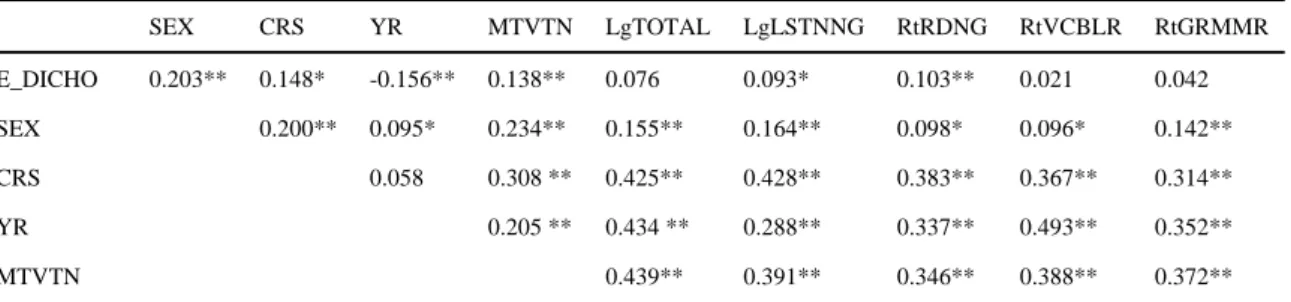
The inter-correlations among variables are shown in Table 2. Most are significant at p < .01 levels. Noteworthy positive relationships between independent variables are those between (1) SEX and E_DICHO, (2) E_DICHO and CRS, (3) SEX and
CRS. Note also in passing that SEX, as well as CRS, is positively correlated with all the dependent variables.
Table 2. Inter-correlations among variables
SEX CRS YR MTVTN LgTOTAL LgLSTNNG RtRDNG RtVCBLR RtGRMMR
E_DICHO 0.203** 0.148* -0.156** 0.138** 0.076 0.093* 0.103** 0.021 0.042
SEX 0.200** 0.095* 0.234** 0.155** 0.164** 0.098* 0.096* 0.142**
CRS 0.058 0.308 ** 0.425** 0.428** 0.383** 0.367** 0.314**
YR 0.205 ** 0.434 ** 0.288** 0.337** 0.493** 0.352**
MTVTN 0.439** 0.391** 0.346** 0.388** 0.372**
LgTOTAL 0.794** 0.779** 0.818** 0.803**
LgLSTNNG 0.552** 0.534** 0.506**
RtRDNG 0.582** 0.566**
RtVCBLR 0.630**
** p < .01 * p
< .05
4.1. t-tests
Since F-tests revealed no significant differences between the EX and NonEX variances, t-tests based on the equal-variance assumptions were carried out. The results are shown in Table 3. With regard to all the variables, the means of EXs were higher than those of NonEXs, and the differences were statistically significant in MTVTN, LgTOTAL (the p-value 0.0576 was judged to be low enough to deserve further analysis), LgLSTNG, and RtRDNG. Analysis of RtVCBLR and RtGRMMR terminated at this point. Please note that these t-tests were statistically equivalent to simple regressions with E_DICHO as the predictor.
Table 3. Means and standard deviations of EX and NonEx groups and the t-test results
MTVTN LgTOTAL LgLSTNG RtRDNG RtVCBLR RtGRMMR
EX Mean 0.839 0.450 1.004 2.125 1.602 1.907
EX SD 1.333 0.433 0.295 0.233 0.328 0.234
NonEX Mean 0.471 0.386 0.952 2.076 1.590 1.888
NonEX SD 1.312 0.418 0.267 0.233 0.298 0.216
t-value -3.487 -1.903 -2.334 -2.600 -0.513 -1.052 p-value 0.0005 0.0575 0.020 0.0010 0.6077 0.293
4.2. Regression using the whole group
All the multiple regression models below were significant at p < 0.0001. The ANOVA tables will not be shown, therefore, to save space.
4.2.1. MTVTN
The adjusted R-squared for the interaction-less model was 0.160. It was low, but its absolute value is not an issue in this paper. Our interest lies in examining the significance of partial regression coefficients for E_DICHO. The parameter estimates
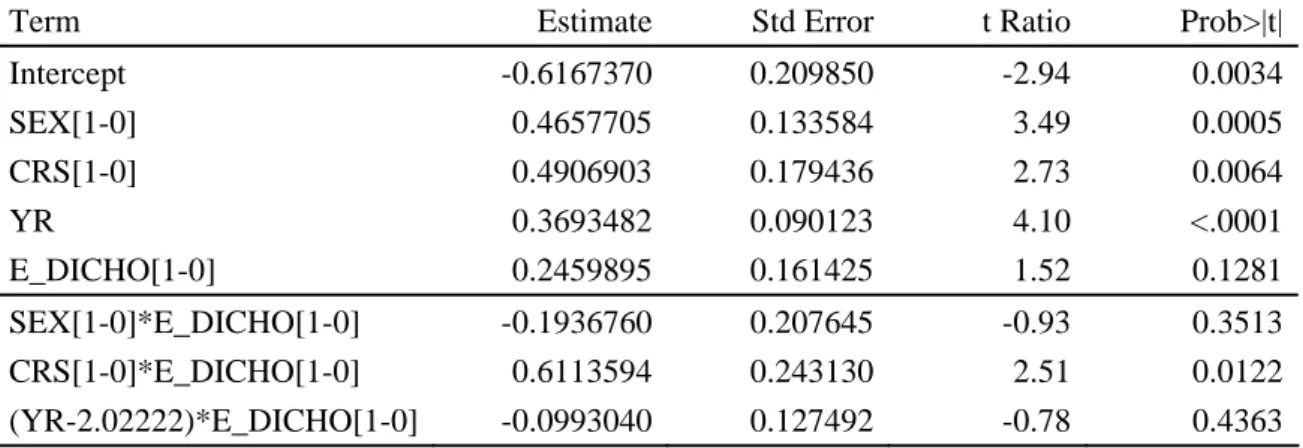
are shown in Table 4. The estimates are all in the positive, meaning that, other things being equal, MTVTN is higher for females than males, the International Course than the General Course, upper year students than lower year students, and EXs than NonEXs. E_DICHO’s unique contribution to the prediction was significant (p = 0.0083). Since E_DICHO was significant, an interaction-added model was also tried. Table 5 shows the results. The adjusted R-squared was improved to 0.165. It can be seen that E_DICHO’s contribution was no longer significant (p = 0.1281), but the interaction CRS*E_DICHO was (p = 0.012). It turns out that the effect of E_DICHO was larger for the International Course than for the General Course.
Table 4. Parameter estimates for predicting MTVTN (no interaction terms)
Term Estimate Std Error t Ratio Prob>|t|
Intercept -0.5439760 0.152873 -3.56 0.0004
SEX[1-0] 0.3881430 0.102524 3.79 0.0002
CRS[1-0] 0.8124868 0.120829 6.72 <.0001
YR 0.3275739 0.063676 5.14 <.0001
E_DICHO[1-0] 0.2706148 0.102210 2.65 0.0083
Table 5. Parameter estimates for predicting MTVTN (interaction terms added)
Term Estimate Std Error t Ratio Prob>|t|
Intercept -0.6167370 0.209850 -2.94 0.0034
SEX[1-0] 0.4657705 0.133584 3.49 0.0005
CRS[1-0] 0.4906903 0.179436 2.73 0.0064
YR 0.3693482 0.090123 4.10 <.0001
E_DICHO[1-0] 0.2459895 0.161425 1.52 0.1281
SEX[1-0]*E_DICHO[1-0] -0.1936760 0.207645 -0.93 0.3513
CRS[1-0]*E_DICHO[1-0] 0.6113594 0.243130 2.51 0.0122
(YR-2.02222)*E_DICHO[1-0] -0.0993040 0.127492 -0.78 0.4363
4.2.2. LgTOTAL
The adjusted R-squared was 0.351686. Parameter estimates for predicting LgTOTAL is shown in Table 6. E_DICHO was significant (p = 0.0166). Note in passing that SEX was not significant (p = 0.52227). Since E_DICHO was significant, the interaction terms were added to the model, but the adjusted R-squared was lowered to 0.3486. None of the interaction terms was significant. In addition,
E_DICHO’s contribution itself ceased to be significant. For these reasons, the no-interaction model was preferred.
Table 6. Parameter estimates for predicting LgTOTAL (no interaction terms)
Term Estimate Std Error t Ratio Prob>|t|
Intercept -0.1775030 0.042862 -4.14 <.0001
SEX[1-0] 0.0183852 0.028745 0.64 0.5227
CRS[1-0] 0.3940168 0.033878 11.63 <.0001
YR 0.2293728 0.017853 12.85 <.0001
E_DICHO[1-0] 0.0688017 0.028657 2.40 0.0166
4.2.3. LgLSTNG
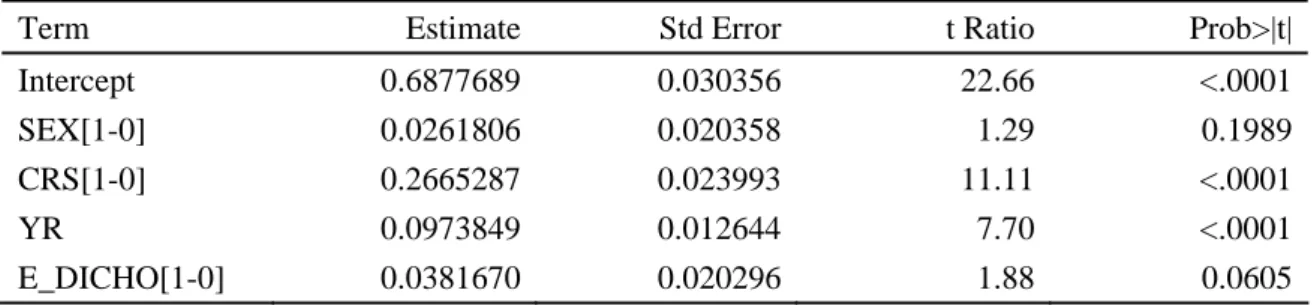
Results for the interaction-less models are shown in Table 7. The model was significant (p = 0.0001) and the adjusted R-squared was 0.255566. The partial coefficient for E_DICHO was marginally significant at p = 0.0605.
Table 7. Parameter estimates for predicting LgLSTNG (no interaction terms)
Term Estimate Std Error t Ratio Prob>|t|
Intercept 0.6877689 0.030356 22.66 <.0001
SEX[1-0] 0.0261806 0.020358 1.29 0.1989
CRS[1-0] 0.2665287 0.023993 11.11 <.0001
YR 0.0973849 0.012644 7.70 <.0001
E_DICHO[1-0] 0.0381670 0.020296 1.88 0.0605
Just in case, the interaction-added model was also tried. Adjusted R-squared did not increase but slightly decreased to 0.253135. None of the interaction terms nor E_DICHO was significant in this model. Hence, the interaction-less model seems to be more appropriate.
4.2.4. RtRDNG
Table 8 shows the results for the interaction-less model. The model was significant at p < 0.0001 and the adjusted R-squared was 0.252265. E_DICHO was a significant predictor (p = 0.0026). Addition of the interaction terms slightly deteriorated the
model-data fit. The adjusted R-squared was slightly lower at 0.249129. None of the E_DICHO-related terms was significant.
Table 8. Parameter estimates for predicting RtRDNG (no interaction terms)
Term Estimate Std Error t Ratio Prob>|t|
Intercept 1.8344607 0.025354 72.35 <.0001
SEX[1-0] -0.0126630 0.017004 -0.74 0.4567
CRS[1-0] 0.1992714 0.020040 9.94 <.0001
YR 0.1005896 0.010561 9.52 <.0001
E_DICHO[1-0] 0.0512669 0.016952 3.02 0.0026
4.3. Regression using the EX sub-group
Based only on the EX sub-sample (n = 289), significance of E_YRS_3PLUS, E_HRS_2PLUS, and E_ELM were tested. This was to see whether, among those who had some experience of learning the language before entering junior high school, the number of years for which, the number of hours per week for which, and where, they learned English made any difference.
4.3.1. MTVTN
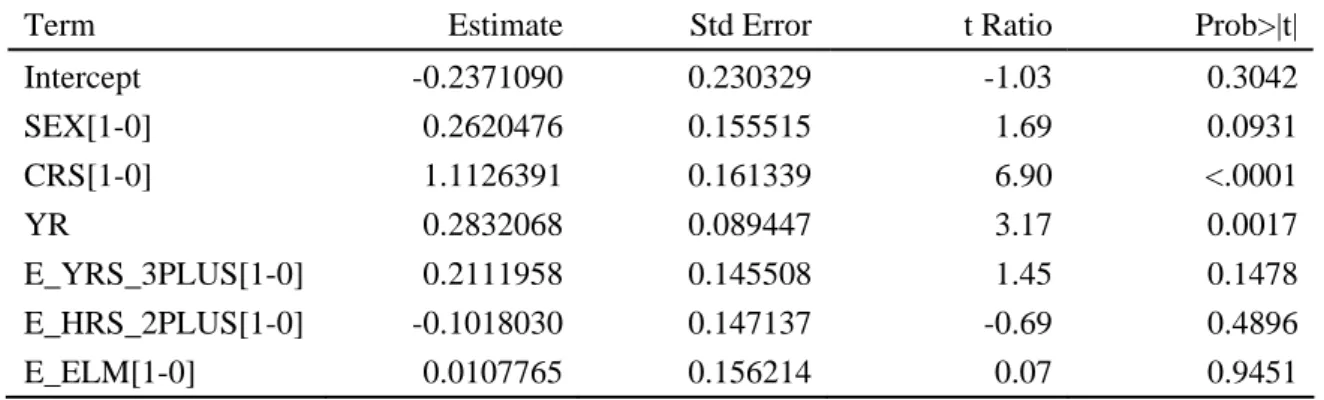
Results regarding MTVTN are shown in Table 9. Neither E_YRS_3PLUS nor E_HRS_2PLUS turned out to be significant. E_ELM was not significant, either.
Table 9. Parameter estimates for predicting MTVTN of EX students
Term Estimate Std Error t Ratio Prob>|t|
Intercept -0.2371090 0.230329 -1.03 0.3042
SEX[1-0] 0.2620476 0.155515 1.69 0.0931
CRS[1-0] 1.1126391 0.161339 6.90 <.0001
YR 0.2832068 0.089447 3.17 0.0017
E_YRS_3PLUS[1-0] 0.2111958 0.145508 1.45 0.1478
E_HRS_2PLUS[1-0] -0.1018030 0.147137 -0.69 0.4896
E_ELM[1-0] 0.0107765 0.156214 0.07 0.9451
4.3.2. LgTOTAL
Results regarding LgTOTAL are shown in Table 10. Although E_HRS_2_PLUS was not significant, E_YRS_3PLUS’s significance level was p = 0.0634. E_ELM was not significant.
Table 10. Parameter estimates for predicting LgTOTAL of EX students
Term Estimate Std Error t Ratio Prob>|t|
Intercept -0.1341840 0.063606 -2.11 0.0358
SEX[1-0] 0.0162508 0.042946 0.38 0.7054
CRS[1-0] 0.4031972 0.044554 9.05 <.0001
YR 0.2325389 0.024701 9.41 <.0001
E_YRS_3PLUS[1-0] 0.0748752 0.040183 1.86 0.0634
E_HRS_2PLUS[1-0] -0.0220090 0.040633 -0.54 0.5885
E_ELM[1-0] -0.0065290 0.043139 -0.15 0.8798
4.3.3. LgLSTNG
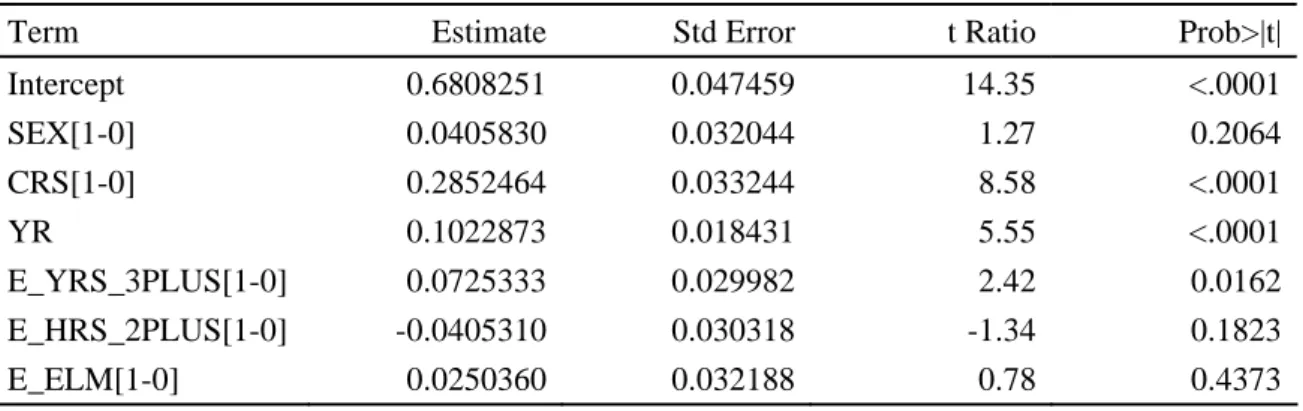
Results regarding LgLSTNG are shown in Table 11. Although E_HRS_2_PLUS was not significant, E_YRS_3PLUS was significant at p = 0.0162. E_ELM was not significant.
Table 11. Parameter estimates for predicting LgLSTNG of EX students
Term Estimate Std Error t Ratio Prob>|t|
Intercept 0.6808251 0.047459 14.35 <.0001
SEX[1-0] 0.0405830 0.032044 1.27 0.2064
CRS[1-0] 0.2852464 0.033244 8.58 <.0001
YR 0.1022873 0.018431 5.55 <.0001
E_YRS_3PLUS[1-0] 0.0725333 0.029982 2.42 0.0162
E_HRS_2PLUS[1-0] -0.0405310 0.030318 -1.34 0.1823
E_ELM[1-0] 0.0250360 0.032188 0.78 0.4373
4.3.4. RtRDNG
Results regarding RtRDNG are shown in Table 12. Neither E_YRS_3PLUS nor E_HRS_2_PLUS was significant. E_ELM was not significant.
Table 12. Parameter estimates for predicting RtRDNG of EX students
Term Estimate Std Error t Ratio Prob>|t|
Intercept 1.885141 0.037341 50.48 <.0001
SEX[1-0] -0.013593 0.025212 -0.54 0.5902
CRS[1-0] 0.207749 0.026157 7.94 <.0001
YR 0.101974 0.014501 7.03 <.0001
E_YRS_3PLUS[1-0] 0.023055 0.023590 0.98 0.3292
E_HRS_2PLUS[1-0] -0.015693 0.023854 -0.66 0.5112
E_ELM[1-0] -0.019940 0.025326 -0.79 0.4317
4.3.5. Results summary
The results obtained are summarized in Table 13.
Table 13. Summary of significance levels in t-tests and regressions
MTVTN LgTOTAL LgLSTNG RtRDNG RtVCBLR RtGRMMR
t-test 0.0005 0.0575 0.0200 0.0010 n.s. n.s.
E_DICHO 0.0083 0.0166 0.0605 0.0026 N/A N/A
E_DICHO*CRS 0.0122 n.s. n.s n.s N/A N/A
E_YRS_3PLUS n.s. 0.0634 0.0162 n.s N/A N/A
E_HRS_2PLUS n.s. n.s. n.s n.s N/A N/A
E_ELM n.s. n.s. n.s. n.s. N/A N/A
5. Discussion
As was indicated by Table 2, SEX, E_DICHO, and CRS are closely
intertwined. Female students seem more likely to start English before junior high school than boys are. Those who do so, irrespective of sex, are more likely to choose, in later years, an English-focused high school course than those who do not
are. Finally, those in an English-focused course tend to outperform those in other courses, in terms of English proficiency and/or motivation toward learning it. As such, even when a t-test reveals EX students outperform NonEX students with regard to a given variable, it is unknown whether one is actually looking at the effect of early English education, being a female, studying at an English-focused course, or all of them.
This is what makes it difficult to interpret the results of the previous studies above. Some failed to provide participants’ sex information at all (JASTEC Project Team, 1988; JASTEC Project Team, 1994; Megumi et al, 1996; Shirahata, 2002);
others simply provided the number of each sex in the participants group (Tanizuka, 2000; Takagi, 2003a), or just stated that each cell had approximately equal numbers of both sexes (JASTEC Project Team 1989a). One study (JASTEC Project Team 1989b) described the data separately by sex, but without conducting any statistical tests. Thus, none among the studies involving male and female participants explicitly controlled the sex factor by a statistical measure, except the present author’s previous study (Shizuka 2007).
Two studies (Takada, 2003a; 2003b) involved only females, in which case controlling for sex factor was not necessary. Unfortunately, however, these had a different drawback. In both of them, EXs were those who had learned English at a private elementary school and were “automatically promoted” (Takada, 2003a, p. 116) to the junior high school where data collection took place, whereas NonEXs entered from public elementary schools through “competitive entrance exams” (Takada, 2003a, p. 116). In other words, whether or not they had learned English in elementary school years was not the only distinctive feature between the groups. They were also
different in the type of elementary school they had attended, as well as in the
experience of competitive studying. For this reason, it is not clear whether the results obtained should be attributed, as the author claims, to ineffectiveness of early English learning per se, or rather to the fact that the EX group generally had “poor study habits” (Takada, 2003a, p. 116) relative to the NonEX group.
It was to circumvent this confounding problem that the present study adopted a multiple regression approach. By coding categorical features (such as sex or school type) as dummy variables, one can incorporate them into a regression model, which makes it possible to single out the effect of each variable, statistically controlling the influences of all the others. (Note in passing that virtually all the students at Nagano High School used to be public elementary school students and, after that, junior high school students. Therefore, English learning was the only known factor that separated our EX from NonEXs.) Through this approach, we have shown that English
education prior to junior high school has clear, unique contributions above and beyond the influences of sex and high school course.
Based on the results of the present study, it seems that, other thing being equal:
(1) EX students tend to be more motivated toward learning the language in high
school years;
(2) the effect of being an EX on motivation tends to be enhanced when the student learns in an English-focused high school course as opposed to a regular course;
(3) EX students tend to be generally more proficient (p = 0.0166) in high school
years;
(4) regarding overall proficiency, there is some possibility (p = 0.0643) that
pre-junior high English learning which continued for three or more years was more effective than that which lasted for shorter years;
(5) EX students’ advantages over NonEX students reside in their higher abilities
in listening (p = 0.0605) and reading (p = 0.0026) skills; no advantage exists regarding vocabulary or grammar knowledge;
(6) with regard to listening, experiencing English learning for three years or
longer was more effective (p = 0.0162) than doing so for shorter years; and
(7) when students learned English in elementary school years, whether or not the
learning took place at an elementary school or at another type of school does not seem to make any difference.
The findings (1), (3), (5) are essentially in line with the findings by JASTEC Project Team (1988, 1989a), Megumi et al (1996), JASTEC Project Team (1989b), JASTEC Project Team (1994), Tanizuka (2000), and Takagi (2003a). What the present study adds to the insights already obtained from these studies is (2), (4), (6), and (7). To reiterate, it is noteworthy that these effects were detected even when other potentially confounding variables were controlled for.
These generalizations do not really clash with the reports by Shirahata (2002), who investigated participants’ phoneme distinction as well as oral production
abilities. These areas we did not look into in the present study. But one observation may be in order. Even if the effect of a given treatment in elementary school years is not detected in junior high school years, if it is at the senior high school stage, the conclusion should be that the treatment does have an effect in the long run. In this sense, if EX high school students are found to be more able than NonEX high school students (JASTEC Project Team, 1988, 1989, Megumi et al, 1996, the present study), then whether or not EX junior high school students are different from their NonEX counterparts will not be an issue.
6. Concluding remarks
What does remain a thorny issue is the discrepancy between the present study’s and our previous study’s (Shizuka, 2007) results. Unfortunately, no plausible explanation is available as to why the unique contribution of early English learning was not significant in the 2004 data but was in the 2005 data. Considering, however, that, in the 2004 data set as well, at least t-tests indicated superior EX performance in the ACE total score and the motivation score, we are inclined to tentatively conclude that both studies are pointing to similar directions. To judge whether the 2004 sample just happened, out of random noise, to make early English learning less effective than it really is or, on the contrary, the 2005 data set gave it an undue credit simply by chance, we need to wait for the 2006-data analyses to be finalized, which should be reported in the near future.
Acknowledgment
This paper is based on the presentation the author made at the 45th JACET annual convention, Osaka, September 2006. I am grateful to the audience for their fruitful comments.
References
JASTEC Project Team (1988). Souki eigo gakushusha no tsuiseki chosa: Dai san pou [A follow-up study on the effects of early English learning: Report III].
JASTEC Bulletin, 7, 43-63.
JASTEC Project Team (1989a). Souki eigo gakushusha no tsuiseki chosa: Dai yon pou [A follow-up study on the effects of early English learning: Report
IV]. JASTEC Bulletin, 8, 3-13.
JASTEC Project Team (1989b). Chugaku sei no eigo gakushu ni kansuru taido:Ex to Non-Ex wo taishou to shita ankeeto chosa [Junior high school students’ attitude towards learning English: A survey]. JASTEC Bulletin 8, 15-38.
JASTEC Project Team (1994). Soki eigo gakushu ga gakushu sha no eigo oyobi gaikokugo gakushu ni okeru taido to doki ni oyobosu eikyo [The effects of English
learning at an early stage on attitudes and motivation toward English and foreign language]. JASTEC Bulletin, 13, 35-48.
Manly, B. F. (1994). Multivariate statistical methods: A primer. (2nd ed.). London:
Chapman & Hall.
Megumi, T., Yokokawa, H., & Miura, I. (1996). Soki eigo gakushu keiken sha no chu kou ni okeru seiseki [High school grades in early learners of English]. JASTEC Bulletin 15, 27-35.
Otsu, Y. (2007, February). Shogakko eigo kyoiku wo kangaeru: Wakaki chisei ni okuru kotoba [On teaching English at elementary schools: My message to young intellectuals]. In T. Osamu (Chair), Shogakkou eigo kyoiku hisshuuka wo megutte [On introducing English as a compulsory subject to public elementary schools].
Symposium conducted at the KELES 10th Seminar for Presenting Graduation and Masters’ Theses, Kansai University.
Rasch, G. (1960). Probabilistic models for some intelligence and attainment tests.
Copenhagen: Denmark Institute for Educational Research (Expanded edition, 1980.
Chicago: University of Chicago).
Shirahata, T. (2002). An investigation into English abilities of the students who were exposed to English at a model school. The Bulletin of the Faculty of Education, Shizuoka University, Educational Research Series, 33, 195-215.
Shizuka, T. (2007). Shogakkou dankai de no eigo gakushuu ga koukou dankai de no eigo ryoku oyobi douki zuke ni ataeru eikyo (I) [Effects of learning English in elementary school years on the proficiency of, and the attitude towards, the language in high school years (I)]. In O. Takeuchi, A. Kikuchi, T. Nabei, S.
Yamane, T, Yashima, S. Sumi, & M. Ikeda (Eds.), Exploration of English language instruction: Papers in honor of Professor Eiji Saito on his retirement from Kansai University (pp. 66-77). Tokyo: Sanseido.
Tabachnick, B. G. and Fidell, L. S. (2001). Using multivariate statistics. (4 ed.).
Needham Heights, MA: Allyn and Bacon.
Takada, T. (2004). The listening proficiency elementary school (ES) and junior high school (JHS) intend to develop: What teachers should know to bridge the gap between ES and JHS programs. Annual Review of English Language Education in Japan (ARELE), 15, 109-118.
Takagi, A. (2003a). The effects of early childhood language learning experience on motivation towards learning English: A survey of public junior high school
students. JASTEC Bulletin, 22, 47-71.
Takagi, A. (2003b). The effects of language instruction at an early stage on junior high school, high school, and university students' motivation. Annual Review of English Language Education in Japan (ARELE), 14, 81-89.
Tanizuka, N. (2000). Soki eigo kyouiku ga onso shikibetu nouryoku to eigo
gakushu ni taisuru taido ni oyobosu eikyo: Nihon jin kou daigaku sei wo taishou to shita chosa kenkyu [Effects of early English learning on phoneme perception and attitude to learning English by Japanese high school and college students]. JASTEC Bulletin, 19, 73-92.
APPENDIX: Survey questions that explored participants’ motivation to study English
Notes:
1. The questions were originally in Japanese.
2. The questions are termed Q6 and Q7 because they were parts of a larger question set that, as a whole, explored the students’ current study habits and future dreams.
3. Items 8A (Infit mean square = 1.26, Outfit mean square = 1.56) and 8J (Infit mean square = 1.49; Outfit mean square = 1.63) were identified as misfits, hence were not used for deriving MTVTN.
Q6. To what extent do you agree with the statements below?
3) strongly agree 2) agree 3) disagree (scored 0)
I would like to brush up my English because I want to . . .
6A. be an educated person with cross-cultural understandings.
6B. be ready for the day when I am spoken to in English by someone from overseas.
6C. confidently travel overseas by myself.
6D. communicate more deeply with English speakers, in our own communities and abroad.
6E. periodically exchange e-mail/letters with friends overseas.
6F. read English newspapers and books without much help from dictionaries.
6G. understand English songs by ear, without reading the lyrics.
6H. enjoy movies in English without reading subtitles.
6I. be good enough at speaking the language to comfortably live overseas.
6J. use English for my job in the future.
Q8. To what extent do you think you need to do the following?
3) absolutely necessary 2) necessary 1) not very much 0) not at all
8A. to your best in preparing for, studying in, and reviewing, English classes at school
8B. brush up my grammar and expand my vocabulary
8C. read as much English as possible, using English newspapers and novels
8D. write as much English as possible
8E. listen to as much English as possible, through TV and radio English programs, movies, songs, etc.
8F. orally produce as much English as possible, using commercially available conversation courses, etc.
8G. increase my chances of talking with foreigners in English, by going to conversation schools and/or making non-Japanese friends, etc.
8H. take proficiency tests like STEP, TOEIC, TOEFL, etc.
8I. stay in an English-speaking country to go to a conversation school there 8J. study for entrance examinations to universities and colleges
8K.reseach global issues and cross-cultural communication