The Japanese Society for Plant Systematics
The JapaneseSociety forPlant Systematics
ISSN OOOI-6799 Acta Phytotax. Geebot. 47 (1): 1-9 (1996)
New Genus and New Species of the Annonaceae from the Malesian Wet Tropics
HIROSHI OKADAi
Department of Biology, FZiculty of Science, Osaka Univenrity, 7byonaka, Osaka 560, lapan.
Abstract. A new
genus, Cleistopetatum,
and fivenew species, Aiphon,seaorthopetaia, (/teis- topetalumborneense, Cleistopetalum
sumatranum,Haplostichanthus
novoguineensis and Oncodostigma microjlorum, aredescribed from
the Malesian wet tropics.Among therm,H.novoguineensis extends the range ofthe
genus,
known as a regional near-endemic to Austra- iia,to New Guinea IsEand.Key words: Aiphensea, Annonaceae, Cleistopetatum,Haptestichanthus,Malesia, new
genus,new species, Oncodostigtna,wet tropics
Received November 20, 1995;
ae(:eptedFebruary 20, 1996
On the
opportunitiesto join botanical
expeditionsto the Malesian
wettropics, I had the
opportunityto
observe some scientifically unknown spe-cies of Annonaceae. In this
reporta
newgenus and five
new specie$found in East Kalimantan
andWest Sumatra, Indonesia,
andPapua New 6uinea
are
described.
Alphensea
orthopetalaH. Okada,
sp. nov.(Figs. IC, 2)
Arbor 15
m alta.Fotia leviter
coriacea, oblonga vel elliptica, apice acuminata,basi
obtusa ad rotundata,
glabra, '10-15
cm
longa, 4-6
cmlata,
nervisprimariis
circa10 paribus
versus marginem arcuatis
in
venamintramarginalem
convenientibus;petioli 5
mmlongi, In-
florescentia
extra-axillaris,fasciculata, 2-
vel3-fiora; pedunculi breves; pedicelli graciles,
1-1.5
cmlongi. Sepala 3,
valvata, triangularia,ferruginea,
tomentosa,1
mmlonga. Petala
6,
valvata, viridifiava, apice acuta non refiexa, ca. 1 cmlonga,
7 mm lata.Stamina
16. 1mm
longa. Ovaria 4,
cyEindrica,ferruginea
tomentosa,3
mmlonga.
stigmatibusglabris.
Ovula 16, biseriatim disposita. Fructus papulosus,
aurantiacus, ellipsoideus ad cylindricus.utroque retundatus,
3
crnlongus, 1.5
cmlatus, pariete
crasso; semina numerosa.
71ype. PAPUA NEW 6UINEA, Madang: Usino, Ramu Area, Mom River,
nearBrah-
men
high
school,25e-400
m alt.,Aug. 26, 1985, Okada, Kerenga & Katik 4377 (Kyo;
isotypes in
BRI, L, LAE, TI,U)・Tree 15
mtall. Leaves
slightly coriaceous, oblong-elliptic, apex acu- minate,base
obtuse or rounded,glabrous,
midrib sunken above, nervesca.
10
on each side of rnidrib, curving andinterarching,
reticulations visiblei New address: Botanical Gardens, Faculty of Science, Osaka City
Universlty,
Kisaichi.Kata-
no,
Osaka
576,Japan,
2 Acta Phytetax. 6eobot. Voi. 47
FIG.l IIabits
ot'new speeics. A Tvunk o['(.Verstopetalufnsuinatrafium. West Sumatra I].trunk of Cleistopelatttmst,ttrtatranuFn. West Sumatra. C. Alphorzsea orthopetala.
Guinca. D. JIaplo,stichanthets
noi,oguineensfs. Papua New GuineuHowcTh ou
?apua New
The Japanese Society for Plant Systematics
The JapaneseSociety forPlant Systematics
June1996 OKADA: New genus
andNew
species ofthe Annonaceae 3
above, raisedbeneath, 10-15
cmlong, 4-6
cmbroad, petiole 5
mmlong.
Flowers extra-axillary, 2 or 3 in fascicles; peduncles
short,pedicels
slender,1-1.5
cmlong. Sepals 3,
valvate,1
mmlong, triangular,
rustytomentose, Petals 6, greenish yellow, both sets saccate at base, the tips
not reflex,acute, subequal in length,
ca.1
cmlong, 7
mmbroad;
outerpetals pubes-
cent on
both
surfaces,inner petals pubescent
outside,glabrous inside. Sta-
mens
16,
miliusoid,1
mmlong, 1 mm broad, Ovaries 4,
cylindrical, rusty-tomentose, 3 mm long, stigma glabrous,
ovules16 in 2
rows.Fruits papu- lous,
orange colored, eilipsoid-cylindric, rounded atboth ends,
wailthick, 3
cmlong, 1.5
cmbroad, seeds many. 2n
=18 (Okada, 1987).
Distribution. Madang, Papua New Guinea.
Habitat. Primary lowland forest.
Other specimen
examined,PAPUA NEW GUINEA, Madang: Ramu Area, Mom River,
nearBrahmen high
school,250-400
m alt.,Aug, 26,
1985, Okada, Kerenga & Katik 4362 (BRI, KYO, L, LAE, TI, U).
uac :sadilil pt
e
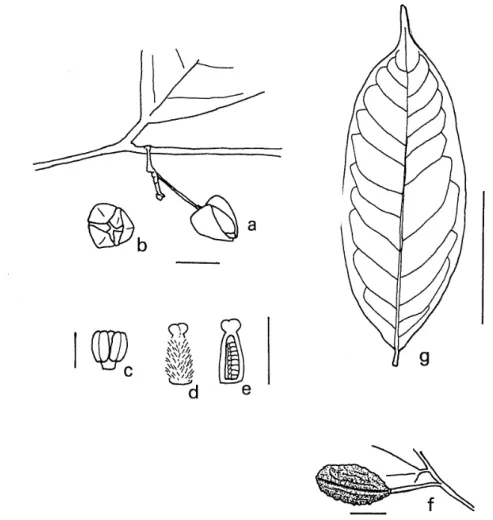
FIG.2 Aiphonsea orthopetala, a:
miliusoid anther, Bar == 1mm.
cm. g:leaf.Bar == 5cm.
flowerat extra axil;
d:
ovary; e: ovules.b:fiowerupper vi¢w,
Bar
=1 cmfor
a-b. c:Baf == 3mm ford-e.f:matured fruit.Bar =- 2
4 Acta Phytotax. Geobot, Vol. 47
Cleistopetalum H. Okada, gen.
nov.Arber
cauliflorafloribus
clausisper
anthesi,Sepala 3,
vaivata.Petala 6,
valvata coriacea. Petalainteriora basi
concavain
medio convexa,Stamina
numerosa.Ovaria
numerosa.
Ovulum 1, basale,
Tlype
species.Cleistopetalum borneense H. Okada
Monopodial trees,
caulifiorous,flowers
many, on woodytubercles
ontrunk. Flowers
closedthrough
anthesis.Sepals 3,
valvate,free. Petals 6,
arranged
in two
series, valvate, coriaceous;inner petals
more orless
smal-ler than
outer, concave atthe base,
convex atthe
middle, connivent, apicesfree. Stamens
many, connectivesflat-topped,
concealingthe
anthers,
filament
short.Ovaries
many, cylindrical, stigmas convex.Ovule 1, basal.
Nbtes. This genus belongs to the Artabotrys group (in the
sense ofFries I1959])
and maybe relatedto (lyathocalyx, but differs fTom Cyatho-
calyx
in its
caulifloroushabit, in
closedpetals
andin the free
sepals.Although the large
crowdedflowers
onthe trunk
are conspicuousin
the forest (Fig. IA, B), I
observed anthesis ofC
sumatranum only onceduring
several visitsto the locality. Examination of
specimens ofAnno-
naceae
in Bo
andslNG failed to yield
additional specimensbelonging to
the genus, It
maybe
verydifficult to
observe and collectthe flowers
ofthis
genus because
ofthe
rarity of anthesis.Cleistopetalum borneense H. Okada, sp. nov. (Fig. 3)
Arbor, Folia
oblonga,basi
rotundata, apice acuta,7-9
cmlonga, 3-4
cmlata. Flores
caulifiori,
Pedicelli 3
cmlongi, basi bracteati. Sepala 3,
valvata.Petala 6,
valvata, coriacea,glabra,
Ianceolata,4
cmlonga, 1
cmlata, Stamina
numerosa.Ovaria
numerosa, tomentosa.Ovulum 1, basale, Fructus
numerosus,T>tpe. INDONESIA, East Kalimantan: Sungai Menubar, 118030'E, leN, 20
m alt.,Dec, 12, 1980, Kato & wrriadinata 7119 (Kyo; isotypes in
Bo, L[to be
sent]).Monopodial tree. Young twigs pubescent, later glabrous. Leaves
membranous or coreaceous, oblong,
base
rounded, apex acute,pubescent
on
the
nerves and midrib above andbelow,
nerves slightlydepressed
above,
prominent beneath, 7-9
cmlong, 3-4
cm wide,petiole 5-7
mmlong. Many flowers
sproutingfrom
woodytubercles
ontrunk. Pedicel 3
cmlong,
with minutebract
atbase. Sepals 3, glabrous, 5
mmlong, 8
mmwide,
broadly
ovate, apex acute.Petals 6 in two
series, coriaceous,glab-
rous,
lanceolate,
slightly narrowed nearthe base;
outerpetals 4
cmlong, 1
cm broad,
concave atbase; inner petals
slightly smaller,3.5
cmlong, 7
mm
broad,
concave atbase,
convex at middle oninner
surface, closed roughly.Stamens
many withflat-topped
connectives concealingthe dorsal
anthers,
2
mmlong, 1
mmbroad. Ovaries
many,tomentose,
stigma rod-like,
shortly stalked,3
mmlong, ovule 1, basal. Ripe carpels 5 cm long, 2.5
cm wide, oblong, cylindrical,glabrous;
stalks8-10
mmlong, pubes-
cent.
Distribution. Borneo: East Kalimantan, Indonesia.
Hdbitat. Riverside in disturbed
area.The Japanese Society for Plant Systematics
The JapaneseSociety forPlant Systematics
June 1996 OKADA: New genus
andNew
species of theAnnonaceae s
b
X"e1ul"c
b,.
lfr
g h
(lll)j
/
m@,
Ciiiil
FiG, 3 Cteistopetatum borneense.
a: fiower;b:innerpetalscohering to sexual organs atbase;
c:free
sepals; d:sepal, Bar= 5rpm
forc-d.e: outerpetal front
view;f:
outerpetal
side view, Bar =4cm
for
a-b, e-f.g: inner petal front
view;h: inneT petal
back view; i:innerpetalside view, Bar =]3cm for
g-i. j:
anther; k:ovary; 1:one ovule at base.Bar = 3mmfor j-1.
m: leaf.Bar ='- 2cm, n:fruits.BaT
m-
2cm.Other specimen examined, INDONESIA, East Sangkulisang Subdiv., Sg, Susuk
region,50 m
alt., mans5581 (BO, L, K, SINq.),
Kalimantan: E. Kutei, July 1, 1951, Kbster-
CIeistopetalum
sumatranumH, Okada,
sp. nov.(Figs. IA, B, 4)
Arbor, 30
m alta.Folia
oblonga vel elliptica,basi
rotundata, apice acuta,15-20
cmlonga, 8-10
cmlata. Flores
cauliflori, virides adfiavi, pedicellati, pedicellis 3-5
cmlongis,
Sepala 3,
valvata,Petala 6,
valvata, coriacea,glabra,
lineariaad ob]onga,4.S-6
cmlonga, 1.5
cmlata. Stamina
numerosa,3
mmlonga, 1
mmlata, Ovaria
numeresa, tomentosu,Ovulum 1, basale. Fructus ignotus,
llype, INDONESIA, West Sumatra: Gn. (Mt.) Gadut, Bt, (Hill) Pinang Pinang,
ca,20
km
eastfrom Padang,
about600m
alt.,Dec. 14, 1987, Okada 4607 (Bo; isotype in
Kyo).Monopodial tree,
ca,30
mtall. Leaves
elliptic or oblong,15-20
cmby 8-10
cm, apex acuminateto
short caudate,base
rounded,bright dark
green
above,glaucous beneath,
nerves slightlydepressed
above andprom-
inent beneath, petioles
ca.1
cmlong. Flowers
many,from woody tubercles
6 Acta Phytotax. Geobot. Vol. 47
of as
stdiIbo (mp
mpfpa'
stpapt"
a
g]'/}i:,: ViopJ
c
ts}k.UJ
k
-
d
fg
FIG.
4Cleistopetalzam
sumatranum. a: caulifiorous fiowerson tubercles of trunk; b:flower;c: outerpetalfrontview;d: outer petalside view; e:
inner
petalscohering to sexual organs atbase; f: inner
petal front
view;g:
innerpetal
side view. Bar == 4cm forb-g.hrfreesepalsl i:sepal. Bar =1 cm forh-i.j:
anther; k:ovary; 1:one ovule at base,Bar = 3mrnfor j-1,
m:leaf.
Bar =:5
cm,on
trunk; pedicels 3-5
cm with minutebracteoles at base. Sepals 3,
triangular, glabrous, 1
cmlong, 7
mm wide.Petals 6, green to
creamyyel- low,
varyingin
colorand size with age, coriaceous, glabrous, linear-
oblong, apex acute,
falling together;
outerpetals 4.5-6.0
cmlong, 1.5
cmbroad,
slightly concave atbase; inner petals
slightly smallerthan
outerones,
3.5-5.0
cmlong, 8
mm wide, curvedinwards,
concave atbase,
con- vex at middle,flowers
closedthrough
anthesis.Stamens
many withflat-
topped
connectives concealingthe dorsal
anthers,3
mmlong, 1
mm wide.Torus
slightly convex.Ovaries
many,tomentose, 4
mmlong;
stigma rod-like,
short stalked with a shallowgroove
runningdown the
adaxial sideto
base
of ovary.Ovule 1, basal. Fruits
unknown.Distribution. West Sumatra, Indonesia.
Habitat. Primary hill forest.
Haplostichanthus
novoguineensisH. Okada,
sp. nov.(Figs. ID, 5)
Frutex, 1-2
m altus.Folia
oblonga ad elliptica, coriacea,basi
cordata,15-20
cmlon-
ga,
S-6
cmlata. Flores
axillares, cremei,pedicellati, pedicellis 3-5
mmIongis. Sepala 3,
valvata
ferruginea
tementosa, ovata,5
mmlonga, 4
mmlata, Petala
coriacea,biseriatim
disposita,
aggregatabasi, Stamina
numerosa.Ovaria 13,
tomentosa, cylindrica,2
mmlonga.
The Japanese Society for Plant Systematics
The JapaneseSociety forPlant Systematics
June1996 OKADA: New genus
andNew
species of theAnnonaceae 7
Fructus ignotus,
71ype, PAPUA NEW GUINEA, Morobe: Oomsis
nearLae, Gabensis Logging Area,
ca. 150 m alt.,Aug, 15, 1985,
Okada & Katik 4202 (KyO; isotypes in
BRI, LAE, Tl).Shrub 1-2
mtall. Leaves
oblong-elliptic, coriaceous,base
acute cor-date, glabrous
above,pubescent
on midribbeneath, 15-20
cmlong, 5--6
cm
broad, petiole 2-3
mm,pubescent. Pedice]s 3-5
mm.Flowers
axillary, cream-colored.Sepals
rustytomentose,
oval,5
mmlong, 4
mmbroad. Pet-
als
6 in 2
series, subequal, aggregated atbase,
coriaceous; outerpetals
spreading, apex acute,
pubescent
outside,glabrous inside, 7
mmlong, 7
mm
broad, inner petals
withfaint
edge,pubescent
upperpart
of marginand outer edge,
glabrous inside,
vaulted and cohering attop, forming
adome. Stamens
numerous,2
mmlong, 1
mmbroad,
connectivesflat
con- cealing anthers.Ovaries 13, tomentose,
cylindrical,2
mmlong. Fruits
un-known,
Distribution. Morobe, Papua New Guinea.
Habitat. Primary lowland forest.
Other specimens
examined.PAPUA NEW GUINEA, Morobe: Oom-
sis, between Wanpit
andGabensis, 100-200
m alt.,Aug. 16, 1985, Okada
& Katik 4216 (Kyo, LAE), 4243 (BRI, Kyo, LAE, TI)
IVotes. Htipiostichanthus was thought to be
endemicto Australia.
This
species extendsthe
range ofthe genus to New Guinea. Jessup (1990,
pers.
comm,) considered"aplostichanthus to be
a regionalnear-endemic
x
/
x//
opc
a
rzv:
Ll lssili)si
`.r';
:d
b
eee
FiG.5 Haplostichanthusnovoguineensts. a: fiowerinaxil. Bar = 1 aggrcgated at
base. Bar
=5
mm. c: anther; d:ovaTy; e: ovules, 5cm.cm.
b: fiower from below.
P¢tals Bar == 2mm forc-e, f:leaf.Bar ==8 Acta Phytotax. Geobet. Vol. 47
genus to Australia,
andpossibly
notgenerically distinct from the New
nean
genus Pcrpualthia. Gui-
Oncodostigma
microflorumH. Okada,
sp. nov.(Fig. 6)
Arbor, 15
m alta.Folia
oblonga,10-12
cmlenga, 4-5
cmlata. Fles
axillaris, solitar-ius,
subsessilis,Sepala
3, valvata, late ovata, extrapubescentia, intra glabra, 2
mmlonga.
Petala 6,
valvata, utrinquepubescentia; petala
exterioralanceoiata
ad oblonga, apice acuta,7
mmlonga, 3
mmlata; petala interiora
crassa, margine complanata,5
mmlonga, 3
mmlata. Stamina
numerosa sessilia,1
mmlonga, 1
mmlata;
connectivum apice complanatum, abscondiens antheras.Ovaria 2-3,
ovoidea,pubescentia, 2
mmlong. Ovula 12, biseriatim disposita. Fructus pariete
crasso.71ype.INDONESIA,
West Sumatra: Gn. (Mt.) Gadut, Bt. (Hill) Pinang Pinang,
ca.20 km
eastfrom Padang,
ca.600
m alt,,Jan. 6, 1983, Hbtta, Okada & lto 263 (Kyo; isotype in
BO),
Tree 15
mtall. Young twigs pale yellow,
striate.Leaves thinly
coriaceous, oblong,
glabrous
onboth
surfaces;10-12
cmlong, 4-5
cm wide, apex acuminate;base
roundto
obtuse, nervesfaint, petiole O.5
cmlong. Flowers
solitary, axillary, almost sessile.Sepals 3, broadly
ovate,pubescent
outside,glabrous inside, 2
mmlong. Petals 6 in two
series, val-vate, cream-colored,
pubescent
onboth
surfaces, coriaceous; outerpetals
t
xltt /
aZt
x'zt'`
Q l
c
b
1
Adl
(Sl)l,
;iitk
< gs,x
h
e(
'
l
f
'
IS,Y
hj(li),
FiG.6 Oncodostigma microjlorum. a: flowerinaxil; b:inncrpctalscohering to sexual organs. c: sep- al. Bar =:2 mm.
d:
outer petalback
view. Bar ==5 mm. e:inneT
petatback
view;f:
innerpetal side view. Bar =:- 5mm forc-f.g:
anthcr; h:ovary; i:ovules. Bar = 1mm forg-i; j:
fruit;k:seeds.The Japanese Society for Plant Systematics
The Japanese Sooiety for Plant Systematios
June
1996 OKADA
:Newgenus
andNew
species of theAnnonaceae 9
lanceolate −oblong
, apex acute ,7mm
long
,3mm
broad ; inner
petals
withsholt claw at
base
curving 量nward ,thick
withflattened
edges ,5mm
long
,3
mm
broad .
Stamens
many , sessile , withflat − topped
con 丑ectives concealingthe
anthers,
1mm
long
,1mm
broad .
Ovarles
20r
3
,0void
,pubescent
,2
mm
long
, stigmadouble
gourd −
shaped , short stalked,
Ovules
12
in
2
rows.
Fruits
short stalked , agglutinated ,glabrous
, wallthick
, seeds several. 2
η =18 ( Okada
,1987 ) .
Distribution .
West
Sumatra
,Indonesia .
Habitat .
Primary
hjll
f
()rest.
α
鱈
瑠 c珈 召η examined.
INDONESIA
,West
Sumatra
:Gn .
Gadut
,Bt .
Pinang
Pinang
,Dec ,
工,1987
,0kada
4505 (
KYo) .
Iwould
like
to express my sinccrc thanks toDr 。
S.
Kawamura
andDr .
A .
Bakar
, theleaders
of theSumatra
Nature
S
亡udyproject ( SNS ) ,
and other members QfSNS for
their support.
Dr .
M .
Hotta ,
Kagoshima
University
, andDr .
Masahiro
Kato ,
University
of Tokyo
,
offered the opportunity to studyin
West
Sumatra
andin
East
Kalimantan ,
respectively
.
Dr .
Kato
gave
me somepickled
materials.
Dr .
J.
R.
Croft,
Acting
Director
,Divisien
ofBotany
,Department
ofForests,
Lae ,
Papua
New
Guinea ,
permitted
the useof equipment and
facilities
ofthe
herbarium ,
and supported thefield
work.
Dr .
H .
Naga −
masu ,
Kyoto
University,
improved
the Latindescript
童ons of new taxa andgave
Ille sug− gestive
com ents.
I
amindebted
to thedirectors
and the curators of theherbarla
BO ,
KYO
,SING ,
TI .
This
study waspartly
supportedby
aGrant−in−Aid
for
Overseas
Scientific
Survey
from
theMinistry
ofEducation
,Science
andCulture,
Japan(
no,59041037
,62041
{〕 48,0104ユ024)
, and by
the Committee
of Osaka
University
South
Pacific
Research Project.
References
Fries
,R .
E
1959.
Annonaceae .
Die NatUrlichenPfianzenfamilien
,2.
Aufl ,
,Bd . 17a
II.
Duncker &
Humbolt
,Berlin,
Jessup,
L
W .1990.
Hab
鰄prcferences
anddistribution
ofAust1’
alianAnnonaceae .
Anno −
naceae
Newsletter
8
:55− 65.
Okada
,H .1987.
A
report of thebotanicai
expedition toPapua
New
Guinea
during
29th
July
and2nd
September , 1985 .
Sci ,
Rep . , Col .
Gen .
Educ ,
Osaka
Univ .36
:7−
32.
摘 要
岡 田
博 : マ レ
ー
シア湿 潤 熱帯
産バ ン
レイ シ 科植 物の
新 属と
新 種
イン ドネシ ア西スマ
ト ラ
, 東カリ
マ ンタ
ン, お よ びパ プ
アニ ュ ー
ギニ ア か ら1
新 属, Cleistopetalum ,5
新 種, ∠41phonsea
orthOlフeta’
a, Cleistopetalum
berneense , Cteistopetalt
〃 η
sumatranum
, Haplostichanthus
novoguineensis ,Oncodostigma
microflorum, を言己載 し た。
そ
の うち
の1
種 (H .
novoguineensis )はいま
までオ ース ト ラ リ
アの 特産
属 と さ れ
てい た
属に
属 すが ,今回
新た に
パ プ
アニ ュ・・ 一 ギ
ニ ア で 採 集さ れ ,新 種と
して記 載さ れ た 。
回
新た に
パプ
アニ ュ・・ 一 ギ
と
して記 載さ れ た 。
(