• 検索結果がありません。

The Detection and Grading of the Fatty Liver Based on Histogram Analysis of Ultrasonographic Image and

N/A
N/A
Protected

Academic year: 2021

シェア "The Detection and Grading of the Fatty Liver Based on Histogram Analysis of Ultrasonographic Image and "

Copied!
10
0
0

読み込み中.... (全文を見る)

全文

(1)

The Detection and Grading of the Fatty Liver Based on Histogram Analysis of Ultrasonographic Image and

Considering Body Measurements and Laboratory Data

Kouki M ASUO

1)

, Hitoshi F UNAGI

2)

and Kunihiko K AWAI

2)

Abstract : This study aimed to establish quantitative diagnosis and grading of the fatty liver using histogram analysis of ultrasonographic image, body measurements (body mass index, body fat percentage) and laboratory data.

A total of 373 subjects (212 men ; age, 46.1 8.7 years and 161 women ; age, 45.6 7.5 years) who underwent a health check service were enrolled in this study. The relationship between body measurements, laboratory data and the L-value (the most frequent gradient resulting from the histogram analysis of the ultrasonographic image) was assessed. About 70% of subjects were healthy at L/K-value (the difference of the L-value between the liver and the right renal cortex)≤ 3 and about 50% at L/K-value = 4. Healthy subjects were dominant at L/K-values up to 4-5. Less than 30% of subjects were healthy at a L/K-value of 5. More than 50% of subjects with a L/K value of 7 suffered from both liver damage and dyslipidemia and less than 5% of subjects with L/K-value ≥ 8 were healthy. Body mass index and body fat percentage had little effect on these results unless the subjects were excessively obese or thin.

Based on the evaluation above, we propose the L/K value criteria for detect- ing and grading of the fatty liver as follows : Normal, ≤ 3 ; borderline, = 4 ; mild fatty liver, 5-6 ; moderate fatty liver, 7-8 ; severe fatty liver, ≥ 9 or when histogram analysis fails to evaluate the liver/kidney contrast due to strong attenuation of echogenicity, such as “bright liver”. There was good agreement between these criteria and the subjective opinion of the operator during actual ultrasound fatty liver diagnosis. The histogram index could provide operator- independent quantitative diagnosis and grading of the fatty liver, which may serve as an efficient tool for diagnosis and follow up of patients.

Key words : fatty liver, diagnosis and grading, ultrasonography, histogram analysis

1)

Department of Surgery, Showa University Toyosu Hospital, 4—1-18 Toyosu, Koto-ku, Tokyo 135—8577, Japan.

2)
Shibuya Core Clinic

Original

(2)

Introduction

 The diagnosis of the fatty liver is being adopted increasingly in standard health checks as an indicator of risk for developing metabolic syndrome or life-style related diseases such as non-alcoholic fatty liver disease, because timely diagnosis and treatment can reverse the dis- ease process. Generally, diagnosis and grading are made by ultrasonography, which is rapid, easy to use, safe, non-invasive, economical and sensitive, but it depends on the subjective opinion of the operator (technologist or doctor) , which limits its practicability.

 To reduce such uncertainty, the histogram analyses of the image have occasionally been reported

1)

. Some have clearly shown the indices that define the fatty liver

2,3)

; however, very few, mention details of the grading, which may be an important clinical tool for diag- nosis and follow up of patients.

 In this paper, we study the diagnosis and grading of the fatty liver by histogram analysis taking into consideration body measurements [body mass index (BMI) and body fat per- centage, (BFP ; the percentage of fat in a personʼs body)] and laboratory data that relate to hepatic damage and dyslipidemia.

Methods

Study population

 Between August and December 2011, a total of 373 subjects who underwent a health check service (212 men ; age, 46.1 8.7 years and 161 women ; age, 45.6 7.5 years, P = 0.54 for age comparison between male and female subjects) were enrolled in the study.

The relationship between the body measurements (BMI, BFP) , laboratory data and variables derived from histogram analysis of ultrasonographic image were assessed to determine the optimal index for diagnosis and grading of fatty liver. Heavy drinkers and subjects suffering from liver cirrhosis were excluded from the study because of the possibility of structural abnormalities of the liver. All subjects enrolled in this study gave informed consent.

Body measurements

 BMI was calculated as an individualʼs bodyweight divided by their height squared (Kg/

m

2

) . BFP for each individual was evaluated by bioelectrical impedance analyzer (X-SCAN ; Owa Medical, Fukuoka, Japan) .

Laboratory assessment

 Blood tests were performed in fasting subjects. Aspartate aminotransferase (AST ;

standard level, 0-35 IU/L) , alanine aminotransferase (ALT ; standard level, 0-39 IU/L) , r-glu-

tamyltransferase (r-GTP ; standard level, 0-70 IU/L) were selected as laboratory indicators

of hepatic damage. Subjects exceeding standard levels of any of the measurements were

diagnosed as suffering from hepatic damage. Triglyceride (TG ; standard level, 30-149 mg/

(3)

dL) , low-density lipoprotein cholesterol (LDL-C ; standard level, 70.0-139.0 mg/dL) and high- density lipoprotein cholesterol (HDL-C ; standard level, 40.0-90.0 mg/dL) were selected as indicators of dyslipidemia. Subjects exceeding standard levels of TG and/or LDL-C, and/or those below standard levels of HDL-C were diagnosed as suffering from dyslipidemia.

The histogram analysis of ultrasonography

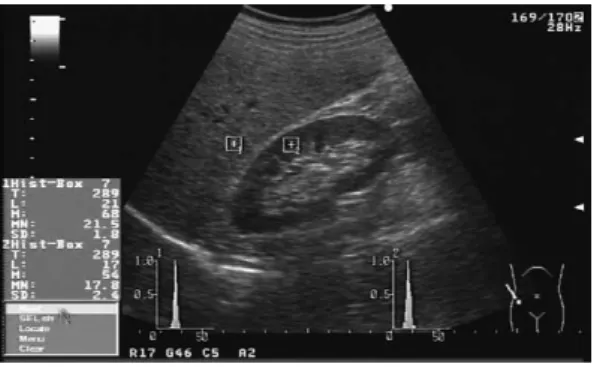
 Using the Aloka SSD-5000 ultrasound system (Hitachi-Aloka Medical, Tokyo, Japan) , with 5.0 MHz on a B-Scan, the region of interest (ROI) was placed in both the liver and the right renal cortex in a square shape (5 5 mm) where the Liver/Kidney contrast should be most clearly displayed. The echogenicity of each pixel included in the ROI was divided into 64 gradients (1 gradient corresponds approximately to 1 dB) by built-in computer on the basis of its intensity, and the frequency distributions of the gradients were shown as a histogram (Fig. 1) . The histogram analyses provide information about the most frequent gradient (L-value) , the number of the pixel that composes the L-value (M-value) and the mean of all pixelsʼ gradient included in ROI (MN-value) . For instance, in Fig. 1, the total number of pixels included in each ROI was 289. In the liver, the L-value was 21, the M-value was 68 and the MN-value was 21.5. In the right renal cortex, the L-value was 17, the M-value was 54 and the MN-value was 17.8. We adopted the L/K-value, the difference between the L-value of the liver and the L-value of the right renal cortex, (4 [21-17] in Fig.

1) , to assess the Liver/Kidney contrast, as used in previous studies

3,4)

. The same operator who was independent of the study and blinded to the body measurements and blood test results of the subjects conducted sonography.

Statistical analysis

 All statistical analyses and graphical presentations were performed using the Analysis ToolPak for Microsoft Excel 2007 (Microsoft Japan Co., Ltd.) . Continuous variables were

Fig. 1.  Sonogram of the liver and right kidney. The

histogram shows the frequency distribution of

the gradients included in the ROI that are

placed in the liver or the right renal cortex.

(4)

presented as means standard deviation (SD) . Correlation strengths are grouped as follows : minimal correlation, 0 ≤│r│< 0.2 ; weak correlation, 0.2 ≤│ r│< 0.4 ; moderate correla- tion, 0.4 ≤│r│< 0.7 ; strong correlation, 0.7 ≤│r │≤ 1. The mean values of the groups were compared using the paired t-test or unpaired t-test based on the outcome of the F-test. P < 0.05 was considered statistically significant for all analyses.

Results

Relationship between BMI or BFP and the histogram index

 The independent influence of BMI and BFP on the histogram analysis was assessed in 193 healthy subjects (90 men ; age, 46.0 9.3 years and 103 women ; age, 43.4 6.5 years, P = 0.03 for age comparison between male and female subjects) , i.e. those free of hepatic damage and dyslipidemia. There was a strong correlation between BMI and BFP (r = 0.80 in men, r = 0.92 in women) . There was a weak correlation between BMI and the L/K-value (r = 0.25 in men, r = 0.21 in women) .

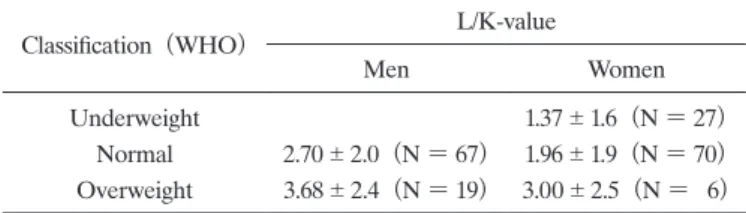
 To assess the influence of BMI on the L/K-value, we compared the L/K-value between the six BMI categories classified by The World Health Organization (WHO ; Underweight,

< 18.5 ; Normal weight, ≥ 18.5 and < 25 ; Overweight, ≥ 25 and < 30 ; Obese Class I, ≥ 30 and < 35 ; Obese Class II, ≥ 35 and < 40 ; and Obese Class Ш ≥ 40)

5)

. The L/K-value of each BMI category is shown in Table 1. In men, the underweight group was excluded because of the small number of subjects (4 men) and there were no subjects in Obese Classes I, II and III. In women, Obese Class I was excluded because it included only one subject and there were no subjects in Obese Classes II and III. Statistically, there was no significant difference in L/K-values between BMI categories for either men or women.

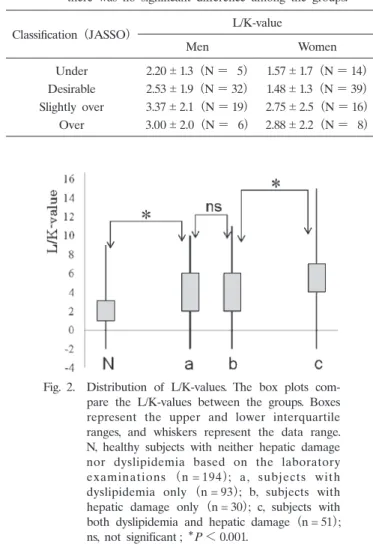
 BFP was evaluated in 139 healthy subjects (62 men ; age, 47.4 9.6 years and 77 women ; age, 44.4 6.3 years, P = 0.04 for age comparison between male and female subjects) . There was a weak correlation between BFP and the L/K-value (r = 0.20 in men, r = 0.27 in women) . To assess the influence of BFP on the L/K-value, we compared the L/K-value between the four BFP categories classified by The Japan Society for the Study of Obesity

(JASSO ; Under, < 15% in men, < 20% in women ; Desirable, ≥ 15% and < 20% in men,

≥ 20% and < 25% in women ; Slightly over, ≥ 20% and < 25% in men, ≥ 25% and < 30%

Table 1.  L/K-value according to WHO BMI class. Statistically, there was no significant difference among the groups.

Classification (WHO) L/K-value

Men Women

Underweight 1.37 1.6(N = 27)

Normal 2.70 2.0(N = 67) 1.96 1.9(N = 70)

Overweight 3.68 2.4(N = 19) 3.00 2.5(N =  6)

(5)

in women ; Over, ≥ 25% in men, ≥ 30% in women)

6)

. The L/K-value of each BFP category is shown in Table 2. Statistically, there was no significant difference in L/K-values between BFP categories for either men or women.

 The data suggest that BMI and BFP would have little independent influence on the his- togram analysis unless a subject was excessively obese or thin, although the analysis did not include obese subjects or underweight men.

The correlation between the laboratory indicators and the histogram index

 The correlations between the laboratory indicators and the L/K-value are shown as box plots in Fig. 2. The mean L/K-value of healthy subjects who had neither hepatic damage nor dyslipidemia was 2.33 2.1 (Fig. 2 ; N, n = 194) . The mean L/K-value was 3.74 2.3 for subjects who had dyslipidemia but no hepatic damage (Fig. 2 ; a, n = 93) , 4.09 3.0 for

Table 2.  L/K-value according to JASSO BFP class. Statistically, there was no significant difference among the groups.

Classification (JASSO) L/K-value

Men Women

Under 2.20 1.3(N =  5) 1.57 1.7(N = 14)

Desirable 2.53 1.9(N = 32) 1.48 1.3(N = 39)

Slightly over 3.37 2.1(N = 19) 2.75 2.5(N = 16)

Over 3.00 2.0(N =  6) 2.88 2.2(N =  8)

Fig. 2.  Distribution of L/K-values. The box plots com- pare the L/K-values between the groups. Boxes represent the upper and lower interquartile ranges, and whiskers represent the data range.

N, healthy subjects with neither hepatic damage

nor dyslipidemia based on the laboratory

examinations (n = 194) ; a, subjects with

dyslipidemia only (n = 93) ; b, subjects with

hepatic damage only (n = 30) ; c, subjects with

both dyslipidemia and hepatic damage (n = 51) ;

ns, not significant ;

P < 0.001.

(6)

subjects who had hepatic damage without dyslipidemia (Fig. 2 ; b, n = 30) and 5.49 2.8 for subjects with both dyslipidemia and hepatic damage (Fig. 2 ; c, n = 51) . Although there was no significant difference in L/K-value between [a] and [b] (P = 0.56) , there was a significant difference between [N] versus [a] and [b] versus [c] (P < 0.001, respectively) . The mean L/K-value of the subjects who had either dyslipidemia or hepatic damage was 3.82 2.5 and there was a significant difference between this value and the L/K-value of

[N] and [c] (both P < 0.001) .

 To evaluate the relationship between L/K-value and hepatic damage or dyslipidemia, we calculated the proportion of healthy subjects (with neither hepatic damage nor dyslipidemia) , and subjects with hepatic damage, dyslipidemia, or both at each L/K-value. The percentage of each group of subjects at each L/K-value is shown in Fig. 3.

 About 70% of subjects were healthy at L/K-value ≤ 3 and about 50% at L/K-value = 4.

Healthy subjects were dominant at L/K-values up to 4-5. Less than 30% of subjects were healthy at a L/K-value of 5. More than 50% of subjects with a L/K-value of 7 suffered from both liver damage and dyslipidemia and less than 5% of subjects with L/K-value ≥ 8 were healthy.

The practical utility of histogram analysis

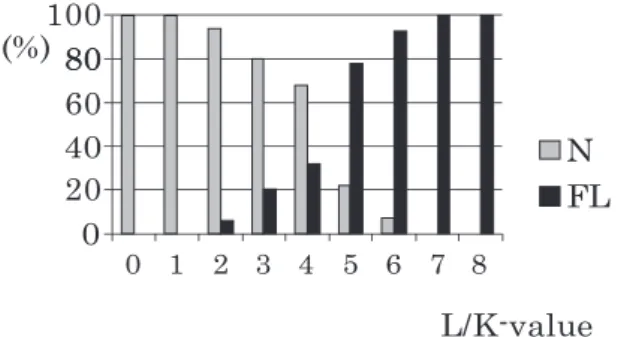
 To verify the agreement of histogram analysis to the actual ultrasound fatty liver diagnosis, we compared the elevated L/K-value with the opinion of the operator (presence or absence of fatty liver) . The relationship between the opinion of the operator and the L/K-value is shown in Fig. 4. The operator judged 32% of subjects with L/K-value = 4 as having fatty liver and 68% as normal. Subjects judged as normal were predominant up to a L/K-value 4-5. At a L/K-value = 5, 78% of subjects was judged as having fatty liver and 22% as normal. At a L/K-value = 6, only 6% were judged as normal and all subjects with a L/

K-value ≥ 7 were judged as having fatty liver.

Fig. 3.  The percentage of each group of patients at each L/K-value. N, healthy subjects with neither hepatic damage nor dyslipidemia ; A, subjects with either dyslipidemia or hepatic damage;

B, subjects with both dyslipidemia and hepatic

damage.

(7)

 Based on the data presented in Figs. 3 and 4, we propose the criteria for assessment of fatty liver using the following histogram index :

     Normal ; L/K-value ≤ 3      Borderline ; L/K-value = 4      Mild fatty liver ; L/K-value = 5, 6      Moderate fatty liver ; L/K-value = 7, 8

     Severe fatty liver ; L/K-value ≥ 9, or when histogram analysis fails to evaluate the liver-kidney contrast, even if the proper adjustment of the gain or the sensitivity time control (STC) were provided, due to strong attenuation of echogenicity associ- ated with fatty liver such as “bright liver”.

Discussion

 The fatty liver, or hepatic steatosis, is generally diagnosed by ultrasonographic examination contrasting the echogenicity of the liver with that of the right renal cortex, which should be free from steatosis (Liver/Kidney contrast)

7)

. However, the procedure is limited by the subjectivity of the operator and uncertainties in quantification. Some previous papers have proposed methods for quantifying the Liver/Kidney contrast by analyzing the histogram of the echogenicity of each pixel included in the ROI appropriately placed in the area of the liver and the renal cortex. Some studies have recommended placing the ROIs on the same beam (vertically placed on the display)

4)

. Another study recommended placing the ROIs at the same depth (horizontally placed on the display) to avoid the influence of attenuation of echogenicity corresponding to its depth

3)

. We adopted the latter approach following assess- ment of a pilot study.

 Kimura

2)

suggested that the fatty liver should be excluded when the difference of the MN-value between the liver and the kidney (L/K (MN) -value) is < 3, and that the pres- ence of fatty liver is strongly indicated when the L/K (MN) -value is ≥ 7 based on compari-

Fig. 4.  The relationship between the opinion of the

operator and the L/K-value. N, subjects judged

as having normal liver by the operator ; FL,

subjects judged as having fatty liver by the

operator.

(8)

son of L/K (MN) -value with histological hepatic steatosis as assessed by liver biopsy. By applying the regression analysis techniques, the following regression equation was developed from our data derived from the histogram analysis : Y = 0.89 (X) + 0.15 (r = 0.82, adjusted R2= 0.67) ; Y, dependent variable = the L/K-value ; X, independent variable = the L/K (MN)

-value ; which provide that the L/K-value = 3.17 and 6.73 when the L/K (MN) -value = 3 or 7 was substituted into the equation. There seems to be no incoherence between our opinion and that of Kimura

2)

.

 In another study, which assessed the ratio between the MN-value of the liver and the kidney with liver biopsy, Webb et al

8)

suggested that the optimal cut-off point for the prediction of histologic steatosis > 5% (mild steatosis) was 1.49, and that the prediction of histologic steatosis ≥ 25% (moderate steatosis) was 1.86.

 The regression equation calculated from our data was Y = 14.1 (X)­ 13.1 (r = 0.78, adjusted R2 = 0.60) ; Y, dependent variable = the L/K-value ; X, the ratio between the MN- value of the liver and the kidney ; which provide that the L/K-value = 7.9 and 13.1 when the ratio between the MN-value of the liver and the kidney = 1.49 or 1.86 was substituted into the equation. There seems to be much incoherence between their opinion and ours.

Firstly, they considered the ratio of the parameters for the assessment of the Liver/Kidney contrast. This may be influenced greatly by the setup mode of the device such as gain or STC

4)

; however, details of the setup mode are not provided. Secondly, physical character- istics of the subjects such as the thickness of the breast or abdominal wall, including racial differences, may influence the assessment, as well as the gain fluctuation. They selected the subjects from patients with a variety of liver diseases which included hepatitis C virus infection, nonalcoholic fatty liver and unexplained elevation of liver enzymes, and this may have led to possible selection bias. In addition, as the radio-frequency signal was automati- cally converted to logarithmic variables prior to display, it might be possible to assess “the difference” rather than “the ratio” when we compare the variables

4)

. The L/K value has an advantage over the MN-value in clinical practice because it can be easily calculated from the L-value, which involves “counting numbers” between 1 and 64, while the MN-value is a

“real number” with a decimal point making it more difficult to calculate the ratio between parameters.

 Taniguchi et al

4)

suggested that a fatty liver is strongly indicated when the L/K-value is

≥ 7, based on comparison of the L/K-values of normal and clinically diagnosed fatty liver, although the criteria used to define normal and fatty liver were not presented. Osawa and Mori

9)

also suggested that the criteria defining a fatty liver was a L/K difference of ≥ 7 dB

(corresponding approximately to L/K-value of 7) based on the computed tomography scan-

ning hepatolienal ratio. In these two papers, the ROIs were placed on the same beam ver-

tically with the liverʼs ROI up on the display. Thus the value may drop to 5 or 6 because

of the attenuation of the liver echogenicity due to its depth compared with placement of

ROIs horizontally. On this point, there appears to be agreement between their conclusion

(9)

and ours.

 A progression of the fatty liver may lead to laboratory test abnormalities. Inai et al

10)

suggested that the existence of fatty liver could be predicted by serum rGTP, ALT and ALT/AST. By comparing the L/K-value with the blood test results, Miki

3)

suggested that the cut-off index of the L/K-value that distinguishes between the fatty and health liver is 4.2. In our study, we selected ALT, AST, and rGTP as the indicators of hepatic damage and TG, LDL-C and HDL-C as the indicators of dyslipidemia. There was a clear correla- tion between the L/K-value, and hepatic damage and dyslipidemia as shown in Figs. 2 and 3.

 In our study, the percentage of healthy subjects declined with increasing L/K-value until the percentage of unhealthy subjects exceeded that of the healthy subjects at a L/K-value of 5, as shown in Fig. 3. We proposed a L/K-value of 4 to be “borderline”, and a L/K-value of 5-6 to be “mild fatty liver”. This definition should not produce a discrepancy with the results of the previous reports described above. We also proposed a L/K-value of 7-8 to indicate “moderate fatty liver”. At this value there was a clear decline in the percentage of healthy subjects, the percentage of unhealthy subjects who had liver damage or dyslipidemia was > 80% and more than half of the subjects had both liver damage and dyslipidemia.

At a L/K-value of 8, the percentage of healthy subjects was < 5%. When the L/K-value was ≥ 9, we proposed the index to be “severe fatty liver”. At this L/K-value, typical ultra- sonographic findings of the fatty liver are so-called “bright liver” and “strong attenuation of echogenicity” in the deep portion of the liver in addition to the clearer “liver/kidney con- trast”. A previous paper suggested that ROIs should be placed on the beam (vertically on the display) on the ground because proper ROIs could not be placed horizontally in either the liver or the right renal cortex because of strong attenuation of the liver echogenicity associated with severe steatosis

4)

. To solve these problems, we included subjects in whom proper ROIs could not be placed horizontally because of strong attenuation of echogenicity associated with obvious fatty liver in the “severe fatty liver” class along with those with L/

K-value ≥ 9.

 Comparing Figs. 3 and 4, our classification is in good agreement with the subjective opin- ion of the operator. This suggests that the operator (the technologists or doctors) could utilize our classification for the diagnosis and grading of patients with confidence, providing benefits for clinical practice.

Conclusion

 The histogram index could provide operator-independent quantitative diagnosis and grad- ing of the fatty liver, which may serve as an efficient tool for diagnosis and follow up of patients.

References

1) Itoh K, Yasuda Y, Aihara T, Koyano A and Konishi T: Acoustic intensity histogram pattern diagnosis of liver

(10)

diseases. J Clin Ultrasound 13:449-456 (1985)

2) Kimura S : Quantitative estimation of the liver-kidney contrast using echo-histogram analysis in diffuse liver diseases and renal diseases. Jpn J Med Ultrason 13:425-433 (1986) (in Japanese)

3) Miki T : Best cut off index of histogram on fatty liver. Jpn J Med Ultrasound Technol 30: 9-17 (2005)

4) Taniguchi N, Itoh K, Suzuki O, Kawai F, Mori H and Nakamura M : Estimation of hepato-renal echo contrast by echo-intensity histogram and its problems. Jpn J Med Ultrason 18:856-863 (1991) (in Japanese)

5) World Health Organization : Global Database on Body Mass Index. http://www.assesmentpsychology.com/icbmi.

htm, (accessed March 20, 2012)

6) Funabashi T : How to evaluate and diagnose the obesity. In : Manual for the Tretment of Obesity, Japan Soci- ety for the Study of Obesity (Ed) , Ishiyaku Publishers, Inc, Tokyo, pp 1-11 (2000) (in Japanese)

7) Yajima Y, Ohta K, Narui T, Abe R, Suzuki H and Ohtsuki : Ultrasound in the diagnosis of fatty liver signifi- cance of the Liver/Kidney contrast. Acta Hepatol Jpn 23:903-908 (1982)

8) Webb M, Yeshua H, Zelber-Sagi S, Santo E, Brazowski E, Halpern Z and Oren R : Diagnostic value of a computerized hepatorenal index for sonographic quantification of liver steatosis. AJR AM J Roentgerol 192:

909-914 (2009)

9) Osawa H and Mori Y : Sonographic diagnosis of fatty liver using a histogram technique that compares liver and renal cortical echo amplitudes. J Clin Ultrasound 24:25-29 (1996)

10) Inai K and Azuma M : Quantitative fatty liver index based on blood chemistry test value. Memoirs of Osaka Kyoiku Univ Ser. lll Nat Sci Appl Sci 52:273-280 (2004)

[Received April 16, 2012: Accepted July 20, 2012]

Fig. 1.  Sonogram  of  the  liver  and  right  kidney.    The  histogram  shows  the  frequency  distribution  of  the  gradients  included  in  the  ROI  that  are  placed  in  the  liver  or  the  right  renal  cortex.
Table 1.  L/K-value  according  to  WHO  BMI  class.  Statistically,  there  was  no  significant  difference  among  the  groups.
Table 2.  L/K-value  according  to  JASSO  BFP  class.  Statistically,  there  was  no  significant  difference  among  the  groups.
Fig. 3.  The  percentage  of  each  group  of  patients  at  each  L/K-value.  N,  healthy  subjects  with  neither  hepatic  damage  nor  dyslipidemia ;  A,  subjects  with  either  dyslipidemia  or  hepatic  damage;
+2

参照

関連したドキュメント

H ernández , Positive and free boundary solutions to singular nonlinear elliptic problems with absorption; An overview and open problems, in: Proceedings of the Variational

Keywords: Convex order ; Fréchet distribution ; Median ; Mittag-Leffler distribution ; Mittag- Leffler function ; Stable distribution ; Stochastic order.. AMS MSC 2010: Primary 60E05

pole placement, condition number, perturbation theory, Jordan form, explicit formulas, Cauchy matrix, Vandermonde matrix, stabilization, feedback gain, distance to

In particular, we consider a reverse Lee decomposition for the deformation gra- dient and we choose an appropriate state space in which one of the variables, characterizing the

In Section 3, we show that the clique- width is unbounded in any superfactorial class of graphs, and in Section 4, we prove that the clique-width is bounded in any hereditary

Inside this class, we identify a new subclass of Liouvillian integrable systems, under suitable conditions such Liouvillian integrable systems can have at most one limit cycle, and

In order to be able to apply the Cartan–K¨ ahler theorem to prove existence of solutions in the real-analytic category, one needs a stronger result than Proposition 2.3; one needs

This paper presents an investigation into the mechanics of this specific problem and develops an analytical approach that accounts for the effects of geometrical and material data on