• 検索結果がありません。

The tongue is a unique organ in the human body.

N/A
N/A
Protected

Academic year: 2021

シェア "The tongue is a unique organ in the human body."

Copied!
8
0
0

読み込み中.... (全文を見る)

全文

(1)

INTRODUCTION

The tongue is a unique organ in the human body.

During mastication, it performs coordinated move­

ment with the jaw, places food on the molar oc­

clusal surfaces on the mastication side, moves food from one side to the other, and mixes secreted sa­

liva and food, thereby forming a bolus that facili­

tates swallowing.

1

Thus, the tongue is intimately involved in masticatory movements, and under­

standing tongue movements can help prevent and treat dysphagia. Currently, video fluorography (VF), video endoscopy (VE), tongue pressure tests, and ultrasonography are used for evaluating tongue movement. VF is a gold standard assessment

method because it allows observation from the oral cavity to the esophagus. However, in this proce­

dure, radiation exposure is unavoidable, and facili­

ties that can perform the examination are limited because of the large size of the testing device.

2

VE, another gold standard assessment method, is indi­

cated for patients with acute symptoms and pa­

tients using a respirator. No contrast medium is needed, and there is no risk of exposure to radia­

tion. Evaluation of pharyngeal residue and larynx entrance is achieved through the addition of blue or green edible coloring to the examination diet. Dur­

ing the swallowing reflex, observation of the larynx entrance is impossible due to whiteout. However, evaluation of aspiration and of the larynx entrance

Effect of meal posture adjustment management on tongue movements during mastication

Shinji Matsuo

1

, Masaki Kakudo

2

, Atsuko Imai

2

, Junko Tanaka

2

and Masahiro Tanaka

2

1

Graduate School of Dentistry (Fixed Prosthodontics and Occlusion),

2

Department of Fixed Prosthodontics and Occlusion, Osaka Dental University, 8-1 Kuzuhahanazono-cho, Hirakata-shi, Osaka 573-1121, Japan

Although posture adjustment in mealtime management is related to mastication, it is not clear how it affects tongue movement during eating. This study was undertaken to evalu­

ate the effect of posture adjustment in mealtime management on tongue movement. We used ultrasonography to observe the tongue movement of 8 healthy individuals. The study was done with unilateral mastication on the right side and free swallowing. The eating postures were an 80° reclined sitting position, 30° reclining position, and 30° re­

clining with the neck 15° anteflexed on a reclining chair. Test foods were steamed rice and chew­swallow­managing food, which is a food used in mastication studies that has the physical properties of jelly and paste. Tongue movements were divided into three stages based on mastication time from the M­mode waveform. B­mode images were ex­

tracted in five continuous M­mode waveforms at each time. The height difference be­

tween the left and the right sides of the tongue was calculated. Friedman and Wilcoxon signed­rank tests were performed to evaluate posture adjustment assistance and masti­

cation time. In each posture for both foods, the tongue height difference significantly de­

creased as mastication progressed. In addition, the tongue height difference was signifi­

cantly larger in the 30° reclining position than in other postures. Although the 80° sitting position is suitable for mastication, the 30° reclining position is not. (J Osaka Dent Univ 2019 ; 53 : 63­70)

Key words : Tongue movements ; Ultrasonography ; Mealtime management ; Mastica­

tion ; Posture adjustment

(2)

is possible through evaluation of the larynx vesti­

bule before and during swallowing. VE is more ef­

fective for the detection of subclinical aspiration, compared with bedside evaluation of general swal­

lowing function. Compared with VF, the agreement rate of aspiration during VE is 85.7%−100%, and reliability is high. However, evaluation during oral and esophageal stages cannot be performed in VE.

Depending on the patient, natural swallowing dy­

namics may not be observable by insertion or by use of an endoscope.

3

The tongue pressure test is a screening test for swallowing function, which has been covered under National Health Insurance in Japan since 2016.

Measuring tongue pressure at rest provides an indi­

rect estimation of swallowing

2

because it is gener­

ally done by tongue pressure examination, rather than during actual mastication or swallowing. In contrast, ultrasonography can confirm tongue move­

ment from mastication to swallowing in real time.

The ultrasonography testing device is simple to op­

erate, relatively easy to carry, and does not expose the patient to radiation. Therefore, it has been used in both research and clinical practice for diagnosing swallowing and feeding disorders.

2

Evaluation of mastication and tongue movement during swallow­

ing has been more frequently done using ultra­

sonography in recent years.

4­7

Height difference be­

tween the left and right sides of the tongue de­

creases as mastication progresses, which can be observed by fixing an ultrasonography probe to the lower part of the chin to visualize tongue move­

ments. Ultrasonography is useful for objectively evaluating tongue movement during mastication.

6, 7

Postural changes affect mastication and swallow­

ing. According to Haraguchi et al., a posture of 30°

during mastication is unfavorable, compared with an inclination of 80° .

8

In addition, according to train­

ing guidelines provided by the Japanese Society of Dysphagia Rehabilitation, adjusting the angle of the trunk in relation to a supine position may make it easier to swallow a bolus. This is indicated as a method to reduce or prevent aspiration.

9

Therefore, guidance regarding postural adjustment for eating and swallowing is necessary in patients with

dysphagia. Importantly, its efficacy can only be de­

termined during actual eating, when there is a risk of aspiration.

8

We studied the effects of postural ad­

justment changes during mastication on tongue movement in healthy dentate subjects using ultra­

sonography.

MATERIALS AND METHODS

The subjects were seven men and one woman with full dentition who had a mean age of 30±3 years.

Their tongue movements during mastication were observed using a portable LOGIQ Book XP En­

hanced Ultrasonographic Device (GE Healthcare Japan, Tokyo, Japan). An I 739­RS 8.0­MHz linear probe (GE Healthcare Japan) was attached to the lower part of the subject’s chin using a probe fixa­

tion device that we made. The layer mode was set at the M+B mode, a depth of 80 mm, and double focus. For the test exercise, the patient was in­

structed to perform unilateral mastication on the right side, along with free swallowing. The test foods were 10 g of cooked steamed rice (Fig. 1 A) and a black sesame milk flavor chew­swallow­

managing food, Process Lead

(Otsuka Pharma­

ceutical, Tokushima, Japan) prepared in accor­

dance with the manufacturer’s recommendations.

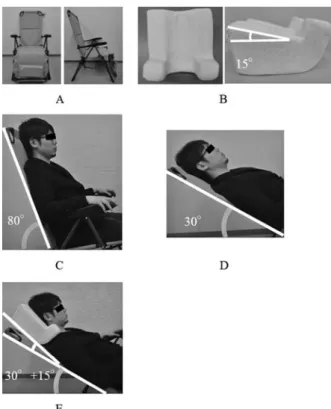
One serving was divided into six equal parts, so that each was approximately 8 g (Fig. 1 B). The eating posture was set to (i) a sitting position (80° ) ; (ii) a reclining position (30° ) by using a folding re­

clining chair and a feeding assistance pillow (Ra­

kuchingokkun, Matsumoto P&O, Aichi, Japan) ; and (iii) a reclining position with 15°cervical an­

teflexion (30°+15° ) (Fig. 2).

Continuous images were recorded in analog for­

Fig. 1 Test foods (A) 10 g of steamed rice, and (B) Process

Lead

chew­swallow­managing food.

(3)

mat for each subject with M-mode ultrasonography.

The images were converted to digital data using an analog-to-digital (A/D) converter, then sampled at one second intervals and connected in chronologi- cal order. Images obtained by connecting each

sliced image were synthesized as a single M-mode image. M-mode can measure elapsed time and dis- tance of the trajectory at an arbitrary point. The tra- jectory of ascending and descending movements of the dorsum of the tongue on the M-mode image was set as the M-mode waveform of tongue move- ments. The time when tongue movement began on the M-mode waveform was set as the start of mastication, and the time when swallowing tongue movement could first be confirmed was set as the end of mastication. We measured the time from the start to end of mastication as the total mastication time (Fig. 3), and measured the initial (mastication immediately after the start of examination), middle (midpoint between the early and late stages), and final (mastication immediately before the onset of swallowing) stages (Fig. 4 A).

B-mode is a basic mode of observation in ultra-

Fig. 2 Eating postures and posture control devices (A) Re- clining chair, (B) Pillow for mealtime management, (C) Sitting position (80° ), (D) Reclining position (30° ), and (E) Reclining position bending the neck 15 degrees forward (30°+15° ).

Fig. 3 Measurement time defined as the period from the start of mastication to the start of the first swallowing.

Fig. 4 Calculations for the difference between the heights of the left and right edges of the tongue

where (A) is an example of an M mode picture, and (B) shows measurements of a B mode picture.

(4)

sonography in which the amplitude in an A-mode image is converted to luminance and displayed. B- mode images at the lowest point on five consecu- tive M-mode waveforms at each stage were ex- tracted from the midline on the B-mode images.

The height to the surface of submaxillary soft tissue was measured from two points on the dorsal side of the tongue, at 15 mm on the left and right sides.

The dorsum of the tongue appeared white on the monitor (Fig. 4 B). The distance in each image was measured using the image measurement software Kinovea ver. 0.8.26 (https : //www.kinovea.org/, Ki- novea Organization, France). The difference be- tween the heights on the left and right sides of the tongue was calculated, and the mean value for each condition during each mastication stage (in- itial, middle, and final) was calculated. The height difference at each mastication stage in each ad- justed posture was also calculated. Statistical

analysis was performed by the Friedman test based on posture adjustment and mastication time. When a significant difference was recognized, the Wil- coxon signed-rank test was performed (α=.05) us- ing SPSS ver. 19.0 (IBM Japan, Tokyo, Japan) for statistical analysis. This study was approved by the Institutional Review Board of Osaka Dental Univer- sity (Approval no.110852).

RESULTS

When eating steamed rice, the height difference between the left and right sides of the tongue at a posture of 80° (position 1) significantly decreased along with the progression of mastication (Fig. 5).

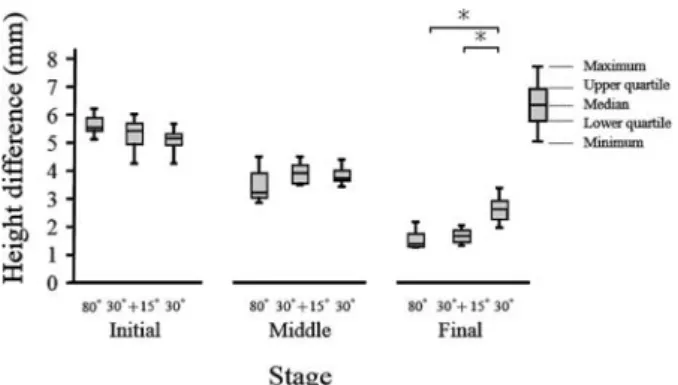
At eating positions of 30° and 30°+15° , the height difference significantly decreased between the in- itial and final stages and the middle and final stages, respectively. However, there was no signifi- cant difference between the initial and middle stages (Figs. 6 and 7). When masticating chew- swallow-managing food, the height difference sig- nificantly decreased with the progression of masti- cation at all postures (Figs. 8-10). In addition, when eating steamed rice, comparison of height differ- ences at each time stage revealed that the final stage was significantly smaller as the posture approached a sitting position (Fig. 11). When masticating chew-swallow-managing food, as with steamed rice, we found that when height differ- ences were compared at each time stage and the three eating positions of 80° , 30° and 30°+15° , at

Fig. 5 Height differences while masticating steamed rice at

a posture of 80° (n=8, *p<0.05). Fig. 6 Height differences while masticating steamed rice at a posture of 30°+15° .

Fig. 7 Height differences while masticating steamed rice at

a posture of 30° .

(5)

the final stage, the height difference disappeared as a sitting position was approached. Similarly, no significant difference was observed at the positions of 80° and 30°+15° (Fig. 12).

DISSCUSION

Experimental Methods

Because tongue movement is influenced by aging and disability,

10

young adults who are unlikely to be affected by aging were selected as subjects in this study. In the future, it will be necessary to include the elderly and young individuals with eating disor- ders or dysphagia as subjects to evaluate the effi- cacy of posture adjustment to counteract deteriora- tion of tongue movement due to aging or disability.

Kakudo et al. reported that with unilateral mastica- tion on the left and right sides, there was no obvi- ous height difference between the two sides.

6

Therefore, in the present study, to alleviate the time limitations of the subjects, unilateral mastication on the right side was specified. In addition, because there were no instructions regarding swallowing during actual eating, the subjects were instructed to freely swallow. In the present study, ultrasonogra- phy, which can measure tongue movements in real time, was selected. There are methods of tongue evaluation by ultrasonography in the sagittal

7

and frontal planes.

6

However, we used the frontal plane to evaluate so-called “first phase transfer” move- ments by which the tongue transfers the bolus from its dorsum to the molar occlusal surface at the time of mastication.

We also attempted to evaluate the influence of posture adjustments on tongue movements during mastication using ultrasonography. Because the test method is not influenced by food, the patient can start with foods that do not tend to cause aspi- ration. Compared with evaluation methods such as VE and VF, ultrasonography enables easy and safe evaluation of tongue movements during mastica- tion. According to the summary of the training method recommended by the Japanese Society of Dysphagia Rehabilitation (2014 version), the angles of posture adjustment during meal assistance are 60° and 30° .

9

Due to time limitations associated with measurement, we used an 80° eating position.

In addition, we set cervical anteflexion, which is considered advantageous for swallowing, to 15° by using a ready-made eating assistance pillow. This

Fig. 8 Height differences while masticating chew-swallow-

managing food at a posture of 80° (n=8, *p<0.05). Fig. 9 Height differences while masticating chew- swallow-managing food at a posture of 30°+15° .

Fig. 10 Height differences while masticating chew-swallow-

managing food at a posture of 30° .

(6)

was done to promote laryngeal elevation and clo- sure by expanding the epiglottic vallecula in re- sponse to a delayed swallowing reflex.

Steamed rice and Process Lead

food were used as test foods. Steamed rice has been previously re- ported to be an appropriate test food for mastica- tory function evaluation.

11

In fact, patients who re- quire posture adjustment during eating do not nec- essarily have a healthy oral cavity. Therefore, we used Process Lead

, which has the physical prop- erties of a jelly-and-paste, in this study. It is mar- keted as a chew-swallow-managing food to be used at a stage when food is upgraded to a diet for which mastication is necessary, for example finely chopped food and pureed food.

12

A previous study that used this food

13

reported direct viewing of the mouth, evaluation by VE, and external evaluation, and included mastication with mandibular move- ment and tongue rotation. In addition, by using a combination of ultrasonography and VF examina- tion during swallowing, it is possible to observe tongue movements during mastication while follow- ing the food bolus at the pharynx.

Tomura et al. reported that, because the tongue carries food from its dorsum to the molar occlusal surface during the initial stage of mastication, it moves in a twisted manner, largely in the direction of the side of mastication.

14

Moreover, compared with the method of calculating tongue pressure used by Kakudo et al., in which the height differ- ence between the left and right sides of the tongue was calculated using ultrasonography, there is no

need to position the inspection device in the oral cavity and no possibility that the test food will stick to the examination device in the oral cavity, thereby affecting measurement values. Furthermore, com- pared with other methods, it is possible to simply measure tongue movements during mastication.

Based on these findings, we selected ultrasonogra- phy as the method for measuring height differences for the assessment of tongue movements.

Experimental Results

Kakudo et al. reported that the use of ultrasonogra- phy to observe height differences in tongue move- ments during mastication over time enables obser- vation of the progression of tongue rotation (first phase transfer) and bolus formation.

6

Regarding the influence of posture adjustment on tongue move- ments, the height difference decreases from the in- itial to the final stage (i.e., from the 30° reclining position to the 80° sitting position). This indicates that, by using ultrasonography, it is possible to evaluate tongue movements during mastication us- ing height differences in the reclining position, as previously reported.

6

In case of chew-swallow-managing food, at any posture, the height difference between the left and right sides of the tongue gradually declined. How- ever, with steamed rice, the height difference gradually decreased at the 80° sitting position. Re- ductions were noted from the initial to the final stage and from the middle stage to the final stage in the 30° and 30°+15° reclining positions. How-

Fig. 11 Height differences while masticating steamed rice showing comparisons for the three postures (n=8, *p<0.05).

Fig. 12 Height differences while masticating chew-swallow-

managing food showing comparisons for the three postures.

(7)

ever, the value did not significantly decrease be- tween the initial and middle stages. chew-swallow- managing food absorbs moisture and is similar to a jelly-and-paste diet, thereby reducing the risk of as- piration. In this study, chew-swallow-managing food absorbed saliva during mastication, such that the tongue may have perceived that mastication was unnecessary, regardless of posture. Moreover, in the 30° reclining position during mastication, steamed rice flowed into the pharynx as a result of gravity. There was a movement to return the steamed rice to the oral cavity, and there was no decrease in height difference between initial and middle stages.

Posture results revealed that the height differ- ence between the left and right sides of the tongue at the end during the reclining position could be at- tributed to the fact that, before completion of masti- cation, the tongue actively prevents early bolus flow into the pharynx due to gravity.

15

Furthermore, at the 30°+15° reclining position with cervical an- teflexion, the height difference became smaller than in the reclining position without cervical anteflexion.

Therefore, pharyngeal influx of the bolus due to gravity before completion of mastication may be ameliorated by cervical anteflexion.

16

The test foods that were used in the present study did not easily cause aspiration in elderly indi- viduals with eating disorders or dysphagia who are living in various facilities, including both nursing homes and home care environments. However, we could not confirm tongue movements during eating.

As reported by Nakagawa et al. and Shibata et al., the chew-swallow-managing food that was used in the present study can be safely used as a paste for the elderly and for those with eating disorders or dysphagia.

12, 17

It can also be used in mastication and swallowing training. It is therefore necessary to further examine elderly individuals and those with eating disorders or dysphagia by using ultra- sonography.

In this study, we set the eating postures to 30° , 30°+15° , and 80° . However, it is necessary to consider 60° as an eating posture. Furthermore, the probe fixation device could not properly be fixed,

which was a limitation of the present study. More- over, because it takes time from measurement to calculation of the height difference between the left and right sides of the tongue, it is necessary to consider a method that allows easy identification within the images.

CONCLUSION

By using ultrasonography, it is possible to evaluate tongue movements during mastication through pos- ture adjustment when eating steamed rice and chew-swallow-managing food. Our results sug- gested that, in a reclining position, tongue move- ments at the final stage of mastication are larger than those in a sitting position. Furthermore, before completion of mastication, pharyngeal influx of the bolus due to gravity may be reduced by cervical anteflexion.

The authors are deeply indebted to all staff of the Depart- ment of Fixed Prosthodontic and Occlusion, Osaka Dental University, and to Otsuka Pharmaceutical, which provided portions of the data. The authors declare no conflicts of in- terest associated with this manuscript. This study was sup- ported in part by Osaka Dental University Research Funds (No.18-06).

REFERENCES

1. Yamada Y. Swallowing. In : Morimoto T, Ninomiya Y, Iawata K, eds. Basic physiology for dental students. Tokyo : Ishiyaku, 2014 : 320.

2. Izue S, Kamakura Y, Kumakura I, Hironaka S, Fujishima I, Matsuo K, Yoshiaki Y, Eichi S, Kouchiro Ueda, eds.

Dysphagia rehabilitation. 3rd ed, Tokyo : Ishiyaku, 2016 : 134-169.

3. Omae Y, Nishiyama K, Ikui Y, Hirose H, eds. Practical swal- lowing endoscopy (VE)−Swallowing medical examination manual seen with animation. Tokyo : Interuna, 2011 : 12.

4. Imai A. A study on the mastication of steamed rice as a test food for the evaluation of masticatory function. J Jpn Prosthodont Soc 1988 ; 42 : 147-156. (Japanese)

5. Nakanishi N, Imai A, Kojima R, Kashiwagi K, Tanaka M, Kawazoe T. Tongue movement during swallowing following mastication J Jpn Soc Stomatognathic Function 2002 ; 8 : 129-130. (Japanese)

6. Kakudo M, Mukai N, Tanaka J, Tanaka M. Ultrasonographic examination of how occlusal support is established by tongue movements during mastication. J Osaka Dent Univ 2015 ; 49 : 1-10.

7. Remijn L, Weijers G, Nijhuis-van der Sanden MW, Groen

BE, de Korte CL. Ultrasound imaging for analyzing lateral

tongue movements during mastication in adults with cere-

bral palsy compared with adults without oral motor disabili-

ties. Ultrasound Med Bio 2015 ; 41 : 1784-1793.

(8)

8. Haraguchi Y, Yamamura C. Influence of the sitting posture including the position of the head and neck on chewing effi- ciency of healthy adults. Rigakuryoho Kagaku 2012 ; 27 : 171-175. (Japanese)

9. Takehara I, Yamamoto H, Takahashi K, Hironaka S, Katsu- mata A, Nito T, Koyama T, Fujiwara Y, Fujishima I, eds.

Summary of training method (2014 version). Jpn J Compr Rehabil Sci 2014 ; 18 : 86-88. (Japanese)

10. Tamine K, Ono T, Hori K, Kondo J, Hamanaka S, Maeda Y.

Age-related changes in tongue pressure during swallowing.

J Dent Res 2010 ; 89 : 1097-1101.

11. Imai A, Kawazoe T, Tanaka M, Iwayama Y, Furuich E. Fun- damental studies on the propriety of steamed rice as a test food for the evaluation of the masticatory function. J Jpn Prosthodont Soc 1997 ; 41 : 856-861. (Japanese)

12. Nakagawa K, Matsuo K, Shibata S, Inamoto Y, Ito Y, Abe, K, Ishibashi N, Fujii W, Saitoh E. Efficacy of a novel training food based on the process model of feeding for mastication and swallowing−A preliminary study in elderly individuals living at a residential facility. Jpn J Compr Rehabil Sci 2014 ; 5 : 72-78.

13. Tohara Y, Kikutani T, Yajima Y, Igarashi H, Tanaka Y, Ta- mura F.An attempt to evaluate masticatory performance us- ing commercially sold masticatory training food. Jpn J Compr Rehabil Sci 2017 ; 21 : 3-10. (Japanese)

14. Tomura Y. Studies on the morphological changes of the tongue movements during mastication by X-ray TV cinema- tography. The observations from the frontal direction. J To- kyo Dental College Society 1980 ; 80 : 33-51. (Japanese) 15. Kogoe C, Saito H. Effect of position on swallowing. J Occu-

pational Therapists 1995 ; 14 : 221-223. (Japanese) 16. Iida Y, Katsumata A, Fujikawa S, Fujishita M, Tanishita K,

Yamashina A. Influence of food texture and postural proce- dures on the sliding of food boluses over the lingual dorsum

−A study of VF simulation using a full-scale model of the oropharyngeal cavity−. Jpn J Compr Rehabil Sci 2009 ; 8 : 215-224.

17. Shibata S, Kagaya H, Tanaka S, Fujii W, Nakagawa K, Mat-

suo K, Abe K, Ishibashi N, Inamoto Y, Saitoh E. Efficacy of

a novel training food based on the process model of feeding

for mastication and swallowing : A study among dysphagia

patients. Jpn J Compr Rehabil Sci 2017 ; 8 : 82-87.

Fig. 1 Test foods (A) 10 g of steamed rice, and (B) Process Lead Ⓡ chew­swallow­managing food.
Fig. 2 Eating postures and posture control devices (A) Re- Re-clining chair, (B) Pillow for mealtime management, (C) Sitting position (80° ), (D) Reclining position (30° ), and (E) Reclining position bending the neck 15 degrees forward (30°+15° ).
Fig. 7 Height differences while masticating steamed rice at a posture of 30°.
Fig. 10 Height differences while masticating chew-swallow- chew-swallow-managing food at a posture of 30°.
+2

参照

関連したドキュメント

Eskandani, “Stability of a mixed additive and cubic functional equation in quasi- Banach spaces,” Journal of Mathematical Analysis and Applications, vol.. Eshaghi Gordji, “Stability

Finally, we give an example to show how the generalized zeta function can be applied to graphs to distinguish non-isomorphic graphs with the same Ihara-Selberg zeta

An easy-to-use procedure is presented for improving the ε-constraint method for computing the efficient frontier of the portfolio selection problem endowed with additional cardinality

It is suggested by our method that most of the quadratic algebras for all St¨ ackel equivalence classes of 3D second order quantum superintegrable systems on conformally flat

Kilbas; Conditions of the existence of a classical solution of a Cauchy type problem for the diffusion equation with the Riemann-Liouville partial derivative, Differential Equations,

It turns out that the symbol which is defined in a probabilistic way coincides with the analytic (in the sense of pseudo-differential operators) symbol for the class of Feller

Then it follows immediately from a suitable version of “Hensel’s Lemma” [cf., e.g., the argument of [4], Lemma 2.1] that S may be obtained, as the notation suggests, as the m A

We give a Dehn–Nielsen type theorem for the homology cobordism group of homol- ogy cylinders by considering its action on the acyclic closure, which was defined by Levine in [12]