A Generic Type System for the Pi-Calculus
Atsushi Igarashi
Department of Graphics and Computer Science Graduate School of Arts and Sciences
University of Tokyo
email:[email protected]
Naoki Kobayashi
Department of Information Science Graduate School of Science
University of Tokyo email:[email protected]
Abstract
We propose a general, powerful framework of type systems for theπ-calculus, and show that we can obtain as its in- stances a variety of type systems guaranteeing non-trivial properties like deadlock-freedom and race-freedom. A key idea is to express types and type environments as abstract processes: We can check various properties of a process by checking the corresponding properties of its type environ- ment. The framework clarifies the essence of recent complex type systems, and it also enables sharing of a large amount of work such as a proof of type preservation, making it easy to develop new type systems.
1 Introduction 1.1 Motivation
Static guarantee of the correctness of concurrent programs is important: Because concurrent programs are more complex than sequential programs (due to non-determinism, dead- lock, etc.), it is hard for programmers to debug concurrent programs or reason about their behavior.
A number of advanced type systems have recently been proposed to analyze various properties of concurrent pro- grams, such as input/output modes [27], multiplicities (how often each channel is used) [17], race conditions [4, 6], dead- lock [14, 18, 30, 38], livelock [16], and information flow [8, 10].
Unfortunately, however, there has been no satisfactorily general framework of type systems for concurrent program- ming languages: Most type systems have been designed in a rather ad hoc manner for guaranteeing certain specific properties. The lack of a general framework kept it difficult to compare, integrate, or extend the existing type systems.
Also, a lot of tasks (such as proving type soundness) had to be repeated for each type system. This situation stands in contrast with that of type systems for functional program- ming languages, where a number of useful analyses (such as side-effect analysis, region inference [36], and exception analysis [3, 26]) can be obtained as instances of the effect analysis [34, 35].
To appear in Proceedings of The 28th Annual ACM SIGPLAN - SIGACT Symposium on Principles of Pro- gramming Languages (POPL 2001).c ACM 2000
The goal of this paper is therefore to establish a gen- eral framework of type systems for concurrent processes, so that various advanced type systems can be derived as its instances. As in many other type systems, we use the π- calculus as a target language: It is simple yet expressive enough to model modern concurrent/distributed program- ming languages.
1.2 Main Ideas
A main idea of the present work is to express types and type environments as abstract processes. So, a type judg- ment Γ⊲ P, which is normally read as “The process P is well-typed under the type environment Γ,” means that the abstract process Γ is a correct abstraction of the processP, in the sense that P satisfies a certain property (like race- freedom and deadlock-freedom) if its abstraction Γ satisfies the corresponding property. (In this sense, our type system may be regarded as a kind of abstract interpretation [2].) We define such a relation Γ⊲ P by using typing rules. Because we use a much simpler process calculus to express type envi- ronments than theπ-calculus, it is easier to check properties of Γ than to check those ofP directly.
To see how type environments can be expressed as abstract processes, let us review the ideas of our pre- vious type systems for deadlock/livelock-freedom [16, 18, 33]. Let x![y1, . . . , yn]. P be a process that sends the tu- ple [y1, . . . , yn] along the channel xand then behaves like P, andx?[y1, . . . , yn]. Q be a process that receives a tuple [z1, . . . , zn] alongx, bindsy1, . . . , yntoz1, . . . , zn, and then behaves like Q. Let us writeP|Qfor a parallel execution of P and Q, and0for inaction. In our previous type sys- tems [18, 33], the processP =x![z]|x?[y]. y![ ]|z?[ ]. z?[ ].0 is roughly typed as follows:
x: [[ ]/O]/(O|I), z: [ ]/(O|I.I)⊲ P
Types of the form [τ1, . . . , τn]/U are channel types: The part [τ1, . . . , τn] means that the channel is used for commu- nicating a tuple of values of types τ1, . . . , τn, and the part U (called a usage) expresses how channels are used for in- put/output. For example, the part O|I.I of the type of z means thatzis used for output (denoted byO) and for two successive inputs (denoted by I.I) in parallel. By focusing on the usage parts, we can view the above type environment as a collection of abstract processes, each of which performs a pair of co-actions I and O on each channel. Indeed, we can reduce the type environment by cancelingIandOof the usage ofxand obtain x: [[ ]/O]/0, z: [ ]/(O|I.I), which is a
type environment of the processz![ ]|z?[ ]. z?[ ].0, obtained by reducingP. By further reducing the type environment, we obtain x: [[ ]/O]/0, z: [ ]/I, which indicates that an in- put on z may remain after P is fully reduced. Based on this idea, we developed type systems for deadlock/livelock- freedom [16, 18, 33].
We push the above “type environments as abstract processes” view further, and express type environments as CCS-like processes (unlike in CCS [22], however, we have no operator for hiding or creating channels). The type environment of the above process P is expressed as x![τ]. z![τ′]|x?[τ].0|z?[τ′]. z?[τ′].0. It represents not only how each channel is used, but also the order of communica- tions on different channels, such as the fact that an out- put on z occurs only after an output on x succeeds (as indicated by the part x![τ]. z![τ′]). The parts enclosed by square brackets abstract the usage of values transmitted through channels. Thanks to this generalization, we can rea- son about not only deadlock-freedom but also other prop- erties such as race conditions within a single framework.
The new type system can also guarantee deadlock-freedom of more processes, such as that of concurrent objects with non-uniform service availability [30, 31].
1.3 Contributions
Contributions of this paper are summarized as follows:
• We develop a general framework of type systems, which we call ageneric type system— just as a generic func- tion is parametrized by types and can be instantiated to functions on various arguments by changing the types, the generic type system is parameterized by a subtyp- ing relation and a consistency condition of types and it can be instantiated to a variety of type systems by changing the subtyping relation and the consistency condition.
• We prove that the general type system satisfies several important properties (such as subject reduction), inde- pendently of a choice of the subtyping relation and the consistency condition. Therefore, there is no need to prove them for each type system.
• We show that a variety of non-trivial type systems (such as those ensuring deadlock-freedom and race- freedom) can indeed be derived as instances of the gen- eral type system, and prove their correctness.
1.4 The Rest of This Paper
Section 2 introduces the syntax and the operational se- mantics of our target process calculus. Section 3 presents our generic type system and shows its properties. As its instances, Section 4 derives a variety of type systems and proves their correctness. To further demonstrate the strength of our framework, Section 5 shows that deadlock and race conditions of concurrent objects can also be ana- lyzed within our generic type system. Section 6 describes preliminary results of our ongoing studies on the power of our generic type system. Section 7 discusses limitations and extensions of our generic type system. Section 8 discusses related work and Section 9 concludes this paper. For the
space restriction, we omit some technical details in this ex- tended abstract. They are found in the full paper [11].1 2 Target Language
2.1 Syntax
Our calculus is basically a subset of the polyadic π- calculus [23]. To state properties of a process, we annotate each input or output operation with a label.
Definition 2.1.1 [processes]: The set of processes is de- fined by the following syntax.
P (processes) ::= 0|G1+· · ·+Gn|(P|Q)
|(νx1, . . . , xn)P| ∗P G(guarded processes)
::=x!t[y1, . . . , yn]. P|x?t[y1, . . . , yn]. P Here,x,y, andzrange over a countably infinite setVarof variables. tranges over a countably infinite setTof labels calledevents. We assume thatVar∩T=∅.
Notation 2.1.2: We write ˜x for a (possibly empty) se- quencex1, . . . , xn, andk˜xkfor the lengthnof the sequence
˜
x. (νx˜1)· · ·(νx˜n)P is abbreviated to (fνx1..n)P or (νx)f P. As usual, ˜yinx?[˜y]. Pand ˜xin (ν˜x)Pare called bound vari- ables. The other variables are called free variables. We as- sume thatα-conversions are implicitly applied so that bound variables are always different from each other and from free variables. The expression [z1/x1, . . . , zn/xn]P, abbreviated to [˜z/˜x]P, denotes a process obtained fromPby replacing all free occurrences ofx1, . . . , xnwithz1, . . . , zn. We often omit the inaction 0 and write x!t[˜y] for x!t[˜y].0. When events are not important, we omit them and just writex![˜y]. P and x?[˜y]. P forx!t[˜y]. P and x?t[˜y]. P respectively. We give a higher precedence to + and (νx) than to˜ |.
The meanings of 0, x!t[˜y]. P, x?t[˜y]. P, and P|Q have already been explained. G1+· · ·+Gn (where G1, . . . , Gn
are input or output processes) denotes an external choice: It behaves like one ofG1, . . . , Gn depending on enabled com- munications. (ν˜x)P creates fresh channels ˜xand then ex- ecutesP.2 ∗P denotes infinitely many copies ofP running in parallel.
2.2 Operational Semantics
As usual [23], we define a reduction semantics by using a structural relation and a reduction relation. For technical convenience, we do not require the structural relation to be symmetric. The reduction relation P −→ Q is annotated with a term of the formxt,t′ orǫt,t′. The term records on which channel and events the reduction is performed: It is used to state properties of a process in Section 4.
Definition 2.2.1: Thestructural preorderis the least re- flexive and transitive relation closed under the rules in Fig- ure 1 (P≡Qdenotes (P Q)∧(QP)).
Definition 2.2.2: The reduction relation −→l is the least relation closed under the rules in Figure 2.
1Available from
http://www.yl.is.s.u-tokyo.ac.jp/~koba/publications.html.
2This is operationally the same as (νx1)· · ·(νxn)P, but we dis- tinguish them in the type system given in Section 3.
P|0≡P (SPCong-Zero) P|Q≡Q|P (SPCong-Commut) P|(Q|R)≡(P|Q)|R (SPCong-Assoc)
∗P ∗P|P (SPCong-Rep)
(νx)˜ P|Q(ν˜x) (P|Q)(if ˜xare not free inQ)
(SPCong-New) P P′ QQ′
P|QP′|Q′ (SPCong-Par) P Q
(ν˜x)P (ν˜x)Q (SPCong-CNew) Figure 1: Structural Preorder
· · ·+x!t[˜z]. P+· · · | · · ·+x?t′[˜y]. Q+· · ·x
t,t′
−→P|[˜z/˜y]Q (R-Com) P−→l Q
P|R−→l Q|R
(R-Par)
Pyt,t
′
−→Q y∈ {˜x}
(ν˜x)P ǫ
t,t′
−→(ν˜x)Q
(R-New1)
P−→l Q (l=ǫt,t′)∨(l=yt,t′∧y6∈ {˜x}) (νx)˜ P−→l (ν˜x)Q
(R-New2) PP′ P′−→l Q′ Q′Q
P−→l Q
(R-SPCong)
Figure 2: Reduction Relation
Notation 2.2.3: We writeP −→QifP−→l Qfor somel.
Notation 2.2.4: When R1,R2 are binary relations on a setS, we writeR∗1 for the reflexive and transitive closure of R1, andR1R2 for the composition ofR1 andR2.
3 Generic Type System 3.1 Types
As explained in Section 1, we extend ordinary type environ- ments and express them as abstract processes. In the rest of this paper, we call themprocess types (or, just types in short). For most of the process constructors introduced in the previous section, there are the corresponding construc- tors for process types. We use the same symbols for them to clarify the correspondence.
Definition 3.1.1 [types]: The sets of tuple types and pro- cess types are defined by the following syntax.
τ (tuple types) ::= (x1, . . . , xn)Γ Γ (process types)
::=0|α|γ1+· · ·+γn|(Γ1|Γ2)|Γ1&Γ2|µα.Γ γ::=x!t[τ].Γ|x?t[τ].Γ|t.Γ
Here, the metavariableαranges over the set of type vari- ables.
Notation 3.1.2: The tuple type (˜x)Γ binds the variables
˜
xin Γ. We assume thatα-conversions are implicitly applied so that bound variables are always different from each other and free variables. In this paper, we restrict the syntax of tuple types so that (˜x)Γ does not contain any free variables or free type variables. (It is possible to remove this restric- tion: See Section 7.) We write [˜y/˜x]Γ for a process type obtained by substituting ˜yfor all free occurrences of ˜xin Γ.
We write∗Γ forµα.(Γ|α). We often omit0and writex!t[τ] and x?t[τ] for x!t[τ].0 and x?t[τ].0 respectively. We also
abbreviatex!t[( )0].Γ andx?t[( )0].Γ tox!t[ ].Γ andx?t[ ].Γ respectively. We assume thatµα.Γ bindsαin Γ. We write [Γ/α] for the capture-avoiding substitution of Γ for α. We write Null(Γ) if Γ does not contain a process type of the form x?t[τ].Γ1 or x!t[τ].Γ1. Whenτ = (˜x)Γ, we call k˜xk the arity ofτ and writekτk.
The tuple type (x1, . . . , xn)Γ is the type of ann-tuple, whose elementsx1, . . . , xnshould be used according to Γ. 0 is the type of the inaction. x!t[τ].Γ is the type of a process that usesxfor sending a tuple of typeτ, and then behaves according to Γ. The output on x must be tagged with t.
Similarly, x?t[τ].Γ is the type of a process that uses xfor receiving a tuple of typeτ, and then behaves according to Γ.
For example, if a process should have typex?t1[ ]. y!t2[ ].0, thenx?t1[ ]. y!t2[ ] is allowed but neithery!t2[ ]. x?t1[ ].0nor x?t1[ ].0|y!t2[ ] is. In this way, we can express more precise information on the usage of channels than previous type sys- tems [17, 18, 27]. t.Γ is the type of a process that behaves according to Γ after some action annotated with t (which is an input or an output action on some channel) occurs.3 Γ1|Γ2 is the type of a process that behaves according to Γ1 and Γ2 in parallel. The type γ1 +· · ·+γn represents an external choice: A process of that type must behave ac- cording to one ofγ1, . . . , γn, depending on the communica- tions provided by the environment. On the other hand, the type Γ1&Γ2 represents an internal choice: A process of that type can behave according to either Γ1 or Γ2, irrespectively of what communications are provided by the environment.
For example, the process typex!t[ ]. y!t′[ ]&y!t′[ ]. x!t[ ] means thatxandycan be used sequentially for output in any or- der; So, bothx!t[ ]. y!t′[ ] andy!t′[ ]. x!t[ ] can have this type.4
3Instead oft.Γ, we could introduce process typest?.Γ andt!.Γ to distinguish between input and output actions. We do not do so in this paper for simplicity.
4So, Γ1&Γ2is similar to an intersection type Γ1∧Γ2. The differ- ence is that a value of type Γ1&Γ2can be usedonly onceaccording to either Γ1or Γ2.
We use the standard notationµα.Γ for recursive types. For example,µα.(x?t[τ]. α) is the type of a process that usesx for receiving a tuple of typeτ repeatedly.
Notice that, unlike the π-calculus processes in Sec- tion 2, the process types contain no operators for creating fresh channels or passing channels through other channels.
Thanks to this, we can check properties of types (as abstract processes) more easily than those of theπ-calculus processes.
Instead, we have some operators that do not have their coun- terparts in processes. A process type of the formt.Γ plays an important role in guaranteeing complex properties like deadlock-freedom. For example, we can express the type of (νx) (x?t1[ ]. y!t2[ ]|y?t3[ ].0) as t1.y!t2[ ]|y?t3[ ], which im- plies that the output onyis not performed until an action labelled witht1 succeeds. Since actually it never succeeds, we know that the input fromyis kept waiting forever.
3.2 Subtyping
We introduce a subtyping relation Γ1 ≤ Γ2, meaning that a process of type Γ1 may behave like that of type Γ2. For example, Γ1&Γ2 ≤ Γ1should hold. The subtyping relation depends on the property we want to guarantee: For example, if we are only concerned with arity-mismatch errors [7, 37], we may identifyt.Γ with Γ, andx!t[τ].Γ withx!t[τ]|Γ, but we cannot do so if we are concerned with more complex properties like deadlock-freedom. Therefore, we state here only necessary conditions that should be satisfied by the subtyping relations of all instances of our type system.
We need some auxiliary operations.
Definition 3.2.1: LetSbe a subset ofVar. Unary opera- tions Γ↓S and Γ↑S on process types are defined by:
0↓S = 0 α↓S = α (x?t[τ].Γ)↓S =
x?t[τ].(Γ↓S) ifx∈S t.(Γ↓S) otherwise (x!t[τ].Γ)↓S =
x!t[τ].(Γ↓S) ifx∈S t.(Γ↓S) otherwise (t.Γ)↓S = t.(Γ↓S)
(γ1+· · ·+γn)↓S = (γ1↓S) +· · ·+ (γn↓S) (Γ1|Γ2)↓S = (Γ1↓S)|(Γ2↓S) (Γ1&Γ2)↓S = (Γ1↓S)&(Γ2↓S)
(µα.Γ)↓S = µα.(Γ↓S) Γ↑S = Γ↓Var\S
Γ↓S extracts from Γ information on the usage of only the channels inS, while Γ↑S extracts information on the usage of the channels not inS.
Example 3.2.2: Let Γ =y?t[τ′]. x!t′[τ′].0. Then Γ↓{x}= t.x!t′[τ].0and Γ↑{x}=y?t[τ].t′.0.
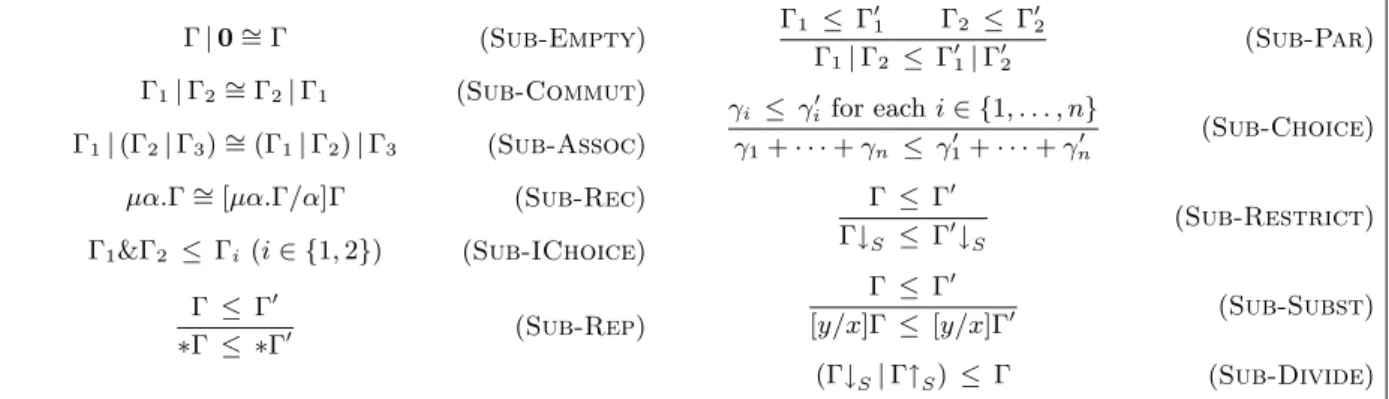
Definition 3.2.3 [subtyping]: A preorder ≤ on process types is a proper subtyping relationif it satisfies the rules given in Figure 3 (Γ1∼= Γ2 denotes Γ1 ≤ Γ2∧Γ2 ≤ Γ1).
In the rest of this paper, we assume that ≤ always de- notes a proper subtyping relation. We extend ≤ to a sub- typing relation on tuple types by: τ1 ≤ τ2 if and only if there exist ˜x,Γ1, and Γ2 such thatτ1 = (˜x)Γ1,τ2 = (˜x)Γ2, and Γ1 ≤Γ2.
The axiom Γ↓S|Γ↑S ≤ Γ allows us to forget in- formation on dependencies between some channels. For example, if Γ = y?t[τ′]. x!t′[τ′].0, then Γ↓{x}|Γ↑{x} = t.x!t′[τ].0|y?t[τ].t′.0 is a subtype of Γ. Notice that Γ↓{x}|Γ↑{x} expresses a more liberal usage ofx, y than Γ:
While Γ means thatxis used for output only afteryis used for input, Γ↓{x}|Γ↑{x}only says that xis used for output aftersomeeventt, not necessarily an input fromy.
3.3 Reduction of Process Types
We want to reason about the behavior of a process by in- specting the behavior of its abstraction, i.e., process type.
We therefore define reduction of process types, so that each reduction step of a process is matched by a reduction step of its process type. For example, the reduction of a process
x?t1[z]. z!t2[ ]|x!t2[y]−→y!t2[ ] is matched by:
x?t1[τ]|x!t3[τ]. y!t2[ ]−→y!t2[ ]
forτ = (z)z!t2[ ]. As is the case for reductions of processes, we annotate each reduction with information on which chan- nel and events are involved in the reduction.
Definition 3.3.1: A reduction relation Γ1
−→L Γ2 on pro- cess types (whereL⊆T∪{xt1,t2 |(x∈Var)∧(t1,t2∈T)}) is the least relation closed under the rules in Figure 4.
We write Γ−→Γ′when Γ−→L Γ′for someL.
3.4 Consistency of Process Types
If a process type is a correct abstraction of a process, we can verify a property of the process by verifying the corre- sponding property of the process type. When a process type satisfies such a property, we say that the process type iscon- sistent. The consistency condition depends on the property we require for processes. So, we state here only necessary conditions that every consistency condition should satisfy.
Consistency conditions for specific instances are given in Section 4.
Definition 3.4.1 [well-formedness]: A process type Γ is well-formed, writtenWF(Γ), if there exist nox,τ1,τ2,t1, t2, Γ1, Γ2, and Γ3 that satisfy the following conditions:
1. Γ−→∗· · ·+x!t1[τ1].Γ1+· · · | · · ·+x?t2[τ2].Γ2+· · · |Γ3. 2. τ1 τ2.
Remark 3.4.2: We could replace the first condition with “Γ contains x!t1[τ1] and x?t2[τ2],” which can be checked more easily. We do not do so, however, to allow maximal flexibility of type systems. Under the above condition, we can allow process types like x?t1[τ1]. x!t2[τ2]|x!t3[τ1]. x?t4[τ2], which allowsxto be used for first communicating a value of typeτ1, and then for com- municating a value of typeτ2.
Definition 3.4.3 [consistency]: A predicate ok on pro- cess types is aproper consistency predicateif it satisfies the following conditions:
Γ|0∼= Γ (Sub-Empty) Γ1|Γ2∼= Γ2|Γ1 (Sub-Commut) Γ1|(Γ2|Γ3)∼= (Γ1|Γ2)|Γ3 (Sub-Assoc) µα.Γ∼= [µα.Γ/α]Γ (Sub-Rec) Γ1&Γ2 ≤ Γi(i∈ {1,2}) (Sub-IChoice)
Γ ≤ Γ′
∗Γ ≤ ∗Γ′ (Sub-Rep)
Γ1 ≤ Γ′1 Γ2 ≤ Γ′2
Γ1|Γ2 ≤ Γ′1|Γ′2
(Sub-Par) γi ≤ γi′for eachi∈ {1, . . . , n}
γ1+· · ·+γn ≤ γ1′+· · ·+γ′n
(Sub-Choice) Γ ≤ Γ′
Γ↓S ≤ Γ′↓S
(Sub-Restrict) Γ ≤ Γ′
[y/x]Γ ≤ [y/x]Γ′ (Sub-Subst) (Γ↓S|Γ↑S) ≤ Γ (Sub-Divide) Figure 3: Necessary Conditions on Subtyping Relation
τ1 ≤ τ2
· · ·+x!t1[τ1].Γ1+· · · | · · ·+x?t2[τ2].Γ2+· · ·{x
t1,t2}
−→ Γ1|Γ2
(TER-Com)
Γ−→∅ Γ (TER-Skip)
· · ·+t.Γ +· · ·−→{t} Γ (TER-Ev)
Γ1 L1
−→Γ′1 Γ2 L2
−→Γ′2 Γ1|Γ2
L1∪L2
−→ Γ′1|Γ′2
(TER-Par) Γ1 ≤ Γ′1 Γ′1
−→L Γ′2 Γ′2 ≤ Γ2
Γ1
−→L Γ2
(TER-Sub)
Figure 4: Reduction of Process Types
1. Ifok(Γ), thenWF(Γ).
2. Ifok(Γ) and Γ−→Γ′, thenok(Γ′).
3. Ifok(Γ1) andNull(Γ2), thenok(Γ1|Γ2)
In the rest of this paper, we assume thatokalways refers to a proper consistency predicate.
Because process types form a much simpler process cal- culus than theπ-calculus, we expect that the predicateok is normally much easier to verify than the corresponding property of a process. The actual procedure to verify ok, however, depends on the definition of the subtyping relation
≤: If we are not interested in linearity information [17], we can introduce the rule Γ|Γ∼= Γ so that the reductions of a process type can be reduced to a finite-state machine. But if we take ≤ to be the least proper subtyping relation, we need to use a more complex system like Petri nets, as is the case for our previous type system for deadlock-freedom [18].
3.5 Typing
A type judgment is of the form Γ⊲P, where Γ is a closed (i.e., containing no free type variables) process type. It means thatP behaves as specified by Γ.
Typing rules are given in Figure 5. The rules (T-Par), (T-Choice), and (T-Rep) say that an abstraction of a pro- cess constructed by using a process constructor |,+, or∗ can be obtained by composing abstractions of its subpro- cesses with the corresponding constructor of process types.
The key rules are (T-Out), (T-In), and (T-New).
Note that channels can be dynamically created and passed through other channels in the process calculus, while in the
calculus of process types, there are no corresponding mech- anisms. So, we must somehow approximate the behavior of a process in those rules.
In the rule (T-Out), we cannot express information that [˜z] is passed through xat the type level. Instead, we put [˜z/˜y]Γ2, which expresses how the channels ˜z are used by a receiver, into the continuation of the output action.
In the rule (T-In), information on how received chan- nels ˜y are used is put into the tuple type (˜y)(Γ↓{˜y}). Be- cause we want to keep only information on the usage of ˜y, we apply ·↓{˜y} to remove information on the usage of the other variables. Information on the usage of the other vari- ables is kept in the continuation Γ↑{y1,...,yn}of the input ac- tion. For example, consider a processx?t1[y]. y?t2[ ]. z!t3[ ].
Its subprocessy?t2[ ]. z!t3[ ] is typed under the process type y?t2[ ]. z!t3[ ].0. By applying (T-In), we obtain the following type judgment:
x?t1[(y)y?t2[ ].t3.0].t2.z!t3[ ].0⊲ x?t1[y]. y?t2[ ]. z!t3[ ] Notice that the parameter type (y)y?t2[ ].t3.0of the channel x carries only information thatsome eventt3 occurs after y is used for input, not that z is used for output. On the other hand, the continuation partt2.z!t3[ ].0says just that z is used for output only after some eventt2 occurs.
In the rule (T-New), we check by the condition ok(Γ↓{˜x}) that ˜xare used in a consistent manner, and forget information on the use of ˜xby·↑{˜x}.
3.6 Properties of the Type System
The general type system given above is parameterized by the subtyping relation ≤ and the consistency predicateok,
0⊲0 (T-Zero) Γ1⊲ P1 Γ2⊲ P2
Γ1|Γ2⊲ P1|P2
(T-Par) Γ⊲ P
∗Γ⊲∗P (T-Rep) Γ′⊲ P Γ ≤ Γ′
Γ⊲ P (T-Sub)
γi⊲ Gifor eachi∈ {1, . . . , n}
γ1+· · ·+γn⊲ G1+· · ·+Gn
(T-Choice) Γ1⊲ P
x!t[(˜y)Γ2].(Γ1|[˜z/˜y]Γ2)⊲ x!t[˜z]. P (T-Out) Γ⊲ P
x?t[(˜y)(Γ↓{˜y})].(Γ↑{˜y})⊲ x?t[˜y]. P (T-In) Γ⊲ P ok(Γ↓{˜x})
Γ↑{˜x}⊲(ν˜x)P (T-New) Figure 5: Typing Rules
which determine the exact properties of each instance of the type system. As we show below, however, several impor- tant properties can be proved independently of a choice of the subtyping relation and the consistency predicate. In particular, we can prove that if Γ⊲ P holds, Γ is a correct abstraction ofP in the sense that P satisfies a certain in- variant property if Γ satisfies the corresponding property (Theorem 3.6.2).
Type Preservation
We define a mappingl# from labels of process reductions to labels of type reductions by: (xt1,t2)# = {xt1,t2} and (ǫt1,t2)#={t1,t2}. The following theorem guarantees that if Γ⊲ P holds, for every reduction ofP, there is a corre- sponding reduction of Γ.
Theorem 3.6.1 [subject reduction]: If Γ⊲ PandP −→l QwithWF(Γ), then there exists Γ′ such that Γ−→l# Γ′and Γ′⊲ Q.
As a corollary, it follows that a process satisfies a certain invariant condition pif the process type of P satisfies the corresponding consistency condition.
Theorem 3.6.2: Supposep(P) holds for any Γ such that Γ⊲ P andok(Γ). If Γ⊲ P and ok(Γ), thenp(Q) holds for everyQsuch thatP−→∗Q.
Proof: By mathematical induction on the length of the reduction sequenceP −→ · · · −→ Q, using Theorem 3.6.1 and the fact thatok is preserved by reduction. ✷ Normalization of Type Derivation
The normal derivation theorem given below is useful for studying a relationship between a process and its process type, and also for developing type-check/reconstruction al- gorithms. We write Γ⊲NP if Γ⊲ P is derivable by using (T-Sub) only immediately before (T-In) or (T-Out).
Theorem 3.6.3 [normal derivation]: If Γ⊲P, then Γ′⊲N
P for some Γ′such that Γ ≤ Γ′.
Proof: This follows from the fact that each application of the rule (T-Sub) above a rule except for (T-In) and (T-
Out) can be permuted downwards. ✷
As a corollary, it follows that if a process is trying to perform an input action, its process type is also trying to perform the corresponding action. (A similar property holds also for output.)
Corollary 3.6.4: If Γ⊲(νxf1..k) (· · ·+y?t[˜z]. P+· · · |Q) and ok(Γ), then the following conditions hold.
1. Ify6∈ {x˜1, . . . ,x˜k}, then Γ ≤ · · ·+y?t[τ].Γ1+· · · |Γ2
for someτ,Γ1, and Γ2.
2. Ify ∈ {x˜1, . . . ,x˜k}, then Γ ≤ · · ·+t.Γ1+· · · |Γ2 for some Γ1 and Γ2.
Conversely, if a process type obtained by normal deriva- tion is trying to perform some action, the process is also trying to perform the corresponding action.
Theorem 3.6.5:
1. If · · · + t.Γ1 + · · · |Γ2 ⊲N P, then P (νxf1..k) (y?t[˜z]. Q|R) or P (fνx1..k) (y!t[˜z]. Q|R), withy∈ {x˜1, . . . ,x˜k}.
2. If · · · + y?t[τ].Γ1 + · · · |Γ2 ⊲N P, then P (νxf1..k) (y?t[˜z]. Q|R) withy6∈ {x˜1, . . . ,x˜k}.
Proof: Trivial by the definition of Γ⊲NP. ✷ Type Check/Reconstruction
By using Theorem 3.6.3, we can also formalize a common part of type-check/reconstruction algorithms: By reading the typing rules in a bottom-up manner, we can develop an algorithm that inputs a process expression and outputs a set of subtype constraints and consistency conditions on process types (see Appendix A). A process is typable if and only if the set of constraints output by the algorithm is satisfiable. Thus, to develop a type-check/reconstruction algorithm for each instance of our type system, it suffices to develop an algorithm to solve constraints on process types.
Such algorithms have already been developed for specific type systems [12, 18].
4 Applications
We show that a variety of type systems — those for arity- mismatch check, race detection, deadlock detection, and static garbage-channel collection — can indeed be obtained
as instances of the generic type system. Thanks to the com- mon properties in Section 3.6, only a small amount of extra work is necessary to define each instance and prove its cor- rectness.
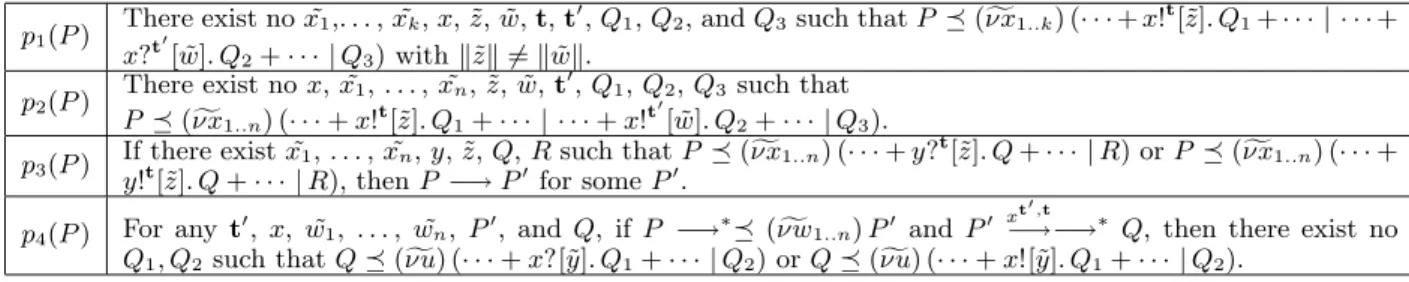
The invariant properties of well-typed processes that the type systems should guarantee are shown in Table 1. The conditionp1(P) means that no arity-mismatch error occurs immediately. (So, ifp1 is an invariant condition, no arity- mismatch error occurs during reduction ofP.) p2(P) means that P is not in a race condition on any output actions annotated with t. p3(P) means that P is not deadlocked on any actions annotated with t in the sense that when- everP is trying to perform an action annotated witht, P can be further reduced. p4(P) means that after a channel has been used for an input action annotated witht, it is no longer used. So, it is safe to deallocate the channel af- ter the action annotated witht. For example, the process (νx) (x!t1[ ]|x!t2[ ]|x?t3[ ]. x?t[ ].0) satisfies this property.
Table 2 shows the consistency condition for each type system. ok2(Γ) means that no race occurs on output actions annotated witht during reductions of the abstract process Γ. ok3(Γ) means that whenever Γ is reduced to a process type trying to perform an action annotated with an event t′less than or equal tot, Γ can be further reduced on some channel or on an event less thant′. (Here, we assume that
≺is some well-founded relation on events, andt4t′means t ≺ t′ or t = t′.) ok4(Γ) means that, after Γ has been reduced on an action involving a channel x and the event t, the reduced process type no longer performs an input or output action on the same channel.
Let ≤ be the least proper subtyping relation. We can prove the following type-soundness theorem for all of the above type systems. By Theorem 3.6.2, it suffices to show that Γ⊲ P andoki(Γ) implypi(P) for eachi, by using The- orems 3.6.3–3.6.5 (see Appendix B.2).
Theorem 4.1: Letok beoki(i∈ {1,2,3,4}). If Γ⊲ P and ok(Γ), thenpi(Q) holds for everyQsuch thatP −→∗Q.
Actually, ≤ can be any proper subtyping relation ex- cept for the casei= 3. Choosing an appropriate subtyping relation for each type system would simplify type-checking or type-reconstruction. For example, in the above type sys- tems, we can identifyt.Γ with Γ by the rulet.Γ∼= Γ, except for the casei= 3. For a naive arity-mismatch check [7, 37], we can ignore the order of communications by introducing rules likex?t[τ].Γ∼=x?t[τ]|Γ.
The following examples indicate that our framework not only subsumes many of the existing type systems but also provides more powerful type systems than them (see also Section 5).
Example 4.2: The processx?[y]. x?[ ].0|x![w]. x![ ] is well typed in the first (i= 1) type system. So, unlike in ear- lier type systems [7, 37] for arity-mismatch check, the same channel can be used for communicating values of different types.5
Example 4.3: The second type system guarantees that the process (νl, x) (l!t0[ ]| ∗l?t1[ ]. x!t[ ]. l!t3[ ]|x?t4[ ].0) is race- free on the channelx. So, unlike the linearπ-calculus [17], our type system can guarantee lack of race conditions even on channels that are used more than once.6
5Yoshida’s type system [38] also allows such use of channels.
6Flanagan and Abadi’s type system [4] also gives such a guarantee.
Because their target calculus has locks as primitives, the problem is a little simpler.
Example 4.4: The third type system rejects the pro- cess P = (νx) (νy) (x?t[ ]. y!t1[ ]|y?t2[ ]. x!t3[ ]). The type of the sub-process x?t[ ]. y!t1[ ]|y?t2[ ]. x!t3[ ] is x?t[ ]. y!t1[ ]|y?t2[ ]. x!t3[ ]. So, in order for P to be well- typed, the following constraints must be satisfied:
ok3(x?t[ ].t1.0|t2.x!t3[ ]) ok3(t.y!t1[ ]|y?t2[ ].t3.0)
The former constraint requires thatt2 ≺t(because the in- put fromxsucceeds only after the eventt2succeeds), while the latter requires thatt≺t2, hence a contradiction.
Remark 4.5: A type environment in a usual type sys- tem corresponds to the equivalence class of a process type with respect to the relation ∼= derived from an appropri- ate subtyping relation. (Recall that Γ1 ∼= Γ2 is defined as Γ1 ≤ Γ2∧Γ2 ≤ Γ1.) For example, the type environment
x: [[ ]/O]/(O|I), z: [ ]/(O|I.I)
given in Section 1 corresponds to the equivalence class of a process type
x!t[(y)y!t[ ]]|x?t[(y)y!t[ ]]|z!t[ ]|z?t[ ]. z?t[ ], with respect to∼= that satisfy the rulesx!t[τ].Γ∼=x!t′[τ].Γ, x?t[τ].Γ∼= x?t′[τ].Γ, t.Γ∼= Γ, and (Γ↓S|Γ↑S) ∼= Γ. The last rule removes information on the order of communica- tions between different channels. A type environment of the linearπ-calculus [17] is obtained by further removing infor- mation on channel usage, by adding the rules x!t[τ].Γ ∼= x!t[τ]|Γ, x?t[τ].Γ∼=x?t[τ]|Γ, and Γ|Γ∼=∗Γ. A type en- vironment of the input-only/output-only channel type sys- tem [27] is obtained by further adding the rule∗Γ∼= Γ.
5 Further Applications: Analysis of Race and Deadlock of Concurrent Objects
The type systems for race- and deadlock-freedom, presented in the last section, are indeed powerful enough to guarantee some useful properties about concurrent objects. In essence, a concurrent object is regarded as a set of processes that provides a collection of services (e.g., methods) [13, 19, 29], just as a sequential object is a set of functions. Clients refer to an object through a record of channels that represent locations of those services. Hence, by giving an appropriate type to the record, we can enforce a certain protocol that clients should respect. Since our type system can capture, in particular, temporal dependency on the utilized services, it is possible to guarantee race-freedom of accesses to methods, studied by Abadi, Flanagan and Freund [4, 6], and deadlock- freedom for objects with non-uniform service availability, studied by Puntigam [30]. Note that, so far, these properties have been discussed only for languages with primitive notion of objects. This section demonstrates how our type system can guarantee these properties.
We first describe race-free accesses to methods. For ex- ample, the following process waits for a request onnewob, and upon receiving a request, creates an object with a lock l, a methodmto print out the string “Hello, ” appended to a given string, and a channelr to receive a reply from the method, and exports its interface [l, m, r] through the reply channelr′.
∗newob? [r′].(νl, m, r) (
l!t′[ ]| ∗m?t′[s]. print!t′[”Hello, ”]. print!t′[s]. r!t′[ ]
|r′![l, m, r])
p1(P) There exist no ˜x1,. . . , ˜xk,x, ˜z, ˜w,t,t′,Q1,Q2, andQ3such thatP (νxf1..k) (· · ·+x!t[˜z]. Q1+· · · | · · ·+ x?t′[ ˜w]. Q2+· · · |Q3) withk˜zk 6=kwk.˜
p2(P) There exist nox, ˜x1, . . . , ˜xn, ˜z, ˜w,t′,Q1,Q2,Q3 such that P (νxf1..n) (· · ·+x!t[˜z]. Q1+· · · | · · ·+x!t′[ ˜w]. Q2+· · · |Q3).
p3(P) If there exist ˜x1, . . . , ˜xn,y, ˜z,Q,Rsuch thatP(νxf1..n) (· · ·+y?t[˜z]. Q+· · · |R) orP(νxf1..n) (· · ·+ y!t[˜z]. Q+· · · |R), thenP−→P′ for someP′.
p4(P) For any t′, x, ˜w1, . . . , ˜wn, P′, and Q, ifP −→∗(νwf1..n)P′ and P′ xt
′,t
−→−→∗ Q, then there exist no Q1, Q2 such thatQ(νu) (· · ·f +x?[˜y]. Q1+· · · |Q2) orQ(νu) (· · ·f +x![˜y]. Q1+· · · |Q2).
Table 1: Properties of Processes ok1(Γ) WF(Γ)
ok2(Γ) WF(Γ), and there exist nox,t′,τ1,τ2, Γ1, Γ2, Γ3such that Γ−→∗· · ·+x!t[τ1].Γ1+· · · | · · ·+x!t′[τ2].Γ2+
· · · |Γ3.
ok3(Γ) WF(Γ), and ift′4t, Γ−→∗Γ′ and Γ′ is· · ·+y?t′[τ].Γ1+· · · |Γ2 or· · ·+y!t′[τ].Γ1+· · · |Γ2 for some y,τ,t′, Γ1, Γ2, then Γ′−→L Γ′′for someLand Γ′′such that (i)L={xt1,t2}or (ii)L={t′′}andt′′≺t′. ok4(Γ) WF(Γ), and for any x,t′, and Γ′, if Γ−→∗x
t′,t
−→ Γ′, then there exist no τ, t′′, Γ1, Γ2 such that Γ′ −→∗
· · ·+x?t′′[τ].Γ1+· · · |Γ2 or Γ′−→∗· · ·+x!t′′[τ].Γ1+· · · |Γ2. Table 2: Consistency Conditions Since the methodmshould not be invoked simultaneously,7
clients should acquire and release the locklbefore and after the invocation ofm, respectively. Indeed by usingok2, it is guaranteed that there are no simultaneous outputs tom:
The exported interface [l, m, r] (through which clients access to the object) can be given a type:
(l, m, r)⋆ l?t′[ ]. m!t[String]. r?t′[ ]. l!t′[ ],
where⋆Γ abbreviatesµα.(0&(Γ|α)), meaning that the tuple can be used according to Γ by arbitrarily many processes.
(Here, we assume that the subtyping relation ≤ satisfies t.Γ∼= Γ.) Then, a client
l?t′[ ]. m!t[”Atsushi”]. r?t′[ ]. l!t′[ ]
|l?t′[ ]. m!t[”Naoki”]. r?t′[ ]. l!t′[ ]
is well typed, but m!t[”Atsushi”]. r?t′[ ].· · · is not. The above type of the interface roughly corresponds to the object type [m:ς(l)String→U nit· {l} ·+] of Abadi and Flana- gan’s type system [4], which means that the methodmcan be invoked only after the lock on the object is acquired.
Similarly, we can express non-uniform service availability in our type system. For example, this is a process that creates a one-place buffer:
∗newbuf? [r].(νput, get, b) (
b![ ]| ∗b?[ ]. put?[x]. get?[r′].(r′![x]|b![ ])
|r![put, get])
Now, two methods putand get are provided but they are available only alternately. By using ok3, we can guaran- tee that invocations of the methodsputand getnever get deadlocked. The interface [put, get] can be given a type:
(put, get)µα.(0&(put!t[τ]| ∞.get!t[(r)r!t[τ]].∞.α)), which says that an output to put must come in paral- lel to or before an output to get. (Here, ∞.Γ abbrevi- atesµα.(Γ&t1.α&· · ·&tn.α) where{t1, . . . ,tn}is the set of
7We do not want an output like “Hello Hello ”.
events occurring in the program. It means that it is allowed to wait for arbitrary events before using the value according to Γ.) Then, both
put!t[v]|(νr)get!t[r]. r?[x].· · · and
put!t[v].(νr)get!t[r]. r?[x].· · ·
are well-typed (and hence never get deadlocked onput! and get!) while (νr′)get!t[r′]. r′?[x]. put!t[v].· · ·is not.
6 Towards a General Type Soundness Theorem
In Section 3.6, we have shown that a process satisfies a cer- tain propertypif its process type satisfies thecorresponding consistency condition ok. However, it was left to the de- signer of a specific type system to find a consistency condi- tion thatcorresponds toa process property of interest and prove that the correspondence is indeed correct. In fact, in Section 4, we had to find a suitable consistency condition on process types and prove its correctness (Theorem 4.1) for each type system. Also, there remains a general ques- tion about the power of our generic type system: What kind of type system can be obtained as an instance? Clearly, not all properties can be verified in our type system: For exam- ple, the property “a process can create at mostnchannels”
cannot be verified, because process types contain no infor- mation on channel creation. This section gives a partial answer to those questions: For a certain class of properties of processes, there is indeed a systematic way for obtain- ing the corresponding consistency condition ok on process types, so that the instantiated type system is sound. For lack of space, details are omitted: They are found in the full paper [11].
We first introduce logical formulas [1, 32] to formally state properties of processes and types.
Definition 6.1: The setPropof formulas is given by the following syntax (i, j denote variables ranging over the set
Natof non-negative integers andndenotes a non-negative integer or a variable ranging overNat):
A ::= tt|x!tn|x?tn|(A|B)| hliA|ev(A)
| ¬A|A∨B| ∃x.A| ∃t.A| ∃i:C.A C ::= {i16=j1, . . . , ik6=jk}
A formula A describes a property of both processes and types. Intuitively, x!tn means that some sub-process is ready to output ann-tuple on the channelx and that the output is tagged with t. Similarly,x?tn means that some sub-process is ready to input ann-tuple. The formulaA|B means that the process is parallel composition of a process satisfyingAand another process satisfyingB. hliA means that the process can be reduced in one step to a process satisfyingAand that the reduction is labelled withl. ev(A) means that the process can be reduced to a process satisfy- ingAin a finite number of steps.8
As a property of processes, the formal semantics [[A]]prof each formula (i.e., the set of processes satisfying the formula) is defined by (Procis the set of processes andF V(A) is the set of free variables inA):9
[[tt]]pr=Proc
[[x!tn]]pr={P |P (νxf1..k) (· · ·+x!t[˜y]. Q+· · · |R), x6∈ {x˜1, . . . ,x˜k},k˜yk=n}
[[x?tn]]pr={P |P (νxf1..k) (· · ·+x?t[˜y]. Q+· · · |R), x6∈ {x˜1, . . . ,x˜k},k˜yk=n}
[[A|B]]pr={P |P (νxf1..k) (Q|R), Q∈[[A]]pr, R∈[[B]]pr,{x˜1, . . . ,x˜k} ∩F V(A|B) =∅}
[[hliA]]pr={P |P −→l Q, Q∈[[A]]pr} [[ev(A)]]pr={P |P −→∗Q, Q∈[[A]]pr}
[[¬A]]pr=Proc\[[A]]pr
· · ·
Similarly, a formula can be regarded also as a property of process types (Typeis the set of process types):
[[tt]]ty=Type
[[x!tn]]ty={Γ|Γ ≤ · · ·+x!t[τ].∆1+· · · |∆2,kτk=n}
[[x?tn]]ty={Γ|Γ ≤ · · ·+x?t[τ].∆1+· · · |∆2,kτk=n}
[[A|B]]ty={Γ|Γ ≤ (∆1|∆2),∆1∈[[A]]ty,∆2∈[[B]]ty} [[hliA]]ty={Γ|Γ−→l# ∆,∆∈[[A]]ty}
[[ev(A)]]ty={Γ|Γ−→∗∆,∆∈[[A]]ty} [[¬A]]ty=Type\[[A]]ty
· · ·
We can show that for any negative formulaAdefined below, a processP satisfies A (i.e.,P ∈[[A]]pr) if its process type Γ satisfies the same formulaA. Our type system is there- fore sound at least for properties described using negative formulas.
Definition 6.2 [positive/negative formulas]: The set F+ (F−, resp.) of positive (negative, resp.) formulas are
8Instead, we could introduce a general fixed-point operator [32].
9Formally, [[A]]pr is parameterized by an assignment of variables to non-negative integers: See the full paper [11].
the least set satisfying the following rules:
tt∈ F+∩ F− x!tn, x?tn∈ F+ A, B∈ F+⇒
A|B, A∨B,hliA,ev(A),∃x.A,∃t.A,∃i:C.A∈ F+ A, B∈ F−⇒A∨B,∃x.A,∃t.A,∃i:C.A∈ F−
A∈ F+⇒ ¬A∈ F− A∈ F−⇒ ¬A∈ F+
Theorem 6.3: Suppose Γ⊲ P andWF(Γ). IfA∈ F−and Γ∈ [[A]]ty, then P ∈ [[A]]pr holds. Conversely, if A ∈ F+ andP ∈[[A]]pr, then Γ∈[[A]]ty holds.
Proof sketch: This follows by induction on the structure of A. The cases for hliA and ev(A) follow from Theo- rem 3.6.1 and the cases forx!tn,x?tn, andA|Bfollow from Theorem 3.6.3 and Corollary 3.6.4. The other cases follow immediately from the definitions of [[A]]pr and [[A]]ty. ✷ Corollary 6.4 [type soundness]: LetA∈ F− andP be a closed process. Suppose that ok(Γ) implies Γ ∈ [[A]]ty. Suppose also that Γ ⊲ P and ok(Γ). Then, if P −→∗ (νx) (νf y)˜ Q, then (νx)f Q∈[[A]]pr.
Intuitively, the last sentence of the above corollary means that all the channels created during reductions of P are used according to A. The corollary implies that, in order to guarantee that property, it suffices to define the consis- tency condition ok by ok(Γ)⇐⇒ WF(Γ)∧inv(A) (where inv(A) =¬ev(¬A)).
The type systems for lack of arity mismatch, race detec- tion, garbage-channel collection discussed in Section 4 can be automatically obtained by using the above corollary: For example, in the case of arity-mismatch check, we can letAbe
¬ev(∃x.∃t,t′.∃i, j:{i6=j}.(x!ti|x?t′j)). In the case of race detection, we can letAbe ¬ev(∃x.∃t′.∃i, j:∅.(x!ti|x!t′j)).
We can also obtain a variant of the linear channel type sys- tem [17]. LetA be¬∃x.∃t1,t2,t3.∃n.ev(hxt1,t2iev(x!t3n∨ x?t3n)); Then it is guaranteed that every channel is used at most once.
Note that our type system is sound also for some non- negative formulas: Indeed, the deadlock-free property is not described as a non-negative formula, but our type system is still sound as proved in Appendix B.2. It is left for future work to identify a larger class of properties for which our type system is sound, and obtain a general type soundness theorem (like Corollary 6.4 above) for that class.
7 Limitations and Extensions
Although a variety of type systems can be obtained as its instances, our generic type system is of course not general enough to obtain all kinds of type systems. There are two major sources of limitations of our type system: One is the way in which processes are abstracted, and the other is the way the consistency conditionok on types is formalized.
Limitations caused by abstraction Because information on channel creation is lost in process types (recall the rule (T- New)), we cannot obtain type systems to guarantee proper- ties like “at mostnchannels are created.” We can overcome that limitation to some extent, by introducing a process type
newk.Γ, which means that the process behaves like Γ after creatingkchannels.
Some information is also lost in the rule (T-In): Because information on the usage of bound channels (expressed by Γ↓{˜y}) is put into the continuation of an output process and that on the usage of free channels (expressed by Γ↑{˜y}) is put into the continuation of the input process, the causal- ity information between communications on bound channels and those on free channels is lost. We can improve the type system by removing the restriction that tuple types can- not contain free variables (Notation 3.1.2) and changing the rule (T-In) into the following rule, to allow an arbitrary de- composition of information on the usage of bound and free channels:
Γ⊲ P Γ1|Γ2 ≤ Γ F V(Γ2)∩ {˜y}=∅ x?t[(˜y)Γ1].Γ2⊲ x?t[˜y]. P
This kind of extension is necessary to account for some exist- ing type systems like Abadi and Flanagan’s type system for race detection [4]. In fact, the analysis of race discussed in Section 5 works only when the lockland the other interfaces m and r are created simultaneously and passed together;
Otherwise, dependencies between the usage of l, m and r are lost. To get rid of such restriction, the above extension of the rule (T-In) and an extension of the rule (T-New) discussed in the next paragraph is necessary.
Limitations caused by the formalization of ok To obtain common properties useful for proving type soundness (in Sections 3.6 and 6), we required that the consistency con- dition ok must be an invariant condition (recall Defini- tion 3.4.3). This requirement is, however, sometimes too strong. For example, suppose that we want to guarantee a property “Before a channelxis used for output,ymust be used for input.” (This kind of requirement arises, for exam- ple, in ensuring safe locking [5].) Note that this property is not an invariant condition: Oncey is used for input,xcan be used immediately. One way to overcome this limitation would be to annotate each channel creation (νx) with the˜ history of reductions, and parameterizeok with the history.
Another limitation comes from the side condition ok(Γ↓{˜x}) of the rule (T-New): Because of the opera- tion ·↓{˜x}, only the causality between simultaneously cre- ated channels can be directly controlled. We can overcome this limitation by parameterizing the condition ok with a set of channels of interest, and replacing ok(Γ↓{˜x}) with ok(Γ,{˜x}).
Other extensions There are many other useful extensions.
Combining our type system with polymorphism, existential types, etc. would be useful. We expect that polymorphism can be introduced in a similar manner to Pierce and San- giorgi’s polymorphicπ-calculus [28].
The type system for deadlock-freedom in Section 4 is ac- tually naive. More special treatment of event tagstis nec- essary to obtain a sophisticated type system for deadlock- freedom [14] (see the full paper [11]).
Besides type-soundness proofs and type inference issues studied in this paper, it would be interesting to formalize other aspects of type systems through our generic type sys- tem. Typed process equivalence would be especially impor- tant, because it is hard even for specific type systems [17, 27, 28].
Another interesting extension is generalization of the tar- get language. If we can replace the π-calculus with a more abstract process calculus like Milner’s action calculi [24], type systems for other process calculi can also be discussed uniformly.
8 Related Work
General framework of type systems Previous proposals of a general framework [9, 20, 21] are (i) so abstract (e.g., [9, 20]) that only a limited amount of work can be shared for developing concrete type systems, and/or (ii) not gen- eral (e.g., [20, 21]) enough to account for recent advanced type systems. Honda’s framework [9] is more abstract than ours. Moreover, his framework only deal with what he call additive systems, where the composability of processes are determined solely by channel-wise compatibility: So, it can- not deal with properties like deadlock-freedom, for which inter-channel dependency is important. On the other hand, his framework can deal with a wide range of process cal- culi as target languages, not only theπ-calculus. In K¨onig’s type system based on hypergraphs [20], type environments do not change during reduction of a process. So, it cannot deal with dynamically changing properties like linearity [17].
Moreover, the target calculus is less expressive than theπ- calculus, our target calculus: It cannot express dynamic cre- ation of channels.
Other type systems viewing types as processes Some pre- vious type systems also use process-like structures to ex- press types. Yoshida’s type system [38] (which guarantees a certain deadlock-freedom property) uses graphs to express the order of communications. Her type system is, however, specialized for a particular property, and the condition cor- responding to our consistency condition seems too strong, even for guaranteeing deadlock-freedom.
Nielson and Nielson [25] also use CCS-like process terms to express the behavior of CML programs. Because their analysis approximates a set of channels by using an abstract channel called a region, it is not suitable for analyses of deadlock-freedom (see [14] for the reason), race detection, linearity analysis, etc, where the identify of a channel is important.
Process-like terms have been used as types also in type systems for deadlock-freedom [30] and related properties [31]
of concurrent objects. As briefly outlined in Section 5, our type system can guarantee such properties without having concurrent objects as primitives.
Abstract interpretation As mentioned in Section 1, our generic type system can be viewed as a kind of abstract interpretation framework [2], in the sense that properties of programs are verified by reasoning about abstract versions of those programs. From this viewpoint, our contribution is a novel formalization of a specific subclass of abstract interpretation for the π-calculus (for which no satisfactory general abstract interpretation framework has been devel- oped to the authors’ knowledge) as a type system. Another novelty seems to be that while conventional abstract inter- pretation often uses a denotational semantics to claim the soundness of an analysis, our type system uses an opera- tional semantics, which seems to be more convenient for analyses of concurrent processes.