MASS SIMULATIONS BASED DESIGN APPROACH AND ITS ENVIRONMENT
Multi-Objective Optimization of Diesel Engine with
Distributed Genetic Algorithm using iSIGHT, MOGADES and HIDECS Satoshi MIYATA*, Keiji KUDO*, Takehiko KATO*,
Tomoyuki HIROYASU†, Mitsunori MIKI†, Jiro KAMIURA†, Hiroyuki HIROYASU††, Masashi UCHIYAMA†††, Mihoko FUKUMOTO†††
* Engineous Japan, Inc., 2-5-5 Shin-Yokohama, Kohoku-ku, Yokohama-shi, Kanagawa, 222-0033, JAPAN
Email: [email protected], Web page: http://www.engineius.co.jp/
†Faculty of Engineering Doushisha University,Kyo-Tanabe,Kyoto,610-0321, JAPAN Email: [email protected], Web page: http://mikilab.doshisha.ac.jp/
††Faculty of Engineering Hiroshima University/ School of Engineering Kinki University, 1 TakayaUmenobe Hiroshima-shi, Hiroshima 739-2116, JAPAN
Email: [email protected]
†††AVL Japan K.K., 2-6 Kanda Suda-cho, Chiyoda-ku, Tokyo 101-0041, JAPAN Email: [email protected], Web page: http://www.avl.com/
Key words: Industrial Applications, Optimization Problems, Parallelization Tools and Environments, Multi Objective Problem(MOP) ,iSIGHT, MOGADES, HIDECS
Abstract.
In this paper, a new design approach is discussed, which makes designer’s decision makings easier and more effective with multi-objective optimization technology. Since proposed approach is based on numbers of simulation run, it is called “mass based” approach.
It enables designer to investigate his problem with wide parameter ranges considering those interactions easily and quickly. First, background of the proposed approach and its software/hardware environment are introduced. Then multi-optimization problem and genetic algorithms are discussed for decision making problem. Finally, engineering application of proposed approach is discussed about optimization of Diesel engine under economical requirement and environmental requirements.
1 INTRODUCTION
Nowadays, computer simulations are perceived as one of standard design tools and many simulation programs have been used in design and manufacturing processes and they are called/recognized as Computer Aided Engineering(CAE). In the past decade, CAE software was run in step-by-step for most of users. In this procedure, a user must check each calculation result at each end of run and make some decisions and predictions that will indicate direction of subsequent simulation runs.
While, since middle of 1990’, some new design methodologies are getting popular, typically, in automotive industry. For example, Design Of Experiment (DOE), Response Surface Model (RSM), Monte-Carlo Simulation (MCS) and many expressive meta-heuristics optimization algorithms, such like Genetic Algorithm (GA), Artificial Neural Net (ANN), Simulated Annealing (SA) and so on. Those new design approaches have been changing user’s stance to CAE from traditional “step-by-step” style to “MASS based” style that runs numbers of CAE calculations all at once and get massive results.
In this paper, Genetic Algorithm based approach is discussed. To clarify its effectiveness, proposed approach is applied to multi-objective optimization problem of Diesel engine.
2 SIMULATION ENVIRONMENTS FOR MASSIVE COMPUTATION
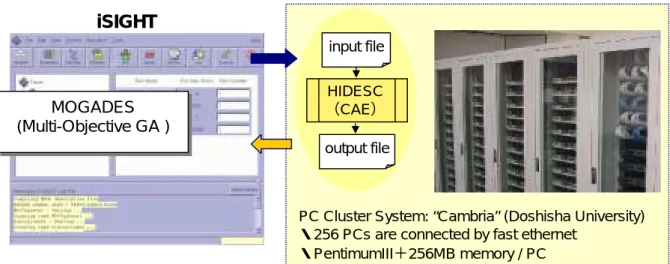
Commercial automation/optimization software iSIGHT[1] is used as fundamental software environment. Since iSIGHT is designed to support multi-level, multi-disciplinary optimization in network distributed environment. It can handle complex engineering problems which consist of hundreds of design parameters and objectives. Also it allows user to add his own optimization algorithms and run it as the same as its built-in optimizer. On iSIGHT, new genetic algorithm that will discussed in section 3.3 runs for deriving information for decision makings. Optimization and CAE simulations are performed on COTS based PC cluster system. Figure 1 shows conceptual image of this system.
iSIGHT
MOGADES (Multi-Objective GA )
HIDESC
(CAE)
input file
output file
PC Cluster System: “Cambria” (Doshisha University)
・256 PCs are connected by fast ethernet
・PentimumIII+256MB memory / PC
Figure 1 Conceptual image of mass simulations based design system
3 MASS SIMULATIONS BASED APROACH WITH GENETIC ALGORITHM 3.1 Numerical Optimization
Numerical optimization is defined as minimizing/maximizing an evaluation measure what is called “objective function” with several design constrains:
where f() is the objective function, gi() and hj() are constrains functions what specifies design constrains. xr
is input variable vector. In actual design investigation, especially in early design stages, it is often difficult that specifying design constrains definitely. If anything designers would rather treat such design constraints as variable condition than as a specific criterion. In this case, the formulation could be modified into:
Design constrains which designer would treat as variable are considered as one of objective functions. This kind of optimization, which consists of multiple objective functions, is called Multi-Objective Problem(MOP).
3.2 MOP
MOPs could be classified into two types. One type is that each objective function can be optimized independently, second type can not be optimized at once, due to potential covariant factors between objectives. Figure 1 illustrates geometric feature of both MOP’s solution.
) ,..., 2 , 1 ( 0 ) (
) ,..., 2 , 1 ( 0 ) ( to
Subject
) ( Maximize /
Minimize
q j
x h
p i
x g
x f
j i
=
=
= r ≤
r
r (1a)
(1b) (1c)
) ,..., 2 , 1 ( 0 ) (
) ,..., 2 , 1 ( 0 ) ( to
Subject
) ( , ), ( ), ( Maximize /
Minimize 1 2 1
n q j
x h
m p i
x g
x f x f x f
j i
n m
−
=
=
−
=
≤
+ +
r r
K r r
r (2a)
(2b) (2c)
MOP TYPE 1 Objective 1
Objective 2
better
better
Optimum
(Complete optimal solution)
Objective Space Objective Space
Pareto optimal solution set (Non-inferior solutions)
Objective 1
Objective 2
better
better
MOP TYPE 2 Figure 2 Geomeric feature of two types of MOP’s solution
The type 1 is just expansion of single objective optimization and there is no special nature coming from multiple objective. So, the type 2 is implicitly assumed as MOP in most cases. In the type 2 MOP, optimal solution is characterized by set of non-inferior solutions. It is called
“Pareto optimal solution set” in general. If just two objectives exist, it is called “Pareto curve”.
On the Pareto optimal solution set, improvement of an objective fi=l()can not be achieved, without degenerating other objectives fi≠l() . So, Pareto optimal solutions satisfy the following condition.
( ( ) ( ( ))) (∀ =1,2,...)
<
¬
i x
f x f
i
Pareto i
I
i r rwhere optimization is assumed as minimization and xr(Pareto)is a Pareto optimal solution.
In general Pareto optimal solution is not only unique but plural solutions, and selecting a specific solution from Pareto solution set depends on users requirement, preference ordering and so on. This means that, in production design, each Pareto solution corresponds to each of design alternatives and the selection corresponds to decision making.
3.3 Parallel Genetic Algorithm: MOGADES
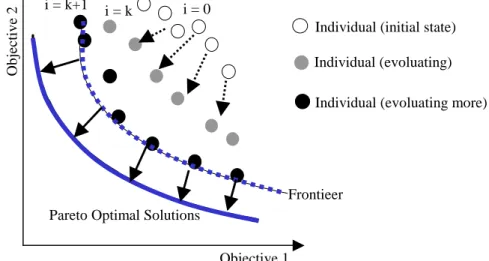
Genetic algorithm (GA) is an optimization algorithm that mimics evolution process of life[2,3]. One of significant features of the algorithm is that multiple search points explore optimal solution simultaneously and independently. This feature is suitable for generating Pareto solution. Figure 3 illustrates GA’s behavior and Pareto Curve. Each searching point are supposed to evolve and move onto potential Pareto solution set asymptotically, and describe a outline of Pareto solution set finally .
Also the multiple search points feature gives high affinity for parallel computation. There are three types of GA, which are categorized by perspective on parallelization: master-slave
(3)
i = k+1 i = k i = 0
Frontieer Pareto Optimal Solutions
Objective 1
Objective 2
Individual (initial state) Individual (evoluating) Individual (evoluating more)
Figure 3 Conceptual image of GA’s convergence behavior and Pareto curve
population model; an island model; a cellular model[4]. Island model GA is also called Distributed GA (DGA). In DGA its population is divided into sub populations and each sub population is assigned to a separated computational resource. Although the same procedure as canonical GA is performed in each island, but some individuals are moved between islands.
This operation is called migration. Proposed parallel GA, Multi-Objective GA with Distributed Environment Scheme (MOGADES), is one of such DGA, besides it have multi- environment feature. In canonical DGA, each island has same genetic parameters(eg.
population size, crossover rate, mutation rate and so on). In MOGADES, each island can has different genetic parameters, which correspond to multi-environment. Multi-environment could encourage diversity of evolution and yields widespread Pareto curve[5].
4 APPRICATION EXAMPLE
4.1 Diesel Engine Combustion Problem and MOP
Because of merit of the durability and fuel efficiency, diesel engine is loaded on from small to large vehicles. Due to increasing environmental concerns and legislated emissions standards, current engine research is focused on simultaneous reduction of Soot and NOx while maintaining reasonable fuel economy[6, 7, 8]. Therefore, these NOx, Soot and fuel consumption become objective functions all at once and proposed approach is applied. Fuel injection control is crucial for better combustion characteristics. Therefore injection characteristics become design parameters in the MOP.
There are some studies that solve such optimization problem[9, 10, 11]. However, these problems are treated as single objective problems.
4.2 CFD for Diesel Engine
Combustion process of Diesel engine is very complicated. At the same time, there are many requirement items for the models such as injection characteristics, spray characteristics, air-fuel mixing, ignition, heat release rate, heat losses, exhaust emissions, and so on.
Numerical models of Diesel combustion are roughly divided into three categories:
thermodynamic model; phenomenological model and detailed multidimensional model. The thermodynamic model only predicts the heat release rate. In the phenomenological model, the prediction of equation, which is derived by the fundamental experiment is used. The detailed multidimensional model predicts several items by solving differential equations with small time steps. In this paper, the HIDECS[12,13,14] which is based on the phenomenological model is used since it can give sufficient information within short time.
4.3 Problem Definition
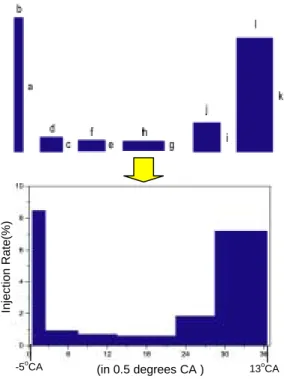
The MOP definition and engine conditions are listed in Table 1, Table2 and Figure 4. In Figure 4, injection profile is defined by conformity of six rectangle shapes, and changes of each height and width of rectangles vary the profile.
Objective (Minimized)
SFC(Specific Fuel
Comsumption), NOx, SMOKE Design
Variable
12 parameters: a, b, c, d, e, f, g, h, i, j, k, l, which define injection profile. (see fig.3) Constrains Nothing
Table 1 MOP definition
Bore 102mm Stroke 105mm Engine Speed 17 Compression Ratio 1800rpm Nozzle Hole Daimeter 0.2mm
Nozzle Hole Number 4
Injected Fuel Volume 40.0mg/st Injection Timing -5ATDC deg.
Injection Duration 18deg.
Table 2 Specification of assumed engine
4.4 Massive Results form Multi-Objective GA
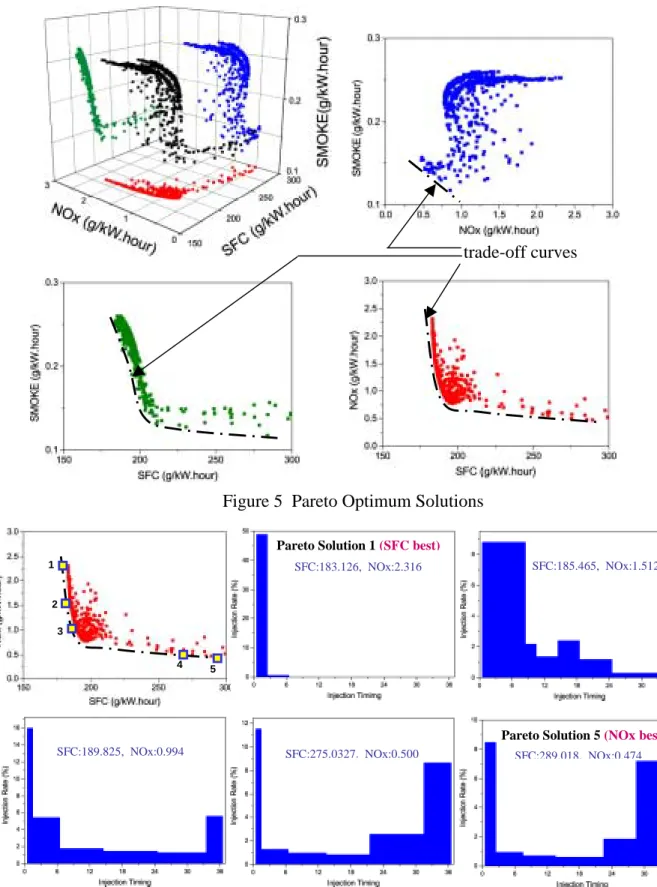
Figure 5 shows derived Pareto optimal solutions from MOGADES in three objective space and projection onto two objective spaces. As discussed in section3.2, each Pareto solution corresponds to design alternatives and whole solutions depict a kind of trade-off curve between two objectives. So, once the Pareto solution set obtained, user can perform trade-off study, such like trial of compromise and improvement regarding to SFC, NOx and SMOKE, which are mutually dependent, quickly and easily. Figure 6 shows such an example. Result of trials improving NOx with compromising SFC and related injection profile changes are figured. User can see easily how much SFC compromise would be necessary in order to get requested mount of NOx reduction through those figures. Also injection feature that characterize good SFC and NOx can be observed.
5 CONCLUSIONS
Mass simulations based design approach with Multi-objective GA is proposed. Multi- objective GA is one of suitable approaches to produce Pareto optimal solutions that enables user to perform trade-off study under complex conditions. Once such Pareto solutions are obtained, user can perform broad range of design investigations based on the massive results within short time. Investigations with wide parameter ranges considering those interactions are available, not only local parameter studies excluding mutual effects in the past “step-by- step” style CAE works. Massive approaches supports designer’s better decisions and choices.
-5oCA (in 0.5 degrees CA ) 13oCA
Injection Rate(%)
Figure 4 Design Variable and injection
Figure 5 Pareto Optimum Solutions
trade-off curves
1
2 3
4 5
Pareto Solution 2
Pareto Solution 3 Pareto Solution 4
Pareto Solution 1 (SFC best)
Pareto Solution 5 (NOx best) SFC:183.126, NOx:2.316 SFC:185.465, NOx:1.512
SFC:189.825, NOx:0.994 SFC:275.0327, NOx:0.500 SFC:289.018, NOx:0.474
REFERENCES
[1] www.engineous.com
[2] C.M.Fonseca and P.J.Fleming, Genetic algorithms for multiobjective optimization:
Formulation, discussion and generalization.In Proceedings of the 5th international coference on genetic algorithms pp.416 ‐423,1993.
[3] D.E.Goldberg, Genetic Algorithms in search, optimization and machine learning Addison-Wesly,1989.
[4] E.Cantu-Paz, A survey of parallel genetic algorithms.Calculateurs Paralleles Vol.10, No.2,1998.
[5] Jiro KAMIURA, Tomoyuki HIROYASU, Mitsunori MIKI,Shinya WATANABE, MOGADES: Multi-Objective Genetic Algorithm with Distributed Environment Scheme, Second International workshop on Intelligent Systems Design and Applications, 07-08 August 2002, Atranta, US, (Submitting)
[6] Walsh, M. P., ”Global Trends in Diesel Emissions Regulation-A 2001 Up Date”, SAE Paper 2001-01-0183, 2001.
[7] Johnson, T. V., ”Diesel Emission Control in Review”, SAE Paper 2001-01-0184, 2001.
[8] Moser, F. X., Sams, T. and Cartellieri, W., ”Impact of Future Exhaust Gas Emission Legislation on the Heavy Duty Truck Engine”, SAE Paper 2001-01-0186, 2001.
[9] Senecal, P. K. and Reitz, R. D., ”Optimization of Diesel Engine Emissions and Fuel Efficiency using Genetic Algorithms and Computational Fluid Dynamics”, Eighth ICLASS, Pasadena, CA., July 2000.
[10] Senecal, P. K. and Reitz, R. D. ”A Methodology for Engine Design Using Melti- Dimensional Modelling and Genetic Algorithms with Validation through Experiments”, International J. of Engine Reseach, vol.1, No.3, pp.229-248, I MechE, 2000.
[11] Senecal, P. K., Pomraning, E. and Richards, K.J., ”Multi-Mode Genetic Algorithm Optimization of Combustion Chamber Geometry for Low Emissions”, SAE Paper 2002-01- 0958, 2002.
[12] Hiroyasu,H., ”Diesel Engine Combustion and its Modeling”, International Symposium on Diagnostics and Modeling of Combustion in Reciprocating Engines. Pp.53-75, 1985.
[13] Imanishi, H. Yoshizaki, T and Hiroyasu, H., ”Simulation Study of Effects of Injection Rate Profile and Air Entrainment Characteristics on D.I. Diesel Engine”, SAE Paper 962059, 1996.
[14] Long, Y. S., Gakumazawa, H. and Hiroyasu, H., ”The Simulation of the Distribution of Temperature and Mass of Liquid and Vapor Fuels, and the Wall Impinging Spray Pattern in a Diesel Combustion Chamber”, SAE Paper 2000-01-1887, 2000.
[15] T. Hiroyasu, M.Miki, J.Kamiura, S.Watanabe, H.Hiroyasu, “Multi-Objective Optimization of Diesel Engine Emissions and Fuel Economy using Genetic Algorithms and Phenomenological Model”, Powertrain & Fluid Systems Conference & Exhibition, SAE, October 21-24, 2002, (Submitting)