F E A T U R E
LARVAL TRANSPORT AND COASTAL UPWELLING: AN APPLICATION OF HF RADAR IN ECOLOGICAL RESEARCH
By Eric Bjorkstedt and Jonathan Roughgarden
H igh-frequency (HF) radar is a recent ad- dition to ecologists' remote sensing tool- b o x . . .
F O R MANY MARINE FISH and invertebrate species, near-surface currents strongly affect the likelihood of surviving as a planktonic larva and arriving at a suitable location, say, a rocky coastline, a kelp for- est, or an estuary, to begin life as a juvenile or adult (i.e., to "recruit" to a population). High-frequency (HF) radar is a recent addition to ecologists' remote sensing toolbox that offers the ability to observe oceanographic processes directly affecting larval ecology at scales appropriate for understanding re- cruitment dynamics in marine populations.
In this article, we report on our application o f HF radar in research focusing on larval ecology at coastal u p w e l l i n g fronts o f f central California.
Coastal u p w e l l i n g regions, such as that o f f the western United States, pose an interesting set of ecological questions that can be addressed with data f r o m HF radar. D u r i n g active coastal up- welling, the same currents supplying nutrients that support high productivity put planktonic larvae at risk of being swept o f f s h o r e and a w a y f r o m coastal habitats. Indeed, some fish and invertebrate populations exhibit reduced recruitment success during periods o f i n c r e a s e d o f f s h o r e a d v e c t i o n (Bailey, 1981; Roughgarden et al., 1988). Coastal upwelling fronts, which f o r m between cold up- welled water near the coast and warmer, fresher surface waters offshore, m a y reduce o f f s h o r e transport of planktonic larvae, thereby facilitating nearshore retention and return of larvae to coastal recruitment sites. To test this hypothesis and to as- sess the utility of HF radar as an ecological tool, we sampled zooplankton along transects spanning coastal upwelling fronts, monitored recruitment to intertidal barnacle p o p u l a t i o n s during the up- welling seasons of 1993 and 1994, and compared our data to coincident HF radar observations.
We used radial data obtained from a single Sea- Sonde HF radar deployed at Granite Canyon, CA
Eric P. Bjorkstedt. Department of Biological Sciences.
Stanford University. Stanford, CA 94305: Jonathan Roughgar- den, Department of Biological Sciences and Department of Geophysics. Stanford University, Stanford, CA 94305, USA.
(36°25.9'N, 121 °55.0'W). Before calculating cur- rents, we 1) discarded radial vectors with a stan- dard error to mean ratio >0.1 to ensure data qual- ity, 2) used simple linear interpolation first to fill spatial gaps of <90 ° within a range bin and then to fill temporal gaps of <24 h in observations in each observation cell. and 3) applied a low-pass filter (PL64) to remove tidal and other high-frequency signals. Under the assumption that the current is uniform across two observation cells, we calculated currents from pairs of radial observations; each re- sult represented the uniform current that would yield both radial currents used in its calculation.
Using a single radar presents a t r a d e o f f be- tween greater spatial resolution (and the increasing likelihood that the current is indeed similar at 2 points closely arranged in space) and the difficul- ties associated with the "baseline problem" of de- termining currents from nearly parallel observa- tions. The baseline p r o b l e m is e x a c e r b a t e d by violations of the assumption that flow is uniform across neighboring observation cells. We screened our results for clear cases where this o c c u r r e d : currents were discarded and replaced by interpola- tion if either 1) they were >150 cm s-' and within 5 ° of perpendicular to the radial vectors used in the calculation or 2) they differed from neighbor- ing vectors by a Euclidean distance >30 cm s '.
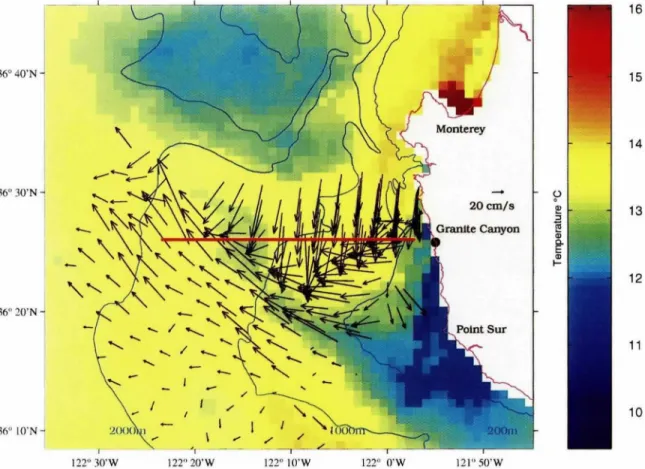
Figure 1 illustrates an example of the resulting low-frequency current field and a coincident satel- lite Advanced Very High Resolution Radiometer (AVHRR) image of sea-surface temperature. Pat- terns in the current field generally coincide with thermal structures. For example, the strong current jet flowing offshore west of Point Sur corresponds directly to the tongue of cool water visible in the A V H R R image. The frontal zone between the cool tongue and warmer water to the north is clearly re- solved in the current field as a sharp transition be- tween equatorward flow and the current jet. The southwestern front apparent in the satellite image appears as a transition to weaker currents in the w a r m e r water mass. T e m p o r a l series o f images demonstrate consistent spatial correlation between HF radar and satellite observations.
64 OCEANOGRAPHY°Vo1. 10, NO. 2°1997
. . . . J
36 ° 4 0 ' N "~
36 ° 3 0 ' N -~
E
36 ° 20"N -'
36 ° 1 0 ' N "
v.
1
\ , , ,
i
f \ " / I . . . 7 . . . L . . . T " " ~ - - - I . . .
122 ° 30"W 122" 2 0 ' W 122 ° IO'W 122 ° O'W 121" 5 0 ' W
16
15
14
13
12
11
10
Fig. 1: Surface currents f r o m detided radial data obtained with a single SeaSonde located at Granite Canyon, CA, and satellite AVHRR image of SST f o r 1700 PST 15 July 1993. Horizontal line shows loca- tion of transect data in Figures 2 and 3.
To compare HF radar observations to zoo- plankton distributions, we calculated divergence from low-frequency surface currents obtained from the SeaSonde data. Convergence zones, marked by negative divergence values, may accu- mulate buoyant or surface-oriented plankton. Fig- ures 2 and 3 show typical distributions of barnacle and fish larvae, respectively, in relation to diver- gence and SST. Barnacle larvae are generally bounded inshore of divergences, or accumulate at convergent fronts. Larval fish (mostly rockfish Se- bastes spp., a coastal group) are most abundant in convergence zones associated with temperature fronts. Fish larvae were sampled from a broader depth range than barnacles (upper 27-37 m and 1 m of the water column, respectively), and distribu- tions of fish larvae across upwelling fronts were observed to follow the slope of the pycnocline.
Slight seaward offsets of peak abundances of fish larvae relative to convergent fronts in the ocean surface may therefore occur, but remain consistent with nearshore retention of larvae by the front.
Observations like those described above repre- sent "snapshots" integrating spawning location, timing and intensity, larval survival, and transport processes. Measuring actual larval transport re- quires time series of such observations. Figure 4 shows a time series of settlement by competent
barnacle larvae to rocks in the upper intertidal zone at a site 15 km north of the radar site in Granite Canyon in relation to surface currents for a period spanning the sole large recruitment pulse of the 1994 upwelling season. In a sense, rather than tracking a patch of larvae with a ship, we use the rocks along the coast to sample temporal vari-
August 1 9 9 3
b).
~. 3 0 o 2 0
~ Z 1 0 v
O
¢)" 15
~ 14 1 3
,ll,ldlll
M a y 1 9 9 4 J u n e 1 9 9 4
10 =*
5 e o o N I
-i 1° l o ;;;;'.-,-.-'-'-" .... I
- 1 0 - 2 0
2oo J T I,II,
1 5 0 5O
1 8 8 I
5 0 2 5
0 - = " 0 I J | l J • _
, 1051 ....
I 9.°
1 0 j . . . . 8.5
3'0 2'0 1'0 o 40 30 20 lO o io 1'o
D i s t a n c e O f f s h o r e ( k i n )
Fig. 2: Distribution o f intertidal barnacle larvae in relation to divergence and SST f o r 11 August 1993, 4 May 1994, and 26 June 1994. Barnacle lar- vae were sampled in the upper meter of the water column. For each cruise (a) divergence calculated at each sampling station, (b) abundance of barna- cle larvae, and (c) SST.
OCEANOGRAPHY'Vo]. 10, NO. 2 " 1 9 9 7 65
H F radar measures currents affecting ecological processes at important spatial and temporal . . , s c a l e s . . .
b).
500 I
~ 2~o
0 "
c).
14 t
~ 13
A u g u s t 1 9 9 3
10 .
. . . ~ -o - o - ° - _ _ _
M a y 1 9 9 4 J u n e 1 9 9 4
o " . . . . . . .
~-:- , : - : - ~ - , - . . . -- .
• o o ° °
-~o I • •
,.,,,llll,..,,,n,,,,,,.I, ..,I ,,
3'0 2'0 1'o o
4ooj
oool
"I
13
12
I u
4'0 3'0 20 10
200 t 150
lOO
50
O "
l 0
9
O 20 1'0 0
D i s t a n c e O f f s h o r e ( k i n )
Fig. 3: Distribution offish larvae in relation to divergence and SST f o r 11-12 August 1993, 4 - 5 May 1994, and 26-27 June 1994. Fish larvae were sampled in the upper 27 meters of the water column (upper 37 meters in May 1994). For each cruise: (a) divergence calculated at each sampling station, (b) abun- dance offish larvae, and (c) SST. Note: In the divergence plot for May 1994, divergence ( X8) is replotted with ( 0 ) at offshore stations to highlight convergence zone associated with an old upwelling front.
ation in larval abundance at a given location. Dur- ing typical upwelling conditions (i.e., surface cur- rents flowing to the south and offshore), recruit- ment is low (Fig. 4, a and b). The onset of the recruitment pulse, presumably because of the re- turn of larvae to the coastal habitat (Farrell et al., 1991), coincided with a rapid transition to onshore currents in response to a strong relaxation in the winds that drive coastal upwelling (Fig. 4, a and c). After northwesterly winds intensified, typical upwelling currents resumed and recruitment rates fell to low levels (Fig. 4, a and d).
The plankton surveys and recruitment time se- ries provide support for hypotheses that 1) conver- gence at fronts contributes to accumulation of plankton, 2) coastal upwelling fronts facilitate nearshore retention of coastal larvae, and 3) cessa- tion of upwelling and subsequent shoreward trans- port of larvae during wind relaxation events is an important m e c h a n i s m causing recruitment in coastal invertebrate populations (Roughgarden et al., 1988; Farrell et al., 1991).
Fig. 4: Recruitment of barnacle larvae to adult populations in the rocky intertidal zone in relation to changes in surface currents during upwelling relaxation. (a) Recruitment of intertidal barnacles to settlement plates affixed in the rocky intertidal zone at Asilomar ( " A B " in Farrell et al., 1991) f r o m 22 April to 29 June 1994. Arrows indicate times of H F radar current maps described below.
(b--d) Surface current maps for 1600 PST 4 May, 1600 P S T 7 May, and 1600 P S T 11 M a y 1994.
The vector on land has a length representing a 50 cm s -~ flow.
t
Just as importantly, the examples above demonstrate the potential of HF radar as a remote sensing technology enabling researchers to moni- tor and predict the location and transport of plank- tonic larvae. HF radar measures currents affecting ecological processes at important spatial (1-100 km) and temporal (hourly-weekly) scales and cap- tures front-scale variability that is absent in larger scale metrics of upwelling intensity (i.e., the
~).
b).
c).
d)
J u l i a n D a t e ~ 1 9 9 4
l l O 120 130 140 150
1 2 - t i i i
,% .
~ Z 0.
36.5
36.4
33,3
36.5 -
36.4
33.3
36.5
"~ 36.4
33.3"
160
11 ,~ i j
~ J
l r a n i t e Z a n y o n
P o i n t S u r q
p f f ? -,
' ]~ ? ? l ~ ~ G r a n i t e
2 ? ? 2 ~ ~ a n y o n
4 ;~
122.5 122.4 122.3 122.2 122,1 122,0 121.9
L o n g i t u d e
66 OCEANOGRAPHY.Vo]. 10, No. 2ol997
Bakun index). Thus HF radar can support detailed field research and modeling (e.g., Alexander and Roughgarden, 1996) linking upwelling intensity and front structure to marine population dynamics.
Such efforts have clear applications in research ef- forts toward predicting the population dynamics of commercially exploited species and designing ef- fective marine reserves.
Acknowledgments
We thank J e f f Paduan and Hans G r a b e r for the o p p o r t u n i t y to contribute to this issue and J e f f Paduan for p r e p a r i n g Figure 1. Brian G r a n t h a m and Y e h o s h u a Shkedy assisted with shipboard plankton sampling. Leslie Rosenfeld p r o v i d e d p h y s i c a l o c e a n o g r a p h i c data for the cruises and the PL64 filter. Y e h o s h u a Shkedy c o l l e c t e d the b a r n a c l e r e c r u i t m e n t data. We thank the captains and crew of the R/V P o i n t S u r
for their valuable assistance during the sampling cruises. This research has been funded by grants N A G W - 2 1 5 9 f r o m N A S A and O C E - 91 15876 from the NSF. E.B. was supported by an N.S.F.
Graduate Research Fellowship.
References
Alexander, S.E. and J. Roughgarden, 1996: Larval transport and population dynamics of intertidal barnacles: a cou- pled benthic/oceanic model. Ecol. Monogr.. 66, 259- 275,
Bailey, M.. 1981: Larval transport and recruitment of Pacific Hake Merhtccius productus. Mar. Ecol. Prog. Set. 6,
1-9,
FarreI1. T.M., D. Bracher and J. Roughgarden, 1991: Cross- shelf transport causes recruitment to intertidal popula- tions in central California. Limnol. Oceanogr.. 36. 279- 288.
Roughgarden, J., S. Gaines and H. Possingham, 1988: Recruit- ment dynamics in complex life cycles. Science. 241,
1460-1466. rl
Oceanographic Consortium Selected as Program Office for National Oceanographic Partnership Program
The Consortium for Oceanographic Research and Education (CORE) has been selected for a
$711,094 contract to become the Program Office for the National Oceanographic Partnership Pro- gram (NOPP). The selection was made by a team representing ten Federal agencies (Office of Naval Research, Oceanographer of the Navy, National Science Foundation, National Oceanic and Atmospheric Administration, National Aeronautics and Space Administration, Minerals Manage- ment Service, US Geological Survey, Defense Advanced Research Projects Agency, Department of Energy, and the Environmental Protection Agency).
The primary objectives of NOPP are to promote the national goals of assuring national security, ad- vancing economic development, protecting quality of life, and strengthening science education and communication through improved knowledge of the oceans. NOPP includes $20.5M of appropria- tions for research and educational activities in oceanography awarded recently on a competitive basis, and it establishes the National Oceanographic Research Leadership Council (NORLC), a high-level group, chaired by the Secretary of the Navy and the Administrator of NOAA (vice- chair). NOPP was introduced in the US Congress as part of the National Oceanographic Partnership Act by Representative Curt Weldon (R-PA), Chair of the Military Research and Development Sub- committee of the House National Security Committee. With the signature of the Fiscal Year 1997 Defense Authorization by President Clinton last fall, NOPP was initiated.
CORE will begin serving as the Program Office for the National Oceanographic Partnership Pro- gram on 14 July. As Program Office, CORE will be responsible for providing technical and admin- istrative support to the NORLC, including assistance in preparation of the legislatively mandated annual report to Congress on the status and plans of the NOPP.
CORE is the Washington, DC based association of U.S. oceanographic research and educational in- stitutions, universities, laboratories and aquaria. The 48 CORE members represent the nucleus of U.S. research and education in the ocean. CORE's President, ADM James D. Watkins, USN (Ret), previously served as Chief of Naval Operations and as Secretary of Energy.
Media contact: Dr. Richard W. Spinrad, Director, CORE Phone: (202) 232-3900 x219
E-mail: [email protected]
OCEANOGRAPHY*Vo1. 10. NO. 2-1997 67