PAPER
Special Section on Foundations of Computer Science — Algorithm, Theory of Computation, and their Applications —The Explicit Formula of the Presumed Optimal Recurrence Relation for the Star Tower of Hanoi
Akihiro MATSUURA†a),Member andYoshiaki SHOJI†,Nonmember
SUMMARY In this paper, we show the explicit formula of the recur- rence relation for the Tower of Hanoi on the star graph with four vertices, where the perfect tower of disks on a leaf vertex is transferred to the cen- tral vertex. This gives the solution to the problem posed at the 17th Inter- national Conference on Fibonacci Numbers and Their Applications[11].
Then, the recurrence relation are generalized to include the ones for the original 4-peg Tower of Hanoi and the Star Tower of Hanoi of transferring the tower from a leaf to another.
key words: Tower of Hanoi, four pegs, star graph, Frame-Stewart algo- rithm, recurrence relation
1. Introduction
The Tower of Hanoi puzzle was invented by French math- ematician E. Lucas in 1883[15]. The original puzzle has 3 pegs with a tower ofndisks of different sizes initially piled on one peg in decreasing order from the bottom. The pur- pose of the puzzle is to transfer all the disks from the initial peg to the other in the minimum number of steps, under the condition that at each step one of the topmost disks is trans- ferred to another peg not to put a disk on a smaller one. This simple mathematical puzzle was then extended to use 4 pegs by Dudeney in 1907 and was called the Reve’s puzzle[7].
The original three-peg puzzle is easily solved, but some- what surprisingly, any algorithm for the Reve’s puzzle was not shown to be optimal for more than 100 years. For the general Tower of Hanoi usingk(≥ 4) pegs, Frame[8] and Stewart[18] independently presented recursive algorithms that produce the same number of steps for transferring n disks; thus, they are generically called theFrame-Stewart algorithm. Whenk=4, it uses the following procedure:
1. transfer the topmostn−mdisks of the initial peg to an intermediate peg using 4 pegs;
2. transfer the largermdisks from the initial peg to the final (destination) peg using 3 pegs;
3. finally, transfer then−mdisks from the intermediate peg to the final peg using 4 pegs.
The algorithm chooses the integerm(0<m≤n) such that the total number of steps of the above procedure is mini- mized. LetH(n) be the number of steps for transferring the
Manuscript received April 3, 2018.
Manuscript revised July 27, 2018.
Manuscript publicized October 30, 2018.
†The authors are with Tokyo Denki University, Saitama-ken, 350–0394 Japan.
a) E-mail: [email protected] DOI: 10.1587/transinf.2018FCP0013
ndisks. Then,H(n) satisfies the following recurrence rela- tion: H(0)=0 and forn≥1,
H(n)= min
0<m≤n{2·H(n−m)+2m−1}. (1) The explicit formula ofH(n) and its various properties have been obtained[12]–[14]. Since the values of H(n)’s (and those for general kpegs) are optimal at least by computer search, it had been believed to be optimal and was called the Frame-Stewart conjecture. As for the lower bounds, there had been little progress until Szegedy gave non-trivial lower bounds[20]. Then, there had been further improvement[6], [9]. Recently, Bousch[3]finally proved the Frame-Stewart conjecture for the case of 4 pegs in the affirmative way, that is, the solution of the Frame-Stewart algorithm is optimal for the case of 4 pegs.
Along with the original Tower of Hanoi, there is a Tower of Hanoi variant that limits the pairs of pegs to be used for transferring disks. The problem can be regarded as the Tower of Hanoi on graphs, by assigning each of the pegs to a different vertex and allowing the transfer of disks only when there is an edge between the pair of vertices.
This variant has been studied for both undirected and di- rected graphs. For example, the original Tower of Hanoi withk(≥ 3) pegs is regarded as the problem on the com- plete graphs withkvertices. The Tower of Hanoi on graphs have been studied on cyclic graphs, path graphs, star graphs, etc.[1],[2],[5],[12],[16],[17],[19].
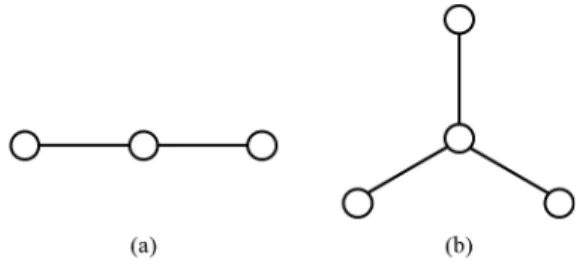
The Tower of Hanoi on star graphs (Fig. 1), which is called the Star Tower of Hanoi[12], is the main topic of this paper. The Star Tower of Hanoi has the following two types of problems. The first one is to transfer all the disks on one leaf of the star graph to another leaf. The second one is to transfer the disks from a leaf to the center of the graph. The first type of problem with 4 pegs was studied by Stockmeyer[19], in which he gave a Frame-Stewart-type recursive algorithm. Then, Bousch[4]again proved its op- timality. The algorithm was further generalized for the case of k (≥ 4) pegs and its explicit solution was obtained in [5]. The second type of Star Tower of Hanoi problem is to transfer thendisks from one leaf to the center. A Frame- Stewart-type algorithm can be also designed in this case and its solution was checked to be optimal up ton=15 by com- puter search[10],[11]; thus, called to be “presumed opti- mal”. However, neither of the explicit solution nor its opti- mality are shown yet and are posed as open problems[11].
In this paper, we make exact analysis of this recurrence Copyright c2019 The Institute of Electronics, Information and Communication Engineers
Fig. 1 Star graphs with (a) 3 vertices; and (b) 4 verticees.
relation. The key step is to make a recursive definition of an integer sequence that is exactly the sequence of differences of the target Tower of Hanoi. Then, we prove its correctness by induction. We further generalize and analyze the recur- rence relation to cover the problems of the original 4-peg Tower of Hanoi, i.e., the Reve’s puzzle, and the leaf-to-leaf Star Tower of Hanoi.
This paper is organized as follows: In Sect. 2, we sum- marize the Star Tower of Hanoi problems with 3 pegs and also 4 pegs in the leaf-to-leaf case. In Sect. 3, we first sum- marize the Frame-Stewart-type algorithm for the Star Tower of Hanoi in the leaf-to-center case, define an integer se- quence for the differences, and then state the main theo- rem. In Sect. 4, the proof of the main theorem is shown.
In Sect. 5, a generalized recurrence relation is analyzed and finally, concluding remarks are given in Sect. 6.
2. Preliminaries
2.1 The Star Tower of Hanoi with 3 Pegs
The star graph with 3 vertices is shown in Fig. 1 (a), which is also regarded as the path graph. On this graph, the follow- ing two kinds of Tower of Hanoi problems are considered.
Givenn disks on a leaf peg, we transfer all the disks from the initial leaf to another, which is denoted asleaf-to-leaf, or to the center peg, which is denoted asleaf-to-center. Note that the leaf-to-center problem is equivalent to the problem of transferring the disks in the opposite direction, that is, from the center to a leaf. The optimal algorithms and their analysis are rather straightforward, but we summarize them as basis for later analysis.
For the leaf-to-leaf problem with 3 pegs, (i) we first move the smallern−1 disks to another leaf (destination);
(ii) then move the largest disk to the center; (iii) move the n−1 disks back to the initial leaf; (iv) move the largest disk to the destination leaf; and (v) finally, move then−1 disks to the destination. LetS3(n) be the number of steps of this recursive algorithm. Then,S3(n) satisfies the following recurrence relation:
S3(0)=0, S3(n)=3S3(n−1)+2 forn≥1.
Therefore,S3(n)=3n−1 andΔS3(n)=S3(n)−S3(n−1)= 2·3n−1forn≥1.
For the leaf-to-center problem, (i) we first move the smallern−1 disks to another leaf with the algorithm for the
leaf-to-leaf problem (withS3(n−1) moves); (ii) move the largest disk to the center; and (iii) finally, move the n−1 disks to the center. The recurrence relation of this algorithm is the following:
T3(0)=0,T3(n)=S3(n−1)+1+T3(n−1) forn≥1.
It is simplified asT3(n)=T3(n−1)+3n−1, soT3(n)=3n2−1 andΔT3(n)=T3(n)−T3(n−1)=3n−1forn≥1.
We will use these results in the Star Tower of Hanoi problems with 4 pegs.
2.2 The 4-Peg Star Tower of Hanoi: Leaf-to-Leaf Case In this section, we summarize the results on the Tower of Hanoi on the star graph in Fig. 1 (b) in the case that then disks are transferred from one leaf to another[19].
LetS4(n) be the number of steps of the recursive al- gorithm to be stated. The task of transferring n disks is achieved by the following procedure:
1. transfer the topmostn−mdisks of one leaf to a non- final leaf using 4 pegs;
2. transfer the largermdisks from the initial leaf to the final leaf using 3 pegs;
3. finally, transfer then−mdisks from the non-final leaf to the final leaf using 4pegs.
Similarly to the original Frame-Stewart algorithm, the algo- rithm chooses the integerm(0 <m≤n) such that the total number of steps of the above procedure is minimized. Then, the following recurrence relation holds: S4(0) =0 and for n≥1,
S4(n) = min
0<m≤n{2·S4(n−m)+S3(m)}
= min
0<m≤n{2·S4(n−m)+(3m−1)}. (2) Stockmeyer[19]obtained the following explicit formulas:
mmin=log3sn+1,
ΔS4(n)=S4(n)−S4(n−1)=2sn, S4(n)=2
n
i=1
si,
wheremminis the value ofmthat minimizes the recurrence relation forS4(n) and
sn=1,2,3,4,6,8,9,12,· · ·
is the sequence of 3-smooth numbers 2j·3k, j,k≥0 lined in increasing order. To summarize:
Lemma 1: For the 4-peg Star Tower of Hanoi of transfer- ringndisks from one leaf peg to another, the Frame-Stewart- type recursive algorithm uses S4(n) = 2n
i=1si steps to achieve the task, where {sn} is the sequence of 3-smooth numbers.
3. The 4-Peg Star Tower of Hanoi: Leaf-to-Center Case
3.1 Frame-Stewart-Type Algorithm and Its Recurrence We first state the Frame-Stewart-type algorithm and the cor- responding recurrence relation for the Star Tower of Hanoi of the leaf-to-center case. LetT4(n) be the number of steps used by the algorithm. The procedure of the algorithm is the following:
1. transfer the topmostn−mdisks of one leaf to another leaf using 4 pegs;
2. transfer the largermdisks from the initial leaf to the center (destination) using 3 pegs;
3. finally, transfer then−mdisks from the intermediate leaf to the center using 4 pegs.
As before, the algorithm chooses the integerm(0 < m ≤ n) such that the total number of steps for the procedure is minimized. Then, the following recurrence relation holds:
T4(0)=0 and forn≥1, T4(n) = min
0<m≤n{S4(n−m)+T3(m)+T4(n−m)}
= min
0<m≤n
T4(n−m)+2
n−m
i=1
si+3m−1 2
, (3)
where Eq. (3) holds due to the results in Sect. 2. The values ofT4(n), the differencesΔT4(n) = T4(n)−T4(n−1), and the argumentmmin at which the equation is minimized are shown in Table 1 for 1 ≤ n ≤ 10. Here we note that the recurrence takes the minimum at two values ofmminatn = 2,5 (then, atn=15). In such cases, if we choose the larger values formmin, that is, if we regardmmin =2 forn=2 and mmin =3 forn=5, then we observe that up ton=10, the following equality holds:
mmin=log3ΔT4(n)+1. (4) Furthermore, the sequence{ΔT4(n)}consists of the terms of {ΔT4(n)+ΔS4(n)}and{ΔT3(n)}arranged in increasing order in the weak sense that there can be identical values. How- ever, we should be careful for these computations because they are self-referential and in order to compute ΔT4(n), the value of mmin itself is needed. By computer experi- ments, values of T4(n)’s are confirmed to be optimal up ton = 15[10], [11], but the exact analysis of the recur- rence relation has not been done yet. In the next section, we present an integer sequence that coincides with the sequence {ΔT4(n)}.
Table 1 Values ofmmin,T4(n) andΔT4(n) for 1≤n≤10.
n 1 2 3 4 5 6 7 8 9 10
mmin 1 1, 2 2 2 2, 3 3 3 3 3 4
T4(n) 1 4 7 14 23 32 47 68 93 120
ΔT4(n) 1 3 3 7 9 9 15 21 25 27
3.2 Explicit Solutions forΔT4(n) andT4(n)
From now on, we regard integer sequences as a multiset which allows the existence of multiple identical integers as elements. Instead of{·}, [·] is used to denote a multiset.
Now we make definitions of a family of multisetsAifor i≥0 and an integer sequence{ti}i≥1, which is the candidate for{ΔT4(n)}. Let{sn}n≥1be the sequence of 3-smooth num- bers 2j·3kfor j,k≥0. Ai’s andti’s are defined recursively as follows:
1. A0 =[3n]n≥0 =[1,3,32,33,· · ·] andt1 =minA0 =1, where minA0is the minimum integer inA0.
2. Fori≥1, the multisetAiis defined as Ai=Ai−1\minAi−1∪[ti+2si],
where minAi−1is the minimum integer inAi−1. Then, ti+1is defined asti+1=minAi.
Here we note that subtraction of minAi−1from the multiset Ai−1 is done only once and the other identical integers, if any, remain in minAi−1.
Example 1: We show some small values ofAn’s andtn’s.
A1 =A0\minA0∪[t1+2s1]=[3n]n≥0\[1]∪[2+1]
=[3,3,32,33,34,· · ·].
So,t2=minA1=3. It impliesti+2sican be a power of 3.
A2 =A1\minA1∪[t2+2s2]=[3n]n≥1\[3]∪[4+3]
=[3,7,32,33,34,· · ·].
So,t3=minA2=3.
A3 =A2\minA2∪[t3+2s3]=A2\[3]∪[6+3]
=[7,32,32,33,34,· · ·].
So,t4=minA3=7.
The values of tn’s for 1 ≤ n ≤ 10 are shown in Ta- ble 2. Compared with Table 1, it is observed that the values of{ΔT4(n)}and{tn}are exactly the same in these cases. We justify this observation by the following theorem.
Theorem 1: Suppose that{tn}n≥1is the aforementioned in- teger sequence. Then, the following equality holds.
ΔT4(n)=tn for n≥1.
Therefore,T4(n) is computed as T4(n)=
n
i=1
ti for n≥1.
Table 2 Values oftnfor 1≤n≤10.
n 1 2 3 4 5 6 7 8 9 10
tn 1 3 3 7 9 9 15 21 25 27
4. Proof of Theorem 1
We proveΔT4(n)=tnforn≥1 by induction onn.
Whenn=1,T4(1)=t1 =1 holds.
Suppose thatΔT4(n)=tnholds for 1≤n≤k−1. Then we show thatΔT4(k)=tk. For this purpose, we first define the logarithm oftksimilarly to Eq. (4):
mn=log3tn+1. (5)
As opposed to Eq. (4), mn can be computed without self- reference sincetnis explicitly defined. We show one lemma on the relation between sequences{mn}and{tn}.
Lemma 2: Let{mn},{tn},{sn}be the aforementioned inte- ger sequences. Then forn ≥ 2,mn is expressed either as mn =mn−1+1 ormn =mn−1. Furthermore,tn is explicitly written as follows:
⎧⎪⎪⎨
⎪⎪⎩(i) Whenmn =mn−1+1,tn=3mn−1. (ii) Whenmn=mn−1, tn=tn−mn+2sn−mn.
Proof: The valuetnis by definition thenth smallest value in the multiset
[3i]i≥0∪[ti+2si]1≤i≤n−1.
We first divide the type of values oftn’s into three cases.
Case 1. Whentn =3lfor someland when 3lappears as an element of the sequence {ti}for the first time, then 3l−1 ≤tn−1 <tn =3l. Thus,l−1 ≤log3tn−1 <log3tn =l.
Recall thatmn=log3tn+1, sol−1≤mn−1−1<mn−1=l.
Therefore,
mn=mn−1+1 andtn =3l=3mn−1.
Case 2. Whentn =3lfor somelbut when it is not the first time for 3l to appear in the sequence{tn}, thentn−1 = tn=3l. Therefore,
mn=mn−1=l+1 andtn =3l=3mn−1.
Case 3.Whentn=tj+2sjfor somejsuch that 1≤j≤ n−1 and whentnis not a power of 3, thentnis bounded as 3l <tn <3l+1for somel. Then,tn−1 must be also bounded in the same interval as 3l ≤ tn−1 ≤tn < 3l+1 since at least one 3lmust exist in{ti}i≤n−1. Therefore,
mn=mn−1=l+1.
Next we find the index jsuch thattn=tj+2sj. Sincen integerst1,· · ·,tnare chosen from the multiset [3i]i≥0∪[ti+ 2si]1≤i≤n−1and since 3mn−1 <tn <3mn, exactlymnsmallest 3i’s in [3n]n≥0, i.e.,{1,3,32,· · · ,3mn−1}, are chosen and used in{ti}1≤i≤n−1. Since the remaining elements for {t1,· · ·,tn} are chosen from{ti+2si},ti+2si’s should appearn−mn
times at the time of determiningtn, yielding j = n−mn. Thus,
tn=tj+2sj=tn−mn+2sn−mn.
This completes Case 3.
Now, we prove (i) and (ii) of the lemma using the re- sults of Cases 1, 2, and 3. As for (i), since Cases 2 and 3 both satisfy mn = mn−1, whenmn = mn−1+1, Case 1 of tn =3mn−1holds and (i) of Lemma 2 is proved.
Whenmn=mn−1of (ii) holds, by Cases 2 and 3, there are two kinds of expressions fortn, that is,tn=3lfor some landtn =tn−mn+2sn−mn. But in Case 2, since 3lappears at least twice,tn−1 =tn =3l. So, this 3lcan be also written as tn−mn+2sn−mn. This shows that whenmn =mn−1,tncan be expressed astn=tn−mn+2sn−mnas claimed in (ii).
This completes the proof of Lemma 2.
Next, we show at whichmthe inner function ofT4(k) takes the minimum.
Lemma 3: Under the assumption of induction, the func- tion
f(m)=T4(k−m)+S4(k−m)+3m−1 2 takes the minimum atm=mk.
Proof: Wheni<mk, f(i+1)−f(i)
=
T4(k−(i+1))+S4(k−(i+1))+3i+1−1 2
−
T4(k−i)+S4(k−i)+3i−1 2
= 3i−ΔT4(k−i)+ ΔS4(k−i)
= 3i−(tk−i+2sk−i) (by Assumption) (6) By the definition of tn and by Lemma 2, the sequence {t1,t2,· · ·,tk}consists of theksmallest numbers
[1,3,· · · ,3mk−1]∪[t1+2s1,· · ·,tk−mk+2sk−mk] in the multiset [3j]j≥0∪[tj+2sj]1≤j≤k−1. This withk−i>
k−mkimplies thattk−i+2sk−iis larger or equal to bothtk−mk+ 2sk−mk and 3mk−1 (≥ 3i). Therefore, Eq. (6) leads to f(i+ 1)−f(i)=3i−(tk−i+2sk−i)≤0 andf(m) is monotonically decreasing form≤mk.
Wheni≥mk, sincek−i≤k−mk, f(i+1)−f(i)
= 3i−ΔT4(k−i)+ ΔS4(k−i)
= 3i−(tk−i+2sk−i) (by Assumption)
≥ 3i−(tk−mk+2sk−mk)
≥ 0. (7)
Inequality (7) holds because the multiset that consists of the nsmallest values in the multiset [3i]i≥0∪[ti+2si]1≤i≤k−1is
[3i]0≤i≤mk−1∪[ti+2si]1≤i≤k−mk
by the definition oftnand by Lemma 2. Therefore, f(m) is monotonically increasing form≥mk.
Consequently, f(m) takes the minimum atm=mk. Now, we are ready to show thatΔT4(k)=tkunder the assumption of induction. First, by Lemma 3,ΔT4(k) is com- puted as follows:
ΔT4(k)=T4(k)−T4(k−1)
=
T4(k−mk)+S4(k−mk)+3mk−1 2
−
T4(k−1−mk−1)+S4(k−1−mk−1)+3mk−1−1 2
=
T4(k−mk)−T4(k−1−mk−1) +
S4(k−mk)−S4(k−1−mk−1) +3mk−3mk−1
2
. (8)
For further computation, we divide into two cases according to the relation ofmkandmk−1in Lemma 2.
Case 1. Forksuch thatmk =mk−1+1,tk =3mk−1by Lemma 2(i). Then, the values in the brackets of Eq. (8) are computed respectively as follows:
T4(k−mk)−T4(k−1−mk−1)
= T4(k−mk)−T4(k−1−(mk−1))=0, S4(k−mk)−S4(k−1−mk−1)=0,
3mk−3mk−1
2 = 3mk−3mk−1
2 =3mk−1.
Therefore, by Lemma 2(i), Eq. (8) is simplified as ΔT4(k)=3mk−1 =tk.
Case 2. Forksuch thatmk =mk−1,tk=tk−mk+2sk−mk
by Lemma 2(ii). Then, the values in brackets of Eq. (8) are computed respectively as follows:
T4(k−mk)−T4(k−1−mk−1)
= T4(k−mk)−T4(k−1−mk)
= ΔT4(k−mk)
= tk−mk (by Assumption), S4(k−mk)−S4(k−1−mk−1)
= ΔS4(k−mk)
= 2sk−mk (by Lemma 1), 3mk−3mk−1
2 = 3mk−3mk
2 =0.
Therefore, by Lemma 2(ii), Eq. (8) is simplified as ΔT4(k)=tk−mk+2sk−mk =tk.
This completes the proof of Theorem 1.
5. Generalized Recurrence Relation and Its Analysis The recurrence relation for the 4-peg Star Tower of Hanoi and its analysis in Sects. 3 and 4 are generalized to include the cases of the original 4-peg Tower of Hanoi, i.e., the
Reve’s Puzzle, and the leaf-to-leaf Star Tower of Hanoi.
Namely, we define a generalized recurrence relation as fol- lows: Let{H(n)}n≥0be an integer sequence such thatH(0)= 0 and thathn= ΔH(n) is monotonically increasing onn(in the weak sense). Then, the recurrence relation for a function G(n) is defined as follows:G(0)=0 and forn≥1,
G(n)= min
0<m≤n
G(n−m)+H(n−m)+a(qm−1) q−1
, (9)
where a andq are constant integers such that a ≥ 1 and q≥2. We note that
a(qm−1)
q−1 −a(qm−1−1)
q−1 =a·qm−1.
Equation (9) generalizes Eq. (1) for the original 4-peg Tower of Hanoi by settingG(n)=H(n) for allnand (a,q)=(1,2), Eq. (2) for the leaf-to-leaf Star Tower of Hanoi by setting G(n) = H(n) for allnand (a,q) = (2,3), and the leaf-to- center Star Tower of Hanoi, i.e., Eq. (3) forT4(n) by setting H(n) = S4(n) for alln and (a,q) = (1,3). For other val- ues of (a,q), we have not found a case in which Eq. (9) has some concrete meaning such as being a recurrence relation for some Tower of Hanoi variant, but emphasis and benefit of the generalization should lie at this point in understanding the algorithms of the three types of 4-peg Tower of Hanoi in the unified manner.
Now, the analysis forT4(n) in Sects. 3 and 4 is gen- eralized for G(n). Similarly to the definition of {ti}i≥1 in Sect. 3.2, we define the integer sequence{gi}i≥1and the mul- tisetsAi’s fori≥0 as follows:
1. A0= a·qn
n≥0andg1=minA0=a.
2. Fori≥1, the multisetAiis defined as Ai=Ai−1\minAi−1∪[gi+hi],
where minAi−1is the minimum integer inAi−1. Then, gi+1is defined asgi+1 =minAi.
When we define mn=
logq gn
a +1,
the following lemma holds, similarly to Lemma 2:
Lemma 4: mn is written either asmn =mn−1+1 ormn = mn−1. Furthermore,gnis explicitly written as follows:
⎧⎪⎪⎨
⎪⎪⎩(i) Whenmn=mn−1+1, gn=a·qmn−1. (ii) Whenmn=mn−1, gn=gn−mn+hn−mn.
Proof: The proof for Lemma 2 works in this case by replac- ing 3nand 2snwitha·qnandhn, respectively and by taking
the logarithm with respect toq.
We finally show the following theorem onG(n) andgn: Theorem 2: Let{gn}n≥1be the the sequence defined above.
Then, the following equalities hold.
ΔG(n)=gnforn≥1, G(n)=
n
i=1
giforn≥1.
Proof: We again prove by induction. First,ΔG(1)=G(1)= g1=a.
Next, assume thatΔG(n) =gn for allnsuch that 1 ≤ n ≤ k−1. Then, the following lemma generalized from Lemma 3 holds:
Lemma 5: Under the assumption of induction, the func- tion
f(m)=G(k−m)+H(k−m)+a(qm−1) q−1 takes the minimum atm=mk.
Proof of Lemma 5: Wheni<mk, similarly to Lemma 3, f(i+1)−f(i)
=
G(k−(i+1))+H(k−(i+1))+a(qi+1−1) q−1
−
G(k−i)+H(k−i)+a(qi−1) q−1
= a·qi−(gk−i+hk−i) (by Assumption)
≤ 0 (by Lemma 4).
Wheni≥mk, sincek−i≤k−mk, f(i+1)−f(i)
= a·qi−(gk−i+hk−i) (by Assumption)
≥ a·qi−(gk−mk +hk−mk)
≥ 0 (by Lemma 4).
Consequently, f(m) takes the minimum atm=mk. Now, we show thatΔG(k)=gk. By Lemma 5,
ΔG(k)=G(k)−G(k−1)
=
G(k−mk)−G(k−1−mk−1) +
H(k−mk)−H(k−1−mk−1) +a(qmk−qmk−1)
q−1 . (10)
We further divide into two cases.
Case 1. Forksuch thatmk =mk−1+1,gk =a·qmk−1 by Lemma 4(i). Then, similarly to Theorem 1,
G(k−mk)−G(k−1−mk−1)=0, H(k−mk)−H(k−1−mk−1)=0, a(qmk−qmk−1)
q−1 = a(qmk−qmk−1)
q−1 =a·qmk−1. Therefore, by Lemma 4(i), Eq. (10) is simplified as
ΔG(k)=a·qmk−1=gk.
Case 2. Forksuch thatmk=mk−1,gk=gk−mk+hn−mk
by Lemma 4(ii). Then,
G(k−mk)−G(k−1−mk−1)=gk−mk (by Assumption), H(k−mk)−H(k−1−mk−1)=hk−mk (by Definition),
a(qmk −qmk−1)
q−1 =a(qmk−qmk) q−1 =0.
Therefore, by Lemma 4(ii), Eq. (10) is simplified as ΔG(k)=gk−mk+hk−mk =gk.
This completes the proof of Theorem 2.
6. Concluding Remarks
We made exact analysis of the Frame-Stewart-type recur- rence relation for the leaf-to-center 4-peg Star Tower of Hanoi. Then we generalized the recurrence relation to in- clude the ones for the original 4-peg Tower of Hanoi and the leaf-to-leaf Star Tower of Hanoi.
Future work includes consideration of applying the generalized recurrence relation in Sect. 5 possibly to other Tower of Hanoi variants, analysis of thek-peg leaf-to-center Star Tower of Hanoi fork≥5, and exploration for the opti- mality of the solution obtained in this paper.
References
[1] D. Berend and A. Sapir, “The cyclic multi-peg Tower of Hanoi,”
ACM Trans. Algorithms, vol.2, no.3, pp.297–317, 2006.
[2] D. Berend, A. Sapir, and S. Solomon, “The Tower of Hanoi problem on pathhgraphs,” Discrete Applied Mathematics, vol.160, no.10-11, pp.1465–1483, 2012.
[3] T. Bousch, “La quatri`eme Tour de Hanoi,” Bull. Belg. Math. Soc.
Simon Stevin, vol.21, no.5, pp.895–912, 2014.
[4] T. Bousch, “La tour de Stockmeyer,” S´eminaire Lotharingien de Combinatoire 77, article #B77d, 2017.
[5] J. Chappelon and A. Matsuura, “On generalized Frame-Stewart numbers,” Discrete Mathematics, vol.312, no.5, pp.830–836, 2012.
[6] X. Chen and J. Shen, “On the Frame-Stewart conjecture about the Towers of Hanoi,” SIAM Journal on Computing, vol.33, no.3, pp.584–589, 2004.
[7] H.E. Dudeney, “The Reve’s puzzle,” The Canterbury Puzzles and Other Curious Problems, Thomas Nelson and Sons, Ltd, London, 1907.
[8] J.S. Frame, “Solution to advanced problem 3918,” Amer. Math.
Monthly, vol.48, pp.216–217, 1941.
[9] C. Grosu, “A new lower bound for the Towers of Hanoi problem,”
Electronic Journal of Combinatorics, vol.23, article #P1.22, 2016.
[10] C.H. Heide, “Distances and automatic sequences in distinguished variants of Hanoi graphs,” Dissertation, LMU M¨unchen: Faculty of Mathematics, Computer Science and Statistics, 2016.
[11] C. Kimberling, “Problem proposals,” Proc. 17th International Con- ference on Fibonacci Numbers and Their Applications, The Fi- bonacci Quarterly, vol.55, no.5, pp.213–221, 2017.
[12] A.M. Hinz, S. Klavˇzar, U. Milutinovi´e, and C. Petr, The Tower of Hanoi - Myths and Maths, Springer, Basel, 2013.
[13] S. Klavˇzar and U. Milutinovi´c, “Simple explicit formulas for the Frame-Stewart numbers,” Annals of Combinatorics, vol.6, no.2, pp.157–167, 2002.
[14] S. Klavˇzar, U. Milutinovi´c, and C. Petr, “On the Frame-Stewart algo- rithm for the multi-peg Tower of Hanoi problem,” Discrete Applied Mathematics, vol.120, no.1-3, pp.141–157, 2002.
[15] E. Lucas, R´ecr´eation Math´ematiques, vol.III, Gauthier-Villars, Paris, 1893.
[16] A. Matsuura, “Analysis of recurrence relations generalized from the 4-peg Tower of Hanoi,” IEICE Trans. Information and Systems, vol.E94-D, no.2, pp.220–225, 2011.
[17] A. Sapir, “The Tower of Hanoi with forbidden moves,” Computer Journal, vol.47, no.1, pp.20–24, 2004.
[18] B.M. Stewart, “Solution to advanced problem 3918,” Amer. Math.
Monthly, vol.48, pp.217–219, 1939.
[19] P.K. Stockmeyer, “Variations on the four-post Tower of Hanoi puz- zle,” Congressus Numerantium, vol.102, pp.3–12, 1994.
[20] M. Szegedy, “In how many steps thek peg version of the Tow- ers of Hanoi game can be solved?,” Proc. STACS’99, LNCS 1563, pp.356–361, 1999.
Akihiro Matsuura was born in 1968. He received his B.S. and M.S. degrees in mathemat- ics from Kyoto University in 1992 and 1994, respectively and his Ph.D. in informatics from Kyoto University in 2002. From 1994 to 1999, he was with NTT Communication Science Lab- oratories. In 2003, he joined Tokyo Denki Uni- versity, where since 2008 he has been an as- sociate professor. His research interests in- clude combinatorics, algorithm theory, interac- tion, and entertainment computing.
Yoshiaki Shoji was born in 1995. He re- ceived his B.I. (Informatics) degree from To- kyo Denki University in 2018 and is currently a graduate student of the Graduate School of Science and Engineering of Tokyo Denki Uni- versity. His research interests include algorithm theory, artificial intelligence, and natural lan- guage processing.