Kyushu University Institutional Repository
Study on Within-Tree Variation in Wood Properties of Melia azedarach Planted in Northern Vietnam
ドゥオン ヴァン ドアン
http://hdl.handle.net/2324/1959177
出版情報:九州大学, 2018, 博士(農学), 課程博士 バージョン:
権利関係:
Study on Within-tree Variation in Wood Properties of Melia azedarach Planted in Northern Vietnam
Duong Van Doan
2018
Study on Within-tree Variation in Wood Properties of Melia azedarach Planted in Northern Vietnam
By
Duong Van Doan
Laboratory of Wood Science, Division of Sustainable Bioresources Science, Department of Agro-environmental Sciences, Faculty of Agriculture, Graduate School of Bioresource and Bioenvironmental Sciences, Kyushu University, Japan
Supervisor
Professor Junji Matsumura
Advisory Committee Members
Associate Professor Shinya Koga
Associate Professor Noboru Fujimoto
i
Table of Contents
Table of Contents ... i
Abbreviations ... v
CHAPTER 1 ... 1
Introduction ... 1
CHAPTER 2 ... 8
Literature Review ... 8
2.1 Introduction ... 9
2.2 Within-tree variations in wood properties ... 9
2.2.1 Growth ring width ... 9
2.2.2 Wood density and specific gravity ... 11
2.2.3 Fiber length ... 14
2.2.4 Microfibril angle ... 15
2.2.5 Shrinkage properties ... 17
2.2.6 Mechanical properties ... 18
2.3 Nondestructive wood evaluation ... 20
2.4 Conclusion of literature review ... 21
CHAPTER 3 ... 22
Variation in Intrinsic Wood Properties ... 22
3.1 Abstract ... 23
3.2 Introduction ... 24
3.3 Materials and methods ... 25
3.3.1 Study site and sampling ... 25
3.3.2 Wood specimen preparation ... 26
3.3.3 Growth ring width ... 26
3.3.4 Wood specific gravity ... 29
3.3.5 Fiber length and microfibril angle ... 29
3.3.6 Determination of fiber length increment (FLI) ... 31
3.3.7 Statistical analysis ... 31
3.4 Results and discussion ... 33
3.4.1 Growth ring width ... 33
3.4.2 Wood specific gravity ... 37
3.4.3 Microfibril angle ... 41
3.4.4 Fiber length ... 41
3.4.5 Stabilizing point of fiber length increment ... 46
3.4.6 Implications for wood utilization of M. azedarach in northern Vietnam ... 46
3.5 Conclusions ... 48
CHAPTER 4 ... 49
Transverse Shrinkage Variations within Tree Stems ... 49
4.1 Abstract ... 50
4.2 Introduction ... 51
iii
4.3.2 Dynamic modulus of elasticity of log (DMOElog) ... 54
4.3.3 Basic density and transverse shrinkage ... 56
4.3.4 Data analysis ... 57
4.3.5 Grade yield ... 57
4.4 Results and discussion ... 60
4.4.1 Basic density and transverse shrinkage ... 60
4.4.2 Relationships between transverse shrinkage and basic density ... 68
4.4.3 Prediction of transverse shrinkage ... 71
4.4.4 Grade yield of shrinkage properties ... 74
4.5 Conclusions ... 76
CHAPTER 5 ... 77
Within-stem Variations in Mechanical Properties ... 77
5.1 Abstract ... 78
5.2 Introduction ... 79
5.3 Material and methods ... 80
5.3.1 Sampling ... 80
5.3.2 Wood density and dynamic modulus of elasticity (Ed) ... 81
5.3.3 MOR and MOE ... 82
5.3.4 Data analysis ... 82
5.3.5 Grade yield ... 84
5.4 Results and discussion ... 84
5.4.1 Wood density and mechanical properties ... 84
5.4.2 Correlation of wood density with mechanical properties ... 90
5.4.3 Correlation between moduli of elasticity ... 94
5.4.4 Prediction of bending strength ... 96
5.4.5 Grade yield of mechanical properties ... 96
5.5 Conclusions ... 100
CHAPTER 6 ... 102
General Discussion and Conclusions ... 102
6.1 General discussion ... 103
6.2 Conclusions ... 109
References ... 111
Acknowledgements ... 126
v
Abbreviations
• BD: Basic density (g/cm3)
• DMOElog: Dynamic modulus of elasticity of log (GPa)
• Ed: Dynamic modulus of elasticity of clear specimen (GPa)
• FL: Fiber length (mm)
• FLI: Fiber length increment (%)
• GRW: Growth ring width (mm)
• MFA: Mircofibril angle (o)
• MOE: Modulus of elasticity (GPa)
• MOR: Modulus of rupture (MPa)
• SG: Specific gravity in air-dry condition
• VL: Acoustic wave velocity (m/s)
• WD: Wood density in air-dry condition (g/cm3)
• αR: Radial shrinkage (%)
• αT: Tangential shrinkage (%)
• αT/αR: Tangential/radial shrinkage ratio
• ρ: Green density of log (kg/m3)
CHAPTER 1
Introduction
2
All forests fulfil a range of roles and provide a variety of goods and services. The roles fulfilled by planted forests are diverse and the goods and services produced include the production of industrial wood, fuel wood, non-wood forest goods (eg. animal fodder, apiculture, essential oils, tan bark, cork, latex, and food) and conservation, carbon sequestration, recreation (eg. hunting, fishing, and hiking), erosion control, and rehabilitation of degraded lands, including landscape and amenity enhancement.
For countries with a low forest cover, the only way to obtain the multiple benefits from forests, is creating new forests, mainly through planting.
Global planted forest area increased from 1990 to 2015 from 167.5 million ha to 277.9 million ha with the increase varying by region and climate domain (Payn et al. 2015). Together with global trend, Vietnam’s planted forest area increased considerably from 1985 with 0.58 million ha to 2016 with 4.13 million ha (Table 1.1) (Ministry of Agriculture and Rural Development of Vietnam 2017).
Large areas of plantation do not only supply material for pulp and paper production but also play an important role in the protection of environment by reducing greenhouse gas and helping to reduce poverty in rural areas (Kim 2009). Besides, with the decrease in the available wood resources and the increase in wood processing costs have led to a significant interest in timber production from plantation. For timber plantation, the current wood is under-utilised and poorly managed. Therefore, there is a need for effective and sustainable utilization of the plantation forests in order to prevent further decline of timber sources and improve quality of timber products. One of the ways of sustainably utilizing wood resources is to study on wood properties.
Wood is a highly variable material due to its biological origin (Zobel and Van Buijtenen 1989).
For a given species, the within-tree variation is further partitioned into variation from pith to bark (radial variation) and variation with position along the stem (axial variation). The large variability of
wood characteristics makes it difficult to precisely predict its performance and therefore to efficiently process and utilize the material. On the other hand, the variability means that this material has potential for genetic improvement and diverse end uses (Zobel and Van Buijtenen 1989, Koga and Zang 2004).
Therefore, a better understanding of the wood variability within tree is of value to both wood quality improvement and efficient wood processing and utilization.
4
Table 1.1 The area of natural and planted forest in Vietnam from 1985 to 2016
9.31
8.25
10.20 10.30 10.17 10.24
0.58 1.05
2.50 2.90
3.88 4.13
0 2 4 6 8 10 12
1985 1995 2005 2009 2015 2016
Area (million ha)
Year
Natural forest Planted forest
Melia azedarach L. is a deciduous tree belonging to the family of Meliaceae. It is native to the Himalaya region of Asia (EL-Juhany 2011). The species is well adapted to warm climates, poor soils and seasonally dry conditions (Harrison et al. 2003). The fully-grown tree has a rounded crown, and commonly measures 7 to 12 m tall. However in exceptional circumstances, M. azedarach can attain a height of 45 m. The leaves are up to 50 cm long, alternate, long-petioled, two or three times compound (odd-pinnate); the leaflets are dark green above and lighter green below, with serrate margins. The flowers are small and fragrant, with five pale purple or lilac petals, growing in clusters. The fruit is a drupe, marble-sized, light yellow at maturity, hanging on the tree all winter, and gradually becoming wrinkled and almost white (Rahman et al. 2014).
M. azedarach could contribute to the prevention of global warming due to their high ability to stock carbon (Osei et al. 2018). Together with other fast growing species, M. azedarach trees are used as pulping materials due to their high productivity (Ministry of Agriculture and Rural Development of Vietnam 2014). Using wood of M. azedarach as a building material (eg. posts and beams in timber construction) to increase their value is expected (Hasegawa et al. 2015). There are some researchers investigated the physical and mechanical properties of the M. azedarach wood. Matsumura et al.
(2006) reported the variation in wood properties of M. azedarach planted in Japan and suggested the possibility of using it as new timber materials. Venson et al. (2008) experimented with the physical, mechanical, and biological properties of M. azedarach planted in Mexico. They demonstrated that M.
azedarach can be used as structural lumber if the appropriate genotypes and clones were collected. In Vietnam, M. azedarach is planted popularly in most of the provinces in northern. Most of the M.
azedarach were planted in short rotation around 5-6 years with the purpose to supply raw material for pulp and particleboard industries. Currently the decrease in the available wood resources and the
6
quite durable, resistant to termites and insects, and easy to work (Nghia 2007). However, until now no effort has been made to investigate the within-tree variations including radial and axial directions in wood properties of M. azedarach planted in Vietnam, despite the importance of this species and the multiuse of its wood.
Rapid and nondestructive evaluation of wood properties has great importance to tree breeders as well as to several other considerations in optimal timber utilization. Nondestructive evaluation is an important tool for the characterization of wood and can be used in industry to improve quality control process through reducing the property variation of the raw material and its by-products (Oliveira et al. 2005). However, the properties of wood vary considerably because it is a natural material. The large variability of wood characteristics makes it difficult to precisely predict its performance. This is one of the most important challenges to apply nondestructive testing method in wood quality evaluation. A number of studies suggested that nondestructive technique may be used to assess wood properties in small wood specimens, lumber and determine the quality of logs and standing trees (Wang et al. 2001, Carter et al. 2005, Ishiguri et al. 2006, Ishiguri et al. 2008). One of the most widespread and accurate nondestructive techniques used to study timber is based on stress waves. These techniques are based on the observed relations between the propagation of a wave through a piece (velocity and attenuation) with some of the properties of the material (mechanical and physical properties), as well as some characteristics or singularities of the piece as decays, holes or other irregularities (Ross and Pellerin 1994, Montero et al. 2015). Therefore, it is necessary to investigate the usefulness of a stress wave technique for evaluation wood properties of M. azedarach planted in northern Vietnam.
The overall objective of this study was to investigate within-tree variations in fulfilment wood properties including information on wood structure as well as physical and mechanical properties of M. azedarach planted at two different sites in northern Vietnam. The specific objectives were:
• To determine and estimate the within-tree variations in intrinsic wood properties such as growth ring width, wood density, fiber length, and microfibril angle.
• To determine and estimate the within-tree variations in radial and tangential shrinkages.
• To investigate the usefulness of a stress wave technique for prediction wood dimensional stability.
• To determine and estimate the within-tree variations in mechanical properties.
• To investigate the usefulness of a stress wave technique for prediction wood strength and stiffness.
The results should provide basic information to wood industry experts on the potential use and sustainable use of the species when processing logs for timber. The results should also suggest the potential of using rapid and nondestructive method to predict the dimensional stability and mechanical properties of M. azedarach wood. Finally, the results should provide foundation for machine grading of M. azedarach timber in Vietnam.
8
CHAPTER 2
Literature Review
2.1 Introduction
Wood has a variety of uses. Each has a particular set of requirements regarding its quality and has to contend with a variable wood resource even after selection. The criteria that a particular industry apply must be assessable (knot size, wood density, cell wall thickness, fiber length, and fiber content) and related to the wood resource (Walker et al. 1993). However, wood is a highly variable material due to its biological origin. Its properties vary from stand to stand, tree to tree, around the circumference, across the radius, along the height, and even within small sampling unit like growth ring (Sharma et al. 2014). The large variability of wood characteristics makes it difficult to precisely predict its performance and therefore to efficiently process and utilize the material. The principal sources of variation in wood properties relate to:
• Within-ring variations;
• Within-tree variations;
• Between-tree variations on similar sites;
• Between-site variations of the same genotype growing in different geographic regions.
In these variations, variation along radial direction is the best known and most studied within- tree variability in wood, which is generally reflected as radial pattern of change in wood characteristics of core wood and outer wood, juvenile and mature wood (Anoop et al. 2014).
2.2 Within-tree variations in wood properties 2.2.1 Growth ring width
10
Growth ring is a layer of wood formed in plant during a single period of growth. Growth rings are often identified by the colour contrast between the light-coloured earlywood and the dark-coloured latewood. Earlywood is part of the wood in a growth ring of a tree that is produced earlier in the growing season. The cells of early wood are larger and have thinner walls than those produced later in the growing season. On the other hand, latewood is part of the wood in a growth ring of a tree that is produced later in the growing season. The cells of latewood are smaller and have thicker cell walls than those produced earlier in the season (Panshin and De Zeeuw 1980, Larson 1994, Missanjo 2017).
Growth rate has little effect on the wood properties of diffuse-porous species. These have approximately the same proportion of vessels across the annual ring, regardless of the growth rate. On the other hand, growth rate has a noticeable influence of the density of ring-porous hardwoods, which usually produce denser wood when fast grown. The volume of vessel tissue produced each year in a ring-porous hardwood remains constant regardless of the total growth during the growing season and therefore the wider the growth ring the smaller the proportion of vessel tissue (Walker et al. 1993).
Ring width variation with age is a potential source of wood property variation. Ring width in plantation trees usually follows a general pattern of decrease as age increases as a result of stand competition while deviations might occur due to soil and climatic conditions (Zobel and Sprague 1998, Matsumura et al. 2006, Adamopoulos et al. 2010, Kiaei et al. 2016). For example, Matsumura et al.
(2006) reported the growth ring width of M. azedarach planted in Japan decreased from pith towards periphery. In ring-porous hardwoods, growth rate, which is expressed by ring width, is positively correlated to wood density and is attributed to the fact that earlywood zone is nearly constant from year to year and the wider rings therefore contain denser latewood with fewer vessels (Panshin and De Zeeuw 1980, Adamopoulos et al. 2010). Nevertheless, other works failed to find any relationship between ring width and wood density (Van Eck and Woessner 1964, Taylor and Wooten 1973, Taylor
1977). A possible reason could be that the earlywood-latewood proportion, the percentage of cell wall material and the tissue proportions differ between the annual rings (Zang and Zhong 1992).
Ring width is highly variable as it is controlled by a variety of factors such as environmental fluctuations and competition for resources of nutrients or sunlight. A number of studies found significant relationship between ring width and growth conditions (Woodcock 1989, Oleksyn and Fritts 1991, Larocque 1997). Variations in ring width can provide a detailed record of tree growth and vitality in response to climatic changes. At the latitudinal and altitudinal edges of their distribution, the growth of tree species is believed to be chiefly limited by the temperature regime, with tree-ring records from these distribution sites generally providing a proxy of the temperature changes in an area (Buntgen et al. 2005, Frank and Esper 2005, Zhuang et al. 2017). In addition, Zhu et al. (2000) reported a wider growth ring width in wider planting spacing. There is acceleration of growth for widely spaced trees than crowded trees, because widely spaced trees do not compete for growth elements such as nutrients, water, and sunlight. Hence, they tend to have wider growth ring.
2.2.2 Wood density and specific gravity
The specific gravity of wood is its single most important physical property. Most mechanical and physical properties of wood are closely correlated to specific gravity and wood density. In general discussions, the terms specific gravity and wood density are often used interchangeably. These terms have distinct definitions though they refer to the same characteristic (Bowyer et al. 2007). The density of wood can be considered once its moisture content has been defined. In physics the density of a material is defined as the mass per unit volume. The situation is not so simple with wood because
12
Wood density is one of the most important properties because it correlates with most physical characteristics, namely mechanical resistance and wear. Wood density is therefore a fundamental criterion to define the wood technological quality and one of the first to be studied when assessing the potential value of a timber species. It is considered a vital wood property for imparting strength and stiffness to solid lumber as well as affecting the physical yields of fiber for composite products and pulp and paper (Zobel and Van Buijtenen 1989, Niklas and Spatz 2010, Shmulsky and Jones 2011).
In general, higher wood density is desirable. Besides its importance in wood technology, wood density has received increasingly higher attention due to its importance in estimating forest biomass and carbon storage in recent years (Henry et al. 2010, Njana et al. 2016). The amount of carbon stored in trees depends on the biomass as well as the carbon content of the wood and other tissues. Therefore, wood density and stem volume alone may control carbon storage at the tree level (Zang et al. 2012, Wassenberg et al. 2015).
The within-tree variation in wood density is more complex with hardwoods. All possible patterns of wood density variation appear in the stem of hardwoods. In radial direction, Knapic et al.
(2011) reported that there was a trend of decreasing density with cambial age in Quercus faginea. This is a common pattern in Quercus species such as Q. garryana (Lei et al. 1996), Q. suber (Knapic et al.
2008). In the contrast, wood density increases linearly from the pith to the bark in some species belong to Meliaceae family such as Melia azedarach (Matsumura et al. 2006), Toona ciliate (Nock et al.
2009), and Swietenia macrophylla (Lin et al. 2012). On the other hand, Wahyudi et al. (2016) reported a nearly constant basic density of Azadirachta excelsa from pith to bark. Besides, Ofori and Brentuo (2005) showed that the wood density of Cedrela odorata was low at the pith, increased rapidly outwards to a peak and declined steadily towards the periphery in the radial direction. In axial direction, the wood density was reported to vary very little with height in Acacia melanoxylon planted in New
Zealand (Nicholas and Brown 2002), while a significant increase of wood density with height was found in Acacia melanoxylon planted in Portugal (Machado et al. 2014).
Corewood is generally of lower density than the outerwood (Matsumura et al. 2006, Ishiguri et alt. 2007, Nock et al. 2009, Lin et al. 2012). It consists largely of earlywood and has a correspondingly low density. The S2 layer is quite thin and so it is not unexpected than the lignin content of corewood is greater and the cellulose content is less than that of outerwood. The transition to outerwood occurs between growth rings from the pith depending on the species and the property being examined (Walker et al. 1993).
The environment exerts strong control over the average basic density of trees in a stand. At the same time genetic control determines the variations between trees within a stand regardless of location. When we say that a wood property is under environmental control we mean that it varies considerably with a change in the environment. When a wood property is under strong genetic control, it may vary without regard to the environment under which the tree is grown or its properties may stay constant despite the trees having been grown in differing environments (Zobel and Van Buijtenen 1989).
Both factors can be important at the same time. The environment exerts strong control over the average basic density of the population while genetic control determines the tree-to-tree variations within the population occupying a particular environment. For this reason, the consequences of introducing a species to a new region are generally difficult to predict and it is desirable to grow that species in a limited way before becoming committed to a major plantation programme. The end results
14
In addition, wood density data can be used to estimate its intra-species and inter-species variation and indicate variations available for selection in tree improvements. Furthermore, knowledge of wood density profile is likely to improve the accuracy of estimate of stem biomass (Walker et al. 1993).
2.2.3 Fiber length
The term fiber if often used in a general way to refer to all wood cells isolated in pulping processes. However, in the context of wood morphology, the term fiber refers to a specific cell type.
Thus libriform wood fibers, or fiber tracheids as they are more properly called, are long, tapered, and usually thick-walled cells of hardwood xylem (Bowyer et al. 2007).
In hardwood, the cells make up the anatomical organization are vessels, fibers, parenchyma cells, and ray parenchyma cells. Fibers are the principal element that is responsible for the strength of the wood (Panshin and De Zeeuw 1980). Thus, cell wall thickness of the fibers and their fractional volume are known to influence wood density, a parameter generally associated with mechanical strength of hardwood species (Ocloo and Laing 2003, Salmen and Burget 2009).
Fiber length is particularly important for the pulp and paper industry since it determines to a large extent the physical and mechanical properties of paper and paperboard (Van Buijtenen et al.
1962, Einspahr et al. 1963, Zobel and Van Buijtenen 1989). Numerous publications on radial variation in fiber length of ring-porous hardwoods reviewed by Dinwoodie (1961) who reported that fibers are shortest near the pith. A common variation pattern is a rapid increase in fiber length during the first years, followed by a more gradual increase until a maximum is reached. This was shown in Robinia pseudoacacia L. and Castanea sativa Mill. (Adamopoulos 2010). For Acacia magium (Honjo 2005)
and Acacia hybrids (Kim et al. 2008), it has been reported as a pattern of a continuous increase in fiber length from the pith to bark. The pattern of radial variation of fiber length differs across species with radial growth rate which is determined by internal (cambial age) and external factors, such as climatic factors (Nicholls 1986). Therefore, it is necessary to investigate variation in fiber length with respect to a particular species including M. azedarach.
2.2.4 Microfibril angle
Microfibril angle (MFA) is perhaps the easiest ultrastructural variable to measure for wood cell walls, and certainly the only such variable that has been measured on a large scale. The secondary cell walls of xylem cells typically have three layers, an outer S1 with transversely oriented microfibrils, a thick S2 layer with axially oriented microfibrils, and an inner S3 layer also with transversely oriented microfibrils. The S2 layer is generally much thicker than the other layers and may therefore dominate the physical and chemical properties of the cell wall (Donaldson 2008).
In conifers, MFA varies from pith to bark, with the highest angles occurring in the first five growth rings from the pith at the base of the tree (Donaldson 1992, Cave and Walker 1994, Zhang et al. 2007). In hardwoods, there are generally fewer information on within-tree variation in MFA, most of the information being for Eucalyptus trees. MFA declines from pith to bark but, unlike conifers, the angles are much lower near the pith. Pith to bark variation in Populus clones showed MFA values ranging from 28˚ (pith) to 8˚ (bark) in 11-year-old trees at breast height (Fang et al. 2006). In Eucalyptus nitens, MFA decreases with height, reaching a minimum at 30-50% of stem height before increasing again towards the crown (Evans et al. 2000, Donaldson 2008).
16
In addition, there are differences in variation in MFA among trees both in softwoods and hardwoods. In softwoods, the differences among trees are generally more apparent in the juvenile wood. The tendency of MFA to show less among-tree variation in the mature wood (15+ years) than in the juvenile wood (Cown et al. 1999). In hardwoods, the most notable difference is that among-tree variation at the pith is only slightly greater than at the bark in 15-year-old Eucalyptus nitens (Evans et al. 2000, Donaldson 2008). Significant variation in MFA among provenances has been observed in a number studies. For example, Vainio et al. (2002) have shown significant variation in MFA between provenances in Picea sitchensis or Yamashita et al. (2000) reported that MFA values varied widely among cultivars in Cryptomeria japonica.
The MFA has two major effects on wood properties. First, the stiffness of the cell wall increases enormously (five-fold) from pith to cambium as the MFA decreases from 40° to 10°. Secondly, longitudinal shrinkage increases with MFA but in a highly non-linear manner and is responsible for some degrade on drying, especially crook (Walker and Butterfield 1995). The importance of MFA, as it relates to wood mechanical properties, is established for hardwoods. Evans and Ilic (2001) investigated the relationship between MFA and mechanical traits indicating that MFA would be the prime determinant of wood stiffness in Eucalyptus delegatensis. Yang and Evans (2003) reported that MFA alone accounted for 87% of the variation in modulus of elasticity in Eucalyptus globulus, Eucalyptus nitens, Eucalyptus regnans. MFA is also known to have a large and direct effect on shrinkages. Because crystalline cellulose is strong, stiff, and does not absorb moisture, the wood shrinks very little in the direction that is parallel to cellulose microfibrils. Therefore, transverse shrinkage increases and longitudinal shrinkage decreases with the decrease of MFA. Yamashita et al.
(2009a, 2009b) reported that MFA was one of the most important indicators of both longitudinal and transverse shrinkages in Cryptomeria japonica.
2.2.5 Shrinkage properties
Wood only shrinks when water is lost from the cell walls and it shrinks by an amount that is proportional to the moisture lost below fiber saturation point. The amount of shrinkage depends on the basic density of the wood. As drying progress from green wood condition, it is inevitable that the moisture content at the center of the piece will be above the fiber saturation point while the fibers at and near the surface will be well below the fiber saturation point. There will be a moisture gradient within the wood and the drying system will not be in equilibrium. In this situation the surface fibers will have started to shrink and the overall volume of the piece will be reduced even though the average moisture content is above fiber saturation. This accounts for the shrinkage of the wood at mean moisture contents a little above the fiber saturation point (Walker et al. 1993, Bowyer et al. 2007).
The shrinkage of wood is different in the three principal directions: longitudinal, radial, and tangential. Typical oven-dry shrinkage values for medium density woods would be:
Longitudinal shrinkage: 0.1 – 0.3%
Radial shrinkage: 2 – 6%
Tangential shrinkage: 5 – 10%
In normal wood the longitudinal shrinkage from the green to the oven-dry condition is one or two orders of magnitude less than transverse shrinkage. Tangential shrinkage is usually 1.5 to 2.5 times that of the radial shrinkage (Walker et al. 1993). The difference in radial and tangential shrinkage is attributed to differences in density of early and latewood. The shrinkage of dense latewood cells is greater than that of earlywood. In the tangential direction, the earlywood and
18
as much as it would wish. In the radial direction, both the earlywood and latewood shrink independently and the total shrinkage corresponds roughly to the weighted mean shrinkage of the two components (Pentoney 1953, Walker et al. 1993).
The patterns of within-tree variations in wood shrinkage can differ widely among genera and species. They can also differ among sites, genotypes, and tree ages. For example, Ofori and Brentuo (2005) and Kord et al. (2010) reported that transverse shrinkage increased from pith to outwards in Cedrela odorata and Populus euramericana, respectively. On the other hand, Anoop et al. (2014) reported that along the radial positions, there was no significant difference of transverse shrinkage in Swietenia macrophylla. Shanavas and Kumar (2006) showed that the trend for transverse shrinkages decreased from pith towards periphery in Acacia mangium. The effects of seed source and growth condition on transverse shrinkage have been investigated in other hardwood species. Montes et al.
(2007) found there was significant genetic variation in wood shrinkage of Calycophyllum spruceanum while Yang et al. (2002) reported that site had a highly significant effect on shrinkage properties in Eucalyptus globulus Labill.
2.2.6 Mechanical properties
Mechanical properties are usually the most important characteristics of wood products for structural applications (Bowyer et al. 2007). Strength and stiffness of timber are primary considerations in the construction industry, for pallets and containers. Strength is defined in terms of the ability of a material to sustain a load. The magnitude of the load that can be sustained varies with the shape and size of the sample being tested, which is inconvenient. Therefore, strength is defined in terms of stress, that is the load or force per unit area. The specific strength or stiffness of a material is the value of that property divided by its density (Walker et al. 1993).
As regards the within-tree variation, the radial variation is the most important for all wood properties, thereby showing the important of cambial age for the wood characteristics (Zobel and Van Buijitenen 1989). In the radial direction, the variation followed the common trend of increase from pith to bark that is linked to the tree age and the transition from juvenile to mature wood (softwood) and from corewood to outerwood (hardwood) (Fuwape and Fabiyi 2003, Izekor et al. 2010, Anoop et al. 2014, Missanjo and Matsumura 2016). In axial direction, the variation of mechanical properties with height was very small and without statistical significant found in Acacia melanoxylon R. Br.
(Machado et al. 2014).
Wood density is a useful index for predicting the strength properties of clearwood, because it is a direct measure of the amount of cell wall material in a given volume. Even with small clearwood specimens there is a large natural variability in strength. It reflects differences in wood density within tree, between trees in a particular stand, and between trees from contrasting locations and growing under different management systems (Walker et al. 1993). The effects of wood density on variations in the mechanical properties of plantation trees were examined by many researchers. The positive linear relationships between wood density and mechanical properties were found on hardwood species such as Eucalyptus tereticornis (Sharma et al. 2005), Tectona grandis (Izekor et al. 2010), and Acacia melanoxylon (Igartua et al. 2015). However, the relationships between wood density and mechanical properties are highly dependent on species (Rozenberg et al. 1999, Yang and Evans 2003). Low density correlations with mechanical properties were some cases attributed to the influence of MFA (Cave and Waker 1994, Evans and Ilic 2001). The reasoning is that wood density increases while MFA decreases with age, thereby impacting the mechanical tests and resulting in poor correlations when density alone is considered. The grain can also affect the correlation between wood density and
20 2.3 Nondestructive wood evaluation
In the forest products industry, nondestructive evaluation has been developed and is used in structural product grading programs that result in engineered material with well-defined performance.
Currently, there is a strong interest in developing and using new, cost-effective nondestructive evaluation technology to evaluate wood quality. One nondestructive technique, which uses stress wave propagation characteristic, has reveived considerable attention during the past few decades. The applicability of vibration modes on wood materials for assessing wood quality has been investigated for standing tree, log, and small-dimension wood specimens.
Numerous publications reported that the modulus of elasticity of lumber can be predicted by stress wave velocity of a tree, log or small specimen (Nanami et al. 1993, Ross et al. 1997, Ikeda and Arima 2000, Wang et al. 2001, Carter et al. 2005, Ishiguri et al. 2006, Ishiguri et al. 2008). For example, Wang et al. (2001) found a strong relationship between dynamic modulus of elasticity of wood in trees measured by stress wave method and modulus of elasticity of small, clear specimens obtained from these trees measured by destructive method in Tsuga heterophylla and Picea sitchensis. Ishiguri et al. (2008) reported a positive significant correlation between the stress wave velocity of trees and modulus of elasticity in static bending of lumber in Larix kaemferi.
A number of studies also suggested that nondestructive techniques may be used to assess the dimensional stability of structural lumber. Yamashita et al. (2009a, 2009b) showed that there were close relationships between longitudinal-transversal shrinkage and modulus of elasticity of logs measured by tapping the logs in the green condition in Cryptomeria japonica. Wang and Simpson (2006) found the potential of acoustic analysis as presorting criteria to identify warp-prone boards before kiln-drying in Pinus ponderosa. The results showed a statistically significant correlation
between acoustic properties of the boards and the grade loss because of exceeding warp limits. In addition, Dundar et al. (2013, 2016) indicated that ultrasonic measurement in green condition has a good potential for predicting the transverse shrinkages both in softwood and hardwood species.
2.4 Conclusion of literature review
Hardwoods have a more complex overall structure than softwood, because they contain more cell types arranged in a greater variety of patterns. The proportion, structure, and distribution of the cell types combine to give these wood a more varied appearance and grain. The variations in the wood properties of the same species are due to different genotypes and ecological conditions of sites such as altitude, precipitation, temperature, soil, water, and nutrients. These two factors affect both the growth and development of trees. Genetic structure is the main source of change of wood’s properties, while ecological conditions of site directly or indirectly affect on the development and fertility, body form and height of tree.
For a given species, the within-tree variation is further partitioned into variation from pith to bark (radial variation) and variation with position along the stem (axial variation). Variation along radial direction is the best known and most studied within tree variability in wood, which is generally reflected as radial pattern of change in wood characteristics of inner and outer wood. The large variability of wood characteristics makes it difficult to precisely predict its performance and therefore to efficiently process and utilize the material. On the other hand, the variability means that this material has potential for genetic improvement and diverse end uses. Because the differences between species, therefore, it is necessary to discuss variations in wood properties with respect to a particular
22
CHAPTER 3
Variation in Intrinsic Wood Properties
A part of this chapter was published as: Doan Van Duong, Edward Missanjo, Junji Matsumura (2017) Variation in intrinsic wood properties of Melia azedarach L. planted in northern Vietnam. J Wood Sci 63(6):560-567
3.1 Abstract
Variation in intrinsic wood properties [growth ring width (GRW), specific gravity (SG), fiber length (FL), and microfibril angle (MFA)] of 17–19-year-old Melia azedarach L. trees grown in two sites in northern Vietnam were investigated for effective utilization of the wood. Five discs were collected at 0.3, 1.3, 3.3, 5.3, and 7.3 m heights above the ground. The estimated mean GRW, SG, FL, and MFA were 7.44 mm, 0.548, 1.07 mm, and 14.65o, respectively. There were significant (P < 0.05) differences among trees and between sites in SG, FL and MFA. Longitudinal position significantly (P
< 0.05) influenced GRW and SG. Radial position was highly (P < 0.001) significant to all the wood properties and contributed highest (GRW: 52.58%, SG: 58.49%, FL: 77.83%, and MFA: 26.20%) of the total variations. FL and SG increased from pith to bark, while GRW and MFA decreased from pith to bark. Fiber length increment (FLI) tends to stabilize between 7th and 10th rings. This should be taken into account when processing logs. The results of this study, therefore, provide a basis for determining management strategies appropriate to structural timber production of M. azedarach plantation trees in northern Vietnam.
Keywords: Melia azedarach, Growth ring width, Specific gravity, Fiber length, Microfibril angle
24 3.2 Introduction
Melia azedarach L. is a deciduous tree belonging to the family of Meliaceae. It is native to the Himalaya region of Asia (EL-Juhany 2011). The species is well adapted to warm climates, poor soils, and seasonally dry conditions (Harrison et al. 2003). The fully grown tree has a rounded crown, and commonly measures 7–12-m tall. However in exceptional circumstances, M. azedarach can attain a height of 45 m. The leaves are up to 50-cm-long, alternate, long-petioled, two or three times compound (odd-pinnate); the leaflets are dark green above and lighter green below, with serrate margins. The flowers are small and fragrant, with five pale purple or lilac petals, growing in clusters. The fruit is a drupe, marble-sized, light yellow at maturity, hanging on the tree all winter, and gradually becoming wrinkled and almost white (Rahman et al. 2014).
The main utility of M. azedarach is its high-quality-timber. Seasoning is relatively simple in that planks dry without cracking or warping and are resistant to fungal infection. The wood is used to manufacture agricultural implements, furniture, plywood, boxes, poles, and tool handles (EL-Juhany 2011). It is also used in cabinet making as well as in construction (Nghia 2007). Besides, M. azedarach is a multi-purpose tree species. Its leaves can be used as green manure and insecticides. It is often planted for fuel supply in Middle East and in Assam (India), where it is grown on tea estates for fuel (EL-Juhany 2011). In Vietnam, most of the M. azedarach were planted in short rotation around 5–6 years with the purpose to supply raw material for pulp and particleboard industries.
Wood property knowledge is of great importance in the quality improvement of various wood products (Kamala et al. 2013). An examination of literature reveals that wood properties are highly variable. They vary from stand to stand, tree-to-tree, around the circumference, across the radius, along the height, and even within small sampling unit like growth ring (Sharma et al. 2014). Although
these variations provide great potential for sustainable utilization of wood, there is no information about wood properties of M. azedarach grown in Vietnam. Thus, no effort has been made to investigate the variation in wood properties of M. azedarach in Vietnam, despite the importance of this species and the multiuse of its wood. Therefore, this study was carried out to investigate variations in wood properties (growth ring width, specific gravity, fiber length, and microfibril angle) within tree, between trees, and between sites of M. azedarach trees grown in northern Vietnam. Information gained provide basis for determining management strategies appropriate for sustainable wood utilization of M. azedarach trees growing in northern Vietnam.
3.3 Materials and methods 3.3.1 Study site and sampling
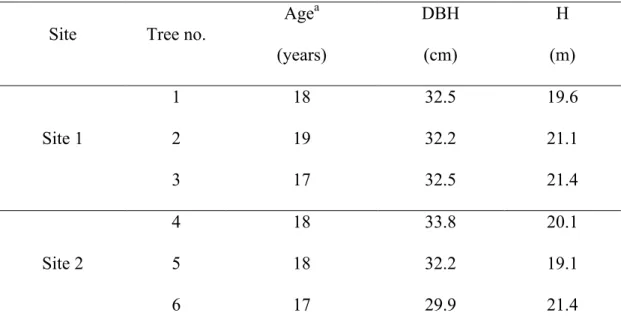
Samples were collected from two M. azedarach state-owned plantations in Vietnam. The location and detailed information of the two sites are given in Table 3.1. The trees were around 17–
19 years old (ring count at 15 cm above the ground). The trees were planted at a density of 830 trees per hectare at spacing of 4 m × 3 m from seedlings produced by seeds from natural forests located near each site. The anticipated rotational age of this species is approximately 15–20 years. Thinning was carried out at the ages of 3 and 6 (removing 50% of standing trees each time). The thinned trees were used as poles while the branches were used as firewood. In August 2016, six trees (three from each plantation) were harvested. The trees were chosen based on straightness, normal branching, and no signs of any diseases or pest symptoms. The trees were felled through cutting their stems at 15 cm above the ground. Diameter at breast height (1.3 m above the ground) as well as the total stem height for each tree were measured just before felling (Table 3.2).
26 3.3.2 Wood specimen preparation
Cross-sectional discs of 3 cm thickness from each tree were cut at different heights (0.3, 1.3, 3.3, 5.3, and 7.3 m height above the ground) to examine growth ring width (GRW) and specific gravity (SG). A 3-cm-thick disc was also collected from each tree at the height of 1.3 m for measurement of fiber length (FL) and microfibril angle of S2 layer of cell wall (MFA).
3.3.3 Growth ring width
Pith-to-bark strips [Radius × 30 (Tangential) × 15 (Longitudinal) mm] from the south side were cut from the discs and air-dried. Thus, the strips were conditioned in a room at a constant temperature (20 oC) and relative humidity (60%) to constant weight. With the same strips, images were taken using a Canon MP-650 scanner attached to a computer. GRW were measured using Image J software version 1.50i (Image-J). GRW of each tree was expressed as a mean value of all rings in that tree.
Table 3.1 General characteristics of the study sites
Description
Site 1 Northeast
Site 2 Northwest
Province Tuyen Quang Son La
Latitude 22°17ʹ′01ʺ″N 20°56ʹ′18ʺ″N
Longitude 105°19ʹ′22ʺ″E 104°26ʹ′25ʺ″E
Altitude (m) 112 434
Mean rainfall (mm year-1) 2000 1300
Mean temperature (°C) 23.4 24.0
Soil origin Calcisols Ferralsols
28
Table 3.2 Age, diameter at breast height, and total stem height of sampled Melia azedarach trees
Site Tree no.
Agea (years)
DBH (cm)
H (m)
Site 1
1 18 32.5 19.6
2 19 32.2 21.1
3 17 32.5 21.4
Site 2
4 18 33.8 20.1
5 18 32.2 19.1
6 17 29.9 21.4
DBH diameter at breast height (at 1.3 m above the ground), H tree height
a Measured by ring counting at the 15 cm above the ground
3.3.4 Wood specific gravity
Due to distinct growth rings (Fig. 3.1), after measuring the GRW, the same strips were then cut into individual rings for measurement of SG in air-dry. Two or more rings were combined in some positions where the rings were too small to be measured. SG, which is the ratio of the density of a wood to that of water at 4 ºC (Zobel and Van Buijtenen 1989), was measured by an electronic densimeter MD-300S (Alfamirage Co.Ltd, Japan). Measurement time per sample was about 10 s.
3.3.5 Fiber length and microfibril angle
Pith-to-bark strips [Radius × 20 (T) × 10 (L) mm] were cut from discs cut at 1.3 m for measuring FL and MFA. The outermost latewoods at ring number 1, 2, 3, 5, 8, 10, 13, 15, and 17 from pith of strips were cut and macerated by dipping in 1:1 solution of 65% nitric acid (HNO3) and distilled water (H2O) plus potassium chlorate (KClO3) (3 g/100 ml solution) for 5 days. The pieces were rinsed three times with distilled water, stained with safranin, and then mounted on a glass slide. The FL of 30 fibers was measured by using a profile projector (V-12, Nikon) at a 50-fold magnification.
Small blocks [10 (R) × 10 (T) × 10 (L) mm] at ring number 1, 2, 5, 10, and 15 were also prepared from the strips. Radial sections of 8 µm thickness were cut by microtome, macerated (using the solution described above) for 40 min, and cleaned in distilled water. The sections were dehydrated in 10% ethanol, and subsequently in an ethanol series of 30, 60, 80, and 100% ethanol for 5 min each.
The sections were then placed on a slide glass and immersed in a 3% solution of iodine-potassium for 2-5 s. One or two drops of 60% HNO3 were added and a coverslip was placed over the wetted specimen. MFA of 25 fibers per small block was measured by light microscope (Olympus DP70,
30
Fig. 3.1 Tree ring in cross section obtained from Melia azedarach (at 3.3 m height, Tree No.1, site 1)
3.3.6 Determination of fiber length increment (FLI)
Variations in length of wood fibers were approximated by a logarithmic relationship to the annual ring from the pith. The FLI was calculated using the procedure described by Honjo et al. (2005).
The FLI annually (from ring to ring) was determined using the following formula:
FLI =∆()∆&' (%)
Where: FLI is the fiber length increment; ΔFL is the change in fiber length; and ΔRN is the change in ring number. The FLI was then expressed as a percentage.
3.3.7 Statistical analysis
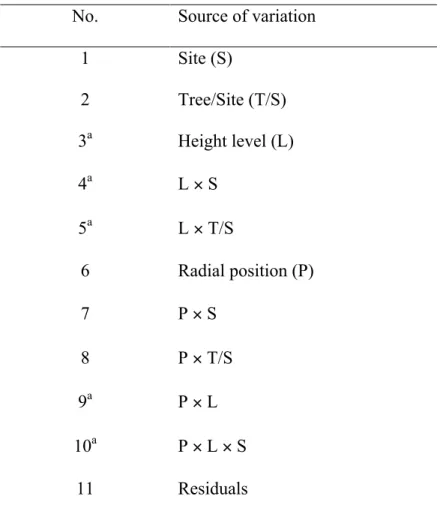
Analysis of variance (ANOVA) for all wood properties (GRW, SG, FL, and MFA) was performed according to the model shown in Table 3.3 to test the significance of site, tree, height level, and radial position effects. Trees were considered as random effects, and the other sources of variation as fixed effects. Variance components for the sources of variation were also estimated. Statistical analysis was performed using R software version 3.2.3 (R-software).
32
Table 3.3 Model used in the analysis of variance No. Source of variation
1 Site (S)
2 Tree/Site (T/S) 3a Height level (L) 4a L × S
5a L × T/S
6 Radial position (P)
7 P × S
8 P × T/S
9a P × L 10a P × L × S
11 Residuals
a Source of variations excluded in fiber length and microfibril angle analysis, since wood specimens were collected at 1.3 m stem height only
3.4 Results and discussion 3.4.1 Growth ring width
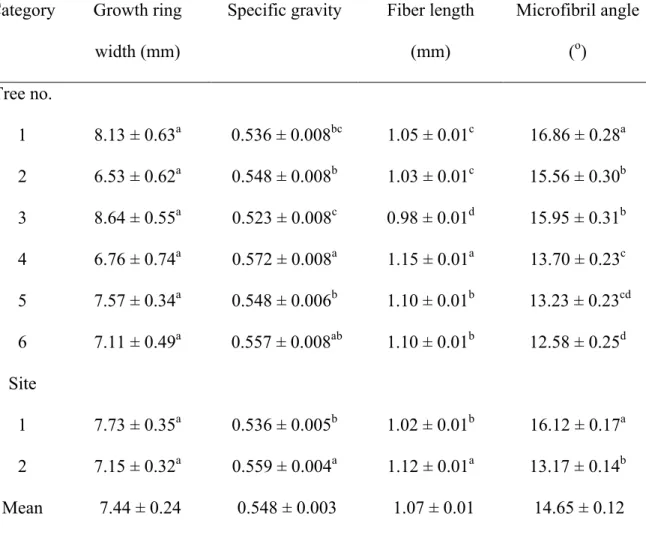
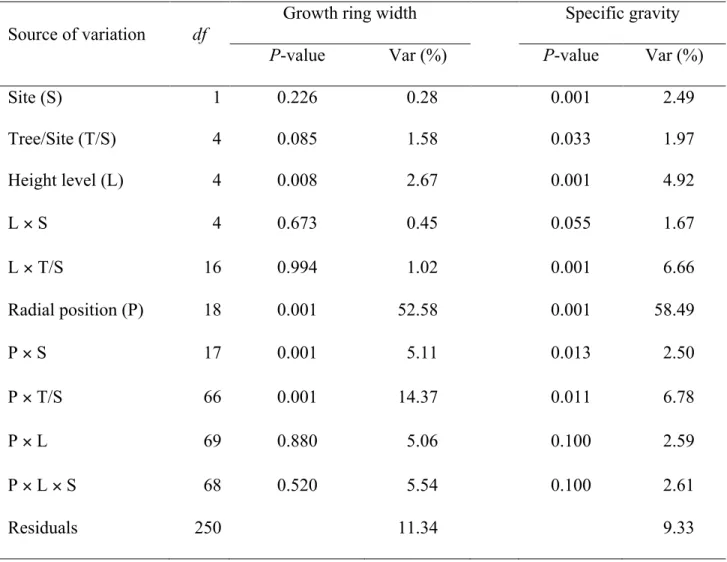
The GRW of M. azedarach was on average 7.44 mm, with an average range between trees from 6.53 to 8.64 mm (Table 3.4). Site and tree-to-tree within a site were not a source of variations of GRW, explaining only 0.28 and 1.58% of the total variation, respectively (Table 3.5). The radial variation of GRW was highly (P < 0.001) significant and contributed the highest (52.58%) of the total variation. Mean GRW near the pith was large and decreased rapidly with cambial age up to 5 and 6 years before being less or more stable to the bark. However, there were some fluctuations and spikes in some trees (Fig. 3.2). The longitudinal variation of GRW was highly significant (P < 0.05) but contributed little (2.67%) to the total variation (Table 3.5). Mean GRW decreased with height level ranged from 8.70 to 6.34 mm.
The findings of the present study are in agreement to those in literature for this species.
Matsumura et al. (2006) reported wood properties and their variation in the stem of 17-year-old M.
azedarach plantation trees grown in Japan. It was found that GRW near the pith up to 3-m height above the ground was large and became stable beyond the fourth ring regardless of stem height. GRW is highly variable as it is controlled by a variety of factors such as environmental fluctuations (Zobel and Van Buijtenen 1989). Besides, plant spacing is also a factor that can influence GRW. There is acceleration of growth for widely spaced trees than crowded trees, because widely spaced trees do not compete for growth elements such as nutrients, water, and sunlight, hence, they tend to have wider GRW (Zhu et al. 2000). In the present study, plant spacing was the same for two sites, hence, no significant (P > 0.05) difference was observed on mean GRW between the sites.
34
Table 3.4 Mean values per site and tree for selected wood properties of Melia azedarach Category Growth ring
width (mm)
Specific gravity Fiber length (mm)
Microfibril angle (o)
Tree no.
1 8.13 ± 0.63a 0.536 ± 0.008bc 1.05 ± 0.01c 16.86 ± 0.28a 2 6.53 ± 0.62a 0.548 ± 0.008b 1.03 ± 0.01c 15.56 ± 0.30b 3 8.64 ± 0.55a 0.523 ± 0.008c 0.98 ± 0.01d 15.95 ± 0.31b 4 6.76 ± 0.74a 0.572 ± 0.008a 1.15 ± 0.01a 13.70 ± 0.23c 5 7.57 ± 0.34a 0.548 ± 0.006b 1.10 ± 0.01b 13.23 ± 0.23cd 6 7.11 ± 0.49a 0.557 ± 0.008ab 1.10 ± 0.01b 12.58 ± 0.25d Site
1 7.73 ± 0.35a 0.536 ± 0.005b 1.02 ± 0.01b 16.12 ± 0.17a 2 7.15 ± 0.32a 0.559 ± 0.004a 1.12 ± 0.01a 13.17 ± 0.14b Mean 7.44 ± 0.24 0.548 ± 0.003 1.07 ± 0.01 14.65 ± 0.12 Mean values are followed by standard errors
a,b,c,d Means with different superscript within a column significantly differ (P < 0.05)
Table 3.5 Variance components for growth ring width and specific gravity of Melia azedarach
Source of variation df
Growth ring width Specific gravity
P-value Var (%) P-value Var (%)
Site (S) 1 0.226 0.28 0.001 2.49
Tree/Site (T/S) 4 0.085 1.58 0.033 1.97
Height level (L) 4 0.008 2.67 0.001 4.92
L × S 4 0.673 0.45 0.055 1.67
L × T/S 16 0.994 1.02 0.001 6.66
Radial position (P) 18 0.001 52.58 0.001 58.49
P × S 17 0.001 5.11 0.013 2.50
P × T/S 66 0.001 14.37 0.011 6.78
P × L 69 0.880 5.06 0.100 2.59
P × L × S 68 0.520 5.54 0.100 2.61
Residuals 250 11.34 9.33
df degrees of freedom, Var variance (%)
36
Fig. 3.2 Variation of growth ring width in the radial and vertical directions of Melia azedarach in two sites
0 5 10 15 20 25 30
0 5 10 15 20
Growth ring width (mm)
Ring number from pith
Site 1 0.3 m
1.3 m 3.3 m 5.3 m 7.3 m
0 5 10 15 20 25 30
0 5 10 15 20
Growth ring width (mm)
Ring number from pith
Site 2 0.3 m
1.3 m 3.3 m 5.3 m 7.3 m
3.4.2 Wood specific gravity
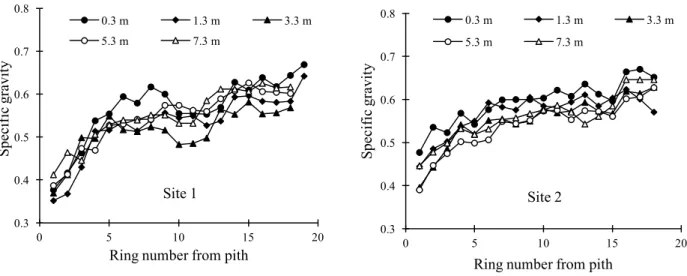
The results on wood SG of M. azedarach are presented in Tables 3.4 and 3.5, and Figs. 3.3 and 3.4. Site, tree-to-tree within the site, stem height position, and radial position significantly (P <
0.05) affected wood SG of M. azedarach. However, radial position contributed the highest (58.49%) to the total variation. The wood SG values of M. azedarach found in the present study ranged from 0.523 to 0.572 between trees. This is in agreement to the values for this species from plantation forest in literature. Richter and Dallwitz (2000) reported an SG of 0.5 – 0.65 of M. azedarach. On the other hand, Trianoski et al. (2011) and El-Juhany (2011) reported lower values, 0.49 and 0.404–0.413, respectively. The variation between different reports of wood SG of the same species may be attributed to age factor (El-Juhany 2011) and to effects of geographic variation such as latitude, temperature, and precipitation (Wiemann and Williamson 2002). In the present study, the differences in altitude, mean annual rainfall, and soil types between the two sites (Table 3.1) may have influenced the variation of wood SG of M. azedarach. However, further experiments will be needed to determine genetic effect on variation in wood SG for M. azedarach planted in northern Vietnam.
Wood SG in M. azedarach increased from pith to bark (Fig. 3.3). The pattern was the same at all stem height levels. The findings of the present study are in agreement to those in literature for M.
azedarach (Matsumura et al. 2006, Nock et al. 2009, El-Juhany 2011). This pattern was also seen in other species belong to Meliaceae family such as Toona ciliata (Nock et al. 2009) and Swietenia macrophylla (Lin et al. 2012). On the other hand, Wahyudi et al. (2016) reported a nearly constant basic density of Azadirachta excelsa from pith to bark. Besides, Ofori and Brentuo (2005) showed that the density of Cedrela odorata was low at the pith, increased rapidly outwards to a peak and
38
previous reports, radial variation of wood SG depends on species. For M. azedarach planted in northern Vietnam, this study showed that wood SG increases gradually from pith toward outside.
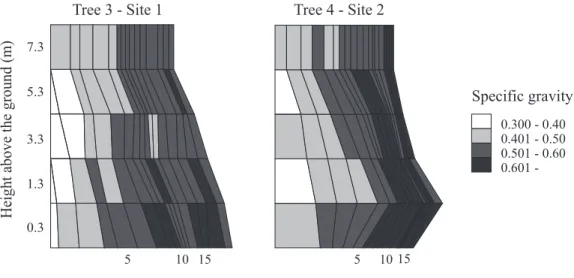
There were significant (P < 0.05) differences on SG among different height levels with the general trend decreasing from 0.3 to 3.3 m before slight increasing to the top (Fig. 3.3). The results are consistent with the results of Kim et al. (2008) who reported the SG at the stump was the highest, tending to decrease and then increase toward the top on Acacia mangium and Acacia auriculiformis planted in northern Vietnam. In agreement with Matsumura et al. (2006), Fig. 3.4 showed that there were low and high SG zones in the stem with the high SG zone exists in the outer area of the stem and the low SG zone in the inner area.
Fig. 3.3 Variation of specific gravity in the radial and vertical directions of Melia azedarach in two sites
0.3 0.4 0.5 0.6 0.7 0.8
0 5 10 15 20
Specific gravity
Ring number from pith Site 1
0.3 m 1.3 m 3.3 m
5.3 m 7.3 m
0.3 0.4 0.5 0.6 0.7 0.8
0 5 10 15 20
Specific gravity
Ring number from pith Site 2
0.3 m 1.3 m 3.3 m
5.3 m 7.3 m
40
Fig. 3.4 Tree stem maps showing variations in growth ring width and specific gravity. Each graph represents one tree from each site. Light and dark colors signify low and high specific gravity, respectively
Tree 4 - Site 2 Tree 3 - Site 1
0.3 3.3 1.3 7.3 5.3
Height above the ground (m)
5 10 15 5 10 15
Ring number from pith
0.300 - 0.40 0.401 - 0.50 0.501 - 0.60 0.601 - Specific gravity
3.4.3 Microfibril angle
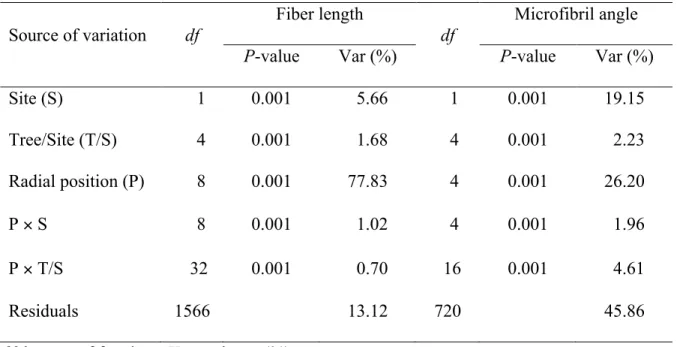
A summary of the results on MFA of S2 layer in cell wall of wood fiber of M. azedarach is presented in Tables 3.4 and 3.6. The results indicate that there were significant (P < 0.001) differences on MFA between sites, among trees, and along the radial direction. The most important and highly significance source of variation was radial position, explaining 26.20% of the total variation. Mean MFA followed a declining trend from pith to bark (Fig. 3.5). The phenotypic trends observed for MFA were consistent with previous reports in M. azedarach (Matsumura et al. 2006) and other species (Ishiguri et al. 2012, Todoroki et al. 2015). High MFA in rings close to the pith ensure flexibility and protect the young shoots from wind damage (Walker and Butterfield 1995).
3.4.4 Fiber length
FL results of M. azedarach are summarized in Tables 3.4 and 3.6. Mean FL was 1.07 mm, varying between trees from 0.98 to 1.15 mm. Site, tree-to-tree within site, and radial position were significant sources of variation in FL of M. azedarach. However, radial position contributed the highest (77.83%) to the total variation. FL at breast height showed an increase from pith to bark (Fig.
3.6). Radial increase in FL from pith to bark is due to increase in length with cambial age (Matsumura et al. 2006).
The length of fibers in the present study is in agreement to those in literature for M. azedarach.
Abdul (2007) reported a 0.78–1.3 mm length for M. azedarach fibers, while Richter and Dallwitz (2000) reported an average FL of 0.8–1.65 mm. Contrary, El-Juhany (2011) reported a lower average
42
L. (Leal et al. 2006). However, other researchers reported a small variation in FL among trees (Gartner et al. 1997). Tree-to-tree variation in FL among trees could be attributed to the inherent potential of individual trees to produce longer or shorter fibers than their neighbours (El-Juhany 2011).
Table 3.6 Variance components for fiber length and microfibril angle of Melia azedarach
Source of variation df
Fiber length
df
Microfibril angle P-value Var (%) P-value Var (%)
Site (S) 1 0.001 5.66 1 0.001 19.15
Tree/Site (T/S) 4 0.001 1.68 4 0.001 2.23 Radial position (P) 8 0.001 77.83 4 0.001 26.20
P × S 8 0.001 1.02 4 0.001 1.96
P × T/S 32 0.001 0.70 16 0.001 4.61
Residuals 1566 13.12 720 45.86
df degrees of freedom, Var variance (%)
44
Fig. 3.5 Radial variation of MFA for two different sites of Melia azedarach (Bars mean standard deviation)
0 5 10 15 20 25
0 2 4 6 8 10 12 14 16
Microfibril angle (o)
Ring number from pith
Site 1 Site 2
Fig. 3.6 Radial variation of fiber length for two different sites of Melia azedarach
y1= 0.2196ln(x1) + 0.6309 R² = 0.9472 y2= 0.1784ln(x2) + 0.8039
R² = 0.9397
0.4 0.6 0.8 1.0 1.2 1.4
0 2 4 6 8 10 12 14 16 18
Fiber length (mm)
Ring number from pith
Site 1 Site 2
46 3.4.5 Stabilizing point of fiber length increment
FL for site 1 and site 2 was regressed logarithmically (Fig. 3.6). Figure 3.6 shows that the radial pattern of FL of the studied trees from site 1 and site 2 could be calculated using the following functions: y1 = 0.2196ln(x1) + 0.6309, and y2 = 0.1784ln(x2) + 0.8039, respectively, where y is the variable of the fiber length and x is the variable of the ring number. Then, FLI in percentage for each ring number for the sites was estimated and plotted (Fig. 3.7). Figure 3.7 shows that FLI started stabilizing between 7th and 10th ring for both sites. This indicates that wood beyond 7th ring consists of comparative long fibers.
3.4.6 Implications for wood utilization of M. azedarach in northern Vietnam
The length of fibers in wood is essential for the optimization of timber utilization, quality, and value of final products (Shmulsky and Jones 2011). Mature wood with long FL, high SG, and low MFA is preferred for structural purposes (Shmulsky and Jones 2011, Uetimane and Ali 2011, Hein and Lima 2012). In the present study, FL increased from pith to bark (Fig. 3.6) and wood beyond ring number 7 from the pith consists of comparatively long fibers, high SG, and low MFA. Therefore, wood from ring number 7 to the bark could be used for structural purposes. In addition, M. azedarach trees planted in site 2 (Son La provenance) had higher SG, longer FL, and lower MFA than trees planted in site 1 (Tuyen Quang provenance). This implies that site 2 or any other location with similar environmental conditions (soil, rainfall, temperature, and altitude) to site 2 should be preferred for establishment of M. azedarach plantations in northern Vietnam. However, further study is required to determine the effect of seed source and mechanical properties for fully sustainable wood utilization of M. azedarach in northern Vietnam.
Fig. 3.7 Fiber length increment with cambial age of Melia azedarach in Vietnam (Bars mean standard error)
0 2 4 6 8 10 12 14 16 18
1 2 3 4 5 6 7 8 9 10 11 12 13 14 15 16 17 18
Fiber length increment (%)
Ring number from pith Site 1 Site 2
48 3.5 Conclusions
The results of the study showed a significant within-tree variation in all wood properties observed in this study. Longitudinal position significantly influenced GRW and wood SG. Mean GRW decreased with increasing stem height, while wood SG decreased from the stump to intermediate stem before slight increasing to the top. Radial position was highly significant to all wood properties and contributed the highest of the total variation. FL and wood SG increased from pith to bark, while GRW and MFA decreased from pith to bark. FLI stabilizes beyond ring number 7 from the pith. This should be taken into account when processing logs of M. azedarach trees in northern Vietnam.
CHAPTER 4
Transverse Shrinkage Variations within Tree Stems
A part of this chapter was submitted to J Wood Sci as: Doan Van Duong, Junji Matsumura (2018) Transverse shrinkage