九州大学学術情報リポジトリ
Kyushu University Institutional Repository
蛹寄生蜂アオムシヒラタヒメバチの繁殖戦略に関連 した栄養の獲得と配分と利用に関する研究
?, 宏岳
九州大学大学院生物資源環境科学府
https://doi.org/10.15017/26662
出版情報:Kyushu University, 2011, 博士(農学), 課程博士 バージョン:
権利関係:
Table of contents
Chapter 1. General Introduction ... 1
Chapter 2. The importance of food for female reproduction of I. naranyae ...10
2.1 Introduction ...10
2.2 Materials and Methods ...13
2.2.1 Insect culturing ...13
2.2.2 Longevity ...13
2.2.3 Fecundity ...13
2.2.4 Statistical analyses ...14
2.3 Results ...16
2.3.1 Longevity ...16
2.3.2 Fecundity ...21
2.4 Discussion ...23
Chapter 3. The cost of reproduction of I. naranyae ...26
3.1 Introduction ...26
3.2 Materials and Methods ...28
3.2.1 Insect culturing ...28
3.2.2 Experimental procedure ...28
3.3 Results ...29
3.4 Discussion ...36
Chapter 4. Food and egg production of I. naranyae ...40
4.1 Introduction ...40
4.2 Materials and methods ...43
4.2.1 Insect culturing ...43
4.2.2 Experimental Procedure ...43
4.2.3 Host fluid extraction ...44
4.3 Results ...46
4.3.1 The effect of food type ...46
4.3.2 The effect of body size and interaction with food type ...49
4.4 Discussion ...56
Chapter 5. Food and investment in egg size of I. naranyae ...60
5.1 Introduction ...60
5.2 Materials and Methods ...63
5.3 Results ...65
5.4 Discussion ...70
Chapter 6. Egg size and reproductive success of I. naranyae ...73
6.1 Introduction ...73
6.2 Materials and Methods ...76
6.2.1 Insect culturing ...76
6.2.2 Hatching time, egg size and larvae size...76
6.2.3 Developmental time ...77
6.2.4 Mother size and developmental time ...78
6.3 Results ...79
6.3.1Hatching time, egg size and larvae size...79
6.3.2 Developmental time ...79
6.3.3 Mother size and developmental time ...80
6.4 Discussion ...87
Chapter 7. General conclusion ...91
SUMMARY ...97
ACKNOWLEDGEMENTS ... 102
REFERENCES ... 104
Chapter 1. General Introduction
Nutrition is one of the most important factor influencing reproduction and survival in all organisms, but the strategies of acquisition and allocation employed are different and affected by a lot of factors. The primary aim of evolutionary ecology has been to explain the divergent patterns in life-history among and within animal species.
Insect parasitoids are one of the most diverse groups of insects with various life-history strategies, and have been shown as an excellent model organism in evolutionary ecology. The patterns of nutrient allocation, utilization, and acquisition in parasitoids are important in understanding their reproductive strategies (Zhang et al., 2004; Bernstein and Jervis, 2007; Jervis et al., 2008). Parasitoids can show species-specific differences in reproductive strategies, which have attracted numerous biologists and evolutionary ecologists, and it is an essential constituent of parasitoids in biological control (Zhang et al., 2004). Moreover, the reproductive strategies of natural enemies, including parasitoids, are fundamental in the evaluation of a potential biological control agent (Jervis and Kidd, 1986).
Parasitoids acquire nutrients during both larval and adult stages. The development of parasitoids before emergence is completed inside the host (Sequeira and Mackauer, 1992, 1993; Harvey and Strand, 2002; Harvey et al., 2004). As a result, host resources for parasitoid development are often highly limited (Slansky, 1986).
Immature parasitoids use host nutrients to support their development, and a part of
these resources is also allocated to egg production in the adult stage (Godfray, 1994;
Harvey, 2005). After emergence from host, adult parasitoids feed on sources of carbohydrates such as honey, honeydew and nectar to support their daily maintenance and reproduction (Boggs, 1981). Many species exhibit a behavior called host-feeding, which is the consumption of the host body fluids and tissues, to acquire the crucial nutrients (mainly protein and lipid) for egg production (Jervis and Kidd, 1986;
Heimpel and Collier, 1996).
Nutrient acquisition and allocation strategies of parasitoids are critically correlated to life-history traits, i.e., the modes of egg production and parasitism.
Flanders (1950) divided parasitoids into two types in terms of egg production: (1) Pro-ovigenic species that emerge with a full egg complement and do not mature additional eggs during adult life, which means the nutrient stored in larval stage should mainly be allocated to reproduction; and (2) Synovigenic species that emerge with no or few mature eggs and continue to mature during the adult stage, so the nutrient stored in larval stage should represent only a part of resources to be used for reproduction.
On the other side, Askew and Shaw (1986), according to the host performance after parasitism, divided parasitoids into idiobionts and koinobionts. Usually, strictly pro-ovigenic species are koinobionts, which produce small, yolk-deficient eggs. In those species, the fecundity is very high in their early adult stage, but decreases fast with age, and the adult diet is utilized for their activities and maintenance. In contrast,
eggs in compensation of the low fecundity; adult nutrient would partly invest to reproduction.
Besides those external factors, internal factors such as body size also affect parasitoids’ fitness. When considering reproductive resource allocation, female body size is a crucial trait in life history (Jervis et al., 2008). Body size, which directly reflects the resource acquiring and/or storing capability of an individual, is one of the key traits because it is correlated with life-history parameters such as mating efficiency, dispersal capability and most importantly, reproductive success (Ueno, 1998, 1999b; Ellers et al., 1998). Theoretically, larger body size enables parasitoids to store more energy and to produce more eggs, resulting in longer life span and higher reproductive success (Ueno, 1999b; Rivero and West, 2002; Ueno and Ueno, 2005).
Numerous laboratory studies have reported the positively correlation between body size and life-history traits such as longevity or fecundity in parasitoids (Nakamura, 1995; Bezemer et al., 2005; Harvey, 2008).
The evolution of life history models assume that trade-offs will arise when two traits are limited by the same resource, such as between early and late reproduction, between body size and fecundity and between reproduction and longevity (Sterns, 1989; Roff, 1992). Generally, trade-off emerges when a change in one trait leads to an increase in some fitness while another trait also changes at the same time, which leads to a decrease in other fitness. Under the constraint of some conditions, a trade-off is a correlation between traits -- a positive change in one by itself is opposed by a negative effect in another (Jervis and Kidd, 1986; Ellers et al., 1998; Roff and Fairbairn, 2007).
For example, an investment of more internal resources towards egg production during adult life is at the cost of a reduced life-span (Harvey, 2008). Many factors can constrain resource availability including ecological conditions and the structure of an organism’s life cycle, especially in natural field. Thus, the developmental, physiological and morphological traits exhibit a species specialization.
Study organism
Itoplectis naranyae Ashmead (Hymenoptera: Ichneumonidae) (Fig. 1-1) is a solitary endoparasitoid wasp that attacks a variety of lepidopterous pupae (Ueno and Tanaka, 1994). This parasitoid is widespread and abundant in rice paddies of Japan and other East Asian countries, where it is an important natural enemy of lepidopterous pests such as rice leaf folder (Ueno and Tanaka, 1994).
This species produces relatively large yolk-rich eggs and has a relatively long lifetime (Ueno, 1998). Ueno and Ueno (2007) have demonstrated that it is typically synovigenic, and host-feeding positively affects its egg production. The fecundity is relatively low and only a small fraction of eggs is stored in the ovary throughout lifetime. Female I. naranyae carries no mature eggs at eclosion, but fecundity quickly increases even when hosts are unavailable. They can produce about 30 eggs without host-feeding using nutrients stored during the larval stage. Host feeding allows females to produce additional eggs, but there is a three days’ delay between the host-feeding behavior and egg maturation (Ueno and Ueno, 2007). I. naranyae is a destructive host-feeder, so the hosts that are used for host-feeding would be not appropriate for oviposition (Ueno, 1998; Ueno and Ueno, 2005). Thus, when encountered a host, female has to make a decision between ovipositing and feeding as food (Ueno, 1998).
Wild Itoplectis naranyae females were collected from grassy fields on the shore of the Umigawa River, Higashi-Ku, Fukuoka City, and then placed individually in plastic containers (7.5 cm in diameter, 4.5 cm in height). Absorbent cotton saturated
with 20% honey solution was offered as food source, and the cotton was replaced twice a week. Parasitoids were incubated under a controlled condition (20 ± 1℃, 60 – 80 % RH, 16:8 h L:D regime). The pupae of greater wax moth Galleria mellonella Linnaeus (Lepidoptera: Pyralidae) were used as hosts. Host cocoons with fresh pupae were offered to female I. naranyae in the container. After parasitization, the hosts were removed from the container and were incubated at 25 ± 1℃ until parasitoid emergence. The voucher specimens were placed in the Laboratory of Insect Natural Enemies, Kyushu University.
Host
Galleria mellonella is a moth of the family Pyralidae and the only member of the genus Galleria. It is widespread in most of the world as a pest of honeybee. They were mass-reared in plastic cases (30 cm in length, 20 cm in width, 5 cm in height), and artificial food – a mixture of wheat bran, honey, bee wax, glycerin and yeast, was presented in the cases. The cases were placed in a climatic incubator at 30 ± 1℃ and 60 – 80 % RH. After pupation, the fresh cocoons were collected and used in the experiments. The rest part of hosts was stored in a refrigerator to prevent them from further development.
Fig. 1-1. Females of the Ichneumonid parasitoid Itoplectis naranyae Ashmead (Hymenoptera: Ichneumonidae). (A) visiting a flower to feed on nectar in the field; (B) parasitizing the pupa of greater wax moth Galleria mellonella Linnaeus (Lepidoptera: Pyralidae).
A
B
Thesis outline
The present thesis was performed to examine the effects of nutrients on the life-history reproductive strategies in the pupae parasitoid Itoplectis naranyae. The objectives of this study were:
Chapter 2 examined the sugar source availability on the longevity and fecundity of female I. naranyae. The body size was employed as a parameter to evaluate the effect on life-span.
In Chapter 3, the benefit of host-feeding and the cost of reproduction of femaleI.
naranyae were discussed. The impact of host availability and body size on female survival was tested, and the interaction of these two traits was analyzed.
In Chapter 4, in response to a fixed amount of different food sources, the strategy of nutrients allocation on the egg production and maturation in the later life stage of I.
naranyae was examined. The effect of body size on fecundity was also evaluated.
Chapter 5 addressed the investment to eggs under variable conditions of adult nutrient types and body size in adult stage of I. naranyae.
In Chapter 6, the effect of egg size on the fitness traits of larval I. naranyae, including hatching time, developmental time, survival, and sex ratio was assessed.
Based on the results above, I summarized life time strategies of I. naranyae, and emphasized the flexibility and variation of reproductive strategies under the
strategies was discussed, and the potential prospect as a successful biological control agent in the field was evaluated.
Chapter 2. The importance of food for female reproduction of I. naranyae
2.1 Introduction
All of organisms need a variety of nutrients, such as carbohydrates, proteins, and lipids, to support their development, reproduction and daily maintenance. Classical life history models assume that trade-offs will arise between reproduction and survival when resources are limited (Sterns, 1989; Roff, 1992). Likewise, trade-offs have commonly been detected between variable life history traits (Jervis and Kidd, 1986;
Ellers et al., 1998; Roff and Fairbairn, 2007; Harvey, 2008). For example, an investment of more internal resources towards egg production during adult stage is at the cost of a reduced life-span, which is a trade-off between reproduction and survival (Harvey, 2008). Many factors can constrain resource availability including ecological conditions and the structure of an organism’s life cycle.
Parasitoids lay their eggs on or in the body of other insects, and the larvae develop by feeding on the host and eventually kill it. Nutrient acquisition and allocation can critically impact the fitness of parasitoids (Rivero and Casas, 1999;
Jervis et al., 2008). Food acquisition by adult parasitoids was described by numerous researches in parasitoid biology and biological control, and information regarding the effect of feeding on the parasitoids’ key life-history variables, such as fecundity and
aspects, such as host-finding and dispersal efficiency (Nakamatsu and Tanaka, 2003).
Moreover, parasitoids should be under selection to optimize utilization of limited resources to competing fitness functions such as reproduction and survival.
Carbohydrates, for example, obtained by adults from host or non-host resources enhance the reproduction and survival of parasitoids (Boggs, 1981; Fadamiro and Chen, 2005; Lee et al., 2006; Ho and Ueno, 2011). Most of daily maintenances are also from sugar sources. Carbohydrates are the only nutrient used for flight by Hymenoptera and this nutrient class is rapidly depleted if adults are starved (Harrison and Fewell, 2002). In the absence of carbohydrates, fat body reserves may be metabolized for maintenance instead (Ellers et al., 1998, 2000). Proteins and lipids obtained through host feeding or other sources increase the production of yolk-rich eggs by allowing females to invest less reservation in maintenance functions.
Consequently, the optimal phenotype is likely to be determined by a trade-off between life-history characters when extrinsic sources of nutrition are in short supply (Rivero and West, 2002).
Body size, which directly reflects the resource acquiring and/or storing capability of an individual, is one of the key traits determining parasitoid fitness (Ueno, 1998, 1999b; Ellers et al., 1998; Rivero and West, 2002; Ueno and Ueno, 2005). Numerous laboratory studies have reported the positively correlation between body size and longevity or fecundity in parasitoids (Nakamura, 1995; Bezemer et al., 2005; Harvey, 2008).
The present study examined: longevity with or without food source; the
relationship between female body size and longevity; the egg production with or without food source. The reproductive strategies of synovigenic parasitoids are discussed here.
2.2 Materials and Methods
2.2.1 Insect culturing
All experiments in this study were carried out under controlled conditions in the laboratory (20 ± 1℃, 16:8 h L:D regime). Newly emerged females for testing were collected from rearing containers (10 cm in diameter, 4.5 cm in height) and were anesthetized with CO2 to weigh on a microbalance. The females were then individually placed in plastic containers (10 cm in diameter, 4.5 cm in height) together with a male. The male was removed after 24 hours.
2.2.2 Longevity
This experiment was conducted to estimate life expectancy of I. naranyae under different food conditions, which is 20% honey solution and water as a control treatment. The food source was saturated in cotton, and the cotton was replaced twice a week. Forewing length of females was also recorded as a parameter of body size.
2.2.3 Fecundity
In this experiment, I designed an experimental tool to estimate egg production by female I. naranyae in the absence of host meal (host-feeding). Plastic tubes (8 mm in diameter) each with 40-50 little holes (0.3 mm in diameter) on the surface were
prepared. A host pupa was put into each tube when given to test females. Female I.
naranyae were able to recognize the host pupae inside the tubes and attack them.
Oviposition into host pupae was possible through the holes made on the surface of plastic tubes but feeding on host materials was prevented.
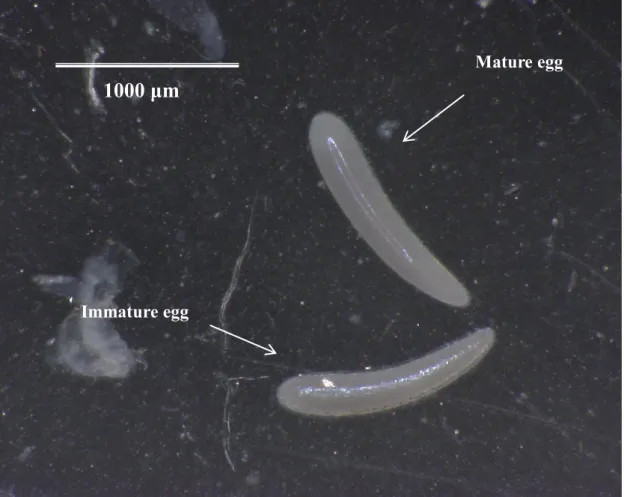
From the 3rd day after emergence, each female was offered two plastic tubes containing a fresh host pupa for 2 hours every day, and this procedure was continued in the next 9 days. Then, the saturated cotton was removed from the containers, and test females were starved for 24 hours. Twenty-four hours later, test females were orally fed 3μL different food sources (i.e., 20% sucrose solution, or water as a control) with a micro-injector. Thereafter, the females were offered with water only. On the 3rd day after the treatment above, test females were dissected under a microscope at 25× magnification. The mature eggs have a smooth and clear surface and relatively straight which can be easily separated from immature eggs with a rough surface (Fig.
2-1). The numbers of total eggs, immature and mature eggs were counted and recorded under a microscope.
2.2.4 Statistical analyses
Statistical analyses were made with the aid of JMP (SAS Institute 2005).
Fig. 2-1. Comparison of mature egg and immature egg of I. naranyae at 100× magnification.
Mature egg
Immature egg 1000 μm
2.3 Results
2.3.1 Longevity
A comparison of survival curves indicated that the longevity of females sharply decreased when food source removed females (survival analysis; x2 = 28.23, P <
0.0001, Fig. 2-2). The mean longevity (with ±SE) was 52.33 ± 2.34 days when honey solution provided while that with water was 11.56 ± 0.81 days. I applied proportional hazard fits for analyzing the longevity data. Because I had two indexes for body size, i.e., body weight at parasitoid emergence and forewing length, and because I did not know which index was better, two models were constructed (see Table. 2-1). Whole models obtained were highly significant (model 1; N = 33, df = 3, x2 = 42.11, P <
0.0001, model 2; N = 33, df = 3, x2 = 42.15, P < 0.0001).
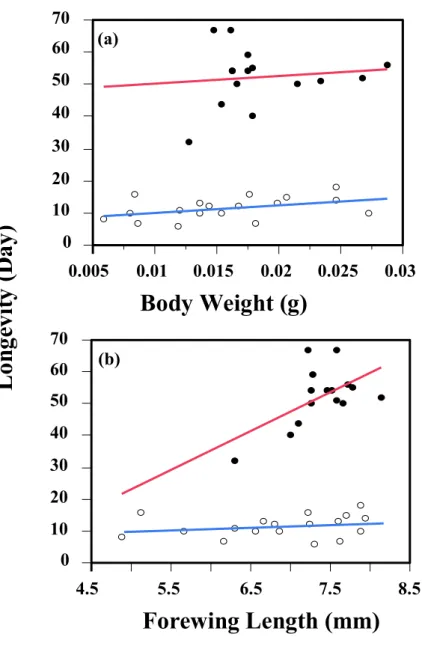
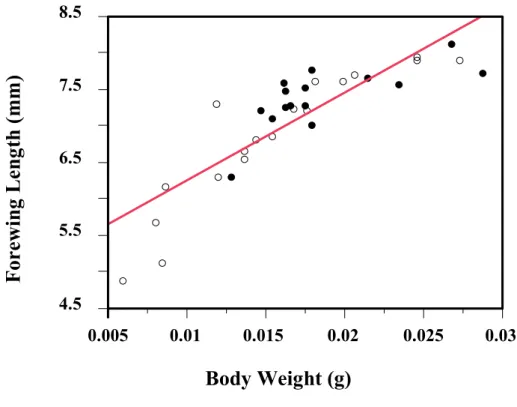
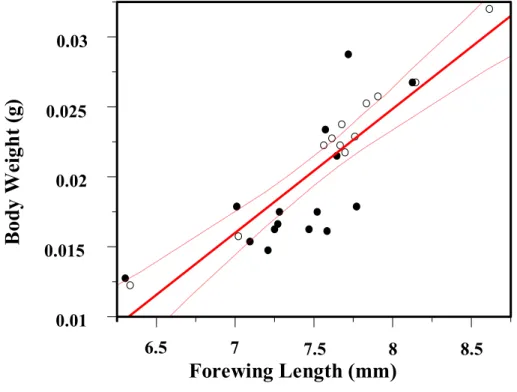
Simple regression analyses were made to examine the relationships between longevity and body weight or forewing length. Forewing length was significantly and positively correlated to female longevity regardless of food presence (r2 = 0.94, F = 139.84, P < 0.0001; Fig. 2-3b), and the same with body weight (r2 = 0.91, F = 101.69, P < 0.0001; Fig. 2-3a). Although body weight at emergence and forewing length were strongly correlated with each other (Fig. 2.4; N = 33, r2 = 0.74, F = 87.24 P = 0.0001), However, in the effect tests, comparing with body weight, the forewing length may be a better predictor of body size of female I. naranyae.
Table 2-1. Survival analysis for accessing factors affecting the longevity of I.
naranyea in the food availability. Proportional hazard fits are applied.
Factors Chi-square P
Model 1
Forewing Length (mm) 2.05 0.15
Food Availability 34.16 < 0.0001
Interaction 1.20 0.27
Model 2
Body Weight (g) 0.32 0.57
Food Availability 39.13 < 0.0001
Interaction 1.18 0.28
Fig. 2-2. The comparison of survival curves of I. naranyea between the females with honey solution ( ) and the ones with water only ( ). The longevity of females sharply decreased when food source removed females (p < 0.0001).
0.0 0.2 0.4 0.6 0.8 1.0
Su rv iv in g
10 20 30 40 50 60 70
Longevity (Day)
Fig. 2-3. Simple regression analyses between longevity and body weight (a) or forewing length (b) of I. naranyea. Both of them significantly affected the longevity no matter the honey group ( ) or water group ( ).
0 10 20 30 40 50 60 70
L on ge vi ty ( D ay )
0.005 0.01 0.015 0.02 0.025 0.03
Body Weight (g)
0 10 20 30 40 50 60 70
4.5 5.5 6.5 7.5 8.5
Forewing Length (mm)
(a)
(b)
Fig. 2-4. The regression analyses between body weight at emergence and forewing length of I. naranyea. The two parameters are significantly correlated with each other (P < 0.0001).
4.5 5.5 6.5 7.5 8.5
Forewing Length (mm)
0.005 0.01 0.015 0.02 0.025 0.03
Body Weight (g)
2.3.2 Fecundity
One way ANCOVAs were performed to access the effect of food availability on the fecundity. The number of total eggs that female I. naranyae carried was significantly different between the two groups (Fig. 2-5a; F = 7.59, P = 0.0115).
Females orally fed with sucrose solution had a greater number of eggs (mean ± SE:
31.1 ± 2.66) in their ovary, those fed with water (21.3 ± 1.96) intermediate. Also, the similar phenomena were detected for immature eggs (Fig. 2-5b; F = 5.14, P = 0.0336;
for sucrose treatment: mean ± SE = 25.3 ± 2.15; for water treatment: mean ± SE = 18.7 ± 1.63). The most significant correlation has been found in mature eggs (Fig.
2-5c; F = 7.09, P = 0.014; for sucrose treatment: mean ± SE = 5.86 ± 0.99; for water treatment: mean ± SE = 1.74 ± 0.37). Without food source, female fecundity decreased critically in no matter egg production or egg maturation.
Fig. 2-5. The ANOVAs performed to assess the effects of food on the total eggs (a), immature eggs (b) and mature eggs (c) of female I. naranyea. The differences were significant in both total eggs and immature eggs, the most in mature eggs.
10 20 30 40 50
Total Eggs
Sucrose Water
5 15 25 35 45
Immature eggs
Sucrose Water
0 5 10 15
Mature Eggs
Sucrose Water
Treatment (a)
(b)
(c)
2.4 Discussion
Sugar sources can have a dramatic impact on the activity, longevity and lifetime fecundity of parasitoids (Lee et al., 2006). In the wild field, it is normal for parasitoids to face a situation of food shortage temporally and spatially. Thus, the availability of food can be very important to their efficiency in biological control (van Rijn and Tanigoshi, 1999; Winkler et al., 2006). Typically, the food availability has a strong impact on survival and reproductive of the adults (van Rijn et al., 2006; Winkler et al., 2006).
Many parasitoids mainly rely on carbohydrates as a source of energy to fuel activity, maintenance, metabolic expend and reproduction (Jervis et al., 2008). For example, arthropods such as Hymenoptera and Diptera show high frequency wing muscle contractions where primarily contain oxidize carbohydrates. The fact that the mobilization of energy from carbohydrates can be very rapidly makes sugars especially suit to supply the large requirement in energy during flight (Hoferer et al., 2000). Carbohydrates obtained by adults from host or non-host resources enhance longevity and survival (Jervis et al., 2008).
In the present study, female I. naranyae were allowed unlimited access to a carbohydrate source, i.e., honey. In this experimental condition, their mean longevity is beyond 1.5 months, the value of which demonstrates I. naranyae has a considerably long lifetime among parasitoid wasps. The sharp decrease of lifetime in the absence of carbohydrate sources indicates that internal storage in I. naranyae is rapidly depleted when resources are allocated to both physical and metabolic activities.
Many parasitic wasps can reabsorb eggs as a temporal nutrient source under food limitation or in the absence of hosts, which was known as ‘egg resorption’ (Jervis et al., 2001). Egg resorption is frequently associated with parasitoid species that produce large, yolk-rich eggs and show host-feeding (Flanders, 1950; Bell and Bohm, 1975).
Also, it is believed that such parasitoids convert nutrients taken from their eggs into energy for maintenance or activity in order to increase the future reproductive opportunity. Egg resorption may particularly be advantageous for long-lived species because flexible re-allocation of resources allows them to endure temporary severe conditions. In the present study, fecundity sharply decreased in the control group when compared with the female group fed with sucrose. This result indicates that egg resorption also takes place in I. naranyae under food limitation. As we have shown, I.
naranyae has a long life span, when sugar source is lacking, I. naranyae show ‘egg resorption’, which implies re-allocation of resources they carry and big size egg production.
Most insects exhibit a variation of adult body size led by the environmental and genetic effects. The size-dependency of reproduction and morality rates is induced by the differences in growth rate and the duration of important periods (Roff, 2002;
Nijhout et al., 2006). Numerous studies have reported that body size is correlated with life-history traits such as mating efficiency, dispersal capability, and longevity (Visser, 1994; Rasa et al., 2000; Skow and Jakob, 2003; Bezemer et al., 2005; Jervis et al., 2008). Larger wasps are presumably better able to storage metabolic resources for maintenance than small wasps. This may explain why body size always positively and
source.
If food limitation occurs, the degree of the cost may be much higher depending on the size of females. Future studies will then focus on the interaction between food and cost of reproduction.
Chapter 3. The cost of reproduction of I. naranyae
3.1 Introduction
Life-history models suggest trade-offs among traits, which may play an important role in shaping the structure of ecological communities (Sterns, 1989; Roff, 1992). Generally, under the constraint of some conditions, a trade-off is a correlation between traits -- a positive change in one by itself is opposed by a negative effect in another (Jervis and Kidd, 1986; Ellers et al., 1998; Roff and Fairbairn, 2007). For example, an investment of more internal resources towards egg production during adult life is at the cost of a reduced life-span (Desouhant et al., 2005). Parasitoids have long been considered as model organisms in testing many aspects of evolutionary theory (Godfray, 1994) but the cost of reproduction has seldom been examined in parasitoids.
Nutrient acquisition and allocation critically impact the fitness of all organisms (Rivero and Casas, 1999; Jervis et al., 2008). During the larval stage, parasitoids acquire nutrients by feeding on hosts mainly for their development but part of the nutrients is stored for future egg production in adult life (Godfray, 1994; Harvey, 2005). Adult parasitoids, particularly the females, feed on sources of carbohydrates such as nectar and honeydew to support their daily maintenance and reproduction (Boggs, 1981). In the other side, many species exhibit a behavior called host-feeding,
nutrients (mainly proteins and lipids) for egg production (Sandlan, 1979; Jervis and Kidd, 1986; Heimpel and Collier, 1996; Ferracini et al., 2006). Synovigenic parasitoids are typically born with no or a limited number of mature eggs and continue to mature eggs during the adult stage (Jervis et al., 2001). Thus, their fitness is strongly dependent on the number of further eggs that they can produce during their adult life (Rosenheim, 1996).
Itoplectis naranyae Ashmead, (Hymenoptera: Ichneumonidae) is typically synovigenic and is a host-feeding species; female I. naranyae carries no mature eggs at eclosion, but fecundity quickly increases even when hosts are unavailable. They can produce about 30 eggs without host-feeding using nutrients stored during the larval stage. Host feeding allows females to produce additional eggs, but there is a three days’ delay between the host-feeding behavior and egg maturation (Ueno and Ueno, 2007). This species is destructive, which means hosts that had been fed on are heavily damaged and not suit for oviposition.
Although carbohydrate food for the adults and host meal obtained via host-feeding are known to affect the fitness of pupal parasitoids like I. naranyae, it is unknown how these two nutrient sources interactively affect the reproductive success of pupal parasitoids. The present study compared the female longevity when different food sources were given and when host availability was changed.
3.2 Materials and Methods
3.2.1 Insect culturing
Experimental hosts and parasitoids were prepared and cultured as described in Chapter 2.
3.2.2 Experimental procedure
This experiment was conducted to estimate life expectancy of I. naranyae under different host and food conditions. Test females were first divided into two groups.
Females of the first group were reared in the absence of host throughout their lifetime whereas, in the other group, each female was provided with 3 hosts for 2 hours every day until the death of them. Both of the two groups were further divided into three groups, and each of the groups was subject to different food type treatments: 20%
sucrose solution, 20% honey solution and water as a control. The food source was saturated in cotton, and the cotton was replaced twice a week. Thus, in all, 6 female groups were set up and 90 individuals in all were tested. Forewing length of females was also recorded as a parameter of female size.
3.3 Results
The mean longevity (with ± SE) of female wasps was 54.35 ± 1.96 days when no hosts had been provided while that with hosts was 45.56 ± 0.60 days. We applied proportional hazard fits for analyzing the longevity data. Because we had two indexes for body size, i.e., body weight at parasitoid emergence and forewing length, and because we did not know which index was better, two models were constructed (see Table. 3-1). Whole models obtained were highly significant (model 1; N = 27, df = 3, x2 = 17.82, P = 0.0005, model 2; N = 27, df = 3, x2 = 15.20, P = 0.0017). For both models, host provision strongly affected the life expectancy of females, and a comparison of survival curves indicated that females that had given hosts had shorter lifetime than those without hosts (Fig. 3-1).
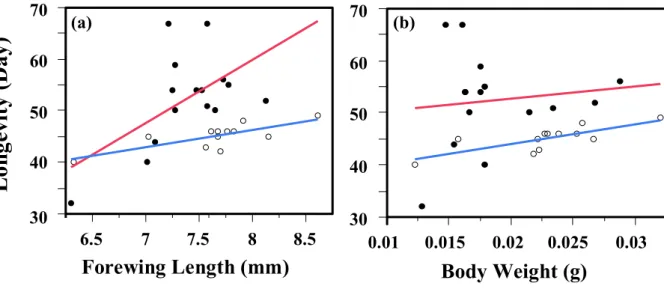
Simple regression analyses were made to examine the relationships between longevity and body weight or forewing length. Forewing length was significantly and positively correlated to female longevity regardless of host presence (Fig. 3-2a; N = 12, df = 1, F = 13.69, P = 0.0041 for host provided group; N = 15, df = 1, F = 6.22, P
= 0.027 for host deprived group). However, body weight had a significant effect only for host provision group (Fig. 3-2b; N = 12, df = 1, r2 = 0.60, F = 14.93, P = 0.0031), but not for host deprived group (N = 15, df = 1, r2 = 0.014, F = 0.18, P = 0.68).
Although body weight at emergence and forewing length were strongly correlated each other (Fig. 3-3; N = 27, r2 = 0.74, F = 71.64, P < 0.0001), forewing length may be a better predictor of body size of female I. naranyae.
On the other side, the lifetime of females feed on sucrose solution (number = 30;
mean ± SE: 84.5 ± 2.44; p < 0.0001; Fig. 3-4a) were apparently improved than ones with honey solution (number = 27; mean ± SE: 49.1 ± 6.22; p < 0.0001; Fig. 3-4b), while longevity sharply decreased in the absence of food (number = 33; mean ± SE:
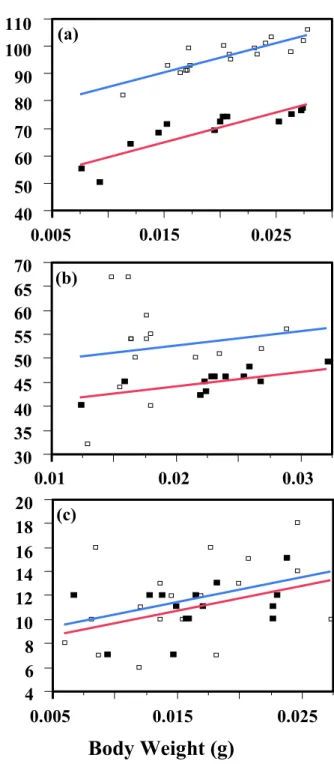
11.3 ± 1.44; p < 0.0001; Fig. 3-4c). The body size had a positive effect on the longevity among food types, but only in sucrose treatment (r2 = 0.95; p < 0.0001; Fig.
3-4a) the positive interacttion between body size and longevity was significant, while not in honey (r2 = 0.26; p < 0.0001; Fig. 3-4b) and water treatment (r2 = 0.17; p <
0.0001; Fig. 3-4c).
Table. 3-1. Survival analysis for accessing factors affecting the longevity of I.
naranyea in the absence and presence of host. Proportional hazard fits are applied.
Factors Chi-square P
Model 1
Forewing Length (mm) 4.84 0.028
Host Provision 16.13 0.0001
Interaction 0.52 0.47
Model 2
Body Weight (g) 1.00 0.32
Host Provision 14.58 0.0001
Interaction 1.63 0.19
Fig. 3-1. The comparison of survival curves of I. naranyea between the females with hosts ( ) and the ones without hosts ( ). Females that had given hosts had shorter lifetime than those without hosts
0.0 0.2 0.4 0.6 0.8 1.0
Su rv iv in g
30 35 40 45 50 55 60 65
Longevity (Day)
Fig. 3-2. Simple regression analyses between longevity and forewing length (a) or
body weight (b) of I. naranyea. Both of them significantly affected the longevity no
matter the host presence ( ) or host absence ( ).
Lo ng ev it y (D ay )
30 40 50 60 70
6.5 7 7.5 8 8.5
Forewing Length (mm)
30 40 50 60 70
0.01 0.015 0.02 0.025 0.03 Body Weight (g)
(a) (b)
Fig. 3-3. The regression analyses between body weight at emergence and forewing length of I. naranyea. The two parameters are significantly correlated with each other (P < 0.0001).
Body Weight (g)
0.01 0.015 0.02 0.025 0.03
6.5 7 7.5 8 8.5
Forewing Length (mm)
Fig. 3-4. The interaction of host availability and body weitht on the longevity of I.
naranyea with different food treatment: Sucrose (a), Honey (b), Water (c). With host ( ); Without host ( ).
40 50 60 70 80 90 100 110
L on ge vi ty ( D ay )
0.005 0.015 0.025
30 35 40 45 50 55 60 65 70
0.01 0.02 0.03
4 6 8 10 12 14 16 18 20
0.005 0.015 0.025
Body Weight (g) (a)
(b)
(c)
3.4 Discussion
As a host-feeding species, upon encountering a host, a female should face a dilemma whether to oviposit or feed on that host (Briggs et al., 1995). She can obtain an immediate reproduction success by using the host for oviposition while oviposition will decrease her life expectancy due to the cost of reproduction; she can gain nutrients for future reproduction by host feeding but loses the current reproductive chance, i.e., oviposition, because host feeding causes the direct mortality of hosts making them unsuitable for oviposition (Rivero and Casas, 1999; Giron and Casas, 2003; Burger et al., 2005). Traditionally, a potential reduction for future reproduction is at the cost of a current reproduction, this trade-off is essential for researches of the evolution of reproductive investment (Desouhant et al., 2005). Thus, how much energy an organism invests to the eggs is supposed to depend on its reproductive chances in the future, which will be affected by both of physiological state (e.g. age, nutrition) and environmental factors (e.g. resource availability), but eventually aim at the optimal reproductive success.
The differing effects of host access on longevity may be based on the strategies parasitoids employ to obtain resources for maintenance versus reproduction (Harvey, 2005; Jervis et al., 2008). In the present study, the longevity of female I. naranyae was lower when provided with hosts than those deprived of hosts. This finding indicates the presence of a trade-off between reproduction and life expectancy, i.e., cost of reproduction. Such a trade-off is the basis of the hypothesis of evolutionary
Adult parasitoid species with host-feeding behavior are highly dependent on resource acquisition from both the environment (carbohydrates and proteins) and host (proteins and lipids), because of the rapid depletion when resources are allocated to both metabolic activity and reproduction (Jervis et al., 2008). The suitability of a particular food source is not only a function of food source characteristics but also depends on how well consumers are adept to its exploitation. Insects have the behavioral, morphological and physiological adaptations that enhance their ability to locate and digest specific food sources. They are supposed to develop adaptation to the food sources within their habitat.
Parasitoids have to balance between the searches for food and hosts. The search for food resources mainly depends on the temporal and spatial relationship between hosts and food resources (Bernstein and Jervis, 2008; Downes and Dahlem, 1987;
Sirot and Bernstein, 1996). Carbohydrates obtained by adults from host or non-host resources can enhance longevity and survival (Jervis et al., 2008). In the natural field, sugar sources for parasitoids are various, such as honeydew, nectar and so on.
Wäckers et al. (2008) suggested that such sugar sources may not always be suitable as food because of the complex contents. As known, the contents of those sources are varied not only in carbohydrates and also proteins or other nutrients. Some of these may be harmful or bring a trouble to metabolite them, such as some harmful oligosaccharides, which negatively affect the survival and reproduction as a result (Jervis and Kidd, 1986).
In the present study, female I. naranyae were allowed unlimited access to a
carbohydrate source, i.e., honey or sucrose. In this experimental condition, their mean longevity was beyond 1.5 months, the value of which demonstrates I. naranyae has a considerably long lifetime among parasitoid wasps. Moreover, individuals fed with sucrose solution exhibited a relative longer lifetime than those with honey solution.
Comparing with honey, the content of sucrose solution is much simpler and more easily to metabolize and convert to energy they need. Even under such a favorable condition, I have detected the cost of reproduction; if food limitation occurs, the degree of the cost may be much higher depending on the size of females.
Some studies in parasitoids have found evidence of a trade-off between reproduction and survival (Hohmann et al., 1989; Harvey, 2005), whereas others have not (Bai and Smith, 1993). Thus, the cost of reproduction is likely to differ among parasitoid species (Ferracini et al., 2005). Harvey (2008) found that even between related species – Lysibia nana and Gelis agilis, there is a strong divergence in reproductive biology because of the difference in life-history strategies they employ.
The trade-offs among traits are constrained by different factors (Roff, 2000). In solitary parasitoid species, which often grow only marginally smaller than their host, host size should limit their body size and resources they can stock (Ellers et al., 1998;
Ueno, 1998, 1999b; Rivero and West, 2002; Harvey, 2005). Because of an absence of lipogenesis during the adult stage, constraints on lipid reserves gained during the larval stage can be a major factor influencing the reproductive strategies of parasitoids.
are able to prolong their lifetime to acquire a future reproductive opportunity, but with sufficient numbers of host, they invest to egg production at the cost of longevity. As I have shown, I. naranyae has a long life span, and resource re-allocation may be advantageous for species with long lifetime because environments (host and food availability) should change temporarily during their lifetime. The next step should be focused on the effects of food source on adult reproduction of I. naranyae.
Chapter 4. Food and egg production of I. naranyae
4.1 Introduction
The diet of adult female parasitoids can have important effects on their lifetime reproductive success (e.g. Jervis et al., 1996; Heimpel et al., 1997). Adult nutrients generally support the mating, foraging, physical activities and also reproduction (Jervis and Kidd, 1986; Heimpel and Collier, 1996; Jervis et al., 1996; Thompson, 1999). The mode of egg production is one of life-history traits, which strongly link to the nutrient acquisition and allocation strategies of parasitoids (Iwasa et al., 1984;
Roff, 1992). Egg production and deposition by female parasitoids have received considerable attention from researchers (Price, 1975; Rosenheim 1996; Sevenster et al., 1998). The pattern of allocation of nutritional resources to reproduction can have important influences to the fitness of parasitoids and is fundamental to numerous aspects in behavioural and evolutionary ecology (Rivero et al., 2001). A female’s egg production includes the total number of oocytes, the number of mature eggs she can store, the rate of egg maturation, and the capacity of egg resorption (Price, 1975;
Jervis and Kidd, 1986). Thus in studies of parasitoids’ reproductive biology, patterns of nutrient allocation, utilization, and acquisition are important in understanding their reproductive strategies (Bernstein and Jervis, 2007; Jervis et al., 2008).
Parasitoids show species-specific differences in reproductive strategies, which
strategies are an essential constituent of parasitoids in biological control (McGinley et al., 1987).
Solitary species rely on resources from a single host individual during their entire developmental stage, so at least a part of these resources must be allocated to reproduction and survival in adult stage. According to the egg production strategies, Flanders (1950) divided parasitoids into two types: (1) pro-ovigenic species that emerge with a full egg complement and do not mature additional eggs during adult life; and (2) synovigenic species that emerge with no or only a fraction of their potential complement of mature eggs and continue to mature eggs during the adult stage. To characterize this, Jervis et al. (2001) developed the ‘ovigeny index’ (OI), which characterizes the proportion of an adult female’s eggs that are ready for oviposition at adult emergence. It is the ratio of the initial egg load (mature eggs) to the lifetime potential fecundity (Jervis et al., 2001). An OI of 1 (strict pro-ovigeny) means that all oӦcytes are mature at emergence, while an OI of 0 (extreme synovigeny) means the absence of mature oӦcytes at emergence. If OI is one, larval resources are the only sources for egg maturation, which is known as ‘capital resource’ (Boggs, 1992, 1997a; Stearns, 1992; Tammaru and Haukioja, 1996). In contrast, if OI is zero, no or only a small part of larval resources would be allocated to egg maturation, and females mature most of their eggs in the adult stage using the nutrients acquired in later adult life (Jervis et al., 2001). The fitness of synovigenic parasitoids is largely dependent on the rate at which eggs can be matured after eclosion, thus the role of adult diet in egg maturation and reproductive success should be more important for syonovigenic than pro-ovigenic species
No-prey food, such as floral and extrafloral nectars, pollens, honeydew etc., is a main carbohydrate source, but is low in quality in terms of proteins (Boggs, 1997b).
Host-feeding parasitoid species feed on host fluids or tissues as a part of adult nutrient sources that are directly used for egg production (Briggs et al., 1995), and are mostly synovigenic species that produce large, yolk-rich eggs (Jervis et al., 2001). As a result, females require large amount of resources for egg production, but nutrients stored during larval stage can not cover the requirement for egg production and maturation.
Therefore, adult food, both host-feeding and non-prey sources, is important in those species.
Ueno and Ueno (2007) have done the research on life history traits of I. naranyae;
the adult females emerge with no mature eggs, and start to produce eggs after eclosion, meaning that this parasitoid is typically synovigenic with the synovigeny index OI of zero. The fecundity is low in the earliest stage of adult life, but subsequently increases with female age. Host-feeding plays an important role in its egg production, and, in the early stage of adult life, I. naranyae use a part of hosts for feeding. However, it is still not known the effect of nutrients on their later stage of life. In addition, females can produce about 30 eggs without host-feeding, indicating that this parasitoid can allocate the nutrients stored during larval stage for egg production (Ueno and Ueno, 2007). In this chapter, I examined the effects of a fixed amount of food on the egg production and egg maturation in the later life stage of I. naranyae. The importance of food on fecundity will also be discussed.
4.2 Materials and methods
4.2.1 Insect culturing
Experimental hosts and parasitoids were prepared and cultured as described in Chapter 2.
4.2.2 Experimental Procedure
In this experiment, I designed an experimental tool to estimate egg production by female I. naranyae in the absence of host-feeding. 5 cm in length plastic tubes (8 mm in diameter) were prepared and each with 40-50 little holes (0.3 mm in diameter) on the surface. The tube was stuck on a plastic board (20mm * 50mm) to prevent tubes rolling inside container (Fig. 4-1). A host pupa was put into each tube when given to test females. Female I. naranyae were able to recognize the host pupae inside the tubes and attacked them. Oviposition into host pupae was possible through the holes made on the surface of plastic tubes but feeding on host materials was prevented.
From the 3rd day after emergence, each female was offered two plastic tubes containing a fresh host pupa for 2 hours every day, and this procedure was continued in the next 9 days. As a result, females used the nutrients stored during larval stage and carbohydrates in adult life to support their reproduction and maintenances.
Then, the saturated cotton was removed from the containers, and test females were starved for 24 hours. Twenty-four hours later, test females were orally fed with 3μL different food sources, i.e., 20% sucrose solution, host blood or water as a control,
with a micro-injector. Thereafter, the females were offered with water only. On the 3rd day after the treatment above, test females were dissected. The numbers of total eggs, immature and mature eggs were counted and recorded under a microscope.
4.2.3 Host fluid extraction
Newly pupated hosts were collected and the cocoons outside pupae were removed. Then, the pupae were mashed in an Eppendorf tube (4cm in length). The tube containing host tissues and fluids was heated in 60 - 65 ℃ water for 5 minutes, and then centrifuged for 1 minute in 10000 rpm. Only host fluids (= hemolymph) were collected from the tube and used for the following experiments.
Fig. 4-1. The experimental tool to estimate egg production by female I. naranyae in the absence of host-feeding
4.3 Results
4.3.1 The effect of food type
The egg production and maturation of I. naranyae differ with food types. One way ANCOVAs were performed to access the effect of different food sources on the fecundity. The number of total eggs that female I. naranyae carried was significantly different among the groups (Fig. 4-2a; Table. 4-1; n = 58, r2 = 0.137). Females orally fed with host blood had the greatest number of eggs (mean ± SE: 30.4 ± 2.27), those fed with sucrose (25.5 ± 1.50) intermediate, and the control group carried the least number of eggs (20.6 ± 2.45). The difference was the most significant in mature eggs of I. naranyae (Fig. 4-2b; Table. 4-1; n = 58, r2 = 0.415). Females orally fed with host blood had the greatest number of mature eggs (mean ± SE: 9.29 ± 1.05), those fed with sucrose (4.59 ± 0.51) intermediate, and the control group carried the least number of eggs (2.41 ± 0.34). However, the number of immature eggs in I. naranyae was 21.2 ± 2.19 for feed with host blood, 21.1 ± 1.23 for feed with sucrose solution and 18.2 ± 1.59 for feed with water only. Although the immature eggs in control treatment (water) was lower than the rest two, it was not significant different (Fig.
4-2c; Table. 4-1; n = 58, r2 = 0.030). Without food source, female fecundity decrease critically in no matter egg production or egg maturation.
Table. 4-1. One way ANCOVAs were performed to access the effect of different food sources on the fecundity of I. naranyae.
Factors F P
Total Eggs 4.35 0.0176
Mature Eggs 19.47 < 0.0001
Immature Eggs 0.84 0.4374
Fig. 4-2. One way ANCOVAs were performed to access the effect of different food sources on the fecundity of I. naranyae. The differences were significant in the number of total eggs (P = 0.0176) and mature eggs (P < 0.0001), but not for immature eggs (P = 0.4374).
10 20 30 40 50
Total Eggs
Host Blood Sucrose Water
0 5 10 15
Mature Eggs
Host Blood Sucrose Water
5 15 25 35 45
Immature Eggs
Host Blood Sucrose Water
Food Types (a)
(b)
(c)
4.3.2 The effect of body size and interaction with food type
Two indexes for female body size, i.e., body weight at parasitoid emergence and forewing length were strongly correlated with each other (Fig. 4-3; N = 36, r2 = 0.84, F = 184.51, P < .0001). Thus, I analyzed the effect of food type with each body size parameter respectively, and simple regression analyses were made.
4.3.2.1 Forewing length
The forewing length was significantly and positively correlated to female fecundity regardless of food type. The effects of both forewing length and food types on total eggs were significantly different (Fig. 4-4a; N = 36, r2 = 0.55, F = 7.43, P = 0.0001), but the interaction of these two factors was not significant (Table. 4-2).
Similarly, for mature eggs, the effect was also significant (Fig. 4-4b; N = 36, r2 = 0.63, F = 10.34, P < .0001), but not in interaction (Table. 4-2).
4.3.2.2 Body weight
The body weight at emergence was significantly and positively correlated to female fecundity regardless of food type. The effect of both body weight and food types on total eggs was significant different (Fig. 4-5a; N = 36, r2 = 0.70, F = 13.97, P
< .0001), and the interaction of these two factors was also significant (Table. 4-3).
Similarly, for mature eggs, the effect was significant (Fig. 4-5b; N = 36, r2 = 0.77, F = 19.73, P < .0001), also in interaction (Table. 4-3).
Thus, the body weight of parasitoid at emergence may be a better predictor of body size of female I. naranyae.
Fig. 4-3. The regression analyses between body weight at emergence and forewing length of I. naranyea. The two parameters are significantly correlated with each other (P < 0.0001).
0.01 0.015
0.02 0.025
0.03 0.035
0.04
B od y W ei gh t (g )
6.5 7 7.5 8 8.5 9
Forewing Length (mm)
Fig. 4-4. The interaction of forewing length and food types on the number of total eggs (a) or mature eggs (b) of I. naranyea. Food types: Host Blood ( ); Sucrose ( ); Water ( ).
10 20 30 40 50
Total Eggs
6.5 7 7.5 8 8.5 9 0
5 10 15
Mature Eggs
6.5 7 7.5 8 8.5 9 Forewing Length (mm)
(a) (b)
Table. 4-2. The effect tests of Generalized Linear Model (GLM) for accessing factors affecting the number of total eggs and mature eggs of I. naranyea.
Factors df F Ratio P values
Total Eggs
Forewing Length (mm) 1 13.0685 0.0006
Food Type 2 731.0974 <.0001
Interaction 2 0.1418 0.8684
Mature Eggs
Forewing Length (mm) 1 7.9800 0.0083
Food Type 2 20.2974 <.0001
Interaction 2 1.1270 0.3373
Fig. 4-5. The interaction of body weight at emergence and food types on the number of total eggs (a) or mature eggs (b) of I. naranyea. Food types: Host Blood ( ); Sucrose ( ); Water ( ).
10 20 30 40 50
Total Eggs
0.01 0.02 0.03 0.04
0 5 10 15
Mature Eggs
0.01 0.02 0.03 0.04
Body Weight (g)
(a) (b)
Table. 4-3. The effect tests of Generalized Linear Model (GLM) for accessing factors affecting the number of total eggs and mature eggs of I. naranyea.
Factors df F Ratio P values
Total Eggs
Body Weight (g) 1 37.7932 <.0001
Food Type 2 24.5481 <.0001
Interaction 2 2.8195 0.0755
Mature Eggs
Body Weight (g) 1 30.2172 <.0001
Food Type 2 40.6008 <.0001
Interaction 2 6.6594 0.0040
4.4 Discussion
The results of this study have revealed that, in Itoplectis naranyae, like other parasitoids, the fecundity is strongly affected by the present of food source. Both the number of total eggs and mature eggs were critically increased after fed with host hemolymph or with sucrose solution. However, comparing with carbohydrates, host-feeding appeared to be the most important in egg maturation of I. naranyae.
Without food sources, because of egg resorption, both the number of total eggs and mature eggs decrease sharply.
Parasitoids larval reserves are usually the most important source of nutrients for egg production in the early adult stage (Rivero et al., 2001). The fat body is accumulated during larval feeding inside hosts and carried over to the adult stage where it may be metabolized for egg production (Rivero et al., 2001; Bezemer et al., 2005). Recent physiological studies have given evidence that adult parasitoids can not synthesize new lipids from carbohydrates (Casas et al., 2003; Giron and Casas, 2003).
Comparative studies have further suggested an absence of lipogenesis during the adult stage may exist across all Hymenoptera (Jervis et al., 2001; Jervis and Harvey, 2008).
Thus, the lipid and protein in adult diet may be the key factor affecting the reproductive strategies of parasitoids.
It is common that adult parasitoids exploit food sources, such as honeydew, pollen and nectar, in the field (Jervis and Kidd, 1986). Also host tissue and blood contain a rich source of nutrients useful for egg production such as proteins and fats
Collier 1996; Rivero and Casas 1999; O’Brien et al., 2004). Thus, parasitoids during the immature stage should store such nutrients by feeding on host tissue or blood and carry over the nutrients to the adult stage. Instead, synovigenic parasitoids can gain such nutrients by feeding on hosts during the adult stage. The fact that only females exhibit host-feeding indicates its importance in female reproduction, i.e., egg production (Jervis and Kidd, 1986). Host-feeding has been demonstrated to improve the fecundity in many parasitoids including I. naranyae (Heimpel and Collier 1996;
Ueno, 1999b; Burger et al., 2005; Ueno and Ueno, 2007). Likewise, in the present study, test females that orally fed with host blood carried much more mature eggs than other groups. This result demonstrates that female I. naranyae maturate eggs by using the nutrients from host blood. The mean difference between 3μL blood-fed and control females was 5.5 for mature eggs. This implies that 1μL host blood contains nutrients equivalent to 1.8 mature eggs.
In contrast, the number of immature eggs of I. naranyae was not different between females fed with sucrose solution and with host blood. Although the number of immature eggs tended to be low in control group, the diversion was not significant.
In fact, I observed abnormally formed eggs in the ovary when dissected the females of control group. Because of accumulation of such eggs, the number of non-matured eggs did not differ among female groups. This result further demonstrated the importance of carbohydrates in egg production and host-feeding in egg maturation.
In solitary parasitoids, the host may limit their body size (Sequeira and Mackauer, 1992; Harvey and Strand, 2002; Harvey et al., 2004). A large number of researches
have employed body size in the research of biology and ecology of parasitoids life time traits (Sequeira and Mackauer, 1992; Rivero et al., 2001; Ueno and Ueno, 2004;
Bezemer et al., 2005; Harvey, 2008; Nijhout et al., 2010; Granger et al., 2011). Most of them used indexes of size such as tibia length (Rivero et al., 2001), hind tibia length (Granger et al., 2011), body weight (Ueno and Ueno, 2004; Bezemer et al., 2005; Harvey, 2008), dry weight (Sequeira and Mackauer, 1992). In the present study, I used two indexes, which were forewing length and body weight at parasitoid emergence, to represent the body size of I. naranyae. Comparing with forewing length, body weight impacted the egg production and maturation much more significantly, especially when interacted with food types. The body weight of an individual can directly reflect the capability of resource acquiring and/or storing, and may be more suitable in the research of nutrition acquisition and allocation of parasitoids. Thus, I hypothesize that the body weight should be a better predictor of body size of I.
naranyae in this research.
In general, synovigenic parasitoids produce relatively large, yolk-rich eggs, but emerge only a small fraction of their potential egg complement and continue to mature eggs throughout the adult life (Jervis and Kidd, 1986; Ueno, 1999b). Thus, the diet of adult females critically affects the lifetime reproductive success (Jervis et al., 1996). I have verified that the adult food strongly impacts both survival and reproduction in I. naranyae. Moreover, adult parasitoids display marked variation in their reproductive and associated traits both within and among species. Optimal progeny size models suggest that an increase in progeny fitness should be archived
predict a trade-off between the number and size of eggs, but this assumption holds true only when females have a fixed amount of resources to allocate to reproduction.
The further research should focus on the variation in parental investment among female individuals.
Chapter 5. Food and investment in egg size of I. naranyae
5.1 Introduction
Egg size evolution is an important life-history trait that has been a central subject in evolutionary biology and ecology (Fox and Czesak, 2000). Because egg size affects the survival and growth of offspring, the amount of maternal investment to each egg can be critical to the reproductive success of both mother and offspring (Giron and Casas, 2003). The optimal egg size however is not fixed because of ecological and physiological constraints. A major constraint is trade-off between egg size and number, which has been found in numerous species of arthropods (McGinley and Charnov 1988; Braby, 1994; Fox and Czesak, 2000; Fischer et al., 2002; Steigenga and Fischer, 2007; Liefting, 2010). This constraint emerges because the amount of resources available for mother is limited (Smith and Fretwell, 1974).
Egg size variation is induced by both internal and external factors. Egg size within a given species can differ in temporally and spatially different environments, such as age, latitude, altitude, seasons and temperature (Fox and Czesak, 2000;
McIntyre and Gooding, 2000). On the other hand, the pattern that mother size is strongly correlated with egg size has been found in many animal taxa (Bernardo, 1996;
Roff, 2002; Bezemer et al., 2005). Body size, which represents the nutrients they have taken previously, is generally correlated with life-history traits such as survival, dispersal capability, and reproductive success (Bezemer et al., 2005). Such, body size
differences among individuals.
Parasitoids are known as excellent organisms to test a variety of evolutionary theory (Godfray, 1994); egg size evolution has rarely been examined for parasitoids, however, although it is known that egg size in parasitoids varies among species (Price, 1973; O’Neill et al., 1990). Price (1973) showed that parasitoid species that carry more, smaller eggs in the ovary use hosts of younger stage to cover higher mortality of younger hosts and to cope with higher host encounter rate. Thus, at species level of parasitoids, the risk of offspring mortality can determine the optimal number of eggs stored, which in turn determines the optimal egg size through the trade-off between egg size and number.
Likewise, egg size can vary among individuals within a species of parasitoids;
Bezemer et al. (2005) have found that the egg size of a non-host-feeding ectoparasitoid Mastrus ridibudus is correlated with body size and food availability. It is however not known whether such egg-size variation is limited to a certain parasitoid and whether the variation depends on parasitoid life history strategies. In synovigenic species that produce eggs throughout the adult stage, food available for adult females should strongly determine the amount of resources allocated to egg production, and females may hence modify the egg number and size in response to external factors, i.e., food availability. Instead, in synovigenic parasitoids, the effect of internal factors, i.e., body size, can be weakened because disadvantage of being small may be balanced with food intake. However, very few studies have given evidence that parasitoids can control the resource allocation to eggs by modifying the number
and size of eggs being produced.
In this chapter, I examined the effects of body size versus adult nutrition in later adult stage on the egg size in the solitary endoparasitoid I. naranyae. Basing on the results obtained, I discussed the importance of food on egg size variation and the adaptive significance of egg size control depending on physiological conditions.