G|ui ideophones: work in progress
1NAKAGAWA, Hirosi
Tokyo University of Foreign Studies
In spite of the recent revision of the Khoisan linguistic view on the ideophone, substantiated researches of this word class in Khoisan languages have not yet been conducted. This article presents an up-to-date description of this word class in G|ui, the southwestern Kalahari Khoe, the Khoe-Kwadi (Central Khoisan) family, by outlining phonological and grammatical features of the ideophones, and providing a list of 172 ideophonic roots with their semantic features and illustrative examples.
Keywords: ideophone, Khoisan, G|ui, Khoe, mimetic 1. Introduction
2. Phonology 3. Morphology 4. Syntax
5. List of ideophonic roots
1. Introduction
Some researchers claimed that Khoisan languages lack the word class of ideophones unlike other African languages (Samarin 1971, Shimizu 1988, Childs 1994), and in accord with this claim, the word class of ideophone was not traditionally used in Khoisan linguistics.
With a recent progress of Khoisan linguistic documentations, however, this view has gradually been revised (Childs 2003, Kilian-Hatz 2001, 2008, Nakagawa 2010), and the term ideophone for a word class is getting in use in Khoisan linguistic descriptions. Thus, relatively up-to-date dictionaries of Khoisan languages tend to employ this label as a word category, e.g., 13 ideophones are recorded in Dickens (1994), 17 in Haacke and Eiseb (2002), 76 in Kilian-Hatz (2003) and one in König and Heine (2008).
Despite this revision, Khoisan ideophones have not yet been sufficiently dealt with in Khoisan linguistics. For example, in the latest publication of a Khoisan linguistic survey, Vossen (2013), the class of ideophones is not described or discussed in any articles. We
NAKAGAWA, Hirosi, 2014. ‘G|ui ideophones: work in progress’. Asian and African Languages and Linguistics 8:
99–121. [Permanent URL: http://hdl.handle.net/10108/75667]
1 I sincerely thank the anonymous reviewers for valuable comments and suggestions to improve the paper. This study was supported by JSPS/MEXT KAKENHI (25300029, 23652082). The field investigations for this study were conducted with research permits from the Botswana Government, i.e. YSC 1/18/1 III (40), CHA 1/17/2 XI (8), and CHA 1/17/2 XII (83).
still lack a substantiated documentation of this word class in any specific Khoisan languages.
This paper aims to describe all 172 ideophonic roots that have so far been identified in G|ui (the G||ana-G|ui group, the Southwestern Kalahari Khoe branch, the Khoe-Kwadi family) spoken by approximately 700 to 800 former hunter-gatherers in the Ganzi district in Botswana, and to outline their generalizations that can be made at the present stage.
As correctly pointed out by Dingemanse (2012: 654), ideophones are “easy to identify but difficult to define”. He introduces a general definition of ideophones as “marked words that depict sensory imagery (p. 655)” for the purpose of cross-linguistic investigation of this word class. This definition can apply to G|ui ideophones to some extent, but is not sufficient to distinguish ideophones from the other word classes. In order to define the word class of ideophones in G|ui grammar, we need phonological and grammatical criteria. First, G|ui ideophones can be analyzed into ideophonic roots, which are characterized by a set of four prosodic forms that I present in section 2 as four template types. Second, all ideophonic roots are free forms, but they never occur as single utterances, and always occur in certain syntactic, morphological, or morphophonological contexts. In this respect, ideophonic roots are different from interjections. Third, ideophonic roots on their own do not fall into any syntactic categories of G|ui, i.e. noun, verb/adjective, adverb, postposition, tense/aspect/mood particle, person-gender-number particle and conjunction. By these criteria ideophonic roots can be distinguished from all the other word classes and their roots.
2. Phonology
G|ui ideophonic roots have different phonotactic and prosodic features from ordinary (i.e. non-ideophonic and non-borrowing) lexical roots and grammatical morphemes.
Virtually all G|ui roots, whether ordinary or ideophonic, fall into one of the four templates listed in Table 1.
Table 1. G|ui root templates. O represents the root-onset where occur all consonants and consonant complexes except /r n/ shown in tables in Appendix 2. C stands for a consonant /b r m n j (w)2/, N for a nasal coda /m n/, and P for a stop coda
/p t/.
Template example of ordinary roots example of ideophonic roots (1)a OV1CV2 ǀÁbá ‘to wear on the head’ ɡǀÚrà ‘manner of heavy steps’
(1)b OV1V2 ǃʰÁē ‘to stab’ ǀqʼÁè ‘manner of jumping out’
(2) OV1N kÚḿ ‘hear’ ǃÁǹ ‘manner of giraffe walking’
(3) OViP — ǃòp ‘sound of ladling water’
2 /w/ is attested in C of a small number of ordinary roots, but is unattested in ideophonic roots.
Templates (1a, b) and (2) are shared by ordinary (see Nakagawa 2006 and 2010) and ideophonic roots, but Template (3) is only used by ideophonic roots. Note that V1 and Vi have different phonemic inventories. Unlike V1 in (1a, b) and (2) which contrasts only in [± round] and [± pharyngeal] (Nakagawa 2010), Vi contrasts in vowel height, as well as lip rounding and pharyngealization. Therefore, the inventory for V1 is /A U A̰ Ṵ/3 (/A U/ are unrounded and rounded plain vowels, and /A̰ Ṵ/ are unrounded and rounded pharyngealized4 vowels, respectively), and the inventory for Vi is /i a o u a̰ ṵ/.
Regarding tones, in contrast to ordinary roots, which distinguish six tonal melodies for HH, HM, HL, MM, LL and LM (Nakagawa 2006), ideophonic roots of (1a, b) and (2) only have the following five melodies, HH, HM, HL, LL, LM, there being a gap in MM and an extremely low frequency in HM (in only two ideophonic roots).
Ideophonic roots of type (3) are monomoraic, and have a two-way contrast, i.e. H and L, like monomoraic grammatical morphemes of the CV type (Nakagawa 2006, 2009).
3. Morphology
As is the case with ideophones in general, G|ui ideophonic roots do not occur as constituents of a sentence on their own. They always occur in highly constrained morphological and syntactic contexts.
Most of the ideophonic roots may occur on their own in the quotative construction if immediately followed by a quotative particle (i.e. cà), and therefore they are regarded as free forms. There are small number of ideophonic roots which occur only as a part of a derived word; at this stage, the following five roots are confirmed to be such bound forms: ǃqʼárà-, ǃqʼúbù-, ǂɢáà-, ɡṵ̀ǹ-, hábù-, which all more or less relate to meaning of movement manner.
Morphological devices which derive other word categories from ideophonic roots are suffixes and reduplications, as sketched below.
3.1. Suffix
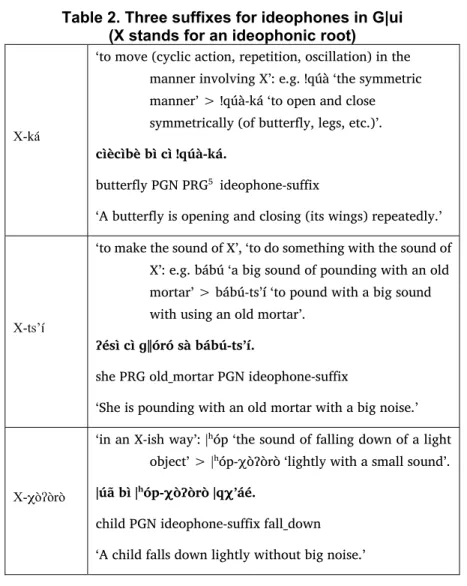
There are three suffixes dedicated to ideophones in G|ui. Two of them, i.e. -ká and -ts’ı́, derive verbs (Nakagawa 2010), and the other, i.e. -χòʔòrò, derives adverbs. Table 2 presents the approximate semantic effects of these suffixes with examples.
The historical origin of -ká is not clear, but that of -ts’ı́ is a loan element from !Xóõ (Nakagawa 2010). The suffix -χòʔòrò, can be etymologically analyzed into two elements χò (i.e. ‘thing, place, matter’) and ʔòrò (< ʔo ‘inside’), but synchronically this etymology is not clear to native speakers.
3 These four abstract phonemes will below be represented in the broad phonetic transcription.
4 Following a Khoisan linguistic convention, I use the diacritic of /V̰/ for pharyngealization in this paper. In the IPA definition, it is for creaky voice.
Table 2. Three suffixes for ideophones in G|ui (X stands for an ideophonic root)
X-ká
‘to move (cyclic action, repetition, oscillation) in the manner involving X’: e.g. ǃqúà ‘the symmetric manner’ > ǃqúà-ká ‘to open and close symmetrically (of butterfly, legs, etc.)’.
cı̀ècı̀bè bı̀ cı̀ ǃqúà-ká.
butterfly PGN PRG5 ideophone-suffix
‘A butterfly is opening and closing (its wings) repeatedly.’
X-ts’ı́
‘to make the sound of X’, ‘to do something with the sound of X’: e.g. bábú ‘a big sound of pounding with an old mortar’ > bábú-ts’ı́ ‘to pound with a big sound with using an old mortar’.
ʔésı̀ cı̀ ɡǁóró sà bábú-ts’ı́.
she PRG old_mortar PGN ideophone-suffix
‘She is pounding with an old mortar with a big noise.’
X-χòʔòrò
‘in an X-ish way’: ǀʰóp ‘the sound of falling down of a light object’ > ǀʰóp-χòʔòrò ‘lightly with a small sound’.
ǀúã bı̀ ǀʰóp-χòʔòrò ǀqχ’áé.
child PGN ideophone-suffix fall_down
‘A child falls down lightly without big noise.’
3.2. Reduplication
There are two types of reduplication that involve ideophones. Type 1 is has the template of complete reduplication of the ideophonic root with the tone melody. Its semantic effect is ‘to be of X’s nature’ as exemplified below:
ɡǁóró sı̀ ts’óō è bábú-bábú.
old_mortar PGN sound subjective ideophone(reduplication1)
‘The sound of the old mortar is of “babu” in nature.’
Type 2 derives the food texture verbs. This derived verb class was described and discussed in Nakagawa (2006, 2010, 2012), therefore, I do not repeat it here.
5 PGN is person gender number marker. PRG is progressive.
4. Syntax
There is a syntactic device which makes an ideophonic root occur on its own in a sentence, namely the quotative construction, which can be illustrated below
[ideophonic root] [quotative particle] [dummy verb]
(1) ʔésı̀ ǀìp cà mı́ı̃
It ideophone QUOT say
‘It (a spear) says ǀìp (it pierces the sand surface with the sound ǀìp).’
(2) ʔésı̀ ǀʼúà cà mı́ı̃
It ideophone QUOT say
‘It (an animal) says ǀʼúà (it is killed and falls instantly)’
In this construction, the ideophonic root is followed by the quotative particle cà, and the predicate verb is a dummy verb which often lose its concrete semantic meaning, as exemplified by (2), in which the ideophonic root indicates a manner, and it cannot be
“said” in even a metaphorical sense. At this stage, ten dummy verbs are attested, namely, mı́ı̃ ‘say’, cı́é ‘stand’, ŋǂúũ ‘sit’, ŋǂu᷇ã-χò ‘cause to sit’, ǁóé ‘lie’, ǁóē-χò ‘lay’, ǂāã ‘enter’, ǂqχ’úā ‘go out’, ʔı̄ı̄ ‘seem’ and hı́ı̃ ‘do’.
5. List of ideophonic roots
This section provides all the 172 ideophonic roots that are attested so far. They are listed in the following order:
ǀ, ǃ, ǂ, ǁ, p, b, pʰ, m, t, tʰ, tqχ’, tχ, dz, tsʰ, tsqχ’, tsχ, r, n, c, cʰ, c’, cqχ’, cχ, k, ɡ, kʰ, ŋ, q, ɢ, qʰ, qχ’, s, χ, h, ʔ, a, a̰, ã, e, i, ı, o, u, ṵ, ũ, j, w, (tones are ordered in high, mid, and low). ̃
If suffixed forms, reduplication, and the quotative construction are confirmed to be ill-formed, they are recorded with * at the end of the entry.
ǀìp a sound with which a heavy spear pierces the sandy ground. qχ’áó sı̀ ǀìp cà mı́ı̃.
‘A spear says ǀìp (a spear pierces the sand surface with the sound ǀìp)’. kʰóè bı̀
qχ’áó sà ǀìp-ts’ı́. ‘A man makes the sound ǀìp (by stabbing the sandy ground) with a spear’.
ǀóp [ǀóᵊp] the manner in which fire is going out. ǀʔéē sı̀ ǀóp cà mı́ı̃. ‘Fire says ǀóp (it goes out with the sound)’. ǀóp-ká (to move around to go out fire and make the sound)’.
ǀùp [ǀùp] the sound with which the stopper of the ostrich eggshell water container is pulled out. kʰóè bı̀ ǃʰábı̄ m̀ kà ǀùp cà mı́ı̃). ‘A man says to the ostrich eggshell water container ǀùp (he pulls out the stopper from the container and makes the sound)’.
ɡǀébà (1) the manner in which muddy (cloudy) water becomes limpid (clear). bíı¯ sì ɡǀébà̀ cà mı́ı̃. ‘Raphionacme burkei says ɡǀébà (water taken from Raphionacme burkei has become clear, e.g., by using leaves of Silver terminalia)’. ɡǀáà sı̀ bíı¯
sì kà ɡǀébà̀ cà mı́ı̃. ‘Silver terminalia says to Raphionacme burkei ɡǀébà̀ (water from Raphionacme burkei becomes clear by Silver terminalia)’. bíı¯ sì há cı̀
ɡǀébà̀-ká ‘Raphionacme burkei becomes clean in many places (repeatedly)’. (2) the manner in which meat becomes sufficiently cooked with the gravy coming from it. ǀχáa¯ sı̀ ɡǀébà cà mı́ı̃. ‘The meat says ɡǀébà (the meat has become cooked sufficiently)’. (*-χòʔòrò, *redup.).
ɡǀúrà the manner in which one walks with heavy steps. ɡǀúrà-ká ‘to walk heavily’.
ǀʰá̰bù the manner of a hyena’s running. ǀʰá̰bù-ká ‘to run of a hyena’.
ǀʰóp [ǀʰóᵊp] the sound with which something light falls down; the texture of fibrous herb or fatless small caterpillar. (> ǀʰúm̀-ǀʰúm̀ [food texture verb]). ǀqχ’áré ǀúã bı̀ ǀʰóp cà mı́ı̃. ‘A baby says ǀʰóp (the baby falls down lightly)’. ǀqχ’áré ǀúã bı̀
ǀʰóp-kārā-ǀqχ’áé; ǀqχ’áré ǀúã bı̀ ǀʰóp-χòʔòrò ǀqχ’áé. ‘A baby falls lightly’.
(*-ts’ı́).
ǀʰúbù a sound with which an animal jumps into bush. ɡǃa᷇ı̃-ǀò bı̀ ǀʰúbù cà ǂāã já tsāā. ‘A small steenbok jumps in with the sound of ǀʰúbù and disappears’.
ǀʼúà the manner in which a game animal is killed instantly and falls. qχʼóōχò bı̀ ǀʼúà cà mı́ı̃. ‘The animal says ǀʼúà (the animal is killed and falls instantly)’. qχʼóōχò bı̀ ǀʼúà-χòʔòrò ǁʔóó. ‘The animal died instantly (being killed)’. qχʼóōχò bı̀
ǀʼúàǀʼúà-sı́ ǁʔóó. ‘The animal died instantly (being killed).’ (ǀʼúà-ká)
ŋǀá̰p the manner in which a long rain eventually stops. cúú bı̀ ŋǀá̰p cà mı́ı̃. ‘The rain says ŋǀá̰p (it stops eventurally)’.
ŋǀòrē the manner in which one dodges quickly. ʔàbı̀ ŋǀòrē cà mı́ı̃. ‘He says ŋǀòrē (he has dodged quickly)’. ʔàbı̀ cı̀ ŋǀòrē-ká. ‘He is stepping and dodging quickly.’
ʔàbı̀ ŋǀòrē-kārā-ŋǁa᷅ã. ‘He stepped aside dodging quickly’.
ǀqánú the manner of something small entering a larger hole. (ǀqánú cà mı́ı̃; ŋǃóē bı̀
ǀqánú cà mı́ı̃/ǂāã; ŋǃóē bı̀ ǀqánú-χòʔòrò ǂāã; ‘A porcupine enters a much larger hole than its size’. ǀqánú-ǀqánú-sı́ ǂēnā-ŋǂùı̃. ‘to enter a much larger hole and stay there’. (*-ts’ı́, *-ká).
ǀqʰábà the ideophone only used for the final stage of the female initiation ceremony.
cı̄āǁú sı̀ ǀúã sı̀ kà ǀqʰábà cà mı́ı̃, ǀúã sı̀ já ǀqʰáà-χòʔòrò ǃʔúú kà χòò dzı̀ mûũ . ‘The aunt (her mother’s elder sister) says to the girl the magic word ǀqʰábà, and then the girl on the following day easily finds the things’. (cf. ǀqʰábà, sá qχ’ó cı̀ mûũ qχ’áò-kò bı̀ ʔı́.) (*-ts’ı́, *-ká, *redup.)
ǀqʰáà the manner of someone finally finding something after a long search. ʔàbı̀ ɟúù m̀
kà ǀqʰáà cà mı́ı̃. ‘He says to an eland ǀqʰáà (he eventually finds an eland)’. cı̀rè ɟúù mà ǀqʰáà-χòʔòrò mûũ ‘Eventually I unexpectedly found an eland’. ʔàbı̀
ǀqʰáà-ǀqʰáà-sı́ qχ’óō-χò mà mûũ. ‘He suddenly finds an animal through’.
ǀqʰáà-ká ‘to find suddenly repeatedly’.
ǀqʰûũ the sound with which something quickly enters a tree with dry leaves (e.g. a bird, animal.). (ǀqʰûũ cà ǂāã) (ǀqʰûũ-ts’ı́) (ǀqʰûũ-ká ‘to walk into with noise’).
(*redup., *-χòʔòrò).
ǀqʼàbū the sound of something falling into water with a splash. ŋǁúá sı̀ ǀqʼàbū cà mı́ı̃. ‘A stone says ǀqʼàbū (it makes the sound when it falls into water)’. ŋǁúá sı̀ tsʰáā sı̀
wà ǀqʼàbū cà ǂāã. ‘A stone falls into the water with the sound of ǀqʼàbū’. ǀqʼàbū-ká
‘to walk in water with noise’. ʔàbı̀ kùà ǀqʼàbū-kārā-ǃûũ. ‘He is walking in water with sound’. ŋǀı̀ sı̀ ǀχáā sı̀ ǀqʼàbū-ǀqʼàbū. ‘This meat is juicy-juicy (of juicy meat, which makes a similar sound when bitten.). ǀqʼàbū-ts’ı́ ‘to make the sound of something falling into water’. (*-χòʔòrò).
ǀqʼáè the manner of something suddenly jumping out (e.g. the manner in which a snake jumps out of a hole in a tree). ǀqχʼáō bı̀ ǀqʼáè cà ǂqχ’úā; ǀqχʼáō bı̀
ǀqʼáè-χòʔòrò ǂqχ’úā. ‘A snake jumps out suddenly’. ǀqχʼáō bı̀ cı̀ ǀqʼáè-ká. ‘A snake jumps out repeatedly’. ǀqχʼáō m̀ kà ǂqχ’úā-qχ’ām̄ sı̀ ǀqʼáè-ǀqʼáè. ‘A snake will jump out’. (*-ts’ı́)
ǀqχ’âũ the texture of raisin, currant, ant etc.; the sound made in the mouth when one is chewing raisins, currants, or edible ants. ʔàbı̀ ǀʰàã dzı̀ kà ǀqχ’âũ cà mı́ı̃. ‘He says to ants ǀqχ’âũ (he chews ants with the sound in the mouth).’ ʔàbı̀ ǀʰàã dzı̀
ǀqχ’âũ-ká. ‘He moves around making the sound by chewing ants’. ʔàbı̀ ǀʰàã dzı̀
ǀqχ’âũ-χòʔòrò ǁáē. ‘He chews ants by making the sound in the mouth’.
(ǀqχ’âũ-ǀqχ’âũ [food texture verb]). (*-ts’ı́)
ǀqχʼóp [ǀqχʼóᵊp] the manner in which one finishes a song. ɡǁàē-kò dzı̀ ǀı́ı̄ sı̀ kà ǀqχʼóp cà mı́ı̃. ‘Women say to the song ǀqχʼóp (they stop the song)’. ɡǁàē-kò dzı̀ ǀı́ı̄ sà ǀqχʼóp-χòʔòrò kʰúã. ‘Women suddenly stop the song’.
ǀqχʼòp [ǀqχʼòᵊp] a sound with which dry grasses (or straws) are broken. ʔàbı̀ ɡǀa᷇ã m̀ kà ǀqχʼòp cà mı́ı̃. ‘He says to the grass ǀqχʼòp (he breaks a grass with the sound)’.
ǀqχʼòp-ts’ı́ ‘to make the sound of ǀqχʼòp repeatedly’. ʔàbı̀ cı̀ ɡǀa᷇ã dzı̀ ǀqχʼúm̀, ʔédzı̀ já cı̀ ǀqχʼòp cà mı́ı̃. ‘He breaks grasses, and the grasses say (i.e. make the sound of) ǀqχʼòp’. ʔàbı̀ cı̀ ɡǀa᷇ã dzı̀ ǀqχʼòp-kārā-kʰúã. ʔàbı̀ cı̀ ɡǀa᷇ã dzı̀ ǀqχʼòp-χòʔòrò kʰúã. ‘He is breaking grasses (straws) with the sound of ǀqχʼòp’.
ǀχàrà the sound with which a porcupine walks. ŋǃóē bı̀ ǀχàrà cà mı́ı̃. ‘A porcupine says ǀχàrà (it makes the sound)’. ŋǃóē bı̀ kùà ǀχàrà-ts’ı́. ‘The porcupine is making the sound of ǀχàrà’.
ǀχàà the sound of seeds being tossed repeatedly on a vessel. ǀχúrı́ dzı̀ ǀχàà cà mı́ı̃.
‘Seeds say ǀχàà (they make the noise)’. ʔàbı̀ ǀχúrı́ dzı̀ cı̀ ǀχàà-ts’ı́. ‘He is making the sound of ǀχàà by tossing seeds’.
ǀχóp [ǀχóᵊp] a sound with which one bites or chews a sandy food. ǁúũ dzı̀ χúḿ-χà sı̀
ǀχáā sı̀ ǀχàè ǀχóp cà cı́é. ‘The teeth stop ǀχóp (the teeth make the sound of a sandy food)’. kʰóè m̀ ǁúũ è ǀχáā sı̀ ǀχàè ǀχóp-ká. (*-ts’ı́, *-χòʔòrò, *-kārā-ǁáē).
ǀhòp [ǀhòᵊp] the texture of dried meat cooked with insufficient water; the sound with which a digging stick sticks in (the sand). ŋǀòè sı̀ χúḿ sı̀ kà ǀhòp cà mı́ı̃. ‘A digging stick says to the sand ǀhòp (it sticks in the sand with the sound’. kʰóè bı̀
χúḿ sà ŋǀòè sı̀ kà ǀhòp-ts’ı́. ‘A man makes the sound of ǀhòp stabbing the sand with a digging stick’. kʰóè bı̀ χúḿ sà ŋǀòè sı̀ kà ǀhòp-kārā-tsʰáō. ‘A man digs the sand around with a digging stick with the sound of ǀhòp’. (*-χòʔòrò).
ǃáǹ a manner of the giraffe’s walking. ǃáǹ-ká ‘to walk of a giraffe’.
ǃánı̀ a state of extreme tallness, typically giraffes’ height. ǃánı̀-ǃánı̀ ‘to be tall (typically of a giraffe) in nature’. (*cà mı́ı̃, *-ts’ı́, *-ká, *-χòʔòrò).
ǃáã a sound which the tendons of the eland’s front legs make. ɟúù bı̀ kùà ǃáã cà mı́ı̃.
‘An eland is saying ǃáã (it is making the sound of ǃáã)’. ɟúù bı̀ kùà ǃáã-ká. ‘An eland is walking with the sound of ǃáã’.
ǃáũ a sound that is made when a piece of steel is hit. ʔàbı̀ ǃánù sı̀ kà ǃáũ cà mı́ı̃. ‘He says to the steel ǃáũ (he makes the sound of ǃáũ with a piece of steel)’. ʔàbı̀ ǃánù sà ǃáũ-ts’ı́. ‘He makes the sound of ǃáũ with a piece of steel repeatedly’.
ǃóp [ǃóᵊp] the texture of small insufficiently parched caterpillar. (> ǃúm̀-ǃúm̀ [food texture verb]). ŋǃòō bı̀ cı̀ ǃóp cà mı́ı̃. ‘A caterpillar says ǃóp (the caterpillar has the texture of ǃóp, which is felt in the mouth when it is eaten)’. ʔàbı̀ ŋǃòō mà ǃóp-ts’ı́. ‘He chews a caterpillar feeling its texture and the sound it makes’. ʔàbı̀
ŋǃòō mà ǃóp-kārā-ǁáē. ‘He moves around chewing a caterpillar and feeling its texture in the mouth’. (*-χòʔòrò).
ǃòp [ǃòᵊp] a sound with which water is ladled. ʔàbı̀ tsʰáā sı̀ kà ǃòp cà mı́ı̃. ‘He says to water ǃòp (he ladles water with the sound of ǃòp)’. ǃòp-ts’ı́. ‘to make the sound of ǃòp repeatedly in ladling water’.
ǃóó a manner of the giraffe’s walking with the sound of footsteps. ǃóó-ká ‘to walk (with the sound of footsteps) of a giraffe’.
ǃúrú a sound with which a small amount of food is pounded in a mortar. ʔàbı̀ ı̀ı̄-qχ’ò sı̀ kà ǃúrú cà mı́ı̃. ‘He says to the mortar ǃúrú (he makes the sound in pounding with the mortar).’ ı̀ı̄-qχ’ò sı̀ ǃúrú cà mı́ı̃. ‘The mortar says ǃúrú’. kʰóè sı̀ ı̀ı̄-qχ’ò sà ǃúrú-ts’ı́. ‘A woman makes the sound of ǃúrú repeatedly by pounding with a mortar’.
ǃúù a dull thud (sound) which an old axe makes. ǃúù-tsʼı́ ‘to make the sound of ǃúù’.
ǃúù-ká ‘to walk around while making the sound of ǃúù’ (e.g. axing around in a woodland). ŋǀı̀ sı̀ bóó sı̀ cı̀ ǃúù cà mı́ı̃ ‘this axe makes the sound of ǃúù’. ʔàbı̀ há cı̀ ǀʔéē dzı̀ ǃúù-ká. ‘He is doing the firewood by repeating the same movement and making the sound of ǃúù’. ǃúù cà cı́é. ‘to be stuck and stand vertically by making the sound of ǃúù’. (cf. ǃúù-ǃúù ‘to be big or thick’, non-derivative of the ideophone ǃúù.)
ǃṵ́rà [ǃṵ́ᵊlà] a sound of rain. ǃṵ́rà-ká ‘for rain to move with a noisy sound’. ǃṵ́rà-tsʼı́ ‘to make the sound of ǃṵ́rà (of a heavy rain)’.
ɡǃá̰nù the manner in which one walks indignantly. ɡǃá̰nù-ká ‘to walk indingnantly’.
ɡǃòt [ɡǃòᵊt] a sound with which something is swallowed. kʰóè bı̀ tsʰáā sı̀ kà ɡǃòt cà mı́ı̃. ‘A man says to water ɡǃòt (a man swallowed water with the sound)’. ʔàbı̀
tsʰáā sà ɡǃòt-ts’ı́. ‘He makes the sound of ɡǃòt in swallowing water’. ʔàbı̀ tsʰáā sà há cı̀ ɡǃòt-kārā-qχ’áà. ‘He is repeatedly drinking water with the sound of ɡǃòt’.
ǃʰábù the manner in which a propeller toy starts spining; a manner in which one
awakes suddenly in a good mood. dzı̀nı̀ sì cì ǃʰábù cà mı́ı̃ ‘A propeller toy says ǃʰábù (i.e. the toy starts spinning).’ The player says to the toy “ǃʰábù kʰóè dzı̀nı̀
è.” ʔàbı̀ ǁʔūmā-há já ǃʰábù-χòʔòrò ǂχáı́. ‘He has slept and wakes up in the ǃʰábù manner.’ ʔàbı̀ ǃʰábù cà mı́ı̃. ‘He says ǃʰábù.’ ʔàbı̀ ǃʰábù-ǃʰábù ‘He will awake suddenly in a good mood (just like a propeller toy which will abrupty start to spin)’.
ǃʰáà the sound with which one hits something. kʰóè bı̀ ɡǃa᷇ı̃ m̀ kà ǃʰáà cà mı́ı̃. ‘A man says to a steenbok ǃʰáà (he hits a steenbok with the sound of ǃʰáà)’. kʰóè bı̀ ɡǃa᷇ı̃
mà ǃʰáà-χòʔòrò ǁqχ’áḿ. ‘A man hits a steenbok with the ǃʰáà beat’. ǃʰáà-ts’ı́ ‘to make the sound of ǃʰáà’. ǃʰáà-ká ‘to move with the sound of ǃʰáà’. (cf. ǃʰáà-ǃʰáà is an unrelated word, meaing ‘very cold’). (*redup.)
ǃʰòp [ǃʰòᵊp] a sound of whip-cracking. ǃʰòp cà mı́ı̃. ‘to say ǃʰòp (to make the sound)’.
ǃʰúrı̀ a sound with which a thin animal is walking. ɡǃa᷇ı̃ m̀ ǀʔúã è ǃʰúrı̀ cà mı́ı̃. ‘a steenbok’s bone says ǃʰúrı̀’. ɡǃa᷇ı̃-ǀò bı̀ cı̀ ǃʰúrı̀-ká. ‘a small steenbok is walking with the sound of ǃʰúrı̀’. ɡǃa᷇ı̃ bi ǃʰúrı̀-ǃʰúrı̀. ‘a steenbok makes the sound of ǃʰúrı̀
in its natute.’
ǃʰúrú a sound which is made by shaking an empty tin can with small things inside.
ʔàbı̀ tòō sı̀ kà ǃʰúrú cà mı́ı̃. ‘He says to a tin can ǃʰúrú (he makes the sound with a tin can)’. ʔàbı̀ tòō sà ǃʰúrú-ts’ı́. ‘He makes the sound of ǃʰúrú repeatedly by using a tin can’.
ǃʰúı̀ the texture of a juicy fruit; the manner in which something juicy is cut and its juice comes out (or the human body is wounded and is bleeding). ǁhá̰mı̀ sı̀ kʰóè m̀ kà ǃʰúı̀ cà mı́ı̃. ‘A whip says to a man ǃʰúı̀ (it wounds his body)’. ǁhá̰mı̀ sı̀
kʰóè mà ǃʰúı̀-ts’ı́. ‘A whip makes a sound in wounding a man’. ǁhá̰mı̀ sı̀ ʔàmà ǃʰúı̀-ká. ‘A whip moves wounding him around’. kʰóè bı̀ ʔàmà ǃʰúı̀-χòʔòrò ǀqa᷅ı̃.
‘A man whips him in the way his body is wounded and bleeds’. (> ǃʰúı̀-ǃʰúı̀
[food texture verb]).
ǃ’árù the texture of a hard food, e.g. acacia gum, an undercooked tuber of Cucumis kalahariensis, (the texture is associated with the sound with which one bites or chews the food. ǃʔūm̄-ǀʔè kà qχ’ūā sı̀ cı̀ ǃ’árù cà mı́ı̃. ‘A raw Cucumis kalahariensis tuber has a texture which makes the sound of ǃ’árù when it is chewed’. ʔàbı̀ ʔésà ǃ’árù-ts’ı́. ‘He makes the sound with it’. ʔàbı̀ ʔésà ǃ’árù-kà.
‘He moves making the sound with it’. ʔàbı̀ ʔésà ǃ’árù-χòʔòrò χāũ. ‘He bites it with the sound’.(> ǃ’árù-ǃ’árù [food texture verb]).
ŋǃà̰bù a sound with which something falls down (the whole thing, with a thud). ɡǃa᷇ı̃ bı̀
ŋǃà̰bù cà mı́ı̃. ‘A steenbok makes the sound of ŋǃà̰bù (e.g. when it tries to run away from a trap in vain). ɡǃa᷇ı̃ bı̀ ŋǃà̰bù-χòʔòrò ǀqχ’áé. ŋǃà̰bù-ts’ı́. ‘to make the sound of ŋǃà̰bù’. ŋǃà̰bù-ká. ‘to move making the sound of ŋǃà̰bù’. (*redup.).
ŋǃùrı̀ a dull sound with which a heavy thing falls on the earth. (= ǂqùũ) ɡǀúà sı̀ (or ɡǀèrō-ǂʔúbī sı̀, or ŋǁúá sı̀) ŋǃùrı ̀cà mı́ı̃/cı́é. ‘A monky orange (or an ostrich egg, or a stone) says/stands ŋǃùrı ̀’. (*kʰóè bı̀ ŋǁúá sı̀ kà ŋǃùrı̀ cà mı́ı̃.). ɡǀúà sı̀
ŋǃùrı ̀-χòʔòrò ǂʰēē. ‘A monky orange falls in the manner of ŋǃùrı̀.’ ɡǀúà dzı̀ ǂʰēē ts’óō dzı̀ ŋǃùrı̀-ŋǃùrı̀. ‘The sound of monky oranges’ falling is ŋǃùrı̀-ŋǃùrı̀’. ǀχóé
dzı̀ cı̀ ŋǃùrı̀-ts’ı́ ‘Hails are falling with the sound of ŋǃùrı̀’. ŋǃùrı̀-ká ‘to move with the sound ŋǃùrı̀ (when a strong wind blows oranges down repeatedly)’.
ǃqàè the way of something falls down and breaks into two pieces; to split open. ǀʔúã tsèrà cı̀ ǃqàè cà mı́ı̃ ‘The leges splits open.’ ǃqàè-ká ‘for many things to fall down and break into pieces in a wide range of area.’ kʰúú-ts’ı́ sı̀ χúḿ sı̀ kà ǃqàè cà mı́ı̃. ‘A Kalahari truffle says to the sand ǃqàè. (the truffle fruits out of the sand.)’ cı̀ãɡà sı̀ ǃqàè-χòʔòrò ǃqárā-sı̀. cı̀ãɡà sı̀ ǃqàè cà mı́ı̃ (*redup. *ǃqàè-ts’ı́).
ǃqúm̀ the texture of foods like baked potato. (> ǃqúm̀-ǃqúm̀ [food texture verb]). ǁ’ōrē bı̀ cı̀ ǃqúm̀ cà mı́ı̃. ‘Brachystelma sp. says ǃqúm̀ (it has the texture of ǃqúm̀)’.
kʰóè bı̀ ǁ’ōrē mà ǃqúm̀-ká. ‘The man walks around eating Brachystelma sp.
feeling its texture’. kʰóè bı̀ ǁ’ōrē mà ǃqúm̀-ǃqūmā-ǂʔúũ’. ‘The man eats Brachystelma sp. feeling its texture’.
ǃqúà the manner in which something symmetry opens or splits (e.g., butterfly). ǀʔúã tsèrà ǃqúà-χòʔòrò ǃ’úà-kú. ‘The legs spread out symmetrically’. ǀʔúã tsèrà ǃqúà cà mı́ı̃. ‘The legs say ǃqúà’. ǃqúà-ká ‘to open something symmetrically repeatedly’. (*redup. *ǃqúà-ts’ı́).
ǃɢàbù a sound with which a long thing falls down. ǃáò m̀ kʰóè bı̀ ǃɢàbù-χòʔòrò ǀqχ’áé.
‘A tall person falls with the sound of ǃɢàbù’. ı̀ı̄ bı̀ ǀqχ’áé já ǃɢàbù cà mı́ı̃. ‘A tree falls down and says ǃɢàbù’. ǃɢàbù-ǃɢàbù-sı́ ǀqχ’áé ‘to fall down with the sound of ǃɢàbù’. (ǃɢàbù-ts’ı́ ‘to make the sound of ǃɢàbù’; ǃɢàbù-ká ‘to move by repeating to make the sound of ǃɢàbù’).
ǃɢúı̃ the manner in which an animal (particularly dog) starts running by noticing something. ʔābā bı̀ ǃɢúı̃-χòʔòrò ǃárū. ‘The dog starts to run in the manner of ǃɢúı̃’. ʔābā bı̀ ǃɢúı̃ cà mı́ı̃ ‘The dog says ǃɢúı̃’. ǃɢúı̃-ká. ‘to start running by noticing something’. (*redup. *ǃɢúı̃-ts’ı́).
ǃqʰájà a sound with which one breaks a tree with one’s hands, a sound which a moving thunder storm makes. ŋǀùnı̄ bı̀ ǃqʰájà-χòʔòrò kʰúã. ‘A Shepherd’s tree breaks with the sound of ǃqʰájà’. ŋǀùnı̄ bı̀ ǃqʰájà cà mı́ı̃. ‘A Shepherd’s tree says ǃqʰájà’.
ŋǀùnı̄ bı̀ ǃqʰájà-ǃqʰájà ‘The Sheperd’s tree will make the sound of ǃqʰájà by its nature’. ǃqʰájà-ká-kàχó ‘for a person to break a tree with the noise of ǃqʰájà’.
ǃqʰájà-ts’ı́. ‘to make the sound of ǃqʰájà’.
ǃqʰòp [ǃqʰòᵊp] a sound with which an old and whitish tsamma mellon was stabbed.
kʰóè bı̀ ŋǁà̰n̄ sı̀ kà ǃqʰòp cà mı́ı̃. ‘A man says to a tsamma melon ǃqʰòp (he stabs a tsamma melon and makes the sound of ǃqʰòp)’. kʰóè bı̀ ŋǁà̰n̄ sà ǃqʰòp-ts’ı́. ‘A man makes the sound of ǃqʰòp repeatedly in stabbing old whitish tsamma melons’.
ǃqʼárà the manner in which a lot of foot prints are left. ǃqʼárà-tsʼı́ ‘(of a game for trap hunting) to leave a lot of footprints’. (*cà mı́ı̃, *-ká, *-χòʔòrò).
ǃqʼárı̀ the manner that one (especially a woman) walks slowly and elegantly. ǃqʼárı̀-ká
‘to walk elegantly (of a woman)’.
ǃqʼárù the manner in which something appears suddenly (e.g. out of a hole/from behind a tree). qχʼóōχò bı̀ ǃqʼárù cà mı́ı̃/ǂqχʼúā. ‘An animal says/goes out ǃqʼárù’.
qχʼóōχò bı̀ ǃqʼárù-ka.́ ‘An animal walks out suddenly’. qχʼóōχò bı̀ ǃqʼárù-χòʔòrò ǂqχʼúā ‘An animal goes out suddenly’. (*redup., *-ts’ı́).
ǃqʼàn̄ the way one ties a belt tightly around the waist. ʔàbı̀ ʔàm̀ qχ’ùù kà ǃqʼàn̄ cà míĩ.
‘He says to his waist ǃqʼàn̄ (he ties his waist tightly).’ ʔàbı̀ ǂqàı̄ m̀ kà ʔàm̀ qχ’ùù kà ǃqʼàn̄-χòʔòrò ǃáé. ‘He ties his waist with a belt in the ǃqʼàn̄ manner (tightly).’
ǃqʼàn̄-ǃqʼàn̄-sı́ ǃáé. ‘to tie tightly’. ǃqʼàn̄-ká. ‘to move with one’s waist tied tightly’.
(*-ts’ı́).
ǃqʼóó the manner in which something long is pulled out abruptly; the manner in which the inner wood of acacia root is pulled out. ǃqʼóó cà mı́ı̃. ‘to say ǃqʼóó (to be pulled out abruptly)’. ɡǃu᷅ũ m̀ kà ǃqχ’áı́ sì ǃqʼóó cà ǂqχ’úā. ǃqʼóó-kā-rā-ǀʰúbı̄.
‘to pull out something in walking around repeatedly’ ǃqʼóó-χòʔòrò ǀʰúbı̄. ‘(for someone) to pull out abruptly’. ɡǃu᷅ũ-ǃqχ’áı́ bì ǃqʼóó-ǃqʼóó. ɡǃu᷅ũ m̀ ǃqχ’áı́ è ǁqʼóó cà mı́ı̃/ɡǃu᷅ũ m̀ ǃqχ’áı́ è ǁqʼóó cà ǂqχ’úā. ‘The acacia root says/comes out abruptly’. ɡǃu᷅ũ m̀ ǃqχ’áı́ è ǁqʼóó-χòʔòrò ǂqχ’úā. ‘The acacia root says/comes out abruptly’.(*-ts’ı́)
ǃqʼúbù the low-pitched and obscure sound. ʔàrı̀ cı̀ ǃqʼúbù-tsʼı́. ‘They speak in a low and obscure voice’; ǃqʼúbù-tsʼı́ ‘to be loose (of the clothes which seems to make a sound when the person in the clothes is moving)’. (cf. ǃqʼúbù-ǃqʼúbù ‘to be soft (of leather)’. kʰóō sı̀ ǃqʼúbù-ǃqʼúbù. ‘Leather is soft’. kʰóè bı̀ kʰóō sà ǃqʼúbù-ǃqʼúbù-kà-χó. ‘A man makes leather soft’.) (*cà míĩ).
ǃqʼùbū a sound which water in a container (e.g. of an ostrich egg shell) makes. kʰóè bı̀
ɡǀèrō-ǂʔúbı̄ sà ǃqʼùbū-ts’í. ‘to make sound of ǃqʼùbū’. ɡǀèrō-ǂʔúbı̄ sı̀ ǃqʼùbū cà mı́ı̃.
‘An ostrich egg says ǃqʼùbū’.
ǃʔùrù the manner in which animals start running together. béē dzı̀ ǃʔùrù cà mı́ı̃.
‘Horses say ǃʔùrù (they start running)’. béē dzı̀ kùà ǃʔùrù-kārā-ǃàrò. ‘Horses are starting to run’.
ǃʔûũ a sound with which a person bumps into someone. ǃʔûũ cà mı́ı̃/cı́é. ‘to bump into someone with the sound of ǃʔûũ’.
ǃhòp [ǃhòᵊp] a sound with which an arrow is stuck at a bird. ʔàbı̀ dzérá m̀ kà ǃhòp cà míĩ. ‘He says to a bird ǃhòp (he shoots a bird and the arrow sticks at it with the sound of ǃhòp)’. *dzérá bı̀ ǃhòp cà míĩ. (*-ts’ı́).
ǃhóó a manner in which the wind is calm and silent. ǂʔaã sı̀ ǃhóó cà mı́ı̃/cı́é. ‘The wind says/stands ǃhóó’. ǂʔáã sı̀ ǃhóó-χòʔòrò cı́é. ‘The wind stops silently.’ (*-ká,
*-ts’ı́, *redup.)
ǂáp the sound with which thick and sticky food is served in a plate/bowl. kʰóè bì ǃχárí kà ɡǂéè sì kà ǂáp cà míĩ. ‘A person says ǂáp to the thick and sticky porridge (he serves the porridge with the sound)’. ɡǂéè sı̀ χò sà ǂáp-ts’ı́. ‘to make the sound of ǂáp repeatedly in serving a thick and sticky food’.
ǂàp the sound with which sticky thing falls onto the ground. ǃχárí sì ǂàp cà míĩ.
‘Porrige says ǂàp’.
ǂá̰m̀ the texture of a juicy root with hard surface. ǂʔúbı̄ sı̀ ǂá̰m̀ cà míĩ. ‘An egg says
ǂá̰m̀ (an egg breaks and its slimy liquid comes out)’. kʰóè bı̀ ǂʔúbı̄ mà ǂá̰m̀-ts’ı́.
‘A man makes a noise in breaking an egg’. kʰóè bı̀ ǂʔúbı̄ mà ǂá̰m̀-ká. ‘A man moves to break an egg’. kʰóè bı̀ ǂʔúbı̄ mà ǂá̰m̀-χòʔòrò ǁqχ’ámā-ʔóè/ǁqχ’ámā-ǃqárā. ‘A man hits and crashes an egg with its liquid out/crashes an egg into pieces’. (> ǂá̰m̀-ǂá̰m̀ [food texture verb].)
ǂı́p the manner in which a hole gets stopped up. ʔàbì kùm̀ sì kà ǂı́p cà míĩ. ‘He says to a hole ǂı́p (he stops a hole up)’. (cf. *kùm̀ sı̀ ǂı́p cà míĩ.) ǀúã m̀ ǂéē è ǂı́p cà míĩ. ‘The child’s ear says ǂı́p (the child will not listen)’. (*-ts’ı́)
ǂı̀p the sound of a heavy object falls onto the sandy ground surface. ǃúḿ sì χò sì ǂı̀p cà míĩ. ‘A heavy thing says ǂı̀p (it makes the sound on falling onto the sandy ground)’.
ǂúp [ǂúp] the sound with which leaking rain water is dripping. cúú bı̀ ǂúp cà míĩ.
‘The rain says ǂúp (the rain water leaks and drips with the sound)’. ǂúp-ts’ı́ ‘to drip and make the sound repeatedly (of leaking rain water)’.
ɡǂı̀bı̀ the manner of person’s running. ɡǂı̀bı̀-ká ‘to run of a person’.
ɡǂùp [ɡǂùp] the sound with which a leather strap breakes. ǂqàı̄ bı̀ ɡǂùp cà mı́ı̃. ‘A leather belt says ɡǂùp (it breaks and makes the sound)’.
ǂʰı̀nı̄ the manner of a hyena’s running. ǂʰı̀nı̄-ká ‘to run of a hyena’.
ǂʰóp [ǂʰúᵊp] the manner in which dirt is cleaned off. ʔāã-χò sı̀ ǂʰóp cà mı́ı̃. ‘The clothes say ǂʰóp (the clothes becomes clean)’. (*-ts’ı́)
ǂʼùbı̄ the manner of fullness. ǃóò sı̀ ǂʼùbı̄ cà mı́ı̃. ‘A water pit says ǂʼùbı̄ (the pit is full of water)’. ǃóò sı̀ ǂʼùbı̄-χòʔòrò ǀqχ’óè (ǀqχ’ōē-há). ‘A water pit is filled with water fully’.
ǂʼúù the manner of making a good landing after jumping. ǂʼúù-ká ‘to run and jump repeatedly’. kʰóè bı̀ ŋǁàı̀ já ǂʼúù cà mı́ı̃/cı́é. ‘A man jumps and says/stands ǂʼúù.’
kʰóè bı̀ ǂʼúù-χòʔòrò ǂʰēē. ‘A man lands (onto the ground) in successful manner.’
ŋǂùp [ŋǂùp] the sound of whip. ǁhá̰mı̀ bı̀ ŋǂùp cà mı́ı̃. ‘A whip says ŋǂùp (it makes the sound)’. ŋǂùp-ts’ı́ ‘to make the ŋǂùp sound repeatedly’.
ŋǂṵ́p [ŋǂṵ́ᵊp] the sound with which one pulls out an edible tuber (of Cucumis kalahariensis). ǃʔūm̄-ǀè m̀ kà ŋǂṵ́p cà mı́ı̃. ‘to say to Cucumis kalahariensis ŋǂṵ́p (to pull out the tuber)’. ʔàbı̀ kùà ŋǂṵ́p-ká ‘He moves around pulling out the tuber making the sound’. (*-ts’ı́)
ǂqáp the manner in which one stops while walking slowly. ǂqáp cà cı́é. ‘to stop ǂqáp.’; the manner in which something becomes flat. (> ǂqám̀-ǂqám̀ [food texture verb]). ǂqáp-ká ‘to walk slowly sometimes stopping to watch out’. ǁ’ōrē sı̀ ǁʔáń já ǂχūū já ǂqáp cà mı́ı̃. ‘Brachystelma sp. is boiled, becomes soft and says ǂqáp (becomes flat)’. ʔàbı̀ cı̀ ǂqáp cà ǁóé (mı́ı̃). ‘He lies (says) ǂqáp (he lies flat)’. ʔàbı̀ ǂqáp-ká. ‘He lies flat repeatedly’. ǂqáp-χòʔòrò ǁóé. ‘to lie flat’.
ǂqáp-χòʔòrò ǂχūū. ‘to become soft and flat’. (*-ts’ı́)
ǂqàbà the manner of softness and sliminess (of e.g. excreta or porridge). ǃχárı́ sı̀ cı̀
ǂqàbà cà mı́ı̃. ‘Porridge is saying ǂqàbà (it is soft and slimy)’. ǃχárı́ sı̀ cı̀ ǂqàbà cà ŋǃáà sı̀ wà ŋǂúũ. ‘Porridge, soft and slimy, is in the ball’.
ǂqábù the sound with which one serves soft food. kʰóè bı̀ ǀχárı́ sı̀ kà ǂqábù cà mı́ı̃. ‘A man says to porridge ǂqábù (he serves porridge with the sound)’. kʰóè bı̀
ǂqábù-kārā-χárò. ‘A man serves around.’.
ǂqáná the sound that a small amount of water makes. tsʰáā sı̀ ǂqáná cà mı́ı̃. ‘ Water says ǂqáná (a small amount of water makes the sound)’. kʰóè bı̀ kùà tsʰáā sà ǂqáná-ts’ı́. ‘A man makes the sound of ǂqáná (by shaking the container with a small amount of water)’.
ǂqánú the sound of something falling into the water (in a deep hole) with a splash; the sound that a small amount of water makes. tsʰáā sı̀ ǂqánú cà ǂāã (mı́ı̃). ‘Water enters (says) ǂqánú’. ʔàbı̀ ŋǃáà sı̀ wà tsʰáā sà ǂqánú cà ǂāã. ‘He pours water into a container with the sound of ǂqánú.’ ʔàbı̀ tsʰáā sà ǂqánú-χòʔòrò ǂāã. ‘He pours water into a container with the sound of ǂqánú.’ tsʰáā-ǀùà dzı̀ ǂqánú-ǂqánú. ‘A small quantity of water makes the sound of ǂqánú’.
ǂqa᷅ã the softness of something when you pushed or stepped on it. ʔàbı̀ tsùū sà ı́jà já ʔésı̀ kà ǂqa᷅ã cà mı́ı̃. ‘He steps on an excreta and says to it ǂqa᷅ã. tsùū sı̀ ǂqa᷅ã-ǂqa᷅ã.
‘Dung is soft.’ ʔàbı̀ tsùū sı̀ wà ǂqa᷅ã cà ǂāã. ‘He steps (onto dung) ǂqa᷅ã.
ǂqúrú the sound of dripping. ǂqúrú-tsʼı́ ‘to drip making a sound (of water).
ǂqùũ a sound (a thump) with which a heavy thing falls down. (= ŋǃùrı̀). ı̀ı̄-ɡǁò sı̀ ǂʰēē já ǂqùũ cà mı́ı̃. ‘A big log falls and says ǂqùũ.’ ı̀ı̄-ɡǁò sı̀ ǂqùũ-χòʔòrò ǂʰēē. ‘A big log falls with a thump of ǂqùũ.’ (NB: reduplication involves irregular tonal alternation. ǂqûũ-ǂqûũ ‘to be heavy’ ı̀ı̄-ɡǁò sı̀ ǂqûũ-ǂqûũ. ‘A big log makes thumps of ǂqùũ.’)
ǂɢàbı̀ the sound with which a long object falls down. ŋǃābē bı̀ ǀqχ’áé já ǂɢàbı̀ cà mı́ı̃.
‘A giraffe falls down and says ǂɢàbı̀ (it makes the sound)’. ǂɢàbı̀-ts’ı́ ‘to make the sound repeatedly’.
ǂɢàrà the sound with which a heavy rain starts. ǂɢàrà-tsʼı́ ‘to start with a noisy sound (of a heavy rain).
ǂɢáà the manner of slow movement. ǂɢáà-tsʼı́ ‘to walk slowly’. ǂɢáà-ká ‘to walk slowly’. (*cà mı́ı̃, *-χòʔòrò).
ǂɢàà a sound of snoring. (ǂɢàà cà mı́ı̃. ‘to say ǂɢàà (to make the sound of ǂɢàà)’.
ǂɢàà-tsʼı́ ‘to snore’ (= ǂɢùrù-tsʼı́). (*-ká, *-χòʔòrò).ǂɢàã a sound of snoring.
ǂɢàã-tsʼı́. ‘to snore’ (= ǂɢàà-tsʼı́, ǂɢùrù-tsʼı́).
ǂɢùrù a sound of snoring. ǂɢùrù-tsʼı́ ‘to snore’ (= ǂɢàà-tsʼı́).
ǂqʰábı̀ the sound with which a razor is sharpened. ǀʔı́ı̄-χò sı̀ ǂqʰábı̀ cà mı́ı̃. ‘A razor says ǂqʰábı̀.’ ǀʔı́ı̄-χò sı̀ ǂqʰá͜ı̀-ǂqʰábı̀. ‘The razor is so thin that it makes the sound of ǂqʰábı̀.’
ǂqʰáà the manner of lying flat on one's stomach. ǂqʰáà-ká ‘to crawl with one’s stomach touching the ground repeatedly.’
ǂqʰáã the high-pitched "ting" sound of cracking of something. ɡǀèrō m̀ kà ǂʔúbı̄ sı̀ kà ʔàbı̀ ǂqʰáã cà mı́ı̃. ‘He says to an ostritch egg ǂqʰáã. (he makes the sound with the egg shell).’ ɡǀèrō m̀ kà ǂʔúbı̄ sı̀ ǂqʰáã-ǂqʰáã ‘An ostritch egg shell will make the sound of ǂqʰáã. (*ɡǀèrō m̀ kà ǂʔúbı̄ sı̀ ǂqʰáã cà mı́ı̃ [ungrammatical]).
ǂqʰáã-ts’ı́. ‘to make the sound of ǂqʰáã’. ǂqʰáã-ká. ‘to move making the sound of ǂqʰáã’.
ǂqʰáù the manner of breaking arms and legs of an animal by hitting or throwing something against it. kʰóè bı̀ qχ’óōχò m̀ ǀʔúã kà ǂqʰáù cà mı́ı̃. ‘A man says to a animal’s child ǂqʰáù. (he hits and breaks the animal’s child with the sound.)’.
ʔàbı̀ ı̀ı̄ m̀ kà ǂqʰáù cà mı́ı̃. ‘He says to a tree ǂqʰáù (he breaks the tree with the noise).’ ɡǃa᷇ı̃-ǀò m̀ ǀʔúã è ǂqʰáù-ǂqʰáù. ‘A young steenbok will make the sound of ǂqʰáù (implying its bones are weak and easily broken with the sound.).’ ʔàbı̀
ǂqʰáù-χòʔòrò qχ’óōχò mà ǁqχ’ámā-kʰúã. ‘He hits and breaks an animal’s bone in the way that the bone makes the sound.’
ǂqʰâũ the sound with which one eats a broiled crispy skin. (> ǂqʰâũ-ǂqʰâũ [food texture verb]). ŋǃābē kʰóō sı̀ cı̀ ǂqʰâũ cà mı́ı̃. ‘Giraffe skin says ǂqʰâũ (the skin crisps when it is bitten)’. ŋǃābē kʰóō sà ǂqʰâũ-ǂqʰã̄wã̄-χâũ. ‘to chew the giraffe skin feeling a crispy texture’. (*-χòʔòrò, *-ts’ı́, *-ká).
ǂqʰòp [ǂqʰòᵊp] the sound with which an awl sticks into a soft thing. (=ǃχòp). ʔàbı̀ ɡǃáà m̀ kà pı́rı́ m̀ kà ǂqʰòp cà mı́ı̃. ‘He says to a goat ǂqʰòp with an awl (he sticks the goat with an awl with the sound)’.
ǂqʼáǹ the manner in which something soft and sticky is stepped onto. cı̀rè ŋǁà̰n̄ sı̀ kà ǂqʼáǹ cà mı́ı̃. ‘I say to a tsamma melon ǂqʼáǹ (I step onto it).’ cı̀rè ŋǁà̰n̄ sà ǂqʼáǹ-ts’ı́. ‘I step onto a tsamma melon’. cı̀rè ŋǁà̰n̄ sà ǂqʼáǹ-ká. ‘I move around steping onto a tsamma melon’. ŋǁà̰n̄ sà ǂqʼáǹ-kārā-ǁáē. ‘to walk around chewing a tsamma melon’. (> ǂqʼáǹ-ǂqʼáǹ [food texture verb] ‘to feel a sticky texture of a food in the mouth’.) (*-χòʔòrò).
ǂqʼàn̄ the manner of walking slowly and quietly. ǂqʼàn̄-ká ‘to walk slowly being tired’.
kʰóè bı̀ ǂqʼàn̄ cà mı́ı̃ já ŋǂúũ. ‘A man says ǂqʼàn̄ and sits (without making sounds and without being noticed)’. (*-tsı́, *-χòʔòrò).
ǂqʼáà the softness and stickiness which one feels when stepping onto something, e.g.
feces. ʔàbı̀ ǃχárı́ sı̀ kà ǂqʼáà cà mı́ı̃. ‘He says to porrigde ǂqʼáà (when he steps onto porridge)’. ʔàbı̀ ǃχárı́ sı̀ wà ǂqʼáà-χòʔòrò ǂāã. ‘He steps onto porridge in the way of ǂqʼáà.’ ǂqʼáà-ts’ı́ ‘to make a noise by stepping a sticky thing repeatedly)’.
ǂqʼáà-ká ‘to walk stepping onto a sticky thing and making a noise.’ ʔàbı̀
ǂqʼáà-χòʔòrò ǃχárı́ sà (or ǂqōō sà) ı́jà. ‘He softly steps onto porridge (or mud).’
ǂʔâũ the manner of being silent. ǂʔâũ cà mı́ı̃ ‘to say ǂʔâũ (to stand silently).’ ǂʔâũ-ká
‘to walk silently’
ǂʔébù the manner in which plants suddenly wither because it gets cold. ǃqʰāı̄ sı̀
cı̀ãɡà-ǁʔûã dzı̀ kà ǂʔébù cà mı́ı̃. ‘The cold says to vines of melons ǂʔébù. (vines of melons suddenly wither).’ cı̀ãɡà dzı̀ ǁʔûã è ǂʔébù cà mı́ı̃. ‘Vines of melons say ǂʔébù (vines of melons suddenly wither).’ cı̀ãɡà-ǁʔûã dzı̀ ǂʔébù-ká. ‘Melon vines’ withering expands’.
ǂʔùrù the manner in which one digs a hole through abruptly. ʔàbì ǂʔùrù cà há̰é sà ŋǂṹã̄-χò. ‘He digs a hole through (to a springhare nest tunnel).’ ʔàbì há̰é sı̀ kà ǂʔùrù cà mı́ı̃. ‘He says to a hole ǂʔùrù. (He digs a hole though to the springhare nest.)’.
ǂhéù the manner of throwing something at a weak animal (e.g. steenbok) to kill it.
ʔàbì ɡǃa᷇ı̃-ǀò m̀ kà ǂhéù cà mı́ı̃. ‘He says to a steenbok ǂhéù (he throw something at a steenbok to kill it).’
ǂhòp [ǂhòᵊp] the sound of an arrow falling after hitting an animal (but not sticking in it). ǀχóò m̀ ǀχàè qχ’áó sı̀ ǂhòp cà mı́ı̃. ‘An arrow on a gemsbok says ǂhòp (it falls off from the gemsbok with the sound)’. ǂhòp-ts’ı́ ‘to fall from an animal with the sound repeatedly’.
ǁáã the way someone has gone away. kʰóè bì ǁáã cà mı́ı̃. ‘The man says ǁáã (the man has completely gone).’ kʰóè bì ǁáã-χòʔòrò ǃûũ. ‘The man has gone away completely.’ (*-ká)
ǁáú the way something is straight. ǁáú cà mı́ı̃. ‘Say ǁáú (say straight, i.e. say in the correct way)’. ǁáú cʰānā ǃûũ. ‘Walk ǁáú (walk straight).’ ǁáú cà ʔı̄ı̄. ‘to look straight, to be straight’. ǁáú cà hı́ĩ. ‘to do straight (to do correctly)’. (*-χòʔòrò).
ǁá̰ũ the manner of hartebeest’s running. ǁá̰ũ-ká ‘to run of a hartebeest’.
ǁṵ́ró the sound made by a falling quiver which has arrows inside of it. ǁṵ́ró cà mı́ı̃.
‘to say ǁṵ́ró (to make the sound)’. ǁṵ́ró cà ǁóē-χò. ‘to lay (with the sound of) ǁṵ́ró (to lay something and make the sound)’. ǃūmā sı̀ cı̀ ǁṵ́ró-ts’ı́. ‘A quiver falls down making a sound’.
ɡǁábù the manner in which a flying feather is falling down shaking. dzı̀nı̀ sı̀ ɡǁábù cà mı́ı̃. ‘The flying feather says ɡǁábù (the feather is falling down shaking).’ A player of the flying feather says to the feather “ɡǁábù cà mı́ı̃” when he is playing. (*-ká, *-ts’ı́, *redup.).
ǁʼàā the manner in which a person has gone away and will never return. ǁʼàā-kà ‘to go away’. ǁʼàā cà mı́ı ̃. ‘to have gone away’. (= ǁáã). (*-χòʔòrò).
ŋǁàbù the manner in which a person grasps something abruptly. ŋǁàbù-ká. ‘to move grasping something abruptly’. ŋǁàbù-χòʔòrò. ‘abruptly’. ʔàbı̀ ǃáó-χò sı̀ kà̀ ŋǁàbù cà mı́ı̃. ‘He says to a knife ŋǁàbù (he grasps the knife abruptly).’ ʔàbı̀ ǃáó-χò sà ŋǁàbù-χòʔòrò ǃχóó. ‘He grasps the knife in the ŋǁàbù manner’. (*-tsʼı́, *redup.).
ŋǁṵ̀p [ŋǁṵ̀ᵊp] the sound made by a large bird falling on the ground (e.g. after being shot). ɡǂéú bı̀ ŋǁṵ̀p cà mı́ı̃. ‘A kori says ŋǁṵ̀p (it makes the sound on falling down)’. ɡǂéú bı̀ ŋǁṵ̀p-ts’ı́. ‘A kori falls down struggling and making the sound’.
ŋǁṵ́ró the sound with which a quiver falls on the ground. ŋǁṵ́ró cà míĩ. ‘to say ŋǁṵ́ró (to make the sound falling on the ground)’. ŋǁṵ́ró cà ǁóé. ‘to fall and lie on the ground with the sound’. ŋǁṵ́ró-ká. ‘to move around falling and making the sound’. ŋǁṵ́ró-tsʼí. ‘to make the sound falling onto the ground’.
ǁqáã the manner in which someone stays silent or keeps still like an apparent death of a beetle; the manner in which a place is very quiet. ŋǃáē-ǁàmà sı̀ ǁqáã cà mı́ı̃.
‘An apparent-death-beetle says ǁqáã’. kʰóè bı̀ ǁqáã cà mı́ı̃. ‘The man says ǁqáã.
(he stops talking and suddenly falls asleep.)’. ǁqáã-χòʔòrò ǁʔúm̀ ‘to stop talking and suddenly fall asleep’.
ǁqâũ the slow and careful way of an animal’s climbing of a tree by using the claws.
ǁqâũ-ká, ǁqâũ-kārā-ǃʔábò/-ı́jà ‘to climb up carefully by using the claws’. ǃʔóè bı̀
ǁqâũ cà cı́é ‘A leopard climbs down and lands smoothly by using the claws.’
ǃʔóè bı̀ ǁqâũ-χòʔòrò ǂʰēē ‘A leopard lands smoothly by using the claws.’
ǁqâũ-ǁqâũ ‘to feel the thorny texture with hands’.
ǁɢàbà the manner of aadvark’s walking with a sound of the footsteps; the manner of raining with a sound similar to that of aadvark’s footsteps. ǁɢàbà-ká ‘to walk (of an aadvark)’. cúú bì cı̀ ǁɢàbà-ts’ı́ ‘The rain is raining and making the sound of ǁɢàbà.’ ǁɢàbā-ǁɢàbà-sí ǂúū. ‘to rain with the sound of ǁɢàbā’. ǁɢàbà cà mı́ı̃. ‘to say ǁɢàbà (to make the sound of aadvark’s walking or rain)’
ǁqʼát the manner in which a snake jumps out. ǀqχ’áō bı̀ ǁqʼát cà mı́ı̃. ‘A snake says ǁqʼát (it jumps out suddenly)’. ǀqχ’áō bı̀ cı̀ ǁqʼát-ká. ‘A snake jumps out suddenly’. ǀqχ’áō bı̀ cı̀ ǁqʼát-χòʔòrò ǂqχ’úā. ‘A snake jumps out suddenly’.
(*ǁqʼát-ts’ı́).
ǁqʼòp [ǁqʼòᵊp] the sound of someone biting at meat. ʔàbì ǀχáā sı̀ kà ǁqʼòp cà mı́ı̃. ‘He says to meat ǁqʼòp (he bites at meat making the sound of ǁqʼòp)’. ʔàbì há cı̀ ǀχáā sà ǁqʼòp-ts’ı́. ‘He bites at meat making the sound repeatedly’.
ǁqχʼùrù the sound made by a rat/mouse moving inside something. ŋǂúnı́ bı̀ ŋǃáà sı̀ wà ǁqχʼùrù cà mı́ı̃. ‘A rat says ǁqχʼùrù (it makes the sound of ǁqχʼùru)̀’. ŋǂúnı́ bı̀ cı̀
ŋǃáà dzı̀ wà ǂāã já cı̀ ǁqχʼùrù-ts’ı́. ‘A rat enters a container and make the sound of ǁqχʼùrù’.
ǁχáù the sound with which something (e.g. an animal) touches a dried tree or enters a thicket of dried trees, such as ɡǀáà (Silver terminalia. Terminalia seicea Burch.
Ex DC.). qχ’óōχò bì ǁχáù cà ǂāã. ‘An animal enters (with the sound of) ǁχáù.’
ʔàbì kùà ǁχáù-tsʼí. ‘He is making the sound of ǁχáù’. ʔàbì kùà ǁχáù-ká. ‘He is moving with (the sound of) ǁχáù’.
ǁχòp [ǁχòᵊp] the sound with which a spear sticks into the body of a game animal. ʔàbì qχ’áò-ı̀ı̄ m̀ kà qχ’óō-χò m ka ǁχòp cà mı́ı̃. ‘He says to an animal ǁχòp with a spear (he shoots at an animal and the spear sticks into the animal body with the sound of ǁχòp)’. ǁχòp-ts’ı́ ‘to stab with a spear repeatedly with the sound of ǁχòp’.
póó a manner of giraffe’s walking with the sound of footsteps. póó-ká ‘to walk of a giraffe with the sound of footsteps’. (Rare).
bábú a big sound of pounding with an old mortar. kʰóè sı̀ (ı̀ı̄-qχ’ò-)ɡǁóró sı̀ kà bábú cà mı́ı̃. ‘A woman says to an old mortar bábú (the mortar makes the sound).’
ɡǁóró sı̀ ts’óō è bábú-bábú. ‘The old mortar’s sound is bábú. ɡǁàē-kò sı̀ cı̀ ɡǁóró sà bábú-ts’ı́. ‘A woman is making the sound in using an old mortar’. ɡǁàē-kò sı̀
cı̀ ɡǁóró sà bábú-ts’ı́-kàχó. ɡǁàē-kò sı̀ cı̀ ɡǁóró sà bábú-kārā cı́ó. ‘A woman is pounding with an old mortar with the sound’. (*-χòʔòrò)
báã the manner in which one bores a hole into a large hollow; the manner in which a flask made of eggshells was emptied of all the water. ʔàbı̀ ŋǃóē m̀ kà há̰é sı̀ kà báã cà mı́ı̃. ‘He says to a porcupine nest (tunnel) báã (he has bored a hole to the nest)’. ʔàbı̀ há̰é sà báã-χòʔòrò ǃʰúı̄. ‘He bores a hole to a larger hollow.’ há̰é sı̀
báã-báã. ‘A hole will be bored.’ (*-ts’ı́, *-ká)
pʰóò the manner in which a person/insect jumps into fire all of a sudden. ǀúã bı̀ ǀqχ’áé já ǀʔéē sı̀ wà pʰóò cà ǂāã. ‘A child falls and enters the fire all of a sudden’.
pʰóò-ká ‘to move into fire’. ǀúã bı̀ pʰóò cà mı́ı̃. ‘A child says pʰóò (a child jumps into fire).’ ǀúã bı̀ ǀʔéē sı̀ wà pʰóò-χòʔòrò ǀqχ’áé ‘A child falls into fire suddenly’.
ǀʔéē sı̀ pʰóò-pʰóò. ‘The fire draws people (e.g. the fire is so large that a child likely falls into it).’ (*-ts’ı́).
pʰúrù the manner in which one walks sticking in the sand. pʰúrù-ká ‘to walk sticking in the sand’.
tı̀ı̀ a sound with which a heavy object falls; the similar sound which kori makes with its throat swollen. ŋǁúá sı̀ tı̀ı̀ cà mı́ı̃. ‘A stone says tı̀ı̀ (it falls and makes the sound).’ ɡǂéú bı̀ tı̀ı̀ cà mı́ı̃. ‘Kori says tı̀ı̀’.
tı ́ı ̃ the manner in which something springs out. dzérá bı̀ tı ́ı ̃ cà mı́ı̃. ‘A bird says tı ́ı ̃ (it comes out suddenly).’ dzérá bı̀ tı ́ı ̃-χòʔòrò pēē. ‘A bird flies suddenly’. dzérá bı̀ tı ́ı ̃-χòʔòrò ʔàm̀ kà ŋǃúū sı̀ wà ǂqχúā. ‘A bird comes out of its nest suddenly’.
ʔàm̀ kà ǂqχ’úā-qχ’áḿ sı̀ tı ́ı ̃tı ́ı ̃. dzérá dzı̀ cı̀ tı ́ı ̃-ká. (*-ts’ı́).
túú the way someone/something become silent/quiet. kı̀ cı̀ qχ’úı̄ m̀ kʰóè bı̀ túú cà mı́ı̃. ‘A man who has kept talking says túú (he becomes silent).’ cúú bı̀ túú cà mı́ı̃. ‘The thunder becomes silent.’ cúú bı̀ túú-χòʔòrò ŋǃóō. ‘The rain becomes quiet.’ cúú/kʰóè bı̀ túú-túú. ‘The rain/man is silent.’ (*-ts’ı́, *-ká)
tùù the manner in which a group of people suddenly stand up; the manner and sound of many birds’ suddenly starting to fly. kʰóè χàrı̀ tùù cà mı́ı̃. ‘People say tùù (they stand up suddenly)’. dzérá dzı̀ tùù cà mı́ı̃. ‘Birds say tùù (they fly away suddenly)’.
tṵ̀p [tṵ̀ᵊp] the manner of squatting with the heels raised up. kʰóè bı̀ tṵ̀p cà mı́ı̃. ‘A man says tṵ̀p (he squats with his heels raised up)’.
tʰábù the manner of walking slowly and unstably. tʰábù-ká ‘to walk slowly and unstably’.
tqχʼáp the manner in which one is/becomes blind (loses sight); the manner in which a hole is stopped up; the manner in which clouds cover the sun. cúú-kʰóō dzı̀ ǀáḿ sì kà tqχʼáp cà mı́ı̃. ‘Clouds say to the sun tqχʼáp (the clouds completely cover the sun.)’. cúú-kʰóō dzı̀ ǀáḿ sà tqχʼáp-ká. ‘Clouds move and cover the sun.’
(*tqχʼáp-ts’ı́, *tqχʼáp-χòʔòrò)
tqχʼàp the sound of stepping into mud. tqχʼàp cà mı́ı̃. ‘to say (i.e. make the sound of) tqχʼàp’
tqχʼûã the manner in which an animal, such as leopard or wildcat, jumps away quietly.
tqχʼûã-ká ‘to walk stealthily (of a wildcat etc.)’.
tqχʼûjã the manner in which an animal, such as leopard or wildcat, jumps away quietly.
(tqχʼûjã cà mı́ı̃ ‘to say tqχʼûjã (jump away quietly)’. tqχʼûjã-ká. ‘to move quietly.’ ǃʔóè bì tqχʼûjã-χòʔòrò cèn̄. ‘A leopard gets up silently’. (*tqχʼûjã-ts’ı́).
tχòp [tχòᵊp] a sound with which the animal neck is stabbed. ǃáò-χò sı̀ tχòp cà mı́ı̃.
‘A knife says tχòp (it makes the sound when it pierces an animal’s neck)’. kʰóè bı̀ pı́rı́ m̀ kà tχòp cà mı́ı̃. ‘A man says to a goat tχòp (he stabs the neck of the goat with the sound)’. kʰóè bı̀ pı́rı́ mà ǃáò-χò sı̀ kà tχòp-ts’ı́. ‘A man stabs a goat (neck) repeatedly with a knife with the sound of tχòp’.
tsá̰bū the manner in which a trap comes off. ɡǃúı̄ bì tsá̰bū cà mı́ı̃. ‘A trap says tsá̰bū (the trap comes off)’. ɡǃúı̄ bì tsá̰bū-ká. ɡǃúı̄ bì tsá̰bū-ts’ı́. ɡǃúı̄ bì tsá̰bū-χòʔòrò cèm̄. ‘A snare comes off’.
dza̰᷅ı ̃ the sound with which trees scrape each other; the sound which a zip fastener makes when it is abruptly fastened. ìī tsèrà cì dza̰᷅ı ̃ cà mı́ĩ. ‘A pair of trees are saying dza̰᷅ı ̃. (the trees make the sound of dza̰᷅ı ̃)’. kʰóè bì dzíípè m̀ kà dza̰᷅ı ̃ cà mı́ĩ. ‘A man says to a zipper dza̰᷅ı ̃ (the zipper makes the sound when it is used by the man)’. dza̰᷅ı ̃-ts’í ‘to make the sound of dza̰᷅ı ̃ repeatedly’. ʔétsèrà ı̀ı̄ tsèrà òē-ǀáḿ kʰá (ʔáó-sı́) cı̀ dza̰᷅ı ̃-ts’ı́. ‘The two trees always (for a long time) make the sound of dza̰᷅ı ̃’.
tsʰáǹ the tender texture (of meat). (> tsʰáǹ-tsʰáǹ [food texture verb]). ǀχáā sı̀ tsʰáǹ cà mı́ĩ. ‘The meat says tsʰáǹ (it is tender)’. ǃáò-χò sı̀ cı̀ ǀχáā sı̀ kà tsʰáǹ cà mı́ĩ. ‘A knife says to meat tsʰáǹ (the knife smoothly cuts the meat, which is tender)’.
kʰóè bì ǀχáā sà tsʰáǹ-ká. ‘A man moves around cutting smoothly the tender meat’. kʰóè bì tsʰáǹ-χòʔòrò ǀχáā sà χáò. (*-ts’ı́)
tsqχʼàbā a sound with which juicy meat is pounded with a bladed-mallet. (tsqχʼàbā-ts’ı́
‘to make the sound of tsqχʼàba’. tsqχʼàbā-ká ‘to walk on the wet sand with the sound of tsqχʼàbā’. kʰóè bı̀ ǀχáā sà cı́ó ʔésı̀ já tsqχʼàbā cà mı́ı̃. ‘A man pounds meat and the meat says tsqχʼàbā.’ kʰóè bı̀ ǀχáā sı̀ kà tsqχʼàbā cà mı́ı̃. ‘A man says to meat tsqχʼàbā (the meat makes the sound)’. kʰóè bı̀ ǀχáā sà tsqχʼàbā-ts’ı́. ‘A man makes the sound with meat’. kʰóè bı̀ ǀχáā sà tsqχʼàbā-kārā- cı́ó. ‘A man pounds meat with the sound of tsqχʼàbā’. ǀχáā sı̀ cı́ó ʔò è tsqχʼàbā-tsqχʼàbā. ǀχáā sı̀ tsqχʼàbā-tsqχʼàbā à cı́ó ʔò. ‘The meat is of making tsqχʼàbā-tsqχʼàbā sound in pounding it.’
tsχòp [tsχòᵊp] the manner in which one snatches something or catch a small animal (e.g. a young steenbok) quickly. ʔàbì ɡǃa᷇ĩ-ǀò m̀ kà tsχòp cà míĩ. ‘He says to a young steenbok tsχòp (he catches it quickly)’. (*tsχòp-ts’í, *ɡǃa᷇ĩ-ǀò bì tsχòp cà míĩ).
cúrı̀ the manner in which an animal (such as a snake) quickly jumps/moves away.
cúrı̀-ká. ‘to jump away’. ı́jà-dá bì cúrı̀ cà ǁóé. ‘black mamba lies quickly.’
ǀqχ’áō bı̀ cúrı̀ cà mı́ı̃. ‘A snake says cúrı̀ (it jumps away quickly.) ’. ǀqχ’áō bı̀
cúrı̀-χòʔòrò ǃárū. ‘A snake rushes away.’ (*-ts’ı́, *redup.).
cʰâũ the manner of walking silently. cʰâũ-ká ‘to walk silently’.
cʰébè the manner of lightning of thunder. cúú bı̀ cʰébè cà mı́ı̃. ‘The rain says cʰébè (it
lightens).’ cúú bı̀ cʰébè-χòʔòrò cı́bè. ‘The rain flushes the lightning.’ cúú bı̀
cʰébè-ká. ‘The rain moves with lightning’. ŋǀı̀ m̀ cúú bı̀ cʰébè-cʰébè ‘This rain has lightning.’ (*-ts’ı́)
cʼı́bà (~ cʼı̀bā) the sound with which a soft thing is stabbed by accident. cʼı́bà cà mı́ı̃.
‘to be stabbed with the sound’. cʼı́bà-ka. ‘to be stabbed around (of a soft thing)’.
kṵ̀à the sound (and the manner) with which (in which) the skull is broken. kʰóè bı̀
ʔésı̀ ma᷅ã kà kṵ̀à cà mı́ı̃. ‘The man says to its head kṵ̀à (the man broke its head bone with the sound).’ cı́ ma᷅ã̃ è kṵ̀à cà mı́ı̃. ‘My head says kṵ̀à (it aches terribly).’ kṵ̀à-ts’ı́ ‘to make the sound of kṵ̀a’. kṵ̀à-ká ‘to move around making the sound’. ma᷅ã sı̀ kṵ̀à-kṵ̀à. ‘The head is broken.’
ɡúã the manner of unsteady movement. ɡúã-ká ‘to walk unsteadily’.
ɡṵ̀ǹ [ɡṵ̀ᵊǹ] the manner of caterpillar’s moving. ɡṵ̀ǹ-tsʼı́, ɡṵ̀ǹ-ká ‘to move (of a caterpillar)’; ‘to walk slowly (of a donkey)’. (*cà mı́ı̃, *-χòʔòrò).
kʰáǹ the texture of nuts. (> kʰáǹ-kʰáǹ [food texture verb]). ǀχúı̄ sı̀ cı̀ kʰáǹ cà mı́ı̃. ‘A gemsbok bean says kʰáǹ (the bean has the texture)’. kʰóè bı̀ ǀχúı̄ sà kʰáǹ-ts’ı́. ‘A man eats the bean making a sound’. kʰóè bı̀ ǀχúı̄ sà kʰáǹ-ká. ‘The man eating a gemsbok been around, feeling its texture’. (*-χòʔòrò).
kʰâũ the manner of walking silently. kʰâũ-ká ‘to walk silently’.
ŋúã (~ wúã) the way in which something inside (e.g. the inner wood of acacia root) is pulled out slowly. ɡǃu᷅ũ-ǃqχ’áı́ bı̀ ŋúã cà mı́ı̃. ‘The acacia root says ŋúã (it is pulled out with the sound.)’. ɡǃu᷅ũ-ǃqχ’áı́ bı̀ cı̀ ŋúã-χòʔòrò ǂqχʼúā. ɡǃu᷅ũ-ǃqχ’áı́ bı̀
ŋúã-kārā-ǂqχʼúā. (*redup. *ŋúã-ts’ı́).
qáı́ a cry which a dog emits when it is beaten. ʔābā bı̀ qáı́ cà mı́ı̃. ‘A dog says qáı́.’
ʔābā bı̀ cı̀ qáı́-ts’ı́. ‘A dog is crying (making a qáı́ sound).’ ʔābā bı̀ cı̀ qáı́-ká. ‘A dog is moving with repeated cries.’ (*-χòʔòrò, *redup.).
qúà the way in which a soft tsamma melon or an edible root breaks in two. ŋǁà̰n̄ sı̀
qúà cà mı́ı̃. ‘A tsamma melon says qúà (the melon breaks).’ ŋǁà̰n̄ sı̀ qúà-χòʔòrò ǃqárā-sı̀. ‘A tsamma melon breaks.’ ŋǀı̀ sı̀ ŋǁà̰n̄ sı̀ qúà-qúà. ‘The tsamma melon is soft and breakbable.’ (> qúà-ts’ı́, qúà-ká).
qʰáã the way a smell starts to waft; the way some smell comes along. ǁqχ’âũ sı̀ qʰáã cà mı́ı̃. ‘The smell says qʰáã (something starts smell)’. ǁqχ’âũ sı̀ qʰáã-χòʔòrò m̀m̀. ‘The smell starts to smell.’ ŋǀı̀ m̀ qχ’óō-χò m̀ ts’óró ǁqχ’âũ è cı̀ qʰáã-ká.
‘This animal’s rotten smell is moving.’ ŋǀı̀ m̀ qχ’óō-χò m̀ ts’óró ǁqχ’âũ è qʰáã-qʰáã. (*-ts’ı́).
qʰúǹ the way one trembles with fear and gets pale; the way one is frightened. cı́ ǂáó è qʰúǹ cà mı́ı̃. ‘My heart says qʰúǹ (I am frightened).’ (> qʰúǹ-ts’ı́, qʰúǹ-ká).
(*-χòʔòrò, *redup.).
qχʼábù the manner in which clouds suddenly rise. cúú bì qχʼábù cà mı́ı̃. ‘The rain says qχʼábù (the rain suddenly rise)’. cúú bì qχʼábù-χòʔòrò ʔābā-χó. ‘The rain suddenly prepares to start.’ cúú bì qχʼábù-qχʼábù-sí ʔābā-χó. ‘The rain suddenly prepares to start.’ (*-ts’ı́, *-ká).
qχʼòp [qχʼòᵊp] the sound with which an edible root (e.g. Cucumis kalahariensis) is broken while it is being digged. ǃʔūm̄-ǀʔè sı̀ qχʼòp cà mı́ı̃. ‘Cucumis kalahariensis root breaks with the sound of qχʼòp’. kʰóè bı̀ ǀàã sı̀ kà qχʼòp cà mı́ı̃. ‘A man says to Coccinia rehmannii qχʼòp (he dreaks it with the sound while he is digging it out’. qχʼòp-ts’ı́ ‘to make the sound of qχʼòp repeatedly and monotonously’.
sa̰᷅ı̃ the scratching sound (e.g. of nails against the tent cloth). ʔāã-χò sı̀ sa̰᷅ı̃ cà mı́ı̃ já tsā̰rā. ‘The clothes say sa̰᷅ı̃ and tear.’ ʔāã-χò sı̀ sa̰᷅ı̃-sa̰᷅ı̃. ‘The clothes make the sound of sa̰᷅ı̃.’ ʔāã-χò sı̀ cı̀ sa̰᷅ı̃-ts’ı́ ‘The clothes make the sound’. ʔāã-χò sı̀ cı̀
sa̰᷅ı̃-ká. (*-χòʔòrò).
súrı̀ a funny manner in which an animal, such as a wild cat, comes rushing out with surprise. ǃqúrù bı̀ súrı̀ cà ǂqχ’úā. ‘A wildcat comes out in a funny way.’súrı̀-ká
‘to move going out in a funny way.’ (=tı́ı̃ cà mı́ı̃)。qχ’óō-χò-ǀò bı̀ súrı̀-χòʔòrò ǃárū. ‘A young animal runs coming out in a fanny way.’ ǀqχ’a᷇ã ŋǂàn̄-ǂè sı̀
súrı̀-súrı̀ já ǂqχ’úā-ʔò. ‘A soft pea jumps out and misses (the mouth, when one is trying to eat it).’ súrı̀-ká ‘to run and go out repeatedly. (*-ts’ı́).
súà the manner in which rain stops shortly. súà cà mı́ı̃ ò. ‘Say súà! (A shout toward the rain, to stop it.)’. súà-ká ‘to walk in light steps’. cúú bı̀ súà cà mı́ı̃. ‘The rain says súà (the rain stops).’ cúú bı̀ súà-χòʔòrò ŋǃáé. ‘The rain stops shortly and goes away.’ súà-ká. ‘to stop and start raining repeatedly’. (*redup. *-ts’ı́) χáù the sound with which something jumps in (or is thrown in). kʰóè bı̀ cı̀ ı̀ı̄ sı̀ wà
ǂāã já χáù cà mı́ı̃. ‘A man enters a bush and says χáù (he enters and makes the sound)’. χáù-ts’ı́ ‘to make the sound of χáù’. χáù-ká ‘to move and make the sound of χáù’.
χárù the sound (and texture) with which one bites a fresh tsamma melon. (>
χárù-χárù [food texture verb]). ŋǁà̰n̄ sı̀ χárù cà mı́ı̃. ‘A tsamma melon says χárù (it has the texture of χárù)’. kʰóè bı̀ cı̀ ŋǁà̰n̄ sà χárù-ts’ı́. ‘A man makes the sound in eating a tsamma melon’. kʰóè bı̀ cı̀ ŋǁà̰n̄ sà χárù-kārā-qχ’áà. ‘A man walks around eating a tsamma melon’. (*-χòʔòrò).
χóp [χóᵊp] the sound with which one eats dried berry. (>χúm̀-χúm̀ [food texture verb]). ǁqánı̄ dzı̀ χóp cà mı́ı̃. dá̰nà dzı̀ χóp cà mı́ı̃. ‘(dry) leaves say χóp (leaves make the sound)’. kʰóè bı̀ dá̰nà dzı̀ χóp-ts’ı́. ‘A man makes the sound in crashing (dry) leaves’. kʰóè bı̀ dá̰nà dzı̀ χóp-kārā-ǃûũ. kʰóè bı̀ dá̰nà dzı̀
χóp-χòʔòrò ı́jà. ‘A man steps on (dry) leaves and makes the sound’.
χòp [χòᵊp] the sound with which a person or animal walks on dry grass. kʰóè bı̀ ɡǀa᷇ã dzı̀ kà χòp cà mı́ı̃. ‘A man says to grass χòp (he makes the sound of χòp in walking on the grass)’. kʰóè bı̀ ɡǀa᷇ã dzı̀ χòp-ts’ı́. ‘The man makes the sound repeatedly’.
hábù a manner of fast walking with long strides. hábù-ká ‘to walk quickly with long strides (often when it is hot).’ (*cà mı́ı̃, *-ts’ı́, *-χòʔòrò).
hı᷇ı ̃ crying or sobbing voice. ǀúã bı̀ hı᷇ı ̃ cà mı́ı̃. ‘A child says hı᷇ı ̃’. ǀúã bı̀ hı᷇ı ̃-hı᷇ı ̃. ǀúã bı̀ cı̀ hı᷇ı ̃-ts’ı́. ǀúã bı̀ cı̀ hı᷇ı ̃-ká. (*-χòʔòrò).