THE HARRIS SCIENCE REVIEWOF DOSHISHA UNIVERSITY, VOL. 60, NO.3October2019
*Department of Electrical Engineering, Doshisha University Kyotanabe, Kyoto 610-0321, Japan Telephone: +81-75-251-6349, Fax: +81-75-383-2000, E-mail: [email protected]
** Graduate School of Science and Engineering, Doshisha University Kyotanabe, Kyoto 610-0321, Japan
Electric Probe Measurements of Ignition Wire Stabilized Atmospheric Pressure Plasma
Joey Kim T. SORIANO* and Motoi WADA**
(Received July 12, 2019)
An electric probe of a double probe configuration was tested in its performance to determine charge density and electron temperature of an inductively driven radio frequency power excited plasma. An ignition wire with the primary purpose of easing plasma ignition was utilized to stabilize the plasma potential with respect to the probe driving electrical circuit. The possible contribution of the electrons emitted from the electrode to the I-V characteristics of the double electric probe was observed. Increase in noise amplitude and current offsets are observed with increasing RF power. Increased RF power also made the asymmetry in the I-V measurements more enhanced. The measured electron temperature ranged from 5.1 eV to 6.3 eV, while the positive/negative bias voltage increased the positive/negative saturation currents. The bias voltage decreased the slope of the I-V curve that may correspond to an underestimated electron temperature measurement.
Key words:atmospheric pressure plasma, RF plasma, electric probe, plasma diagnostics
1. Introduction
Ion mobility devices separate lighter mass ions from the target large size molecules in the atmospheric phase prior to the introduction into a high-resolution mass analyzer system. Fragmentations of molecules are determined by the ionization process, and studies are being made to improve ion source performance to realize a highly accurate chemical analysis system.
Diagnostics of the ion source before coupling into the ion mobility spectrometer can yield insights into determination of several factors affecting the mechanisms involved in ionization of the sample analyte.
Commonly used technique for a plasma diagnostics is an electric probe which has a simple configuration to clarify plasma parameters; it quantifies concentrations of charge particles, and determines electron temperature1).
The theory to use electric probes for atmospheric pressure plasma largely differs from the one for reduced
pressure plasma due to decrease in mean free path and ambiguous plasma potential2). The plasma potential fluctuates when plasma drifts forming a path of electric current, or due to the presence of RF field which leads to erroneous plasma parameters3). On the other hand, double probes and emissive probes are more efficiently used for fluctuating plasma potential1-4). The double probe is a floating probe used to obtain saturation as the two probes are referenced to each other. The derivative of the symmetric I-V measurements in double probes are used to obtain the electron temperature4). Varied probe separation can also be used to obtain the plasma conductivity and determine charge density species1).
Meanwhile, emissive probes are heated probes used to measure local plasma potential5-8). The hot probe emits electrons which are released into the plasma below the plasma potential and trapped into the probe sheath above the plasma potential5). Different heating
Probe Measurement of Atmospheric Plasma
techniques are being used including Joule heating, indirect heating, self-emission, secondary electron, capacitive emissive probes, and laser heating8). Every heating schemes are simple and easy to employ but each has its own demerits.
The problem of undetermined plasma potential also arises when the ion source excites a plasma in an insulating tube through inductively coupling the radio frequency (RF) power to the plasma. The problem of the undetermined plasma potential can be mitigated if the plasma touches to an electrode of known electrical potential. The wire electrode invented to ease ignition of an atmospheric pressure plasma9) can also determine the local plasma potential as it is biased with respect to the probe driving electrical circuit.
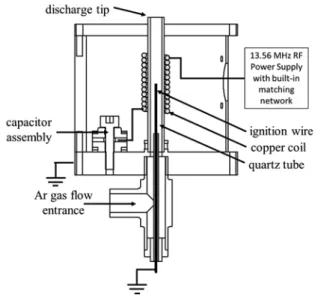
This study investigates the effect of the ignition wire to the I-V measurements in atmospheric pressure plasma. The plasma source is composed of helical copper coil wound around a quartz glass tube and utilizes an ignition wire fixed at the center of the quartz tube that assists the ignition of the Ar plasma10). Probe location, diameter, and the source operation parameters were changed to investigate the effects to the probe I-V characteristics.
2. Experimental Set-up 2.1 The atmospheric pressure plasma device
Plasma ignition of atmospheric pressure plasma was done by connecting a 13.56 MHz RF power supply with built-in matching network to a 12 turns helical copper coil wound around a 57 mm long quartz glass tube (5 mm inside diameter, 7 mm outside diameter) where one end of the coil is connected to a capacitor assembly.
Plasma is produced inside the quartz tube upon introduction of Ar gas which is regulated using a gas flow meter ranging from 1-5 L/min. The ICP assembly is contained in a cylindrical aluminum enclosure attached to the ground terminal. The ignition wire is inserted at the axial center of the quartz tube and is isolated from the aluminum enclosure using ceramic tubes.
2.2 Description of the probe
The double electric probe is composed of two 0.70 mm diameter, 90 mm long tungsten wire inserted inside a V-shaped double hole ceramic tube. The position of the probe inside the quartz tube is shown in Fig. 1 (b) and the description of the probe is shown in Fig. 1 (c). One of the wires is connected to a voltage source while the other wire is a reference wire which is connected to ground terminal. The probe voltage was swept from -40 V to +40 V between the tips and the current was simultaneously measured.
Fig. 1. Schematic diagram of the atmospheric pressure plasma.
Fig. 2. Position (a) and description (b) of the electric probe.
175
Joey Kim T. Soriano and Motoi Wada
3. Results and Discussions
3.1 Noise, off-set, and asymmetry in I-V measurements
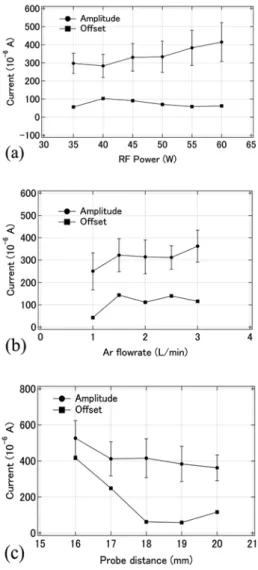
Fig. 3 shows the raw data of the typical I-V measurements and the derivative of the I-V measurements. The I-V measurements is symmetric with respect to the zero-axis as revealed by the uniform distribution in the |dI/dV| with respect to the probe voltage. The noise in the I-V measurement of the electric probe is characterized by the amplitude of the sinusoidal current measured from the raw data, and current offset measured using the y-axis (current) displacement (at x=0) using the low-pass filter curve. Figs. 4(a) – 4(c) show the noise amplitude and offset measurements with increasing RF power, Ar flowrate, and probe distance. The amplitude and offset increased with additional input of RF Power and Ar flowrate. Increase in probe distance reduced the noise amplitude and offset. Minimum RF power and Ar flowrate results in minimum signal amplitude and offset. Heating of the ignition wire mainly caused the increase in the noise amplitude. The same problem of the enhanced noise was observed on the ion mobility spectrometer signal. The larger RF input power can cause higher electrode temperature resulting in emission of adsorbed gas from the electrode into plasma. Filamentations of the plasma are often observed at higher Ar flow rate to fluctuate the path of the electric current but the possible reasons for observing noise still need to be addressed.
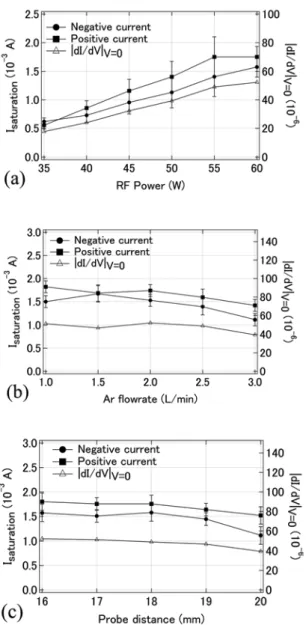
Figs. 5(a) – 5(c) show the negative and positive saturation currents and the slope of the I-V characteristic at V=0 measured for varied RF power, Ar flow rate, and probe distance. The saturation currents increased with additional input of RF power and decreased with higher Ar flow rate and larger probe distance. The symmetric I-V characteristics show equal current collection by both electrodes; they are identical in current collection performance. The symmetry is broken with increased RF power where the negative current saturation is slightly greater than the positive current saturation. At
Fig. 4. Amplitude and offset measurements using varied RF power (a), Ar flowrate (b), and probe distance (c).
Fig. 3. Typical I-V measurements using the double probe.
176
Probe Measurement of Atmospheric Plasma
60 W, the symmetry appeared to improve when Ar flow rate was set at 1.5 L/min. The I-V measurements become more asymmetric with increasing probe distance, possibly indicating the development of a homogeneous plasma far from the electrode which can possibly serve as the electron source.
3.2 Electron temperature
The electron temperature measurements are shown in Figs. 6(a) – 6(b). The electron temperature ranges from
Fig. 5. Negative and positive current saturation, and
|dI/dV|V=0 measurements using varied RF power (a), Ar flowrate (b) and probe distance (c).
Fig. 6. Electron temperature measurements using increasing RF power for various Ar flowrate (a) and probe distance (b).
Fig. 7. I-V curve (a) and current saturation and slope measurements (b) using a bias voltage in the ignition wire.
177
Joey Kim T. Soriano and Motoi Wada
5.13 eV to 6.33 eV. There are no significant effects of changing the power, Ar flowrate and probe distance in the electron temperature of the atmospheric pressure plasma. It may be due to the small range of RF power, Ar flowrates and probe distance used.
3.3 Space potential
A bias voltage was applied to the ignition wire to see if it is possible to vary the plasma space potential of the atmospheric pressure plasma by electrically biasing the wire. The effects of the bias voltage to the I-V measurements are shown in Fig. 7(a) which is still symmetric with respect to zero axis. The current saturation and slope measurements are shown in Fig. 7(b).
Positive bias voltage increased the positive current saturation awhile negative bias voltage decreased the negative current saturation. The bias voltage drastically decreased the slope of the I-V curve resulting in enlarging the uncertainties in electron temperature measurements.
4. Summary
A symmetric I-V measurement was achieved using a V-shaped double electric probe. The symmetry is disrupted with increased RF power where the negative current saturation is slightly greater than the positive current saturation. Heating of the ignition wire mainly caused the increase in noise amplitude and offset in the I- V measurements of the double probe. The electron temperature appeared to range from 5.1 eV to 6.3 eV.
Positive bias voltage increased the positive current saturation whilst negative bias voltage decreased the negative current saturation. The bias voltage substantially reduced the slope of the I-V curve indicating lower temperature.
References
1) F. J. J. Peeters, R. F. Rumphorst, and M. C. M. van de Sanden, “Plasma Conductivity as a Probe for Ambient Air Admixture in an Atmospheric Pressure Plasma Jet”, Plasma Chemistry and Plasma Processing, 38, 63-74 (2018).
2) P. R. Smy, “The Use of Langmuir Probes in the Study of High-Pressure Plasmas”, Advances in Physics, 25, 517- 553 (1976).
3) S. Yan, H. Kamal, J. Amundson, and N. Hershkowitz,
“Use of Emissive Probes in High Pressure Plasma”, Review of Scientific Instruments, 67, 4130-4137 (1996).
4) K. G. Xu and S. J. Doyle, “Measurement of Atmospheric Pressure Microplasma Jet with Langmuir Probes”, Journal of Vacuum Science & Technology A: Vacuum, Surfaces, and Films, 34, 051301 (2016).
5) E. Y. Wang, N. Hershkowitz, T. Intrator, and C. Forest,
“Techniques for Using Emitting Probes for Potential Measurement in RF Plasmas”, Review of Scientific Instruments, 57, 2425-2431 (1986).
6) J. P. Sheehan, and N. Hershkowitz, “Emissive Probes”, Plasma Sources Science and Technology, 20, 063001 (2011).
7) M. A. Fink, M. Endler, and T. Klinger, “New Developments of Self-Emitting Electrostatic Probes for Use in High Temperature Plasmas”, Contributions to Plasma Physics, 44, 668-676 (2004).
8) D. Strele, M. Koepke, R. Schrittwieser, and P. Winkler,
“Simple Heatable Langmuir Probe for Alkali Plasmas”, Review of Scientific Instruments, 68, 3751-3754 (1997).
9) S. Kumagai, H. Matsuyama, Y. Yokoyama, M. Hori, M.
Sasaki, “Novel Atmospheric Pressure Inductively Coupled Microplasma Source Using Floating Wire Electrode”, Japanese Journal of Applied Physics, 50, 08JA02 (2011).
10) J. K. Soriano, T. Torii, M. C. C. Lacdan, and M. Wada,
“Development and Characterization of Ion Mobility Spectrometer”, Plasma and Fusion Research, 14, 3406093-3406093 (2019).
178