Japanese Speakers' Comprehension of Indirect
Refusals Used in American English
Junko Yamaai
Abstract
The present study investigates Japanese speakers'
comprehension of indirect refusals among equals used in American
English (AE). First, a discourse completion test (DCT) was conducted with native speakers (NSs) of At to obtain naturally
occurring indirect refusal statements. Based on this production data,
the multiple-choice questionnaire (Beebe, Takahashi, & Uliss-Weltz, 1990; Bouton, 1988; Chui, 1990; Robinson, 1992) was developed for
the present study to examine the comprehension of indirect AE
refusals by Japanese speakers. Sixty-one freshmen majoring in Education at the Japanese University and learning English as a foreign language (L2) participated in the study. A one-way ANOVA with repeated measures consisting of four levels of situations (Request, Invitation, Suggestion, and Offer) were employed. The results have
shown that there are significant differences among four situations:
Offer = Request> Suggestion> Invitation situations.
0. Introduction
One of the particular interests in cross-cultural pragmatics has been the comprehension of indirect speech (Blum-Kulka, 1982;
Blum-Kulka, Danet, & Garson, 1985; Searle, 1975; Sperber &
1981). Research on speech act comprehension is based on
psycholinguistic work on the interpretation of literal and non-literal
meanings. To date, many studies related to indirect speech (Blum-
Kulka, 1982; Blum-Kulka, et al., 1985; Ervin-Tripp, 1976; House &
Kasper, 1981; Takahashi & Dufon, 1989; Takahashi, 1992) have
examined request behaviors. However, none of the studies has
focused on the comprehension of indirect refusals by Japanese L2 in
English learners particular, although an increasing number of studies
have done production research on refusals (Beebe & Takahashi, 1989; Beebe, et al., 1990) . Since NSs soften directness to maintain
politeness, they sometimes use the words that are not too direct.
Although some speech acts are universal, others are culturally determined. Different production, interpretive, and signaling
strategies (Gumperz, 1982a, b) are used among different cultures.
These indirect utterances literally mean something different from the actual intention of speakers. Thus, NNSs fail to pick up appropriate illocutionary meanings, and they have difficulty in comprehending the actual intention of speakers correctly. NNSs may take the literal meaning of indirect speech; therefore two interlocutors may arrive at a different conclusion about what is said. These different interactional styles can lead to intercultural miscommunication
(Kasper, 1989). Therefore, the present study examines the comprehension of indirect AE refusals by Japanese L2 English
learners. Although there is a strong interest in investigating how AE
speakers comprehend Japanese refusals, the present study focuses on the comprehension of AE refusals by Japanese speakers. This paper
discusses the comprehension of indirectness, the speech act of
refusals, American and Japanese cultures, and the study of the
comprehension of AE refusals by Japanese speakers.
Japanese Speakers' Comprehension of Indirect Refusals Used in American English 163
1. Review of Literature
1.1. The comprehension of indirectness
Conversational indirectness is associated more with politeness
than direct speech (Yule, 1996), although it does not necessarily entail in all situations and in all cultures (Kasper, 1989). Social
perceptions of indirect speech also differ. Since it is the speech act
that people mean more than what they say (Blum-Kulka, House, &
Kasper, 1989), it tends to be vague and ambiguous especially for
NNSs. It contains multiple meanings, so listeners have to share a fair amount of knowledge of a situation with speakers to understand correctly. They have to infer the conveyed meanings by utilizing cues in the utterance, contextual information, and various sources.
When comprehending indirect speech, NNSs may take the literal interpretation of words that speakers use by taking utterances at face value, due to the lack of sociopragmatic and pragmalinguistic knowledge. Thus, NNSs fail to comprehend the intended meanings of indirect speech, the meaning of extralinguistic information hints, and its politeness value of other cultures. NNSs will arrive at different interpretations than NSs.
There are some other factors that affect perceptions and
performances of speech act behaviors. Kasper (1992) lists learning
contexts, proficiency, developmental effects, and familiarity to
situations, and Robinson (1992) states that instruction has an effect on
speech act performances. In addition, the age and personal characteristics may have effects on comprehending indirect speech.
Bouton (1988) compared NSs and NNSs about the ability to
interpret implicatures in English. If people are from the same background, NSs draw one possible implicature in a given utterance in a particular context. If two people from a different background, they will draw different implicatures from the same utterance. NSs are likely to draw the same interpretation with other AE speakers;
however, Bouton (1988) states that even if people share the same
inference that each person draws will vary with each person's world view. In other words, people with the same cultural background may sometimes miscomprehend the intended meaning of indirect speech.
In this study, Bouton (1988) designed a multiple-choice
instrument to determined the extent to which NSs and NNSs interpret the same implicatures in the same way. The test was administered to 436 NNSs entering the University of Illinois and 28 American NSs as a control group. There were seven different groups altogether. The results show that a cultural background has an important role in predicting their relative success on the implicature test. However, not all types of implicatures seem to be of equal difficulty, and some types are definitely easier than others. The results also indicate that the multiple-choice instruments can be effective tools in a study like this.
Among indirect speech studies, Takahashi (1992) investigated
indirect request behavior. She examined the transferability from
Japanese to English of five conventionally indirect request strategies in four contexts. Native speakers of Japanese provided rating-scale judgments in English and Japanese for the pragmatic acceptability of
each request strategy in each context. She found that transferability of the conventionally indirect request strategies she examined were highly context-dependent. It was also influenced by learner factors,
such as proficiency and familiarity with different situational contexts.
1.2. The speech act studies of refusals
The speech act of refusals is a face-threatening act (Brown &
Levinson, 1978), and a negative face act. Since there are differences
in the degree of saving face, the function of politeness, and the use of directness and indirectness in different cultures, the interpretation of refusals in other cultures may be entirely different. Some factors that influence how directly or indirectly people refuse include the imposition of tasks, distance, and a power relationship between two
Japanese Speakers' Comprehension of Indirect Refusals Used in American English 165
interlocutors (Blum-Kulka et al., 1989). These factors affect how
people produce and interpret refusals depending on their cultural backgrounds.
To date, an increasing number of production research has been
done on refusals (Beebe & Takahashi, 1989; Beebe et al., 1990). For example, Beebe et al. (1990) did a study on the pragmatic transfer in
ESL refusals with the use of DCTs. They found that the pragmatic
transfer from Japanese influenced English of Japanese speakers in the
United States on at least three levels: the order, frequency, and instrinsic content of the semantic formulas they selected to make their refusals. However, the focus of their studies was not on comprehension.
Beebe and Takahashi (1989) examined the acts of disagreements between speakers of AE and Japanese. They studied the situations
where higher status people disagreed with lower status people, and lower to higher status. They found that Americans used more positive remarks, more softeners, and fewer explicit criticism in
English. On the other hand, Japanese made explicit criticism.
Furthermore, Japanese ESL speakers often used a questioning
strategy to show disagreement and Americans often failed to pick up
the intent of this strategy. Another difference was that Japanese
repeated the questioning strategy when they failed to get results. In that situation, Americans may turn to the statement of opinions,
when their initial questioning does not seem to work (Imai, 1989) . Chui (1990) replicated the study by Beebe et al. (1990) partially,
and she studied the similarities and differences among the Chinese from mainland China and Taiwan, and speakers of AE in business situations. The four types of stimulus questions used in her study were refusals of invitations, requests, offers, and suggestions. She found differences between these groups, except similarities outweighed differences. In all groups she compared, excuses were preferred in more than half of the responses, and the expression of gratitude was the second most frequent.
1.3. Cross-cultural comparison on politeness
Americans belong to a positive politeness culture, and direct
speech is considered polite. Scollon and Scollon (1983) have stated
that Americans emphasized equality of opportunity, and that this has led to a positive politeness culture. American speakers provide more
specific, personalized information (Beebe & Takahashi, 1990).
Although there are agreed rules, there are own variations in their use.
Nash (1983), however, argues that Americans prefer negative
politeness strategies in his study, reflecting individualism. For NNSs, it is difficult to understand various functions of refusal use by AE
speakers. According to Imai (1981), when superiors in the West are
faced with a difficult question to which they do not have an answer, they often employ the following strategy. First, they may say, "this is a good question," and look at the other person squarely in the eye and say, "What do you think?" Although AE emphasizes directness, this is the area where NNSs of AE may fail to comprehend the intended meaning of indirect speech. This type of speech has culturally determined rules; hence, NNSs have to acquire this pragmatic competence.
On the other hand, Japanese belong to a negative politeness culture. In refusing, Japanese follow a negative politeness, go off
record, and avoid responsibility for the potentially face-damaging
interpretation (Brown & Levinson, 1978) . Japanese learners' refusals
show highly formulaic structure with little specific meaning, leaving
much room for inference. For example in the Japanese culture, there
are several ways to say no. First of all, when people refuse, they might say yes meaning no, which might be confusing to NSs of AL
For instance, Imai (1981) has given several examples. The first way
to imply no is to say yes and then to follow this with an explanation.
The second way to imply no is to be vague, ambiguous, and so evasive in reply that the other side loses track of what the issue was.
The third way is to imply not to answer the question, and to leave the
Japanese Speakers' Comprehension of Indirect Refusals Used in American English 167
matter unattended. If Japanese businessmen make a comment that
has a negative tone to it during negotiations, this means a refusal.
In summary, many studies have focused on the production of refusals; however, none of studies have done in the area of the
comprehension of indirect AE refusals by Japanese speakers. It is
important to understand the intended meanings of indirect speech to gain sociogragmatic competence for successful intercultural communication. In order to do this, L2 learners need to notice a necessary hint and the function of directness and indirectness, and comprehend the correct intentions of speakers. The present paper
focuses on the comprehension of AE indirect refusals by Japanese L2
English learners.
2. The study
2.1. Research questions
The recent issue in pragmatic is indirectness (Blum-Kulka, 1982;
Blum-Kulka, et al., 1985; Searle, 1975; Sperber & Wilson, 1986;
Takahashi & Dufon, 1989; Takahashi, 1992; Tannen, 1981). To date, many studies related to indirect speech (Blum-Kulka, 1982; Blum-
Kulka, et al., 1985; Ervin-Tripp, 1976; House & Kasper, 1981;
Takahashi & Dufon, 1989; Takahashi, 1992) have examined request behaviors. Refusal production research has been done (Beebe &
Takahashi, 1989; Beebe et al., 1990); however, none of the
comprehension studies has been done on indirect refusals by
Japanese speakers learning English as L2. Therefore, the present
study examines the comprehension of indirect AE refusals. Based on
studies of refusals (Beebe et al., 1990; Chui, 1990; Robinson, 1992),
the following research questions were formulated:
1. Are there any differences in the comprehension of indirect AE
refusals among four situations (Request, Invitation, Offer, and
Suggestion) ?
2.2.
1.
Research hypotheses
Ma: Indirect refusals in Requests ituations are comprehend than those in Invitation.
Hlb: Indirect refusals in Requests ituations are
comprehend than those in Offer.
Mc: Indirect refusals in Requests situations are comprehend than those in Suggestion.
Hid: Indirect refusals in Invitation situations are
comprehend than those in Offer.
Hle: Indirect refusals in Invitation situations are comprehend than those in Suggestion.
Hlf: Indirect refusals in Offer situations are
comprehend than Suggestion.
easier to
easier to
easier to
easier to
easier to
easier to
3. Method 3.1. Design
A one-way ANOVA with repeated measure with four levels of
Situation (Requests, Invitation, Suggestion, and Offer) was employed to
investigate the comprehension of indirect AE refusal realizations by
Japanese L2 English learners.
3.2. Participants
Sixty-one freshmen majoring in Education at a Japanese University in a metropolitan area participated in the present study.
They were mostly non-English majors. The average TOEFL score
was 408, and it was their first proficiency test. This might have resulted in lower scores since they were not familiar with this type of tests. In addition, participants have never been taught about how to comprehend indirect refusals or other speech acts at the time of this study. There were 21 males and 40 females.
Japanese Speakers' Comprehension of Indirect Refusals Used in American English 169
3.3. Procedures
The multiple-choice questionnaires on indirect refusals were administered in two intact classes. Participants were provided with
questionnaire materials written in Japanese, except for refusal
statements and multiple-choice options. The descriptions of the
situations were translated into Japanese in order to avoid miscomprehension of the situations. Questions were randomized to
avoid possible guessing or learning effects. After participants had training procedures using example questions in the testing material, they were asked to complete questionnaires in the classroom. The task of participants was asked to read 20 situation questions and select the interpretation that closely matched the intended meaning of the indirect refusal statement from four multiple-choice options.
No time limits were imposed on them, but it took approximately 40 minutes.
3.4. Materials
3.4.1. The DCT to NSs of AE
Before the multiple-choice comprehension was developed for the present study, the DCT was conducted to gather indirect refusal
statements from five native speakers of AE as a first step (Yamaai, 1994). In this production study, situations were adopted from previous refusals studies (Beebe et al., 1990; Chui, 1990; Robinson,
1992). These situations consisted of four requests, invitations, offers,
and suggestions with some modifications. A few of the situations
were modified and applied to the Japanese culture and classmates'
interactions. In addition, only status-equal situations were presented,
since situations in this questionnaire needed to be neither too direct
nor indirect. Thus, interlocutors were among friends, who were not
too intimate and not too unfamiliar. Furthermore, other speech-act
situations were incorporated (Bouton, 1988; Gibbs, 1987),
functioning as distracters from the previous studies. Each situation
was presented without joinders. The task of the participants was to
example DCT question for NSs of AE:
An American classmate, Jennifer who is graduating asks Stuart to take over her responsibilities as secretary of the student association in your department for the next semester.
fennifer: I really need to find someone to take over as secretary of our student association for next semester. You'd be perfect.
Gould you possibly do it?
Stuart:
3.4.2. The multiple-choice questionnaire to Japanese learners
of English as L2 to assess comprehension
On the basis of indirect refusal responses gathered from NSs of
AE on DCTs (Yamaai, 1994), a written multiple-choice
comprehension questionnaire for the present study was developed for
Japanese learners of English as L2. A few pilot studies were done to Japanese speakers both in ESL and EFL situations to create a reliable questionnaire. In this multiple-choice questionnaire to Japanese
learners of English, situations were given first, followed by initiating statements and responses. Response statements were directly
adopted from the previous DCT studies (Yamaai, 1994). In addition, gender differences were randomly assigned to each situation type: 1) female to male 2) male to female 3) male to male and 4) female to
female. Then, four alternative interpretations for each situation were constructed. They consisted of two totally different interpretation options, one literal meaning, and the other was the correct
interpretation. Two AE female native speakers teaching at Japanese
universities checked whether these multiple options included the correct, the literal, and the two incorrect interpretation options for
Japanese Speakers' Comprehension of Indirect Refusals Used in American English 171 each AE refusal statement. The following is an example question:
Kurt and his friend have formed a study group to prepare for the final exam in a difficult class. Their classmate, James, asks Kurt if he can also join his group.
James:
Kurt:
I understand that you and Richard are studying together. I'm
having some real problem in this class and I wonder if I could join you? It would sure help me.
Well..., we haven't really finalized anything yet, and schedules are really crazy. But if we get it together, I'll try to
get back to you.
What does Kurt mean?
(1) When Kurt sets the schedule, he will letJames know (2) Kurt is good at mathematics.
(3) Kurt is busy these days.
(4) Kurt doesn't want to work withJames.
The content of these items are summarized in Table 1 (see Appendix A). The previous pilot study with different population
produced 0.81, and the reliability of this present test was 0.76.
3.5. Scoring
This questionnaire was scored based on the total number of
correct answers (correct 1; incorrect 0). The total questions were
twenty. Four distracter questions were deleted for main analyses, because they were not targeted situations to be investigated for the
present study. Thus, the maximum score was sixteen. Each situation
(Request, Invitation, Suggestion, and Offer) had four questions.
3.6. Analysis
A one-way ANOVA with repeated measure with four levels of
The SuperAnova program on a Macintosh was used to conduct statistical analysis.
4. Results 4.1. Means
Sixteen situations were scored and analyzed, while the other
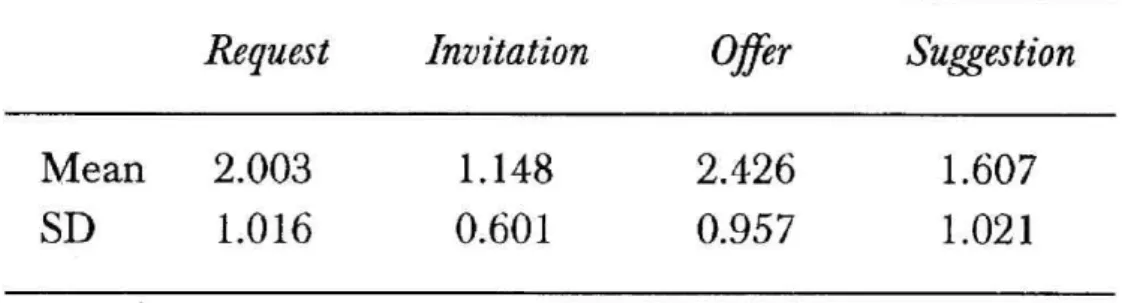
situations were not included for the main analyses (the total score, 16). The results of the descriptive statistics were summarized in
Table 2 and 3.
Table 2. Means and standard deviations for Correct and Literal options
Correct Literal
Mean SD
7.213 2.224
6.885 2.450
The mean for correct answer was 7.21, and the literal answer was 6.89. As a whole, participants chose correct and literal options at the same percentage rate (43%). This might be the reason why the mean
score of correct options was low.
The mean scores were analyzed by Situation.
Table 3. Means and standard deviations for four situations
Request Invitation
Offer
SuggestionMean SD
2.003 1.016
1.148 0.601
2.426 0.957
1.607 1.021
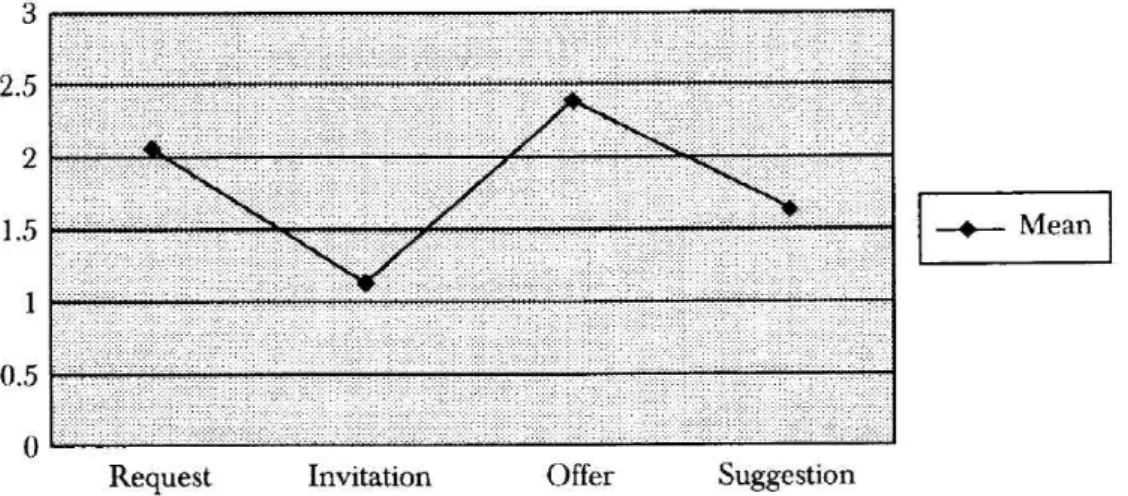
Japanese Speakers' Comprehension of Indirect Refusals Used in American English 173 Figure 1 shows the means for four situations.
3 --- 2.5
2 ---
1.5,.,,i~~—~--Mean
. 0.,5 --- 0 ---
Request Invitation Offer Suggestion Figure 1. Means for four situations
On the basis of mean scores, participants scored higher in the
order of Offer, Request, Suggestion, and then Invitation situations.
4.2. Main analyses
Table 4 shows the results of a one-way ANOVA procedure by
the Situation within-subject effect (see Appendix B).
Table 4. One-way ANOVA results - Tests of within-subject effects - Situation effect
Source of Variation SS DF MS F Sig.of F
Situation Residual
55.475 201.082
3 240
18.492 0.838
22.071 0.0001
0.05<p
A significant difference was observed for the Situation effect, F
(3,240) = 22.071, 0.05. Scheffe's test was conducted to locate
where significant differences occurred. There were significant differences between Request and Invitation, between Invitation and
Offer, and between Offer and Suggestion situations. However,
In summary, there were significant differences among four situations:
Offer = Request> Suggestion> Invitation. Refusals in Offer and Request
situations were easier to comprehend, and Invitation was the most
difficult for Japanese speakers among four situations.
5. Conclusion and discussion
On the whole, hypotheses were partially supported. Among four situations compared, participants comprehended indirect refusals in
Offer and Request situations more correctly than Suggestion and
Invitation, and the most difficult situation was Invitation. The results of each hypothesis are discussed.
H la: Indirect refusals in Request situations are easier to comprehend than those in Invitation situations.
This hypothesis was supported. There was a significant difference between Request and Invitation situations. Since refusal statements in Request situations tended to be more direct than Invitation due to the nature of situations, it was easier for participants to understand the intended meaning of refusals in Request. Although NSs of AE provided the most indirect way of refusing in the previous DCT, NSs refused more directly in Request than Invitation. The reason might be that it was more polite to refuse requests directly, compared to invitations.
Hlb: Indirect refusals in Request situations are easier to
comprehend than those in Offer situations.
This hypothesis was not supported. There was not a significant difference between these two situations.
H 1 c: Indirect refusals in Request situations are easier to comprehend than those in Suggestion.
This hypothesis was supported. There was a significant difference between these two situations. Refusals in Suggestion situations were more difficult to comprehend than Request. It
Japanese Speakers' Comprehension of Indirect Refusals Used in American English 175 appeared that speakers were not required to refuse directly in Suggestion in comparison with Request in terms of politeness; thus, Request was easier for NNSs to comprehend. This situation-specific characteristic may have influenced this result.
Hid: Indirect refusals in Invitation situations are easier to
comprehend than those in Offer situations.
This hypothesis was not supported. The result turned out to be
opposite, and Offer situations were significantly higher than Invitation.
Refusals in Invitation situations were more difficult than Offer in the
present study. This might be due to the fact that NSs refused more indirectly in Invitation.
Hie: Indirect refusals in Invitation situations are easier to comprehend than those in Suggestion situations.
This hypothesis was not supported. Suggestion situations were instead significantly higher than those of Invitation. Refusals in Suggestion were more difficult than Invitation.
H 1 f: Indirect refusals in Offer situations are easier to comprehend
than Suggestion situations.
This hypothesis was supported. Suggestion situations were more
difficult than Offer, because refusals in Suggestion situations tended to be more indirect than Offer. It was more polite to refuse directly to Offer than Suggestion, which did not forcefully require speakers direct refusal responses. Thus, refusals in Offer situations were easier to
comprehend than Suggestion.
In summary, the level of comprehension differed among four
situations. There was a significant difference between 1) Offer and Request, and 2) Suggestion. There was also a significant difference
between Suggestion and Invitation. However, there was not a
significant difference between Offer and Request. That is, both Offer
and Request situations were significantly higher than Suggestion, which was then significantly higher than Invitation. Easier situations to
comprehend the intended meaning of speakers were both Offer and
Request, and the most difficult situation was Invitation. Inherent
it seemed to be more polite to refuse directly in Request and Offer than Suggestion and Invitation, and refusal statements in Request and Offer
situations were more direct than those of Suggestion and Invitation.
Thus, it was easier for learners to comprehend correct interpretation for the first two situations. Furthermore, when NSs used accepting- like statements in Suggestion and Invitation situations, NNSs had difficulty in comprehending the correct meanings.
The average score for choosing intended interpretations ( x = 7.213, the total score = 16) was about half of the total score (see Table 2). This was due to the fact that participants chose the literal
meaning options at about similar percentage rates of the time as the
correct answers (43%) (see Table 2). They failed to choose the
intended meaning of indirect refusals and took the literal meaning instead, which made scores lower. This tendency was especially observed in accepting-like refusal statements.
The written questionnaire has a limitation to include all cues available for understanding indirect refusals, since there are a variety
of cues for refusing (e. g., pauses, facial expressions) in a real
situation. It would be easier to comprehend indirect refusals better if extralinguistic information were provided. Some combinations of
other measures (e. g., role-plays, qualitative research) could be
incorporated to investigate comprehension of refusals in future research.
Since speech acts represent a highly complex mapping of
meaning onto form (Olshtain & Cohen, 1989), learners need to
notice rules or be taught the function and meaning of indirect speech explicitly, especially in limited input environments as in the EFL classrooms. In order to develop learners'sociopragmatic
competence, teachers can provide consciousness-raising activities or
explicit instruction. As Schmidt (1993) has claimed, consciousness
and awareness are important factors in establishing rules and patterns of pragmatic knowledge and developing pragmatic competence. He
Japanese Speakers' Comprehension of Indirect Refusals Used in American English 177
(1993) has stated that noticing is the necessary condition for
converting input to intake, and consciousness learning is effective.
Learners should also observe what NSs say and behave in similar situations. For example, the use of videos seems to be a good option
(Rose, 1994), which familiarizes learners to context-based variations
in language use. Teachers also need to provide much input to learners, and they begin to notice the rule of indirect speech in a real life communication situation. In addition, some possible pitfalls of miscommunication among people from a different cultural background may be avoided. Finally, since there are various ways of
refusing, the comprehension of Japanese indirect refusals by AE
speakers is a fruitful area for further research.
Note:
The earlier version of this paper was presented at 12th World Congress of Applied Linguistics in 1999 in Tokyo.
Table 1. Contents of the questionnaire
Situation
Comp.*
Q No.
Content Gender ReferenceRequest #1 Request #2 Request #3 Request #4
Q6 Q11 Q14 Q17
Helping moving Female-female A secretary
A study group Notes
Female-male Male-male Male-female
Robinson #3 Robinson #1 Robinson #2 Robinson #6
Invitation #1 Q3 Invitation #2 Q7 Invitation #3 Q12 Invitation #4 Q19
A dinner A dinner A jazz concert A party
Male-female Female-female Male-male Female-male
Beebe, Takahashi, Uliss-Weltz #10 Chen #12
Yamaai
Beebe, Takahashi, Uliss-Weltz #4
Offer #1 Offer #2 Offer #3 Offer #4
Q2 Q5 Q10 Q15
A china base A snack A cake Offering a ride
Male-male Female-male Male-female Male-female
Beebe, Takahashi, Uliss-Weltz #7 Beebe, Takahashi, Uliss-Weltz #5 Beebe, Takahashi, Uliss-Weltz #9 Robinson #5
Suggestion #1 Q4 Suggestion #2 Q9 Suggestion #3 Q13 Suggestion #4 Q18
A desk
A purple clothe Ties
A teacher
Male-male Male-female Female-male Female- female
Beebe, Takahashi, Uliss-Weltz #6 Chen #4
Chen #5
Beebe, Takahashi, Uliss-Weltz #15
Others #1 Others #2 Others #3 Others #4
Q1 Q8 Q16 Q20
Computer center Male- SingingMale-
ChiliFemale-female
International food Female-female
Gibbs Bouton #18 Bouton #22 Bouton #15
* Comp. Q. = Comprehension questionnaires
Japanese Speakers' Comprehension of Indirect Refusals Used in American English 179
REFERENCES
Beebe, L. M., & Takahashi, T. (1989). Sociolinguistic variation in face- threatening speech acts: Chastisement and disagreement. In M.
Eisenstein (Ed.), The dynamic interlanguage (pp.199-218). New York:
Plenum.
Beebe, L. M., Takahashi, T., & Uliss-Weltz, R. (1990). Pragmatic transfer in ESL refusals. In R. C. Scarcella, E. Anderson, & S.C. Krashen (Eds.), On
the development of communicative competence in a second language (pp. 55-73).
Cambridge, MA: Newbury House.
Bouton, L. F. (1988). Cross-cultural study of ability to interpret implicatures.
World Englishes, 7(2), 183-196.
Brown, P., & Levinson, S. (1978). Universals in language use: Politeness
phenomena. In E. Gordon (Ed.), Questions and politeness (pp. 54-310).
Cambridge: Cambridge University Press.
Blum-Kulka, S. (1982). Learning how to say what you mean in a second language: A study of the speech act performance of learners of Hebrew
as a second language. Applied Linguistics, 3, 29-59.
Blum-Kulka, S., Danet, B., & Garson, R. (1985). The language requesting in Israeli society. In J. Forgas (Ed.), Language and social situation (pp. 113-
141). New York: Springer Verlag.
Blum-Kulka, S., House, S. J., & Kasper, G. (1989). Cross-cultural pragmatics.
Norwood, NJ: Ablex.
Chui, W. K. (1990). Thanks, Sorry, Excuse: Chinese and American Refusals in
Business situations. Unpublished scholarly paper. University of Hawai'i at Manoa.
Ervin-Tripp, S. (1976). Is Sybil there? The structure of some American
English directives. Language in Society, 5 (1), 25-66.
Gumperz, J. J. (1982a). Discourse strategies. Cambridge, England:
Cambridge University Press.
Gumperz, J. J. (Ed.), (1982b). Language and social identity. Cambridge,
England: Cambridge University Press.
House, J., & Kasper, G. (1981). Politeness markers in English and German.
In F. Coulmas (Ed.), Conversational routine (pp. 157-185). The Hague,
Netherlands: Mouton.
Imai, M. (1981). 16 ways to avoid saying no: An invitation to experience
Japanese management from the inside. Tokyo: Japanese Economic
Journal.
Kasper, G. (1992). Pragmatic transfer. Second Language Research, 8(3), 204-231.
RELCJournal, 14 (2), 87-98.
Olshtain, E., & Cohen, A. D. (1989). Apology: A speech act. In N. Wolfson
& F. Judd (Eds.), Sociolinguistics and language acquisition (pp.18-35).
Rowley: Newbury House.
Robinson, M. A. (1992). Introspective methodology in interlanguage
pragmatics research. In G. Kasper (Ed.), Pragmatics of Japanese as native
and target language, Technical Report No. 3, Second Language Teaching and Curriculum Center, University of Hawai'i at Manoa.
Rose, K. (1994). Pragmatic consciousness-raising in an EFL context.
Pragmatic and Language Learning, 5, 52-63.