Japan Advanced Institute of Science and Technology
JAIST Repository
https://dspace.jaist.ac.jp/
Title 書換え論理に基づくメタプログラミングを用いた分散
システムの形式仕様とモデル検証
Author(s) Doan, Ha Thi Thu Citation
Issue Date 2019‑03
Type Thesis or Dissertation Text version ETD
URL http://hdl.handle.net/10119/15790 Rights
Description Supervisor:緒方 和博, 情報科学研究科, 博士
FORMAL SPECIFICATION AND MODEL
CHECKING OF DISTRIBUTED SYSTEMS WITH REWRITING LOGIC META-PROGRAMMING
FACILITIES
By DOAN, HA THI THU
submitted to
Japan Advanced Institute of Science and Technology, in partial fulfillment of the requirements
for the degree of Doctor of Philosophy
Written under the direction of Professor Kazuhiro Ogata
March, 2019
Abstract
In recent decades, key software systems on which human beings heavily rely on are in the form of distributed systems. Such systems are quite complex and thus very hard to design and verify. Model checking is a popular automatic formal technique and highly suitable for verifying distributed systems. Several researchers have attempted to formally analyze and verify distributed systems. However, these are several tough problems or new forms of distributed systems that have not been tackled well by existing approaches (or tools).
Control algorithms are a large important class of distributed algorithms, which deal with significant problems, such as snapshot recording algorithms and checkpointing algorithms.
One main characteristic of these algorithms is that they are superimposed on underlying distributed systems. Although some research have been conducted to formally verify control algorithms, all of them directly require humans to specify by hand underlying distributed systems on which control algorithms are superimposed. It is expected to have more general approaches. However, it is challenging to specify control algorithms in almost all existing specification languages for model checkers because it is necessary to treat an underlying distributed system as the data that is handled by these algorithms. Therefore, it is one of the challenging problems to be solved that how to specify control algorithms but not underlying distributed systems on which control algorithms are superimposed is.
Recent advances in distributed computing highlight models and algorithms for au- tonomous mobile robots that self-organize and cooperate together in order to solve a global objective. Due to the mobility aspect, robot algorithms are often complex, ar- guably even more complex than classical distributed systems. Designing and analyzing mobile robot algorithms is notoriously difficult.
Rewriting logic is a natural model of computations for concurrency and communica- tion systems. Several specification languages based on rewriting logic, such as Maude, CafeOBJ and Elan have been designed and implemented. Moreover, rewriting logic is a reflective logic that can be faithfully interpreted in itself. Rewriting logic is highly suitable to formalyze distributed algorithms. However, rewriting logic only at the object level may not be powerful enough to precisely specify some distributed algorithms.
This thesis focuses on exploiting Rewriting logic meta-programming facilities to formal- ize the distributed algorithms that have not been tackled well by existing approaches (or tools), as well as by any methods (or tools) based on rewriting logic at the object level.
The aim of the research is to achieve how to tackle two important families of distributed systems, namely control algorithms and mobile robot algorithms, with rewriting logic meta-programming facilities. Theoretically, we have faced the above mentioned problems
by moving from the object level to the meta level, namely that it is necessary to deal with the specifications of underlying distributed systems as data for the specification of a control algorithm and the succinct specification of mobile robot algorithms as data for a translator by which the succinct ones are transformed to those that can be directly treated by Maude.
First of all, we propose a new approach to specifying and model checking control al- gorithms. Meta-programming technique is applied to the challenges above-mentioned.
We have used meta-programs as formal specifications of control algorithms. A control algorithm is specified as a meta-program that takes the specification of an underlying dis- tributed system as an input and generates the specification of the underlying distributed system on which the control algorithm is superimposed (UDS-CA). A control algorithm is only specified at once, and for each underlying distributed system, the specification of the UDS-CA is automatically obtained. Furthermore, we propose a technique that takes the number of each kind of entities used, generate all possible initial states that satisfy some constraints and conduct model checking experiments for all the initial states, which makes it more likely to detect a subtle flaw lurking in a control algorithm or improves the confidence in the correctness of a control algorithm. We have conducted two case studies, which specify and model check snapshot and checkpointing algorithms.
Several classic distributed algorithms have been formally verified with some techniques based on rewriting logic. We aim to obtain similar achievements for distributed mobile robot systems - a new form of distributed systems. We come up with formal specifi- cation and model checking based on rewriting logic for mobile robot algorithms. We have conducted two case studies in which we specify and model check an exploration algorithm and a gathering algorithm on rings in Maude. However, no existing specifi- cation language is designed for mobile robot algorithms on rings: rings are not directly supported by such languages and specifications of such algorithms are far from the corre- sponding mathematical descriptions. This is because of the particular symmetries owned by rings. Consequently, we need to specify rings by adapting other defined structures, such as sets and sequences. It, therefore, makes the specification task tedious as well as time-consuming, while the specifications obtained are complicated and lengthy. It is worth providing a specification environment in which rings are directly supported. An environment and a domain-specific language (DSL) for specifying and model checking mo- bile robot algorithms on rings (or mobile ring robot algorithms) are proposed. First, we develop Maude Ring Specification Environment (Maude RSE), a ring specification envi- ronment that explicitly supports ring-shaped networks. Then, we build our DSL, Mobile Ring Robot Maude (MR2-Maude), on top of Maude RSE. MR2-Maude makes it possible to specify mobile ring robot algorithms in such a way that the specifications are as close as possible to their mathematical descriptions. One key underlying these tools is pattern matching between ring patterns and ring instances, called “ring pattern matching.” The advantages of Maude RSE and MR2-Maude are demonstrated by case studies analyzing exploration and gathering mobile robot algorithms.
Keywords: control algorithm, mobile robot algorithm, model checking, meta-programming, domain-specific language.
Acknowledgements
I had an unforgettable time during my doctoral program at JAIST with an interesting topic on formal verification of distributed systems. I would like to express my sincere appreciation to who contributed to my thesis and supported me during this amazing journey of my life and this thesis would not have been completed without their supports.
First and foremost, I would like to express my sincerest gratitude to my supervisor, Professor Kazuhiro Ogata, for his support, motivation and encouragement. I was so lucky to have a supervisor who cared so much about my work. He gave me many valuable advices and great ideas that made my work productive and stimulating. His valuable suggestions, comments and guidance kept my research going on track. His deep insights helped me at many stages of my research. He experienced all of the ups and downs of my research and encouraged me to improve my research. He handed me not only the necessary knowledge but also his valuable research experiences. Moreover, I also appreciate his help and kindly guidance in my daily life at JAIST.
I extremely appreciate useful comments from the committee members: Professor Mizuhito Ogawa, Professor Xavier Defago, Professor Tatsuhiro Tsuchiya and Associate Professor Razvan Beuran, who pointed out the limitations of my research in several cases and provided suggestions for improving my work. Specially, I would like to sincerely thank Professor Xavier Defago, who gave me several important advices, suggestions and comments from the beginning of my research to its end. His valuable comments about the principle of distributed systems made my thesis be more consistent and rich.
My grateful gratitude is reserved for Associate Professor Fran¸cois Bonnet for his valu- able insights and suggestions. He suggested me several great research ideas on formal verification of mobile robot algorithms, which is the main contribution of my thesis.
Without him, the main part of this thesis could not be established. He discussed and gave me many useful advices and valuable comments for my research. I am really grateful for his time and effort for this research. His wide knowledge and logical way of thinking have been of great value for me. I cannot imagine how difficult it would be to complete this work without his guidance.
I would like to give a great thank to Associate Professor Adri´an Riesco, who is an expert of Maude. It is a great opportunity for me to have conducted part of my research under his supervision during my internship at Universidad Complutense de Madrid. He gave a big help on my research, including technical support, with his extensive knowledge of Maude. I cannot thank him enough for all he has done to make this work possible. With his valuable supports, a new environment and a domain specific language for mobile robot algorithms
on rings has been successfully designed and implemented. I am amazed that even during his busy schedule, he was always willing to support me with my research. Furthermore, I would like to take this opportunity to thank Professor Narciso Mart´ı-Oliet, who provided me with a chance to join and work at Department of Software Systems and Computation, Universidad Complutense de Madrid and assisted me greatly on many procedures. I am really grateful for working in a professional environment with all cooperations and supports. I owe the members at the department a big thank for helping me a lot of time with many complex procedures for my stay in Madrid.
I would want to thank JAIST Grants, Monbukagakusho Honors Scholarship, NEC C&C Foundation Grants, Tokyo Institute of Technology for financially supporting me during my study, such as the expenses for attending conferences and the expenses for studying abroad. Their financial supports mean a lot to me and encouraged me to do my best in the studying and researching to be worthy with their supports.
A heartfelt thanks to my supportive wonderful family for their constant support and encouragement. Their unconditional support both in my life and my study as well. The love and support that they gave motivated me to work harder and to strive towards my goal. I would not be me today without your love. You are always with me whenever I’m happy or sad. Thank you so much for being with me in the wonderful, but challenging time of my life.
Last but not least, my acknowledgement would be incomplete without thanking my friends both at JAIST and in Madrid, who make my social life a pleasure experience.
Their friendship and kindness help me to adapt my self to a new environment and culture.
They made me more happy to avoid stress in doing my research. I am indebted to them for their help. Thank to great time with them, I could balance my life and recover my energy for pursuing doctoral degree during these challenging years.
Doan Thi Thu Ha
Table of Contents
Abstract i
Acknowledgements ii
Table of Contents viii
List of Figures x
List of Tables xi
1 Introduction 1
1.1 Distributed Systems . . . 1
1.1.1 Control Algorithms . . . 1
1.1.2 Mobile Robot Algorithms . . . 2
1.2 Formal Verification of Distributed Systems . . . 3
1.3 Contributions . . . 5
1.3.1 A New Approach to Specifying and Model Checking Control Algo- rithms . . . 5
1.3.2 An Environment and a Domain-Specific Language for Specifying and Model Checking Mobile Ring Robot Algorithms . . . 6
Formal Analyzing Mobile Robot Algorithms in Maude . . . 7
An Environment and a Domain-Specific Language . . . 8
1.3.3 Summary . . . 8
1.4 Thesis Structure . . . 9
2 Preliminaries 11 2.1 Distributed Algorithms . . . 11
2.1.1 Control Algorithms . . . 11
Four-Counter Algorithm . . . 12
Chandy-Lamport Distributed Snapshot Algorithm (Chandy-Lamport Algorithm) . . . 14
Checkpointing Algorithm . . . 15
2.1.2 Mobile Robot Algorithms . . . 17
Computational Model . . . 18
Perpetual Exploration . . . 19
Exploration with Stop . . . 21
Robot Gathering . . . 22
2.2 Literature Review on Formal Verification of Distributed Systems . . . 23
2.3 Reflection and Meta-programming . . . 26
2.3.1 Rewriting Logic as a Reflective Logic . . . 26
2.3.2 Meta-programming . . . 27
3 Maude and Meta-programming in Maude 28 3.1 Maude and Its LTL Model Checker . . . 28
3.2 Specifying an Underlying Distributed Systems as a Module . . . 32
State Expressions . . . 33
Initial States . . . 33
State Transitions . . . 34
3.3 Meta-program in Maude . . . 34
4 Specifying and Model Checking Control Algorithms at the Meta Level 37 4.1 Specifying Control Algorithms at the Meta Level . . . 37
4.1.1 Meta-programs as Formal Specifications . . . 37
TState . . . 38
TInit . . . 39
TTrans . . . 39
T . . . 39
4.1.2 Model Checking at the Meta Level . . . 43
4.1.3 Experiments . . . 44
4.2 Generating and Model Checking All Possible Initial States . . . 45
4.2.1 Generating All Possible Initial States . . . 45
4.2.2 Model Checking All Possible Initial States . . . 47
4.2.3 Experiments . . . 47
4.3 Case Studies . . . 48
4.3.1 Specification and Model Checking of Chandy-Lamport Algorithm . 49 The Specification of an Underlying Distributed System . . . 50
Specifying Chandy-Lamport Algorithm as a Meta-program . . . 51
Model Checking of the Distributed Snapshot Reachability Property 53 Experiments . . . 54
4.3.2 Formal Analysis of a Checkpointing Algorithm . . . 56
The Specification of an Underlying Mobile Distributed System (UMDS) 57 Specifying Checkpointing Algorithm . . . 58
Model Checking . . . 60
Experiments . . . 61
5 Formally Analyzing Mobile Robot Algorithms in Maude 65 5.1 Specification and Model Checking of a Perpetual Exploration Algorithm . 65
5.1.1 System Specification . . . 65
State Expressions . . . 66
State Transitions . . . 68
5.1.2 Model Checking . . . 71
State Predicates . . . 71
Property Specifications as LTL Formulas . . . 72
5.1.3 Experiments and Counterexample . . . 73
5.2 Model Checking of Robot Gathering . . . 77
5.2.1 Formal Model . . . 77
State Expressions . . . 77
State Transitions . . . 80
Formal Model . . . 81
5.2.2 Model Checking . . . 82
5.2.3 Experiments and Counterexamples . . . 83
Omission of Special Cases . . . 84
Design Errors (difficult to detect by mathematical proof) . . . 84
Some Minor Errors . . . 87
5.2.4 Summary of Model Checking . . . 89
6 An Environment and a Domain-Specific Language for Specifying and Model Checking Mobile Ring Robot Algorithms 90 6.1 Overview . . . 90
6.1.1 Mobile Robot Computing on Rings . . . 91
6.1.2 Problems . . . 91
6.1.3 Our solutions . . . 94
6.2 Maude RSE . . . 94
6.2.1 Ring Patterns . . . 95
Sequences . . . 95
Rings . . . 97
6.2.2 Extending Maude with Ring Attributes . . . 103
6.2.3 Syntax declaration . . . 105
6.2.4 Applications . . . 106
Robots Exploration on Ring under ASYNC . . . 106
Formal Specification of Exploration Algorithm . . . 107
Model Checking . . . 110
6.3 MR2-Maude . . . 111
6.3.1 Syntax . . . 112
State Expression . . . 112
State Transition . . . 113
6.3.2 Model Checking Facilities . . . 114
6.4 Evaluation . . . 114
6.4.1 Specifications with “Ring” Attributes in Maude RSE . . . 115
A Perpetual Exploration Algorithm . . . 115 A Gathering Algorithm . . . 115 6.4.2 Specifying Mobile Ring Robot Algorithms in MR2-Maude . . . 116
7 Conclusion and Future Work 118
7.1 Conclusion and Main Findings . . . 118 7.2 Future Work . . . 120
List of Figures
1.1 The control algorithm execution is superimposed on an underlying appli-
cation execution. . . 2
1.2 The existing approaches and our new approach to specifying control algo- rithms. Sys1, . . . , Sysn are underlying distributed systems and Sys1-CA, . . . , Sysn-CA are the underlying distributed systems on which a control algorithm is superimposed. . . 4
2.1 A control algorithm is superimposed on an underlying distributed system (UDS), which may be regarded and treated as data by the control algorithm. 12 2.2 The initial state of the 3-processes, 6-channels and 2-tokens system . . . . 12
2.3 The initial state of a toke system with 3-processes & 4-channels . . . 14
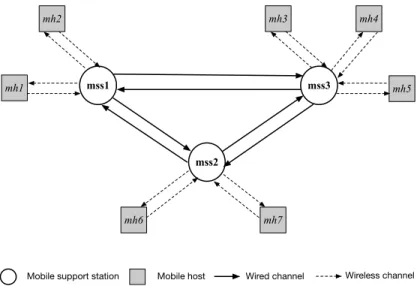
2.4 A mobile distributed system that consists of three mobile support stations and five mobile hosts. . . 16
2.5 Configuration (R2, F2, R1, F5) with 3 robots on a 10-node ring. . . 20
2.6 Rule RL1: (R2, F2, R1, Fz)→(R1, F1, R1, F2, R1, Fz). . . 20
2.7 Rule RL2: (R1, F1, R1, F2, R1, Fz)→(R2, F3, R1, Fz). . . 21
2.8 Rule RL3: (R2, F3, R1, Fz)→(R2, F2, R1, Fz+1). . . 21
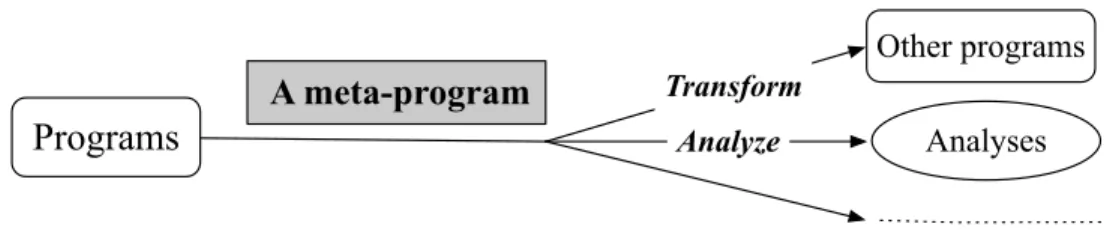
2.9 A meta-program takes programs as inputs and perform some useful com- putations, such as transforming and analyzing. . . 27
3.1 The initial configuration of the system. . . 29
4.1 A control algorithm is specified as a meta-program . . . 38
4.2 The state-transition diagram of a process. . . 44
4.3 The counterexample found . . . 46
4.4 A challenge of model checking and our solution to model check control al- gorithms. Init-1 . . . Init-i. . . Init-nare initial states that represent concrete system. The function InitGene takes some system parameters of an un- derlying distributed system as inputs and returns all possible initial states of the underlying distributed system. . . 47
4.5 All possible initial states of a fully connected system. . . 47
4.6 Some possible initial states of a partially connected system. . . 48
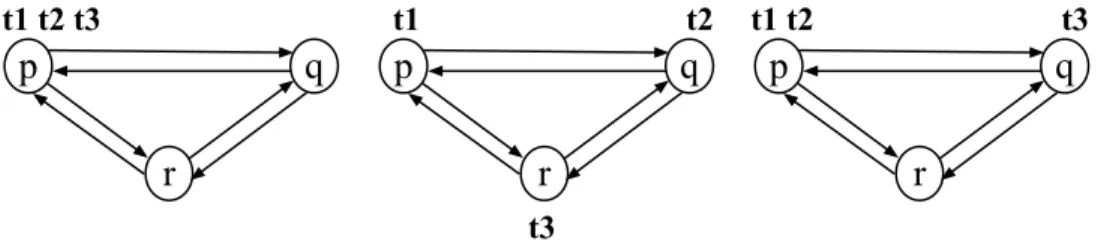
4.7 Some initial states of the system with 3 processes & 2 tokens. . . 48
4.8 The initial state of a token system . . . 50
4.9 The state-transition diagram of a process. . . 55
4.10 A mobile distributed system consists of three mobile support stations and five mobile hosts, in which mobiles directly communicate with other mobiles
in the same cell. . . 61
4.11 Some possible initial states of a mobile distributed system consisting of four mobile support stations and four mobile hosts. . . 64
5.1 Describing a system by the configuration and the size of the ring . . . 67
5.2 Scenario of the counter example . . . 75
5.2 Scenario of the counter example (continued) . . . 76
5.3 Some configurations. A dashed arrow represents a pending move. Black nodes represent multiplicities. . . 79
5.4 A transition graph of one specific initial configuration (a) . . . 79
5.5 Expected executions for the two specific symmetric configurations with two multiplicities. . . 85
5.6 Three configurations where (a) is some initial configuration, (b) is the con- figuration obtained if only one robot moves, and (c) the one obtained if both symmetric robots move. . . 85
5.7 Five configurations. The gathering algorithm should follow the sequence (a), (b), (c), (d), but the configuration (f) is actually obtained from (b). . . 86
5.8 Four configurations. The gathering algorithm should follow the sequence (a), (b), (c), but the configuration (d) is actually obtained from (b) . . . . 87
5.9 Three configurations, where (a) may lead to (b), and (c) presents the ex- pected behavior of the algorithm for the specific asymmetric configuration (b). . . 88
6.1 The four configurations are considered the same. . . 91
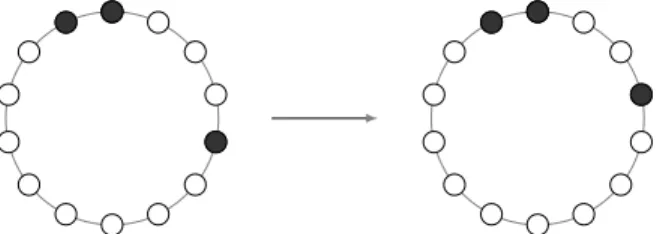
6.2 (a) A system with two adjacent robots and (b) The obtained system after the movement. . . 92
6.3 Architecture of Maude RSE. . . 104
6.4 Some configurations. A dashed arrow represents a pending move. Black nodes represent multiplicities. . . 108
6.5 Transition graph from the initial configuration (a). . . 108
6.6 (a) A system with 10 nodes and 3 robots and (b) The system obtained after a robot moved. . . 111
6.7 (a) A system with 10 nodes and 3 robots, (b) a robot takes the snapshot of the system and computes a move, and (c) the robot executes its pending move. . . 112
6.8 Some configurations. A dashed arrow represents a pending move. Black nodes represent multiplicities. . . 113
6.9 (a) A configuration with a multiplicity obtained from a symmetric con- figuration and (b) The configuration with a multiplicities obtained from (a). . . 115 6.10 Maude RSE preserves the performance of the ordinary Maude environment. 117
List of Tables
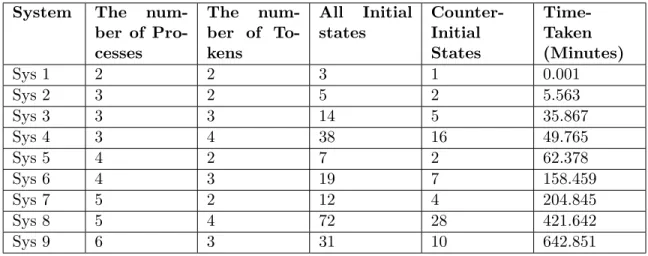
4.1 Results of the nine model checkings for Four-Counter Algorithm . . . 49
4.2 A comparison of performance between the two approaches . . . 55
4.3 Results of the six model checkings for the algorithm . . . 62
6.1 Performance comparison between ordinary Maude and Maude RSE. . . 116
Chapter 1 Introduction
1.1 Distributed Systems
In recent decades, key software systems on which humans heavily rely on are in the form of distributed systems, which consist of multiple nodes (or processes) connected with networks (or channels). Distributed system is an essential form of today software with many significant applications, such as telephone networks and aircraft control systems. A distributed system consists of independent entities that cooperate to solve a problem that cannot be individually solved. The entities are connected and communicate by passing messages though communication networks. Modern applications of distributed systems, such as cloud computing and web search engine, usually provide their services to a large number of customers.
1.1.1 Control Algorithms
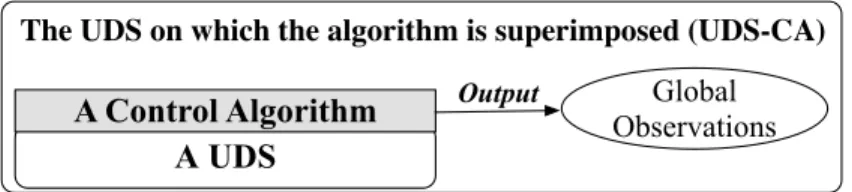
Because distributed systems are collections of many individual components, it has raised many global problems, which cannot be detected and handled by a single component and thus require global solutions. Among such problems are detecting termination, detect- ing distributed deadlock, detecting global stable predicates, recording global states and checkpointing. It is, therefore, necessary to use many non-trivial distributed algorithms, such as termination detection algorithms, deadlock detection algorithms, global stable predicate detection algorithms, snapshot recording algorithms and checkpointing algo- rithms. These algorithms need to be executed in order to monitor underlying application executions or to perform various auxiliary functions. They are essential to distributed systems. One main characteristic of these algorithms is that a control algorithm execu- tion is superimposed on an underlying application execution and in many cases does not interfere with the application execution (Fig 1.1). Said differently, they run concurrently with underlying distributed systems (UDSs). Such distributed algorithms are called Con- trol algorithms [43]. An underlying distributed system is regarded and treated as data by control algorithms.
Based on our surveys of [43] and [60], there are around 30% problems tackled by control
A UDS
The UDS on which the algorithm is superimposed (UDS-CA) A Control Algorithm Output Observations Global
Figure 1.1: The control algorithm execution is superimposed on an underlying application execution.
algorithms. Control algorithms, therefore, is a large and important class of distributed algorithms.
1.1.2 Mobile Robot Algorithms
Traditionally, distributed computing has focused on systems that consist of immobile en- tities connected with fixed communication networks in which communication is explicit.
However, distributed computing is extending to solve problems relevant to a distributed mobile environment where entities are mobile and communication might not be explicit.
Mobile distributed computing has become the heart of various different systems, such as software mobile agent in communication networks, mobile sensor networks, swarms and robotic networks. Motivated by the various tasks that can be performed by autonomous mobile robots, many researchers have been investigating the field of autonomous mobile robot. Recent developments in theoretical computer science (especially in distributed com- puting) focus on models and algorithms for autonomous mobile robots that self-organize and cooperate in order to achieve global goals. Autonomous mobile robots have been pro- posed for several promising applications, such as working in damaged environments. The seminal model introduced by Suzuki and Yamashita [40] proposes a distributed system of k robots that have low capacities: identical (they are indistinguishable and all execute the same algorithm), oblivious (they have no memory of their past actions), and disori- ented (they share no common orientation). Moreover, the robots do not communicate by sending or receiving messages, but have the ability to sense their environment and see the relative positions of the other robots. Researchers have proposed formal models for these systems and have designed algorithms for solving some predefined tasks. Most papers focus on the computability of mobile robots; one of the main goals is usually to find the weakest assumptions (on robots and/or model), such as synchrony, multiplicity detection, and chirality that might make a problem solvable or unsolvable. In this context, various models and algorithms have been proposed to solve particular problems. There exist several different models, but they can be classified in two main classes: (i) discrete models in which movement is restricted to a graph [10, 11, 22] and (ii) continuous models in which entities move on a continuous space [34, 40, 64]. For both cases, a large variety of tasks have been considered, especially gathering and exploration. In discrete models, robots perform their activities in specific shape networks, such as rings and grids. They can be observed only at specific discrete locations of these networks.
What and how problems can be solved by a group of autonomous mobile robots on
ring-shaped networks is an important topic in the area, as shown by the large number of algorithms that have been proposed: e.g. the papers [10, 24, 26, 27, 33, 44] propose algorithms for exploration on ring, robot gathering on rings is solved in [11, 21, 23, 39, 41, 55], and some other problems are solved in [22, 59]. In this thesis, we focus on discrete models where robots move on a ring-shaped network.
1.2 Formal Verification of Distributed Systems
Distributed systems are quite complex and thus very hard to design and verify. Formal verification is one of the main approaches to distributed system verification and model checking [4, 32] is a popular automatic formal technique and highly suitable for verifying such systems. Several researchers [3, 42, 65, 66] have attempted to formally analyze and verify distributed systems (or algorithms) and many tools are developed to that purpose.
However, these are several tough problems that have not been tackled well by existing approaches and more new forms of distributed systems that require new methods (or tools) to deal with.
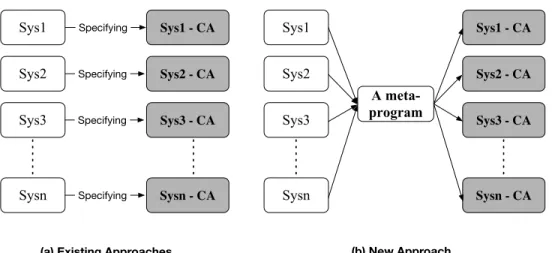
Control algorithms have raised a challenge to verification by model checking because such algorithms cannot be specified independently of the underlying systems. Although some control algorithms have been specified and model checked in [7, 12, 57], all of them directly require humans to specify by hand the underlying systems on which control algo- rithms are superimposed (Fig. 1.2(a)). When the same control algorithm is to be verified for different underlying systems (or different variants of the same underlying system), we need to write new specifications of the underlying systems on which the algorithm is superimposed. This consumes time and exhausts specifiers due to repetitions. We may, therefore, want to propose a new approach such that we only need to specify a control algorithm at once and the specification of the system on which a control algorithms is superimposed (UDS-CA) is automatically generated from the specification of an underly- ing system. However, it is challenging to specify control algorithms in almost all existing specification languages for model checkers, such as PROMELA [37], because it is neces- sary to treat an underlying system as data handled by control algorithms. Moreover, two different systems (an underlying distributed system and the UDS-CA) may be taken into account to model check some properties for control algorithms, while almost all existing model checkers (to our knowledge), such as SPIN [37], NuSMV [14], and TLC [45], do not support it.
Designing and analyzing mobile robot algorithms is notoriously difficult. In the litera- ture, the correctness of such algorithms relies on handmade mathematical proofs, which are error-prone. Most of these proofs are handmade and may consist of a large number of cases, especially when the algorithm is given explicitly as a set of transition rules (e.g.[10]) in opposition to a more abstract algorithm where movements are implicitly given by some mathematical rules (e.g. [22]). It is not easy and not trustful to check the correctness of these algorithms only by hand. We believe that the research field of distributed mobile robots is now mature; some main models have emerged and have been adopted by the community. It is time to study how to automatically verify such algorithms and this
Sys1 - CA Sys1
Sys2
Sys3
Sysn
Sys2 - CA
Sys3 - CA
Sysn - CA
Specifying
Specifying
Specifying
Specifying
Sys1 - CA Sys1
Sys2
Sys3
Sysn
Sys2 - CA
Sys3 - CA
Sysn - CA
(a) Existing Approaches (b) New Approach
A meta- program
Figure 1.2: The existing approaches and our new approach to specifying control algo- rithms. Sys1, . . . , Sysn are underlying distributed systems and Sys1-CA, . . . , Sysn-CA are the underlying distributed systems on which a control algorithm is superimposed.
thesis presents an example of automatic verification. However, due to the mobility as- pect, mobile robot algorithms are often complex, arguably even more complex than classic distributed systems. This inherent difficulty explains probably the limited number of at- tempts in obtaining formal verifications. The untruthfulness of handmade mathematical proofs has been pointed out in [5, 9, 28, 29]. Formal, automatic techniques could help us increase the confidence of the existing algorithms/proofs, as shown in [5, 9, 19, 28, 29].
For discrete models, model-checking has been proven useful to find errors in the proposed algorithms [9, 28, 29]. However, ring discrete models are not well supported by any exist- ing specification languages, such as SPIN [37], DVE [6], and Maude [16]. This is because of the particular symmetries owned byrings. Consequently, the specifiers, such as Berard et al. [9] and Doan et al. [28, 29], need to specify rings by adapting other defined struc- tures, such as sets and sequences. For instance, Doan et al.[28] need to use commutative binary operators to specify rings in Maude. It, therefore, makes the specification task tedious as well as time-consuming, while the specifications obtained are complicated and lengthy.
Recent publications, such as [5], have attempted to include formal proofs. Such proofs require the hard efforts of researchers to have the knowledge for specifying an algorithm in a particular specification language. However, no existing specification language is designed for mobile robot algorithms on rings: rings are not directly supported by such languages and the specifications of such algorithms are far from the corresponding mathematical descriptions. Therefore, it is worth providing a specification environment in which rings are directly supported. The environment would allow users to concentrate on mobile ring robot algorithms. It is also worth designing a domain-specific language dedicated to mobile ring robot algorithms on top of the environment. The domain-specific language allows users to specify mobile ring robot algorithms such that the specifications are as close as possible to their mathematical descriptions. It also provides predefined LTL
formulas as well as atomic propositions to model check that such algorithms enjoy the desired properties.
Rewriting logic is a natural model of computations for concurrency, parallel and com- munication systems. Several specification languages based on rewriting logic, such as Maude, CafeOBJ and ELAN have been designed and implemented. Moreover, rewriting logic is a reflective logic that can be faithfully interpreted in itself. This makes some of these languages, such as Maude able to provide meta-programming facilities. Rewriting logic is highly suitable to formalyze distributed algorithms. This is demonstrated by many researches on formalization of distributed systems based on the rewriting logic framework.
However, rewriting logic only at the object level may not be powerful enough to precisely specify some tough distributed algorithms.
1.3 Contributions
This thesis focuses on exploiting rewriting logic meta-programming facilities to formalize the distributed algorithms that have not been tackled well by existing approaches (or tools), as well as by any methods (or tools) based on rewriting logic at the object level. The aim of the research is to achieve the formal specification and model checking of distributed systems with rewriting logic meta-programming facilities. Theoretically, we have faced the above mentioned problems by moving from the object level to the meta level. We have manipulated rewriting logic as a reflective logic and used meta-programming techniques to specify distributed algorithms.
1.3.1 A New Approach to Specifying and Model Checking Con- trol Algorithms
We carefully take into account the important aspect of control algorithms — they run concurrently with an underlying distributed system. We have investigated one possible solution that is to apply meta-programming techniques to the challenges above-mentioned.
A meta-program is a program that takes a program (or specification) as an input and performs some useful computations, such as analyzing the program and transforming the program into another. Metaprogramming is very powerful with many important applications. Translators and debuggers, for instance, are such applications.
As we have mentioned, when the same control algorithm is to be verified for different underlying distributed systems (or different variants of the same underlying distributed system), we need to write new specifications of the underlying distributed systems on which the control algorithm is superimposed (UDS-CA). We present an approach that aims at avoiding this repetition by specifying a control algorithm as a transformation that converts the specification of an underlying distributed system into one that combines both the underlying distributed system and the algorithm. A control algorithm is specified as a meta-program that takes the specification of an underlying distributed system as an input and generates the specification of the UDS-CA. A control algorithm is specified at once, and for each underlying distributed system, the specification of the UDS-CA is
automatically obtained. This is depicted in Fig. 1.2(b). The model checking is conducted at the meta level as well. The meta level makes it possible to model check the properties that involve both an underlying distributed system and the UDS-CA. The distributed snapshot reachability property is one of these properties. We explain how to model check it in a case study presented in Section 4.3.1.
Model checking is a verification technique that explores all possible system executions and checks whether a desired property that should be satisfied by an algorithm is sat- isfied. It is necessary to provide the initial states of an underlying distributed system to model check that the UDS-CA enjoys a desired property. One main challenge is that counterexamples may be found for some initial states, while they may not be for others.
Even fixing the number of every kind of entities, used in an underlying distributed sys- tem, there may be more than one underlying distributed system due to many options, such as network topologies, such as mobile support stations and mobile hosts in a mobile checkpointing algorithm. Facing the challenge, then, one piece of our work is to come up with a verification technique that generate all possible initial states of an underlying distributed system for a fixed number of each kind of entities. Because too many initial states could be generated, however, we use some constraints to make the number of initial states moderate. One possible constraint is that mobile support stations are strongly connected with a reliable wired network. We demonstrate the usefulness by reporting on a case study in which a counterexample is found for some specific initial states but not for the other initial states, detecting a subtle flaw lurking in a mobile checkpointing algorithm.
We have conducted two case studies in which the approach is utilized to specify and model check a snapshot algorithm and a checkpointing algorithm. Two main contribu- tions of this work are:
(1) Specification: It is an approach to specifying control algorithms as meta-programs, which allows us:
• to specify a control algorithm once and automatically generate the specification of the UDS-CA for each underlying distributed system;
• to faithfully specify and model check properties that involve both an underlying distributed system and the UDS-CA.
(2)Model checking: We propose a technique that takes the number of each kind of entities used, generate all possible initial states and conduct model checking experiments for all the initial states, which makes it more likely to detect a subtle flaw lurking in a control algorithm. Our model checking has found two subtle errors in a checkpointing algorithm.
1.3.2 An Environment and a Domain-Specific Language for Spec- ifying and Model Checking Mobile Ring Robot Algorithms
Several classic distributed algorithms have been formally verified with methods based on rewriting logic, while few studies have been conducted to formally verify distributed mobile
robot systems — a new form of distributed systems — with those based on rewriting logic.
Our work implies that the rewriting logic framework is powerful and flexible to successfully express a new form of distributed system.
Formal Analyzing Mobile Robot Algorithms in Maude
We come up with formal specification and model checking based on writing logic to mobile robot algorithms. We present how to formalize a mobile robot algorithm as a state ma- chine and then specify the state machine in Maude, a language and a system supporting executable specification and declarative programming in rewriting logic. We have demon- strated in [28, 30, 31] that Maude allows us to specify distributed algorithms/systems more succinctly than others. For instance, it supports associative and commutative op- erator attributes that are very necessary to concisely specify mobile robot algorithms as shown in [28]. A case study of how to specify and model check a given robot exploration algorithm is conducted. A formal model of a system consisting of three robots on the ring shaped network is given. The main work consists in using the model checking ap- proach to automatic verification of a perpetual ring exploration algorithm. Rewriting logic makes it possible to naturally specify dynamic systems, and the Maude system has an LTL model checker. The two significant properties which the algorithm should satisfy have been specified as Linear Temporal Logic (LTL) formulas [38]. We then model check the two properties for the algorithm with the LTL model checker. As the result of our model checking for the algorithm, a counterexample has been found. This states that the algorithm is not correct since it does not satisfy the two properties.
Furthermore, we have proposed a formal model for mobile robot algorithms on anony- mous ring shaped network under multiplicity and asynchrony assumptions. About timing assumption, we consider the more general asynchronous model ASYNC. We take into account multiplicity assumption, which makes it much harder to formalize mobile robot algorithms. We focus on the gathering problem and analyze the algorithm proposed by D’Angeloet al. [21] as a case study. As the result of the model checking, counterexamples have been found. We refute by model checking that the algorithm enjoys desired prop- erties. We detect the sources of some unforeseen design errors. We, furthermore, give our explanations on these errors. Two main results are: (1) a formal model for mobile robot algorithms on anonymous ring shaped network under multiplicity and asynchrony assumptions – our model is general enough and could be applied to other problems (in the ring); (2) a refutation by model checking that the algorithm enjoys desired properties
— in detail, the algorithm contains design errors that prevent robots from gathering into one location. The additional contributions are a preliminary set of Maude modules that could be re-used for future verifications and the interpretations of the errors found.
The contribution of our work is the proof by example that formal methods must be used to verify distributed robot algorithms. Indeed, even algorithms described and proven using mathematical abstractions (may) still contain errors. While some of them are minor and could have been detected by a careful reader (simple typos), some errors would have been almost impossible to detect without model-checking. Said differently, we claim that informal and semi-formal mathematical proofs are not enough for this kind of algorithms.
The complexity of analyzing all situations may be too high for human brains. Another valuable contribution of our work is that we discover the challenges to specify and model check mobile ring robot algorithms. Because rings are not supported in Maude, we need to specify rings by adapting other defined structures, such assets andsequences. It, thus, makes the specification task tedious as well as time-consuming, while the specifications obtained are complicated and lengthy.
An Environment and a Domain-Specific Language
An environment and a domain-specific language for specifying and model checking mo- bile robot algorithms on rings (or mobile ring robot algorithms) are proposed. First, we develop Maude Ring Specification Environment (Maude RSE), a ring specification envi- ronment that explicitly supports ring-shaped networks. Maude RSE is implemented in Maude. Then, we build our domain-specific language, Mobile Ring Robot Maude (MR2- Maude), on top of Maude RSE. MR2-Maude makes it possible to specify mobile ring robot algorithms in such a way that the specifications are as close as possible to their mathematical descriptions. One key underlying these tools is pattern matching between ring patterns and ring instances, called “ring pattern matching.” Because rings are not commonly available data structures in any existing specification language, we encode ring patterns as sets of sequence patterns and simulate ring pattern matching by pattern matching between sets of sequence patterns and sequence instances, which is proven cor- rect and transparent to both Maude RSE and MR2-Maude users. MR2-Maude predefines some LTL formulas as well as atomic propositions to model check that such algorithms en- joy desired properties. The advantages of Maude RSE and MR2-Maude are demonstrated by case studies analyzing exploration and gathering mobile robot algorithms.
Maude RSE and MR2-Maude themselves are the main achievements. Our research illustrates the power of rewriting logic in that Maude RSE can be implemented by ex- tending Maude, more precisely Full Maude, and MR2-Maude can be implemented by further extending Maude RSE. That is, we do not need to implement such formal tools from scratch but we can do so by extending Maude and/or new formal tools on top of Maude. Case studies are conducted with Maude RSE as well as MR2-Maude, demon- strating that because Maude RSE supports ring structures, mobile ring robot algorithm specifications in Maude RSE are more concise and compact than those in Maude; the overhead incurred by handling rings is almost nothing and mobile ring robot algorithm specifications in MR2-Maude are close to their mathematical descriptions. From a theo- retical point of view, we prove that ring pattern matching can be correctly simulated by pattern matching between sets of sequence patterns and sequence instances. Therefore, Maude RSE as well as MR2-Maude will benefit researchers in both the formal methods community and the distributed computing community.
1.3.3 Summary
Our research discovers the power of rewriting logic as well as its meta-programming facil- ities to formal specification and model checking of distributed systems. We have demon-
strated that meta-programs can be used as formal specifications of distributed algorithms.
The main contributions of the thesis are: (1) a formal specification and model checking approach based on meta-programming to control algorithms, (2) a specification environ- ment and a domain-specific language for specifying and model checking mobile ring robot algorithms.
1.4 Thesis Structure
We organize the structure of this thesis into seven chapters. We summarize each chapter as follow:
Chapter 1 is an introductory chapter. It first gives a brief introduction to control algo- rithms and mobile robot algorithms. It then summaries the problems of formal verification of distributed algorithms followed by our contributions, and thesis structure.
Chapter 2 provides preliminaries to this thesis. Many researchers have attempted to formally analyze and verify distributed systems (or algorithms). This chapter will present a careful investigation on the advancements of some related researches as well.
This chapter then introduces rewriting logic and its applications, and explains about its important aspects as reflective logic.
Chapter 3 introduces Maude and its LTL model checker. It then describes how to specify and model check a distributed system in Maude. It also introduces Maude meta- progamming facilities and show how to implement a meta-program in Maude.
Chapter 4 proposes a new approach to specifying and model checking control algo- rithms. The approach is explained by applying it to specifying and model checking a termination detection algorithm. We give our idea on generation of all possible initial states that fulfill some constraints so as to make it more likely to detect subtle errors lurking in control algorithms. Two case studies are given at the end of the chapter.
Chapter 5 focuses on how to specify and model check mobile robot algorithms in Maude. Namely, we analyze a perpetual exploration algorithm and a gathering algorithm.
Chapter 6 introduces Maude RSE and describes the theory of ring-patten matching. It presents how to specify mobile ring robot algorithms in Maude RSE. Maude RSE allows us to concisely and naturally specify mobile robot algorithms on ring shape networks. It then introduces MR2-Maude and evaluates Maude RSE and MR2-Maude.
Chapter 7 concludes the thesis, summarizing the main contributions made. It also reveals future directions.
References and publications follow Chapter 7.
Chapter 2
Preliminaries
This chapter provides preliminaries to this thesis. It first introduces control algorithms and mobile robot algorithms. Many researchers have attempted to formally analyze and verify distributed systems (or algorithms). This chapter will present a careful investigation on the advancements of some related research as well. This chapter then introduces rewriting logic and its applications, and explains about its important aspects as reflective logic.
2.1 Distributed Algorithms
A distributed system consists of a collection of computation units abstractly namedprocess that cooperate to achieve a common goal. A set of n processes could be denoted as Π
= {p1, . . . , pn}, where each pi, 1 ≤ i ≤ n, represents a distinct process. The processes communicate by sending and receiving messages through channels, which are wired or wireless network. In some case, channels are assumed to be reliable (no lost, modify, or duplicate messages) and first in first out (FIFO), which means that the messages are received in the order sent.
2.1.1 Control Algorithms
This section introduces a class of distributed algorithms - Control algorithms to which our methods are going to apply.
In distributed systems, an underlying application executes its own program, which rep- resents the logic of the application. An application execution involves processes and their related communication channels. In many cases, however, some extra additional tasks should be carried out in order to monitor the application execution or to perform various global functions, such as: detecting termination, detecting distributed deadlock, detect- ing global stable predicates, recording global states, and checkpointing. It is, therefore, necessary to use many non-trivial distributed algorithms, such as termination detection algorithms, deadlock detection algorithms, global stable predicate detection algorithms, snapshot recording algorithms, and checkpointing algorithms. The essential characteris-
tics of such algorithms is that an algorithm execution is superimposed on the underlying application execution. An underlying distributed system may be regarded and treated as data by control algorithms (Fig 2.1).
A Control Algorithm
Input Output
A UDS
Global Observations or
Agreements The UDS on which the algorithm is superimposed
The UDS
Figure 2.1: A control algorithm is superimposed on an underlying distributed system (UDS), which may be regarded and treated as data by the control algorithm.
The following part presents three different control algorithms. They are a termination detection algorithm, a snapshot recording algorithm and a checkpointing algorithm.
Four-Counter Algorithm
Let us consider the following simple, but non-trivial, control algorithm. The algorithm is called “Four-Counter Algorithm” for termination detection in an asynchronous atomic model.
Computation Model. A distributed system consists of a finite set of processes that are connected and communicate with the communication network, which is fully con- nected. Assuming the processes do not share a common global memory. Let p1, . . . , pn be n asynchronous processes. Each pi has a local variable denoted modei whose value is either active or passive. Initially, some processes, at least one, are in the active mode, while the others are in the passive mode. When a process pi is active, it can execute local computations and send messages to the other processes. When a message reaches a process pj, pj instantaneously sets modej to active. Messages are delivered reliably without any error in finite but arbitrary time that may or may not be in the sent order.
The atomic model is a simplified model in that it takes only time to deliver a message to a destination process from a source process but the destination process does anything in it instantaneously, such as updating its internal state, on receipt of the message.
p q
r
t
1t
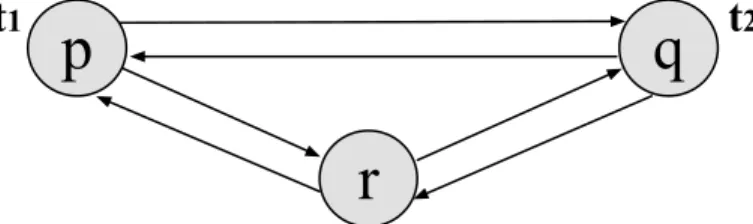
2Figure 2.2: The initial state of the 3-processes, 6-channels and 2-tokens system
Fig. 2.2 describes an underlying distributed system consisting of three processes p,q,r and two tokens t1 and t2. The state of a process mainly depends on the set of tokens owned by the process. pi has two actions: (1) consuming one of its tokens or sending the token to another process by putting the token into one of its outgoing channels if the process is active and (2) receiving a token from one of its incoming channels and becom- ing active in case it is in the passive mode. When a process does not hold any tokens, it may become passive and then remains passive unless it receives a message from another process. Initially, p is active and holds t1, and q is passive, and holds t2, while r is passive and does not have any tokens and all channels are empty.
Termination Detection Problem. It is very important to know when the distributed computation has terminated so that the result could be used or the next computation could be started. Intuitively, a distributed computation has terminated when all the pro- cesses are passive and all the channels are empty. The termination detection problem consists in designing an algorithm in order to detect the termination. Let c[i, j] denote the channel frompi topj and empdenote the empty channel. A distributed computation is said to be terminated if and only if:
For all i, j, modei = passive and if there existsc[i, j], then c[i, j] = emp.
This is called the “termination prediate.”
Four-Counter Algorithm. The idea that underlies the algorithm is simple: it detects the termination by counting and comparing the number of messages that have been sent and received. The system is claimed to be terminated when the total number of messages sent is equivalent to the total number of messages received. Messages used in the under- lying computation are called computation messages, and messages used for the purpose of termination detection (by Four-Counter Algorithm) are called control messages. The algorithm does not block any computation messages. Let us consider a simple version of the algorithm based on an inquiry-based principle. Each process pi is required to count the numbersenti of messages it has sent, and the numberreci of messages it has received.
Let us assume that there is an observer in charge of the termination detection. To start, the observer requests each process pi to answer to let it know the pair (senti, reci) by sending the pair to it. When the observer has all the pairs, it computes the total number S of the messages sent, and the total number R of the messages received. If S = R, it claims that the system has terminated. Otherwise, it starts its next inquiry.
At each process pi:
• Receiving a computation message:
reci :=reci + 1;
• Sending a computation message:
senti :=senti + 1;
• Receiving a request from the observer:
send the pair (senti, reci) to the observer.
At the observer:
repeat
S := 0; R := 0;
for eachi ∈ {1, ..., n} do send a request to pi end for;
wait for an answer message (senti, reqi) from each pi; S := P
1≤i≤n senti ; R :=P
1≤i≤n reci ; if(R = S)then claim termination; exit loop end if
// start the next inquiry.
endrepeat.
Chandy-Lamport Distributed Snapshot Algorithm (Chandy-Lamport Algo- rithm)
CLDSA [50] is the first and fundamental snapshot algorithm to record a consistent global state of a distributed system.
Underlying Distributed System. Channels are unbounded reliable queues (FIFO).
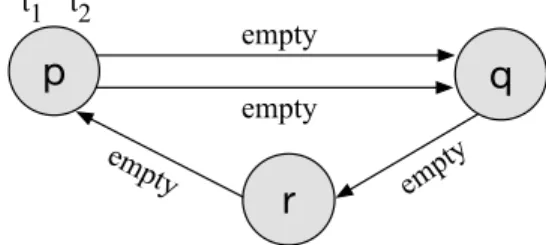
The state of a channel is characterized by the sequence of in-trans messages sent along the channel and not yet received by the destination process. Fig. 2.3 shows a system that consists of three processes p,q,r and four channels, in which there are two channels from p to q.
p q
r
t1 t2
empty empty
empty empty
Figure 2.3: The initial state of a toke system with 3-processes & 4-channels Chandy-Lamport Algorithm. Chandy and Lamport have proposed Chandy-Lamport algorithm by which processes can record their own states and the states of incoming channels such that the combination of all process states and all channel states forms a consistent global state. Chandy-Lamport algorithm guides each process when it should
record its own state and the state of each incoming channel by using a special message calledmarker. Each process can record its state at any time when it has not yet received any markers from other processes. These rules must be followed:
Marker-Sending Rule for a process p: for each of its outgoing channels c, p sends one marker alongc after recording its state and before sending further messages along c.
Marker-Receiving Rule for a process p: when the process p gets a marker from one of its incoming channels c,
if p has not yet recorded its state
then p records its state according to Marker-Sending Rule for p and the state of channel cas the empty sequence
else p records the state of c as the sequence of messages received along c after recording p’s state and before receiving the marker alongc.
The algorithm will be terminated when each process has recorded its state and the states of all of its incoming channels. The global snapshot then is collected by combining those recorded process and channel states. An important aspect of the algorithm is that the algorithm runs concurrently with, but does not alter, the behavior of an underlying dis- tributed system.
The Distributed Snapshot Reachability Property. Let s1, s∗ and s2 be the state in which Chandy-Lamport algorithm is initiated (the start state), the snapshot taken, and the state in which Chandy-Lamport algorithm is terminated (the finish state), re- spectively. Although the snapshot s∗ may not be identical to any of the global states that occur in the computation from s1 tos2, one desired property (called the distributed snapshot reachability property) Chandy-Lamport algorithm should satisfy is that s∗ is reachable from s1 and s2 is reachable from s∗, whenever Chandy-Lamport algorithm is terminated. Note that s1, s2 and s∗ are states of the underlying distributed system but not those of the underlying distributed system on which Chandy-Lamport algorithm is superimposed (UDS-CLDSA).
Checkpointing Algorithm
Checkpointing is an essential technique for fault tolerance distributed systems. It helps to reduce the amount of lost work by periodically saving the state of a process during the failure-prone execution. A failure system could restart its execution from the saved state upon to the failure. The saved state by a process is called local checkpoint and a global checkpoint is a set of local checkpoints, one from each process. However, an arbitrary set of local checkpoints may not form a consistent global checkpoint. A consistent global checkpoint is a global checkpoint such that no message that is sent by a process after taking its local checkpoint is recorded as a received message by another process in its
local checkpoint. There are two main approaches for checkpointing: coordinated check- pointing and uncoordinated checkpointing. In this case study, we specify and model check a coordinated checkpointing algorithm for mobile distributed systems with our approach.
Mobile Distributed Systems.A mobile computing system consists of the set of mobile hosts that can move and the set of mobile support stations that act as access points to connect mobile hosts to the rest of the network. Mobile support stations communicates with other mobile support stations by wired networks, but it communicates with mobile hosts by wireless networks. The location of a mobile host is represented by its current local mobile support station. The system as shown in Fig. 2.4 consists of three mobile support stations and seven mobile hosts. Because of the mobility of a mobile host, it may connect to different mobile support stations from time to time. A mobile host may voluntarily disconnect from the network and a disconnected mobile host is unreachable from the rest of the network. Wired networks provide reliable FIFO message delivers.
Messages are delivered in the order sent and arbitrary, but limited time. A mobile host can pass messages in a reliable FIFO wireless channel to communicate with an mobile support station when it locates in the cover of the mobile support station (called cell).
mss1 mss3
mss2 mh1
mh2
mh5 mh4
mh6
mh3
mh7
Mobile support station Mobile host Wired channel Wireless channel
Figure 2.4: A mobile distributed system that consists of three mobile support stations and five mobile hosts.
Mutable Checkpointing Algorithm.Due to the mobility of mobile hosts and the lim- ited capacity of wireless networks, it has raised some new issues in recording consistent global checkpoints, such as: (1) the communication delay and message complexity are increased because of the changes of the location of a mobile host; (2) the disk storage on a mobile host, which could be loss, theft, or physically damaged, cannot be considered as the stable storage and thus only minimum number of processes should be forced to take checkpoints, which need to be transferred to stable stores in mobile support stations through low bandwidth wireless channels; (3) a disconnected mobile host is not able to record its local checkpoints.
A checkpointing algorithm is executed in order to record a consistent global checkpoint.
A checkpointing algorithm is superimposed on an underlying mobile distributed system (UMDS). There are two kinds of messages: computation underlying messages generated by the underlying distributed application and control messages generated by processes to advance checkpoints. Among several checkpointing techniques proposed, coordinated checkpointing is a commonly used technique, by which a process needs to synchronize their checkpointing activities in order to record a consistent global checkpoint. When a process records its local checkpoint, it asks (by sending control request messages) all relevant processes to take checkpoints. Cao and Singhal [13] have proposed a coordinated check- pointing algorithm, by which only the minimum number of processes have to take their checkpoints on the stable storage. The concept of “mutable checkpoints” is introduced.
A mutable checkpoint is neither a tentative checkpoint nor a permanent checkpoint, but it can be turned into a tentative checkpoint at some points. It could be saved at any- where, e.g, local storages in mobile hosts or stable storage. Intuitively, a process could start the algorithm at anytime when it is not in any checkpoint process. It takes its local checkpoint, and then sends checkpoint requests to its relative processes from which it has received messages. Requests made by a process can be inherited by other processes. A process may take a mutable checkpoint when it receives a computational message from a checkpointing process that has recorded its local state. The mutable checkpoint is turned to a tentative checkpoint if and only if the process is inherited a request message. Other- wise, it is discarded. In [13], the algorithms are described and explained in plaintext and also given in terms of pseudo-code.
2.1.2 Mobile Robot Algorithms
For the last two decades, the Distributed Computing community has been investigating what can be solved by a team of autonomous mobile robots. Following a different approach compared to the AI and Robotic communities, researchers started to propose formal models for these systems and design algorithms solving some predefined tasks. Theoretical research on distributed mobile robot focuses mainly on computability aspects; the goal is to determine whether a problem can be solved given some assumptions, such as synchrony, multiplicity detection and chirality. In this context, various models and algorithms have been proposed to solve various problems. There exist several different models, but they can be classified in two main classes: (i) discrete models in which movement are restricted on a graph [10, 11, 22] and (ii) continuous models in which entities move on a continuous space [34, 40, 64]. For both cases, a large variety of tasks have been considered such as gathering, pattern formation, scattering, flocking for continuous environments, and gathering, exploration, patrolling for discrete environments. For more details, we invite the interested reader to check the book [34] of Flocchini et. al that surveys many results (mostly on continuous models). In the discrete models, robots perform their activities in specific shape networks, such as rings and grids. They are observed at specific discrete locations. This thesis focuses on the ring discrete model. What and how problems can be solved by a group of autonomous mobile robots on ring shaped networks is a very interesting topic in the area, as shown by the large number of algorithms that have been
proposed. The authors in [10, 26, 27, 33, 44] have proposed algorithms to exploration on ring. Robot gathering on ring is solved in [11, 21, 23, 39, 41] and some other problems are solved in [22, 59]. There have been already some efforts to unify and formalize existing results [21, 22, 23, 33].
Computational Model
We considers the classic problems in the ring. The ring is anonymous, that is, there is neither node nor edge labeling. The robots are identical, i.e., they are indistinguishable and all execute the same algorithm. Moreover, the robots are oblivious and disoriented, meaning that they have no memory of past actions, and they share no common orien- tation (no chirality). The robots cannot explicitly communicate, but have the ability to sense their environment and see the relative positions of the other robots, in their local coordinate system. When there is more than one robot, the node is called a multiplicity (or a tower). In some problems, such as robot gathering problem robots are assumed to have the global multiplicity detection. If robots have weak multiplicity detection, they can distinguish whether a node is empty, occupied by one robot, or more than one robot, but are not able to count the actual number of robots. With strong multiplicity detec- tion, robots can count the exact number of robots in the multiplicity. In case they have no multiplicity detection, robots simply detect whether a node is empty or occupied by robots.
Robots follow a three-phase behavior: Look,Compute, andMove. During its Look phase a robot takes a snapshot of all robots’ positions. The collected information (position of the other robots in the egocentric view) is used in the Compute phase during which the robot decides to move or stay idle. In the Move phase, the robot may move to one of the two adjacent nodes, as computed in the previous phase. The moves are assumed to be instantaneous which means that, during a Look phase, robots can be located on nodes only.
There are different types of synchronization for the robots: fully synchronous model (FSYNC), the semi-synchronous model (SSYNC) and the asynchronous model (ASYNC).
We consider here the classic asynchronous ASYNC model [34]. The start and duration of each Look-Compute phases and the start of each Move phase of each robot are arbitrary and determined by an adversary. Note that it is possible for a robot to make a move based on a previously observed configuration which is not the current one anymore (e.g.
if its Look phase occurred before the Move phase of another robot). A move that has been computed (during a Compute phase) but not yet executed (in the subsequent Move phase) is called a pending move.
The following part presents three mobile robot algorithms that solve three main prob- lems on the ring shaped network: perpetual exploration, exploration with stop and gath- ering problems.