Journal of the Operations Research Society of Japan
Vol. 45, No. 1, March 2002
DYNAMIC MACHINING PROJECT CONTROL MODEL UNDER ORDER QUANTITY AND DEADLINE CONSTRAINTS
Tian-Syung Lan Chun-Hsiung Lan Long-Jyi Yeh Tatting University Tungnan Institute of Technology Tatung University De Lin Institute of Technology
(Received February 19, 2001; Final September 13, 2001)
Abstract To achieve the optimal control of material removal rate (MRR) for a machining project, a Dy- namic Machining Project Control ( D M P C ) Model is proposed under the considerations of order quantity and deadline constraints. This paper not only introduces material removal rate into the objective function dynamically, but also implements Calculus of Variations to resolve the continuous control problem compre- hensively. In addition, the optimal solution t o minimize the cost of a machining project with production deadline is provided, and the decision criteria for selecting the optimal solution are recommended. More- over, the sensitivity analyses of decision variables in the optimal solution as well as the numerical simulation of a real industrial problem are fully discussed. This study contributes a significant approach t o control a machining project for production engineers in today's machining industry with profound insight.
1. Introduction
The cutting speed, feed rate and depth of cut were considered as three factors of input cutting parameters [14]. To calculate the optimum cutting conditions is the objective for
production [13]. Rash and Rolstadas [16] used a mathematical model to determine optimum feed and speed for turning operations; however, the equations developed are limited to typical machines only. Koren et al. [ll] have also described several methods to be used under stepwise constant variation in feed, speed, or depth of cut, but none is practically applicable when two or more cutting conditions are changed. Therefore, controlling cutting conditions with fixed material removal rate has been introduced [I, 31.
The
MRR
is used widely in adaptive controllers for optimization of machining opera- tions [lo]. With the design of a variable structure system{ V S S }
controller on commercial computer numerical controlled( C N C )
turning machines [5], the material removal rate is dynamically manageable through overriding the spindle speed. These P C-based controllers have also been implemented to on-line override the programmed feedrate on the CNCrnilling machines [17] as well as on the machining centers [9]. Therefore, by overriding the feedrate and/or spindle speed on various CNCmachines, the material removal rate is surely capable of being dynamically controlled for most machining operations.In addition, the tool life is also a critical parameter of the machining process [3]. Novak
and Wiklund [15] proposed a suitable implementation to predict tool life, and Lee e t al. [12]
proposed a method of optimal control to ensure maximum tool life. Meng et al. 1131 also
provided a modified Taylor tool life equation to minimize tool cost. As a matter of fact, the maximum tool life or the minimum tool cost will not guarantee the minimal cost of a machining project. Besides, the various tool checking periods for tool change from different machine tool operators will decrease the productivity and increase the cost of a. machining
84 T.-S. Lan, C. -H, Lan & L. -J. Yeh
project significantly. In order to manage the consumption of tools well, a fixed tool life is then practically considered into the machining project in this study.
Although several time series modeling on the control of machining process are mentioned 81, none is guaranteed to achieve minimum cost. They are mostly emphasizing on the maximal tool usage. Actually, the machining cost and the production deadline are mainly concerned problems for a machining project confronting the manufacturing industry. The cost to machine each part is a function of the machining time [6]. While the marginal cost of production is a linear increasing function of production rate [ 7 ] , the marginal cost of machining operation is also considered to be a linear function of
MRR
in this study. This denotes that the higher machining rate results higher operational cost, such as machine maintenance and machine depreciation costs. Besides, Soroush [18] mentioned that meeting the production deadline is the most desirable objective of management. It is that an earlier completed order will freeze the capital, raise the inventory cost, and indicate the sub-optimal resource utilization. On the other hand, an order completed later than the production deadline may lose customers. Therefore, meeting the deadline of an order is critical to production projects.The interest in the minimum-cost production control grows up in modern manufacturing systems with the necessity of being more and more flexible to match the order quantity and production deadline. As the modern computer numerical controlled ( C N C ) machines are widely used to perform from job shops to flexible manufacturing systems
(FMS)
[19], there is an economic need to dynamically control the material removal rate with fixed tool life during the machining operation of a production project. The material removal rate is an important control factor of a machining project, and the control of machining rate is also critical for production planners. Hence, it is essential to find the optimum solution ofMRR
control for a machining project to not only reach the minimal cost but also meet the order quantity at the production deadline. The DMPC Model proposed in this study provides the practical solution t o the technique, and contributes the significant approach to control a machining project for the industry.
2. Assumptions and Notations
Before formulating the problem, several assumptions and notations are to be made. They are described as follows:
2.1. Assumptions
1. The production project is a single-tool and continuous machining operation on one CNC
machine.
2. The order quantity Q is considered as the production assignment to the controlled ma- chine.
3. The upper limit of
MRR
is generated from the maximum allowable cutting conditions suggested in the handbook, and the fixed tool life is derived from the Taylor's expression of the tool life [4] with these maximum conditions. Thus, no tool will break before this fixed tool life even with the upperMRR
limit.4. There is no chattering or scrapping of parts occurs during the whole manufacturing process.
Dynamic Machining Project Control Model 85
7. The marginal cost of operation is considered to be a linear function of the material removal rate [7].
8. The machining speed of a tool is continued and controlled following the final machining speed of the previous tool.
2.2. Notations
a : average volume of material machined per unit part.
B : upper limit of material removal rate.
-
B : fixed MRR for traditional machining model.
bx'{t)
: marginal operation cost [7] at the material removal ratex'(t}\
where 6 is a constant.bxf2
( t )
: operational cost [7] at timet .
c
: overall holding cost per unit chip machined per unit time at the machine; including chip holding cost per unit chip machined per unit time, and part holding cost per unit chip machined per unit time.el
: labor cost of a machine per unit time; including production and queuing.ct
cs : tool cost of a tool per unit machining time forD M P C
Model, wherecS
= -.-
t
1C S : tool cost of a tool per unit machining time for traditional machining model, where
-
ct
c* = z.
t
1C t : tool cost per tool, including cost of tool and tool set-up cost. 0 5 : production cost for DMPC Model.
Ob : production cost for traditional machining model.
Q
: order quantity of the machining project.T : production deadline that is given by the customer.
t 1
- : fixed tool life for DMPC Model.
t
1 : fixed tool life for traditional machining model.2.3. Decision functions
x ( t )
: cumulative volume of material machined during time interval[ t z ,
tl,
wheretZ
is the queuing time before production.x t ( t )
: material removal rate at timet .
3. Model Formulation
In this study,
x ( t )
is time continuous and differentiated [2,7]. Therefore,jT
[bz'\t)
+
4 t )
+c,] dt
denotes the operation cost, overall holding cost and tool cost during the time in- terval[tZ,
TI.
Besides, c{T represents the labor cost during the production deadline period[O,T]. In addition, it is noted that the upper limit of material removal rate
B
must satisfyaQ
B
^>
-; otherwise, the machining operation will never meet the order quantity at produc-T
1
tion deadline. Thus, the objective function and its constraints for the machining project with order quantity and deadline constraints are constructed as below.
[
mtn{jzT[bx12(t)
+
c x ( t )
+
cs1dt
+
c j ~
DMPC s.t.
x ( T )
= aQx ( t x )
= 0 , 0<
&
<
T
0
5
x t ( t )
5
B
fort
E
[t,,T]
T.-5. Lan, C.-H. Lan & L.-J. Yeh
y (material removal rate)
-
-I.<È
/
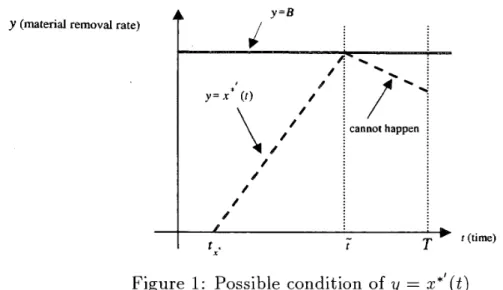
''cannot happen
I
t X .-
t ++ i (time)Figure 1: Possible condition of y =
a'*"(t)
4. Optimal Solution
Set
x*
t o be the optimal solution of DMPC Model, and settx*
to be the optimal queuing time before production. Also, assume that the time interval[tx4,
i]
is the maximal subinterval of[O, TI to satisfy Euler Equation [2, 71.
There are two possible situations to be discussed in this study. 1
4.1. Situation 1:
x* ( t )
does not touch B before T The optimal solution forSituation 1
is shown as follows:The detailed processes are described in Appendix A. Here, a Property is proposed and discussed as follows:
Property: If the line y = x * " ( t ) touches the line y = B, two lines should overlap to be y =
B
from the touch pointf
to the end point7'.
Proof.
From Eq. ( I ) ,x * ( t )
is a strictly increasing linear function oft .
And it holds for any subinterval satisfying 0<
x * ( t )
<
B during[tx4,
TI. Therefore,x * ( t )
in the time interval[f,
T ] (shown in Figure 1) cannot exist because it contradicts the Euler Equation [2, 71 to be a decreasing linear function oft ,
the Property is then verified.4.2. Situation 2:
x * ( t )
touches upper limitB
a t timei
beforeT;
wherek
T The optimal solution for Situation 2 is shown as follows:Dynamic Machining Project Control Model
The detailed processes for the solutions above are described in Appendix
B.
The algorithm in achieving the optimal solution of t h e DMPC Model provides a con- tinuous function indicating the optimal path to be followed by t h e variables through time or space. Using the properties of the Calculus of Variations for dynamic optimization, the completeness and the optirnality of the solution are guaranteed [2, 71. Additionally, the time and space complexity of t h e algorithm are not discussed in the study because the
DMPC
Model concludes the exact solution without search. 4.3. Decision criteria
From Eq. (2), the maximum value of x*(t) is found at t =
T
and ty* = 0. That is, the range of x*(t) for Situation 1 is [0, ;T2+
@I.
Therefore, the following criteria are made.- -
1. If aQ
5
à ‘ ~+
,/ÑT
a-'(t) will not reach the upper limit B before T .4h - - . -
2. If aQ
>
5~2
+
@,
x ' ( t ) will reach the upper limitB
beforeT .
45
-
c
Thus, when aQ
5
-T2+
JFT, x*'(t) will not reach the upper limitB
before T; the46 -
c
optimum solution is Situation 1. When a Q
>
-T2+
i/'^T, x * (t ) will reach the upper46 b
limit B a t
i
before T ; the optimum solution is Situation 2.5. Sensitivity Analyses
The sensitivity analyses for the two feasible cases are discussed as follows: 5.1. The sensitivity analysis for Situation 1
From Eq. ( 3 ) ; it is claimed that &* is decreasing with 6, a , or Q . It shows that increasing marginal operation cost, material volume per unit part machined, or order quantity may shorten the queuing time before production. Besides, tz* is increasing with the production deadline T .
By Eq. ( I ) , (2) and (3), the cumulative volume of material machined x*(t), and material removal rate x* (t) is increasing with order quantity Q, material volume per unit part machined a , or marginal operation constant
6;
and decreasing with production deadline T . The overall sensitivity analysis for Situation 1 is shown in Table 1.Table 1: The sensitivity analysis for Situation 1.
Parameter b a QT Reference
z * I ( t )
+ + +
- Eq. (1) and (3)'+": Decision variable is a n increasing function of the parameter. - : Decision variable is a decreasing function of the parameter.
88 T.-S. Lan, C.-H. Lan & L.-J. Yeh
5.2. T h e sensitivity analysis for Situation 2
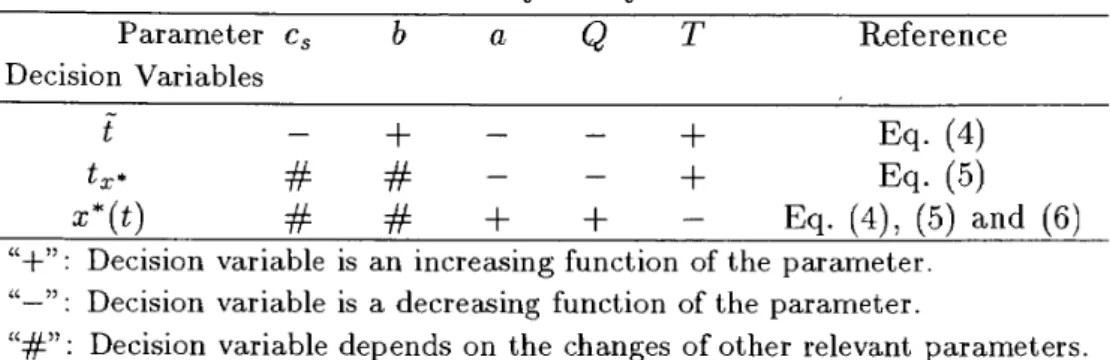
From Eq. (4)) it is derived that the time to reach upper limit
5 is increasing with marginal
operation constant b or production deadline T ; and is decreasing with tool cost cS, order quantity Q , or material volume per unit part machined a. In addition, it is asserted by Eq. (5) that the queuing time before production tzi is increasing with production deadline T, and is decreasing with order quantity Q or material volume per unit part machined a.Moreover, from Eq.
(4))
(5) and (6)) the cumulative volume of material machined x*(t) is increasing with the material volume per unit part machined a or order quantityQ ;
and is decreasing with production deadline T . The overall sensitivity analysis for Situation 2 is shown in Table 2.Table 2: The sensitivity analysis for Situation 2.
Parameter C, b a Q T Reference Decision Variables - - -- t
-
+
-
-+
Eq- (4) tx*#
#
-
-+
Eq. (5) x* (t)#
#
+ +
- E q . ( 4 ) , ( 5 ) a n d ( 6 )'+":
Decision variable is an increasing function of the parameter.- : Decision variable is a decreasing function of the parameter.
"#": Decision variable depends on the changes of other relevant parameters.
6. Numerical Simulation
To demonstrate t h e extensive versatility of the DMPC Model, a numerical case from real- world industry is studied. The machining project of a single-tool turning operation for specific fixture plates from AirTAC Corporation in Taiwan, R.O.C. is referenced for the simulation. The order quantity is assigned to a MIYANO LX-21 CNC lathe. All data compiled are transformed into SI units as well as US dollars. They are listed as follows:
Q = 4000 parts, T = 7000 mini a = 17355 rnm3, b = 1.7 x 10⁻⁸(dollars-min)/mm6, c = 6.625 x 10⁻⁸dollars/(min-mm3), B = 16470mm3/min,
-
ci = 0.135dollars/min, ct = 6.523dollars) t\ = 70 min, and tl = 40 min.
To compare the DMPC and traditional machining models on the aspect of production cost, a computer program written in VISUAL BASIC is then developed. The concept of the flow chart is described as follows:
Q, 7, a , 6, c, B , el, ct,
5;
and t\ should be given before the following algorithm- aQ ct ct
S t e p 1 : C o r n p ~ t e B = - , Z , = ~ , a n d c ~ = - ;
T
t
1t
1c B T 2
then compute the production cost,
DÃ
=b B 2 T
+
-
+
EST+
c ~ Tz,
for traditional machining model. Go to Step 2.
Step 2: If aQ
>
-^T~
+
@,
go to Step 4; otherwise go to Step 3.46
Dynamic Machining Project Control Model
Go t o
Step
5.Step
4:
Computef
andtx,
then compute the production cost for DMPC Model.Go to Step 5.
Step 5: Write
tx*
and Ob for DMPC Model, andOh
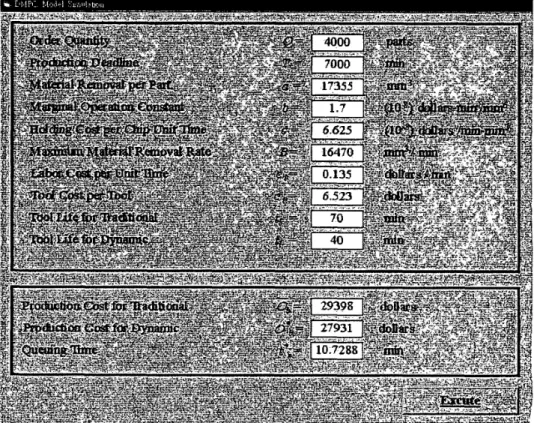
for traditional model.From the simulated result shown in Figure 2, it is observable that the production cost of DMPC Model is $1467 dollars less costly than the traditional machining model, which is considered cost competitive through years of experiences in AirTAC Corporation. In addition, t h e optimal queuing time tP = 10.7288 min can always be used for machine setup, machine maintenance, or material handling. The result of this numerical study shows good agreement with the DMPCModel in minimizing the production cost of a machining project.
Figure 2: Cost simulation for DMPC and traditional models
7. Conclusions
The fixed tool life, tool cost, operation cost, holding cost, production deadline, order quan- tity, volume of material machined per unit part, and upper limit of
MRR
are considered simultaneously to determine the optimal control of material removal rate and the queuing time before machining. This is an extremely hard-solving and complicated issue. However, the problem becomes concrete and solvable through theDMPC
Model.In addition, the characteristics of this study are illustrated as follows: First, the optimal material removal rate x *
(t)
is a strictly increasing linear function oft
before reaching the1
upper speed limit. Second, by Property described before, if the optimal
MRR
x*(t)
touches the upper limit&
it will stay to be the upper limit B. Third, from the optimal solution proposed in Section 4; the optimal number of tools required for the project can be determined90 T. -5. Lan, C.-H, Lan & L.-J. Yeh
the optimal queuing time before production can be scheduled for machine maintenance or small machining projects to promote the efficient time utilization. Moreover, the decision criteria in selecting the optimal solution for t h e control of MRR are fully suggested in this paper; and the sensitivity analyses of the optimum solution are also provided. Furthermore, the simulated result of a real-world production planning presents good reliability of t h e
DMPC
Model in cost minimization. With this study, t h e production planning, production cost estimating, and even the contract negotiation can be then further approached.The material removal rate is an important control factor of a machining project, and the control of machining rate is also critical for production planners. This study not only delivers the idea of automatic control on material removal rate to the modern machining technology, but also leads a machining project towards t o achieve minimum cost. Future researches with the dynamic optimization modeling on multi-tool machining processes, multi-order machining control and scheduling, as well as the optimum design and implementation of PC-based MRR controllers on various types of CNC machines are encouraged. Thus, the foreseen future improvement t o the work is definitely extended. In sum, the DMPCModel surely provides a better and practical solution to this field, and generates a reliable and applicable concept of machining control to the industry.
Acknowledgment
T h e authors would like to thank Mr. L. A. Yeh at AirTAC Corporation as well as the anonymous referees who kindly provide the suggestions and comments to improve this work.
Appendix A: T h e optimal solution for Situation 1.
r
Suppose that the material removal rate x*
( t )
will never reach the upper limit B before timeT . Also, let F =
6xJ2(t)
+
cx(t}
+
cs.d
From Euler Equation [2, 71)
Fx
= -FXt, it is derived thatdt
d I
c = -2ba;*
( t ) .
dt
There exists a constant
ki
t o satisfyf c
x*
( t )
=-t
+
kl
'v't
â[t&
q.
2b
Integrating Eq. ( A l ) with
t ?
it is obtained thatWith the transversality condition for free
tx
[2, 71,F
- dFXiI t .
= 0, thenDynamic Machining- Project Control Model
Comparing Eq. (-41) and (Ad) at t = tx*, it is then found
With Eq. (A2), (A5), and x(tx*) = 0 ; we have
Substituting Eq. (A5) and (A6) into Eq. ( A l ) and (A2); x*'(t) and x*(t) are then ob- tained.
Using the boundary condition, x*(T) = aQ, ty;* is derived.
Appendix B: The optimal solution for Situation 2.
/
Before x* (t) touches the upper limit, Eq. (1) and (2) are satisfied either. In addition, when it reaches the upper limit B ; the Property is then applied.
Using the transversality condition for free end point [2, 7L
F
- x'Fy11,
= 0 ; it is derivedthat
12 I I
bx* (t)
+
cx*(i)+
cs - x* (;)2hx*(i)
= 0 . ( B l ) Introducing x * ( t ) =5
into Eq. ( B l ) and then compare with Eq. (2) a tt
=i,
we haveUsing the boundary condition, x*(T) = aQ, and Property; it is found that
By Eq. (B2) and (B3), tx. and
f
can be determined.From Eq. (2), Property and x*(T) = aQ; x*(t) is then obtained.
References
[l] M. Balazinski and E. Ennajimi: Influence of feed variation on tool wear when milling stainless steel 17-4 Ph. Journal of Engineering Industry, 116 (1984) 516-520.
21 A. Chiang: Dynamic Optimization (McGraw-Hill Inc, Singapore, 1992).
31 S.
K.
Choudhury and I. V.K .
Appa Rao: Optimization of cutting parameters for maximizing tool life. International Journal of Machine Tool & Manufacture, 39-2 (1999) 343-353.[4] E. P. DeGarmo,
J. T.
Black and R.A.
Kohser: Materials and Processes in Manufac- turing (Prentice Hall, New Jersey, 1997).[5]
K. H.
Fuh, C. T. Chen andY.
F. Chang: Design and imp-lementation for maximummetal removal-rate control of a constant turning-force system. Journal of Materials Processing Technology, 57 (1996) 351-359.
6
J.
Jung and A. Ahluwalia: Feature-based noncutting tool path selection. Journal of Manufaturing Systems, 13-3 (1995) 165.[7]
M.
Kamien andN.
Schwartz: Dynamic Optimization (Elsevier Science Publishing, New York, 1991).92 T.-S. Lan, C. -H. Lan & L.-J Yeh
[8] T. Y. Kim,
D.
K. Choi, C. N. Chu and J. W. Kim: Indirect cutting force measurement by using servodrive current sensing and it's application to monitoring and control of machining process. Journal of I<SPE, 13-12 (1996) 133-145.[9] T. Y. Kim and J. Kim: Adaptive cutting force control for a machining center by using direct cutting force measurement. Intern~tional Journal of Machine Tools and Manufacture, 36-8 (1996) 925-937.
[lo] Y. Koren: Computer Control of Manufacturing Systems (McGraw Hill, New York, 1983).
[11] Y. Koren, T. R. KO, K. Danai and A. G. Ulsoy: Frank wear estimation under varying cutting conditions. A S M E Journal of Dgnarnic Systems Measurement a n d Control, 113
(1991) 300-307.
[12] K. S. Lee, L. C. Lee and S. C, Teo: On-line tool wear monitoring using a PC. Journal of Materials Processing Technology, 29 (1992) 3-13.
[13] Q. Meng, J. A. Arsecularatne and P. Mathew: Calculation of optimum cutting condi- tions for turning operations using a machining theory. International Journal of Machine
Tool & Manufacture, 0 (2000) 1709-1733.
[14] D. C. Montgomery: Design and Analysis of Experiments (John Wiley & Sons, New York. 1976).
[15] A. Novak and H. Wilklund: On-line prediction of tool life. Annals of
CIRP,
45-1 (1996) 93-96.[16] F. Rach and A. Rolstadas: Selection of optimum feed and speed in finish turning.
Annals of C IRP, 5 4 (1971) 787-792.
[17] S. J. Rober and Y. C. Shin: Modeling and control of CNC machines using a PC-based open architecture controller. Mechatronics, 5-4 (1995) 401-420.
181 H. Soroush: Sequencing and due-date determination in the stochastic single machine problem with earliness and tardiness costs. European Journal of Operational Research, 1-13 (1999) 450-468.
[19] J. Wang and P. B. Luh: Scheduling of a machining center. Mathematical Comput. Modelling, 2 3 (1996) 203-214.
Chun-Hsiung Lan
90-2, Nanya W. Rd. Sec.2, Panchiao, Taiwan 220, R.O.C.