第 巻 第 号 抜 刷
年 月 発 行
Land Asset Market and Properties
of the Growth Paths
Land Asset Market and Properties
of the Growth Paths
Katsuhiro Aono
. Introduction
In the previous paper(Aono( )), we integrated a land asset market into the economic growth model and examined the characteristics of the steady state growth path. In this paper, we examine the stability of the long-run steady state path, and consider the paths which do not converge to the long-run steady state in greater detail.)
The rest of the paper is organized as follows. Section outlines the basic structure of the model, and derives the dynamic equations of the economy. Section examines the stability of the equilibrium path, and considers the paths which do not converge to the long-run steady state in greater detail. Section considers the link between credit, collateral, land prices and capital accumulation. Section considers what we could learn from the Japanese experience from to , the Japanese experience in the period of“bubble economy”and the period of“lost decade”. Section summarizes the main results and discusses possible extensions.
* Former Professor/Matsuyama University, Dr. Economics(Kobe University)
)This paper is a revised version of Aono( ). In this paper we mainly focus on the stability of the equilibrium path, and consider the paths which do not converge to the long-run steady state in greater detail.
. Model
..The basic modelThe basic model and notation in this section are as follows. ⒜ Technology.
Output, Y is a function of inputs of labor, N , capital, K , and land, L. The production function for this output is twice differential, homogeneous of degree one, in addition, it has the following properties : positive and diminishing marginal productivities of the three factors, impossibility of any product without one of the factors. Technical change is assumed to be land-augmenting and labor-augmenting. The rate of land-augmenting technical progress and the rate of labor-augmenting technical progress are denoted as h and%, respectively. The above assumptions are summarized by
%#!$""$""#"%"!
""!$""!#"$!"!"""!$"$""!#"#"#!" ⑴
#"##$&%" ⑵
$"#$$%%! ⑶
⒝ The supply of land and labor.
Land is assumed to be fixed in supply, and labor is assumed to grow at the given exponential rate, n. Thus the sum of the rate of labor-augmenting technical progress and the rate of growth of labor is %!'. We assume that the following conditions are satisfied.
####"##: constant ⑷
$#$!$'%" ⑸
⒞ Land asset market
Now consider a portfolio equation which determines the price of land. For analytical simplicity, we assume that there exists a perfect land asset market. Portfolio equilibrium requires that alternative investment options yield the same net rate of return. Since capital is the only asset other than land, and since these two assets have the same risk properties under the assumption of a perfect land asset market, we obtain the following equilibrium condition ;
!!"
! !$
"
! "#"" ⑺
where P is the price of land in terms of goods, !!"is the expected change of land prices, $"is the expected rent of land, and #"is the expected rate of return on capital. The equation⑺ tells us that the land asset market is in equilibrium when the expected rate of increase in land prices, !!"#! plus the expected rent-price ratio, $"#!are equal to the expected rate of return on capital, #".
For simplicity, we assume that expected and actual price changes are identical, i. e.
!!"
! "!!"$! ""$"#""#! ⑻ It is important to consider the implications and the limitations of the equation ⑺ and ⑻. We do not assume that landowners have a long-run perfect foresight because they do not know what will happen in the long and distant future. We assume that landowners adjust their expectations instantaneously for analytical simplicity.
⒟ Consumption function and savings function
We now consider the consumption function, and hence the savings function. We shall assume that landowners can consume or save out of capital gains on land.
We also assume a generalized Cambridge savings function instead of a proportional savings function. For analytical simplicity, we assume that workers do not own their land, and that they do not have to pay the rental rate of land to landowners.)
If landowners save a constant fraction of capital gains on land, then, the consumption function is
!#)!$+%%*"$&""+(&$"+#"&#("%"!+##&%%#
with!$+(#+#""+%$+###"" ⑼
where +%: the saving rate of capitalists(entrepreneurs) out of profits, +(: the
saving rate of workers, +#": the saving rate of landowners out of rents, +##: the
saving rate of landowners out of capital gains on land. $: the rate of depreciated capital. r : the net rate of return on capital, R : the real wage rate, &: the rental rate of land.
Since total output, Y is equal to consumption, C plus capital depreciation, $", plus net investment, "%, we get
)#!"$"""%! ⑽
Substituting⑼ into ⑽ yields
"%"$"#'+%%*"$&""+(%&$&"+#"&#(!%"!'##&%%#
with!$+(#+#""+%$+###"! ⑾
⒠ Determination of factor prices.
Given R , &and the production function which is homogeneous of degree one
)In the previous paper(Aono( )), we implicitly assumed that rents payed by workers are reinvested in land and that they are directed to the maintenance cost of land. In this paper, we assume that workers do not have to pay the rental rate of land. The results are almost the same.
(exhibits constant returns to scale), a competitive producer can maximize the net rate of return on capital when the marginal productivities of capital, !", labor, !$
and land, !#are equal to+"$, R , and %respectively. Thus, we get
!"$+"$" ⑿
!$$&! ⒀
!#$%! ⒁
..Derivation of dynamic equations
It turns out that the dynamics of economy can best be described in terms of the ratios, *%%##$#, ,$###$#and)%"#$#.
From the equation⑴, we obtain '
$#$!&"#$#"""###$#'!
Thus, letting -$'#$#, the production function can be rewritten as a function of k and u.
'$(&)",'! ⒂
Differentiating the above equation with respect to K , $#and##, we get !"$()&)",'" ⒃
!$#$(&)",'!)()&)",'!,(,&)",'" ⒄
!##$(,&)",'! ⒅
For analytical simplicity, we shall assume that u is constant. Since ,$###$#, the assumption implies that technical change is of such a character that the rate of land-augmenting technical progress is equal to the sum of the rate of growth of labor supply and the rate of labor-augmenting technical progress. Thus, !", !$#and!##
can be written as a function of k.
Differentiating,%%##$#with respect to time t, we get
,%$%%"#%!$%"# ⒆
where,%$,&#,, ,&$(,&#(0. Substituting ⑺ and ⑻ into ⒂, and using ⑶, ⑷, ⑸, ⑿ and⒁, we obtain
,%$!!#
% "!"!&%"$"-'!
Using the definition of ,%%##$#and substitute ⒃ and ⒅ into the above equation, we find
,&$!1)1"()+!&%"$"-'),! ⒇
We shall now derive+&&+",'. From the definition of +%"#$#, we get +%$"%!$%$"%!&$"-'!#
From⑾, we obtain
"%"%$ /#&&."%'"/'& $! ""/" #!'#"$!&!!/#"'%" !&#
Using ⑷, ⑿, ⒀, ⒁, !#$!###*$and !$$!$##$$, the above equation can
be rewritten as
"%"%$/&!""/'!$
#
+ "/#!!##1
+!&!!/#"'%%,+!
Also, %%can be rewritten as %%$!1!##
Substituting into and using⒃, ⒄ and ⒅, we get !'"%#(&$%"(#%$!%$%!)$)&"
%"(""$))
% !%"!("#&%!)$&"$) %!%&&
%! If we substitute into , we obtain
%(#(&%$%"(#%$!%$%!)$)&"("")$)"%"!("#&)$)
!%"!("#&%$%!%&&!%%"$"'&%!
The dynamic behavior of the system is described by⒇ and .
. Properties of the Equilibrium Growth Path
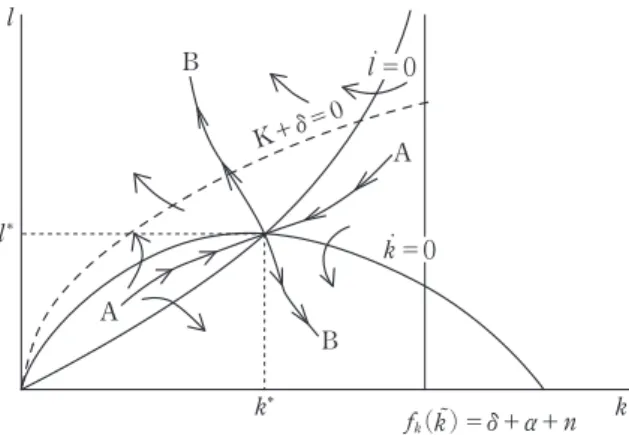
..Stability of the Equilibrium Growth PathWe shall now examine the stability of the equilibrium growth path. The dynamic behavior of the system can be illustrated in a phase diagram, as in Figure . In order to examine the equilibrium growth path, we first derive the&(#! curve. From⒇, we see that&(#!and &$#!if and only if
&# )$)
$%!%%"$"'&!
It is easily verified that has the following properties. &%%%&)&(#!#*)$)%'$%!%%"$"'&(!$%%)$)+
'$%!%%"$"'&(# #!"
%$&
%, !&%%&)&(#!#!"
%$&
$+ $'%&$'*%($!$%!
In the case where $$$', #$&$''$$"#"&. Therefore, in Figure , along the
vertical line #$&$''$$"#"&, there is no change in k. Above the %($!curve, l
increases, below it, l decreases.
We now examine the $($!curve and its properties. From , we get the $($!curve :
%$'%$#$!&$"#"&'$"'"&#!$#$!)#)'"'!")#)"&"!'!#')#)
&"!'!#'&#$!$' !
Differentiating with respect to k, we derive the formula for the slope of the $($!curve :
%$&$'*$($!$ &#$!$'
&"!'!#'&#$!$'#('%#$!&$"#"&'"&'%!'"'$##$$
"&'!"!'""&"!'!#')#)$!&"!'!#'#$$%#)!
Since the denominator is positive, it follows that the sign of depends only upon the numerator. Although the numerator is unsigned, we see that #$+ % for
$+ !and that the $($!curve meets the k-axis(see ). Above the $($!curve, k decreases, below it, k increases.
The above results enable us to examine some qualitative properties of the dynamic behavior of the system in the&$"%'plane. The qualitative behavior of the possible time paths is illustrated in the&$"%'plane in Figure . The movements in the variables are indicated by arrows. As Figure makes clear, the equilibrium point &$#"%#'is a saddle point. Therefore, %$&(+ %&$("%('$&$#"%#'only from
K+δ=0 l˙=0 k˙=0 A A B B k k* l l* fk(k˜)=δ+α+n
For completeness, we shall show that the equilibrium point%%#"&#&is locally
a saddle point. It is sufficient to prove that det. !##!" !#$!"" #" !#"#" !"## !### ! " where
!""#$(&$%!%%"$"'&"%#$%%%(&!(#&")$)%%(""!(#&
"%"!("#&%)$)%!&#$%%&"
!"##$!%"!("#&%$%!%&"
!#"#$!)$)%"&#$%%"
!###$$%!%%"$"'&!
!#is the Jacobian of the system ⒇ and evaluated at the equilibrium point
%%#"&#&. It is verified that
Figure . Phase diagram of the dynamic behavior of the system Land Asset Market and Properties of the Growth Paths
det. !#$(%&!&%"$"(')()&%&!&%"$"('"&#%&&&)&!)$'
"*%*&&)#"!)$')!&"!)##'&%&!%'&*%*&!'#%&&'!
Consequently, det. !##!
with!#)$%)#"$)&%)###"!
Thus we have shown that the equilibrium point &&#"'#'is locally a saddle
point.
..Properties of the Non-steady State Growth Path
We now consider the paths which do not converge to the long-run steady state in greater detail. It is seen that the behavior of the possible time paths depends crucially upon the assumptions on the portfolio equation and the savings function.
We first show that paths starting from the initial positions&&!"'!'lying above
the AA curve approach the point where gross investment goes to zero in finite time. To see this, we derive the "'"%$!curve. From , we obtain the "'"%$! curve,
'&&'*"'"%$!$)&&%&")$&%!&%&"!)&!*%*'")#"*%*"&"!)##'*%* ##'&%&!%' !
It is verified that has the following properties. %$&&+ !'&&'*"'"%$!$!
%$&&+ &('&&'*"'"%$!$)&&%&")$&%!&%&"!)&!*%*'")#"*%*"&"!)##'*%* ##'&$"(' !
Differentiating with respect to k, we derive the formula for the slope of the !$"%#!curve.
'&$&%(!$"%#!#$"!("
"#%$%&!%%#$%&!%%&(&%&"$(&!($%&%&&
"$(""!($%)%)&"$"!("#%)%)&!%&&&(&&%&
"($$%!&%&!)%)%"("")%)"$"!("#%)%)'!
From , we see that the slope of the!$"%#!curve is positive for !#&#&%. !$"%#!curve is indicated by a dashed curve in Figure in Section .. As Figure indicates, paths starting from any initial positions$&!"'!%lying above the
AA curve approach the!$"%#!curve, and thus gross investment goes to zero in finite time.
Consider now the economic implications of the above results. Our results depend crucially upon the assumptions on the portfolio equation and the savings function. Under the assumption of a perfect land asset market with short-run perfect foresight, if the price of land P , is too high(the rent-price ratio, '$# is too low)initially, portfolio equilibrium requires that the price of land has to rise faster than the initial value. Thus the price of land continues to move further from the initial value. It should be noticed that the instability of land prices is attributed to the landowners who seek larger capital gains on land.
On the other hand, the effect of land on capital accumulation depends crucially upon the assumptions on the consumption function, and hence the savings function. Since we assume that landowners consume a constant fraction of capital gains on land, the increase in capital gains resulting from the increase in land prices increases consumption, and eventually consumption exceeds output. Thus the system itself breaks down. It should be clear that the decline in investment results from the assumption that landowners consume a constant fraction of capital gains on land.
Therefore, if all of the capital gains on land are not consumed, the increase in land prices does not lead to zero-investment.
We have assumed a full employment neoclassical growth model. In the real world, unemployment exists. A long as the unemployment workers continue to exist, the increase in land prices coexists with the increase in output. But, as Stiglitz( )states,“if the initial price of land is too high, the price of land eventually increases super exponentially. As a result, in finite time, the“bubble” will be“corrected.” But it can be a long time. And even when there is a “correction”, it may still be on a“bubble path.” The price of land falls, but to a
level still above the convergent path.”(pp. )
In our neoclassical growth model, If paths start from the initial positions $$!!%!%lying above the AA curve, it is possible that land prices continue to rise,
and that capital accumulation continues to decrease for more than several years. The asymptotic behavior of the model starting from the initial points $$!!%!%
lying below the AA curve is not evident. However, if we define$#as the root of '$$#$"'"$#!$#$!(#(%"'!"(#("$"!'!#%(#(!$#"""&%$#!!
it is easily shown that the point$$#!!%is not a stable equilibrium point. The point $$#!!%is the point where the price of land is zero and the rate of return on capital is positive. But the price of land must be positive because rents are positive and because the land market is perfect by our assumptions in this section. Thus paths approaching the point$$#!!%are not stable.
. Credit, collateral, land prices and capital accumulation
The model presented in this paper abstracts from Keynesian aggregate demand effects. We have assumed a full employment neoclassical economy. We also have ignored the role of the financial system. However, in the real world,unemployment exists, and land can be used as collateral. What will happen when we consider the existence of unemployment and the role of the financial system ? We shall briefly describe the link between credit, collateral, land prices and capital accumulation.
When we ignore the role of the financial system and the fact that land can be used as collateral, the increase in unrealized capital gains on land due to the increase in land prices may increase consumption, but does not increase capital accumulation. However, if we consider the role of the financial system and the fact that land can be used as collateral, an increase in unrealized capital gains on land may be directed to investment, and in doing so, may influence the real economic activities.
As we mentioned earlier, land is non-reproducible, durable, alterable to other uses and limited in supply. For these reasons, land serves better as collateral than other capital goods. The fact that land can be used as collateral may increase the value of land, but the value associated with the ability to be used as collateral will depend on the financial system. The banking system provides credit based on collateral. The demand for land depends itself on the availability of credit. When an increase in land prices is expected, lending against land collateral appeared lucrative and safe. Because even when the borrower fails to pay back their loan, banks can expect to recover the money by selling the land collateral at prices higher than when the loan was originated(Hoshi( )pp. ). If banking system provides credit based on collateral, the banks are willing to lend more to landowners. If the banks are willing to lend more, the price of land goes up furthermore. In Japan, the inheritance tax on land is assessed at less than the market value, while what landowners owe in credit is valued at the market value. Since the Japanese inheritance tax rates are progressive, landowners who want to bequeath their land to their heirs prefer to borrowing money from the banks. The facts that land is used as collateral, and that the Japanese inheritance
tax on land is assessed at less than the market value accelerate the increase in land prices.
There are two important channels through which the increase in land prices influences the real economic activities. First, given the propensity to consume out of capital gains on land, the increase in land prices raises the capital gains, and in doing so, increases the consumption of landowners. As long as unemployment and the lack of aggregate demand persist, the increase in consumption raises output and stimulates the economy. This is called the wealth effect. But, when the economy reaches a full employment, the increase in consumption due to the rise in the value of land crowds out capital accumulation, and the capital stock declines, even though wealth(the capital stock + the value of land)continues to increase.
Second, since land is used as collateral and the banking system provides credit based on collateral, the increase in the value of land raises credit availability, and, in doing so, accelerates the increase in land prices. It is the decision of the banks concerning credit availability that drives the price of land. Thus the increase in the value of land makes it easy for landowners(entrepreneurs)to finance investment because the landowners(the entrepreneurs)can use the land with increased value as additional collateral to borrow more from banks. This is called the collateral effect. The financial system plays an important role in credit creation. It should be noted that banks provide credit based on the collateral value of land, not the value of land itself. Therefore, when the price of land is expected to increase and the collateral value of land is expected to increase, banks are willing to lend more. On the other hand, when the price of land is expected to decline sharply and the collateral value of land is expected to decrease sharply, banks are not willing to lend more. The wealth effect and collateral effect are put into the reverse gears. The aggregate demand falls and the economy enters a contraction phase.
increase in credit leading to an increase in the value of land can initially lead to more investment, and contribute to the expansion of the aggregate demand. But, when the economy reaches a full employment, increased consumption due to the increase in the value of land crowds out investment, and investment declines, even though wealth(the capital stock + the value of land)continues to increase.
A boom or bubble caused by the collateral effect does not last perpetually. As long as banks expect that a boom continues, the value of land as collateral increases. And land as collateral accelerates the increase in land prices. But a boom does not last perpetually. When a boom or bubble collapses, land as collateral accelerates the decrease in land prices. For these reasons, it may be not so unrealistic to say that land collateral contributes to volatility of land prices without enhancing long-term economic performance.
. Japanese Experience and Lessons from the Experience
..Japanese ExperienceLet us consider what we could learn from the Japanese experience from to . From November to February , the Japanese economy enjoyed an expansion that lasted more than years. Hoshi( )says as follows. “This expansion was characterized by extraordinary appreciation of asset prices, especially stock and land prices.” Many people call this period of the Japanese economy “bubble economy”(pp. ).
According to Land Price Index published by the Japan Real Estate Research Institute, the average urban land price index rose from around ( .)in to about ( .)by the peak in . (The value of the indices is normalized to be for March .) The land prices fell gradually over the next years or so, and in urban land price index was around ( .). By , land lost more than % of the peak value on average. The Commercial Land Price Index
rose from around ( .)in to around ( .)by the peak in , and fell to around ( .)in . It lost more than / of the peak value. From to , the economy stagnated, recording a couple of spells of negative growth. Many people call this period of the Japanese economy“lost decade”.
From the view point of the behavior of land prices,“bubble economy”and “lost decade”are characterized not by the fact that the increase in land prices in “bubble economy”was high, but by the fact that the land prices fell gradually over the next years. Many people assert that the increase in land prices in“bubble economy” was extraordinary. But, it was not “extraordinary”. In “bubble economy”, that is, between and , the average urban land price index rose by around . times. However, between ( . )and ( .), it rose by around . times. Between ( .)and ( .), it rose by around . times. Between ( .)and ( .), it rose by around . times. The fact that the land prices fell gradually over the next years was “extraordinary”. Due to the first oil shock, the average urban land price index fell from ( .)to ( .), but it rose in the next year and in , it was .. For the first time after World War Ⅱ, the average urban land price index continued to fall more than years in“lost decade”.
What caused the increase in land prices in the late s ? First, we point out the so-called the“Myth of Land”that had been firmly entrenched in the post-war Japanese economy. From to the late s, the real value of land increased tremendously. It is remarkable to note that except for one year( )the land price did not fall between and the late s. This spectacular increase in the land price until the late s was behind the“Myth of Land”that land was an ultimate safe asset always beating any other assets with ever-increasing prices. In Japan land served better as collateral than any other capital goods. As we mentioned earlier, when land is used as collateral and the banking system provides
credit based on collateral, the increase in the value of land raises credit availability, and, in doing so, accelerates the increase in land prices. It is the decision of the banks concerning credit availability that drives the price of land.
The second important factor that fueled the land price boom was the loose monetary policy, which allegedly made money cheap and pushed money into stock and land markets to increase prices. The rate of interest was low in the late s. As long as land owners and borrowers believed that the low interest rate policy would last for some time, the low interest rate must have accelerated the increase in land prices.
Another important factor was the increase of real estate-related lending by banks and other financial institutions. It was a result of the financial deregulation that started in the late s. Given the“Myth of Land”and the loose monetary policy, lending against land collateral appeared lucrative and safe. Thus, the banks increased their loans to real estate developers, households and those collateralized by land. This made them vulnerable to a sharp fall in land prices and sowed the seeds for the financial crisis of the s(See Hoshi( )pp. − ).
..Lessons from the Japanese experience
The experience of the“bubble economy” and “lost decade” that followed provides some useful lessons on the role of the banking system and the government policy. There is agreement that the trigger was the large stock and land prices declines that began in early s. These shocks impaired collateral values sufficiently that any banking system would have had tremendous problems adjusting. Because of the lack of the aggregate demand, many investments that had made sense in the bubble economy did not make sense anymore.
Following the collapse of land prices in early s, Japanese banks ended up holding a massive amount of non-performing loans. Rather than writing off those
loans, many banks continue to extend credit to insolvent borrowers, gambling that somehow these firms would recover or that the government would bail them out. Failing to rollover the loans also would have sparked public criticism that banks were worsening the recession by denying credit to needy corporations. (See Hoshi ( )pp. − ). “By keeping these unprofitable borrows(that we call“zombies”
alive, the banks allowed them to distort competition throughout the rest of the economy. The zombies’ distortions came in many ways, including depressing market prices for their products, raising market wages by hanging of the workers whose productivity at the current firms declined and, more generally, congesting the markets where they participated”(Hoshi( )pp. ).
“Recapitalization was ultimately driven by macroeconomic recovery. Since macroeconomic recover also depends on a healthy function of the financial system, the causality runs two ways. In the Japanese case, export expansion to large and growing economies, especially China and the U. S., contributed to the macro-economic recover in the mid- s independent of the recovery of the financial system. To the extent that macroeconomic policy can successfully stimulate the recovery that will also help recapitalization.”(Hoshi( )pp. ).
From the view point of our paper, the following experience may be useful. First, without changing the behavior of the landowner who seeks capital gains on land, stopping the asset(land)price boom may be dangerous even when it is successful. Japan raised the policy interest rate and applied direct regulation on real estate lending to stop asset price inflation. Soon after these policy changes, the asset price not only stopped rising, but also started to decline rapidly. The declining trend of asset prices continued for much of the following years. As we stated earlier, when landowners seek capital gains on land, land prices are apt to be unstable.
credit based on collateral, the instability of land prices is accelerated. It is extremely difficult to strike the balance by changing the rate of interest and applying direct regulation.
Turning to the question of how the government should respond to the collapse of asset prices, the Japanese government responded to the collapse of asset prices by expansionary macroeconomic policy. “The budget deficit, which was close to zero in the early s, was quickly expanded. The interest rate was reduced, eventually to zero by the end of s.”(Hoshi( )pp. − ). The government deficit reached more than % in . During and , the huge government deficit was mainly financed by households. That is, the household sector was the largest creditor.(See Hayashi( )pp. − .)“Since the decline of asset prices reduced the aggregate demand through wealth and collateral effects, the policy response was in the right direction. The problem for Japan was that the expansionary macroeconomic policy had been aborted prematurely.”(Hoshi( )pp. ).
Second, regulatory forbearance that fails to force banks to address the non-performing loan problem hurts economic growth by creating zombie firms. Avoiding regulatory forbearance and cleaning up the financial system is of vital importance.
The important question is why the decline of land prices continued so long, bringing down the economy. Why the decline of land prices impaired collateral values sufficiently that any banking system would have had tremendous problems adjusting. We think that one of the main reasons is the effect of the“Myth of Land”which had been deeply rooted in the Japanese economy and the banking system. Between and , urban land prices rose by more than times(in the metropolitan area rose by nearly times), whereas the consumer price index was increased by times during the same period. It is remarkable to note that
except one year( )land prices continued to increase between and . As we mentioned earlier, land is non-reproducible, durable, alterable to other uses and limited in supply. For these reasons, land serves better as collateral than other capital goods. In addition, the tremendous increase in urban land prices until was behind“Myth of Land”that land served an ultimate safe asset as collateral beating any other assets with ever-increasing prices. Without the“Myth of Land”, banks would not have had lent such a lot of money to firms including small and medium sized ones. As we stated earlier banks provide credit based on the collateral value of land, not the value of land itself. Even when land prices decline, as long as banks expect the increase in land prices in the near future, the collateral value of land will not decrease. When most of the banks expect that the decline of land prices will continue so long that it will impair collateral values sharply, banks are not willing to lend more. The wealth effect and collateral effect are put into the reverse gears. The aggregate demand falls and the economy enters a contraction phase. Because of the“Myth of Land”, there was a large time lag between the decline of land prices and the decrease in the collateral value of land. Once the decrease in the collateral value of land began, it accelerated the decline of land prices and prolonged the Japanese macroeconomic stagnation that began in the early
s.
Another important reason is distortion in the inheritance and capital gains tax system in Japan. There is a substantially favorable treatment for land in the inheritance base. Land is assessed, in practice, substantially lower than their market value. There is no such special treatment for financial assets. Their value is assessed at the market value. There is even more favorable treatment for farm land in the inheritance tax base(Yamazaki( a), Nishimura. et al.( ), Asada et al.( )). Nishimura. et al.( )says that after , the value of farmland in the Tokyo metropolitan area has been, in fact, assessed based on
agricultural income from the land if the farmer’s heir pledges to continue farming, even though his farmland is traded as residential land in the market place. For example, in the Tokyo metropolitan area, the assessed value of the farmland was .% of the market value in . Thus by pledging to continue farming, the farmer’s heir could virtually avoid paying the inheritance tax.
As for the capital gains tax, by postponing realization until death, the capital gains go entirely untaxed. Under the Japanese tax code, the basis of the appreciated land value is the acquisition value of the decedents. Thus, if the heirs sell the land, the capital gains accrued by the decedents are subject to a capital gains tax. However, when the heirs do not sell the land, a capital gains tax is not imposed on the heirs(Kaneko( ), Stigliz( )). In addition, the tax reform of allowed exemption of the inheritance tax payment from capital gains if the heirs sold the land in order to pay the inheritance tax. This tax change deterred the landowner from selling land prior to death.
Distortion in the inheritance and capital gains tax systems created an incentive to hold land, especially agricultural land in the Urbanization Promotion Area, and in so doing, discouraged land development and impeded efficient land use. Thus distortion in the inheritance and capital gains tax systems prolonged the Japanese macroeconomic stagnation that began in the early s.
. Concluding Remarks
In this paper, we integrated a land asset market into the full employment neoclassical economic growth model. We have examined the stability of the long-run steady state path and considered the paths which do not converge to the long-long-run steady state in greater detail. We have shown the following results. First, when landowners seek capital gains on land and consume out of the capital gains, the equilibrium point is a saddle point. Second, the instability of land prices is
attributed to the landowners who seek capital gains on land. Third, the decline in investment results from the assumption that landowners consume a constant fraction of capital gains on land.
Furthermore, under the assumption of unemployment and the lack of aggregate demand, we described the link between credit, collateral, land prices and capital accumulation. As long as unemployment and the lack of aggregate demand persist, an increase in credit leading to an increase in the value of land can initially lead to more investment, and contribute to the expansion of the aggregate demand. But, when the economy reaches a full employment, increased consumption due to the increase in the value of land crowds out investment, and investment declines, even though wealth(the capital stock + the value of land)continues to increase. As long as banks expect that a boom continues, the value of land as collateral increases. And land as collateral accelerates the increase in land prices. But a boom does not last perpetually. When a boom or bubble collapses, land as collateral accelerates the decrease in land prices. For these reasons, it may be not so unrealistic to say that land collateral contributes to volatility of land prices.
Finally, we considered what we could learn from the Japanese experience from to . From the view point of the behavior of land prices,“bubble economy”and“lost decade”are characterized not by the fact that the increase in land prices in“bubble economy”was high, but by the fact that the land prices fell gradually over the next years. From the view point of our paper, the following Japanese experience provides useful lessons. First, without changing the behavior of the landowner who seeks capital gains on land, stopping the land price boom may be dangerous even when it is successful. Second, regulatory forbearance that fails to force banks to address the non-performing loan problem hurts economic growth by creating zombie firms. Avoiding regulatory forbearance and cleaning up the financial system is of vital importance.
Third, distortion in the inheritance and capital gains tax system prolonged the Japanese macroeconomic stagnation that began in the early s. Improving distortion in the inheritance and capital gains tax systems is of vital importance.
Two extensions of our model are being considered. First, we have described the link between credit, collateral, land prices and capital accumulation. But, we did incorporate these factors into the growth model. Incorporating these factors into the growth model, and examining the effects of these factors on the growth paths are left for future research. Second, we disregard the effects of the capital gains tax on the steady state price of land, capital accumulation and the stability of the system. The effects of the capital gains tax on a capital gains-seeking economy are an interesting research topic for the future.
REFERENCES
Aono, K.( )“Economic Growth with Land”, The Matsuyama Shodai Ronsyu(The Matsuyama University of Commerce Review), VoL. , No. , pp. − .
Aono, K.( )Tochi no Keizai Bunseki(Economic Analysis of Land), Nihonkeizaihyoronsya, Tokyo.
Aono, K.( )“Shin Tochi Jyotosyotoku Zei no Shiboji Kazei”(“A new Realized Capital Gains Tax at the Time of Death”), Urban Housing Sciences, No. , pp. − (In Japanese), Osaka. Aono, K.( )Kaitei Zoho Hudosan no Zeiho to Keizaigaku(Economics and Real Estate
Taxation Revised Edition), Seibunsha, Tokyo.
Aono, K.( )“Economic Growth and Land Asset Market”, Matsuyama Daigaku Ronshu (Matsuyama University Review), Vol. , No. ,pp. − .
Aono, K.( )“Proposal for a Combination of Inheritance Tax and a Realized Capital Gains Tax at the Time of Death”, Urban Housing Sciences, April, Vol. .
Asada, Y., Nishimura, K., and Yamazaki, F.( )“Zeisei Henka no Eikyou : Tika wo Huanteika sita Souzokuzei to Totijyotosyotokuzei(The Effect of the Change in the Tax : Instability of the Land Price Caused by the Inheritance Tax and the Realized Capital Gains Tax on Land)in Nishimura ed., Hudousan Shijyou no Keizai Bunseki(Economic Analysis of Real Estate Market) Nihon Keizai Shinbunsha, Tokyo.
Auerbach, A. J.( )“Retrospective capital Gains Taxation”, American Economic Review, VoL. , No. , pp. − .
Caballero, R. J. Hoshi, T. and A. K. Kashyap( )“Zombie Lending and Depressed Restructuring in Japan”, NBER Working Paper No. .
Hoshi, T. and A. K. Kashyap( )“Will the U. S. Bank Recapitalization Succeed ? Eight Lessons from Japan”, NBER Working Paper No. .
Hoshi, T.( )“The Bubble Economy and Its Aftermath”in Hayashi, T., Political Economy of Japan, Ch. , The Open University of japan, pp. − .
Hayashi, T.( )Political Economy of Japan, The Open University of japan, pp. − . Homburg. S.,“Critical Remarks on Piketty’s ‘Capital in the Twenty-first Century’, Discussin Paper
No. , ISSN − , October .
Iwata, K.( )Tochi to Jutaku no Keizaigaku(Economics on Land and Housing)Nihon Keizai Shinbunsha, Tokyo.
Iwata, K. and T. Hatta.( )Nihon Saisei ni Itami wa iranai(A Road to the Rebirth of Japan Without a Sharp Pain)Toyo Keizai Shinposha, Tokyo.
Kaneko. H( )“Syotokuzei to Kyapitaru Gein”(“Income Tax and Capital Gains”), Kazei Tani oyobi jouto-syotoku no kenkyu(Study of Tax Unit and Realized Capital Gains)Yuhikaku, Tokyo.
Nishimura, K., Yamazaki, F., Idee, T., and Watanabe, T.( )“Distortionary Taxation, Excessive Price Sensitivity, and Japanese Land Prices”NBER Working Paper Series, Working Paper , July .
Stiglitz, J. E.( )The Price of Inequality w. w. Norton & company, New york・London. Stiglitz, J. E.( )“Reforming Taxation to Promote Growth and Equity”, White Paper, May ,
The Roosevelt Institute.
Stiglitz, J. E.( )“New Theoretical Perspectives on the Distribution of Income and Wealth among Individuals : Partⅳ : Land and Credit”, NBER Working Paper Series, : Working Paper
, May .
Stiglitz, J. E.( )“New Theoretical Perspectives on the Distribution of Income and Wealth among Individuals”, To be published in Kaushik Basu and Joseph E. Stigliz eds., Inequality and Growth : Patterns and Policy, Hoboken, New York : Palgrave Macmillan.
Soros, J( )“Soros : General Theory of Reflexivity”, FINANCIAL TIMES, October , . Yamazaki, H.( a)“The Effects of Bequest Tax on Land Prices and Land Use”The Japanese
Economic Review, VoL. , No. ,pp. − .
Yamazaki, H.( b)Tochi to Jutaku shijyou no Keizaigaku(Economics on Land and Housing Market)Tokyo Daigaku shuppankai), Tokyo.