Title
Separation of Inorganic Anions on a Pyridine Stationary Phase in
Ion Chromatography( 本文(Fulltext) )
Author(s)
TAKEUCHI, Toyohide; KAWASAKI, Tatsuya; LIM, Lee Wah
Citation
[Analytical Sciences] vol.[26] no.[4] p.[511]-[514]
Issue Date
2010-04
Rights
The Japan Society for Analytical Chemistry (社団法人日本分析
化学会)
Version
出版社版 (publisher version) postprint
URL
http://hdl.handle.net/20.500.12099/39085
Introduction
Various stationary phases have been developed in ion chromatography since its introduction in 1975.1 Most of the stationary phases employed in ion chromatography have functional groups with charged or chargeable moieties, where ionic analytes undergo an electrostatic attractive or repulsive force.
Pyridine groups have been employed as silica-based and polymer-based stationary phases in ion chromatography. The retention behavior of aromatic acids on a vinylpyridine polymer column was investigated in ion-exchange chromatography, compared with that on a vinyl-N-methylpyridinium polymer column.2 The effect of the eluent pH on the retention factor, k, of the acids on these polymer columns was explained by the extent of dissociation of both the solute and the polymer.2 Positively charged propylpyridinium groups chemically bonded to silica were employed as a stationary phase for the separation of common inorganic anions using a phthalate buffer solution as a mobile phase with non-suppressed conductivity detection.3
Pyridine groups have also been employed as a stationary phase in supercritical fluid chromatography and liquid chromatography. Secondary and quaternary amines were separated on an ethylpyridine-bonded silica column in supercritical fluid chromatography with carbon dioxide as the eluent.4 The retention behaviors of substituted benzenes and different drug compounds were investigated on a 2-ethylpyridine bonded silica column in supercritical fluid chromatography.5
Tertiary pyridine resin was also used for the separation of strontium from other alkaline earth elements and alkali metal elements using a methanol/nitric acid mixed solution.6 2-Vinylpyridine and 4-vinylpyridine were used as a functional monomer to prepare uniformly sized molecularly imprinted
polymers for chiral recognition of nilvadipine and other dihydropyridine calcium antagonists using a mixture of sodium phosphate buffer (or water) and acetonitrile or only acetonitrile as the mobile phase.7
The present paper investigates the retention behavior of inorganic anions on a pyridine stationary phase commercially available for hydrophilic interaction chromatography (HILIC) in ion chromatography.
Experimental
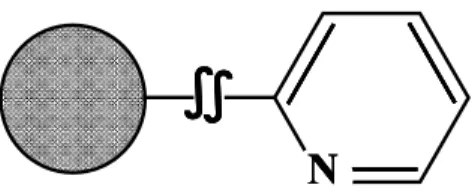
Reagents and materialsThe reagents employed were of guaranteed reagent grade, which were obtained from Wako Pure Chemical Industries (Osaka, Japan) or Tokyo Chemical Industry (Tokyo, Japan), unless otherwise noted. Purified water was produced in the laboratory by using a GS-590 water distillation system (Advantec, Tokyo, Japan). All solutions used in this work were prepared using purified water. HILIC Polar-Pyridine (120 Å mean pore diameter, 5 µm particle diameter, 300 m2/g specific surface area) was obtained from Sepax Technologies (Newark, DE, USA). The expected structure of the stationary phase is shown in Fig. 1.
2010 © The Japan Society for Analytical Chemistry
† To whom correspondence should be addressed.
E-mail: [email protected]
Separation of Inorganic Anions on a Pyridine Stationary Phase in Ion
Chromatography
Toyohide T
AKEUCHI,
†Tatsuya K
AWASAKI, and Lee Wah L
IMDepartment of Chemistry, Faculty of Engineering, Gifu University, 1-1 Yanagido, Gifu 501–1193, Japan
The retention behavior of inorganic anions on a pyridine stationary phase commercially available for hydrophilic interaction chromatography was examined in ion chromatography. Inorganic anions were retained on a protonated pyridine stationary phase under acidic eluent conditions (pH 3.1 – 3.3) in the ion-exchange mode. The logarithm of the retention factor of analytes was linear to the logarithm of the eluent concentration, and the slopes of the plots were –0.55 to –0.64, except for nitrite (–0.39). The smaller slope for nitrite was due to the fact that nitrous acid is weak (pKa 3.25 at 25°C) and was partially ionized under the operating conditions. The elution order of the examined anions was the same as that observed in common ion chromatography. The present system was applied to the determination of UV-absorbing anions contained in saliva.
(Received January 25, 2010; Accepted March 5, 2010; Published April 10, 2010)
Fig. 1 Structures of the HILIC Polar-Pyridine stationary phase employed in this work.
Apparatus
Chromatographic measurements were carried out by using a capillary LC system constructed by an L.TEX-8301 Micro Feeder (L.TEX Corporation, Tokyo, Japan) equipped with an MS-GAN 050 gas-tight syringe (0.5 ml; Ito, Fuji, Japan) as a pump, a Model M435 microinjection valve with an injection volume of 0.15 µl (Upchurch Scientific, Oak Harbor, WA, USA) as an injector, a 0.53-mm i.d. × 75 or 150 mm microcolumn, and a UV-2070 detector (JASCO, Tokyo, Japan). The UV detector was operated at 210 nm. A capillary flow cell (75 µm; JASCO) was attached to a UV detector. The data were acquired by a Chromatopac C-R4A data processor (Shimadzu, Kyoto, Japan). The inlet pressure was monitored by an L.TEX-8150 Pressure Sensor (L.TEX). Elemental analysis of the packing materials was carried out by using an MT-6 CHN Corder (Yanaco, Kyoto, Japan). The separation column was prepared from a fused-silica capillary tube (0.53 mm i.d.) using a slurry packing method, previously reported.8
Preparation of saliva sample
A 1.21-g amount of saliva was diluted in 10 ml of deionized water by using a volumetric flask, and centrifuged at 3000 rpm for 5 min, followed by filtration with a 0.45-µm membrane filter. The saliva sample was then stored in a refrigerator.
Results and Discussion
Concentration of pyridine group
The surface coverage of the pyridine group was calculated from results obtained by the elemental analysis of HILIC Polar-Pyridine. The percentages by weight were 1.20 and 7.85% for nitrogen and carbon, respectively. The results indicate that nitrogen and carbon exist on the stationary phase by 0.86 and 6.53 mmol/g, respectively. Considering the results of the elemental analysis, the concentration of the pyridine group could be estimated to be 0.86 mmol/g, provided that no other
functional group containing nitrogen existed on the stationary phase. On the other hand, the element ratio of carbon to nitrogen is 7.6, meaning that 2.6 carbon atoms exist besides the pyridine group, provided that no other carbon exists on the stationary phase. The spacer of the alkyl group attached to the second position of the pyridine ring was therefore presumed to be an ethyl or propyl group.
Effect of pH
Pyridines are weakly basic. For example, the pKa values at 25°C of pyridine and 2-ethylpyridine are 5.25 and 5.89, respectively.9 This means that the HILIC Polar-Pyridine stationary phase employed in this work is expected to be protonated at a lower pH, while it has no charge at a neutral or higher pH. In other words, it can be expected that the HILIC Polar-Pyridine can work as an anion-exchange stationary phase at a lower pH. Figure 2 demonstrates the separation of iodate, nitrate, iodide and thiocyanate on the HILIC Polar-Pyridine under neutral (A, pH 5.2) and acidic eluent conditions (B, pH 3.3). It can be seen from the figure that the anions cannot be separated under the neutral eluent condition, while they are retained on the stationary phase under an acidic condition. In addition, the elution order was the same as that observed under common ion chromatography conditions. Since the pyridine stationary phase is a weakly basic anion exchanger, the pH effect on the retention is more drastic, compared with strongly basic anion exchangers. Secondary interaction of analytes with the pyridine group can also be expected.
Effect of the eluent concentration
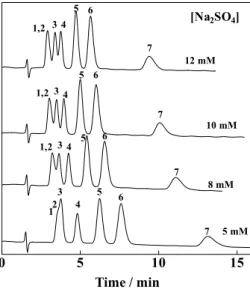
It can be confirmed by changing the eluent concentration whether the retention of analyte anions is based on an ion-exchange mode or not. It is well-known that plots of the logarithm of the retention factor (log k) of analyte ions versus the logarithm of the eluent concentration are linear. Figure 3 demonstrates the separation of seven kinds of inorganic anions on the HILIC Polar-Pyridine column using eluents with different sodium sulfate concentrations, where 0.5 mM sulfuric acid is
Fig. 2 Separation of inorganic anions on a HILIC Polar-Pyridine column at different pH. Column, HILIC Polar-Pyridine, 75 × 0.53 mm i.d.; mobile phases, 12 mM sodium sulfate (pH 5.2) for A and 12 mM sodium sulfate in 0.5 mM sulfuric acid (pH 3.3) for B; flow rate, 8.0 µl/min; wavelength of UV detection, 210 nm; analytes, 0.1 mM each of iodate (1), nitrate (2), iodide (3) and thiocyanate (4); injection volume, 0.15 µl.
Fig. 3 Separation of inorganic anions on a HILIC Polar-Pyridine column with different eluent concentrations. Mobile phases, mixture of 0.5 mM sulfuric acid and sodium sulfate, the concentration of sodium sulfate as indicated; analytes, 0.1 mM each of iodate (1), bromate (2), nitrite (3), bromide (4), nitrate (5), iodide (6) and thiocyanate (7); other operating conditions as in Fig. 2.
contained in the eluent to keep low pH values, 3.1 – 3.3. It can be seen from the figure that the retention of analyte anions decreases with increasing sodium sulfate concentration. It is also recognized that the retention of nitrite decreases at different degree with increasing sodium sulfate concentration, and that nitrite is separated from bromate at higher sodium sulfate concentrations. Since the efficiency of the column employed in Fig. 3 was not so excellent, the resolution was not satisfactory for early eluting anions. The resolution can be improved by using longer columns and/or weak eluents at the sacrifice of the analysis time.
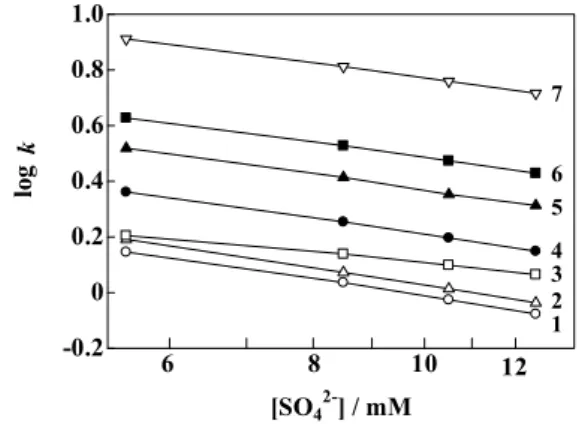
The logarithm of retention factor of analyte anions is plotted versus the logarithm of the sulfate concentration in Fig. 4. The non-retained time was estimated from the solvent peak, i.e., a water dip, appeared in the chromatogram. The time required for passing through the connecting parts was corrected when the retention factors were calculated. It can be seen from the figure that the plots are almost linear for all analyte anions and that the slope for nitrite is shallower than that of other analytes. The slopes are –0.62, –0.64, –0.39, –0.60, –0.58, –0.56, and –0.55 for iodate, bromate, nitrite, bromide, nitrate, iodide, and thiocyanate, respectively. The slopes should theoretically be –0.5 if ion exchange is involved alone in the retention, because the analyte anions are monovalent and sulfate is divalent. The smaller slope for nitrite is due to the fact that nitrous acid is weak, e.g., pKa at 25°C is 3.259 and partially ionized in the column. The pKa values of other acids of the analyte anions are smaller than the pH value of the eluent, e.g., 3.1 – 3.3. In other words, all analyte anions, except for nitrite, are totally dissociated. Although the slopes are not exactly –0.5, the analytes are expected to be primarily retained on the stationary phase in the ion-exchange mode.
Effect of flow rate
The plate height was measured at flow rates of between 8 and 20 µl/min. Figure 5 shows the height equivalent to a theoretical plate height (HETP) versus the flow rate of the mobile phase. It can be seen that the plate height decreases with decreasing flow rate in the examined flow rate region. In order to increase the resolution, it is better to operate at lower flow rates at the sacrifice of the analysis time.
The repeatability of the retention and the peak signal was evaluated at a flow rate of 12 µl/min. The relative standard deviations for the successive six measurements were 0.25 – 0.41, 0.90 – 2.7 and 1.2 – 3.5% for the retention time, peak height and peak area, respectively.
Determination of anions in saliva sample
Figure 6 demonstrates the separation of inorganic UV-absorbing anions contained in a saliva sample using a 15-cm column, where nitrite, bromide, nitrate, iodide and thiocyanate could be detected. The saliva sample was taken from a healthy non-smoker. The signal of the anions could be enhanced by detecting at 190 nm. The concentration of the anions in the saliva could be determined to be 4.5, 5.7, 46.1, 4.9 and 17.5 µg/g for nitrite, bromide, nitrate, iodide and thiocyanate, respectively. It can also be seen from Fig. 6 that the resolution of the anions is improved, compared with that in Fig. 3.
Conclusion
A pyridine stationary phase commercially available for HILIC could be used for the ion-exchange separation of inorganic anions under acidic eluent conditions. The retention of analyte
Fig. 4 Logarithm of the retention factor as a function of the sulfate concentration in the mobile phase. Operating conditions as in Fig. 3.
Fig. 5 HETP versus the eluent flow rate. Mobile phase, 12 mM sodium sulfate in 0.5 mM sulfuric acid (pH 3.3); flow rate, as indicated; analyte, 0.1 mM iodide; other operating conditions as in Fig. 2.
Fig. 6 Separation of inorganic anions contained in saliva. Column, HILIC Polar-Pyridine, 150 × 0.53 mm i.d.; mobile phase, 15 mM sodium sulfate in 0.5 mM sulfuric acid (pH 3.3); flow rate, 8.0 µl/min; wavelength of UV detection, 190 nm; analytes, 0.2 mM each of iodate (1), bromate (2), nitrite (3), bromide (4), nitrate (5), iodide (6) and thiocyanate (7) for A, saliva sample for B; injection volume, 0.15 µl.
anions could be varied by changing the eluent concentration as well as the eluent pH. The column efficiency could be improved by using a longer column at the sacrifice of the analysis time. References
1. H. Small and T. E. Miller, Jr., Anal. Chem., 1982, 54, 462. 2. A. Sugii, K. Harada, and N. Ogawa, J. Chromatogr., 1986,
354, 211.
3. L. M. L. A. Auler Lucia, C. R. Silva, K. E. Collins, and C. H. Collins, J. Chromatogr., A, 2005, 1073, 147.
4. J. Zheng, L. T. Taylor, and J. D. Pinkston, Chromatographia, 2006, 63, 267.
5. H. Bui, T. Masquelin, T. Perun, T. Castle, J. Dage, and M.-S. Kuo, J. Chromatogr., A, 2008, 1206, 186.
6. T. Suzuki, M. Sato, and Y. Fujii, J. Radioanal. Nucl. Chem., 2008, 277, 81.
7. Q. Fu, H. Sanbe, C. Kagawa, K. Kunimoto, and J. Haginaka, Anal. Chem., 2003, 75, 191.
8. T. Takeuchi and D. Ishii, J. Chromatogr., 1981, 213, 25. 9. “Handbook of Chemistry and Physics”, ed. D. R. Lide, 75th
ed., 1994, CRC Press, Boca Raton, Ann Arbor, London, Tokyo.