*1公立大学法人福島県立医科大学附属病院救命救急センター 受付日2017年 5 月10日 (〒960-1295 福島県福島市光が丘一番地) 採択日2017年 5 月31日 *2一般財団法人太田綜合病院附属太田西ノ内病院麻酔科(〒963-8558 福島県郡山市西ノ内2-5-20) *3公立大学法人福島県立医科大学ふくしま国際医療科学センター(〒960-1295 福島県福島市光が丘一番地) 要約:救急/集中治療領域で気管挿管困難症に遭遇する確率は手術室より遥かに高く,かつ気 道確保の失敗は致命的な結果を招く。一刻の猶予も許されない状況で使用するレスキューデ バイスは「迅速,単純,容易」に操作できなければならない。声門上器具はこれらの観点から はほぼ理想的なデバイスであり,近年麻酔科領域のみならず,救急/集中治療領域のdifficult airway management(DAM)でもその有用性を示す報告が増加している。しかし,本邦の救 急/集中治療領域における声門上器具の普及率は諸外国に比して低く,現状では声門上器具が 適切に配備されているとは言い難い。一刻を争う事態での安全を確保するために,声門上器 具を含め,平時より適切なDAMデバイスを配備し運用しておくことが望まれる。本稿を通し, 救急/集中治療領域のDAMにおける声門上器具の役割を再考する。 Key words: ①extraglottic airway device, ②redundancy of safety, ③rescue ventilation
救急
/
集中治療領域の
difficult airway management
におけ
る声門上器具 ─その役割を再考する
大野 雄康
*1, 2篠原 一彰
*2谷川 攻一
*1, 3Ⅰ.はじめに
気道管理は,救急/集中治療において,最も重要な
処置の一つである。しかしながら,患者の生理学的予
備能が少ないことや十分な評価ができないこと,そし
て喧噪とした環境などにより,ICUや救急部での気道
管理は手術室よりも遥かに難易度が高い。例えば,気
管挿管困難症に遭遇する確率は,予定手術の麻酔では
0.5〜8.5%
1)〜6)と さ れ る の に 対 し,ICUで は10.0〜
21.0%
7)〜11),救急部では6.1〜23.5%
9),12)〜16),そして
病院前の現場では6.0〜17.7%
1),17)〜19)と報告されて
いる。さらに予定手術の麻酔であれば,気管挿管困難
症例に遭遇した場合,
「麻酔から覚醒させ自発呼吸を
促す」という選択肢があるが
20) 〜 22),救急 / 集中治療
領域の difficult airway management(DAM)にはこ
の選択肢がない。緊急挿管時にいたずらに喉頭展開
を繰り返すと,重篤な気道関連合併症のリスクが増加
し
12),13),低酸素脳症や心停止などの致命的な結果に至
りやすくなる
23)。
これらのことから,救急/集中治療領域のDAMに
おけるレスキューデバイスの必要性は明白である。
Ⅱ.声門上器具
vs
輪状甲状靭帯穿刺
/
切開
一刻を争う緊急事態や冷静を保つのが困難な状況で
は,複雑なタスクはこなせない。安全工学上「迅速,
単純,容易」に操作できることが,このような環境下
で使用するデバイスに必要な特性である
24)。例えば,
スカイダイビングにおいて,メインのパラシュートに
不具合が発生した時に使用するバックアップパラ
シュートは,ワンタッチで迅速に作動するように設計
されている。
救急/集中治療領域のDAMにおけるレスキューデ
バイスにも,同様の特性が求められる
24)。操作が「迅
速,単純,容易」であるという観点からは,声門上器具
の方が緊急外科的気道確保よりも優れている。例えば,
輪状甲状靭帯穿刺/切開は十分な経験がないと手技完
了までに許容できない時間(90〜150秒)を要する
が
25)〜27),声門上器具は使用経験にかかわらず,挿入
から換気確立までの時間は約20秒程度である
28)〜30)。
気道管理の経験豊富な麻酔科医でさえ,40秒以内に輪
状甲状靭帯切開を成功させるにはマネキンで少なくと
も5例の経験が必要であった
26)。それに対し声門上
器具は医学的な背景が全くない市民ボランティア
29)であっても,ごく簡単な講義の後で,正しく挿入可能
であった。予定手術の麻酔症例において,医学生は声
門上器具を挿入する方がバッグバルブマスクを使用す
るよりも有意に早く有効な換気を確立できた
30)。こ
れらの調査結果は,声門上器具が「迅速,単純,容易」
な,緊急時の使用に適した換気デバイスであることを
支持している。
低侵襲であることも声門上器具の重要な特性であ
る。換気/気管挿管不能の決定的な場面であっても,
特に不慣れな術者は,侵襲的な手技ゆえに輪状甲状靭
帯穿刺/切開に踏み切るまで時間を要する傾向があ
る
31)。英国の全国調査によれば,外科的気道確保手
技に踏み切るタイミングの遅れ,および手技完遂に長
時間を要してしまったことが,気道関連死の主要な原
因であった
23)。
さらに,輪状甲状靭帯穿刺/切開手技に関連して起
こりうる合併症(気管後壁損傷,気管外留置,頸動脈
穿刺など
27),32)〜34))は声門上器具挿入に関連して起こ
りうる合併症(誤嚥,咽頭損傷
35))に比して,より重篤
なものとなりうる。
もちろん救急/集中治療領域で遭遇する換気/気管
挿管困難症例のすべてが声門上器具でレスキューでき
るわけではない。例えば,開口障害,閉塞起点,気道
の変形,肺コンプライアンスの低下がある症例には,
声門上器具の使用は困難である
36)。重症顔面外傷,
頸部切創,気道熱傷,長期挿管の喉頭浮腫など,救急/
集中治療領域には,声門上器具使用困難症例が確実に
存在する。確実性,気道保護などの観点からは緊急外
科的気道確保が声門上器具の使用に勝る。したがって,
救急/集中治療に携わる医療従事者は,決して外科的
気道確保の修練を怠ってはいけない。外科的気道確保
手技,声門上器具の得手/不得手(Table 1)を理解し
たうえで両方の手技に精通し,遭遇する状況に最も適
したデバイスを使用できることが望ましい。
Ⅲ.冗長化による安全性
失敗,もしくは障害の発生が致命的な結果を招く場
合には,複数のバックアップシステムを設けることに
より,安全を「冗長化」する必要がある
37)。これは
fault tolerance systemの一つで,障害の発生に備えて,
予備装置を平常時からバックアップとして適切に配
置/運用しておくという安全工学の概念である
37)。
冗長化の例としては,航空機に常備される複数のバッ
クアップエンジンや,コンピュータの制御系統の二重
Table 1 Comparison of supraglottic airway devices vs cricothyrotomy as a rescue ventilation strategy Supraglottic airway devices Cricothyrotomy Time of insertion Fast (approximately 20 sec)regardless of the training level of the person administering the device 28)〜30) Requires considerable time(90〜150 sec) to implement if one is not familiar with the technique 25)〜27) Simplicity of technique Simple(insertion and confirmation of ventilation) Requires several steps(identification of cricothyroid membrane, puncture or incision, cannula insertion, and confirmation of intubation) Potential complications during insertion Aspiration(minor, major), and pharyngeal injury 35) Laceration of the thyroid cartilage, cricoid cartilage, or tracheal rings; perforation of the posterior trachea; passage of the tube into an extratracheal region; bleeding; and carotid sheath intubation 27),32)〜34) Duration of use Temporary measure until another definitive airway can be established Can be used as a definitive airway Airway protection Does not secure the airway from aspiration Secure the airway using a cuff Difficult cases RODS(restricted mouth opening, obstruc-tion/obesity, disrupted or distorted airway, and stiff lung)36) SMART(surgery[recent or remote], mass, access/anatomy challenging, radiation and other deformity or scarring, and tumor)36)化などがある。失敗が致命的となる救急/集中治療領
域の気道管理においても,同様に冗長化による安全性,
すなわち複数のセーフティーネットが必要である
24)。
集中治療医や救急医であれば,誰しも直接喉頭展開
に加え,ビデオ喉頭鏡や気管支鏡ガイドなど,複数の
気道確保手技を持っているだろう。それと同じように,
確実に使用できる代替換気手技も複数習得しておくべ
きである。
声門上器具を適切に配備し,しかも平常時から使用
しておくことが理想ではあるが,予定手術の麻酔以外
では声門上器具の使用頻度は少なく,現状では麻酔科
医以外にはトレーニングの機会が限られてしまってい
る
38),39)。一刻を争う緊急事態で適切に使用できるよ
うに,手術室での研修やシミュレーションなど,救
急/集中治療医に対する適切な声門上器具教育プログ
ラムの確立が望まれる
38),39)。
Ⅳ.救急
/
集中治療領域での
声門上器具の有用性
麻酔科領域のDAMにおいて,声門上器具の使用に
は十分なエビデンスの蓄積があり,現在複数のガイド
ラインで第一選択のレスキューデバイスに位置づけら
れている
20)〜22)。
救急/集中治療領域のDAMにおける声門上器具の
有用性を明らかにするために,2017年5月に我々は
PubMed,OvidSP,Google Scholarを使用して,以下の
searching strategyを用いて系統的な調査を行った:
(“intensive care unit” OR “critical care” OR
“emergency department” OR “emergency medicine”
OR “prehospital” OR “trauma”)AND(“supraglottic
airway device” OR “extraglottic airway device” OR
“rescue ventilation”)AND(“difficult airway” OR
“failed intubation” OR “cannot intubate” OR “cannot
ventilate”)。さらに,論文に含まれる引用文献からも
cross referenceを行った。この手法により160本の論
文がスクリーニングされた。このうち,以下の基準を
満たす論文を除外した:①声門上器具をレスキューの
ために使用した状況が明確でない,または声門上器具
を使用してもその成否が明確に記載されていない,②
英語もしくは日本語以外の言語で書かれている,③マ
ネキンなどを使ったシミュレーション研究,④麻酔科
領域でのDAMにおける声門上器具の使用,である。
これにより146本が除外され,最終的に14本の論文を
reviewした。
以下に所見を記載する。
救急/集中治療領域のDAMにおいて,声門上器具
は気管挿管や気管切開などのより確実な方法に切り替
えるまで,ブリッジングデバイスとして十分に機能す
る。病院前で遭遇した気管挿管困難症例は,初回から
外科的気道確保が行われた症例を除き,全例,声門上
器具を挿入することで救急部到着まで安全に換気可能
であった
17),40)〜44)[The 2011 Oxford CEBM Levels
of Evidence
45)(LOE 4)]。このうち声門上器具を通し
て気管挿管を試みた症例では,全例気管挿管に成功し
た
17),40)。一つの文献では,病院前のDAMにおける
LMA™(Teleflex, USA)とCombitube™(COVIDIEN,
USA)のレスキュー換気成功率が比較記述されてい
る
18)。LMA™の成功率は8/9(89%)であったのに対
し,食道閉鎖式換気デバイスであるCombitube
TMの
成功率は11/13(85%)であった。失敗の理由は開口
障害,吐物/血液であった(LOE 4)。本邦の教育病院
に搬送された554例の外傷症例のうち3例(0.54%)は
ビデオ喉頭鏡,気管支鏡など複数の手段を使っても気
管挿管不能であったが,これらの全例に対して声門上
器具を用いることにより気道確保に成功した
46)。こ
のうち2例はデバイスを通して気管挿管に成功し,1
例は気管切開術に成功した。これらの症例で,誤嚥な
どの大きな合併症は発生しなかった(LOE 4)。
ICUにおいて,用手換気不能/気管挿管不能という
緊急事態に陥ったが,声門上器具を使用することで十
分な酸素化が得られた(LOE 4)
47),48)。さらに,声門
上器具を使用することで経皮的気管切開術中の換気,
気管支鏡の視野ともに良好に確保できた(LOE 4)
48),49)。
気管挿管が困難であった院外心肺停止症例のうち,
声門上器具を使用して早期にレスキューを行った群
は,そうでない群よりも自己心拍再開率が高かった
(LOE 4)
50)。これは,DAMにおける声門上器具の重
要性を示唆している。
声門上器具は,禁忌とされる喉頭浮腫のレスキュー
にも有用であった。救急外来で遭遇した45例の喉頭
浮腫症例のうち,気管挿管が困難であった5例に声門
上器具を挿入した。全例で声門上器具を通して十分に
酸素化可能であり,さらに器具を通した気管挿管に成
功した(LOE 4)
51)。
声門上器具はまた,小児の気管挿管困難症例の救済
においても有用であった(LOE 4)
52)。
このように,救急/集中治療領域のDAMにおいて
声門上器具の有用性を示す報告は増加している。
Ⅴ.本邦の救急
/
集中治療領域で声門上器具は
適切に使われているか
?
近年,救急/集中治療領域のDAMにおける声門上器
具の有用性が広く認知されるようになり,英国および
スカンジナビアの病院前気道管理ガイドライン
53),54),
さ ら にDe Jongら
55),Limら
56),お よ びAll India
Difficult Airway Association
57)が提唱するICU気道管
理ガイドラインにおいて,声門上器具の使用はレス
キューストラテジーの第一選択に位置づけられてい
る。
それでは,本邦の救急/集中治療領域で,声門上器
具は適切に使われているだろうか? この臨床的疑問
を解決するために,我々は2015年から2016年にかけ
て,本邦のドクターヘリ基地病院および日本集中治療
医学会専門医認定施設に配備されているDAMデバイ
スを系統的に調査した
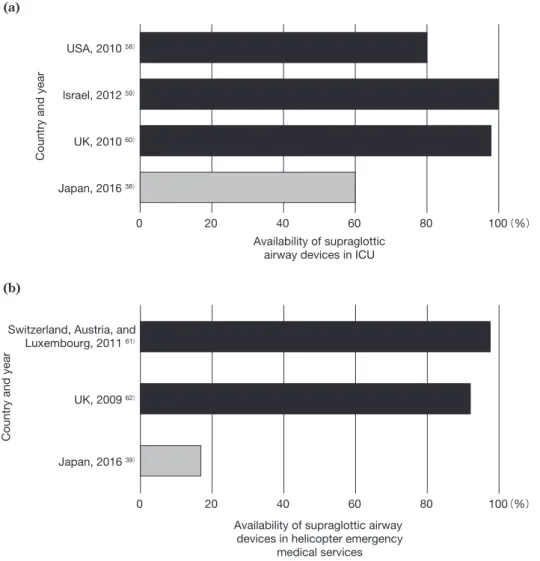
38),39)。Fig. 1a,bに示すように,
本邦の救急/集中治療領域における声門上器具の普及
率
38),39)は諸外国における普及率
58)〜62)と比較して低
く,本邦で声門上器具が適切に配備されているとは現
状では言い難い。
救急/集中治療領域で起こる気道トラブルの少なく
とも一部は,DAMデバイスの不備に起因すると言わ
れている
23),63)。理想的には,救急部やICUに備えて
おくDAMデバイスは手術室と同一レベルにすべきで
ある
23),63),64)。声門上器具を含んだDAMカートを院
内に正しく整備し,スタッフにDAM教育を徹底した
後,外科的気道確保の頻度が著明に減少したという報
告がある
65)。本邦の救急/集中治療領域においても,
声門上器具を含め,複数の気道管理ガイドラインで推
奨されているような
20)〜22),適切なDAMデバイスを
整備することが重要であると考える。
0 USA, 2010 58) 20 40 Availability of supraglottic airway devices in ICU60 80 100
lsrael, 2012 59)
UK, 2010 60)
Japan, 2016 38)
Country and year
(a)
(%)
0 Switzerland, Austria, and
Luxembourg, 2011 61)
20 40 60 80 100
UK, 2009 62)
Japan, 2016 39)
Country and year
Availability of supraglottic airway devices in helicopter emergency
medical services (b)
(%)
Fig. 1 International comparison of the availability of supraglottic airway devices in ICU(a) and helicopter emergency medical services(b)
Ⅵ.結 語
救急/集中治療領域の気道管理では,換気を担保す
るための「複数」の安全機構が必要である。声門上器
具は,手技の迅速さ,単純さ,容易さの点では輪状甲
状靭帯穿刺/切開に勝る代替換気法である。救急/集
中治療領域のDAMにおける声門上器具の有用性を示
すエビデンスは増加している。しかしながら,諸外国
に比して,本邦の救急/集中治療領域における声門上
器具の普及は遅れており,依然として多くの改善の余
地が残されている。今後,本邦の救急/集中治療領域
において声門上器具を含め,手術室に準じたDAMデ
バイスの整備が望まれる。
謝 辞 福島県立医科大学附属病院救命救急センター (福島県, 福島市)の佐藤ルブナ医師,島田二郎医師,反町光太朗医師, 福島県立医科大学男女共同参画支援室の大内香澄さん,同白 河総合診療アカデミーの矢野徹宏医師,そして星ヶ丘病院精 神科(福島県,郡山市)の大野 望医師に本稿の準備,校正段 階で多くの協力や助言をいただいた。彼/彼女らの貢献に感 謝する。 本稿の一部は第44回日本集中治療医学会学術集会(2017 年,札幌)の教育講演で発表した。 本稿の全ての著者に規定されたCOIはない。 文 献1) Adnet F, Borron SW, Racine SX, et al. The intubation difficulty scale (IDS): proposal and evaluation of a new score characterizing the complexity of endotracheal intubation. Anesthesiology 1997;87:1290-7.
2) Nørskov AK, Rosenstock CV, Wetterslev J, et al. Diagnostic accuracy of anaesthesiologists’ prediction of difficult airway management in daily clinical practice: a cohort study of 188 064 patients registered in the Danish Anaesthesia Database. Anaesthesia 2015;70:272-81. 3) Burkle CM, Walsh MT, Harrison BA, et al. Airway
management after failure to intubate by direct laryn-goscopy: outcomes in a large teaching hospital. Can J Anaesth 2005;52:634-40.
4) Crosby ET, Cooper RM, Douglas MJ, et al. The unantici-pated difficult airway with recommendations for management. Can J Anaesth 1998;45:757-76.
5) Langeron O, Cuvillon P, Ibanez-Esteve C, et al. Prediction of difficult tracheal intubation: time for a paradigm change. Anesthesiology 2012;117:1223-33.
6) Lundstrøm LH, Møller AM, Rosenstock C, et al. High body mass index is a weak predictor for difficult and failed tracheal intubation: a cohort study of 91,332 consecutive patients scheduled for direct laryngoscopy
registered in the Danish Anesthesia Database. Anesthesiology 2009;110:266-74.
7) Jaber S, Amraoui J, Lefrant JY, et al. Clinical practice and risk factors for immediate complications of endotracheal intubation in the intensive care unit: a prospective, multiple-center study. Crit Care Med 2006;34:2355-61. 8) Heuer JF, Barwing TA, Barwing J, et al. Incidence of
difficult intubation in intensive care patients: analysis of contributing factors. Anaesth Intensive Care 2012;40: 120-7.
9) Martin LD, Mhyre JM, Shanks AM, et al. 3,423 emergency tracheal intubations at a university hospital: airway outcomes and complications. Anesthesiology 2011;114:42-8.
10) De Jong A, Molinari N, Pouzeratte Y, et al. Difficult intubation in obese patients: incidence, risk factors, and complications in the operating theatre and in intensive care units. Br J Anaesth 2015;114:297-306.
11) De Jong A, Molinari N, Terzi N, et al; AzuRéa Network for the Frida-Réa Study Group. Early identification of patients at risk for difficult intubation in the intensive care unit: development and validation of the MACOCHA score in a multicenter cohort study. Am J Respir Crit Care Med 2013;187:832-9.
12) Mort TC. Emergency tracheal intubation: complications associated with repeated laryngoscopic attempts. Anesth Analg 2004;99:607-13.
13) Hasegawa K, Shigemitsu K, Hagiwara Y, et al; Japanese Emergency Medicine Research Alliance Investigators. Association between repeated intubation attempts and adverse events in emergency departments: an analysis of a multicenter prospective observational study. Ann Emerg Med 2012;60:749-54.
14) Reed MJ, Dunn MJ, McKeown DW. Can an airway assessment score predict difficulty at intubation in the emergency department?. Emerg Med J 2005;22:99-102. 15) Walls RM, Brown CA 3rd, Bair AE, et al; NEAR II
Investigators. Emergency airway management: a multi-center report of 8937 emergency department intubations. J Emerg Med 2011;41:347-54.
16) Brown CA 3rd, Bair AE, Pallin DJ, et al; NEAR III Investigators. Techniques, success, and adverse events of emergency department adult intubations. Ann Emerg Med 2015;65:363-70.
17) Combes X, Jabre P, Margenet A, et al. Unanticipated difficult airway management in the prehospital emergency setting: prospective validation of an algorithm. Anesthesiology 2011;114:105-10.
18) Timmermann A, Eich C, Russo SG, et al. Prehospital airway management: a prospective evaluation of anaes-thesia trained emergency physicians. Resuscitation 2006;70:179-85.
19) Breckwoldt J, Klemstein S, Brunne B, et al. Expertise in prehospital endotracheal intubation by emergency medicine physicians-Comparing ‘proficient performers’ and ‘experts’. Resuscitation 2012;83:434-9.
20) Japanese Society of Anesthesiologists. JSA airway management guideline 2014: to improve the safety of induction of anesthesia. J Anesth 2014;28:482-93.
21) Apfelbaum JL, Hagberg CA, Caplan RA, et al; American Society of Anesthesiologists Task Force on Management of the Difficult Airway. Practice guidelines for management of the difficult airway: an updated report by the American Society of Anesthesiologists Task Force on Management of the Difficult Airway. Anesthesiology
2013;118:251-70.
22) Frerk C, Mitchell VS, McNarry AF, et al; Difficult Airway Society intubation guidelines working group. Difficult Airway Society 2015 guidelines for management of unanticipated difficult intubation in adults. Br J Anaesth 2015;115:827-48.
23) Cook TM, Woodall N, Harper J, et al. Major complications of airway management in the UK: results of the Fourth National Audit Project of the Royal College of Anaesthetists and the Difficult Airway Society. Part 2: intensive care and emergency departments. Br J Anaesth 2011;106:632-42.
24) Levitan RM. Patient safety in emergency airway management and rapid sequence intubation: metaphorical lessons from skydiving. Ann Emerg Med 2003;42:81-7. 25) Eisenburger P, Laczika K, List M, et al. Comparison of
conventional surgical versus Seldinger technique emergency cricothyrotomy performed by inexperienced clinicians. Anesthesiology 2000;92:687-90.
26) Wong DT, Prabhu AJ, Coloma M, et al. What is the minimum training required for successful cricothyroid-otomy?: a study in mannequins. Anesthesiology 2003;98:349-53.
27) Heymans F, Feigl G, Graber S, et al. Emergency Cricothyrotomy Performed by Surgical Airway-naive Medical Personnel: A Randomized Crossover Study in Cadavers Comparing Three Commonly Used Techniques. Anesthesiology 2016;125:295-303.
28) Martel M, Reardon RF, Cochrane J. Initial experience of emergency physicians using the intubating laryngeal mask airway: a case series. Acad Emerg Med 2001;8: 815-22.
29) Schälte G, Stoppe C, Aktas M, et al. Laypersons can successfully place supraglottic airways with 3 minutes of training. A comparison of four different devices in the manikin. Scand J Trauma Resusc Emerg Med 2011;19:60. 30) Timmermann A, Russo SG, Crozier TA, et al. Novices
ventilate and intubate quicker and safer via intubating laryngeal mask than by conventional bag-mask venti-lation and laryngoscopy. Anesthesiology 2007;107:570-6. 31) McCrossin K, White HT, Sane S. The effect of
high-fidelity simulation on the confidence and decision-making ability of anaesthesia trainees in managing subsequent simulated ‘can’t intubate, can’t oxygenate’ scenarios. Anaesth Intensive Care 2014;42:207-12.
32) Bair AE, Panacek EA, Wisner DH, et al. Cricothyrotomy: a 5-year experience at one institution. J Emerg Med 2003;24:151-6.
33) Gillespie MB, Eisele DW. Outcomes of emergency surgical airway procedures in a hospital-wide setting. Laryngoscope 1999;109:1766-9.
34) Cheah T, Ha JF. Carotid sheath ‘intubation’ during an emergency surgical cricothyroidotomy. BMJ Case Rep 2016;pii:bcr2016214898.
35) Michalek P, Donaldson W, Vobrubova E, et al. Complications Associated with the Use of Supraglottic Airway Devices in Perioperative Medicine. Biomed Res Int 2015;2015:746560.
36) Walls RM, Murphy MF. Identification of the Difficult and Failed Airway. In: Walls RM, Murphy MF, editors. Manual of emergency airway management 4th ed. Philadelphia: Lippincott Williams & Wilkins; 2012. p. 8-21. 37) Downer J. When Failure is an Option: Redundancy,
reliability and regulation in complex technical systems. 2009 May [cited 2017 Aug 23]. Available from: http://
eprints.lse.ac.uk/36537/1/Disspaper53.pdf 38) Ono Y, Tanigawa K, Shinohara K, et al. Difficult airway management resources and capnography use in Japanese intensive care units: a nationwide cross-sectional study. J Anesth 2016;30:644-52. 39) Ono Y, Shinohara K, Goto A, et al. Are prehospital airway management resources compatible with difficult airway algorithms? A nationwide cross-sectional study of helicopter emergency medical services in Japan. J Anesth 2016;30:205-14.
40) Timmermann A, Russo SG, Rosenblatt WH, et al. Intubating laryngeal mask airway for difficult out-of-hospital airway management: a prospective evaluation. Br J Anaesth 2007;99:286-91.
41) Lockey D, Crewdson K, Weaver A, et al. Observational study of the success rates of intubation and failed intubation airway rescue techniques in 7256 attempted intubations of trauma patients by pre-hospital physicians. Br J Anaesth 2014;113:220-5.
42) Chenaitia H, Soulleihet V, Massa H, et al. The Easytube for airway management in prehospital emergency medicine. Resuscitation 2010;81:1516-20.
43) McQueen C, Crombie N, Hulme J, et al. Prehospital anaesthesia performed by physician/critical care paramedic teams in a major trauma network in the UK: a 12-month review of practice. Emerg Med J 2015;32:65-9. 44) Grier G, Bredmose P, Davies G, et al. Introduction and
use of the ProSeal laryngeal mask airway as a rescue device in a pre-hospital trauma anaesthesia algorithm. Resuscitation 2009;80:138-41.
45) OCEBM Levels of Evidence Working Group. “The Oxford Levels of Evidence 2”. Oxford Centre for Evidence-Based Medicine [cited 2015 May 20]. Available from: http://www.cebm.net/index.aspx?o=5653
46) Ono Y, Yokoyama H, Matsumoto A, et al. Surgical airways for trauma patients in an emergency surgical setting: 11 years’ experience at a teaching hospital in Japan. J Anesth 2013;27:832-7.
47) Siddiqui S, Seet E, Chan WY. The use of laryngeal mask airway Supreme™ in rescue airway situation in the critical care unit. Singapore Med J 2014;55:e205-6. 48) Cook TM, Taylor M, McKinstry C, et al. Use of the
ProSeal Laryngeal Mask Airway to initiate ventilation during intensive care and subsequent percutaneous tracheostomy. Anesth Analg 2003;97:848-50.
49) Linstedt U, Möller F, Grote N, et al. Intubating laryngeal mask as a ventilatory device during percutaneous dilata-tional tracheostomy: a descriptive study. Br J Anaesth 2007;99:912-5.
50) Wnent J, Franz R, Seewald S, et al; German Resuscitation Registry Study Group. Difficult intubation and outcome after out-of-hospital cardiac arrest: a registry-based analysis. Scand J Trauma Resusc Emerg Med 2015;23:43. 51) Driver BE, McGill JW. Emergency Department Airway
Management of Severe Angioedema: A Video Review of 45 Intubations. Ann Emerg Med 2017;69:635-9.
52) Jagannathan N, Wong DT. Successful tracheal intubation through an intubating laryngeal airway in pediatric patients with airway hemorrhage. J Emerg Med 2011;41: 369-73.
53) The Association of Anaesthetists of Great Britain and Ireland. AAGBI SAFETY GUIDELINE: Pre-hospital Anaesthesia [cited 2015 May 20]. Available from: https:// www.aagbi.org/sites/default/files/prehospital_glossy09. pdf
54) Rehn M, Hyldmo PK, Magnusson V, et al. Scandinavian SSAI clinical practice guideline on pre-hospital airway management. Acta Anaesthesiol Scand 2016;60:852-64. 55) De Jong A, Jung B, Jaber S. Intubation in the ICU: we
could improve our practice. Crit Care 2014;18:209. 56) Lim MS, Hunt-Smith JJ. Difficult airway management in
the intensive care unit: practical guidelines. Crit Care Resusc 2003;5:43-52.
57) Myatra SN, Ahmed SM, Kundra P, et al. Republication: All India Difficult Airway Association 2016 Guidelines for Tracheal Intubation in the Intensive Care Unit. Indian J Crit Care Med 2017;21:146-53.
58) Porhomayon J, El-Solh AA, Nader ND. National survey to assess the content and availability of difficult-airway carts in critical-care units in the United States. J Anesth 2010;24:811-4.
59) Haviv Y, Ezri T, Boaz M, et al. Airway management practices in adult intensive care units in Israel: a national survey. J Clin Monit Comput 2012;26:415-21.
60) Georgiou AP, Gouldson S, Amphlett AM. The use of
capnography and the availability of airway equipment on Intensive Care Units in the UK and the Republic of Ireland. Anaesthesia 2010;65:462-7.
61) Schmid M, Schüttler J, Ey K, et al. Equipment for pre-hospital airway management on Helicopter Emergency Medical System helicopters in central Europe. Acta Anaesthesiol Scand 2011;55:583-7.
62) Schmid M, Mang H, Ey K, et al. Prehospital airway management on rescue helicopters in the United Kingdom. Anaesthesia 2009;64:625-31.
63) Cook TM, MacDougall-Davis SR. Complications and failure of airway management. Br J Anaesth 2012;109: i68-i85.
64) Mort TC. The incidence and risk factors for cardiac arrest during emergency tracheal intubation: a justifi-cation for incorporating the ASA Guidelines in the remote location. J Clin Anesth 2004;16:508-16.
65) Berkow LC, Greenberg RS, Kan KH, et al. Need for emergency surgical airway reduced by a comprehensive difficult airway program. Anesth Analg 2009;109:1860-9.
Abstract
Reappraising the role of supraglottic airway devices for difficult airway management in
critical care and emergency medicine
Yuko Ono
*1, 2, Kazuaki Shinohara
*2, Koichi Tanigawa
*1, 3*1 Emergency and Critical Care Medical Center, Fukushima Medical University Hospital *2 Department of Anesthesiology, Ohta General Hospital Foundation, Ohta Nishinouchi Hospital *3 Fukushima Global Medical Science Center, Fukushima Medical University *1, 3 1 Hikarigaoka, Fukushima, Fukushima 960-1295, Japan *2 2-5-20 Nishinouchi, Koriyama, Fukushima, Fukushima 963-8558, Japan Difficult airways and severe airway-related adverse events occur much more commonly in emergency departments and ICUs than in operating rooms. Thus, rescue ventilation strategies are indispensable in emergency departments and ICUs. Rescue ventilation techniques in time-sensitive situations must be fast, simple and easy to perform. Considering this situation, supraglottic airway devices are near-ideal instruments. Using a supraglottic airway device is a common first-line rescue ventilation strategy in difficult airway management (DAM) algorithms advocated by several professional anesthesiology societies. Furthermore, supraglottic airway devices are also proving to be useful for DAM in emergency departments and ICUs, and evidence supporting their implementation in such environments is increasing. However, supraglottic airway devices are much less likely to be available in Japanese emergency medical services and ICUs than in other countries. Immediate access to appropriate DAM devices, including supraglottic airways, is essential to ensure safety. The aim of this study was to reappraise the role of supraglottic airway devices in the field of emergency and critical care medicine. Key words: ①extraglottic airway device, ②redundancy of safety, ③rescue ventilation