Peter W. Roux
AbstractThe international media’s coverage of large political gatherings, such as the conferences of the United Nations Committee on Climate Change, typically captures significant governmental and public attention. These debates provide fertile grounds for linguistic research seeking to understand some of the ways in which language shapes and maintains ideological forces in society. Utilizing a framework of critical discourse analysis (CDA), this paper explores and compares the occurrences of the word green in two sub-corpora of the Bank of English. It seeks to understand if, and how, this chosen lexical item functions as a key to discursive activity within the framework of the discourse on climate change. In addition, this paper briefly reviews CDA and its utility in the analysis of corpora as well as offering a short exposition of the discourse on climate change. Findings indicate limited, yet significant linguistic evidence that the word green is either associated with, or clearly involved at sites where certain constructs in the discourse on climate change operate. These findings, although tentative, demonstrate the value of a CDA approach in the analysis of discursive activity as well as the increasing potential of large corpora to support and extend an understanding of the functions of language in society.
Key terms: corpus analysis; critical discourse analysis; climate change; ideology; green
1. Introduction
Climate change can arguably be considered as one of the defining debates within modern society. According to the official website of the UN Climate Change Conference, the 2009 summit in Copenhagen (COP15) 1, attracted the unprecedented and historical number of 120 world leaders, underscoring not only the urgency of the debate but, as the event testified, also highlighting the enormous differences that exist in the socio-historical, geo-political and economic realities that nations face. Considering the media coverage of the debate on climate change, Weingart, Engles & Pansegrau (2000) conclude that the politically charged undertones of the various issues have once again reiterated the importance of adequate and sensible representation of facts and events. This observation is echoed in Koteyko, Thelwall & Nerlich (2010, p. 25), with the authors’ reference to the evolution of ‘a whole new language’ that has characterized the development of this debate.
The focus on language stands central to the development of discourse, since meaning, and the potential interpretation thereof, is seen as a reciprocal, socially constructed process that can ultimately find ideological expression in the formation and shaping of public attitudes and perceptions (Teubert, 2005; Hunston, 2002). Words, and their use in different contexts, stand central in the creation and maintenance of public debates. In this view, the discourse on climate change, which has spawned words and concepts such as ‘eco-friendly’, ‘carbon footprint’ and ‘carbon finance’ (Koteyko et al., 2010, p. 26), can thus be treated as a prime site for linguistic investigation.
In order to explore how corpus research can assist in studies of ideology in discourse, this paper will present a limited study of the occurrence of the lexical item green in two contrasting corpora contained within the Bank of English. A brief introduction to the theoretical background of corpus studies, with specific reference to critical discourse analysis (CDA) and the discourse on climate changeis provided, followed by methodological considerations, analysis and discussion of results. The overall aim is to investigate, through a comparative analysis, how, and within which contexts the keyword green occurs, and to form initial impressions about whether the word can be said to be involved in ideological construction and maintenance within the greater discourse on climate change.
2. Corpus linguistics and the discourse on climate change 2.1 Corpus linguistics and critical discourse analysis (CDA)
The relationship between language and society is notoriously complex. Hunston (2002, p.110, citing Fowler and Fairclough) elucidates this relationship by drawing attention to the role of language in ‘forming and transmitting assumptions’ about reality – what it is, or what it could be like. From this perspective, the study of language is occupied with meaning as it is observed in the social arena, which is the concern of corpus linguistics. According to Teubert (2005, pp.5-8), discourse can be defined as a totality of texts produced by a community of language users who identify themselves as members of a social group, based upon the commonality of their view of the world. The linguistic analysis of texts produced by these communities can provide potential keys to understanding the development and maintenance of a discourse.
As Teubert (2005, p. 8) points out, the discourse only provides a particular interpretation (or ‘misinterpretation’) of a reality at any given time. Discourse can therefore be characterized as a ‘self-referential system’, i.e. that meaning is internally created by the particular discourse in question – regardless of whether these meanings correspond correctly to any given ‘objective’ reality. A corpus, as a mere store of language, or a series of texts taken out of its socio-cultural context, does not have inherent meaning: it is rather in the analysis that some of the potential meanings become apparent. These analyses gain further meaning once their contextual and discursive linkages are realized, and a particular view of the social world emerges.
The vantage point of critical linguistics provides a paradigm for viewing language, not as an isolated system, but as it intervenes in the social world by virtue of its ability to perpetuate assumptions and values about that world (Hunston, 2002, p. 109). Critical linguists therefore study language in order to understand how language is involved in the formation and maintenance of the existing values and codes prevalent in current societies. These studies then take a further step by exploiting the mentioned functions of language in order to challenge societal phenomena, such as certain ideological constructs, for example global warming. This is made possible through the particular stance that critical linguists take in studying corpora, namely: (1) to study texts within the particular social context that they were produced; (2) to reveal the implicit ideology encoded within specific overt propositions; and (3) to provide a challenge to common sense in pointing out that something could have been presented differently, with a very different significance (Fowler, cited in Hunston, 2002, p. 109).
The methods employed in corpus analysis have in recent years been much enhanced by advances in the technology (in the form of computer software) to access and analyze corpora. Instances where analysis of corpora using corpus software may yield valuable information are, for example, word occurrences and their frequency, collocations, parts of speech, grammatical frames, et cetera (Bednarek, 2009, p.20). These developments have enabled studies in discourse analysis to provide some ‘evidence’ pertaining to the trends or themes occurring in natural language, given the parameters of a certain discursive frame. It is therefore possible to take the discourse of a particular community in a particular context, and, using a CDA approach, examine the lexical behavior that occurs within the particular framework in order to reveal its possible ideological implications (Hunston, 2002, p.23).
A number of important caveats should however be kept in mind in the analysis of corpora. A corpus as a specific collection of texts only provides information about its own contents - it is only representative of what it contains, or what it was designed for. As such, it can give evidence in terms of observations, allowing for deductive extrapolation about the corpus in question, but not for generalizations about language in general (Hunston, 2002, pp. 22-3). Equally important is the fact that a corpus presents language outside of its socially produced context, which implies that data obtained for analysis, although ‘objectively’ obtained through quantitative methods, needs to be treated cautiouslyas ‘testimony’; that is, the data is only a representation of what was observed about reality (Teubert, 2005, p. 7). The links between (external) reality and representational or discursive reality, although observable in terms of patterns or themes at the interpretative level, thus can become rather tenuous, and remain true only for the texts or corpus in question.
29
Turning to language and power in more general terms, it should be noted that CDA, as Fairclough (2001, pp. 1-4) explains, sees language being centrally involved in the production and maintenance of relations of power in society. This stance implies that the relationship between text and society is indirect, characterized by two important mediating factors. Firstly, text should be seen as part of a larger discourse; that is, discursive activity imbues text with certain values, which only assumes its full (or intended) meaning if they are embedded in social interaction. Secondly, the particular social context of the discourse also acts as mediator, since it is in the social operation of the discourse that particular values are realized as parts of societal and institutional processes of struggle. The common sense-assumptions (or values) that are found in a particular discourse, in turn incorporate ideologies that correspond with certain sets of power relations (Fairclough, pp. 117-8). Thus, the indirect, mediated relationships or linkages that exist between language and society are reciprocally created and maintained, or given expression, through existing forces of power. To summarize, discourse could perhaps be characterized as a form of power that articulates a particular series of events in a society. 2.2 The discourse on climate change
Authors using a CDA approach to investigate this field have identified a number of related issues, many of which characterize the mentioned discourse as a prime site for ideological excavation. Koteyko (2010) observes that the trends in this field have focused on how climate change is discursively constructed, and notes that the long tradition of environmentalist discourse has recently shifted from discussions about nature, to discussions about the science behind climate change.
Due to increasing public scrutiny, skepticism and uncertainty, discussions by the various stakeholders have not only included ways to solve or mitigate climate change itself, but have also looked at means to manage the larger public concern about the issue. Weingart et al. (2000), investigated the risks involved in climate change communication, singling out some of the discrepancies in reportage prevalent within the mass media, scientific and political arenas. Grundmann & Krishnamurty (2010) used comparative corpus data from the US, the UK, France and Germany to show how the issue of climate change has been framed differently in these countries, with these differences beingreflected in national climate change policies. Koteyko et al.’s (2010) fascinating linguistic analysis of online blogs and dialogues pertaining to climate change reveals a process of language evolution in terms of the creation of new lexical compounds (e.g. carbon sinner, carbon guilt, et cetera) and, in conjunction with this, the acquisition of new context-dependent connotations resulting from the consistent negative associations in online discussions, in addition to the diachronic primary meanings of these words.
Evidence from the preceding studies not only demonstrates the value of corpus analysis but also highlights the influence of stakeholders and their interests. In addition, as a result of the power differentials between entities involved in the discourse, differences in societal uptake and policymaking become evident. In other words, the research demonstrates how the specific slant of the discourse may hold sway over public debate and social life, thus qualifying the discourse as an ideology, with language at its very centre. Consequently, the remainder of this paper will focus on the exploration and analysis of the chosen lexical item green, in order to investigate whether, and if so,how this word adds to the ideological underpinnings of the discourse on climate change. 3. Methodological considerations
The keyword green was chosen based on my own increased awareness of the word, coming across it more often in conversation and in the media. In addition to the primary meanings and more common occurrences of the word green, as an adjective (as a color:
green hat; to describe nature: green foliage; to describe young or unripe: green shoots, etc.), in noun-adjective combinations
(salad greens, a green light, green zones of a city, a Green |member of an environmental group| etc.), and asa verb (greening the
desert, or greening with moss), other uses of the word began to intrigue me. Examples includinggreening the industry, green power generation, green policies, green energy, green energy jobs, green energy schemes, green habits, green businesses, to name but a
sound. It left me wondering what kind of potential meanings the word was being endowed with by virtue of these associations. Williams (quoted in Koteyko, 2010, p. 658), defines a word as “an element of the problem” which can, depending on its use, betray a certain world-view, an issue that was discussed in section 2.1. It therefore seemed reasonable to argue that the lexical vicinity of the word green may provide some ‘clues’ as to whether this lexical item was indeed involved in the promotion or maintenance of a particular agenda, as assumed at the outset of the investigation.
The practice of critical linguistics, as advocated by Stubbs (1996), ascribes to a method of discourse analysis that concerns itself with two central questions: firstly, what is to be observed, and secondly, how interpretations from these observations are to be made (Hunston, 2002, p. 120). These methodological steps, which are utilized in this paper, involve the observation and analysis of the frequency of occurrence of certain lexical items in a particular discourse, and the regularity and usage with which they co-occur. Once these patterns of regularity in usage have been established in the data, these pieces of text can then be investigated for particular instances of linguistic phenomena such as collocation, semantic prosody and typical semantic and grammatical roles that certain lexical items assume in the text. In a further step, this information is then used to identify salient concepts in the data, observed inconsistencies and sites of conflict, and instances of difference and change. Finally, at the interpretative level, the implicit messages, covert attitudes and the discontinuity between discourse and actual experience are then related to the observed aspects. As Stubbs (1996, p. 158) points out, discourse does not determine thought, but rather provides familiar and conventional representations of people and events, in view of the fact that it helps to filter and crystallize ideas, and assists in providing a pre-fabricated means through which ideas can easily be grasped or conveyed. The life of polar bears, for instance, would be understood in one particular sense when viewed from within a larger discursive frame of naturalist observation, but quite differently if alternatively viewed from within the larger discourse on climate change. It is the intention of critical discourse analysis therefore, to discover the discursive operation of the manner, codes, values and ideological constructs that can be found in the (spoken or written) utterances of a society.
This investigation will subsequently employ a limited comparative frequency and collocate analysis of two chosen sub-corpora in the Bank of English (BoE). I chose to compare the guard corpus (Guardian Newspaper) and the newsci (New Scientist) corpus, reasoning that the former could perhaps give me a broad indication of the lexical behavior of the word in the British public press, whilst the latter may provide more information about the occurrence of the word in a scientific domain. Analysis of corpora distinguishes between corpus-driven and corpus-based research. Teubert (in Halliday et al., 2004, p. 112) uses Tognini-Bonelli’s (2001) distinction in pointing out that corpus-driven research typically uses linguistic methods to extract findings from corpora, which are then intellectually processed/interpreted to obtain results. This is a word-form based method, with an emphasis on the
behavior of individual words or phrases. Corpus-based research, in contrast, is based on word categories and provides information
that can be validated with corpus evidence. The method used here is the corpus-driven approach, since I was interested in exploring the lexical behavior of a certain item within a larger discourse.
Collocation provides information about the statistical tendency of words to co-occur, i.e. it shows the associations or connotations that the lexical items might have. In reference to discourse analysis, as Stubbs (1996, p. 172) points out, this information may be central to understanding the assumptions that the choice of words may embody. Also termed ‘cultural keywords’, collocations are considered central to understanding discursive activity. In addition, a particular collocate phenomenon, semantic prosody (Louw, 1993 and Sinclair, 1991, cited in Stubbs, 1993, p. 172) can account for a certain connotation that a word might carry, in addition to its ‘real’ meaning. It refers to a word (or phrase) that might typically be used in a particular environment in such a manner that the word takes on connotations from that environment. In addition, this connotation often carries an evaluative element, making it negative or positive. The use of a particular item, in a typical manner and within a certain environment, can thus imbue it with a certain connotation so that even when used outside of the recognized context, it may continue to carry the
31
additional imbued meaning. This ‘hidden meaning’ (Louw, 1993, cited in Hunston, 2002, p. 140) may in turn provide cultural and/or ideological information.
Finally, three statistical methods employed in this investigation are presented forthwith. Firstly, frequency analysis simply refers to the ordering of words in a corpus according to their frequency of occurrence. This data can be used to identify possible differences, with respect to frequency, between corpora. Alternatively, the frequency of any given word(s) may be compared across corpora, in order to gain some understanding of ‘how’ the lexical item occurs, that is, the manner of its contextual behavior in relation to the larger corpus, or in comparison with frequent occurrences in other corpora. In both cases however, a closer inspection of the items, such as collocations, is required to determine the behavior of the word and its relation to that of other words in its vicinity (Hunston, 2002, pp. 3-5). To determine the likelihood of collocation, two other methods, the t-score and mutual information
(MI)-score can be employed as measures of significance. The MI-score is a measure of the strength of a collocation, and this score
can be compared across corpora. The t-score is a measure of the certainty of a collocation in a given corpus, based on a comparison of the actual frequency of a lexical item with the expected frequency2 of that item. Importantly, this frequency depends on the size of a corpus, which means that t-scores cannot be compared across corpora due to differences in size. It may be useful however, to compare the t-score rankings because these are based on data drawn from within a corpus, and are therefore different sets of information about a specific corpus which, when ranked, can be used for comparisons between corpora. Both measurements can thus give useful, if different information, but to demonstrate a strong collocation, both the strength (MI-score) and certainty (t-score) need to be ascertained (Hunston, 2002: pp. 68-74).
4. Analysis and discussion of results
4.1 Frequency analysis and general statistical observations
A comparative frequency analysis of the word green in the Guardian (guard) and New Scientist (newsci) corpus indicates that it occurs roughly with the same frequency (guard: 160,6 and newsci: 160,2) (Appendix 1, Table 1). Observing the ranking of occurrence in the two respective corpora (5th and 6th, respectively), the word occurs with much higher frequency in, for example, the British magazine (brmags) corpus (256,1 per million). This may simply be due to the fact that green, in general, is quite commonly used in, for instance, magazines dedicated to gardening, cooking and nature, or magazines that frequently run columns on these topics.
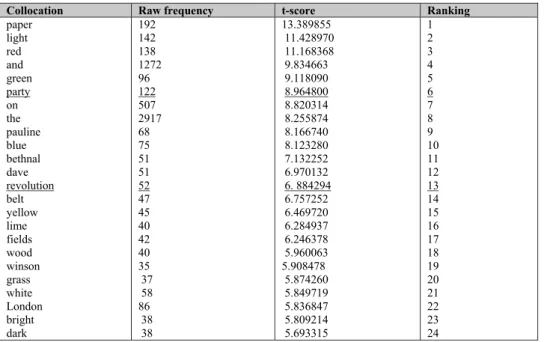
In order to better understand what is happening in the vicinity of the word, a list of significant collocates in both corpora was obtained (Tables 2 and 3 in Appendix 2). The lists highlight the most certain associations: paper (guard corpus, t-score: 13,4) and blue (newsci corpus: t-score: 10,4). However, given my interest in words with potential ideological connotations, I focused instead, for the purpose of exploration, on the words party and revolution, which occur in both corpora. The first observation (see Table 1 below) involves comparing the occurrence of the items in the vicinity of green, in the two respective corpora.
Table 1: Two example-collocates of ‘green’ in the guard and newsci corpus
Corpus Collocate Frequency per million t-score t-score ranking
guard revolution party 122 52 8.9 6.9 13 6 newsci revolution party 13 11 3.4 3.2 19 23
2 The expected frequency is a measure of the likelihood of that item occurring in any given span of text; it is obtained by determining the actual
frequency of the collocate in the corpus as a whole and comparing it to the actual observed occurrence in the given text. For further explanation on how to obtain the mentioned statistical measures, please refer to Hunston (2002, pp. 68-74) and also Barnbrook (1996, pp. 97-100).
In terms of ranking, the two collocates occur more frequently in the guard corpus (6th and 13th respectively, in a rank of 24; versus 19th and 23rd in a rank of 25, in the newsci corpus). This observation could well be explained by the strong politico-social connotations (political party, for instance, and political revolution). In contrast, the much lower rankings of the items in the newsci corpus may be simply explained by the fact that the corpus represents a very different societal domain, i.e. scientific research activities. Nevertheless, the fact that the items are found in both corpora, in the vicinity of the keyword, may indicate that they somehow intersect or possibly interconnect the socio-political and scientific domains. The t-scores of these collocations also give an indication that both items are associated with green, with at least with some certaintyin both corpora, thus deserving a closer look at the nature of their particular collocation.
Referring to the immediate position of these words in relation to green (Pictures 1, 2, 3 and 4 in Appendix 3), the following information can be observed (Table 2 below). It should be clear that the observed total frequencies between the two corpora differ strikingly for these two words, as do the frequencies of the immediate collocation with the keyword. Although the t-scores cannot be compared directly, it also shows that both the t-scores (certainty of association) and MI-scores (strength of association) are significant enough to warrant a closer investigation.
Table 2: Two example-collocates of green in terms of position to the node Corpus Collocate Total frequency Frequency as
collocation t-score MI-score
guard party
revolution 17884 1834 103 50 9.8 7.0 5.1 7.4
newsci party
revolution 484 354 13 10 3.6 3.1 7.4 7.5
4.2 Collocations in context: The politics of green
An additional method of analyzing collocation data, namely concordance line observation, is now presented in order to provide a closer look at the word green in the context of its textual occurrences. Bearing in mind potential linkages to ideology, I chose to focus on the adjectival function, reasoning that green is frequently used to describe the word that follows it, and is utilized in a similar, but metaphorical manner to stress an environmental dimension within the context of the discourse of climate change. In other words, the use of green, in a particular context, could represent a certain way of thinking, or could perhaps be utilized to promote a certain agenda. Following Hunston’s (2002, pp. 42-66) framework for studying concordance lines, a series of comparative observations from some of the incidences are now presented, with specific reference to the distinctions in meaning and the occurrence of patterns.
Based on the data retrieved from the guard corpus (see Pictures 5 and 6 in Appendix 4), the top four most frequent words, arranged according to the certainty of collocation (t-score), are and, paper, light, and party. In the case of the newsci corpus, they are light, and, list and algae. Aside from the (perhaps to be expected) high incidence of the grammatical word and in both corpora, it is also interesting to note that light also frequently occurs as a collocation in both. Briefly comparing the usage of green light in both corpora (Pictures 7 and 8 in Appendix 5), it can be observed that the instances of green light in the newsci corpus mainly provide literal information about its uses in the domain of science (such as research on the refraction of light). In contrast, the most common usage in the guard corpus, is restricted largely to figurative use, as in ‘permission given for a project to go ahead’, in relation to governmental incentives, public works or corporate strategies.
Concerning the use of the lexical items green party (see extracts 1 and 2 below), it can be observed that this collocation occurs twice as often in the guard corpus in comparison to the newsci corpus (3.2 versus 1.6 per million words), again illustrating the difference in the focus of the two corpora.
33 Extract 1: A few concordance lines for green party in the guard corpus
(From 103 total occurrences, or 3.2 per million)
Extract 2: A few concordance lines for green party in the newsci corpus
(From 13 total occurrences or 1.6 per million)
A closer inspection of the concordance lines reveals that in both corpora, green party is capitalized and refers to a political party that appears to be fully functional as a political entity in a number of countries. Words occurring in the vicinity of this lexical item indicates a range of political activities that the party is involved with: there are ‘votes’, ‘supporters’ and ‘polls’; ‘arguments’, ‘campaigns’, ‘opposition to’ and a number of references to spokespersons for the Green Party. In both corpora then, ‘green party’ denotes the activity of a party that concerns itself with a political agenda.
Political activity is by definition a contested terrain, and in the example below the political and societal involvement of green
party on thisideological terrain, is well illustrated by the references made to other ideologies (e.g. pacifism, anti-Europeanism and communism) that it interacts with:
… the leader of the party's left wing, pacifist, less Atlanticist, and critical of Mr Kohl's European integration policies - although not anti-European. He is expected to pursue closer links with the Green party and is soon to break a political taboo by holding talks to seek a modus vivendi with the Party of Democratic Socialism, the successor to the East German communists. Unable to capture the… (guard)
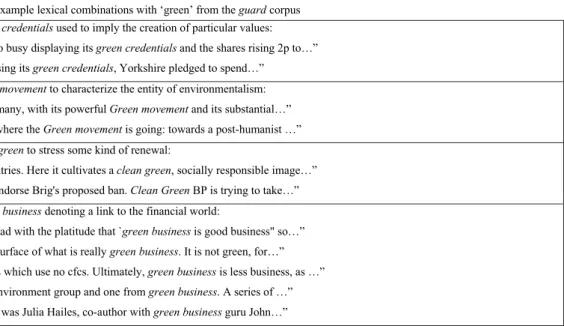
Examples such as these may demonstrate the political dimension of this lexical combination, and it appears to be further supported by similar uses of the word green for example use of the word ‘(capital g) green + s’ (appearing as ‘Greens’) in headlines: “Greens startled as Labour warms to nuclear power” and “Le Monde: Europe's Greens gain new allies” (guard corpus). Following further in this vein, several other examples of lexical combinations with green occur in the corpus:
Table 3: Example lexical combinations with ‘green’ from the guard corpus a. green credentials used to imply the creation of particular values: “…Tesco busy displaying its green credentials and the shares rising 2p to…” “…stressing its green credentials, Yorkshire pledged to spend…”
b. green movement to characterize the entity of environmentalism: “… Germany, with its powerful Green movement and its substantial…” “… It's where the Green movement is going: towards a post-humanist …” c. clean green to stress some kind of renewal:
“… countries. Here it cultivates a clean green, socially responsible image…” “… to endorse Brig's proposed ban. Clean Green BP is trying to take…” d. green business denoting a link to the financial world:
“… instead with the platitude that `green business is good business" so…” “… the surface of what is really green business. It is not green, for…” “… units which use no cfcs. Ultimately, green business is less business, as …” “… an environment group and one from green business. A series of …” “… why was Julia Hailes, co-author with green business guru John…”
The point here is that the co-occurrence of the lexical item with other words, accumulated over large amounts of text, tends to form certain patterns (Hunston, 2002, p. 109). Due to their recurring associative patterns, certain words thus become imbued with a particular meaning, different to their general, or traditional use(s) and intended meaning(s), which may have an alternate significance when understood from within a certain context. Given the backdrop of the discourse on climate change, it is possible to draw some preliminary observations from the very limited analysis of the given lexical item. In the first instance, there are some indications that the word green seems to find itself, with significant recurrence, in the vicinity of a complex ideological conflict around value creation and/or formation between a number of stakeholders, such as corporations, governments, political parties and the environmental movement itself. As was illustrated earlier, green regularly occurs in the vicinity of texts that report on political activity; in fact, it has formally entered modern political realms in recent years in the form of the lexical combination ‘green party’, now a commonly recognized political entity in a number of countries, where it has an overtly stated ideological agenda to promote ecological sustainability of the environment – at least according to the public pronouncements made by this political entity. Given the close partnerships between government and corporate business, coupled with the ongoing competition between nations in securing natural resources on the one hand, and the goals of the environmental movement (in broad terms) on the other, it should come as no surprise that the word green finds itself, in a manner of speaking, on contested grounds, as these various stakeholders try to lay claim to the most palatable public representation of its interests.
To further illustrate the previous point, Table 3 shows a few examples of textual occurrences. The lexical combinations that are formed with words such as clean and stressing its credentials, co-referenced with other words in the vicinity, such as powerful,
substantial and socially responsible, endows the word green with a certain intrinsic value, i.e. that it might be a valuable item to
possess. Use of the verbs displaying and stressing are particularly interesting as it illustrates the emphasis that stakeholders (Yorkshire as a county; Tesco as a supermarket) places on the (re)presentation of this supposed ‘green value’. In addition, the lexical combinations with clean and business are remarkable occurrences of use since business interests have triumphed over environmental interests for decades – in fact, the environmental movement has its roots in the social resistance movements that started in response to environmental disasters caused by irresponsible or unethical business practices. To witness the increasing usage of the word green in the context of ‘big business’ (clean green BP in the example above) is therefore particularly revealing
35
given the oppositional history of the stakeholders involved. Regardless of the conflicting interests represented by these societal forces, and the resultant animosity between them, it seems that forming some sort of association with green in current society increases the chances of a potentially valuable appraisal (from, for example, the public, shareholders, governments), which is well illustrated in examples such as “…the platitude that green business is good business…” as well as those instances signifying the struggle around green credentials. Given these examples, it is ironic (if not tragic) to observe that business interests are again benefiting at the expense of the environmentalist project; this time, it is also – literally – extracting value by mere virtue of association.
Ideological terrain, as pointed out in the first part of this paper, remains contentious. The preceding evidence might lead one to believe that there is only benefit for business through this ‘virtuous association’ with green, i.e. that there might be financial benefit (or perhaps just ensuring financial survival), or, that it might imbue the participant with a certain set of social values it wants to be seen to display. Presumably, as the previous discussion highlighted, these values are an asset that a stakeholder (a multi-national corporation, a government, a political party) would want to obtain or cultivate. This valuation, however, provides only a partial interpretation of the observed usage. Given the sheer number and variety with which the key word green occurs in the corpora under investigation, and that it has been shown to occur frequently in texts that are socio-linguistically contentious and complex, it is further necessary to discuss the semantic prosody contained in this lexical item. Semantic prosody ‘…usually refers to a word that is typically used in a particular environment, such that the word takes on connotations from that environment’ (Hunston, 2002, p. 142). One of the features of semantic prosody, relevant to our purposes here, is that it can be used ‘… to hint at a hidden meaning, or can reveal a speaker’s hidden attitudes’ (Hunston, 2002, p. 141, citing Louw, 1997). As such, it can account for a certain ‘connotation’: the sense that there might be an implied, additional meaning to the use of a particular word, a meaning that is often evaluative – that is, it can be positive or negative (Hunston, 2002, p. 142).
Earlier points in this discussion drew attention to the potentially ‘virtuous association’ with green, i.e., that such an association might be of benefit to a stakeholder. We can thus assume that in some instances the keyword green would display a positive semantic prosody, as in: “…pride themselves on their green credentials…”; “…impeccable green credentials…” (Table 4 below); or, “…green business is good business…” (Table 3 above). This valuation, as the concordance lines illustrate, might alternatively assume very different meanings or connotations. For example, in other occurrences, we read that “…green business is less business…”, and “…their supposedly green credentials…” examples that either hint at a more negative estimation of the association, or cynically, that the projected image should not necessarily be accepted at face value. These examples appear in contrast to the earlier – mostly positive – associations with the keyword, yet they also confirm its potentially evaluative and connotative properties. Further examples illustrate that the implied meanings for this keyword shift continuously, and demonstrate the potential for semantic prosody that a lexical association with green can engender. Consider again the usage in association with green credentials (Table 4 below). One reads that both products and people can have green credentials that can be ‘advertised’, ‘recognized’ or ‘re-established’ – i.e., as the word credentials implies, green has an intrinsic value that might be exploited in some way, that can (or should?) be noticed, and might also be lost or can be rehabilitated (it takes time to become ‘established’ as a green entity, and one needs to protect such an acquired status). And further, that one could take ‘pride’ in having green credentials, implying that these credentials would also be open to scrutiny and could therefore invite judgment from an audience (and in current society, this has potentially far-reaching implications: thanks to modern media, the audience is now global). The implication is that green carries with it a potential that can incur a valuation or judgment that might change over time or shift in relation to changing contexts.
Table 4: Example lexical combinations with ‘green’ from the newsci corpus a. green credentials
“…logo recognizing a product’s green credentials. The logo is in the…” “…need to re-establish my green credentials before I am permanently…” “… basis of their supposedly green credentials. The strategy has been…” “…level, he has impeccable green credentials as a cyclist and would-be…” “…pride themselves on their green credentials, are the most…”
b. green movement
“…consumer movement or by the green movement. Old cars are…” “…coming also from the Green movement which argues that we should…” “…almost no one outside the green movement shares the aim of…” “…criticizes the green movement, saying it does not always…” c. clean green
“…system and make it a world standard. Clean green rockets US Naval…” “…The dream of clean green electricity from the ocean…”
“…simple way to turn it into a clean, green fuel…” “A clean, green power machine” (headline)
“…simple way of turning diesel into a clean, green fuel…” d. green business
* no instances found
In contrast to the analysis of the guard corpus, a very brief look at the same lexical combinations in the newsci corpus (see Table 4) reveals that the high frequency occurrences of green credentials reflect a similar preoccupation with values, and that green
movement (the umbrella term for the modern political ideology that aims to create a ecologically sustainable society), based on the
re-occurring instances of use, also emerges as a prominent stakeholder in this corpus. In view of the earlier discussion regarding the prevalence and particular usage of the keyword green in corresponding instances, the similarity of these findings in a different corpus can be taken as further support for the keyword’s contentious textual appearance. In contrast, there appears to be a shift regarding the emphasis of the occurrences of clean green in the newsci corpus, where the lexical combination is followed by the nouns rocket, electricity, fuel, and power machine. This emphasis appears to accentuate the applications of (green) energy, which could be assumed given the focus of the corpus. Regardless of the different focus of this corpus, what again seems clear from looking at some of the co-occurrences in relation to the keyword, is that a lexical association with green carries with it a certain value-laden potential, that can shift over time and depends on certain contextual features for its meaning. Similar to the examples highlighted in the guard corpus, it seems, therefore, that an association with green could potentially add positive value to a significant number of lexical items in the keyword’s vicinity – and, by implication, also to their ‘collaborators’ (i.e., those entities that gain by virtue of association). In short, it seems possible for a stakeholder to gain access to a very powerful socio-political and financial ideological framework merely by virtue of association with the word green. Although earlier discussion highlighted that this association might be quite positive for a stakeholder, the fact that the keyword was also shown to display features of negative semantic prosody implies that its influence might vary significantly across contexts and intended use. The assertion that ‘being green is valuable’ would therefore have to be borne out by further probing and research across additional corpora and using a larger sample of data.
5. Conclusion
Using a critical linguistics framework, this short paper presented a limited corpus investigation of the occurrence of the lexical item
37
the chosen keyword potentially functions as a key to discursive activity within the frame of the discourse on climate change. Findings from a brief quantitative analysis suggested limited but significant statistical evidence that the chosen keyword is operative in both the corpora investigated, where it occurred frequently with other items that signified socio-political and/or socio-economic activity. Slight differences observed in the frequency and manner of occurrence with other items reflected corresponding differences in the scope and focus of the respective corpora.
A limited qualitative analysis, aided by an analysis of the collocations of the keyword, explored some of the political and social dimensions found in association with the lexical item green. Further to the frequency of socio-political associations that the quantitative analysis revealed, the investigation also indicated that the keyword green consistently occurred in the vicinity of other ideological constructs, most strikingly appearing in conjunction with the textual activities or events that involved value creation and/or maintenance. More specifically, a preliminary impression from this investigation indicated that green could potentially signify the addition of a particular social and/or financial value for the associated entity (whether an institution, company or person). This potential value of being green was further observed to be potentially controversial, given a number of instances of semantic prosody and the tone and level of socio-political content being expressed by the surrounding text.
The present analysis thus provides initial evidence, as far as the two mentioned corpora are concerned, that the word is significantly involved at linguistic sites where certain primary constructs in the discourse on climate change operate. These involve the intersections between science, politics/governance, business and the environmental movement itself. Findings thus indicate and provide support that the item green, lexically speaking, found itself consistently and importantly, in terms of the discursive analysis here, in the conceptual vicinity of ideologically contested grounds. Based on this brief investigation it is not possible to state, in general, that the chosen keyword green functions as a ‘cultural keyword’ (Stubbs, 1996) in the wider discourse; this would require larger samples of data across different corpora. However, I would argue that with further investigation, it would, for instance, be possible to prove that the lexical item green has become the ‘poster-word’ for the whole discourse on climate change. The present study has, however, delivered suitable linguistic evidence to support the notion that being green has value. The fact that this was shown to be a contested value certainly provides an impetus for further investigating the discursive role of language in society.
References
Barnbrook, G. (2006). Language and Computers: A practical introduction to the computer analysis of language. Edinburgh: Edinburgh University Press.
Bednarek, M. (2009). Corpora and Discourse: A Three-Pronged Approach to Analyzing Linguistic Data. Selected Proceedings of the 2008 HCSNet workshop on Designing the Australian National Corpus, ed. Michael Haugh et al., 19-24. Somerville, MA: Cascadilla Proceedings Project.
Fairclough, N. (2001). Language and Power. London: Pearson Education.
Grundmann, R. and Krishnamurthy, R. (2010). The Discourse of Climate Change: A Corpus-based Approach. Critical Approaches
to Discourse Analysis across Disciplines Vol. 4(2), 113-133.
Hunston, S. (2002). Corpora in Applied Linguistics. Cambridge: Cambridge University Press.
Koteyko, N. (2010). Mining the Internet for linguistic and social data: An analysis of ‘carbon compounds’ in Web feeds. Discourse
and Society, Vol. 21(6), 655-674. Retrieved November 14, 2013, from http://das.sagepub.com/content/21/6/655
Koteyko, N., Thelwall, M. and Nerlich, B. (2010). From Carbon Markets to Carbon Morality: Creative Compounds as Framing Devices in Online Discourses on Climate Change Mitigation. Science Communication 32(1), 25-54. Retrieved December 27, 2013, from http://scx.sagepub.com/content/32/1/25
Stubbs, M. (1996). Text and Corpus Analysis. Oxford: Blackwell Publishers Ltd.
Teubert, W. (2005). My version of corpus linguistics. International Journal of Corpus Linguistics 10(1), 1-13. Retrieved January 11, 2014, from http://www.corpus4u.org/forum/upload/forum/2005071006505939.pdf
Weingart, P., Engles, A. and Pansegrau, P. (2000). Risks of communication: discourses on climate change in science, politics and the mass media. Public Understanding of Science, Vol. 9(3), 261-283.
39 Appendix 1
Table 1: Frequency data for green in the Bank of English
Corpus Total number of occurrences Average number per million
words brmags brephem usephem brbooks guard newsci indy times oznews strathy usbooks sunnow usnews npr wbe econ brspok usacad bbc usspok 11309 1054 733 6970 5184 1265 4237 7772 5232 2046 3903 5315 861 1821 786 1253 1382 340 922 36 256.1 227.1 209.1 160.7 160.6 160.2 150.9 149.8 149.7 128.5 120.3 118.8 86.1 81.9 81.5 79.7 68.8 53.6 49.6 17.8 Appendix 2
Table 1: Collocations list for green in the guard corpus: t-scores
Collocation Raw frequency t-score Ranking
paper light red and green party on the pauline blue bethnal dave revolution belt yellow lime fields wood winson grass white London bright dark 192 142 138 1272 96 122 507 2917 68 75 51 51 52 47 45 40 42 40 35 37 58 86 38 38 13.389855 11.428970 11.168368 9.834663 9.118090 8.964800 8.820314 8.255874 8.166740 8.123280 7.132252 6.970132 6. 884294 6.757252 6.469720 6.284937 6.246378 5.960063 5.908478 5.874260 5.849719 5.836847 5.809214 5.693315 1 2 3 4 5 6 7 8 9 10 11 12 13 14 15 16 17 18 19 20 21 22 23 24
Table 2: Collocates for green in the newsci corpus: t-scores
Collocation Raw frequency t-score Ranking
blue light red <h> list algae and </h> yellow waste paper colour oxford green groups lights college dark party bright says revolution brown amber 110 91 77 64 35 27 303 45 22 21 21 19 17 16 17 13 15 14 13 12 55 11 12 10 10.387748 8.825472 8.546790 6.418221 5.721944 5.121899 5.062160 4.821822 4.604604 4.131390 4.054747 4.051888 3.817812 3.594621 3.508788 3.482187 3.478139 3.444295 3.433482 3.234681 3.193150 3.179809 3.135513 3.092557 1 2 3 4 5 6 7 8 9 10 12 13 14 15 16 17 18 19 20 21 22 23 24 25 Appendix 3
41 Picture 2: The word revolution in the newsci corpus
Picture 4: The word revolution in the guard corpus
Appendix 4
43
Picture 6: The most frequent collocates of green in newsci corpus: t-scores
Appendix 5