<論 文>
Cultivating ASEAN Citizenship in the Cambodian
Educational Experience:
ASEAN Integration, Challenges and Contradictions
HAGAI, Saori * & OGISU, Takayo **
Abstract
This paper is concerned with the Cambodian government s attempt to promote ASEAN citizenship through social studies textbooks at the level of basic education. We argue that the challenges and contradictions that arise in the teaching of the concept of ASEAN are linked to the uneasiness felt when one is compelled to adopt a dual sense of citizenship - the traditional sense of Cambodian citizenship and new emerging norms of ASEAN citizenship. When Cambodia joined ASEAN at its last member state in 1999, it sent a clear message that the government was seeking a return to the regional and international community after 30 years of political turmoil. This political reappearance was necessary to regain trust and invite official development assistance for the purpose of rebuilding the country. Membership in the regional and international community, however, also implied taking on certain responsibilities.
Keywords: ASEAN integration, ASEAN regional identity, post-conflict, citizenship
education, Cambodia
* Associate Professor at Ritsumeikan International, Ritsumeikan University. ** Assistant Professor at Graduate School of Education, The University of Tokyo.
1. INTRODUCTION
Cambodia joined ASEAN as the last member state on 30 April 1999, a day which marked the final step for the Cambodian government in its struggle to return to the regional and international community after 30-years of political turmoil. Since then, Cambodia has been comprehensively drawn into the frameworks of the ASEAN charter, as well as associated conventions and agreements in the political, economic, and socio-cultural domains. Education is not an exception. ASEAN established the ASEAN Education Ministers Meetings or ASED in 2005 as a new mechanism to inspire ASEAN integration by promoting cultivation of ASEAN citizenship. Cambodian education invariably started to be influenced by the decisions made at ASED. By allowing these new political dependencies, Cambodia has indicated its willingness to submit to the regional and international community in order to regain trust, attract investments and attract official development assistance from donor countries for the purpose rebuilding the country. In such an arrangement, it is not surprising that Cambodia would agree to new responsibilities and strive to make its own contributions to ASEAN countries. In the give and take relationship with ASEAN, the benefits and duties come packaged, leaving national agencies such as the Ministry of Education, Youth and Sports (MOYES) with the awkward obligation of conceiving of, and inculcating ASEAN values . This paper is primarily concerned with the Cambodian government s attempt to fulfil its responsibilities by promoting ASEAN awareness through the medium of social studies textbooks at the level of basic education. We argue that the challenges and contradictions that arise in teaching the basic concept of ASEAN are linked to the uneasiness felt when one is compelled to adopt a dual sense of citizenship - maintain the traditional sense of Cambodian citizenship while integrate new emerging norms of ASEAN regional citizenship.
Before embarking on this challenge directly, we would like to define a provisional concept of citizenship. According to Delanty (2000), the concept of citizenship is divided into two types: the first denotes nationality as a standard for the nation-state, and is profoundly connected to rights, responsibilities, social engagement and identity (Delanty, 2000, 11). The second refers to the citizen in the context of civil society which goes beyond the framework of the nation state. In EU member countries, it is not unusual to see nationals living alongside others from different member states in addition to migrants and exchange students. The question of how to integrate these people, while treating these diverse citizens equally, is an important one. The concept of citizenship in this context holds a
meaning closer to a human right than nationality (Kitayama, 2014, 3). This article adopts this broader meaning of citizenship, unfettered by questions of nationality.
Understanding how such a wide concept can be applied in the ASEAN context can be informed by past experiments in national citizenship education. The origin and definition of citizenship education in Europe differs from country to country and has continued to evolve against a backdrop of different social phases. In Germany, it was developed as the core of the traditional subject of political science, the beginnings of which can be traced back to the 17th century (Kondo, 2007, 114). In France, it is understood that the interest in citizenship education which continues today began in the mid-1980s. In the UK, citizenship was introduced into the National Curriculum in 2002 as a compulsory topic. Since then, citizenship education has been promoted as a framework for integrating citizens of diverse backgrounds, including race, ethnicity, religion, gender, sexual orientation, disability and so on (Kitayama, 2014, 7-8). Respect for diversity, or the notion that members of society previously not included should no longer be excluded, forms the core of citizenship education (Hashizaki, 2015, 189).
Beyond Europe, increased interest in citizenship education has also emerged in ASEAN. In Thailand, social, religious and cultural studies became a compulsory topic of study within the core curriculum in 2001. This covers the duties of a good citizen in addition to social ethics and logic (Hirata, 2010, 186-188; Morishita, 2010, 210). Similarly, Malaysia introduced a subject called civics and citizenship education in 2005 (Teshima, 2013, 135-137). For Malaysia, as a plural society composed of Malay, Chinese and Indian ethnic groups, fostering a sense of citizenship which transcends these different communities sense of belonging is crucial. The growth and development of citizenship education has, however, not been consistent throughout ASEAN. In Cambodia, there is no school subject which deals solely with topics directly related to citizenship education. However, in response to the grave human rights violations committed by the Communist Party of Kampuchea under Pol Pot in the 1970 s, including execution, forced labor, interrogation, torture and rape, the inculcation of concepts such as peace and democracy could no longer be seen merely as marginal topics of interest, but rather critical issues in Cambodia. This priority has led to their more comprehensive coverage in civics, history, geography and the local life skill program (Hagai, 2013, 166-174; Kaizuka, 2014, 9-11; Kitamura, 2015, 135). Clearly, if the urgency to use education as a tool for social progress is felt, the capacity in public institutions is sufficient to realize an undertaking such as citizenship education.
on national education in Cambodia. Firstly, this paper addresses the recent education trends and challenges Cambodia faced when compelled to integrate new norms of ASEAN citizenship while maintaining the traditional sense of Cambodian citizenship. Secondly, this paper attempts to analyze the how these two formulations of citizenship are inculcated through social studies textbooks at the level of basic education.
2. METHODOLOGY
The data and insights in this article are based on our field research; the original research was conducted by Takayo OGISU and Fata NO (World Bank Officer, local research collaborator) in September 2016 for a week s duration in Phnom Penh. Methodologies adopted during that time included document collection and curriculum analysis. Semi-structured interviews with government employees at MOYES, along with academics and officers at an international organization were also a part of the research. The interviews with the government officials at MOYES covered a wide range of departments; Information and ASEAN Department, Primary Education Department, General Secondary Education Department, Teacher Training Department to give ideas which department has responsibilities with ASEAN related matters within MOYES. The follow-up field research was carried out in March 2017 by Saori HAGAI for a week in order to continue interviews with stakeholders, collect the latest textbooks and begin analysis of the textbook. During this time, textbooks used for primary education were purchased at the MOYES Printing Office.
William (2014) suggests that the school textbook is a medium for the transmission of social content and this is made apparent through textbooks covering history and social studies, which can leverage civics and geography as an instrument of the state (Williams, 2014, 1). Previous research has revealed that, historically, Cambodian male students learned civic, moral and religious values in wat (pagoda) schools and, as a school subject, civic and moral education was a tool used by political leaders to transmit their political ideologies and consolidate their power (Tan, 2008, 562). Some of the major components that make the textbook distinct from other types of books̶novels, drills, dictionaries and encyclopedias̶are (a) systematic organization and repetitiveness of contents (when to learn what topics is precisely decided and the content is often repeated), (b) anonymity of the author s scholarly orientations (usually MOEYS forms a writing committee which is expected to follow composition guidelines authorized by the Ministry thus it is usually
difficult to ascertain individual author s personality or academic perspectives) and, most importantly, (c) mandatory usage of textbooks, especially if a particular nation or state adopts an only government–designated textbook. Cambodia serves as an example of this mechanism presented above since there is a free provision of textbooks across all subjects; which, in return, helps to reach all pupils attending state schools across the Kingdom (elementary 6 years and upper secondary 3 years). Under this scheme, textbooks are considered the primary medium of instruction, such that individual teachers have little discretion in their selection of class materials. In this sense, school textbooks play a critical role in the ongoing (re)definition of nation and state, the linking of the state with the nation, the inculcation of the belongingness to the nation in the minds of the young, and the creation of citizens in a more general sense (Williams, 2014, 1).
How textbooks are produced is important to mention here, regarding the textbook production process, textbooks from primary education to upper secondary education have been reviewed and revised once in ten years in line with each education reform that is also taken place in once in a decade. Department of Curriculum Development in MOEYS first begins with an initiative to design the curriculum and syllabus framework. Based on that framework, the publishing and Distribution House of MOYES is responsible for recruiting intellectuals from the ministry, universities and other higher education institutions to undertake the initial writing of a textbook. The newly revised textbooks will be sent back to Department of Curriculum Development for further review and editing. The final process is conducted at the publishing and distribution house where mass printing starts and succeeded by distribution. The biggest challenge that MOEYS normally faces, however, is budgeting. It is relatively easy to develop the curriculum framework of textbooks but to secure adequate funding to fulfill the tasks associated with production and distribution is a daunting mission. The lack of budget for purchasing enough printing papers, deploying personnel to distribute them across the country and renting warehouses to store them until final delivery is a critical issue. Having said that, this is not an exclusive issue to Cambodia; in fact, Sakurai (1999) pointed out that most underdeveloped countries such as Iran in Middle East have encountered similar issues due to a lack of budget, human resources, technology and logistical management skills (Sakurai, 1999, 16).
Therefore, distributing new textbook revisions ultimately face a significant lag time. For instance, a grade 6 social studies textbook, which we examine in more detail later in this chapter, represents this issue clearly. This textbook that was finally approved by MOEYS in 2011 was originally envisioned in the 2005 curriculum development reform. The textbook
revision process began with grade 1 in 2007, and proceeded to grade 2 in 2008, grade 3 in 2009, grade 4 in 2010, and grade 5 in 2011. The grade 6 textbook composition was therefore only finished in 2011; even then, it was only printed in 2016. As mentioned above, one can assume that the primary reason for this additional 5-year of delay is shortage of funding for printing, as well as the inevitable correction of some errors. It should therefore not be surprising that adding any new content, especially controversial social topics, further complicate a process of producing textbooks that is already both politically and technically contentious.
3. RECENT EDUCATION TRENDS AND CHALLENGES IN CAMBODIA
In order to explore the impact of ASEAN in Cambodian basic education, our team analyzed the medium-term education strategies and the current basic education policies. Interviews with administrators of MOEYS and projects was also a part of our research. One of the most important results of our research was that we could not identify any substantial or direct impact of ASEAN integration on Cambodian basic education, in both mid-term plans and recent policies. This can largely be attributed to the unavoidable global influence on Cambodian education, UN Convention on the Rights of the Child, Education For All (EFA), Millennium Development Goals (MDGs) and Sustainable Development Goals (SDGs). These agencies are among the most influential global agendas and have forcefully and intentionally been incorporated into the national development scheme, based on which Cambodia s long- and mid-term education strategies are developed. In fact, the five-year education guideline Education Strategic Plan 2014-2018 or ESP, clearly reflects both national and global development agendas, not only regional ones. Once the lack of adequate human capital was pointed out in the national development strategy Socio-Economic Development Plan V (2014-18) which was deemed to hinder industrialization and economic development of the country, ESP immediately stressed the equitable access, the quality and relevance of learning and effective leadership education that resonated with EFA and Goal 4 of SDGs. In contrast, regional initiatives such as ASEAN do not seem to have the significance on Cambodian education, with the exception of the higher education sub-sector that works towards aligning its quality assurance system with ASEAN s Quality Assurance Framework for Higher Education. Therefore, it is quite difficult to find documentation solely mentioning regional initiatives, such as education for ASEANness proposed by the ASEAN Socio-Cultural Community or ASCC. That being said, ESP briefly
mentions ASEAN integration in the comparative context where Cambodia is compared to other ASEAN members to justify that the increasing investments in education is necessary.
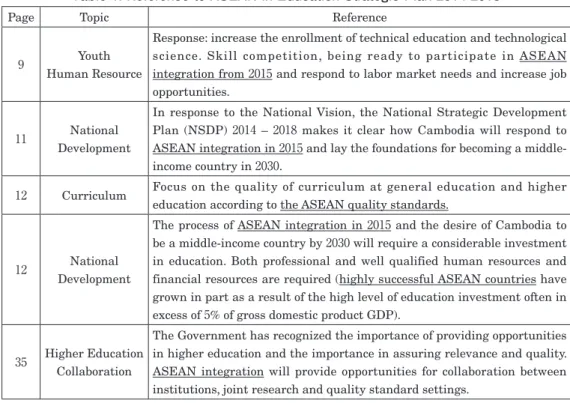
As shown in Table 1, the ASEAN standard is described mostly as a theoretical goal, rather than a binding agreement, to which Cambodia hopes to eventually catch up with other member states at some point in the future. In this regard, the Chancellor of Pannasastra University of Cambodia, Sam-Ang Sam provides similar comments:
It does not make much sense that we try to compare and compete with Thai higher education system, for example. Thailand has its own history and process of development, and no one can just catch up with it in a short period of time. My university understands that ASEAN higher education standard is a benchmark. If the significant number of Cambodian high school students for instance, will choose Thai or Singaporean universities, that reflects something is missing in our education in Cambodia. This suggests that we, educational decision-makers must improve curriculum, instructional designs, classroom organizations, and on campus student s activities. ASEAN standard is a wake-up call for us, not a threat, and an opportunity for educational improvements which accelerates internal drive toward the education quality reform in Cambodia1).
Table 1. Reference to ASEAN in Education Strategic Plan 2014-2018
Page Topic Reference
9 Youth
Human Resource
Response: increase the enrollment of technical education and technological science. Skill competition, being ready to participate in ASEAN integration from 2015 and respond to labor market needs and increase job opportunities.
11 National Development
In response to the National Vision, the National Strategic Development Plan (NSDP) 2014 – 2018 makes it clear how Cambodia will respond to ASEAN integration in 2015 and lay the foundations for becoming a middle-income country in 2030.
12 Curriculum Focus on the quality of curriculum at general education and higher education according to the ASEAN quality standards.
12 National Development
The process of ASEAN integration in 2015 and the desire of Cambodia to be a middle-income country by 2030 will require a considerable investment in education. Both professional and well qualified human resources and financial resources are required (highly successful ASEAN countries have grown in part as a result of the high level of education investment often in excess of 5% of gross domestic product GDP).
35 Higher Education Collaboration
The Government has recognized the importance of providing opportunities in higher education and the importance in assuring relevance and quality. ASEAN integration will provide opportunities for collaboration between institutions, joint research and quality standard settings.
36 Higher Education Curriculum
Enhance curriculum diversification and priority programs with ASEAN standards (engineering, architecture, medicine, dentist, nursery, accountant, tourism and profession).
37 Higher Education Curriculum
Curriculum development and instructional design: develop curriculum based on labor market needs and focus on analytical skills, problem solving, group work, communication and indicators for ASEAN priority curriculum standard.
54
Higher Education Quality Assurance
Encourage the establishment of mechanism and self-evaluation processes among higher education institutions based on the defined standard, especially ASEAN priority programs.
61 Youth
Awareness
Creating forums between youth and industries, mainstreaming entrepreneurship, promoting Information Technology, cultural science and sport, promoting awareness and preparing for the 2015 ASEAN integration, national and international cooperation, and building youth networks.
Source: Created by authors based on Education Strategic Plan 2014-2018 and emphasis added by authors.
4. ASEAN REPRESENTATION THROUGH THE CAMBODIAN CURRICULUM
FRAMEWORK
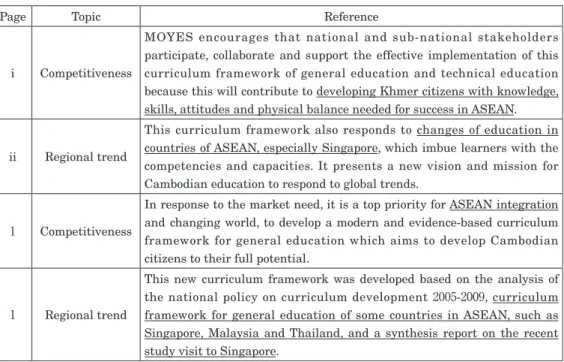
To identify the impact of ASEAN on the Cambodian national curriculum, the Curriculum Framework of General and Technical Education was analyzed (Table 2). This framework was developed in 2015, reflecting the ministry s commitment to improve the quality of education. In this process, MOYES, in fact, used the Singaporean, Malaysian and Thai curricula as a reference. These countries often have good reputations for curriculum development as they are the most developed members in the region; Singaporean curriculum is, in particular, identified as the most successful model. In fact, MOYES sent a curriculum investigation committee to Singapore for further research on curriculum development. Thanks to interconnectivity among the member states within the region, it allowed MOYES to observe the essential educational agendas - human rights and sustainable development, and set the new ASEAN standardized goal. Given that these terms have never been appeared in the previous curriculum guideline which was Policy for Curriculum Development 2005-2009, this framework clearly pays keener attention to the contribution of ASEAN integration.
-Understanding of human rights as responsible citizens as an individual and a member of a family, community, society, region and the world.
culture, national identity and environment of the nation, the region and the world that contributes sustainable development and ensures partnership and love with humankinds.
Table 2. Reference to ASEAN in Curriculum Framework
Page Topic Reference
i Competitiveness
MOYES encourages that national and sub-national stakeholders participate, collaborate and support the effective implementation of this curriculum framework of general education and technical education because this will contribute to developing Khmer citizens with knowledge, skills, attitudes and physical balance needed for success in ASEAN.
ii Regional trend
This curriculum framework also responds to changes of education in countries of ASEAN, especially Singapore, which imbue learners with the competencies and capacities. It presents a new vision and mission for Cambodian education to respond to global trends.
1 Competitiveness
In response to the market need, it is a top priority for ASEAN integration and changing world, to develop a modern and evidence-based curriculum framework for general education which aims to develop Cambodian citizens to their full potential.
1 Regional trend
This new curriculum framework was developed based on the analysis of the national policy on curriculum development 2005-2009, curriculum framework for general education of some countries in ASEAN, such as Singapore, Malaysia and Thailand, and a synthesis report on the recent study visit to Singapore.
Source: authors (emphasis added by authors)
5. ASEAN NARRATIVE IN THE CAMBODIAN SOCIAL STUDIES CONTEXT
According to the Curriculum Framework of General Education and Technical Education in Cambodia, the purpose of social studies is to strengthen and expand the ability of learners to be accountable citizens2). To be more precise, MOEYS reveals what it takes to
be an accountable citizen by setting goals that social studies learners will acquire knowledge and skills related to tradition, customs, environment, history, geography, laws and politics of Cambodia and those of other countries in the region (MOEYS, 2015, 5-6). The second goal is to love the nation, natural environment, religion and king as educated and responsible citizens and be proud of their nation while holding respect of other nations and religions (MOEYS, 2015, 5-6). The ministry has aspirations that the young Cambodians should aim to be responsible residents with a sense of national pride while simultaneously respecting other countries in Southeast Asia, along with the rest of the
world.
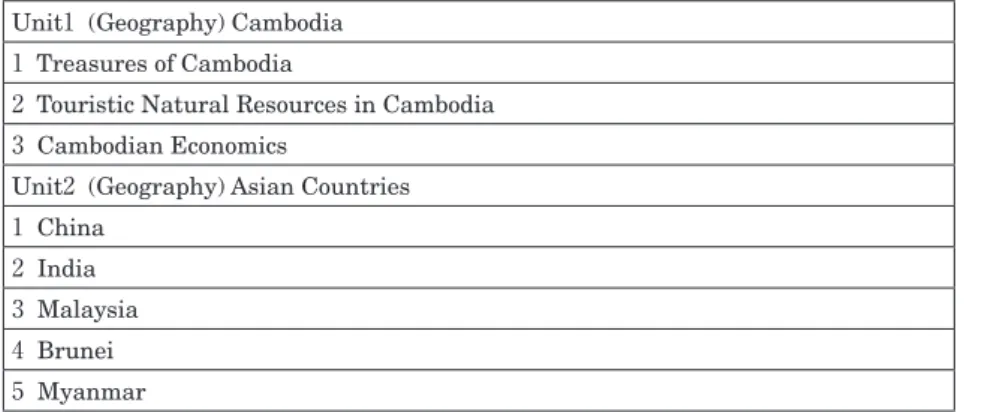
By skimming the tables of contents shown here (Tables 3 and 4), a logical pattern for the flow of these textbooks emerges; Unit 1 and 2 mainly deal with relatively small-scale issues and individual duties such as greetings, hygiene matters (grade 2) and proper behavior (grade 6). Unit 3 and 4 on the other hand, cover slightly larger scale of issues, such as community (grade 2) and society (grade 6). One important characteristic of these textbooks is that Cambodia-related topics are comprehensively covered, but no regional studies or international issues are directly integrated. Once pupils become a bit older, such as can be seen for grade 9 (see Table 5), a clear shift in direction of textbook structure can be observed in which Cambodia-related topics and ASEAN/world issues are more equally arranged. Geography, history, moral-civics and home economics are the main four components of the grade 9 social textbook. Here, relative geographic location, historical development, political profiles and everyday customs of most ASEAN states (Laos and the Philippines are missing while China and India are included) receive attention. More importantly, one may also find an organizational overview of ASEAN, the role of the international community, UN, democracy and world history. Compared to the grade 2 and 6 (Tables 3 and 4), an intention for 9th graders to broaden their horizons outside of the
Kingdom can be clearly discerned in the structure of their textbook; despite this shift, however, the topics still tightly corresponded to the educational goals of MOYES described in the Curriculum Framework of General Education and Technical Education. The category of home economics, however, demonstrates its own distinctive feature, namely a focus on practical skills related to food, textiles and craft, at both the individual and collective (family, society) scale. In this section, it is not surprising that students are also expected to gain additional values and skills within Khmer culinary arts, Cambodian tailoring and Cambodian dressing etiquette.
Table 3. Grade 2 Science and Social Studies Integrated Textbook (2016)
Unit 1 Good behavior for your happiness and good health
1.Greetings
2.Hygiene and taking care of teeth 3.My job
4.Hygienic meals 5.Good behavior at school
6.Good behavior on the way to school 7.Safety management around water 8.Avoiding dangers
Unit 2 People, animals and plants 1.My family
2.Food 3.My crops 4.My livestock 5.Animals
Unit 3 My community 1.My school in the village
2.My school and history of the village 3.Working together with friends 4.Dancing
5.Studying
Unit 4 People arounds us 1.The king and the government 2.Things around us
3.Things in the sky
Source: translated Khmer social studies textbooks by authors
Table 4. Grade 6 Social Studies (2016)
Unit 1 Good behaviors 1.A well-regulated life
2.Good behavior and their values 3.Rights and responsibilities 4.Arts and creativity
Unit 2 Good behavior that brings happiness 1.Avoiding accidents
2.Traffic accidents
Unit 3 Current life style in our society 1.Song and dance
2.National traditional festivals 3.Professional Unions and Associations 4.Law
5.Capital city in our nation Unit 4 Past life style in our society 1.Traditional music instruments 2.Chaktamuk Period
3.Longvek Period 4.Old capital at Oudong
Source: translated Khmer social studies textbooks by authors
Table 5. Grade 9 Social Studies (2016)
Unit1 (Geography) Cambodia 1 Treasures of Cambodia
2 Touristic Natural Resources in Cambodia 3 Cambodian Economics
Unit2 (Geography) Asian Countries 1 China
2 India 3 Malaysia 4 Brunei 5 Myanmar
Unit1 (History) War and organizations helping to restore peace 1 World War 1 (1914-1918)
2 Peace in the nation 3 World War 2 (1939-1945) 4 United Nations 5 ASEAN
Unit2 (History) Cambodian history 1 French Colonization (1863-1953)
2 People s Socialist Community (1955-1970) 3 Khmer Republic (1970-1975)
4 Democratic Kampuchea (1975-1979)
5 People's Republic of Kampuchea (1979-1993) and the Kingdom of Cambodia (1993-) Unit3 (History) History of countries in the region
1 Indonesia 2 Malaysia 3 Singapore 4 Thailand 5 Vietnam
Unit1 (Moral-Civics) How to work with neighbors 1 Respect our neighbors
2 Khmer customs
3 Khmer traditional festivals
4 Good communication with your friends 5 Good communication with your family Unit2 (Moral-Civics) Living in the community 1 Solving problems with the international community 2 Understanding democracy
3 Neutrality 4 Leadership 5 Occupation
Unit1 (Home economics) Cooking 1 Meat
2 Chicken Rice
3 Stir-fry chili or stir-fry lemongrass 4 Raw-beef salad
5 Bean dessert
Unit2 (Home economics) Sewing 1 Lubrication for a sewing machine 2 Khmer skirt tailoring
3 Sewing machines 4 Knitting
Unit3 (Home economics) Clothing 1 Clothing and your body size 2 Dressing
3 Other people
Source: translated Khmer social studies textbooks by authors
6. THE CHALLENGES AND CONTRADITIONS IN THE TEACHING OF ASEAN
(1) Traditional Sense of Cambodian Citizenship
Throughout ESP, MOEYS defined its mission to develop human resources, with a broader intention of developing a knowledge-based society that responds to ASEAN integration while laying the foundation for becoming an upper-middle income country by 2030. How do social studies contribute in helping MOEYS achieve its goal of instilling a sense of national and civic pride, high moral and ethical standards and a strong belief in young people s responsibility for the country and its citizens? How is national identity, which firmly adheres to the principles of multi-party democracy and shows respect for human rights and dignity, possibly fostered? Situated within Cambodia s social, cultural and political realities, the successful promotion of a traditional sense of citizenship within the nation has long been emphasized, especially after the period of national destruction by the Khmer Rouge under Democratic Kampuchea a.k.a. the Pol Pot Regime. It was extremely crucial in 1979, when the genocidal period was finally over, for the new government to reconstruct the nation by drawing on the notion of the collective suffering and by eventually fostering a post-survivorship constituent of society3). The mass grave of
Choeung Ek, also known as the killing field, and the genocidal museum- Tuol Sleng, were designed during this period as visible proof of the atrocities committed by Khmer Rouge. This contrasts with their memorial design concept by which the dead remain anonymous, with no names or individual stories to experience (Emde 2013, 30). Anonymity was considered a strategic necessity adopted to wipe away personal remembrance for the sake of a clean slate and unified nation-building (Hagai, 2010).
In this process, one of the essential roles that education played was the cultivation of patriotism and loyalty based on a nation-state framework (Hagai, 2017, 74; Hagai et al, 2017, 71). This is illustrated, for example, when Khmer classical dance, thought to be enduring from the Angkor dynasty era, is described in social studies textbooks. Khmer classical dance is repetitively taught in social studies and Khmer language, not within
physical education. This suggests that physically learning or practical skills to master the dance is not the final goal of their education, but rather, understanding the cultural significance of Cambodian classical dance is emphasized to enhance the sense of national and civic pride or patriotic sentiment which are deemed to be shared among the survivors (Hagai, 2009, 143-174).
(2) New Emerging Norms of ASEAN Citizenship
The ongoing process of Cambodian nation-building and reconciliation, which has been slow and contested due to the destabilization caused by the Khmer Rouge, now faces the additional challenge of implementing civic education associated with ASEAN membership. Consequently, attempts in recent years to familiarize young people with new norms of ASEAN citizenship have only slowly progressed, and the extent to which an ASEAN identity has been internalized remains questionable. Nevertheless, this slow progress not only Cambodian, but also broader regional uncertainties about how to conceive of a new regional form of mutual identity. To begin with, the general term ASEANness is relatively a new concept, having been only formally elaborated in 2009, at the Fourteenth ASEAN Summit. The process began with the aim of enlisting co-operation from ASEAN member nations to ensure political stability within the region, promote economic growth and encourage sociocultural exchange. At the summit, plans adopted in relation to sociocultural development promulgated a program of Education for ASEANness meant to diffuse a shared sense of regional education and identity.
The ASEAN Vision 2020, which charts a future direction for ASEAN as a concert of Southeast Asian nations, outward-looking, living in peace, stability and prosperity, bonded together in partnership in a just, democratic, and harmonious environment, dynamic development and ever-closer economic integration and in a community of caring societies, conscious of its ties of history, aware of its shared cultural heritage and bound by a common regional identity (ASEAN Secretariat, 2009, 1).
To achieve a common ASEAN identity expressed in the slogan One Vision, One Identity, One Community , a new concept of ASEAN citizenship slowly but surely emerged after 2009. Yet, some researchers remain skeptical about what is called the collective ASEAN identity, as it is created top-down through ASEAN integration. Although the concept of an ASEAN identity is pushed at the macro policy level, questions persist about whether it is possible to foster citizenship based on common values in a politically-created community composed of peoples of different languages and religions (Jones 2004, Jönsson 2010,
Acharya & Layug 2012). Murti (2016) argues that the common identity illusion might exist only among certain segments of the population in ASEAN, namely among the political elite and non-state actors. Nevertheless, she notes that optimism remains high that ASEAN collective identity will become entrenched across all parts of the populations (Murti, 2016, 94).
Some of this optimism derives from observers who understand citizenship as a process of accumulation of identity rather than a zero-sum game of competition between identities. Fabrian (2016) suggests that model activities for regional identity building, such as movie collaboration or Facebook s ASEAN Community platform are promising bottom-up initiatives, but she is also careful to highlight a crucial lesson for ASEAN leaders: to forge an ASEAN identity alongside people s national identity (Fabrian 2016). Although it is tempting to believe that the increasing number of common regional activities would be an effective way to propagate shared consciousness and mutual understanding – and thereby creating P. M. Goff s invisible border and B. Anderson s imagined community in Southeast Asia (Fabrian 2016, page unknown) – this process does not necessarily replace the usual domestic identity-building experience, which countries are also separately prioritizing for domestic reasons. However, her argument continues that one can have multiple identities that are not conflicting, such that the ASEAN identity need not override any national identity.
7. FINDINGS FROM TEXTBOOK ANALYSIS
From the perspective of building a regional identity, it is not necessarily problematic that MOEYS does not directly include regional or international topics during early education (see Table 3, 4 and 5). Nevertheless, the avoidance of such topics in social studies textbooks at the elementary school level might also suggest a cautious or distrustful approach to dissemination of ASEAN influence to young pupils in Cambodia. In other words, it can be understood that the structure of social studies textbooks examined in this section represents that the higher priority placed by MOEYS to focus initially on identity issues directly related to the Kingdom. Doing so would anchor a strong sense of Cambodian citizenship before complementary or competing identities are introduced. Once properly inculcated with a strong national identity, pupils in lower secondary schools are allowed to broaden their perspectives toward ASEAN and the world. Nevertheless, the impact of starting late with ASEAN education is that the transmission of an official representation
of ASEAN may come up against more strongly-rooted nationalistic sentiments, which can hamper regional integration.
Through this brief look inside current Cambodian social studies textbooks, it can be concluded that teaching concepts of ASEAN community in Cambodia has not become a major aspect of early pedagogy; rather it has likely complicated the process of pluralism while and setting up frictions between the traditional sense of Cambodian citizenship and new emerging norms of ASEAN regional citizenship. Given the social vulnerability, economic insecurity and political instability that Cambodia has experienced since the end of the Pol Pot Regime in 1979, it is unsurprising that the urgency of domestic nation-building continues to be the central pillar of education, with ASEAN topics left for follow-up or higher education. Given the political sensitivity, it is perhaps rational for MOEYS to be unable to provide privileged space to the importance of the ASEAN community inside official textbooks.
Despite the seeming contradiction of a Cambodian post-war educational approach that prioritizes the theme of nationalism rather than regional connectivity, patriotic sentiment can also be guided to encourage countries to help raise the profile of the whole region s educational system too. MOEYS has been formally pushed to bring ASEAN integration into their curricula with external pressure focused on raising educational quality, especially from the regional organization, The Southeast Asian Ministers of Education Organization or SEAMEO4). SEAMEO recognizes that quality education is the key that
keeps Southeast Asia at pace with the changing world while maintaining a stronghold of its regional identity (ASEAN 2012, ⅳ ). SEAMEO and ASEAN jointly embarked on developing the ASEAN Curriculum Sourcebook in 2012, which is meant to be used for 10 countries as a teaching manual or benchmark, in its entirety or in part to be incorporated into respective national curricula5). Since each ASEAN member country has its own
curriculum, the sample lesson plans that are provided in the sourcebook are not meant to match with any country s curriculum. They, however, firmly believe the lessons are both specific enough to support existing curricula and flexible enough to adapt to the range of approaches used in schools across ASEAN.
Within the three educational levels (upper primary, lower secondary and upper secondary), the content of the ASEAN curriculum is set to be further divided into seven broad subject areas: history and social studies; science and mathematics; civic and moral education; languages and literature; arts; health and physical education; and technology education. The five designated themes are stipulated in the sourcebook (1) knowing
ASEAN, (2) valuing identity and diversity, (3) connecting global and local, (4) promoting equity and justice and (5) working together for a sustainable future. Most are covered in the Cambodian social textbooks, while the topic of valuing identity and diversity has become somewhat controversial in the Cambodian context. For this reason, trying to meet the criteria that ASEAN Curriculum Sourcebook demands has led to some tension, confusion and stress for MOYES.
8. CONCLUSION
In sum, Cambodian attitudes towards ASEAN integration are hesitant but under continual pressure; ASEAN integration certainly promises a better future but it also asks the government of Cambodia to take on new, politically challenging responsibilities. When in 1999 Cambodia joined ASEAN at its last member state, it hoped to send an explicit message to the world that the government was ready to take its place in the regional and international community, but it also had to contend with unresolved political and social challenges in its domestic sphere. The show of re-emerging on the world stage was necessary to help Cambodia regain trust, attract investments and encourage official development assistance to help rebuild. Nevertheless, this display of membership, particularly in ASEAN, implied new responsibilities and contributions to the regional community. Recently, ASEAN integration has delivered on many of its promises, including increased accessibility of study and travel abroad experiences, wider job opportunities and opportunities for business expansion. For Cambodia to leverage ASEAN to help realizes its mission to become a middle-income country by 2030, ASEAN naturally demands something from Cambodia in return, namely to help stabilize regional security, reduce tariffs and to keep up with the ASEAN education standards. In this give and take relationship with ASEAN, benefits and duties come package together, with one particularly challenging obligation left to MOYES: the conception and inculcation of ASEAN values. In order to fulfill these obligations, which are not necessarily aspired to domestically, MOEYS reformed education policies by integrating ASEAN influence into its educational system, even if it is, as we document here, often at the periphery. Therefore, it can be understood that the external pressure associated with the inter-dependent nature of ASEAN membership has remained a major motive for inserting the notion of ASEAN citizenship onto Cambodian education. And yet, what happens outside of the formal sphere of education may prove more effective at spreading ASEAN values. The material benefits
associated with ASEAN integration, which are warmly embraced by Cambodian citizens in the form of expanded job, travel and trade opportunities, invariably cause the external hope and internal demand for shared ASEAN values to evolve together.
FOOTNOTES
1) Interview on March 16, 2017 at Pannasastra University of Cambodia in Phnom Penh.
2) The subject of social studies focuses on cultural and traditional identity, environment, history, geography, law and politics by covering the components of history, geography, moral-civics, home economics and arts education (MOEYS 2015, 5).
3) Emde pointed out that in Toul Sleng genocide museum displays the dead remain anonymous where visitors are encouraged to learn no names and no personal stories behind of the victims. More importantly, the exhibitions of skulls and bones served as symbol of atrocities, which even helped to renew the nation. More for Emde (2013).
4) Regarding SEAMEO, the organization s highest policy-making body is the SEAMEO Council, which comprises the 11 Southeast Asian education ministers (ASEAN members as well as East Timor). The SEAMEO Secretariat is located in Bangkok, Thailand.
5) The ASEAN curriculum sourcebook was prepared in the course of the USAID Regional Development Mission Asia (ASEAN-US Technical Assistance and Training Facility, Phase II under the ADVANCE Program). Prior to embarking the development of the ASEAN curriculum sourcebook, they undertook a careful review and assessment of curriculum materials on ASEAN in 2009 indulging textbooks, curriculum standards and frameworks, that at used in primary and secondary schools in member states of ASEAN.
REFERENCE English Publications
Acharya, A., & Layug, A. (2012). Collective identity formation in Asian regionalism: ASEAN identity and the construction of the Asia-pacific regional order. A paper presented at the World Congress of
International Political Science Association (IPSA). Madrid, Spain, 1-47.
ASEAN Secretariat. (2009). Blueprint for the ASEAN Socio-Cultural Community (2009-2015). Bangkok, Thailand, 1-36.
ASEAN Secretariat. (2012). ASEAN Curriculum Sourcebook. Bangkok, Thailand, 1-333.
Delanty, G. (2000). Citizenship in a global age: Society, culture, politics. Buckingham, Open University Press.
Emde, S. (2013). National memorial sites and personal remembrance: Remembering the dead of Tuol sleng and Choeung Ek at the ECCC in Cambodia. In Pholsena, V. and Tappe, O. (Eds.) Interactions
with a Violent Past: Reading Post-Conflict Landscapes in Cambodia, Laos, and Vietnam.
Singapore, NUS Press, 19-45.
Fabrian T. D. (2016, Dec 28). Could the ASEAN community bring about a Southeast Asian identity?.
Yale Journal of International Affairs. Retrieved September 8, 2017, from http://yalejournal.org/
article_post/could-the-asean-community-bring-about-a-southeast-asian-identity/.
Hagai, S., Kitamura, Y., Ratha, K. V., & Brehm, W. C. (2017). Ideologies inside textbooks: Vietnamization and re-Khmerization of political education in Cambodia during the 1980s. In Bellino, J. M and Williams H. J (Eds.) (Re) constructing memory: Education, identity, and conflict. Rotterdam, the Netherlands, Sense Publishers, 49-73.
Jones, M. E. (2004). Forging an ASEAN identity: The challenge to construct a shared destiny.
Jönsson, K. (2010). Unity-in-diversity? : Regional identity-building in Southeast Asia. Journal of
Current Southeast Asian Affairs, 29(2), 41-72.
Ministry of Education, Youth and Sports, Cambodia. (2005). Policy for Curriculum Development
2005-2009, Phnom Penh, Cambodia.
Ministry of Education, Youth and Sports, Cambodia. (2014). Education Strategic Plan 2014-2018, Phnom Penh, Cambodia.
Ministry of Education, Youth and Sports, Cambodia. (2015). Curriculum Framework of General
Education and Technical Education, Phnom Penh, Cambodia.
Murti, G. (2016, March 14). ASEAN's one identity and one community: A slogan or a reality? Yale
Journal of International Affairs. Retrieved September 9, 2017, from http://yalejournal.org/article_ post/asean-one-identity-one-community/.
Royal Government of Cambodia. (2014). Socio-Economic Development Plan V 2014-18, Phnom Penh, Cambodia.
Tan, C. (2008). Two views of education: Promoting civic and moral values in Cambodia schools.
International Journal of Educational Development, 28, 560-570.
Williams, J. H. (Eds.). (2014). (Re) constructing Memory: School textbooks and the imagination of the
nation. Rotterdam, Netherlands, Sense Publishers.
Japanese Publications
Hagai, S. (2009). 開発下カンボジアにおける古典舞踊と自文化をめぐる教育 [Teaching own culture: Khmer classical dance for Cambodian educational development]. Nishino, S. (Eds.).現代カンボジ ア教育の諸相 [Cambodian education: approaching from diversified aspects], Toyko, Asian Cultures Research Institute, Toyo University & Center for Asian Area Studies, 143-174.
─ (2010). ヘン・サムリン政権下カンボジアにおける教育改革と教科書にみる国家像 [Redefining Cambodia; Heng Samrin s School Textbook Reform in the Early 1980 s].Kyoto, Ritsumeikan Annual Review of International Studies, Vol 23, 3. 137-158.
─ (2013). カンボジア前期中等教育における市民性を育む教育:国家への帰属意識と ASEAN をめ ぐるパラドクス [Citizenship Education in ASEAN Countries Aiming at Regional Integration: Citizenship Education at Lower Secondary Schools in Cambodia : The Paradox of Achieving a Dual Sense of Belongingness towards Cambodia and the ASEAN Community]. Bulletin of the Japan Comparative Education Society, Vol 46, 164-179.
─ (2017).カ ン ボ ジ ア の 市 民 性 教 育 ― 大 人 と 若 者 の ア セ ア ン 意 識 の 世 代 間 相 違 [Citizenship Education in Cambodia: Generation Difference in ASEAN Awareness]. In Hirata, T. Citizenship Education in ASEAN Community, Tokyo, Toshindo Publisher, 51-81.
Hashizaki, Y. (2015).多様性の尊重と普遍性の担保 をめざすシティズンシップ教育の教授学習過程 [A Study of Teaching and Learning Process of Citizenship Education that respect diversity and universal values: The Analysis of Teaching Manuals developed by Council of Europe]. Bulletin of Teacher Education Center for the Future Generation of Nara University of Education, Vol 1. 189-197.
Hirata, T. (2010). タイにおけるシティズンシップ教育 [Citizenship Education in Thailand]. In Mochida, K. 21 世紀の教育改革と教育交流 [Education reform and Educational cooperation in the 21 century]. Tokyo, Toshindo Publisher, 185-199.
Kaizuka, N. (2014). カンボジアにおける国民意識の形成とその変容:1993 年以降の初等社会科教育の分析 から [Formation of National Identity and Its Transformation in Cambodia: An Analysis Social Education in Elementary School science 1993]. AGLOS: Journal of Area-Based Global Studies, Vol 5. 1-25.
Kitamura, Y. (2015). 国際教育開発の研究射程:「持続可能な社会」のための比較教育学の最前線 [The scope of international Educational development studies]. Tokyo, Toshindo Publisher.
Kitayama, Y. (2014). 英国のシティズンシップ教育:社会的包摂の試み [Education for citizenship in England : the challenges for social inclusion]. Tokyo, Waseda University Press.
Kondo, T. (2007). ヨーロッパ統合のなかのドイツの政治教育 [German Political Education in European Integration]. Bulletin of Nanzan University, Center for European Studies. Vol 13, 113-124.
Morishita, M. (2010). タイにおける 1999 年国家教育法による教育改革 [Thai Education reform and 1999 National education law]. In Mochida, K. 21世紀の教育改革と教育交流 [Education reform and Educational cooperation in the 21 century]. Tokyo, Toshindo Publisher, 200-215.
Sakurai, K. (1999). 革命イランの教科書メディア―イスラームとナショナリズムの相克 [Textbook Media in Revolutionary Iran- Conflict between Islam and Nationalism].Tokyo, Iwanami Publisher. Teshima, M. (2013). 地域統合をめざす ASEAN 諸国における市民性教育:「ナショナル」 を超える市民性
育成にむけたマレーシアの挑戦 [Citizenship Education in ASEAN Countries Aiming at Regional Integration: Malaysia's Challenge towards the Development of Citizenship beyond the National Category]. Bulletin of the Japan Comparative Education Society, Vol 46, 134-148.
Textbook Analyzed
Ministry of Education, Youth and Sports, Cambodia. (2016). Social Studies Textbook (grade 2). Phnom Penh, Cambodia.
Ministry of Education, Youth and Sports, Cambodia. (2016). Social Studies Textbook (grade 6). Phnom Penh, Cambodia.
Ministry of Education, Youth and Sports, Cambodia. (2016). Social Studies Textbook (grade 9). Phnom Penh, Cambodia.