Recent advances
on
1-cocycles
in the space of knots
Arnaud Mortier
OCAMI, Osaka City University
AbstractThisisasurvey of two recent papers[8, 13]inwhichwereintroducednewmethods forconstructing 1-cocyclesin the space of knots. The construction from [13] isanatural adaptation of Polyak-Viro’s formulas for finite-type knotinvariants;it isconjecturedtogivethe firstcombinatorial formulas for$\mathbb{Z}-$ valued Vassiliev 1-cocycles. In [8], the cocycles take valuesin skein modules associated withquantum knot invariants; conjecturally, the examples produceddetect information regardingthe geometry of knots.
Fora broader panoramaon this topic, see also [6, 7, 15, 16, 19], Sections 1.6-1.8 of [5], and [9] whichis a sequel to [8],
1
Finite-type
1-cocycles
of
knots given
by
Polyak-Viro formulas
[13]
Vassiliev’s cohomologyclasses
were
introduced in 1990, ata
time when the cohomology ofthe spaceof knotshadbarely been studied. Intheyears that followed, two kinds ofexplicit
formulas were proved to describe all of Vassiliev’s $0$-cocycles, best known as finite-type
invariants: anintegral formula, due to Kontsevich [12], andpurely combinatorial formulas
due to Polyak-Viro [14] (see also [10]).
In the meantime, in higher degree, only one example was proved to exist, by Teiblum
and Turchin (at the time a student of Vassiliev), and this 1-cocycle $v_{3}^{1}$ waited unti12001
before Vassiliev [19] found how to actually evaluate it, over $\mathbb{Z}_{2}$, with a combinatorial
formula involvingdifferential geometry. Ten years later, Sakai [15] described
a
realizationof$v_{3}^{1}$ over $\mathbb{R}$ by
means
of an integral formula.
The purpose of [13] is to fill the gap of amissing combinatorial formula for $v_{3}^{1}$ over $\mathbb{Z},$
to
remove
geometric conditionsfrom the computation process, and to findmore examplesof 1-cocycles. Just like the original works of Vassiliev [17, 18], this article considers the
space of smooth long knots–i.e., embeddings $\mathbb{R}\mapsto \mathbb{R}^{3}$
that
are
standard outside of $[0$,1$].$1.1 Preliminary: Gauss diagram formulas (after [14])
Thespirit of Polyak-Viro’s Gauss diagramformulas is to count the subdiagrams ofaknot,
with weights. Here, knot diagrams arerepresented combinatorially using Gaussdiagrams
-see
Fig.1, and a subdiagram is the result ofremoving $a$ (possibly empty) set ofarrows.
One ofthe origins of that idea lies in the well-knownformula for computing the linking
number of a 2-component oriented link: given a link diagram, $lk(L_{1}, L_{2})$ is the sum of
crossing is
a
subdiagram with onlyone
arrow
remaining, oriented from $L_{1}$ to $L_{2}$, andtheweight given to each subdigram is the writhe ofthe crossing.
In [14], Polyak and Viro give such formulas for computing (among others) the first two
Vassiliev invariants (Theorems 1 and 2). In both
cases
(as wellas
in the linking numberformula), the weight given to asubdiagram is equal to the product of its writhe numbers,
times a constant which depends only
on
theunderlying unsigned diagram. Suchparticularchoices of weights proved to be extremely
common
in further literature (see for instance[3, 2, 4 and yield what is often called
arrow
diagramformulas
(anarrow
diagram isa
Gauss diagram deprived from its decorating signs).
$\nearrow^{\cross+\backslash }$ $/_{-}\backslash ^{\nearrow}$
$\sim$
$\cross^{\backslash }$
Figure 1: Along figure eight knot diagram and its Gauss diagram
Figure 2: Example of computationof the Casson invarianton arandomGauss diagram
The main interest of these formulas lies in the following result.
Theorem 1 (Polyak-Viro [14], Goussarov [10]). A knot invariant admits
a
Gauss diagramformula
if
and onlyif
it isa
Vassiliev invariant.Although the proof given by the authors of this theorem does not mention the original
definition of Vassiliev invariants, it is possible to obtain such formulas by computing
weight systems (see [1]) and integrating them via the homological calculus presented in
[19]. This process highlights the deep origin ofthe writhe numbers in these formulas,
as
co-orientations of singular strata in the space of all (including singular) knots. It is also
one reason to believe that computing products of writhes at a higher level could yield
formulas for Vassiliev 1-cocycles.
1.2 Arrow germ formulas
The idea in [13] is to copy Polyak-Viro’s construction using
as
raw
material not a Gaussdiagram, but
a
Reidemeister move, which is here regardedas an
elementary path in theDefinition 1. An $i$-germ $(i=1,2,3)$ is
a couple
of
Gauss diagrams thatdiffer
only by aReidemeister$i$
move.
$A$ partia13-germ is a 3-ge7m with
one
arrowremoved (in both diagrams)
from
theReidemeister triple.
$A$ subgerm is the result
of
removing a setof
arrowsfrom
$a$ (possibly partial)germ,
con-sistently in both diagrams.
Arrows
involved in the Reidemeistermove
cannot be removed,except in 3-germs where at most one
arrow
from
the triple can be forgotten.As before, these notions have a counterpart with no sign decorations, called (partial)
arrow
$germs-and$ as before, the latterare
meant to count subgerms, weighted with theproduct of writhes of the
arrows
involved.The main result of [13] is the following.
Theorem 2. The
formal
sum
$\alpha_{3}^{1}$of
(partial)arrow
germson
Fig.3defines
$a$ 1-cocyclein the space
of
long knots,over
$\mathbb{Z}$. Its reduction mod 2 coincides with Teiblum-Turchin’s
cocycle $v_{3}^{1}.$
The second statement is proved by showing directly that $\alpha_{3}^{1}$ mod2 is “of finite type”,
using Vassiliev’s homological calculus presented in [19]. The proof of the first
state-ment relies on a higher order Reidemeister theorem, that is,
an
exhaustive list of all2-codimensional strata corresponding to the most generic degeneracies of Reidemeister
moves
(by definition, a 1-cocycle should vanish on the meridians of such strata). Acom-plete description of those strata and their meridians is given in [13]; see also [7].
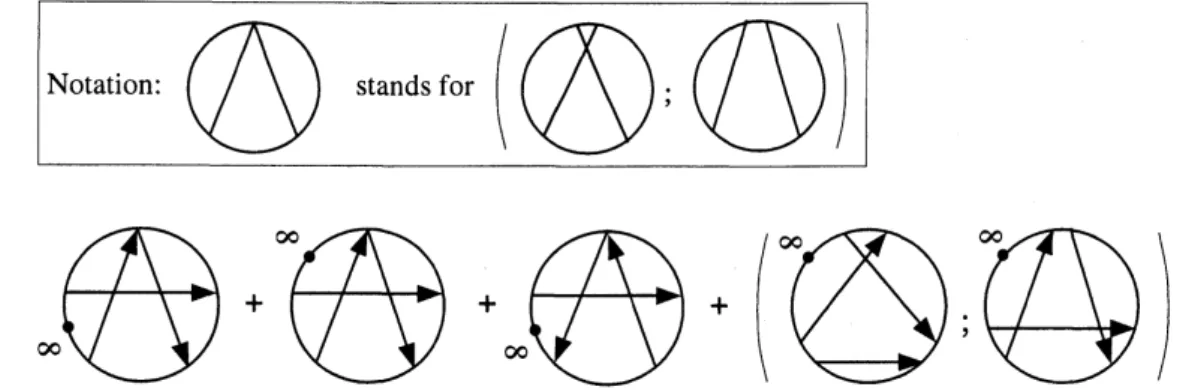
Notation:
Figure3: The first non-trivialarrowgerm formula$\alpha_{3}^{1}$: three partialarrow3-germsandonearrow 3-germ
As one
can
see, no 1- or 2-germsare
involved in the formula of Theorem 2, and thisis actually
a
general fact: in any cohomology class represented by germ formulas, thereis a formula which contains only (possibly partial) 3-germs ([13], Proposition 2.8). As a
result, the linear system with germs as variables and 2-meridians as equations is reduced
to a reasonable size ([13], Theorem 2.11).
Conjecture 1. Every 1-cohomology class with an arrow germ presentation is
of
finite
type in the sense
of
Vassiliev.So far, only
one
way is known for proving that a 1-cocycle is of finite-type over $\mathbb{Z}$;it consists in defining orientations on the varieties involved in Vassiliev’s homological
1.3 Evaluation of$\alpha_{3}^{1}$
on
canonical cyclesOne interest of 1-cocycles is that evaluating them
on
loops thatare
defined canonicallyfor all knots produces knot invariants. The easiest example ofsuch aloop, for long knots,
is the loop rot (K) which consists of a full positive rotation of $K$ around its axis–see
Figs.4 and 5. It is proved in [13] that $\alpha_{3}^{1}(rot(K))$ is equal to minus the Casson invariant
of $K$:
$\alpha_{3}^{1}(rot(K))=-v_{2}(K)$.
This equality
was
conjectured to hold for the Teiblum-Turchin cocycle in [16]. Turchin’sconjecture would follow from the above result and Conjecture 1.
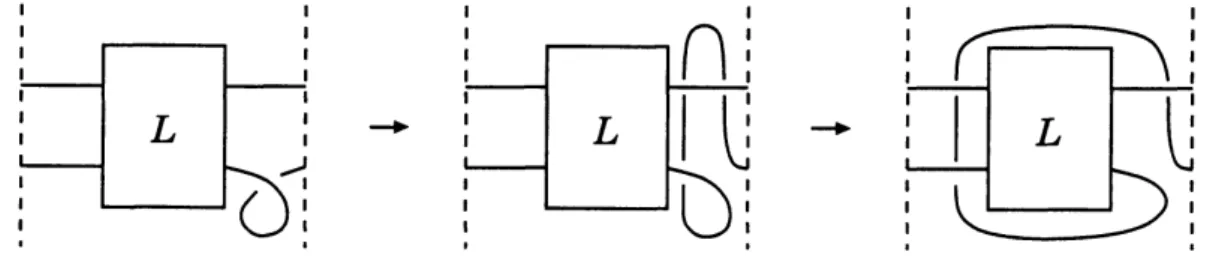
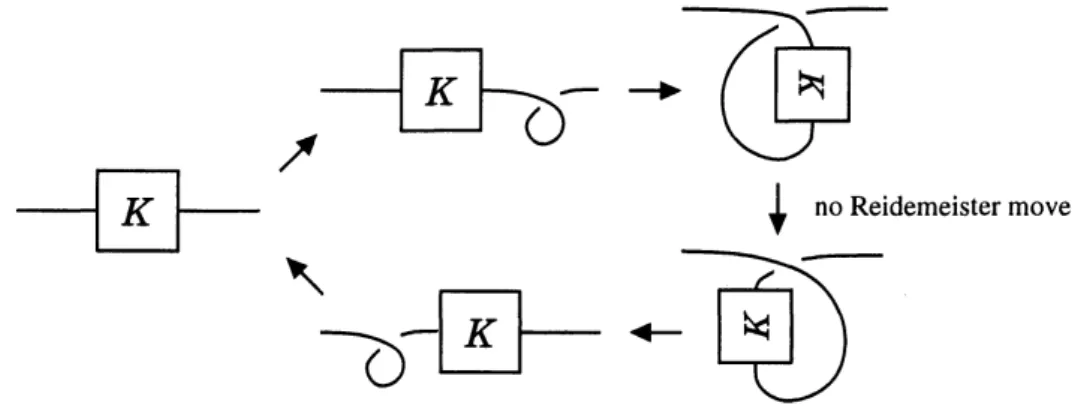
Figure4: One realization of the looprot(K) as asequence of Reidemeister moves
Figure5: Therailwayfollowed by $K$onFig.4 is isotopictoafull rotationaround the axis
A result of Hatcher [11] states that besides rot(K), there is essentially only
one
otherinteresting loop in the moduli space of all long knots equivalent to
a
given prime knot.This second loop, often called the Hatcher loop Hat (K), consists of sliding alittle “ball at
infinity”’ along a fixed parametrization ofthe knot in$\mathbb{S}^{3}$
(a framing convention should be
made, because every time the ball makes a full spin arounditself, it adds $\pm rot(K)$ to the
loop). Although it does not
seem
easy to evaluate $\alpha_{3}^{1}$ on Hat (K), further investigationshowed that there is another
arrow
germ
formula $\tilde{\alpha}_{3}^{1}$, with thesame
propertiesas
$\alpha_{3}^{1}$so
far, and such that if $K$ has framing $0$, then
$\tilde{\alpha}_{3}^{1}$(Hat (K) )
$=-6v_{3}(K)$
.
Here$v_{3}$ denotes the only Vassiliev invariant of order 3 with value 1 on the positive trefoil,
$-1$ on the negative trefoil and $0$ on the unknot. This result is to appear in asubsequent
2
Quantum
one-cocycles
for knots [8]
In this article, Fiedler defines a
new
family of 1-cocycles in the topological moduli spaceoflong knots, which are then extended to cocycles in the space of string links. As in the
previous article (Section 1), the formulas are constructed as algebraic intersection forms
with the variety of Reidemeister moves, purely combinatorially: follow aloop in the space
of knot diagrams, and every time you meet a Reidemeister move, count something. Only
thistime what you countdoes not livein
a
“small” group like$\mathbb{Z}$, but in
a
more
complicatedstructure that stays closer to topology and keeps
more
information.One of the motivations here is to detect geometry-related information, with the
fol-lowing result in mind (see the definitions of rot and Hat in the previous section).
Theorem 3 (Hatcher [11]). Let $K$ be a long knot which is not a satellite. Then the loops
rot (K) and Hat (K)
are
linearly independent over $\mathbb{Q}$if
and onlyif
$K$ is hyperbolic.It
means
that if one can create a 1-cocycle powerful enough to detect exactly whenrot (K) and Hat (K)
are
linearly dependent, then it givesa
simple criterionto evaluate thegeometry of prime knots. The ultimate goal in that direction is to find
a
cocycle $v$ suchthat the quotient v(rot)/v(Hat), when not arational number, is related to the hyperbolic
volume.
2.1 The space of cochains
There
are
alot of combinatorial tools required to define properly the objects in Fiedler’stheory; we begin with a simplified version, which will be refined gradually in the next
subsections. In particular, we first set aside orientation and sign issues.
Let us describe the elementary cochains from which one tries to obtain 1-cocycles.
They
are
based on a simple surgery operation that generalizes knot mutations. Indeed,let $T$ be a tanglediagram in a2-disc, with 6 boundary points. One defines anelementary
cochain $c_{T}$ as follows. Pick a generic path $\gamma$ in the space of long knot diagrams. For
each Reidemeister III move involved in $\gamma$, notice that the local Reidemeister picture is a
tangle diagram in a disc, with 6 boundary points; remove that disc from your diagram,
and replace it with $T$, making sure that the boundary points match; there are six ways
to do that, and we will explain later how to choose
one
canonically. The evaluation $c_{T}(\gamma)$is by definition the formal
sum
of all tangle diagramsso
obtained.By considering tangles with 4 (respectively, 2) boundary points,
one can
similarlyconstruct cochains that detect Reidemeister II (respectively, I)
moves.
Now ifone stops here, thespaceof cochains is indexed by tangles in a disc, so that it is
infinite-dimensional.
Moreover, abrief examination reveals that therearevery few chancesto ever find a cocycle in that space: indeed, a 1-cocycle should vanish
on
2-meridians,and it is not easy for a formal sum of tangle diagrams to vanish (even with proper signs
defined). The natural
answer
to both these issues is to push the values of the cochainsin a skein module. In [8], two modules are separately considered: the HOMFLYPT and
Kauffman polynomials, which both yield finitely generated cochain spaces. Note that in
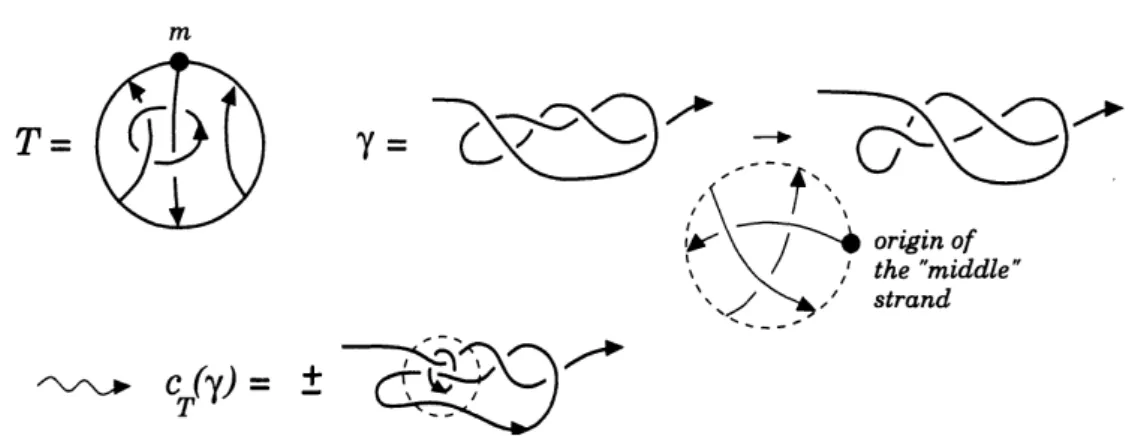
へ$\sim$ $c_{T}(\gamma)=$
Figure6: Elementarycochainassociated with an oriented tangle$T$. The middlestrand issueis explained
in Subsection 2.1.3.
2.1.1 Local and globaltypes
An empiricalfact in this theoryis that 1-cocycle formulas tend to contain
a
lot ofsymme-try, and themoresymmetry there is inaformula, themorelikely it isto be cohomologically
trivial. There are mainly two ideas in [8] to get round this difficulty: first,
use
parametersand decorations
so as
to break the symmetryas
much as possible; second, finda
way toextract interesting information
even
froma
cocycle that is cohomologically trivial (seeSection
2.2.1).Let us
assume
for now thatwe
work with long knot diagrams (see exampleon
Fig.1).There are a number of data that
one
can
read given a Reidemeistermove
in sucha
diagram, which together define the local and global types of the move. Then, if$l$ denotes
one particular local type, and $g$ a global type,
one
can enrich the previous settings bydefining an elementary cochain $c_{T,l,g}$: it makes the
same
computation as $c_{T}$ but only ifthe Reidemeister
move
has type $(l, g)$ (so that $c_{T}$ is thesum
of $c_{T,l,g}$over
all types$l$
and $g)$
.
Local types
are more
conveniently readon
the local knot diagram picture, while globaltypes require to look at how the involved crossings
are
arrangedon
the Gauss diagram,with respect to each other and to the point at infinity; the point at infinity appears to be
the key to break the symmetry and allow non-trivial solutions to exist.
Figure
7 sums
up the definitions of all types, and where to find them in [8].Terminology. Thenotation $c_{T,l,g}$
”
, althoughconvenient for
an
overviewof the article,is not the one used in [8]. There, cochains
are
systematically defined by giving, for eachcoupleoftypes $(l, g)$, which tangles$T$ (calledpartialsmoothings) contribute. Forinstance,
“for the cochain $R$, the partial smoothing $T_{r_{c}}$ for type 3 is
means
in the currentterminology that $R$can be written
$R=c$
Figure 7: All local and global typeswiththeirreference pagesin [8] (version 2)
2.1.2 Signs
One obvious necessary condition for a cochain $c$ to define a 1-cocycle is that $c$ should
vanish
on
any little loop in whichone
Reidemeistermove
is performed and then undone.As a result,
one
must either workover
$\mathbb{Z}/2$,or
define “co-orientations” of Reidemeistermoves.
The latter choice is made in [8],as
follows.In the
case
of Reidemeister I and II moves, the evaluation of an elementary cochain$c_{T,l,g}$
comes
withan
additional minus sign if and only if themove
destroys crossings.In the case of Reidemeister III, the co-orientation is defined separately for each local
type. That is the meaning of $the+and-$ signs in [8] Fig.16 p.31, they indicateon which
side of the
move
each picture is. When evaluating a cochain, count an additional minussign if and only if the
move
goes from the positive to the negative side. Note that thesigns here were not chosen arbitrarily. The easiest way to show it might be to point out
that in Fig.8, where every local type appears exactly once, all eight triangles
are on
their1
Figure8: All eight local types ontheir positiveside, inonepicture
2.1.3 Gluing conventions
We
now
explain how Fiedler choosesone
out of six ways of gluinga
graft tangle afterremoving a Reidemeister III tangle (for $R$I there is nochoice since the skein modules are
1-dimensional, and for R II it is directly made clear on each picture, like [8] Fig.41 p.59,
which in
our
current notations would read $-(v-v^{-1})c$)$(,+,0)$.
First, notice that for local types 2 and
6
(called star-like),sources
and sinks alternatealong the boundary of the Reidemeister tangle; for the remaining (braid-like) types 1,
3, 4, 5, 7 and 8, the
sources
can be grouped togetheron
one side of the disk. In thelatter case, the convention is that the three boundary points at the
left
ofany picture ofagraft tangle $T$ should replace the three
sources
of the removed tangle. This conventionis especially useful when working
over an
unoriented skein module; otherwise, the simplefact that orientations should match leaves no choice.
For local types 2 and 6, one defines the mid point in the Reidemeister tangle as
the
source
of the “middle strand, which goes neitherover
the two other strands,nor
under them. The convention is then to decorate one of the boundary points in the graft
tangles with a letter $m$”, indicating that this point always replaces the mid point when
performing
a
surgery–see Fig.6.When working
over an
oriented skein module, only graft tangles with consistentorien-tations
are
allowed; note that this consistency condition dependson
the local type.2.1.4 Weights
There are two major ingredients in Fiedler’s formulas. The first is the idea ofperforming
surgeries that formally depend on
some
local and global parameters, i.e., the cochains$c_{T,l,g}$ defined so far. The second is to weight these cochains with Gauss diagram
formulas. Very roughly, it amounts to considering the module freely generated by the
elementary cochains $c_{T,l,g}$, not over
$\mathbb{Z}$, but over a ring of arrow diagrams (as defined in
Section 1).
Asin Section1, those
arrow
diagramscomputesums
of productsofwrithes in theGaussdiagram that represents the long knot at the moment where each Reidemeister
move
isperformed. The number of writhes involved in each product determines the degree ofthe
2.2 Results
Recall that when a 1-cochain in the space of knots isdefined as an intersectionform with
Reidemeister moves, the condition for being a cocycle is to vanishon the meridians of the
2-codimensional strata defined by the higher order Reidemeister theorem (just like knot
invariants, i.e., $0$-cocycles, should vanish
on
the meridians of the 1-codimensional strata
defined by the usual Reidemeister theorem). Two of these strata are by far the most
complicated, and occupy acentral place in [8]:
$\bullet$ The set of
knots whose projection to the plane contains a quadruple point (which
can
be thought of as anarc
sliding over a Reidemeister III move), denoted $by*.$The equations associated with their meridians are called the tetrahedron equations.
$\bullet$ The set
ofknots whose projection contains
a
triple point withtwo tangent branches(an arc sliding over/under/through a Reidemeister II move), denoted by $\succ|\prec$
.
Theassociated equations
are
called the cube equations.The results
are
organized as follows: for each skein module (HOMFLYPT, pp.34-149and Kauffman, pp.149-168), two 1-cocycle
formulas
are
constructed: $R_{\eta eg}^{(1)}$and $\overline{R}^{(1)}$ in the
HOMFLYPT
case, $R_{F,reg}^{(1)}$ and $R_{F}^{-(1)}$in the Kauffman
case.
Each of theseare
builtstep by step, by first solving the tetrahedron equation, then adjusting the solution so
that it satisfies also the cube equations, then adjusting again so as to get all (when
possible) remaining equations satisfied. Formulas whose
name
contains a subscript “reg”do not vanish
on
meridians involving Reidemeister I moves; however they vanish on allother meridians, which makes them regular cocycles, i,e., invariants of regular loops up
to regular isotopy ([8] Theorem 3 p.94); they are both made of quantum cochains with
linearweights. Onthe other hand, $R^{(1)}-$
and$R_{F}^{-(1)}$
satisfy all equations and define non-trivial
cocycles in the space of long knots ([8] Theorem 4p.127 and Theorem 5 p.165). They are
made of amain part which is a quantum cochain with (at most) quadratic weights, and
a corrective term which purely consists ofa weight ofdegree 3 (and no surgery part).
2.2.1 From long knots to string links
There
are
manyreasons
for whichone
would like to generalize a construction related tolong knots to string links in a 3-ball. For instance, producing families of invariants via
knot cabling, or generalizing a formula computing the trivial knot invariant, which may
prove to be non-trivial when applied to string links. When it comes to 1-cocycles, tangles
ingeneral are a little bit unfriendly: the moduli space of all tangles isotopic to agiven one
has very often a trivial first homology group. However, even a 1-cocycle formula that is
null-cohomologous can lead to non-trivialinvariants of tangles if evaluated on a canonical
arc which is not a loop.
The way Fiedler extends his long knot cocycle formulas to arbitrary string links is
extremely simple: just like knots, string links can be represented with Gauss diagrams,
the only difference is that the base manifold is not a circle, but a collection of numbered
arcs.
Fix arbitrarily:2.
a
point at infinityamong
the gluing points.That is all. Now any sequenceofReidemeister
moves
applied toanystringlink diagramlooks like a sequence applied to a long knot, and it makes
sense
to evaluate Fiedler’sformulas there. Any quantum cocycle for long knots defines a family of cocycles in the
moduli space of string links, indexed by the above choices of
a
circular permutation andapoint at infinity.
2.2.2 The scan-arc and the scan-property
As mentioned earlier, there
are no
non-trivial loops in the moduli space ofstring links ingeneral, except for particular
cases
suchas
longknots and their cables (for which there isa version of the Hatcher $1oop-[8]$, p.8).
Fiedler introduces a scan-arc, defined canonically for all string links, and denoted by
scan
(L). We represent iton
Fig.9. Itcan
be thought ofas a
generalization of the looprot (K) defined for long knots: indeed, rot (K) consistsbasically of twoconsecutive $\langle$
scans”
(Fig.4). Notice that the little loop on the first frame is not a part of the string link, and
its “creation” by Reidemeister I is not apart of the
scan-arc
either (although the sequenceof Reidemeister II
moves
that lead to the second frame is included in the scan-arc): itfollows that the
scan-arc
is regular (it does not involve any Reidemeister I move), henceit makes
sense
to evaluate $R_{veg}^{(1)}$and $R_{F,reg}^{(1)}$ there.
$arrow$ $arrow$
Figure 9: Thescan-arcofastringlink $L$
Now
one
would likea
result of the type “Let $c$ bea
quantum cocycle formula. Then$c(scan(L))$ is
an
isotopy invariant of the string link L.” It is not difficult tosee
that thisholds true if$c$is aquantumformula with constant weights. However itfailswith arbitrary
weights.
By definition, aquantum cocycle formula$c$issaid to have the scan-property if$c(scan(L))$
defines an isotopy invariant of the string link $L$
.
All four formulas constructed in [8] havethat property ([8] Theorems 3, 4, 5).
Among many examples, let usmentionthat if$L$is chosen to bethepositive generatorof
the 2-strand braidgroup,andif the point at infinity is chosen correctly, then $R_{7eg}^{(1)}(scan(L))$
is equal to the HOMFLYPT polynomial of the right trefoil (times the class of the trivial
braid in the HOMFLYPT skein module).
As for $\overline{R}^{(1)}$
, the computations made lead to the following conjectures ([8], Conjectures
1 and 2).
its
HOMFLYPT
polynomial. Let $\delta$denote the
HOMFLYPT
polynomialof
the trivial2-component link. Then
$\overline{R}^{(1)}$
(rot (K) ) $=\delta v_{2}(K)P_{K}.$
Conjecture 3. Let $K$ be
a
longknot
with trivialframing
and with
non
trivialCasson
invariant. Then $R^{(1)}(Hat(K))$ is a
non
zero
integer multipleof
$R^{(1)}(rot(K))-$if
and onlyif
$K$ is a torus knot.So far those two conjectures have been checked for knots up to 4 crossings.
2.2.3 Gradings
One specificity ofthe
formulas
$R_{eg}^{(1)}$and $R_{F,reg}^{(1)}$ extended to string links
is that they
can
be refined into a collection of cocycle formulas $R_{\tau eg}^{(1)}(A)$ and
$Rreg$) (A) indexed by a set of
gradings, sothat the originalformulas
are
thesum
of the refined formulasover
all possiblegradings.
A grading is defined for any
Reidemeister
II or IIImove.
Just like $c_{T,l,g}$ is oblivious ofReidemeister
moves
thatare
not of type $(l, g)$, $R_{\gamma eg}^{(1)}(A)$ and$R_{Fre}^{(1)}(A)$ disregard themoves
that do not have grading $A$
.
The fulldefinition, however, is not very enlightening, so
we
do not mention it here;
see
[8], Definition 9 p.48.References
[1] Dror
Bar-Natan.
On the Vassiliev knot invariants. Topology, $34(2):423-472$,1995.
[2] Michael Brandenbursky. Link invariants via counting surfaces. ArXive-prints,
September
2012.
[3] Sergei Chmutov, Michael Cap Khoury, and Alfred Rossi. Polyak-Viro formulas for
coefficients of the Conwaypolynomial. J. Knot TheoryRamifications, $18(6):773-783,$
2009.
[4] Sergei
Chmutov
and Michael Polyak. Elementary combinatorics of theHOMFLYPT
polynomial. Int. Math. Res. Not. IMRN, (3):480-495,
2010.
[5] Thomas Fiedler. Gauss diagram invariants
for
knots and links, volume 532 ofMath-ematics and its Applications. Kluwer Academic Publishers, Dordrecht, 2001.
[6] Thomas Fiedler. Isotopy invariants for closed braids and almost closed braids via
loops in
stratified
spaces.ArXiv Mathematics
$e$-prints, June2006.
[7] Thomas Fiedler. Knot polynomials via one parameter knot theory. ArXiv
Mathe-matics $e$-prints, December 2006.
[8] Thomas Fiedler. Quantum one-cocycles forknots (v2). ArXiv Mathematics $e$-prints,
Apri12013.
[9]
Thomas
Fiedler. Singularization of knots and closed braids.ArXiv
$e$-prints, May[10] Mikhail
Goussarov.
Finite-type invariantsare
presented byGauss
diagram formulas,1998. Ranslated from Russian by Oleg Viro.
[11] Allen Hatcher. Spaces of Knots. ArXiv Mathematics $e$-prints, September 1999.
[12] MaximKontsevich.
Vassiliev’s
knot invariants. In I. M.Gel’fand
Seminar, volume16
of Adv.
Soviet
Math., pages137-150.
Amer. Math. Soc., Providence,1993.
[13] Arnaud Mortier. Finite-type 1-cocycles ofknots and virtual knots given by
Polyak-Viro formulas. Available at https:$//$sites.google.com/site/mortier2xO/home/
publications thesis and-preprints.
[14] Michael Polyak and Oleg Viro. Gauss diagram formulas for Vassiliev invariants.
Internat. Math. Res. Notices, (11):445ff., approx. 8 pp. (electronic),
1994.
[15] Keiichi Sakai. An integral expression of the first nontrivial one-cocycle of the space
of long knots in $\mathbb{R}^{3}$
.
Pacific
J. Math., $250(2):407-419$, 2011.[16] Victor Turchin. Computation of the first nontrivial 1-cocycle in the space of long
knots. Mat. Zametki, $80(1):105-114$,
2006.
[17] Victor A. Vassiliev. Cohomology of knot spaces. In Theory
of
singularities andits applications, volume 1 of Adv. Soviet Math., pages 23-69. Amer. Math. Soc.,
Providence, RI, 1990.
[18] Victor A. Vassiliev. Complements
of
discriminantsof
smooth maps: topology andap-plications, volume
98
of Translationsof
Mathematical Monographs. AmericanMath-ematical Society, Providence, RI, 1992. Translated from theRussian by B. Goldfarb.
[19] Victor A. Vassiliev. Combinatorial formulas for cohomology of spaces of knots. In
Advances in topological quantum
field
theory, volume 179 ofNATO Sci. Ser. II Math.Phys. Chem., pages 1-21. Kluwer Acad. Publ., Dordrecht, 2004.
OCAMI, Osaka City University
3-3-138
Sugimoto, Sumiyoshi-ku, Osaka-shiOsaka 558-8585,

![Figure 7: All local and global types with their reference pages in [8] (version 2) 2.1.2 Signs](https://thumb-ap.123doks.com/thumbv2/123deta/5958589.1056151/7.892.124.712.115.576/figure-local-global-types-reference-pages-version-signs.webp)