
Hyperfunctions and Cech-Dolbeault cohomology in the microlocal point of view (Microlocal analysis and asymptotic analysis)
6
0
0
全文
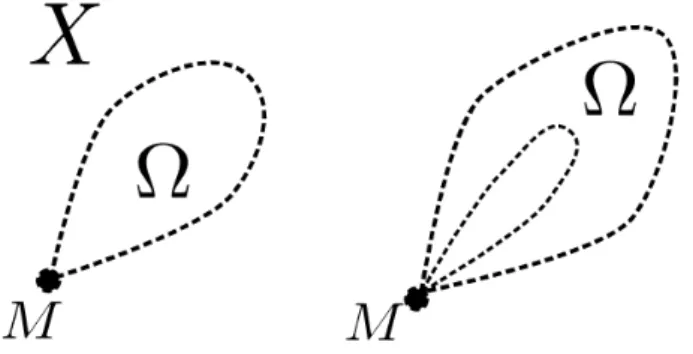
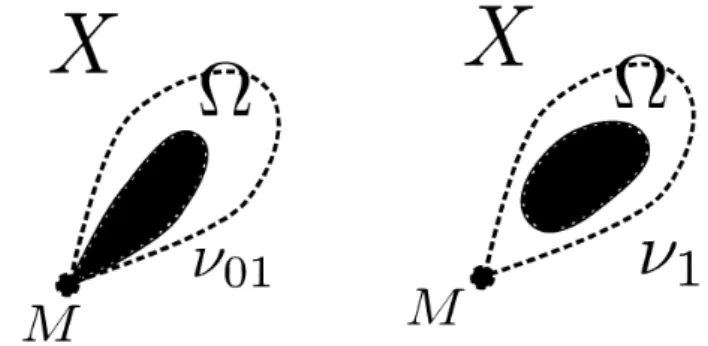
(2) 8. NAOFUMI HONDA. For example, a usual convex wedge. \Omega. along. M. like a left shape in Fig. 1 satisfies the. condition (B_{2}) . However, the right shape in the same figure that is a wedge along in which the smaller one is removed violates. connected components while. N. X\backslash \Omega. (B_{2}). because. (X\backslash \Omega)\backslash M. M. consists of two. is connected.. ’. \prime^{\prime^{\prime^{\prime^{t} \backslash} .-\sim_{s_{\backslash} .. l^{\prime^{\prime^{\prime'} ,. 1. e^{\prime^{e\backslash}.\ovalbox{\t\smal REJ CT}.-\ovalbox{\t\smal REJ CT}\backslash.. \Omega \prime 1. M\buletprim.\ elprim'\ eprim'\ elprim\ e. Omga\prie m\prie, m'\prie^{ m'}\prie ’. Figure 1. A good case (left) and bad case (right).. Set. \mathcal{W}=\{V_{0}=X\backslash M_{:}V_{1}=X\}. and. In what follows, we always assume that. \mathcal{W}'=\{V_{0}\} . \Omega. We also set V_{01}=V_{0}\cap V_{1} as usual.. satsifies the above two conditions. Then we. will define the following boundary value map b_{\Omega}. :. \mathscr{O}(\Omega)arrow \mathscr{B}(M)=H_{M}^{n}(X;\mathscr{O})\otimes_{Z_{M} (Af)}or_{II/X}(M). \simeq H_{\frac{0}{\vartheta'} ^{n}(\mathcal{W}, \mathcal{W}') \otimes_{Z_{\Lambda I}(M)}or_{M/X}(M) using Čech‐Dolbeault cohomology. As. M. is orientable, we can take a global section fl in or_{M/X}(M) which generates. each stalk of the sheaf or_{M/X} over \mathb {Z} . We fix such a section ] \lfo r hereafter.. The canonical sheaf morphism \mathbb{Z}_{X}arrow \mathbb{C}_{X} induces the morphism of. \mathb {Z} ‐modules. or_{M/X}(JI)=H_{M}^{n}(X;\mathbb{Z}_{X})\mapsto H_{\Lambda I}^{n}(X;\mathbb{C}_ {X})=H_{D}^{n}(\mathcal{W}, \mathcal{W}'). ,. The image in H_{M}^{n}(X;\mathbb{C}_{X}) of If by this morphism is still denoted by the same symbol in what follows. The following lemma is crucial to our. which is clearly injective. construction of b_{\Omega}.. Lemma 2.1. Under the conditions (B_{1}) and (B_{2}) , the 1\in H_{D}^{n}(\mathcal{W}, \mathcal{W}') has a rep‐ resentative. (\nu_{1}. \nu_{01})\in \mathscr{E}^{(n)}(V_{1})\oplus \mathscr{E}^{(n-1)} (V_{01})=\mathscr{E}^{(n)}(\mathcal{W}, \mathcal{W}') which satisfies Supp_{V_{1}}(\nu_{1})\subset\Omega and Supp_{V_{01}}(\nu_{01})\subset\Omega (see Fig. 2 also)..
(3) 9. HYPERFUNCTIONS AND ČECH‐DOLBEAULT COHOMOLOGY IN THE MICROLOCAL POINT OF VIEW. .. N. \primebackslh_{ }\primebackslh^{1. \primebackslh \ :^{r}backslhi1 ’. 1 M^{\bullet}\prime I..- V_{1}. M. Figure 2. The support of. The canonical sheaf morphism. \nu_{01}. and. \nu_{1}. indicated by black regions.. : \mathbb{C}_{X}arrow \mathscr{O} induces the canonical morphisms of. \iota. \mathb {C} ‐vector spaces:. H^{k}(\iota):H_{M}^{k}(X\prime:\mathbb{C}_{X})arrow H_{M}^{k}(X;\mathscr{O}). .. Its counterpart in the relative de Rham and relative Dolbeault cohomologies is, as was. explained in Section 5 in [2], given by. \rho^{k} : \mathscr{E}^{(k)}(\mathcal{W}, \mathcal{W}')ar ow \mathscr{E}^{(0,k)} (\mathcal{W}, \mathcal{W}') Hereafter we often write. \rho. given by ( \omega_{1} , \omega 0ı). \mapsto(\omega_{1}^{(0,k)}, \omega_{01}^{(0,k-1)}) ,. instead of \rho^{n} . We give an example of a. \nu. in the above lemma. for a typical case.. Figure 3. The typical picture of. Example 2.2. Let M=\mathbb{R}^{n}, proper convex cone in in. \mathb {R}_{y}^{n}. \mathbb{R}^{n} .. X=\mathbb{C}^{n}. We first take. n. n=2.. and \Omega=M\cross\sqrt{-1}\Gamma , where. \Gamma. is an open. linearly independent unit vectors. so that. \bigcap_{1\leqk\underline{<}n H_{k}\subset\Gam a. \eta_{1} ,. ... ,. \eta_{n}.
(4) 10. NAOFUMI HONDA. holds, where we set. H_{k}=\{y\in \mathbb{R}_{y}^{n}|\{y\backslash \eta_{k}\}>0\} .. We also set. \eta_{n}+{\imath}=-(\eta_{1}+\cdots+\eta_{n}) Then, let. \varphi_{k}. ,. k=1 ,. . . . , n+1 , be. c\propto ‐functions. (1) Supp_{X\backslash M}(\varphi_{k})\subset M\cross\sqrt{-1}H_{k} for any (2) Set. \sum_{k=1}^{n+1}\varphi_{k}=1. on. k=1 ,. on. .. X\backslash M. ...,. which satisfy. n+1.. X\backslash M.. \nu_{01}=(-1)^{n}(n-1)!\hat{\chi}_{H_{n+1}}d\varphi_{1}\wedge\cdots\wedge d\varphi_{n-1:} where \hat{\chi}_{H_{n+1}} is the anti‐characteristic function of the set H_{n+1} , that is,. \hat{\chi}_{H_{n+1} (z)=\{ begin{ar ay}{l} 0 z\inH_{n+{\imath} , 1 otherwise. \end{ar ay} Then we can easily confirm that. \nu_{01}\in \mathscr{E}^{(n-{\imath})}(X\backslash M). and. Sup _{X\backslash M}(\nu_{01})\subset\lambda I\cros \sqrt{-1}\bigcap_{1\leq k\underline{<}n}H_{k}\subset\Omega. Furthermore, \nu=. ( 0, \nu0ı) \in \mathscr{E}^{(n)}(V_{1})\oplus \mathscr{E}^{(n-1)}(V_{01})=\mathscr{E}^{(n) }(\mathcal{W}, \mathcal{W}'). gives the image of a positively oriented generator of orientations on. M. and. X.. or_{M/X}(M) under the standard. Note that, by the definition of \rho , we have. \rho(\nu)=(0, (-1)^{n}(n-1)!\hat{\chi}_{H_{r\iota+1}}\overline{\partial} \varphi_{1}\wedge \cdot \cdot \cdot \wedge\overline{\partial}\varphi_{n-1})\in \mathscr{E}^{(0,n)}(\mathcal{W}.\mathcal{W}') Let us construct the boundary value map.. .. We first take, thanks to Lemma 2.1,. \nu=(\nu_{1}, \nu_{01})\in \mathscr{E}^{n}(\mathcal{W}_{:}\mathcal{W}') which is a representative of 1\in or_{M/X}(M) and satisfies. Supp_{X}(\nu_{1})\subset\Omega_{:} Supp_{X\backslash M}(\nu_{01})\subset\Omega.. H_{\frac{0}{\vartheta'} ^{n}(\mathcal{W}, \mathcal{W}') .. By tracing the image of fl in the diagram below, we obtain \rho(\nu) in H^{n}(\iota). or_{M/X}=H_{M}^{n}(X;\mathbb{Z}_{X})arrow H_{M}^{n}(X;\mathbb{C}_{X})arrow H_{M}^{n}(X;\mathscr{O}) 1?. |?. H_{D}^{n}(\mathcal{W}_{\cap}.\mathcal{W}') arrow^{\rho} H_{\frac{0}{\vartheta'} }^{n}(\mathcal{W}, \mathcal{W}') u). 1\lrcorner). u. 1L \nu \rho(\nu). ..
(5) HYPERFUNCTIONS AND ČECH‐DOLBEAULT COHOMOLOGY IN THE MICROLOCAL POINT OF VIEW. Then, using \rho(\nu) , we define the boundary map. (2.1). b_{\Omega} :. \mathscr{O}(\Omega)ar ow H_{\frac{0}{\vartheta'} ^{n}(\mathcal{W}, \mathcal{W} '). \otimes \mathbb{Z}(M). or_{M/X}(M)=\mathscr{B}(l1I). by, for f\in \mathscr{O}(\Omega) ,. b_{\Omega}(f) :=[f\rho(\nu)]\otimes 1\in H_{\frac{0}{\vartheta'} ^{n} (\mathcal{W}, \mat\mathbb{Z}(\hLambdacalI){W}') \otimes or_{M/X}(M) .. (2.2). Lemma 2.3. The above b_{\Omega} is well‐defined. choice of. ][. and. That is, b_{\Omega} does not depend on the. \nu.. Remark. Thus constructed b_{\Omega}(\bullet) coincides with the original boundary value map by. Sato‐Kawai‐Kashiwara [1]. The proposition below immediately comes from the definition:. Proposition 2.4. Let \Omega'\subset\Omega be an open subset in X. Assume that. \Omega'. also satisfies. the conditions (Bı) and (B_{2}) . Then we have. b_{\Omega'}(f|_{\Omega^{f}})=b_{\Omega}(f) , f\in \mathscr{O}(\Omega). .. We can easily estimate the microlocal analyticity of the hyperfunction b_{\Omega}(f) . Be‐ fore stating the estimate, we give the characterization of microlocal analyticity of a hyperfunction in our framework. For an open subset V in X , we set. \mathcal{W}_{V}=\{V_{0}=V\backslash M, V_{1}=V\}. and. \mathcal{W}_{V}'=\{V_{0}\}.. Proposition 2.5. Let u be a hyperfunction at x_{0}\in\Lambda I . Then u is microlocally analytic at p_{0}=(x_{0}, \sqrt{-1}\xi_{0})\in\sqrt{-1}T^{*}M if and only if there exist a closed cone G\subset \mathbb{R}^{n} with the condition. G\backslash \{0\}\subset\{y\in \mathbb{R}^{n}|{\rm Re}(\sqrt{-1}y, \sqrt{-1} \xi_{0}\rangle>0\}=\{y\in \mathbb{R}^{n}|\langle y, \xi_{0}\}<0\}, an open neighborhood. V. of. x_{0}. and a representative. (\tau_{1}, \tau_{01})\in \mathscr{E}^{(0,n)}(V_{1})\oplus \mathscr{E}^{(0,n}1) (V_{01})=\mathscr{E}^{(0,n)}(\mathcal{W}_{V}, \mathcal{W}_{V}') of. u. near. x_{0}. which satisfies \tau_{1}=0 and Supp_{VMI}(\tau_{01})\subset \mathbb{R}_{x}^{n}\cross\sqrt{-1}G.. Then it follows from the above two propositions that we have: Theorem 2.6. Let. \Omega\cap(\{x_{0}\}\cross\sqrt{-1}\mathbb{R}_{y}^{n}). M. be an open subset in \mathb {R}_{x}^{n} and. SS (b_{\Omega}(f))\subset\Omega^{\circ} where. \Omega^{\circ}. X=iM\cross\sqrt{-1}\mathbb{R}_{y}^{n} .. Assume that. is a non‐empty convex cone for any x_{0}\in M. Then we have. is the polar set of. \Omega. f\in \mathscr{O}(\Omega) ,. defined by. x\in M\lflo r\rflo r\{\sqrt{-1}\xi\in(T_{l\backslash I}^{*}X)_{x}|\{\xi, y\rangle\geq 0 for any. y. with. (x, \sqrt{-1}y)\in\Omega\}\subset T_{M}^{*}X.. 11 11.
(6) 12. NAOFUMI HONDA. References. [1] M. Sato, T. Kawai and M. Kashiwara, Microfunctions and pseudo‐differential equations, Hyperfunctions and Pseudo‐Differential Equations_{\grave{1}} Proceedings Katata 1971 (H. Ko‐ matsu, ed.), Lecture Notes in Math. 287, Springer, 1973, 265‐529. [2] T. Suwa, Relative Dolbeault cohomology and Sato hyperfunctions, in this volume.. [3] K. Umeta, Laplace hyperfunctions from the viewpoint of Čech‐Dolbeault cohomology, in this volume..
(7)
図
関連したドキュメント
In particular, we consider a reverse Lee decomposition for the deformation gra- dient and we choose an appropriate state space in which one of the variables, characterizing the
Keywords: continuous time random walk, Brownian motion, collision time, skew Young tableaux, tandem queue.. AMS 2000 Subject Classification: Primary:
Interesting results were obtained in Lie group invariance of generalized functions [8, 31, 46, 48], nonlinear hyperbolic equations with generalized function data [7, 39, 40, 42, 45,
Then it follows immediately from a suitable version of “Hensel’s Lemma” [cf., e.g., the argument of [4], Lemma 2.1] that S may be obtained, as the notation suggests, as the m A
Definition An embeddable tiled surface is a tiled surface which is actually achieved as the graph of singular leaves of some embedded orientable surface with closed braid
In order to be able to apply the Cartan–K¨ ahler theorem to prove existence of solutions in the real-analytic category, one needs a stronger result than Proposition 2.3; one needs
In this paper we focus on the relation existing between a (singular) projective hypersurface and the 0-th local cohomology of its jacobian ring.. Most of the results we will present
Besides the number of blow-up points for the numerical solutions, it is worth mentioning that Groisman also proved that the blow-up rate for his numerical solution is
