Dynamics of the
fluid balancer:
Perturbation
solution of
a
forced
Korteweg-de
Vries-Burgers
equation
M.
A.
Langthjema* T.Nakamurab
aGraduate School
of
Science
and Engineering,Yamagata University,
Jonan 4-chome, Yonezawa,
992-8510
JapanbDepartment
of
MechanicalEngineereng,
OsakaSangyo University,
3-1-1
Nakagaito, Daito-shi, Osaka,574-8530
JapanAbstract
The work described here is concemed with the dynamics ofaso-called fluid balancer; a
hulahoop ring-likestructure containingasmall amount ofliquid which, during rotation, is
spun out to form a thinliquid layer on theoutermost inner surface of the ring. The liquid
is able to counteract unbalanced mass in an elastically mounted rotor. The present paper
gives adetailed discussion of an approximateanalyticalsolution which includes a so-called
cnoidal wave; and it is demonstrated numericallyhow the surfacewave can counterbalance
the unbalanced mass.
Keywords: rotor, autobalancer, shallowwater wave, cnoidal wave,forced Korteveg-de
Vries-Burgers equation, method of multiple scales
1
Introduction
A fluid balancer isused in rotatingmachineryto eliminate the undesirable effectsofunbalanced
mass. It has become a standard feature in most household washing machines, but is also used
in heavyindustrial rotating machinery. Takingthe washingmachine fluid balancer
as
example,it consists of a hollow ring, like a hula hoop ring but typicallywith rectangular
cross
sections,which contains a small amount ofliquid. The ring is typically attached on top of the drum.
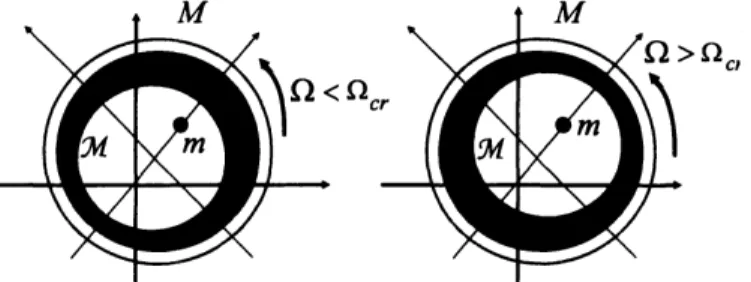
Whenit rotates at a high angular velocity$\Omega$theliquidwill form athin liquid layer
on the inner
surface of the outermostwall, assketched in Fig. 1.
Consider the situation where an unbalancedmass $m$ is present, for exampledue tothe
non-uniform distribution ofclothes in a washing machine. The rotor has a critical angular velocity
$\Omega_{cr}$ where the centrifugal forces are in balance with the forces due to the restoring springs.
Belowthis velocity $(\Omega<\Omega_{cr})$ the
mass
center of the fluid will be located ‘on thesame
side’ asthe unbalanced mass, as shown in the left part of Fig. 1. [Here $M$ indicates the mass of the
$*a$[email protected],$b$
empty rotor and $\mathcal{M}$the
mass
ofthecontained liquid.] At acertain supercritical angular velocity $\Omega>\Omega_{cr}$ (say, during the spin drying process) themass
center of the liquid will move to the‘oppositeside’ ofthe unbalanced mass,
as
shown in the right part ofFig. 1, resulting in ‘massbalance’ and thus in reduced centrifugal forces and reduced oscillation amplitudeof the rotor.
Figure 1: Workingprincipleof the fluid balancer.
This is the working principle of the fluid balancer. The main idea appeared already in
1912, and $US$ patent
was
granted in 1916 (Leblanc, 1916). The original layout consisted ofone or several very narrow concentric channels (narrow in the radial direction but wide in the
axial direction, i.e., perpendicular to the paper in Fig. 1) partially filled with, “liquid, or
very small steel balls ormetal fillings”. Leblanc’s fluid balancer
was
discussed and criticized byThearle (1932);and later also by Den Hartog(1985), inconnectionwith
a
discussion of Thearle’sbalancing head of 1932. It is argued there that Leblanc’s balancer cannot work with
a
liquid,only withsteel balls, andthus that the invention
was
flawed. It appears that this is due to thevery narrow channels which basically prevent the formation ofsurfacewaves.
None the less, a complete automatic washing machine equipped with a fluid balancer was
presented in 1940, and patented in 1945 (Dyer, 1945). The layout of the fluid balancer
was
verysimilarto themodern layouts, with awide concentric channel, wideenough to allow for surface
waveswith large amplitudes.
The idea is thus not new; but recently there has been a renewed interest, both in industry
and in academia. [There has also been a renewed interest in the so-called automatic dynamic
balancer,
as
the balancer thatuses
steel balls running ina
circular channel (or race) is called(vande Wouw et al., 2005; Green et al., 2006, 2008).$]$
Experimental fluid damper studies have been carried out by Kasahara et al. (2000a) and
Nakamura(2009). Astomathematicalmodels,simple lumpedmassmodelshavebeenconsidered
by Bae et al. (2002), Jung et al. (2008), Majewski (2010), Chen et al. (2011), and Urbiola-Soto
and Lopez-Parra (2011). The first andthelast two ofthesepapers include experimental studies
as well. The paper by Jung et al. (2008) includes a few numerical simulation results based on
computational fluid dynamics.
It should be emphasized that the fundamental principle of operation of the fluid balancer
can beunderstoodin termsof theexplanationof Thearle’s balancinghead, given inDen Hartog
(1985), p. 237. But a more detailed understanding is desirable; in particular, a more detailed
understandingof the fluid dynamics of the balancer.
the dynamics and stability of rotors partially filled with fluid/liquid; see e.g. Bolotin (1963)
and Crandall (1995) for good overviews. Most of the studies, such as those of Wolf, Jr. (1968),
Hendricks and Morton (1979) and Holm-Christensen and Tr\"ager (1991), are based on linear
theory/linearization. While this is sufficient to determine the stability properties, it may be
insufficient for modeling and understanding the dynamics of the fluid balancer (at any rate if
free (unforced) wave componentsare included) since the amplitudeof the surface
waves
needtobe known.
Non-linearstudies havebeencarriedout by Berman etal. (1985), Colding-Jrgensen (1991),
Kasahara et al. (2000b), and Yoshizumi (2007). Berman et al. (1985) found, both bynumerical
analysis and by experiment, that non-linear surface waves can exist on the fluid layer in the
formof hydraulic jumps, undularbores, and (what appears to be”) solitary waves (or solitons).
[An undular bore is a relatively weak hydraulic jump, with undulations behind it (Lighthill,
1978, p. 180). As to a solitary wave, described by the square of a hyperbolic secant function, sech, it should be noted that such a solution/wave exists only in a doubly infinite (i.e.
non-periodic) domain. In theperiodicdomainof the rotorvessel, thesolution whichcorresponds toa
solitarywaveis described bythe square ofa Jacobian elliptic cosine function, cn, and is termed
acnoidalwave.] Colding-Jrgensen(1991) concentrated onahydraulicjumpsolution, following
the analytical solution approach given in Berman et al. (1985). Contrary to this approach, the
studies of Kasahara et al. (2000b) and Yoshizumi (2007) are purely numerical.
As by Colding-Jrgensen (1991) the formulation of the basic shallow waterwavetheoryused
inthe present paper is based largelyonthe approachof Berman et al. (1985). Thepresent work
considersarotorwith two degrees of freedom, contrary to the one-degree-of-freedomassumption
inBerman et al. (1985) and Colding-Jrgensen(1991). Also, rather than relyingona numerical
integration approach, we find an (approximate) analytical solution to the fluid equations via a
perturbation approach.
The presentpaper is to be considered
as
acontinuation of Langthjem and Nakamura (2011)where the mathematical formulationofthe problem is described in detail.
2
The
fluid equations
and
approximate solution
of them
The fluid motion in the rotating vessel is described by a shallow water approximation of the
Navier-Stokes equations, and in terms of a coordinate system $(x, y)$ attached to the wall of the
rotor. This coordinatesystemis relatedtoapolarcoordinate system $(r, \theta)$ attachedto the rotor
such that $x=R\theta,$
$y=R-r$
, where $R$ is the radius of the vessel. It is noted that $x,$$y$ arerectangular (Cartesian) coordinates, indicating that curvature effects will be ignored. This is permissable when the fluid layer thickness $h(t, x)$ is sufficiently small in comparison with the
vesselradius $R$, i.e., $|h(t, x)|/R\ll 1$ for all $x,$$t$
.
Under these assumptions the fluid equations ofmotion can be written as (Berman et al., 1985; Whitham, 1999)
$\frac{\partial u}{\partial t}+u\frac{\partial u}{\partial x}+v\frac{\partial u}{\partial y}-2\Omega v = -\frac{1}{\rho}\frac{\partial p}{\partial x}+\nu\frac{\partial^{2}u}{\partial y^{2}}+\mathfrak{F}$, (1)
Here$u$ and $v$
are
thefluid velocity components in the $x$and $y$ directions,$p$is thefluid pressure, $\rho$ is the fluid density, $\nu$ is the kinematicviscosity ofthe fluid, and$\mathfrak{F}$isa body force due to the
rotating vessel.
A perturbation approach applied to (1) and (2) gives the following equation for the
non-dimensional fluid layer perturbation $\kappa_{0}=h’/R$ (with $h’$ being the change in the fluid layer
thickness $h$):
$A_{1} \frac{\partial\kappa_{0}}{\partial\xi}-B_{1}\kappa_{0}\frac{\partial\kappa_{0}}{\partial\xi}-C_{1}\frac{\partial^{3}\kappa_{0}}{\partial\xi^{3}}-D_{1}\frac{\partial^{2}\kappa_{0}}{\partial\xi^{2}}+E_{1}\kappa_{0}^{2}=x_{*}\sin\xi-y_{*}\cos\xi$ , (3)
where $A_{1},$ $B_{1},$ $D_{1}$, and $E_{1}$ are parameters; see Langthjem and Nakamura (2011). The variable
$x_{*}$ and $y_{*}$ represent the vessel deflections, and $\xi$ is a ‘traveling wave’ variable, defined by $\xi=$ $\frac{x}{R}-(\omega-\Omega)t$. Here $\omega$is the angular whirling velocityofthevessel, which is assumed to beclose,
but not equal, to the imposed angular velocity $\Omega.$
Equation (3) isaforced Korteweg-de Vries-Burgersequation. Without damping$(D_{1}=E_{1}=$
$0)$ and external forcing $(x_{*}=y_{*}=0)$ it reduces to the classical Korteweg-de Vries equation.
The Burgers equation is obtained with $C_{1}=E_{1}=0$ (and again $x_{*}=y_{*}=0$ too). $A_{1}$ is
an
unknown parameter which can be determined from the condition that the fluid volume must
remain constant,
$\Delta V_{f}=\int_{0}^{2\pi}\kappa_{0}(\xi)d\xi=0$. (4)
2.1
Perturbation
solution of theforced Korteweg-de
Vries-Burgersequation
(3)
Viscous wallfrictionis ignored in the following; that is, in (3) it willbe assumed that$E_{1}=0$
.
Theeffect of this term isnot uninteresting; but we are heremainly interestedjustin thequalitative
aspectsofthe fluid balancer dynamicsand wall friction is not considered to beessential in that respect.
When dividing through by$C_{1}$ (which is always $\neq 0$), (3) takes the form
$a_{1} \frac{\partial\kappa_{0}}{\partial\xi}-b_{1}\kappa_{0}\frac{\partial\kappa_{0}}{\partial\xi}-\frac{\partial^{3}\kappa_{0}}{\partial\xi^{3}}+\epsilon d_{1}\frac{\partial^{2}\kappa_{0}}{\partial\xi^{2}}=\epsilon(\hat{x}\sin\xi-\hat{y}\cos\xi)$ , (5)
where
$a_{1}= \frac{A_{1}}{C_{1}}, b_{1}=\frac{B_{1}}{C_{1}}, d_{1}=\frac{D_{1}}{C_{1}}$, (6)
and
$\hat{x}=\frac{x}{C_{1}}*, \hat{y}=\frac{y_{*}}{C_{1}}$
.
(7)Here$\epsilon$ isa bookkeeping parameter’ (order symbol)whichisintroducedtoindicatethesmallness
of the rotor deflections $\hat{x},\hat{y}$
.
The damping parameter $d_{1}$ is assumed to be of thesame
order ofmagnitude/smallness.
We seek anexpansion on theform
$\kappa_{0}(\xi)=v_{0}(\xi)+\epsilon v_{1}(\xi)+\cdots$ (8)
Atthe endof the analysis$\epsilon$ is set equaltoone. Itwill be
seen
that any term contained in $v_{1}(\xi)$Inserting (8) int$o(5)$ we get
$\epsilon^{0}$
order: $a_{1} \frac{\partial v_{0}}{\partial\xi}-b_{1}v_{0}\frac{\partial v_{0}}{\partial\xi}-\frac{\partial^{3}v_{0}}{\partial\xi^{3}}=0$, (9)
$\epsilon^{1}$ order:
$a_{1} \frac{\partial v_{1}}{\partial\xi}-b_{1}(v_{1}\frac{\partial v_{0}}{\partial\xi}+v_{0}\frac{\partial v_{1}}{\partial\xi})-\frac{\partial^{3}v_{1}}{\partial\xi^{3}}-d_{1}\frac{\partial^{2}v_{0}}{\partial\xi^{2}}=\hat{x}\sin\xi-\hat{y}\cos\xi$. (10)
2.2 Cnoidal
wave
solution of (9)Equation (9) is a Korteweg-de Vries equation which can be solved in exact, closed form. The
solution is
$v_{0}(\xi)=\alpha cn^{2}[\Xi\xi, k]$
.
(11)Here cn is the Jacobian elliptic cosine function (Whittaker andWatson, 1927; Abramomitz and
Stegun, 1965), withthe parameters
$\Xi=\{\frac{1}{12}b_{1}(2\alpha-3\frac{a_{1}}{b_{1}})\}^{\frac{1}{2}} k=\{\frac{\alpha}{2\alpha-3a_{1}/b_{1}}\}^{\frac{1}{2}}$ (12)
The solution (11) is called a cnoidal wave (due to the cn-function), and $\alpha$ is the amplitude of
thewave. The parameter $k$ is called the modulus (ofthe elliptic function).
The period of thefunctioncn$[\xi, k]$ is $4K$, where
$K=K(k)= \int_{0}^{\frac{\pi}{2}}(1-k^{2}\sin^{2}\theta)^{-\frac{1}{2}}d\theta$ (13)
is the complete elliptic integral of the first kind (Abramomitz and Stegun, 1965). Thus the period of$cn^{2}[\xi, k]$ is $2K$, and the period $(T_{0}, say)$ of the solution (11) is
$T_{0}= \underline{2K(k)}---=4K(k)\{\frac{3}{b_{1}(2\alpha-3a_{1}/b_{1})}\}^{\frac{1}{2}}$ (14)
We seeka$2\pi$-periodicsolution, such that $\kappa_{0}(0)=\kappa_{0}(2\pi)$. Thus,oneconditionfor determination
ofthetwo unknown parameters$\tilde{\omega}_{1}$ (which is hidden in
$a_{1}$) and $\alpha$ is that
$T_{0}(\tilde{\omega}_{1}, \alpha)=2\pi$, or $\triangle T_{0}=T_{0}(\tilde{\omega}_{1}, \alpha)-2\pi=0$
.
(15)Another condition is that of conservation of fluid volume, asexpressed by (4).
It is noted, finally, that the Jacobian elliptic cosine function cn degenerates into the hyper-bolic secant function sech when $karrow 1$ and into the normal cosine function $\cos$ when $karrow 0.$
Regarding the first case, it will be
seen
from (13) that $karrow 1$ implies that the $Karrow\infty$, that is,the period goes towards infinity. The solution in this case $(\alpha sech^{2}[\Xi\xi])$ is known as a solitary
wave, or asoliton.
2.3
Multiple scales solution of (10)For the determination of $v_{1}(\xi)$, the second term in the expansion of $\kappa_{0}(\xi)$, we will make
the assumption that the modulus $k$ of $v_{0}(\xi)$ is small. The following expansion is then valid
(Abramomitz and Stegun, 1965):
Assuming here, forsimplicity, that $|k|\ll 1$,
we
dropthe $O(k^{2})$ terms. That is, forthedetermi-nation of$v_{1}(\xi)$, we
assume
that$v_{0}( \xi)\approx\alpha\cos^{2}\Xi\xi=\frac{1}{2}\alpha\{1+\cos 2\Xi\xi\}$ . (17)
[It is noted here that in connection with the numerical examples to follow, it has beenverified
that $k$ actually is small.]
Now, integration of (10) with respect to $\xi$ gives
$a_{1}v_{1}-b_{1}v_{0}v_{1}- \frac{\partial^{2}v_{1}}{\partial\xi^{2}}-d_{1}\frac{\partial v_{0}}{\partial\xi}=-\hat{x}\cos\xi-\hat{y}\sin\xi+C_{1}$, (18)
where$C_{1}$ isan integration constant. We choose to set$C_{1}=0$ inorderto get aperiodic solution.
Inserting (17) into (18) gives, after reordering the terms,
$\frac{d^{2}v_{1}}{d\xi^{2}}+\{\mathfrak{a}^{2}+\frac{1}{2}\alpha b_{1}(1+\cos 2\Xi\xi)\}v_{1}=\hat{x}\cos\xi+\hat{y}\sin\xi+\alpha d_{1}\Xi\sin 2_{-}^{-}-\xi$, (19)
where $\mathfrak{a}^{2}$
is written in place $of-a_{1}$. [It is noted also that we write $dv_{1}/d\xi$ in place of$\partial v_{1}/\partial\xi$
from now on.]
Equation (19) isa forced Mathieuequation. Itis noted here that ifwe had used(11) directly
in (18) instead of the approximation (17), the homogeneous version of (19) would be a Lam\’e
equation. Exact solutions exist; these are termed Lam\’e functions and a considerable literature
about them exist $($Whittaker $and$ Watson, $1927; Ince, 1940a,b, 1956)$
.
Still, to solve thenon-homogenous Lam\’e equation, approximations (i.e., series expansions of Lam\’e functions) would
be necessary. It seems simpler, and in place, to introduce simplifications at anearlier
stage-already in the differential equation-as doneabove.
Now $\alpha$, which appears in (11), is used in the role of a small parameter. Employing the
method ofmultiplescales (Nayfeh, 2004), $v_{1}(\xi)$ is expanded
as
$v_{1}( \xi)=\sum_{m=0}^{M-1}\alpha^{m}\nu_{m}(\xi_{0}, \xi_{1}, \cdots, \xi_{M})$ , (20)
where
$\xi_{0}=\xi, \xi_{1}=\alpha\xi, \xi_{2}=\alpha^{2}\xi, \cdots$ (21)
It is notedthat, while the final solution (20) willcontain termsup to order$M-1$ ,the expansion must be carried out up to order $M$. We choose $M=2$; thus
$\frac{d\nu_{m}}{d\xi}=\frac{\partial\nu_{m}}{\partial\xi_{0}}+\alpha\frac{\partial\nu_{m}}{\partial\xi_{1}}+\alpha^{2}\frac{\partial\nu_{m}}{\partial\xi_{2}}=D_{0}\nu_{m}+\alpha D_{1}\nu_{m}+\alpha^{2}D_{2}\nu_{m}$ . (22)
Inserting (20) (running up to $M=2$) and (22) into (19) gives
$\epsilon^{0}$ order: $D_{0}^{2}\nu_{0}+\mathfrak{a}^{2}\nu_{0}=\hat{x}\cos\xi_{0}+\hat{y}\sin\xi_{0}$, (23)
$\epsilon^{1}$ order: $D_{0}^{2} \nu_{1}+\mathfrak{a}^{2}\nu_{1}=-2D_{0}D_{1}\nu_{0}-\frac{b_{1}}{2}(1+\cos 2_{-}^{-}-\xi_{0})\nu_{0}+d_{1}\Xi\sin 2\Xi\xi_{0}$ ,
(24)
$\epsilon^{2}$
The complete solutionto (23) is
$\nu_{0}(\xi_{0}, \xi_{1}, \xi_{2})=A(\xi_{1}, \xi_{2})e^{i\mathfrak{a}\xi_{0}}+\frac{1}{2}\frac{\hat{x}-i\hat{y}}{\mathfrak{a}^{2}-1}e^{i\xi_{0}}+c.c.$, (26)
where$A(\xi_{1}, \xi_{2})$ isacomplexfunction andc.c.denotes thecomplex conjugates of the preceeding
terms. Inserting (26) into (24) gives
$D_{0}^{2} \nu_{1}+\mathfrak{a}^{2}v_{1}=-e^{i\mathfrak{a}\xi_{0}}[2i\mathfrak{a}D_{1}A+\frac{b_{1}}{2}(1+\cos 2\Xi\xi_{0})A]-\frac{i}{2}d_{1}\Xi e^{i2\Xi\xi_{0}}$ (27)
$- \frac{b_{1}}{4}\frac{\hat{x}-i\hat{y}}{\mathfrak{a}^{2}-1}[e^{i\xi 0}+\frac{1}{2}e^{i(1+2\Xi)\xi_{0}}+\frac{1}{2}e^{i(1-2\Xi)\xi_{0}}]+c.c.$
Secular terms will not appear in the solution to (27) if
$2 i\mathfrak{a}D_{1}A+\frac{b_{1}}{2}(1+\cos 2\Xi\xi_{0})A=0$. (28)
Writing $A= \frac{1}{2}ae^{i\phi}$ and separating real and imaginaryparts gives
$\frac{da}{d\xi_{1}}=0, \frac{d\phi}{d\xi_{1}}=\frac{b_{1}}{4\mathfrak{a}}(1+\cos 2\Xi\xi_{0})$ . (29)
Theseequations have the solutions
$a= \hat{a}(\xi_{2}) , \phi=\frac{b_{1}}{4\mathfrak{a}}(1+\cos 2_{-}^{-}-\xi_{0})\xi_{1}+\hat{\phi}(\xi_{2})$ (30)
With (28) being satisfied, aparticular solution of (27) is
$v_{1}=- \frac{b_{1}}{4}\frac{\hat{x}-i\hat{y}}{\mathfrak{a}^{2}-1}[\frac{e^{i\xi_{0}}}{\mathfrak{a}^{2}-1}+\frac{e^{i(1+2_{-}^{--})\xi_{0}}}{2\{\mathfrak{a}^{2}-(1+2_{-}^{-}-)\}}+\frac{e^{i(-)\xi_{0}}1-2_{-}^{-}}{2\{\mathfrak{a}^{2}-(1-2_{-}^{-}-)\}}]$ (31)
$- \frac{i}{2}\frac{d_{1^{--}}^{-}-e^{i2-\xi_{0}}-}{\mathfrak{a}^{2}-4_{-}^{-2}-}+c.c.$
Next (26) and (31) areinserted into (25). This gives
$D_{0}^{2}v_{2}+ \mathfrak{a}^{2}v_{2}=[\frac{1}{2}\hat{a}(\xi_{2})(^{b}\lrcorner)^{2}(1+\cos 2\Xi\xi)^{2}-\mathfrak{a}\{i\frac{da}{d\xi_{2}}-\hat{a}\frac{d\phi}{d\xi_{2}}\}]\cross$ (32) $\cross\exp(i\mathfrak{a}\xi_{0})\exp(i(_{4\mathfrak{a}}^{b}\lrcorner)(1+\cos 2\Xi\xi_{0})\xi_{1}+\hat{\phi}(\xi_{2}))$
$+n.s.t. +c. c.,$
where n.s.t. stands for non-secular terms, that is, terms that arenot proportionalto $\exp(i\mathfrak{a}\xi_{0})$
.
Secularterms will not appear in the solutionto (32) if thetermsin the squarebracketsonthe
right-hand side are equal to zero. This condition gives, upon separation of real and imaginary
parts,
$\hat{a}(\xi_{2})=\overline{a}, \overline{\phi}(\xi_{2})=\frac{1}{2\mathfrak{a}}(\frac{b_{1}}{4\mathfrak{a}})^{2}(1+\cos 2\Xi\xi)^{2}\xi_{2}+\overline{\phi}$ , (33)
whereaand $\overline{\phi}$ areconstants. For the final
solution wewill choose$\overline{a}=0$ whichwill leave (11) as
the only free (unforced) waveoscillation component in thefinalsolution. Inserting these results
into (26) and (31) and returning to the original variableswe thus get
with
$\nu_{0}(\xi)=-\frac{1}{\mathfrak{a}^{2}-1}\{\hat{x}\cos\xi+\hat{y}\sin\xi\}$ (35)
and
$\nu_{1}(\xi)=-\frac{b_{1}}{2}\frac{1}{(\mathfrak{a}^{2}-1)^{2}}\{\hat{x}\cos\xi+\hat{y}\sin\xi\}-\frac{b_{1}}{4}\frac{\hat{x}\cos\{(1+2_{-}^{-}-)\xi\}+\hat{y}\sin\{(1+2_{-}^{-}-)\xi\}}{(\mathfrak{a}^{2}-1)\{\mathfrak{a}^{2}-(1+2_{-}^{-}-)^{2}\}}$ (36)
$- \frac{b_{1}}{4}\frac{\hat{x}\cos\{(1-2_{-}^{-}-)\xi\}+\hat{y}\sin\{(1-2_{-}^{-}-)\xi\}}{(\mathfrak{a}^{2}-1)\{\mathfrak{a}^{2}-(1-2_{-}^{-}-)^{2}\}}+\frac{d_{1-}^{-}-}{\mathfrak{a}^{2}-4_{-}^{-2}-}\sin 2\Xi\xi.$
Theresults given above
are
valid only when internal resonance does not take place, that is,when $\mathfrak{a}^{2}$ is away
from 1. If $\mathfrak{a}^{2}$
is close to 1 then there
are
several specialcases
that need tobe analyzed, such
as
$\Xi$ close to 1, close to -, and $\Xi$ away from these values. In the numericalwork (to be described in the following) we have not experienced problemswith proximity to an
internal resonance. Accordingly thosespecial
cases
will not be analyzedhere.3
Numerical evaluation
approach
There
are
four unknown parametersin ourproblem, namely afrequencyparameter$\tilde{\omega}_{1}$ includedin the coefficient $A_{1}$, the amplitude parameter $\alpha$defined by (11), and the rotor deflection
com-ponents $x_{*}$ and$y_{*}$. The four equations needed for determining these fourparameters are $(i, ii)$
the two coupled rotor equations ofmotion, (iii) thevolumeconstraint specified by (4), and (iv)
the periodicity constraint specified by (15). The unknown parameters are
now
determinedas
follows.
First guesses are made onthe values of$\tilde{\omega}_{1}$ and $\alpha$, in order to evaluate the fluid forces. [See
Langthjem and Nakamura (2011) forthe specific equations.] Thenthe rotorequation system is
solved with respect to $x_{*}$ and $y_{*}$
.
Following this, improved values of$\tilde{\omega}_{1}$ and $\alpha$are
obtained bytaking one stepwith theNewton algorithm
$\{\begin{array}{l}\tilde{\omega}_{l}\alpha\end{array}\}=\{\begin{array}{l}\tilde{\omega}_{1}\alpha\end{array}\}-$$( \frac{1}{D}[-\frac{\partial\Delta V_{f}\Delta V_{f}\partial\alpha}{\partial\overline{\omega}_{1}}\frac{\partial}{}$ $- \frac{\partial\Delta To}{\partial\overline{\omega}_{1}\Delta T_{0}\partial\alpha}\frac{\partial}{}]\{\begin{array}{l}\tilde{\omega}_{1}\alpha\end{array}\})_{n}$ $D=| \frac{}{\partial\overline{\omega}_{1}}\frac{\partial\Delta T_{0}}{\partial\Delta\partial\overline{\omega}_{\star_{f}}}$ $\frac{}{\partial\alpha}\frac{\partial\Delta T_{0}}{\partial\Delta V_{f}\partial\alpha}|\cdot$ (37)
Then the fluid forces are again evaluated and the rotor equation system is again solved with respect to $x_{*}$ and $y_{*}$. This loop is continued until the absolute values of$\Delta V_{f}$ and $\Delta T_{0}$, which
should ideally be zero, are deemed sufficiently small, say smaller than $10^{-5}.$
4
Numerical
example
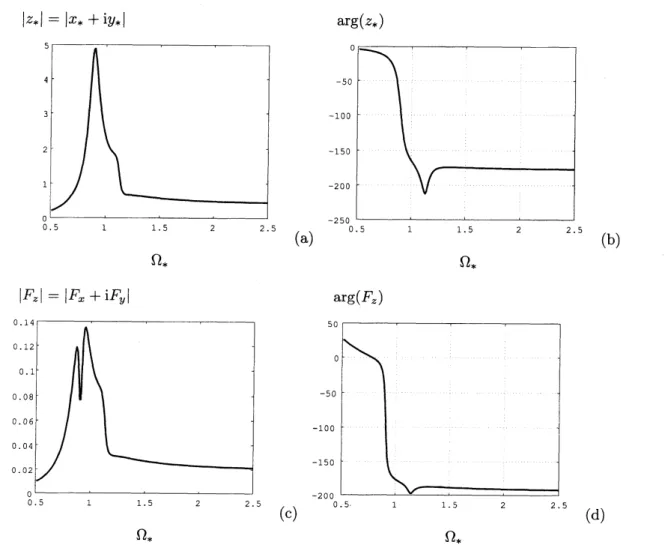
Vessel deflection components $x_{*},$ $y_{*}$ and fluid force components $F_{x},$ $F_{y}$ are shown in Fig. 2,
parts (a) and (c). Here $\Omega_{*}$ is anon-dimensionalvessel rotational speed, defined by $\Omega_{*}=\Omega/\omega_{S},$
with $\omega_{s}$ beingthe critical rotational speed for the empty rotor.
Part (b) and (d) show the phase angle of the vessel deflection $(\varphi_{d}, say)$ and ofthe resultant
fluid force $(\varphi_{f}, say)$, respectively. The phase angle of the deflection starts, by small rotational
speeds, at$\varphi_{d}\approx 0$; that is, thedeflectionisin thedirectionof the unbalanced
mass.
Uponpassingthroughresonance thephase angle shifts approximately $180^{o}$
.
(Byzooming inonthe graphtheprecisevalue $\varphi_{d}=-177^{0}$isfound.) The phase angleof the resultant fluid force (shown byafull
$|z_{*}|=|x_{*}+iy_{*}|$ $\arg(z_{*})$ (a) (b)
$\Omega_{*} \Omega_{*}$
$|F_{z}|=|F_{x}+iF_{y}|$ $\arg(F_{z})$ (c) (d)$\Omega_{*} \Omega_{*}$
Figure 2: Vessel deflection and fluid force amplitudes $(a, c)$ and phase angles $(b, d; in$ degrees)
as functions ofthe angular velocity $\Omega_{*}.$
Thus, after thepassagethroughresonance, the resultantfluidforcestarts to work against the
unbalanced mass, tendingto generate a deflection which is opposed tothe deflection generated
by the unbalanced mass. This explains the basic dynamics ofthe fluid balancer.
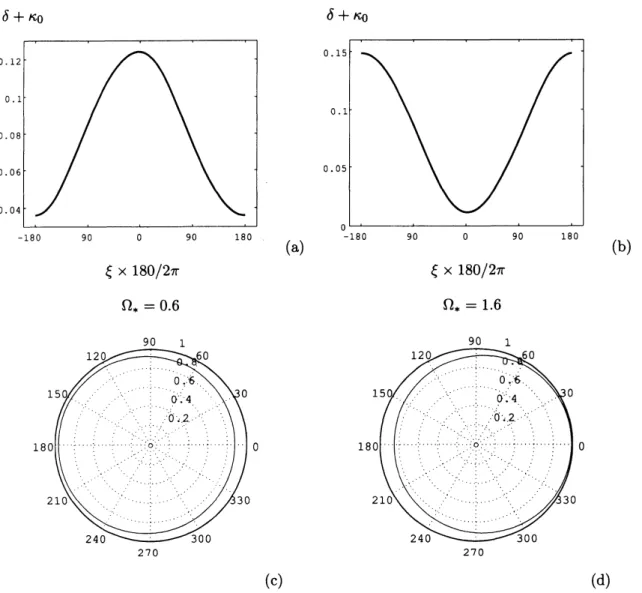
Fig. 3 shows the liquid surface, described by the non-dimensional parameters $\delta+\kappa_{0}$, fora
sub-criticalvalue of$\Omega_{*}(\Omega_{*}=0.6)$inparts (a) and (c); and forasuper-criticalvalue$(\Omega_{*}=1.6)$in
parts (b) and(d). [Parts (a) and (b) givean‘outfolded’representationin rectangular coordinates,
while parts (c) and (d) give a more physical representationin polar coordinates.]
It is noted that ‘unphysical’ solutions can be generated around $\Omega_{*}\approx 1$, in the sense that
$\delta+\kappa_{0}(\xi)$ (which should be $>0$ for all $\xi$) can become $<0$ at certain values of$\xi$. The problem has been reported and discussed also by Jung et al. (2008) and Urbiola-Soto and Lopez-Parra
(2011). In order to avoid it, constraints on the form $\delta+\kappa_{0}(\xi)>0$ should be imposed at a
relatively large number of values of$\xi$ around the circumference. This will implythat there will be (many) moreequationsthan unknowns andwillin turnrequirethat the Newton method (37) is replaced by, for example, a least squares methodology. We prefer, however, to avoid this at
thepresent stage. The issue does not cause any ‘singular’ behavior in the equation system and
Retuming to Fig. 3, initially $(at time t_{*}=0, say)$ the unbalanced
mass
is located at $\xi=0,$in a coordinate system moving with the whirl (i.e., with the angular velocity $\omega-\Omega$, or $\tilde{\omega}-1$
in terms of non-dimensional parameters). Thus, a wave top is located at the position of the
unbalanced
mass
by the sub-critical rotational speed, and opposite of the unbalancedmass
bythesuper-critical rotational speed, just
as
illustrated in Fig. 1. There is however a slow drift’withangularvelocity $1-\tilde{\omega}$
.
Thisundesirable phenomenon has been verified inexperiments, andvarious remedies have been considered in order to prevent it, e.g. a hexagon-shaped channel
and separator plates (Nakamura, 2009).
$\delta+\kappa_{0}$ $\delta+\kappa_{0}$
$-180$ 90 $0$ 90 180
(a) (b)
$\xi\cross 180/2\pi \xi\cross 180/2\pi$
$\Omega_{*}=0.6 \Omega_{*}=1.6$
$270 270$
(c) (d)Figure 3: The fluidlayer in thevessel, described by$\delta+\kappa_{0}$, in terms of‘rectangular’ plots (a, b)
and polar plots (c, d). The unbalanced
mass
is initially $(at time t_{*}=0, say)$ located at $\xi=0.$Parts (a) and (c) show the fluid layer before
resonance
$(\Omega_{*}=0.6)$ and parts (b) and (d) the5
Conclusion
The dynamics of the fluid balancer has been investigated basedon a modelofatwo
degrees-of-freedom rotor containing asmallamount ofliquid. The thininternalfluidlayer,which forms due
tothe rotation,is describedinterms of shallowwaterwavetheory. $A$perturbation approachgives
that the fluid layer thickness perturbation is described by a forced Korteweg-de Vries-Burgers
equation. This equationis solved- approximately-also by a perturbation approach. The first approximationinvolves$a$ (single) cnoidalwavesolution of the (homogeneous) Korteweg-de Vries
equation. The next term in the approximationis govemed bya forced Mathieu equation. The fluid and rotor equations are coupled by integrating the fluid pressure over the inner
vesselsurface. The phase anglefunctionofthe resultant fluidforcehasa behaviorthatresembles
theexperimentallyobtained function (Nakamura, 2009). In particular, it isconfirmed that,when
the unbalanced
mass
initially is placed at the angular position $\varphi=0$ (ina
coordinate systemmoving with the whirl), the phase angle of the resultant fluid force moves from $\varphi=0^{o}$ at
subcritical rotational speeds to $\varphi=180^{0}$ at supercritical speeds; that is, after passage through
resonance. As observed in experiments, there is however a drift of the resultant fluidforce.
Finally,itmustbe mentioned that it is notdifficulttofind parameter values where thepresent
numerical approach does not convergence. This suggests that a stable
one-wave
solution doesnot exist (at those parameter values). Numerical simulations $($Kasahara $et al., 2000b)$ suggest
the existence of multi-wave solutions, stillof solitary (or rather, cnoidal) wave type. It is known
(Miura, 1976) that the Korteweg de-Vries equation (9) admits multiple-soliton solutions (in a
doubly infinite domain). It would be interestingto pursue such analytical multi-wave solutions
to the fluid balancerproblem in future research.
References
Abramomitz, M. and Stegun, I. A. (1965). Handbook
of
Mathematical Functions. DoverPubli-cations, Inc., New York.
Bae, S., Lee, J. M., Kang, Y. J., Kang, J. S.) and Yun, J. R. (2002). Dynamic analysis ofan
automatic washing machine with a hydraulic balancer. J. Sound Vib., 257, 3-18.
Berman, A. $S$., Lundgren, T. $S$., and Cheng, A. (1985). Asyncronouswhirl inarotating cylinder
partiallyfilled with liquid. J. Fluid Mech., 150, 311-327.
Bolotin, V. $V$. (1963). Nonconservative Problems
of
the Theoryof
Elastic Stability. PergamonPress, Oxford, $UK.$
Chen, H.-$W$., Zhang, Q., and Fan, S.-$Y$
.
(2011). Studyonsteady-stateresponse ofavertical axisautomatic washing machine with a hydraulic balancer using a new approach and a method
forgetting asmaller deflectionangle. J. Sound Vib., 330, 2017-2030.
Colding-Jrgensen, J. (1991). Limit cycle vibration analysis ofa long rotating cylinder partly
Crandall, S. $H$
.
(1995). Rotor dynamics. In W. Kliemann and N. S. Namachivaya, editors,NonlinearDynamics and Stochastic Mechanics, pages 1-44. CRC Press, Boca Raton.
Den Hartog, J. $P$
.
(1985). Mechanical Vibrations. Dover Publications, Inc. [Orig. 4th Ed. byMcGraw-Hi111956], New York.
Dyer, J. $B$
.
(1945). Domestic appliance. U. S. Patent No. 2,375,635.Green, K., Champneys, A. $R$., and Lieven, N. $J$
.
(2006). Bifurcation analysis of an automaticdynamic balancing mechanism for eccentric rotors. J. Sound Vib., 291, 861-881.
Green, K., Champneys, A. $R$., Friswell, M. $I$., and Munoz, A. $M$
.
(2008). Investigation ofa
multi-ball, automatic dynamic ballbalancing mechanism for eccentric rotors. Phil. Trans. $R.$
Soc. $A,$ $366,705-728.$
Hendricks, S. $L$
.
and Morton, J. $B$.
(1979). Stability of a rotor partially filled with a viscousincompressiblefluid. J. Appl. Mech., 46, 913-918.
Holm-Christensen, O. and Tr\"ager, K. (1991). $A$ note on rotor instability caused by liquid
motions. J. Appl. Mech., 58, 804-811.
Ince, E. $L$. (1940a).
.The
periodic Lam\’efunctions. Proc. $Roy$.
Soc. Edinburgh, 60,47-63.
Ince, E. $L$
.
(1940b).2Further
investigations into the periodic Lam\’e functions. Proc. $Roy$.
Soc.Edinburgh, 60, 83-99.
Ince, E. $L$
.
(1956). OrdinaryDifferential
Equations. Dover Publications, Inc., New York.Jung, C.-$H$., Kim, C.-$S$., and Choi, Y.-$H$
.
(2008). $A$ dynamic model and numerical studyon
theliquid balancer used in an automatic washing machine. J. Mech. Sci. Tech., 22,
1843-1852.
Kasahara, M., Kaneko, S., Oshita, K., and Ishii, H. (2000a). Experiments ofliquidmotion in a
whirling ring. In Proceedings
of
the Dynamics and DesignConference
2000, 5-8August 2000,pages 1-6, Tokyo, Japan. Japan Soc. Mech. Eng.
Kasahara, M., Kaneko, S., and Ishii, H. (2000b). Sloshing analysis of
a
whirling ring. InProceedings
of
theDynamics and DesignConference
2000, 5-8August 2000, pages1-6, Tokyo,Japan. Japan Soc. Mech. Eng.
Langthjem, M. $A$. andNakamura, T. (2011). Dynamics ofthefluid balancer. RIMSKokyoroku,
1761, 140-150.
Leblanc, M. (1916). Automatic balancer for rotating bodies. U. S. Patent No. 1,209,730.
Lighthill, J. (1978). Waves in Fluids. Cambridge University Press, Cambridge, $UK.$
Majewski, T. (2010). Fluid balancer fora washingmachine. In Proceedings
of
the XVIIntema-tional Congress, pages 1-10. SOMIM (Societyof Mechanical Engineers ofMexico).
Miura, R. $M$
.
(1976). The Korteweg-de Vries equation: $A$ survey of results. SIAMReview, $1S,$Nakamura, T. (2009). Study ontheimprovement of the fluid balancerof washing machines. In
Proceedings
of
the 13thAsia-Pacific
Vibrations Conference, 22-25 November 2009, pages1-8.University ofCanterbury, New Zealand.
Nayfeh, A. $H$
.
(2004). Perturbation Methods. Wiley-VCH Verlag, Weinheim.Thearle, E. (1932). $A$new type of dynamic-balancing machine. Trans. ASME, 54, 131-141.
Urbiola-Soto, L. andLopez-Parra, M. (2011). Dynamic performanceof the Leblanc balancerfor
automatic washing machines. J. Vibr. Acoust., 133,
041014-1-041014-8.
vandeWouw, N.,vanden Heuvel, M.$N$., Nijmeijer, H., andvanRooij,J.$A$. (2005). Performance
ofan automatic ball balancer with dry friction. Int. J.
Bifurcation
and Chaos, 15, 65-82.Whitham, G. $B$
.
(1999). Linear and Nonlinear Waves. Wiley-Interscience, New York.Whittaker, E. $T$
.
and Watson, G. $N$.
(1927). A Courseof
Modern Analysis. CambridgeUniver-sity Press, Cambridge, $UK.$
Wolf, Jr., J. $A$. (1968). Whirl dynamics of a rotor partially filled with liquid. J. Appl. Mech.,
35, 676-682.
Yoshizumi, F. (2007). Self-excited vibration analysis of a rotating cylinder partiall filled with
liquid (Nonlinear analysis by shallow watertheory). Trans. Japan Society