Periodic Solutions
of the Forced Burgers
Equation
1
Problem
We consider the forced Burgers equation
早稲田大学
(Waseda University)
西田孝明
(Takaaki Nishida)
[email protected]
早稲田大学
(Waseda
University)
曽我幸平
(Kohei Soga)
[email protected]
(1.1) $u_{t}(x, t)+u(x, t)u_{x}(x, t)=F_{x}(x, t)$,
where the forcing term $F_{x}$ is the partial derivative of
a
given $C^{2}$-function
$F$ whichis periodic in both $x$ and $t$ with the period 1. The problem is to find $\mathbb{Z}^{2}$-periodic
(weak) solutions of (1.1), namely periodic solutions with the period 1 in both $x$ and $t$,
in constructive ways. Our basic tool is the Lax-Friedrichs difference scheme. We present
two methods of constructing $\mathbb{Z}^{2}$-periodic
solutions of (1.1): Tlie one is based on the long
time behavior of the Lax-IFlriedrichs difference scheme. The other is based
on
Newton’smethod, regarding$\mathbb{Z}^{2}$-periodic
solutions
as
fixed
pointsof thePoincar\’emap
derived fromthe $Lax- Riedric\cdot hs$ scheme. We give
convergence
proofs to these methods and simulate $\mathbb{Z}^{2}$-periodic solutions.
It is known that there is
an
interesting connection between the forced Burgersequa-tion and Hamiltonian dynamics. One of the central issues in the theory ofHamiltonian
dynamics is to look for their invariant manifolds. The graph of
a
$\mathbb{Z}^{2}$-periodic
solu-tion to (1.1) plays
an
important role in the issue. We also simulate trajectories of theHamiltonian dynamics corresponding to the forced Burgers equation and $vis^{\backslash }ualize$ their
connection.
2
Background
In this section
we
state the history ofour
problem. Letus
goback
toBoltzmann’s
statistical mechanics.
Boltzmann
tried to derive thermodynamics from the dynamics ofparticles. The dynamics of particles is governed by Hamiltonian systems
(2.1) $x’(s)=\mathcal{H}_{y}(x(s), y(s))$, $y’(s)=-\mathcal{H}_{x}(x(s), y(s))$,
where the
Hamiltonian
$\mathcal{H}(x, y)$ : $\mathbb{R}^{2n}arrow \mathbb{R}$ is the total energy of particles. Becauseof the energy conservation law, each trajectory $(x(\backslash 9), y(s))$ of (2.1) is trapped
on
the$2n-1$-dimensional energy level set
In
order
toderive
thermodynamical variables such $u$ entropy, temperature, pressure,etc., it is required that
for
eachfunction
$G(x, y)$ the following equalityholds:
$<$ time-average
of
$G$ along any trajectoryon
$\Sigma_{h}>=$ $<$ space-averageof
$G$on
$\Sigma_{h}>$.
This is possible, if each trajectory on $\Sigma_{h}$ passes through all the points
of
$\Sigma_{h}$ (Boltzmann’sergodic hypothesis). After this hypothesis was presented, many mathematicians started
to analyze the ergodic problems and improved Boltzmann’s ergodic hypothesis (see [4]),
Although $tI_{1}e$ consequences of tlie ergodic properties of the equations (2.1)
come
out,it is not easy to find Hamiltonian systems with the ergodic properties. As
an
example,let us consider harmonic lattices, which
are a
model of crystals. In thecase
of thel-dimensional harmonic lattice with fixed end points, its total energy is given by
(2.2) $\mathcal{H}(x, y)=\sum_{i=1}^{r\iota}\frac{1}{2}y_{i}^{2}+\frac{1}{2}\kappa^{i}x_{1}^{2}+\sum_{i=1}^{n-1}\frac{1}{2}\kappa(x_{i+1}-x_{i})^{2}+\frac{1}{2}\kappa^{r}x_{r\iota}^{2}’$.
We
can
find $t\mathfrak{l}_{1}e$ symplectic transform: $(x, y)\mapsto(\tilde{x},\tilde{y})w1\downarrow ic\cdot\}_{1}$ decornposes the motions ofthe system (2.1) into the normalmodes. The
new
Hamiltonian $\tilde{\mathcal{H}}$takes the simpler form
$\tilde{\mathcal{H}}(\tilde{x},\tilde{y})=\sum_{i=1}^{r}\frac{1}{2}\omega_{i}(\tilde{x}_{i}^{2}+\tilde{y}_{i}^{2})$ ($\omega=(\omega_{1},$ $\cdots,$$\omega_{n})$ is constant).
By the symplectic polar coordinates $(q,p)\in T^{n}\cross(\mathbb{R}_{+})^{n},$ $T^{n}:=\mathbb{R}^{n}/2\pi \mathbb{Z}^{n}$ defined by
$\tilde{x}_{i}=\sqrt{2p_{i}}\sin q_{i}$, $\tilde{y}_{i}=\sqrt{2p_{i}}\cos q_{i}$,
$\tilde{\mathcal{H}}$
changes into
$H(q,p)= \sum_{i=1}^{n}\omega_{i}p_{i}:T^{n}\cross(\mathbb{R}_{+})^{n}arrow \mathbb{R}$.
Therefore each trajectory is given by
$(q(s),p(s))=(\omega s+q(O),p(O))$ niod $2\pi$,
which implies for any $s\in \mathbb{R}$
$(q(s),p(s))\in \mathcal{I}:=T^{n}\cross\{p(0)\}$.
$Eac\cdot I\iota$ trajectory is $traI$)$ped$ on an $r\iota$
-dirnensional
torus and cannot be ergodic!Fermi, Pasta and Ulam [2] made numerical siniulatioiis to anharmonic lattices which
have non-quadratic potential energy in addition to (2.2). In the anharmonic cases, the
above reduction yields the Hamiltonian of the form
$H(q,p)= \sum_{i=1}^{n}\omega_{i}p_{i}+H_{1}(q,p):T^{n}\cross(\mathbb{R}_{+})^{n}arrow \mathbb{R}$,
where $H_{1}$ is a perturbation due to the anharmonic potential
energy.
Since $H_{1}$ dependson
$q$, it is difficult to give expression of each trajectory $(q(s),p(s))$.
They expectedresults, however, suggested strongly that $7nar\iota y$ trajectories
of
anharmonic lattices arestill trapped on slightly
deformed
n-dimensional
tori and not ergodic.Nishida [7] showedthat the $KAM$theory, stated later, is applicabletothe anharmonic
lattices and proved that there exist the
deformed
n-dimensionaltorion
which trajectoriesare
trapped.Existence of such deformed n-dirnensional tori is significant to an understanding of
the stability or instability of
Hamiltonian
dynamics. Nowwe
give a brief description ofthe problem of the search for such deformed n-dimensional tori.
We consider $C^{2}$
-Hamiltonians
(2.3) $H(q,p):T^{r\iota}\cross Darrow \mathbb{R},$ $T^{n}:=\mathbb{R}^{n}/\mathbb{Z}^{n},$ $D\subset \mathbb{R}^{n}$
and
Hamiltonian
systerns(2.4) $q’(s)=H_{p}(q(s)\}p(s))$, $p’(s)=-H_{q}(q(s),p(s))$
.
The solution (trajectory) of (2.4) with
an
initial value $(\theta, I)\in T^{n}\cross D$ isdenoted
by$\phi_{H}^{s}(\theta, I)$,
where $\phi_{H}^{s}$ is the flow of (2.4). A manifold $\mathcal{I}$is called
a
$\phi_{H}^{S}$-invariant
manifold
diffeomor-phic to $T^{n}$
or
just$\phi_{H}^{s}$-invariant $n$-torws, if $\mathcal{I}$ is
an
ernbedded$n$-dimensional torus by
a
smooth embedding: $T^{n}arrow T^{n}\cross D$ and satisfies for each $s$
$\phi_{H}^{s}(\mathcal{I})\subset \mathcal{I}$
.
First,
we
consider the simplecase
where Hamiltoniansare
of the form$H(q,p)=H_{0}(p)$
.
It is proved that, in “general”, Hamiltonians of integrable Hamiltonian systems
can
bebrought intothe
above
form byan
appropriate symplectic transform (e.g.,see
[6]). Theharmonic lattice is an example of integrable Hamiltonian systems. Each trajectory is
represented by
$\phi_{H}^{s}(\theta, I)=(\partial_{p}H_{0}(I)s+\theta,$ $I)mod 1$,
where $\partial_{p}H_{0}$ is thegradient of$H_{0}$.
Hence we can
find $\phi_{H}^{s}$-invariant n-torus for each $I\in D$$\mathcal{I}:=T^{n}\cross\{I\}$,
which implies that the phase space $T^{n}\cross D$ is foliated by these tori, namely
$T^{n}\cross D=\cup \mathcal{I}$
.
Each $\mathcal{I}$ carries trajectories
$(q(s), p(s))$, which
are
just straight lines with thesame
slope$\lambda:=\lim_{|s|arrow\infty}\frac{\tilde{q}(s)}{s}=’\partial_{p}H_{0}(I)$,
where $q(s)=\tilde{q}(s)mod 1$. $\lambda$ is called the frequency vector of the
Next
we
consider the perturbed Hairiiltonians$(2_{\iota}^{r}))$ $H(q,p)=H_{0}(p)+H_{1}(q,p)$ : $T^{n}\cross Darrow \mathbb{R}$,
where $H_{1}$ is
a
perturbation. Because of the so-called small divisor problem, people haddifficulties in proving existence of $\phi_{H}^{\theta}$-invariant $r\iota$-tori for (2.5). In 1954, Kolmogorov
brouglit the great progress. His arguments
were
completed byArnoldarid Moser, whichisnow
well-knownas
theKAM theory. Oneof the main assertion ofthe KAMtheory isthatthere exist the $\phi_{H}^{s}$-invariant n-tori carrying trajectories with the strongly nonresonant
frequency vectors:
The KAM
Theorem
([5][1]).Let
$D$ bea bounded
connected closed domainof
$\mathbb{R}^{n}$.
Suppose $(A 1)-(A3).\cdot$
$(A1)H(q, p)=H_{0}(p)+H_{1}(q,p)$ is analytic $or\iota$ a complex neighborhood $G$
of
$T^{n}\cross D$,$(A2)H_{0}$ is nondegenerate, namely the Hessian matrix
of
$H_{0}$ has rank $n$on
$D$,(A3) $\Vert H_{1}\Vert=\sup_{G}|H_{1}(q,p)|$ is sufficiently small.
Then there exists afamily
of
$KAM$n-tori $\mathcal{I}wf\iota ose$ unionsatisfies
thefollowingmeasure
estimate:
mes$[\cup \mathcal{I}]arrow$
mes
$[T^{n}\cross D]$ as1
$H_{1}\Vertarrow 0$,where
a
$KAM$ n-torus $\mathcal{I}$ is a$\phi_{H}^{8}$-invariant
manifold
diffeomorphic to $T^{n}$ which is aLagrangian
sub-manifold
and
$ca$rries quasi-periodic trajectories with thesame
frequencyvector $\lambda$ satisfying the Diophantine condition.
The developments of the
KAM
theory within halfa
centuryare
collected in [9]. TheKAM
theory leaves interesting questions: What is going on in the region $I^{n}\cross D\backslash \cup \mathcal{I}$?What happens for large perturbations? Nurnerical studies tell
us
that tliereare
irregulartrajectories called “chaos”, which sometimes
seem
to be ergodic in Boltzmann’ssense.
Finally
we
search for $\phi_{H}^{\delta}$-invariant n-tori in the generalcase
with $C^{2}$-Hamiltonians(2.3). We restrict ourselves to the manifolds diffeomorphic to $\nu_{J1^{n}}$ which
are
of the form(2.6) $\{(q, \partial S(q))|q\in T^{r\downarrow}\}$,
where $S$ : $\mathbb{R}^{n}arrow \mathbb{R}$ is
a
$C^{2}$-function with the $\mathbb{Z}^{n}$-periodic gradient $\partial S$.
Note that theyare
Lagrangian sub-manifolds. It is easily proved that each KAM n-torus takes the form(2.6) with
a
real analytic function $S$ satisfying the Hamilton-Jacobi equation(2.7) $H(q, \partial S(q))=h$ in $\mathbb{R}^{n}$ ($h$ is constant)
with the real analytic Hamiltonian $H(q,p)=H_{0}(p)+H_{1}(q,p)$
.
Letus
consider theHamilton-Jacobi equations (2.7) with general $C^{2}$-Hamiltonians. Note that each solution
of the
Hariiiltoniari
system (2.4) is part of thecharacteristics
of (2.7). The followingassertion is well-known: Let $H$ : $T^{n}\cross Darrow \mathbb{R}$ and $S:\mathbb{R}^{n}arrow \mathbb{R}$ be a $C^{2}$
-function.
Thenthe graph
of
$\partial S(q)$$\mathcal{I}_{\partial S}:=\{(q, \partial S(q))|q\in T^{n}\}$
is
a
$\phi_{H}^{S}$-invariantmanifold
diffeomorphic to $\mathbb{T}^{n}$,if
and onlyif
$S$ isa
$C^{2}$-solutionof
have the following: Let $S$ be a $C^{2}$-solution
of
theHamilton-Jacobi
equation $(6l.7)$ withthe $\mathbb{Z}^{n}$-periodic gradient
$\partial S(q)$
.
If
$n=2$ and $H$satisfies
the relation $H(q_{1}, q_{2_{7}}p_{1},p_{2})=h\Leftrightarrow p_{2}=f(q_{1)}q_{2},p_{1};h)$,then $u(q)$ $:=S_{q_{1}}(q)$ is a $\mathbb{Z}^{2}$-periodic $C^{1}$
-solution
of
the scalar conservation law(2.8) $\partial_{q_{2}}’u(’.q_{1}, q_{2}, u(q_{1}, q_{2}’))\}$ in $\mathbb{R}^{2}$
and the graph$\mathcal{I}_{\partial S}$ is represented by
$\mathcal{I}_{\partial S}=\{(q, u(q), f(q, u(q);h))|q\in T^{2}\}$
.
A $C^{1}$-solution of (2.8) yields a $C^{2}$-solution ofthe corresponding
Hamilton-Jacobi
equa-tion. Of
course
we
cannot always expect classicalsolutions
of theHamilton-Jacobi
equations (2.7)
or
tfie scalar conservation laws (2.8). This implies that we may have nouniversal methods
of
searchingfor
the $\phi_{H}^{s}$-invariantn-tore
we
are
concemed with,even
no
such tori.An interesting question arises: what is the relation among regular/chaotic properties
of
the Hamiltonian systems (2.4), viscosity solutionsof
the Hamilton-Jacobi equations(2.7) and entropy solutions
of
the scalar conservation laws (2.8).We consider this question taking
a
simple example ofa
nonlinear pendulum in theextended phase space with the
Hamiltonian
of theform
(2.9) $H(q_{1}, q_{2},p_{1},p_{2})= \frac{1}{2}p_{1}^{2}+p_{2}-F(q_{1}, q_{2}):T^{2}\cross \mathbb{R}^{2}arrow \mathbb{R}$
.
We
assume
that $F$ is a $C^{2}$-function. The corresponding scalar conservation law (2.8)becomes the
forced
Burgers equation (1.1):$u_{t}(x, t)+u(x, t)u_{x}(x, t)=F_{x}(x, t)$,
replacing the variables $(q_{1}, q_{2})$ with $(x, t)$
.
The Hamiltonian system for (2.9) is reducedto the nonautonomous
Hamiltonian
system(2.10) $X’(s)=U(s)$, $U’(s)=F_{x}(X(s), s)$,
whichgivesthe
characteristics
of (1.1). We focusour
attentiononthe connectionbetween$\mathbb{Z}^{2}$
-periodic entropy solutions of (1.1) and the dynamics of (2.10).
Jauslin, Kreiss and Moser [3] obtained $\mathbb{Z}^{2}$
-periodic solutions of (1.1) by the vanishing
viscosity method. They also pointed out several interesting open problems
on
the forcedBurgers equation and the corresponding Hamiltonian dynamics. They considered the
parabolic equations with the periodic boundary condition
(2.11) $u_{t}^{\nu}(x, t)+u^{\nu}(x, t)u_{x}^{\nu}(x, t)=F_{x}(x, t)+\nu u_{xx}^{\nu}(x, t)$ in $T\cross \mathbb{R}_{+}$,
where $\nu>0$ is an artificial viscosity. Using the long time behavior ofsolutions to (2.11),
they proved the following: For each $\nu>0$ and $C\in \mathbb{R}$ there exists the unique $\mathbb{Z}$-periodic
in $t$ solution$\overline{u}^{\nu}\in C^{2}$ to (2.11) such that
for
all $t\in \mathbb{R}$Moreover there is a sequence
$\overline{u}^{1}$ノ
$t\in\{\overline{u}^{\nu}|\nu>0, <\overline{u}^{\nu}>=C\}$
with $\nu_{i}arrow 0$ which converges to a $\mathbb{Z}^{2}$-penodic entropy solution $\overline{\iota\nu}$
of
(1.1) $with<\overline{u}>=C$in the $C^{0}(T;L^{1}(T))$-topology.
Takeno [10] also obtained $\mathbb{Z}^{2}$-periodic solutions of
(1.1) by the Lax-Friedrichs
differ-ence
scheme and Brouwer’s fixed point theorem. He regarded approximate $\mathbb{Z}^{2}$-periodicsolutions of (1.1)
as
fixed points of the Poincar\’e map derived from the Lax-Friedrichsdifference scheme and showed existence of these fixed points by Brouwer’s fixed point
theorem.
$E[11]$ made clear the connection between $\mathbb{Z}^{2}$-periodic solutions of (1.1)
and
regularmotions of the corresponding Hamiltonian system. His results include
a
flow
versionof
the Aubry-Mather theory
for
twist maps. Let $\overline{u}$ be a$\mathbb{Z}^{2}$-periodicentropy solution of (1.1)
with $<\overline{u}>=C$ and $c(s)$ $:=(\tilde{X}(s), s, U(s))mod 1$ be characteristic
curves
derived fromthe equations (2.10). He proved the following: Each characteristic
curve
$c(s)$ which isdefined
on
$(-\infty, \tau]$ with $\tau\in[0,1]$ andsatisfies
the initial condition$c(\tau)\in graph(\overline{u})$ $:=\{(x, t,\overline{u}(x, t))|(x, t)\in T^{2}\}$
is trapped
on
graph$(\overline{u})$ and never absorbed by the shocksof
$\overline{u}$.
The motionof
$c(s)$ ongraph$(\overline{u})$ is characterized by the asymptotic slope
$s arrow-\infty 1i_{IIl}\frac{\tilde{X}(s)}{s}=\alpha(C)$,
where $\alpha(C)$ depends only on the average
C.
Moreover there exist charactertsticcurves
$c^{*}(s)=(\tilde{X}^{*}(s), s, U^{*}(s))mod 1$
defined
on
$\mathbb{R}$ with thesame
asymptotic slope$\lim_{|s|arrow\infty}\frac{\tilde{X}^{*}(s)}{6}=\alpha(C)$
which are trapped
on
$gr\cdot apf\iota(\overline{u})$ andnever
$absor\cdot bed$ by the shocks. For any given $\alpha\in \mathbb{R}$there exists $C\in \mathbb{R}$ such that $\alpha(C)=\alpha$. Note that if $\overline{u}$ is a $C^{1}$-function, then any $c(s)$
with an initial condition on graph$(\overline{u})$ is trapped on it for any $s\in \mathbb{R}$. In the original
$pha\backslash e$space $T^{\prime z}\cross D$ with the Hamiltonian (2.9), these results
mean
that for each $h\in \mathbb{R}$the set
$\mathcal{I}_{\overline{u}}:=\{(q,\overline{u}(q), h-\frac{1}{2}\overline{u}(q)^{2}+F(q))|q\in T^{2}\}$
is $\phi_{H}^{s}$-backward-invariant. Moreover there exists a $\phi_{H}^{S}$-invariant closed set $\Gamma^{*}\subset \mathcal{I}_{\overline{u}}$, on
which each trajectory has the frequency vector
$\lambda=(\alpha(C), 1)$.
Note that if $\overline{u}$ is
a
$C^{1}$-function, then $\mathcal{I}_{\overline{u}}$ isa
$\phi_{H}^{S}$-invariant manifold diffeomorphic to $T^{2}$.
3
Main Results
Analytical results. We make
use
ofthe two-step $Lax- R\dot{n}edr\dot{v}chs$difference
scheme on$T\cross \mathbb{R}_{\geq 0}\ni(x, t)$: Let $N,$ $K$ be natural numbers. We define the mesh sizes
as
We set $x_{n};=r\iota\Delta x\in[0,1](n=0,1,2, \cdots, N)$ arid $t_{k}:=k\Delta t\in[0, +\infty)(k=$ $0,1,2,$ $\cdots)$
.
The solution to the initial value problem of (1.1)$\{\begin{array}{l}u_{t}(x_{1}t)+u(x, t)u_{x}(x, t)=F_{x}(x, t) in T\cross \mathbb{R}_{+},u(x, 0)=g(x) on T\end{array}$
is replaced with the vectors
$u^{k}=(u_{0}^{k}, u_{1}^{k}, \cdots, u_{N-1}^{k})\in \mathbb{R}^{N}(k=0,1,2, \cdots)$
called the
difference solution
with the initial value$u^{0}=(g(x_{0}), \cdots, g(x_{N-1}))$
.
Each difference solution $u^{k}$ with
an
initial value $u^{0}\in \mathbb{R}^{N}$ is determined in the following$\tau_{l}=l\Delta\tau\in[0,$
$+ \infty(l\prime_{=}0, 1,2,\cdot\cdot).Weway:Let\Delta y:=\frac{1}{2,)}\Delta x_{\dot{1}}y_{m}:=.m\triangle y\in[0_{J}l](mdefine=0,1,2, \cdots, 2N),$ $\Delta\tau:=\frac{1}{2}\triangle t$ and
$u_{n}^{k}:=lt_{2n}^{r2k}$
ノ,
where $W_{rn}^{l}$
are
computed for $l+rn=even$ by the difference equation$\{\begin{array}{l}\frac{W_{rr\iota+1}^{l+1}-\frac{(W_{rr\iota+2}^{l}+W_{rr}^{\ell})}{\Delta\tau 2}}{}+\frac{1}{2}\frac{(\prime}{2\Delta y}=\frac{F(\tau_{l},y_{rn+2})-F(\tau_{l},y_{rr\iota})}{2\Delta y},W_{2N\pm m}^{l}=W_{\pm m}^{l},W_{2n}^{0}=u_{n}^{0}.\end{array}$
We put $u_{N\pm n}^{k}=u_{\pm n}^{k}$
.
The maps: $u^{0}\mapsto u^{k}$ arid $W^{0}\mapsto W^{l}$are
denoted by$\psi^{k}:\mathbb{R}^{N}arrow \mathbb{R}^{N}$, $\Psi^{l}:\mathbb{R}^{N}arrow \mathbb{R}^{N}$
respectively.
Since
$F$ is $\mathbb{Z}^{2}$-periodic, we have the Poincar\’e map (or the time-l map)
$\phi:=\psi^{K}=\Psi^{2K}$
.
Note that $\psi^{k},$ $\Psi^{l},$$\phi$ are $C^{2}$ and $\psi^{KT+k}=\psi^{k}0\phi^{T}$ for each $T\in \mathbb{N}$, where $\phi^{T}$ is the
T-iteration
of$\phi$.
We call the following stepfunction
an
approximatesolution
of (1.1):$u_{\Delta}(x, t):=u_{n}^{k}$ for $x\in[x_{n}, x_{n+1}),$ $t\in[t_{k}, t_{k+1}),$ $\triangle=(\triangle x, \Delta t)$
.
It follows from a simple calculation that the average in $x$ ofeach difference solution $u^{k}$
at each $k$ and therefore that of the approximatesolution
$u_{\triangle}(x, t)$ is conservative, namely
$C(u^{0}):= \sum_{n=0}^{N-1}u_{n}^{0}\Delta x\equiv\sum_{n=0}^{N-1}u_{n}^{k}\Delta x\equiv\int_{0}^{1}u_{\Delta}(x, t)dx$
.
The value $C=C(u^{0})$ is called the momentum of solution. $u^{k}(C),$$u_{\Delta}^{C}(x, t)$ denote
$u^{k},$$u_{\Delta}(x, t)$ with the
momentum
$C$.
We
say that $u^{k}$ isa
periodic difference solution,if for all $k=0,1,2,$ $\cdots$
which is equivalerit to $t\}_{1e}$ relation
$\phi(u^{0})=u^{0}$
.
For each $v=(v_{0}, \cdots, v_{N-1})\in \mathbb{R}^{N}$ we set
$\Vert v\Vert_{\infty}:=\max_{1\leq n\leq N-1}|v_{n}|$, $\Vert v\Vert_{1}:=\sum_{n=0}^{N-1}|v_{n}|$, $Var.[v]:= \sum_{n=0}^{N-1}|v_{n+1}-v_{n}|(v_{N}=v_{0})$.
We state analytical results.
Theorem. Let $M$ $:=\sqrt{\max_{(xt)\in R^{2}}F_{xx}(x,t)},$ $r>0,\tilde{r}\geq M$ and
$B_{r,\overline{r}};=\{v\in \mathbb{R}^{N}|$ $-r \leq\sum_{n=0}^{N-1}v_{n}\Delta x\leq r,\max_{0\leq n\leq N-1}\frac{v_{n+1}-v_{n}}{\Delta x}\leq\tilde{r}(v_{N}=v_{0})\}$
.
Initial values $u^{0}ar\cdot e$
restncted
to $B_{r,\overline{r}}$. Fix $ar \cdot bitrar\eta_{1}ly\Delta x=\frac{1}{N},$ $\Delta t=\frac{1}{K}$so
that(3.1) $0< \lambda_{0}\leq\frac{\Delta t}{\Delta x}=\lambda<(r+\tilde{r})^{-1},\tilde{r}<K,$ $\triangle t\leq\Delta x$
for
some
wnstant $\lambda_{0}$.
Then1. For each $u^{0}\in B_{r,\overline{r}}$, there exists the unique
difference
solution $u^{k}=\psi^{k}(u^{0})$, whichsatisfies
for
any $k$rriax
$\underline{u_{n+1}^{k}-u_{n}^{k}}\leq\overline{r}$, $\Vert u^{k}\Vert_{\infty}\leq|C(u^{0})|+\tilde{\gamma\cdot}$, Va$7^{\cdot}$.$[u^{k}]\leq 2\tilde{r}$.
$0\leq n\leq N-1$ $\Delta x$
2. For each $C\in[-r, r]$, there exists the unique pert,odic
difference
solution $\overline{u}^{k}(C)$with the momentum $C$, which
satisfies
for
any $k$$\max_{0\leq n\leq N-1}\frac{\overline{u}_{r\iota+1}^{k}(C)-\overline{u}_{n}^{k}(C)}{\Delta x}\leq M$, $\Vert\overline{u}^{k}(C)\Vert_{\infty}\leq|C|+M$, $Var.[\overline{u}^{k}(C)]\leq 2M$.
3. The stability
of
$\overline{u}^{k}(C)$; For any otherdifference
solution $u^{k}(C)$ with themomen-tum $C$, we have $\Vert u^{k}(C)-\overline{u}^{k}(C)\Vert_{1}arrow 0$ $(karrow\infty)$
.
4.
The asymptotic behavior: For any twodifference
solutions $u^{k}(C),$ $v^{k}(C)$ with thesame momentum $C$,
we
have1
$u^{k}(C)-v^{k}(C)\Vert_{1}arrow 0$ $(karrow\infty)$.5. The decay rate
of
the asymptotic behavior: There exist constants $a>0$ and$\rho<1$depending
on
$\triangle x$ such thatfor
any twodifference
solutions $u^{k}(C),$ $v^{k}(C)$ with thesame
momentum $C$ and $T\in N$,
we
have $\Vert u^{TK}-v^{TK}\Vert_{1}=\Vert\phi^{T}(u^{0})-\phi^{7^{}}(v^{0})\Vert_{1}\leq a\rho^{T}$ .6. Newton’s rnethod is applicable to the equation $\phi(u)=u$.
7. There exists a sequence $\overline{u}_{\Delta}^{C},$ $\in\{\overline{u}_{\Delta}^{C}(t, x)|\Delta x>0, \Delta t>0, (3.1)\}$ with $\triangle_{i}arrow 0$ as
$iarrow\infty$ which converges in the $C^{0}(T;L^{1}(T))$-topology to
a
$\mathbb{Z}^{2}$-periodic entropysolution
$\overline{u}^{C}$
of
(1.1) haveng the momentum C. (The $\mathbb{Z}^{2}$-periodic entropy solution
of
(1.1) havingIdea for proof of
Theorem.
Basically we follow thesame
way as Oleinik’s in [8],where the $\triangle$-independent
one-sided estimate for
$\frac{?\iota_{r\iota+1}^{k}-u_{r\iota}^{k}}{\Delta x}$
is established and then the argument
on
the functions of bounded variation is used.However we need
some
modifications, sincewe
deal with $tI_{1}e$ long timebehavior
ofour
difference scheme
in $T\cross \mathbb{R}_{\geq 0}$ with thefixed
mesh $\Delta=(\triangle x, \Delta t)$, namelywe
consider thelimit $t_{k}arrow\infty$ with the
fixed mesh
$\Delta$ at first and then take the limit $\Deltaarrow 0$.
Theabove
difference scheme has the $numeri\cdot cal$ viscosity. This causes, like the artificial viscosity in
the parabolic equation (2.11), the $\Vert\cdot\Vert_{1}$-contraction for the difference scheme.
Numerical
results. We simulate $\mathbb{Z}^{2}$-periodic solutions$\overline{u}$ of (1.1) and characteristic
curves
$c(s)$ derived from (2.10). Weuse
the long time behavior of the two-stepLax-$\mathbb{R}iedriclis$
difference scllerrle
for the computation of $\overline{u}$ and tfie Rurige-Kutta method for$c(s)$
.
Note thatNewton’s
method is also available for the computation, sincewe
can
calculate the derivative $D\phi(u^{0})$ through the linearized difference equation along $u^{k}$
.
Wetake the following function
as an
example of the forcing term:$F(x, t)=- \frac{1}{10}\cos(4\pi x)\sin(2\pi t)$
.
The following figures show the intersections of graph$(\overline{u})=\{(x, t,\overline{u}(x, t))|(x, t)\in$
$T^{2}\}$ or
curves
$c(s)=(\tilde{X}(s), \backslash \backslash 1, U(s))mod 1$ (of course approximate ones) onto thePoincar\’e sectiori: $Y=0$ in the three-dirnensional space $T^{2}\cross \mathbb{R}\ni$ $(X, Y, Z)$, where
$(x, t),$ $(\tilde{X}(s), s)mod 1$ correspond to $(X, Y)$ and $\overline{u}(x, t),$ $U(s)$ to $Z$.
Figure 1.
Figure 1 shows
a
$\mathbb{Z}^{2}$-periodicsolution $\overline{u}^{C}$ with the
momentum $C=1.O$
.
Since graph(ti)seems to besmooth,
we
expect that any characteristiccurve
$c(s)$ withtheinitialcondition$N$
X
Figure 2.
Figure 2 is formed by a characteristic
curve
$c(s)$ withan
initial conditionon
the graphin Figure 1. The set formed by $c(s)$ numerically coincides with the graph in Figure 1.
This implies tliat $\overline{u}^{c}$
is really smooth.
$N$
X
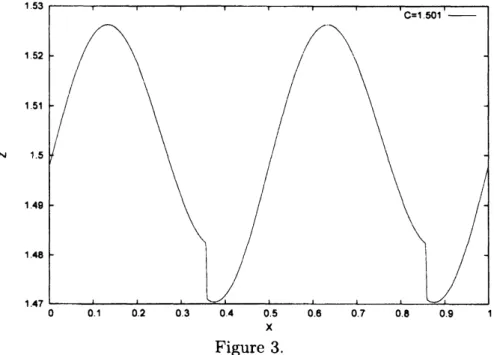
Figure 3.
Figure 3 shows a discontinuous $\mathbb{Z}^{2}$-periodic solution $\overline{u}^{C}$ with $t1_{1}e$
mornentum $C=1.501$
.
We took $N=60000$ as the number of meshes on x-axis in oder to make the shocks
sharpen. The dynamics ofcharacteristic
curves
around thisgraph is visualized in Figure$\triangleright 1$
Figure 4.
In Figure 4,
we
see
twocharacteristic curves
forminga
curve-like set and in betweenthree characteristic
curves
forming a pair of islands. The dynamics may haveon
thePoincar\’e section
a
pair of elliptic points with elliptic islands and a pair of hyperbolicpoints with the stable/unstable curves. We put Figure 3 and 4 together in Figure 5.
$N$
X
Figure 5.
We
can
say that Figure 5 indicates the situation where the smooth parts of thediscon-tinuous graph
are
pieces of the unstablecurves
arid theshocks
are
across
the
ellipticX
Figure 6.
Figure
6
illustrates discontinuous $\mathbb{Z}^{2}$-periodic solutions $\overline{u}^{C}$with the momentum $C=$
0.7, 0.05, $-0.2$. The dynamics around their graph is “chaotic”. The scattered dots
are
formed by a characteristic
curve
$c(s)$ wandering wide range of the space. The previousrelation between $t1_{1}e$ discontinuous graph and $t$}$)e$ unstable
curves
is not so clear.References
[1] V. I. Arnol’d, Proof of
a
theorem of A. N. Kolmogorovon
the persistence ofquasi-periodic motions under small perturbations of the Hamiltonian, Russ. Math.
Surv.
18 (1963), No. 5, 9-36.
[2]
E.
Fermi,J.
Pasta,S.
Ulam,Los Alamos
reportLA-1940.
(InE.
Fermi,Collected
Papers II (1955), Univ. Chicago Press (1965), 977-988.)
[3] H. R. Jauslin, H. O. Kreiss, J. Moser, On the forced Burgers equation with periodic
boundary conditions, Proc. Sympos. Pure Math. 65 (1999), 133-153.
[4] A. I. Khinchin (trans. by G. Gamow), Mathematical foundations of statistical
me-chanics, Dover (1949).
[5] A. N. Kolmogorov, Preservation of conditionally periodic motions for a small change
in Hamilton’s function, Dokl. Akad. Nauk
SSSR
98 (1954), No. 4, 527-530.[6] J. Moser, E. J. Zehnder, Notes on dynamical systems,
Courant
Lecture Notes inMathematics 12 (2005),
[7] T. Nishida, A note
on an
existence of conditionally periodic oscillation ina
[8] O. A. Oleinik, Discontinuous solutions of nonlinear differential equations, A. M. S.
Transl. (ser. 2) 26 (1957), 95-172.
[9] M. B. Sevryuk, The
classical KAM
theory at the dawn of the twenty-first century(To V. I. Arnold
on
the occasion of his 65th birthday), Mosc. Math. J. 3 (2003),no.
3, 1113-1144, 1201-1202.
[10] S. Takeno, Time-periodic solutions for a scalar conservation law, Nonlinear Anal.
45 (2001),
no.
8,1039-1060.
[11] W. $E$, Aubry-Mather theory and periodic solutions of the