Complex Hadamard matrices
attached to
some
association
schemes*
神戸学院大学法学部
生田卓也
Takuya
Ikuta
Department
of
Law,
Kobe
Gakuin
University
東北大学大学院情報科学研究科
宗政昭弘Akihiro Munemasa
Graduate School of Information Sciences,
Tohoku
University
1
Introduction
A complex Hadamard matrix is a square matrix $H$ with complex entries ofabsolute
value 1 satisfying $HH^{*}=nI$, where $*$ stands for the Hermitian transpose and $I$ is
the identity matrix of order $n$. They arethe natural generalization of real Hadamard
matrices. Complex Hadamard matrices appear frequently in various branches of
mathematics and quantum physics.
A type-II matrix, or an inverse orthogonal matrix, is a square matrix $W$ with
nonzero complex entries satisfying $WW^{(-)^{T}}=nI$, where $(x, y)$-entry of $W$ is
defined by $W_{y,x^{-1}}$ Obviously, a complex Hadamard matrix is a type-II matrix.
Complete classifications of complex Hadamard matrices, and of type-II matrices
are only available up to order $n=5$ (see [7, 14, 10 Although it is shown by Craigen
[7] that there are uncountably many equivalence classes of complex Hadamard
ma-trices of order $n$ whenever $n$ is a composite number, some type-II matrices are more
closely related to combinatorial objectsthan the others. Szollosi [16] used design
the-oretical methods to construct complex Hadamard matrices. Strongly regular graphs
were used to construct type-II matrices in [5, 6]. See [15] for a generalization. In this
paper, we construct type-II matrices and complex Hadamard matrices in the
Bose-Mesner algebra of a certain 3-class symmetric association scheme. In particular, we
recover the complex Hadamard matrices of order 15 found in [4].
The method of finding complex Hadamard matrices in the Bose-Mesner algebra
of a symmetric association scheme generalizes the classical work of Goethals and
*Thework of T.I. wassupportedby JSPS KAKENHIgrant number 25400215, and that ofA.M.
Seidel
[9]. Assuming that theassociation
scheme is symmetric, the resulting complexHadamard matrices
are
symmetric. It turns out that this assumption enables us toconsider only the real parts of the entries of a complex Hadamard matrix, since the
orthogonality
can
be expressed in terms of the real parts. Extending this reductionto type-II matrices, we
are
led to consider a rational map whose inverse is explicitlygiven in Section 2. In
Section
3, we explain why only real partscome
into playwhen
we
construct complex Hadamard matrices in the Bose-Mesner algebra of asymmetric association scheme. In Section 4, we consider aparticular family of3-class
association schemes. This family
was
found after extensive computer experimenton
the list of 3-class association schemes up to
100
vertices given in [8]. Surprisingly,most other association schemes up to
100
vertices, with the exceptionsof
amorphicor pseudocyclic schemes, do not admit a complex Hadamard matrix in their
Bose-Mesner algebras. In Section 5, we compute the Haagerup set to show inequivalence
oftype-II matrices constructed in Section 4.
All the computer calculations in this paper were performed by Magma [2].
2
The image
of
a
rational map
We define a polynomial in three indeterminates $X,$$Y,$$Z$ as follows:
$g(X, Y, Z)=X^{2}+Y^{2}+Z^{2}-XYZ-4.$
Lemma 1.
$g( \frac{X}{Y}+\frac{Y}{X}, \frac{X}{Z}+\frac{Z}{X}, \frac{Z}{Y}+\frac{Y}{Z})=0.$
Lemma 2. In the rational
function
field
withfour
indeterminates$X,$$Y,$$Z$ and $z$, thefollowing identities hold:
$w+ \frac{1}{w}=Y+\frac{z^{2}(z^{2}-1)g+c_{1}f}{(z^{2}-1)(zZ-Y)(zX-2)}$, (1) $\frac{z}{w}+\frac{w}{z}=Z+\frac{z^{2}(z^{2}-1)g+c_{2}f}{z(z^{2}-1)(zZ-Y)(zX-2)}$, (2) $ww’=1+ \frac{z^{2}g+(2zX-zYZ+f)f}{z(zZ-Y)(zY-Z)}$, (3) where $f=z^{2}-zX+1,$ $g=g(X, Y, Z)$, $c_{1}=(z^{2}-1)(zX-Z^{2}+2)-(zY-Z)^{2},$ $c_{2}=(z^{2}-1)(zX-Y^{2}+2)-(zZ-Y)^{2},$ $z^{2}-1$
$w=-$
$zZ-Y$’ $w’= \frac{z^{-2}-1}{z^{-1}Z-Y}.$We define a polynomial in six indeterminates $X_{0,1},$ $X_{0,2},$ $X_{0,3},$ $X_{1,2},$ $X_{1,3},$ $X_{2,3}$ as
follows:
$h(X_{0,1}, X_{0,2}, X_{0,3}, X_{1,2}, X_{1,3}, X_{2,3})=\det\{\begin{array}{lll}2 X_{0,1} X_{0,2}X_{0,1} 2 X_{1,2}X_{0,3} X_{1,3} X_{2,3}\end{array}\}$
Lemma 3. In the rational
function field
withfour
indeterminates $X_{0},$ $X_{1},$ $X_{2},$ $X_{3}$, set$x_{i,j}= \frac{X_{i}}{X_{j}}+\frac{X_{j}}{X_{i}} (0\leq i<j\leq 3)$.
Then $h(x_{0,1}, x_{0,2}, x_{0,3}, x_{1,2}, x_{1,3}, x_{2,3})=$ O.
For a finite set $N$ and
a
positive integer $k$,we
denote by $(\begin{array}{l}Nk\end{array})$ the collection of all$k$-element subsets of $N.$
Lemma 4. Let $N=\{0, 1, . . . , d\},$ $N_{3}=(\begin{array}{l}N3\end{array})$ and $N_{4}=(\begin{array}{l}N4\end{array})$. Let $a_{i,j}(0\leq i,j\leq$
$d,$ $i\neq j)$ be complex numbers satisfying
$a_{i,j}=a_{j,i} (0\leq i<j\leq d)$, (4)
$g(a_{i,j}, a_{j,k}, a_{i,k})=0 (\{i,j, k\}\in N_{3})$, (5)
$h(a_{i,j}, a_{i,k}, a_{i,\ell}, a_{j,k}, a_{j,\ell}, a_{k,\ell})=0 (\{i,j, k, \ell\}\in N_{4})$. (6)
Assume
$a_{i_{0},i_{1}}\neq\pm 2$ $forsomei_{0},$$i_{1}$ with $0\leq i_{0}<i_{1}\leq d$. (7)
Let $w_{i_{0}},$ $w_{i_{1}}$ be
nonzero
complex numbers satisfying$\frac{w_{i_{0}}}{w_{i_{1}}}+\frac{w_{i_{1}}}{w_{i_{0}}}=a_{i_{0},i_{1}}$. (8)
Define
complex numbers $w_{i}(0\leq i\leq d, i\neq i_{0}, i_{1})$ by$w_{i}= \frac{w_{i_{1}}^{2}-w_{i_{0}}^{2}}{a_{i_{1},i}w_{i_{1}}-a_{i_{0},i}w_{i_{0}}}$. (9)
Then
$\frac{w_{j}}{w_{i}}+\frac{w_{i}}{w_{j}}=a_{i,j} (0\leq i<j\leq d)$. (10)
Conversely,
if
complex numbers $\{w_{i}\}_{i=0}^{d}$ satisfy (10), then (9) holds.Moreover,
if
$a_{i,j}(0\leq i<j\leq d)$ are all real and$-2<a_{i_{0},i_{1}}<2$, (11)
then $|w_{i}|=|w_{j}|$
for
$0\leq i<j\leq d.$Theorem 1. Let $d,$$N,$$N_{3},$$N_{4}$ be
as
in Lemma 4.Define
$\phi$ : $(\mathbb{C}^{\cross})^{d+1}arrow \mathbb{C}^{d(d+1)/2}$ by $\phi(w_{0}, \ldots, w_{d})=(\frac{w_{i}}{w_{j}}+\frac{w_{j}}{w_{i}})_{0\leq i<j\leq d}$Then the image
of
$\phi$ coincides with thezeros
of
the ideal generated by the polynomials$g(X_{i,j}, X_{j,k}, X_{i,k})=0 (\{i,j, k\}\in N_{3})$, (12)
$h(X_{i,j}, X_{i,k}, X_{i,p}, X_{j,k}, X_{j,\ell},X_{k,\ell})=0 (\{i,j, k, \ell\}\in N_{4})$, (13)
where $X_{i,j}=X_{j,i}.$
The following lemma will be used in the proof of Theorem
2.
Lemma 5. In the rational
function field
with three indeterminates $X_{1},$ $X_{2},$ $X_{3}$, set$x_{i,j}= \frac{X_{i}}{X_{j}}+\frac{X_{j}}{X_{i}} (0\leq i<j\leq 3)$,
where $X_{0}=1$. Then
$(X_{1}X_{2}X_{3}+1)(x_{0,1}x_{0,2}+x_{0,3}-x_{1,2})$
$=(X_{1}X_{2}+X_{3})(x_{0,1}x_{0,2}x_{0,3}+2- \frac{1}{2}(x_{1,2}x_{0,3}+x_{1,3}x_{0,2}+x_{2,3}x_{0,1}))$.
3
Type-II
matrices
contained
in
a
Bose-Mesner
algebra
Throughout this section, we let $\mathcal{A}$ denote a symmetric Bose-Mesner algebra with
adjacency matrices $A_{0}=I,$$A_{1}$, . . .,$A_{d}$
.
Let $n$ be the size of the matrices $A_{i}$, andwe
denote by
$P=(P_{i},)_{0\leq j\leq d}$
the first eigenmatrix of$\mathcal{A}$
.
Then the adjacency matrices are expressedas
$A_{j}= \sum_{i=0}^{d}P_{i,j}E_{i} (j=0,1, \ldots, d)$,
where $E_{0}= \frac{1}{n}J,$ $E_{1}$,
.
..
,$E_{d}$ are the primitive idempotents of$\mathcal{A}$. The secondeigenma-trix
$Q=(Q_{i,j})_{0\leq i\leq d ,0\leq j\leq d}$
is defined
as
$Q=nP^{-1}$, so that$E_{j}= \frac{1}{n}\sum_{i=0}^{d}Q_{i,j}A_{i} (j=0,1, \ldots, d)$
holds. Since $QP=nI$ and $Q_{i,0}=P_{i,0}=1$ for $i=0$, 1,
. .
. ,$d$, we haveLemma 6. Let $w_{0},$$w_{1}$, .
. .
,$w_{d}$ be nonzero complex numbers, and set$W= \sum_{j=0}^{d}w_{j}A_{j}\in \mathcal{A}$, (15)
Then the following
are
equivalent.(i) $W$ is a type-IImatrix,
(ii)
$( \sum_{j=0}^{d}w_{j}P_{k,j})(\sum_{j=0}^{d}w_{j}^{-1}P_{k,j})=n (k=1, \ldots, d)$. (16)
Lemma 7. Let $e_{k}$ be the polynomial in the variables $X_{i,j}(0\leq i<j\leq d)$
defined
by$e_{k}= \sum_{0\leq i<j\leq d}P_{k},{}_{i}P_{k,j}X_{i,j}+\sum_{i=0}^{d}P_{k,i}^{2}-n (k=1, \ldots, d)$. (17)
If
the matrix$W$ given by (15) is a type-II matrix whichis not equivalent to an ordinaryHadamard $matrix_{Z}$ then the complex numbers $a_{i,j}$
defined
by (10) arecommon zeros
of
the polynomials $e_{k}(1\leq k\leq d)$ and satisfy (4)$-(7)$.Conversely,
if
$a_{i,j}(1\leq i,j\leq d)$ arecommon
zerosof
the polynomials $e_{k}(1\leq$$k\leq d)$ and satisfy (4)$-(7)$, then there exist complex numbers $w_{0},$$w_{1}$,
. .
. ,$w_{d}$ satisfying(10) such that the matrix$W$ is a type-II matrix which is not equivalent to an ordinary
Hadamard matrix.
Moreover, the matrix $W$ is a scalar multiple
of
a complex Hadamard matrixwhichis not equivalent to an ordinary Hadamard matrix
if
and onlyif
$a_{i,j}$defined
by (10)are
common
realzeros
of
the polynomials $e_{k}(1\leq k\leq d)$, satisfy (4)$-(7)$ and (11).4
Infinite
families of complex
Hadamard matrices
Let $q\geq 4$ be an integer, and $n=q^{2}-1$
.
We consider athree-class association scheme$\mathcal{X}=(X, \{R_{i}\}_{i=0}^{3})$ with the first eigenmatrix:
$P=[_{1}^{1}11 -2^{2}q^{q_{2}} \frac{q^{2}}{2}-q-q+1 -\frac{q2q}{2}-L^{2}g22 q_{-1}^{-2]}q_{-1}^{-}2$ (18)
For $q=2^{s}$ with an integer $s\geq 2$, there exists a 3-class association scheme with the
first eigenmatix (18) (see [3, 12.1.1]).
Let $\mathcal{M}=\langle A_{0},$ $A_{1},$ $A_{2},$$A_{3}\rangle$ be the Bose-Mesner algebra of $\mathcal{X}=$ $(X, \{R_{i}\}_{i=0}^{3})$. Then, $\mathcal{X}$
has two non-trivial fusion schemes. One is an imprimitive scheme $\mathcal{X}_{1}=$
$(X, \{R_{0}, R_{1}\cup R_{2}, R_{3}\})$ with the first eigenmatrix:
Another is
a
primitive scheme $\mathcal{X}_{2}=(X, \{R_{0}, R_{1}\cup R_{3}, R_{2}\})$ with the first eigenmatrix:$P_{2}=[_{1}^{1}1 -qL^{2}z_{2^{-}}^{-2}22_{-1_{1}} -22g^{2}L^{2}g]$ (20)
Theorem 2. Let $w_{1},$ $w_{2},$$w_{3}$ be
nonzero
complex numbers. The matrix$W=A_{0}+w_{1}A_{1}+w_{2}A_{2}+w_{3}A_{3}\in \mathcal{M}$ (21)
is a type-II matrix
if
and onlyif
one
of
the following holds:(i) $w_{1}=w_{2}=w_{3}$, where
$w_{3}+ \frac{1}{w_{3}}+q^{2}-3=0,$
(ii) $w_{3}$ is as in (i), and
$w_{1}=w_{2}= \frac{-(q-3)w(q-1)}{q^{2}-21},$ (iii) $w_{1}+ \frac{1}{w_{1}}=\frac{2(q^{2}-6)}{q^{2}-4}, w_{2}=-1, w_{3}=w_{1},$ (iv) $w_{1}=w_{3}=1, w_{2}+ \frac{1}{w_{2}}=\frac{-2(q^{2}-2)}{q^{2}},$ (v) $w_{1}+ \frac{1}{w_{1}}=-\frac{2}{q}, w_{2}=\frac{1}{w_{1}}, w_{3}=1,$ (vi) $w_{1}+ \frac{1}{w_{1}}=a_{0,1},$ and
$w_{i}= \frac{w_{1}^{2}-1}{a_{1,i}w_{1}-a_{0,i}} (i=2,3)$,
where $a_{0,1}= \frac{-(q-1)(q-2)+(q+2)r}{2q(q+1)},$ $a_{0,2}= \frac{(q+2)(q-1)-(q-2)r}{2q(q-3)},$ $a_{0,3}= \frac{5q2q-19-(q-1)r}{(q+1)(q-3)},$ $a_{1,2}= \frac{2(-q^{4}+2q^{3}+4q10q+1+(q-1)r)}{q^{2}(q+(q-3)},$ $a_{1,3}=-a_{0,2},$ $r^{2}=(17q-1)(q-1)$
.
Note that $w_{1}w_{2}=-w_{3}$ holds.
Corollary 1. Let $W$ be a type-II matrix in Theorem 2. Then, $W$ is a complex
Hadamard matrix
if
and onlyif
$W$ is given in (iii), (iv), (v), or (vi) with $r=$$\sqrt{(17q-1)(q-1)}>0.$
Chan [4], found three complex Hadamard matrices on the line graph of the
Pe-tersen graph. This is the 3-class association scheme with the first eigenmatrix (18),
where $q=4$, and the three matrices can be described as the matrix $W$ in (21) with
$w_{1},$ $w_{2},$$w_{3}$ given as follows.
$w_{1}=1, w_{2}= \frac{-7\pm\sqrt{15}i}{8}, w_{3}=1$, (22)
$w_{1}= \frac{5\pm\sqrt{11}i}{6}, w_{2}=-1, W_{3}=W_{1}$, (23)
$w_{1}= \frac{-1\pm\sqrt{15}i}{4}, w_{2}=w_{1}^{-1}, w_{3}=1$. (24)
The
cases
(22), (23) and(24) aregiven by (iv), (iii) and(v), respectively, ofTheorem2.Note that (22) is equivalent to the matrix $U_{15}$ in [16].
The complex Hadamard matrix of order 15 constructed in Theorem 2 (vi) seems
to be new. This is obtained by setting $q=4$ and $r=\sqrt{201}$, and has coefficients
$w_{1},$ $w_{2},$$w_{3}=-w_{1}w_{2}$, where $w_{1}+ \frac{1}{w_{1}}=a_{0,1},$ $a_{0,1}= \frac{3}{20}(\sqrt{201}-1)$, $w_{2}= \frac{a_{0,1}w_{1}-2}{a_{1,2}w_{1}-a_{0,2}},$ $a_{0,2}=- \frac{1}{4}(\sqrt{201}-9)$, $a_{1,2}= \frac{3\sqrt{201}-103}{40}.$
We have verified using the span condition [13, Proposition 4.1] that, this matrix, as
well as the one given by (22) are isolated, while the two matrices given by (23) and
(24) do not satisfy the span condition.
5
Equivalence
For a type-II matrix $W$ of order $n$, the Haagerup set $H(W)$ (see [10]) is defined
as
We also
define
$K(W)= \{w+\frac{1}{w}|w\in H(W)\backslash \{1\}\}.$
Two complex Hadamard matrices $W_{1}$ and $W_{2}$ are said to be equivalent if they are
type-II equivalent. It is easy to see that, if$W_{1}$ and $W_{2}$ are equivalent, then $H(W_{1})=$
$H(W_{2})$, and hence $K(W_{1})=K(W_{2})$
.
In this section, we compute the Haagerupsets of type-II matrices constructed in Theorem 2 to conclude that
some
ofthemare
inequivalent to others.
We suppose that
$W= \sum_{i=0}^{d}w_{i}A_{i}$
is
a
complex Hadamard matrix, where $A_{0}$, .. .
, $A_{d}$are
the adjacency matrices ofa
symmetric Bose-Mesner algebra of an association scheme $(X, \{R_{i}\}_{i=0}^{d})$, and $w_{0}=1.$
Let $H(W)$ be the Haagerup set of$W$. Then
$H(W)= \bigcup_{i=1}^{4}H_{i}(W)$,
where
$H_{i}(W)= \{\frac{W_{x_{1},y_{1}}W_{x_{2},y_{2}}}{W_{x,y_{1}}W_{x_{1},y_{2}},2}|x_{1}, x_{2}, y_{1}, y_{2}\in X, |\{x_{1}, x_{2}, y_{1}, y_{2}\}|=i\}$
for $i=1$,2, 3,
4.
Clearly,$H_{1}(W)=\{1\},$
$H_{2}(W)=\{1\}\cup\{w_{i}^{\pm 2}|i=1, . . . , d\}$. (25)
It should be remarked that, although$H(W)$ isaninvariant, noneof$H_{i}(W)(i=2,3,4)$
is.
Lemma 8. $If|X|\geq 3$, then
$H_{3}(W)= \{1\}\cup\{(\frac{w_{i}w_{j}}{w_{k}})^{\pm 1}|1\leq i,j, k\leq d, p_{ij}^{k}>0\}.$
Lemma 9. Let $\triangle$
be a subset
of
$\{$1, ..
. ,$d\}$. Suppose that there exists $i\in\{1, . . . , d\}$such that$p_{i_{1)}j_{1}}^{i}>0$
for
any $i_{1},j_{1}\in\triangle$. Then$H_{4}(W) \supset\{\frac{w_{i_{1}}w_{i_{2}}}{w_{j_{1}}w_{j_{2}}}|i_{1}, i_{2},j_{1},j_{2}\in\Delta\}\backslash \{1\}.$
In particular,
if
there exists $i\in\{1, . . . , d\}$ such that $p_{i_{1},j_{1}}^{i}>0$for
any $i_{1},$$j_{1}\in$$\{1, . . . , d\}$, then
Lemma 10. Suppose that there exists $i\in\{1, . . . , d-1\}$ such that $p_{i_{1},j_{1}}^{i}>0$
for
any$i_{1},$$j_{1}\in\{1, . . . , d-1\}$
.
Moreover, suppose$p_{i,j}^{d}>0$for
any $j\in\{1, . . . , d-1\}$. Then$H_{4}(W) \backslash \{1\}=\{\frac{w_{i_{1}}w_{i_{2}}}{w_{j_{1}}w_{j_{2}}}|i_{1}, i_{2},j_{1},j_{2}\in\{1, . . . , d\}\}\backslash \{1\}.$
Below,
we
determine the Haagerup set ofthe type-IImatrices given in Theorem 2.In what follows, let $X=(X, \{R_{i}\}_{i=0}^{3})$ be
an
association scheme with the firsteigen-matrix (18), where $q$ is an evenpositive integer with $q\geq 4$
.
The intersection numbersof$X$ are given by
$B_{1}=[^{L^{2}}2_{0}^{-q}00 \frac{(q-2)^{2}1}{}\frac{q(q-2)4}{L\underline{4}_{\underline{4}},2} \frac{(q-2)^{2}0}{}\frac{q(q-2)4}{\frac{q2\underline{4}}{2}} \frac{q(q-4)0}{L,04{\}}]$ , (26)
$B_{2}=[_{2}^{0} L^{2}00 \frac{q(q-2)0}{L,q4{\} 2} \frac{q(q-2)1}{L^{*}L\underline{4},2^{\underline{2}}} L^{2}L004*]$ , (27)
$B_{3}=[000$ $L^{-\underline{4}} \frac{2q}{02}0$ $\frac{q_{\frac{-0_{2}}{02\underline{2}2}}q}{}$
$q-$ ヨ
$001]$ , (28)
where $B_{h}$ has $(i,j)$-entry$p_{hi}^{;}(0\leq i,j\leq 3)$.
Lemma 11. Let$W=I+ \sum_{i=1}^{3}w_{i}A_{i}$ be a type-II matrix belongingto the Bose Mesner
algebra
of
X. Then$H(W)=\{w_{i}^{\pm 2}|i=1, 2, 3\}$
$\cup\{(\frac{w_{i_{1}}w_{i_{2}}}{w_{i_{3}}})^{\pm 1}|1\leq i_{1}, i_{2}, i_{3}\leq 3, p_{i_{2},i_{3}}^{i_{1}}>0\}$
$\cup\{\frac{w_{i_{1}}w_{i_{2}}}{w_{j_{1}}w_{j_{2}}}|\dot{\iota}_{1}, i_{2},j_{1}, j_{2}\in\{1, 2, 3\}\}.$
Using Lemma 11,
we can
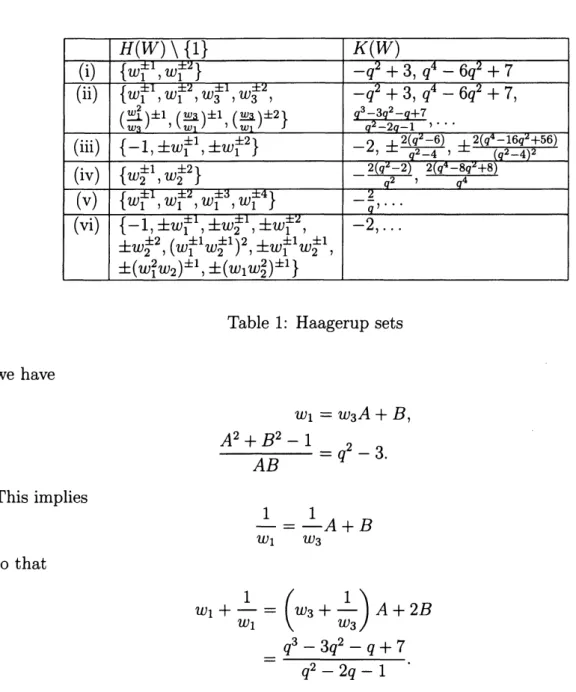
determine the Haagerup set $H(W)$ for each type-IImatrix given in Theorem 2. Note that the description of $H(W)$ in Table 1 is valid
for all
even
$q\geq 4$,even
though $p_{11}^{3}=0$ for $q=4.$The elements of$H(W)$ given in Table 1 can be found
as
follows:As for the Case (i), $K(W)$ has two elements
$w_{1}+ \frac{1}{w_{1}}=-q^{2}+3, w_{1}^{2}+\frac{1}{w_{1}^{2}}=q^{4}-6q^{2}+7.$
As for (ii), setting
Table 1: Haagerup sets we have $w_{1}=w_{3}A+B,$ $\frac{A^{2}+B^{2}-1}{AB}=q^{2}-3.$ This implies $\frac{1}{w_{1}}=\frac{1}{w_{3}}A+B$ so that $w_{1}+ \frac{1}{w_{1}}=(W_{3}+\frac{1}{w_{3}})A+2B$ $= \frac{q^{3}-3q^{2}-q+7}{q^{2}-2q-1}.$
The
Cases
(iii) and (iv) are immediate. Finally, it is clear that$K(W)$ contains-$\frac{2}{q}$ and$-2$, in the Cases (v) and (vi), respectively. We do not need the remaining elements
of$K(W)$ to prove the following propositions.
Proposition 1. Let $W_{1}$,. .
.
,$W_{6}$ be type-II matrices given in $(i)-(vi)$of
Theorem 2,respectively. Then $W_{1}$,.
.
. , $W_{6}$ are pairwise inequivalent.Proposition 2. Let $W_{+}$ and $W_{-}$ be type-II matrices given in Theorem 2 (vi) with
$r>0$ and $r<0$, respectively. Then $W_{+}$ and $W$-are inequivalent.
Wewereabletousethe Haagerup set to distinguishsomeof the complex Hadamard
matrices in Theorem 2. This is because the Haagerup set
can
be described by thein-tersection numbers of the association scheme, and is independent of the isomorphism
class. In general, if$q\geq 8$ is a power of 2, there may be manynon-isomorphic
matrices having the same coefficients are equivalent if they belong to Bose-Mesner algebras of non-isomorphic association schemes.
Note that there
are
two type-II matrices described in Theorem 2(i), since $w_{1}=$$w_{2}=w_{3}$ is either of the two
zeros
ofa
quadratic equation. Similarly, thereare
twotype-II matrices in each of $(ii)-(v)$ in Theorem 2. Moreover, there are four type-II
matrices in (vi), since there
are
two choices for $r$ and $a_{0,1}^{2}-4\neq$ O. The followinglemma shows that the two type-II matrices in Theorem 2(i) are inequivalent, and so
are those in Theorem 2(ii).
Lemma 12. Let$W$ and$W’$ be type-II matrices belongingto the Bose Mesner algebra
of
an
association scheme$\mathcal{X}=(X, \{R_{i}\}_{i=0}^{d})$.
Suppose that eachof
$W$ and$W’$ has $d+1$distinct entries, the valencies
of
$\mathcal{X}$ arepairwise distinct, and $\min\{p_{11}^{i}|0<i\leq d\}>$
$u_{2}X$.
If
$W$ and $W’$ are type-II equivalent, then $W$ is a scalar multipleof
$W’.$For a matrix $W$ with
nonzero
complex entries, we denote its entrywise inverse by$W$
Proposition 3. Let $W$ be a type-II matrix given in (i)
of
Theorem 2. Then $W$ and$W$ are inequivalent. The same conclusion holds
if
$W$ is a type-II matrix given in(ii)
of
Theorem 2.We do not know whether the two type-II matrices in each of$(iii)-(v)$ in Theorem 2
are
equivalent or not, and whether the two type-II matrices in Theorem 2(vi) witha
given sign for $r$ are equivalent ornot.
Acknowledgements
We
are
very grateful to Ferenc Sz\"oll\’osi and Ada Chan for helpful discussions onvarious parts of the paper. We also thank Doug Leonard for giving us suggestions for
Section 2.
References
[1] E. Bannai and T. Ito, Algebraic Combinatorics $I$: Association Schemes,
Ben-jamin/Cummings, Menlo Park, 1984.
[2] W. Bosma, J. Cannon, and C. Playoust, The Magma algebra system. I. The user
language, J. Symbolic Comput., 24 (1997), 235-265.
[3] A. E. Brouwer, A. M. Cohen, and A. Neumaier, Distance-Regular Graphs,
Springer-Verlag, Berlin, Heidelberg, 1989.
[4] A. Chan, Complex Hadamard matrices and strongly regular graphs,
$arXiv:1102.5601.$
[5] A. Chan andC. Godsil, Type-II matrices and combinatorial structures,
[6] A. Chan and R. Hosoya, Type-II matrices attached to
conference
graphs, J.Alge-braic Combin. 20 (2004), 341-351.
[7] R. Craigen, Equivalence classes
of
inverse orthogonal and unit Hadamardmatri-ces, Bull.
Austral.
Math.Soc.
44 (1991),no.
1,109-115.
[8] E.
van
Dam, Three-class association schemes, J. Algebraic Combin. 10 (1999),69-107.
[9] J. M. Goethals andJ. J. Seidel, Strongly regular graphs derived
from
combinatorialdesigns, Can. J. Math., 22, (1970), 597-614.
[10] U. Haagerup, 0rthogonal maximal Abelian $*$-subalgebras
of
$n\cross n$ matrices andcyclic$n$-roots, OperatorAlgebras andQuantumField Theory (Rome), Cambridge,
MA, International Press, (1996), 296-322.
[11] R. Hosoya and H. Suzuki, Type II matrices and their Bose-Mesner algebras, J.
Algebraic Combin. 17 (2003),
19-37.
[12] F. Jaeger, M. Matsumoto, and K. Nomura, Bose-Mesner algebras related to
type II matrices and spin models, J. Algebraic Combin. 8 (1998),
39-72.
[13] R. Nicoara, A finiteness result for commuting squares of matrix algebras, J.
Operator Theory 55 (2006), 101-116.
[14] K. Nomura, Type II matrices
of
size five, Graphs Combin.15 (1999), 79-92.[15] A. D. Sankey, Type-II matrices in weighted Bose-Mesner algebras
of
ranks 2 and3, J. Algebraic Combin. 32 (2010), 133-153.
[16] F.
Sz\"oll\’osi,
Exotic complex Hadamard matrices and their equivalence, Cryptogr.Commun. 2 (2010), no. 2, 187-198.
[17] W. Tadej and K. Zyczkowski A concise guide to complex Hadamard matrices,
A
Verification
by
Magma
Isolation
$n:=15$;
AO:$=$ScalarMatrix($n, 1)$ ;
$J:=$Parent($AO)!$ [$1:i$ in [l. .n2]];
L03:$=$LineGraph(OddGraph(3));
Al:$=$Adj acencyMatrix(L03);
A2:$=A1^{-}2-A1-4*A0$;
A3:$=J-AO-A1-A2$;
DM:$=$DistanceMatrix(L03);
DM eq $A1+2*A2+3*A3$;
hermitianConjugate:$=$
func$<H|$Parent($H)$ ! [ComplexConjugate(x):$x$ in Eltseq (Transpose$(H))$]$>$;
$c$omplexHadamard:$=f$unct$i$
on
(xyz)AA:$=[$ChangeRing($A,$Parent($xyz[1])):A in [AI,A2, A3]]$ ;
return $AO+xyz[1]*AA[1]+xyz[2]*AA[2]+xyz[3]*AA[3]$ ; end function; spanCondition:$=$function(H) $F:=$Parent($H[1,1])$ ; $MnF:=$Parent($H)$ ; $n:=$Nrows($H)$; Es:$=[MnF|O:i in [1. .n]]$ ; for $i$ in [1. .n] do Es$[i][i, i]$ $:=1$; end for; $EsF:=[MnF|e:e in Es]$ ;
Hs:$=$hermitianConj ugate(H);
Vn:$=$VectorSpace($F,n^{-}2)$ ;
bracket:$=sub<Vn|$ [Vn$|$Eltseq(v$*$Hs$*$w$*$H-Hs$*$w$*$H$*$v):$v,w$ in $EsF$]$>$;
return Dimension(bracket) eq $n^{-}2-2*n+1$; end function; $F<s>:=$QuadraticField($-15)$ ; $y:=(-7+s)/8$ ; $H:=$complexHadamard($[1,y, 1])$ ; H$*$hermitianConjugate(H) eq $n*AO$; spanCondition(H); $F<s>$:$=$QuadraticField$(-11)$ ; $x:=(5+s)/6$;
$H:=$complexHadamard( $[x, -1,x])$ ; H$*$hermitianConjugate(H) eq $n*AO$; not spanCondition(H); $F<s>$:$=$QuadraticField$(-15)$ ; $x:=(-1+s)/4$; $H:=$complexHadamard($[x,x^{-}(-1),$$1])$ ; H$*$hermitianConjugate(H) eq $n*AO$; not spanCondition(H); $F<s>:=QuadraticField(201)$ ; $Z:=(53-3*s)/10$; $R<T>:=$PolynomialRing($F)$ ; $K<z>:=ext<F|T^{-}2-Z*T+1>$; $z+1/z$ eq $Z$; $x:=1/144*((-5*Z+31)*z-25*Z+155)$ ; xb:$=1/144*((-5*Z+31)*z^{\sim}(-1)-25*Z+155)$; $y:=1/144*((25*Z-155)*z+5*Z-31)$ ; yb:$=1/144*((25*Z-155)*z^{-}(-1)+5*Z-31)$ ; $x*xb$ eq 1; $y*yb$ eq 1; $H:=$complexHadamard($[x,y,Z])$ ; H$*$hermitianConjugate(H) eq $n*AO$; spanCondition(H) ;
Table
1
HWminusl:$=$function(w) I3:$=\{1. .3\}$; $H3q:=\{w[il]*w[i2]/w[i3]:il,$$i2$,i3 in I3$|\#[i:i in [il, i2, i3]|i eq 3]$ ne 2};
$H3q4:=\{w[il]*w[i2]/w[i3]:il,$$i2$,i3 in I3
$|\#[i:i in [il, i2, i3]|i eq 3]$ ne 2 and $\{il, i2, i3\}$ ne {1, 3}};
plus:$=[\{w[i]^{\sim}2:i$ in I3} join $H:H$ in $[H3q,H3q4]]$ ;
return $\{(p$ join $\{x^{\sim}(-1):x in p\}$ join
$\{w[il]*w[i2]/(w[jl]*w[j2]):il, i2, jl,j2 in I3\})$
diff $\{1\}:p$ in plus};
end function;
$Rw<wl,w2,w3>$:$=$FunctionField(Rationals(),3) ;
HWminusl([wl,wl, wl]) eq
$\{\ j oin\{\{wl^{-}s,wl^{\sim}(s*2)\}:s in \{1, -1\}\}\}$;
HWminusl$([wl, wl, w3])$ eq
{&j$oin\{\{w^{-}s,w^{} (s*2)\}:s in \{1, -1\},w in \{wl,w3\}\}$ join
&j$oin\{\{(wl^{\sim}2/w3)^{-}s, (w3/wl)^{\sim}s, (w3/wl)^{-}(s*2)\}:s in \{1, -1\}\}\}$;
&join$\{\{sl*wl^{\sim}s, sl*wl^{\sim}(s*2)\}:s, sl in \{1, -1\}\}$};
HWminusl $([1,w2,1])$ eq $\{$
&join{{w2 $s,w2^{arrow}(s*2)\}:s$ in $\{1,$$-1\}\}\}$;
HWminusl$([wl, w1^{arrow}(-1),$$1])$ eq $\{\{w1^{arrow}(s*k):s in \{1, -1\},k in \{1. .4\}\}\}$;
HWminusl$([wl, w2,-wl*w2])$ eq $\{\{-1\}j$oin
$\{s0*w^{-}(s*k):w in \{wl,w2\}, s, sO in \{1, -1\},k in \{1, 2\}\}$ join
&join$\{\{s0*w1^{-}sl*w2^{-}s2, (w1^{\sim}s1*w2^{\sim}s2)^{\sim}2\}:s0, sl, s2 in \{1, -1\}\}$
join &join{$\{s0*(w1^{-}2*w2^{\sim}(-1))^{\sim}s, s0*(wl^{\sim}(-1)*w2^{\sim}2)^{arrow}s\}$
$:s,$$sO$ in $\{1, -1\}\}\}$;
// (i)
$Rq<q>$:$=$FunctionField(Rationals()) ;
$(-q^{arrow}2+3)^{\sim}2-2$ eq $q^{rightarrow}4-6*q^{\sim}2+7$; // (ii) Rw3$<w3>$:$=$FunctionField(Rq) ; $A:=-(q-3)/(q^{arrow}2-2*q^{-1)}$; $B:=(q-1)/(q^{-}2-2*q^{-1)}$; $(A^{arrow}2+B^{arrow}2-1)/(A*B)$ eq $q^{\sim}2-3$; wl:$=A*w3+B$; $(A/w3+B)-1/wl$ eq $1/w1*A*B*(w3+1/w3+(q^{arrow}2-3))$ ; // (iii) $(2*(q^{\sim}2-6)/(q^{\sim}2-4))^{arrow}2-2$ eq $2*(q^{arrow}4-16*q^{\sim}2+56)/(q^{-}2-4)^{arrow}2$; // (iv) $(-2*(q^{\sim}2-2)/q^{\sim}2)^{-}2-2$ eq $2*(q^{-}4-8*q^{-}2+8)/q^{\sim}4$;
Proof of Proposition
1
$(iii)\not\cong(vi)$$Rq<q>$:$=$FunctionField(Rationals());
$k3a:=(q^{-}2-6)/(q^{\sim}2-4)$;
$k3b:=2*(q^{\sim}4-16*q^{\sim}2+56)/(q^{arrow}2-4)^{\sim}2$;
ral: $=(k3a+(q-1)*(q-2)/(2*q*(q+1)))/(q^{+2)}$ ;
fac:$=$Factorization(Numerator$(ral^{-}2-(17*q-1)*(q-1)))$ ;
#fac eq 1 and Degree $(fac[1] [1])$ gt 1;
ra2:$=(-k3a+(q-1)*(q^{-}2)/(2*q*(q+1)))/(q^{+2)}$ ;
fac:$=$Factorization(Numerator ( $ra2^{-}2-(17*q-1)*(q-1)))$;
#fac eq 1 and Degree $(fac[1] [1])$ gt 1;
rbl: $=(k3b+(q-1)*(q-2)/(2*q*(q+1)))/(q^{+2)}$ ;
fac:$=$Factorization$($Numerator$(rbl^{\sim}2-(17*q-1)*(q-1)))$ ;
#fac eq 1 and Degree(fac[1] [1]) gt 1;
rb2: $=(-k3b+(q-1)*(q-2)/(2*q*(q+1)))/(q^{+2)}$ ;
fac:$=$Factorization$($Numerator$(rb2^{-}2-(17*q-1)*(q-1)))$ ;
#fac eq 1 and Degree $(fac[1] [1])$ gt 1;
$(i)\not\cong(ii)$
Numerat
or
$((2-n)-(q^{-}3-3*q^{\sim}2-q+7)/(q^{\sim}2-2*q-1))$ eq $-(q-2)*(q+1)*(q^{\sim}2-5)$ ; Numerator$((n^{\sim}2-4*n+2)-(q^{arrow}3-3*q^{-}2-q+7)/(q^{\sim}2-2*q-1))$ eq$(q-2)*(q+1)^{-}2*(+7)$
$(iv)\not\cong(v)$ Numerator $(-2*(n-1)/(n+1)-(-2)/q)$ eq $-2*(q-2)*(q^{+1)}$; Numerator$(2*(n^{\sim}2-6*n+1)/(n+1)^{\sim}2-(-2)/q)$ eq $2*(q-2)*(q+1)*(q^{arrow}2+2*q-4)$ ;Proof
of Proposition
2
ral: $=(2+(q-1)*(q-2)/(2*q*(q+1)))/(q^{+2)}$ ;fac:$=$Factorization$($Numerator$(ral^{arrow}2-(17*q-1)*(q-1)))$ ;
#fac eq 1 and Degree(fac[1] [1]) gt 1;
ra2:$=(-2+(q-1)*(q-2)/(2*q*(q+1)))/(q+2)$ ;
fac$:=$Factorization$($Numerator$(ra2^{-}2-(17*q-1)*(q-1)))$ ;