A FINITE PRESENTATION OF THE LEVEL 2 PRINCIPAL
CONGRUENCE SUBGROUP OF $GL(n;\mathbb{Z})$
RYOMA KOBAYASHI
ABSTRACT. It is known that the leve12 principal congruence subgroup of $GL(n;\mathbb{Z})$ has a
finite generating set (see [6]). In this paper, we give a finite presentation of the leve12
principal congruencesubgroup of$GL(n;\mathbb{Z})$.
1. INTRODUCTION
For $n\geq 1$, let $\Gamma_{2}(n)=ker(GL(n;\mathbb{Z})arrow GL(n;\mathbb{Z}_{2}))$ denote the level 2 principal congruence
subgroup of $GL(n;\mathbb{Z})$. Note that for $A\in\Gamma_{2}(n)$ the diagonal entries of $A$ are odd and the
others
are
even.For $1\leq i,j\leq n$ with $i\neq j$, let $E_{ij}$ denote the matrix whose $(i,j)$ entry is 2, diagonal
entries are 1 and others are $0$, and let $F_{i}$ denote the matrix whose $(i, i)$ entry is $-1$, other
diagonal entries are 1 and others are O. It is known that $\Gamma_{2}(n)$ is generated by $E_{ij}$ and$F_{i}$ for
$1\leq i,j\leq n$ with $i\neq j$ (see [6]).
In this paper, we give a finitepresentation of$\Gamma_{2}(n)$.
Theorem 1.1. For$n\geq 1,$ $\Gamma_{2}(n)$ has a
finite
presentation with generators $E_{ij}$ and $F_{i}$,for
$1\leq i,j\leq n$ with $i\neq j$, and with relators
(1) $F_{i}^{2}$
for
$1\leq i\leq n,$(2) $(E_{ij}F_{i})^{2},$ $(E_{ij}F_{j})^{2},$ $(F_{i}F_{j})^{2}$
for
$1\leq i,j\leq n$ with $i\neq j$ (when$n\geq 2$),(3) (a) $[E_{ij}, E_{ik}],$ $[E_{ij}, E_{kj}],$ $[E_{ij}, F_{k}],$ $[E_{ij}, E_{ki}]E_{kj}^{2}$
for
$1\leq i,j,$$k\leq n$, and $i,j,$$k$ aremutually
different
(when $n\geq 3$)(b) $[E_{ji}F_{j}E_{ij}F_{i}E_{ki}^{-1}E_{kj}, E_{ki}F_{k}E_{ik}F_{i}E_{ji}^{-1}E_{jk}]$
for
$1\leq i<j<k\leq n$ (when$n\geq 3$),(4) $[E_{ij}, E_{kl}]$
for
$1\leq i,$$j,$ $k,$$l\leq n$, and$i,j,$$k,$$l$ are mutuallydifferent
(when$n\geq 4$),where $[X, Y]=X^{-1}Y^{-1}XY.$
We now explain about an application of Theorem 1.1. For $g\geq 1$, let $N_{g}$ denote a
non-orientable closed surface of genus $g$, that is, $N_{g}$ is a connected sum of $g$ real projective
planes. Let : $H_{1}(N_{g};R)\cross H_{1}(N_{g}, R)arrow \mathbb{Z}_{2}$ denote the $mod 2$ intersection form, and let
$Aut(H_{1}(N_{g};R), \cdot)$ denote the group of automorphisms
over
$H_{1}(N_{g};R)$ preserving the mod2intersection form
.,
where $R=\mathbb{Z}$ or$\mathbb{Z}_{2}$. Consider the natural epimorphism$\Phi_{g}:Aut(H_{1}(N_{g};\mathbb{Z}), \cdot)arrow Aut(H_{1}(N_{g};\mathbb{Z}_{2})$,
MacCarthy and Pinkall [6] showed that $\Gamma_{2}(g-1)$ is isomorphic to $ker\Phi_{g}.$
We denote by $\mathcal{M}(N_{g})$ the group of isotopy classes ofdiffeomorphisms over $N_{g}$. The group
$\mathcal{M}(N_{g})$ is called the mapping class group of$N_{g}$. In [6] and [3], it is shown that the natural
homomorphism $\mathcal{M}(N_{g})arrow Aut(H_{1}(N_{g};R), \cdot)$ is surjective, where $R=\mathbb{Z}$ or $\mathbb{Z}_{2}$. Let $\mathcal{I}(N_{g})$
denote the kernel of $\mathcal{M}(N_{g})arrow Aut(H_{1}(N_{9};\mathbb{Z})$, We say $\mathcal{I}(N_{g})$ the Torelli group of$N_{g}$. In
[4], Hirose and the author obtained agenerating set of$\mathcal{I}(N_{g})$ for $g\geq 4$, using Theorem 1.1.
2. PRELIMINARIES
2.1. Basics on presentations ofgroups.
Let $G_{1},$$G_{2}$ and $G_{3}$ be groups with ashort exact sequence
$1arrow G_{1}arrow\phi G_{2}arrow\pi G_{3}arrow 1.$
If$G_{1}$ and $G_{3}$ are presented then we can obtain apresentation of$G_{2}$. In particular, if$G_{1}$ and $G_{3}$ are finitely presented then $G_{2}$ can be finitely presented.
More precisely, a presentation of $G_{2}$ is obtained
as
follows. Let $G_{1}=\langle X_{1}|R_{1}\rangle$ and$G_{3}=\langle X_{3}|R_{3}\rangle$. For each $x\in X_{3}$, we choose $\tilde{x}\in\pi^{-1}(x)$. We put $X_{2}=\{\phi(x_{1})$,$\tilde{x_{3}}|x_{1}\in$
$X_{1},$$x_{3}\in X_{3}\}$. For $r=a_{1}^{\epsilon_{1}}\cdots a_{k}^{\epsilon_{k}}\in R_{3}$, let $\tilde{r}=\tilde{a_{1}}^{\epsilon_{1}}\cdots\tilde{a_{k^{\epsilon_{k}}}}$. For $g\in ker\pi$, let $\overline{g}$ be a
word over $\phi(X_{1})$ with $g=\overline{g}$. Let $A=\{\phi(r_{1})|r_{1}\in R_{1}\},$ $B=\{\tilde{r_{3}}\overline{\tilde{r_{3}}}1|r_{3}\in R_{3}\}$ and
$C=\{\tilde{x_{3}}\phi(x_{1})\tilde{x_{3}}^{-1}\overline{\tilde{x_{3}}\phi(x_{1})\tilde{x_{3}}^{-1^{-1}}}|x_{1}\in X_{1}, x_{3}\in X_{3}\}$
. We put $R_{2}=A\cup B\cup C$. Then we
have $G_{2}=\langle X_{2}|R_{2}\rangle.$
In addition, if there is
a
homomorphism $\rho$ : $G_{3}arrow G_{2}$ such that $\pi 0\rho=id_{G_{3}}$, choose$\tilde{x}=\rho(x)\in\pi(x)^{-1}$ for$x\in X_{1}$. Then, wehave the relation in $G_{2}$ for$r\in R_{3}.$
If$G_{2}$ is presentedthen we can examine apresentationof $G_{1}$, by the Reidemeister-Schreier
method. In particular, if $G_{3}$ is a finite group, that is, the index of${\rm Im}\phi$ is finite, then $G_{1}$ can
befinitely presented.
For further information see [5].
2.2. Presentations of groups acting on a simplicial complex.
Let $X$ be a simplicial complex, and let $G$ be a group acting on $X$ by isomorphisms as a
simplicial map. We suppose that the action of $G$ on $X$ is without rotation, that is, for a
simplex $\triangle\in X$ and $g\in G$, if$g(\triangle)=\triangle$ then $g(v)=v$ for all vertices $v\in\triangle$. For a simplex
$\triangle\in X$, let $G_{\triangle}$ be the stabilizer of$\triangle$. For $k\geq 0$, the $k$-skeleton$X^{(k)}$ is the subcomplexof$X$
consisting of all simplices of dimension at most $k.$
Consider ahomomorphism $\Phi$ $:*_{v\in X(0)}G_{v}arrow G$. For$g\in G$, if
$g$stabilizesavertex$w\in X^{(0)},$
we denote $g$ by $g_{w}$ as an element in $G_{w}<*_{v\in X(0)}G_{v}$. For a 1-simplex $\{v, w\}\in X$ and
$g\in G_{v}\cap G_{w}$, we have $g_{v}g_{w}^{-1}\in ker\Phi$. We call this the edge relator.
Atfirst, for any 1-simplex$\{v, w\}$, chooseanorientationsuch that orientationsarepreserved
by the action of$G$. Namely, orientations of$\{v, w\}$ and $g\{v, w\}$ are compatible for all $g\in G.$
We denote the oriented1-simplex $\{v, w\}$ by$(v, w)$. Similarly, choose orders of2-simplices, and
denote the ordered 2-simplex $\{v_{1}, v_{2}, v_{3}\}$ by $(v_{1}, v_{2}, v_{3})$. For an oriented 1-simplex $e=(v, w)$,
let$o(e)=v$ and $t(e)=w$. Foran oriented 2-simplex $\tau=(v_{1}, v_{2}, v_{3})$, wecall $v_{1}$ the base point
of$\mathcal{T}.$
Next, choose an oriented tree$T$of$X$suchthataset of vertices of$T$isa set ofrepresentative
elements forverticesoftheorbit space$G\backslash X$. Let$V$denotethe setofvertices of$T$. In addition,
choose a set $E$ of representative elements for oriented 1-simplices of$G\backslash X$ such that $o(e)\in V$
for $e\in E$ and 1-simplices of $T$ is in $E$, and a set $F$ of representative elements for ordered
2-simplices of $G\backslash X$ such that the base point of $\tau$ is in $V$ for $\tau\in F$. For $e\in E$, let $w(e)$
denote the element in $V$ which is equivalent to $t(e)$ by the action of $G$, and choose $g_{e}\in G$
suchthat $g_{e}(w(e))=t(e)$ and$g_{e}=1$ if$e\in T.$
For a 1-simplex $\{v, w\}$ with$v\in V$, notethat $\{v, w\}=\{o(e), hg_{e}w(e)\}$ or $\{w(e), hg_{e}^{-1}o(e)\}$
for some $e\in E$ and $h\in G_{v}$. Thenwe define respectively $g_{\{v,w\}}=hg_{e}$ or $hg_{e}^{-1}$. Let $\alpha$ be a
loop in $X$ starting at a vertex of $V$. We denote $\alpha=\{v_{i}, \{v_{i}, v_{i+1}\}|1\leq i\leq k, v_{k+1}=v_{1}\}.$
Note that $v_{1},$$g_{1}^{-1}v_{2}\in V$, where $g_{1}=g_{\{v_{1},v_{2}\}}$. For $2\leq i\leq k$, define $g_{i}=g_{g_{i-1}^{-1}\cdots g_{1}^{-1}\{v_{t},v_{i+1}\}},$
inductively. Notethat for $2\leq i\leq k$, there exists an oriented 1-simplex$e_{i}$ suchthat $o(e_{i})\in V$
and $\{v_{i}, v_{i+1}\}=g_{1}\cdots g_{i-1}\{o(e_{i}), t(e_{i})\}$. Let $g_{\alpha}=g_{1}\cdots g_{k}$. We have $g_{\alpha}(v_{1})=v_{1}$, namely,
For $e\in E$, put aword $\hat{g}_{e}$. For
a
1-simplex $\{v, w\}$ with $v\in V$, let $\hat{g}_{\{v,w\}}=h\hat{g}_{e}$or
$h\hat{g}_{e}^{-1}$ if$g_{\{v,w\}}=hg_{e}$or$hg_{e}^{-1}$, respectively. For aloop$\alpha$in$X$startingatavertexof$V$, let$\hat{g}_{\alpha}=\hat{g}_{1}\cdots\hat{g}_{k}$
if$g_{\alpha}=g_{1}\cdots g_{k}$. Note that
we can
define $g_{\tau}$ and $\hat{g}_{\tau}$ for $\tau\in F$, regarding $\tau$as
a
loop in $X.$Let $\hat{G}=(*_{v\in V}G_{v})*(*_{e\in E}\langle\hat{g}_{e}\rangle)$.
The following theorem isa special
case
of the result of Brown [1].Theorem 2.1 ([1]). Let $X$ be a simply connected simplicial complex, and let $G$ be a group
acting withoutrotation on$X$ by isomorphisms as a simplicial map. Then $G$ is isomorphic to the quotient
of
$\hat{G}$by the normal subgroup generated by followings
(1) $\hat{g}_{e}$, where $e\in T,$
(2) $\hat{g}_{e}^{-1}X_{o(e)}\hat{g}_{e}(g_{e}^{-1}Xg_{e})_{w(e)}^{-1}$, where $e\in E$ and$X\in G_{e},$
(3) $\hat{g}_{\tau}g_{\tau}^{-1}$, where $\tau\in F.$
3. $0$UTLINE OF THE PROOF OF THEOREM 1. 1
We will prove Theorem 1.1 by induction on $n$. Let $e_{1}$,. . .,$e_{n}$ be canonical normal vectors
in $\mathbb{Z}^{n}$
, and let $\Gamma_{2}(n)_{e_{t}}$ denote a subgroup of$\Gamma_{2}(n)$ which consists of matrices $A\in\Gamma_{2}(n)$ such
that$Ae_{t}=e_{t}$. We first prepare the next lemma.
Lemma 3.1. For $1\leq t\leq n$ there is a short exact sequence
$0arrow \mathbb{Z}^{n-1}arrow\Gamma_{2}(n)_{e_{t}}arrow\Gamma_{2}(n-1)arrow 1.$
Proof.
For $\mathbb{Z}^{n-1}$we give the presentation $\mathbb{Z}^{n-1}=\langle x_{1}$, . . .,$x_{n-1}|x_{i}x_{j}x_{i}^{-1}x_{j}^{-1}(1\leq i<j\leq$
$n-1$ Let $\mathbb{Z}^{n-1}arrow\Gamma_{2}(n)_{e_{t}}$ be the homomorphism which sends $x_{i}$ to $E_{u}$ when $i<t$ and to
$E_{ti+1}$ when $i\geq t$. Let$\Gamma_{2}(n)_{e_{t}}arrow\Gamma_{2}(n-1)$ bethe homomorphism which sends $A$to$A_{tt}$, where $A_{ij}$ is the $(n-1)$-submatrix of$A$ obtained by removing the $i$-row vector and the $j$-column
vector of $A$. Then, it follows that the sequence $0arrow \mathbb{Z}^{n-1}arrow\Gamma_{2}(n)_{e_{t}}arrow\Gamma_{2}(n-1)arrow 1$ is
exact. $\square$
It is clear that Theorem 1.1 is valid in the
case
$n=1$. In addition, thecase
$n=2$ ofTheorem 1.1 is provedbyusingtheReidemeister-Schreier method. We
now
prove Theorem 1.1for $n\geq 3$, using Lemma 3.1.
3.1. The case $n=3$ of Theorem 1.1.
For$R=\mathbb{Z}$or$\mathbb{Z}_{2}$, let$\mathcal{B}_{n}(R)$denote thesimplicialcomplexwhose$(k-1)$-simplex$\{x_{1}, . .. , x_{k}\}$
is the set of$k$-vectors $x_{i}\in R^{n}$ suchthat $x_{1}$,. ..,$x_{k}$ are mutually different column vectors of
a
matrix $A\in GL(n;R)$. In [2], Day and Putman proved that $\mathcal{B}_{n}(\mathbb{Z})$ is $(n-2)$-connected.Here, asimplicial complex $X$ is $m$-connected if its geometric realization $|X|$ is $m$-connected.
In addition, $X$ is $-1$-connected if$X$ is nonempty. Note that there is the natural left action $\Gamma_{2}(n)\cross \mathcal{B}_{n}(\mathbb{Z})arrow \mathcal{B}_{n}(\mathbb{Z})$ defined by $A\{x_{1}, . . . , x_{k}\}=\{Ax_{1}, . . . , Ax_{k}\}$ for $A\in\Gamma_{2}(n)$ and $\{x_{1}, ..., x_{k}\}\in \mathcal{B}_{n}(\mathbb{Z})$, and that the action is without rotation.
Since $GL(n;\mathbb{Z}_{2})$ is the quotient of $GL(n;\mathbb{Z})$ by $\Gamma_{2}(n)$, it follows that the orbit space
$\Gamma_{2}(n)\backslash \mathcal{B}_{n}(\mathbb{Z})$ is isomorphic to$\mathcal{B}_{n}(\mathbb{Z}_{2})$. Let
$\varphi$ : $\mathcal{B}_{n}(\mathbb{Z})arrow \mathcal{B}_{n}(\mathbb{Z}_{2})$ beanaturalsurjection induced
by the surjection $GL(n;\mathbb{Z})arrow GL(n;\mathbb{Z}_{2})$. For $1\leq i\leq 7$, let $v_{i}$ be $v_{1}=e_{1},$ $v_{2}=e_{2},$ $v_{3}=e_{3},$
$v_{4}=e_{1}+e_{2},$ $v_{5}=e_{1}+e_{3},$ $v_{6}=e_{2}+e_{3}$ and $v_{7}=e_{1}+e_{2}+e_{3}$. Then, the vertices of$\mathcal{B}_{n}(\mathbb{Z}_{2})$
are
$\varphi(v_{i})$, the 1-simplices
are
$\varphi(\{v_{i},$$v_{j}$ and the 2-simplicesare
$\varphi(\{v_{1},$$v_{2},$$v_{3}$ $\varphi(\{v_{1},$$v_{2},$$v_{5}$$\varphi(\{v_{1},$
$v_{2},$$v_{6}$ $\varphi(\{v_{1},$$v_{2},$$v_{7}$ $\varphi(\{v_{1},$$v_{3},$$v_{4}$ $\varphi(\{v_{1},$$v_{3},$$v_{6}$ $\varphi(\{v_{1},$$v_{3},$$v_{7}$ $\varphi(\{v_{1},$$v_{4},$$v_{5}$
$\varphi(\{v_{1},$$v_{4},$$v_{6}$ $\varphi(\{v_{1},$$v_{4},$$v_{7}$ $\varphi(\{v_{1},$$v_{5},$$v_{6}$ $\varphi(\{v_{1},$$v_{5},$$v_{7}$ $\varphi(\{v_{2},$$v_{3},$$v_{4}$ $\varphi(\{v_{2},$$v_{3},$$v_{5}$
$\varphi(\{v_{2},$$v_{3},$$v_{7}$ $\varphi(\{v_{2},$$v_{4},$$v_{5}$ $\varphi(\{v_{2},$$v_{4},$$v_{6}$ $\varphi(\{v_{2},$$v_{4},$$v_{7}$ $\varphi(\{v_{2},$$v_{5},$$v_{6}$ $\varphi(\{v_{2},$$v_{6},$$v_{7}$
$\varphi(\{v_{3},$$v_{4},$$v_{5}$ $\varphi(\{v_{3},$$v_{4},$$v_{6}$ $\varphi(\{v_{3^{d}},$
$v_{5},$$v_{6}$ $\varphi(\{v_{3},$$v_{5},$$v_{7}$ $\varphi(\{v_{3},$$v_{6},$$v_{7}$ $\varphi(\{v_{4},$$v_{5},$$v_{7}$
$\varphi(\{v_{4}, v_{6}, v_{7}\})$ and $\varphi(\{v_{5},$
$v_{6},$$v_{7}$ (Note that $\{v_{1}, v_{2}, v_{4}\},$ $\{v_{1}, v_{6}, v_{7}\},$ $\{v_{1}, v_{3}, v_{5}\},$ $\{v_{2}, v_{3}, v_{6}\},$
$\{v_{2}, v_{5}, v_{7}\},$ $\{v_{3}, v_{4}, v_{7}\}$ and $\{v_{4}, v_{5}, v_{6}\}$
are
not 2-simplices of$\mathcal{B}_{n}(\mathbb{Z}).$)Lemma 3.2. $\Gamma_{2}(3)$ is isomorphic to the quotient $of*\Gamma(3)_{v_{i}}$ by the normal subgroup
generated by edge relators.
Proof.
We set followings $\bullet V=\{v_{1}, \cdots v_{7}\},$$\bullet T=\{(v_{1}, v_{i})|2\leq i\leq 7\}UV,$ $\bullet E=\{(v_{i}, v_{j})|1\leq i<j\leq 7\},$
$\bullet F=\{(v_{\iota’}, v_{j}, v_{k})|1\leq i<j<k\leq 7, \varphi(\{v_{i}, v_{j}, v_{k}\})\in \mathcal{B}_{n}(\mathbb{Z}_{2})\}.$
For$e=(v_{i}, v_{j})\in E$, since$w(e)=t(e)$, we choose$g_{e}=1$, and write$g_{ij}=g_{e}$. By Theorem 2.1, $\Gamma_{2}(3)$ is isomorphic tothequotientof$(*\Gamma(3)_{v_{i}})*(*1\leq i<j\leq 7\langle\hat{g}_{ij}\rangle)$ by the normal subgroup
generated by followings
(1) $\hat{g}_{1i}$, where $2\leq i\leq 7,$
(2) $\hat{g}_{ij}^{-1}X_{v_{i}}\hat{g}_{ij}X$ , where $1\leq i<j\leq 7$ and $X\in\Gamma_{2}(3)_{(v_{i)}v_{j})},$
(3) $\hat{g}_{\tau}g_{\tau}^{-1}$, where $\tau\in F.$
Note that $g_{\tau}=g_{ij}g_{jk}g_{ik}^{-1}$ for $\tau=(v_{i}, v_{j}, v_{k})$. Hence, therelation$\hat{g}_{\tau}g_{\tau}^{-1}=1$is equivalent to the
relation$\hat{g}_{ij}\hat{g}_{jk}=\hat{g}_{ik}$. Since$\hat{g}_{1i}=1$ for $2\leq i\leq 7$, wehave the relation$\hat{g}_{ij}=1$ for$2\leq i<j\leq 7$
except $(i,j)=(2,4)$ , $(3, 5)$ and $(6, 7)$. For example, the relation $\hat{g}_{23}=1$ is obtained from the
relation $\hat{g}_{12}\hat{g}_{23}=\hat{g}_{13}$. In addition, relations $\hat{g}_{24}=1,$ $\hat{g}_{35}=1$ and $\hat{g}_{67}=1$ are obtained from
relations $\hat{g}_{23}\hat{g}_{34}=\hat{g}_{24},$ $\hat{g}_{23}\hat{g}_{35}=\hat{g}_{25}$ and $\hat{g}_{26}\hat{g}_{67}=\hat{g}_{27}$, respectively. Hence, wehave the relation
$\hat{g}_{ij}=1$ for $1\leq i<j\leq 7$. Therefore, $\Gamma_{2}(3)$ is isomorphic to the quotient $of*\Gamma(3)_{v_{i}}$ by
the normal subgroup generated by $A=\{X_{v_{i}}X_{v_{j}}^{-1}|1\leq i<j\leq 7, X\in\Gamma_{2}(3)_{(v_{i},v_{j})}\}$. Since $A$
is the set ofedge relators, weobtain the claim. $\square$
Fkom Lemma 3.1 and Lemma 3.2, we obtain thepresentation of $\Gamma_{2}(3)$.
3.2. The case $n\geq 4$ of Theorem 1.1.
In this subsection,
we
introduce a simplicial complexwhich $\Gamma_{2}(n)$ acts on.Let $\Gamma_{2}\mathcal{B}_{n}(\mathbb{Z})$ denote thesubcomplexof$\mathcal{B}_{n}(\mathbb{Z})$ whose $(k-1)$-simplex $\{x_{1}, . . ., x_{k}\}$ is the set
of $k$-vectors $x_{i}\in \mathbb{Z}^{n}$ such that $x_{1}$,...,$x_{k}$ are mutually different column vectors of a matrix
$A\in\Gamma_{2}(n)$
.
Note that for a vertex $v$, we have $v\equiv e_{i}$ mod2 forsome
$1\leq i\leq n.$We have the following.
Proposition 3.3. For$n\geq 4$, the simplicial complex$\Gamma_{2}\mathcal{B}_{n}(\mathbb{Z})$ is simply connected.
We will prove this proposition in Appendix. We now prove Theorem 1.1.
Lemma 3.4. For any $n\geq 4,$ $\Gamma_{2}(n)$ is isomorphic to the quotient $of*\Gamma(n)_{e_{i}}$ by the
normalsubgroup generated by edge relators.
Proof
For$a(k-1)-$simplex$\triangle=\{x_{1}, ... , x_{k}\}\in\Gamma_{2}\mathcal{B}_{n}(\mathbb{Z})$ with$x_{j}\equiv e_{i(j)}$ mod2, let$A\in\Gamma_{2}(n)$
be an extension of$\triangle$.
Then we have $A^{-1}\cdot\triangle=\{e_{i(1)}, . . . , e_{i(k)}\}$. Therefore,
we
have $\Gamma_{2}(n)\backslash \Gamma_{2}\mathcal{B}_{n}(\mathbb{Z})=\{\{e_{i(1)}, . .. , e_{i(k)}\}|1\leq k\leq n, 1\leq i(1)<\cdots<i(k)\leq n\}.$It is clear that $\Gamma_{2}(n)\backslash \Gamma_{2}\mathcal{B}_{n}(\mathbb{Z})$ is contractible. Note that the action of $\Gamma_{2}(n)$ on $\Gamma_{2}\mathcal{B}_{n}(\mathbb{Z})$ is
without rotation.
We first set followings.
$\bullet T=\{(e_{1}, e_{i})|2\leq i\leq n\}.$
$\bullet E=\{(e_{i}, e_{j})|1\leq i<j\leq n\}.$
$\bullet F=\{(e_{i}, e_{j}, e_{k})|1\leq i<j<k\leq n\}.$
$\bullet$ For $e\in E$, wechoose
$g_{e}=1$, and write$g_{e}=g_{ij}$ when $e=(e_{i}, e_{j})$.
Then, since$\Gamma_{2}\mathcal{B}_{n}(\mathbb{Z})$ is simply connected, itfollows from Theorem2.1 that $\Gamma_{2}(n)$ isisomorphic
to the quotient of $((*\Gamma(n)_{e_{i}})*(*1\leq i<j\leq n\langle\hat{g}_{ij}\rangle))$ by the normal subgroup generated by
followings
(1) $\hat{g}_{1i}$, where $2\leq i\leq n,$
(2) $\hat{g}_{ij}^{-1}X_{e_{i}}\hat{g}_{ij}X$ , where $1\leq i<j\leq n$ and$X\in\Gamma_{2}(n)_{(ei_{)}e_{j})},$
(3) $\hat{g}_{\mathcal{T}}g_{\tau}^{-I}$, where $\tau\in F.$
Since $g_{\tau}=1$, the relation $\hat{g}_{\tau}g_{\tau}^{-1}$ is equivalent to the relation $\hat{g}_{ij}\hat{g}_{jk}=\hat{g}_{ik}$ if $\tau=(e_{i}, e_{j}, e_{k})$.
By relations $\hat{g}_{1i}=1$, we have the relation $\hat{g}_{ij}=1$ for $1\leq i<j\leq n$. Thus, we obtain the
claim. $\square$
From Lemma 3.1 and Lemma 3.4, we obtain the presentation of$\Gamma_{2}(n)$, by inductionon $n.$
Thus, we finish the proofofTheorem 1.1.
APPENDIX $A$
In this appendix, weprove Proposition 3.3. In aproof of this proposition, wewill usetheir
idea for proving that $\mathcal{B}_{n}(\mathbb{Z})$ is $(n-2)$-connected (see [2]).
A.l. Preparation.
Let $X$ be a simplicial complex. Then we define followings.
$\bullet$ Forasimplex$\Delta\in X,$ $star_{X}(\Delta)$ is the subcomplex of$X$ whosesimplex$\triangle’\in X$ satisfies
that $\Delta,$ $\Delta’\subset\triangle"$ for some simplex $\Delta"\in X$. We also define$star_{X}(\emptyset)=X.$
$\bullet$ For a simplex $\triangle\in X,$ $1ink_{X}(\Delta)$ is the subcomplex of $star_{X}(\triangle)$ whose simplex
$\triangle’\in$
$star_{X}(\triangle)$ does not intersect $\triangle$
. We also define$1ink_{X}(\emptyset)=X.$
For $a(k-1)$-simplex $\triangle=\{x_{1}, . . . , x_{k}\},$ $A\in\Gamma_{2}(n)$ is an extension of $\Delta$ if each $x_{i}$ is a
column vector of$A$. Here, we prove followings.
Lemma A.l. For$n\geq 2,$ $\Gamma_{2}\mathcal{B}_{n}(\mathbb{Z})$ ispath connected.
Proof
We first consider the case $n=2$. Let $v_{0}=v_{01}e_{1}+v_{02}e_{2}\in\Gamma_{2}\mathcal{B}_{2}(\mathbb{Z})$ be a vertex.Then there exist vertices $v_{1}=v_{11}e_{1}+v_{12}e_{2}$,.
.
.,$v_{k}=v_{k1}e_{1}+v_{k2}e_{2}\in\Gamma_{2}\mathcal{B}_{2}(\mathbb{Z})$ such that$\{v_{i}, v_{i+1}\}\in\Gamma_{2}\mathcal{B}_{2}(\mathbb{Z})$, $|v_{i1}|>|v_{i+11}|$ for $0\leq i\leq k-1$ and $v_{k}=e_{1}$
or
$e_{2}$, forsome
positiveinteger $k$. Hence, $\Gamma_{2}\mathcal{B}_{2}(\mathbb{Z})$ is path connected.
Next, we suppose $n\geq 3$. Let $v,$$w\in\Gamma_{2}\mathcal{B}_{n}(\mathbb{Z})$ be vertices. Without loss of generality,
we
suppose $v\equiv e_{1}$ and $w\equiv e_{2}$ mod2. Then there is an extension $A\in\Gamma_{2}(n)$ of $v$. We write
$A^{-1}w= \sum_{i=i}^{n}a_{i}e_{i}$. Let $S_{A^{-1}w}= \sum_{i=3}^{n}|a_{i}|$. For $3\leq i\leq n$, if $|a_{2}|<|a_{i}|$, there is an integer $u\in \mathbb{Z}$ such that $|a_{2}|>|a_{i}+2ua_{2}|$. Then we have that $S_{E^{\grave{u}_{2}}A^{-1}w}<S_{A^{-1}w}$ and $E_{i2}^{u}A^{-1}v=e_{1}.$ If $|a_{2}|>|a_{i}|\neq 0$, there is an integer $u’\in \mathbb{Z}$ such that $|a_{2}+2u’a_{i}|<|a_{i}|$. Then we have that
$S_{E_{2i}^{u’}A^{-1}w}<S_{A^{-1}w}$ and$E_{2i}^{u’}A^{-1}v=e_{1}$. Repeating this operation, weconclude that there exists $B\in\Gamma_{2}(n)$ such that $S_{Bw}=0$ and $Bv=e_{1}$. Note that $Bw$ can be regarded as a vertex in
$\Gamma_{2}\mathcal{B}_{2}(\mathbb{Z})$. Hence, $Bw$ is joined to $e_{1}$ or $e_{2}$, that is, $Bw$ is joined to $Bv$. Therefore, $v$ and $w$
arejoined by a path. Thus, $\Gamma_{2}\mathcal{B}_{n}(\mathbb{Z})$ is path connected.
$\square$
Lemma A.2. Let $\triangle\in\Gamma_{2}\mathcal{B}_{n}(\mathbb{Z})$ be $a(k-1)$ -simplex. Then we have followings.
$\bullet$ $star_{\Gamma_{2}\mathcal{B}_{n}(\mathbb{Z})}(\triangle)$ is $isomor^{\urcorner}phic$ to $star_{\Gamma_{2}\mathcal{B}_{n}(\mathbb{Z})}(\{e_{1}, \ldots, e_{k}\})$ as a simplicial complex.
$\bullet$ $1ink_{\Gamma_{2}\mathcal{B}_{n}(\mathbb{Z})}(\triangle)$ is isomorphic to $1ink_{\Gamma_{2}\mathcal{B}_{n}(\mathbb{Z})}(\{e_{1}, \ldots, e_{k}\})$ as a simplicial complex.
Proof.
For $\triangle=\{x_{1}, . . . , x_{k}\}$, suppose $x_{j}\equiv e_{i(j)}$ mod2. Let $A\in\Gamma_{2}(n)$ be an extension of$\triangle.$
Then restrictions of the action of$A^{-1}$ on $\Gamma_{2}\mathcal{B}_{n}(\mathbb{Z})$
$A^{-1}|_{star_{\Gamma_{2}B_{n}(Z)}(\Delta)}$ : $star_{\Gamma_{2}\mathcal{B}_{\mathfrak{n}}(\mathbb{Z})}(\triangle)arrow star_{\Gamma_{2}\mathcal{B}_{n}(\mathbb{Z})}(\{e_{i(1)}, \ldots, e_{i(k)}\})$,
are isomorphisms as a simplicial map. It is clear that $star_{\Gamma_{2}\mathcal{B}_{n}(\mathbb{Z})}(\{e_{i(1)}, \ldots, e_{i(k)}\})$
and $1ink_{\Gamma_{2}\mathcal{B}_{n}(\mathbb{Z})}(\{e_{i(1)}, \ldots, e_{i(k)}\})$ are respectively isomorphic to $star_{\Gamma_{2}\mathcal{B}_{n}(\mathbb{Z})}(\{e_{1}, \ldots, e_{k}\})$ and
$1ink_{\Gamma_{2}\mathcal{B}_{n}(\mathbb{Z})}(\{e_{1},$
$\ldots,$$e_{k}$ Thus, we obtain the claim.
$\square$
Corollary A.3. Let$\triangle\in\Gamma_{2}\mathcal{B}_{n}(\mathbb{Z})$ be $a(k-1)$ -simplex.
If
$n-k\geq 2$, then $1ink_{\Gamma_{2}\mathcal{B}_{n}(\mathbb{Z})}(\triangle)$ ispath connected.
Proof
Byasimilarargumentto theproofof Lemma A.1,wehave that$1ink_{\Gamma_{2}\mathcal{B}_{n}(\mathbb{Z})}(\{e_{1}, \ldots, e_{k}\})$is path connected. By Lemma A.2, $1ink_{\Gamma_{2}\mathcal{B}_{n}(Z)}(\triangle)$ is also path connected. $\square$
A.2. Proof of Proposition 3.3.
We suppose $n\geq 4$. Let $\alpha=\{x_{i}, \{x_{i}, x_{i+1}\}|1\leq i\leq k, x_{k+1}=x_{1}\}$ be a loop on $\Gamma_{2}\mathcal{B}_{n}(\mathbb{Z})$.
We show that $\alpha$ is null-homotopic.
For $v= \sum_{=1}^{n}v_{i}e_{i}\in \mathbb{Z}^{n}$, we define Rank$(v)=|v_{n}|$. Let $R_{\alpha}= \max Rank(x_{i})$.
We first prove the next lemma.
Lemma A.4. For $a$ 1-simplex $\{v, w\}\in\Gamma_{2}\mathcal{B}_{n}(\mathbb{Z})$ with Rank(v) $=Rank(w)=0$, we have
$\{v, w\}\in 1ink_{\Gamma_{2}\mathcal{B}_{n}(\mathbb{Z})}(e_{n})$.
Proof.
Note that $v\not\equiv w$ mod2. Suppose that $v\equiv e_{i},$$w\equiv e_{j}$ mod2 and $i<j$ . Since
Rank(v) $=Rank(w)=0$ , we have that $v,$$w\not\equiv e_{n}$ mod2. Then there exists an extension
$A=(a_{1}\cdots a_{n})\in\Gamma_{2}(n)$ of $\{v, w\}$. Let $S_{A}= \sum_{l=1}^{n}$Rank(a). Note that $S_{A}$ is odd.
First, we consider the
case
$S_{A}=1$. Note that Rank$(a_{l})=0$ for $1\leq l\leq n-1$ andRank$(a_{n})=1$. Then there exists $B\in\Gamma_{2}(n)$ such that $BA=(a_{1}\cdots a_{n-1}e_{n})$. Hence, we have
that $\{v, w\}=\{a_{i}, a_{j}\}\in 1ink_{\Gamma_{2}\mathcal{B}_{n}(\mathbb{Z})}(e_{n})$.
Next, we suppose $S_{A}\geq 3$. Note that there exists $1\leq l\leq n-1$ exceptl $=i,$$j$ such that
Rank$(a_{l})\neq$ O. If Rank$(a_{l})>Rank(a_{n})$, there exists an integer $u\in \mathbb{Z}$ such that Rank$(a_{l}+$
$2ua_{n})<Rank(a_{n})$. Then we have that $AE_{nl}^{u}$ is an extension of $\{v, w\}$ and that $S_{AE_{nl}^{u}}<S_{A}.$
Similarly, if Rank$(a_{l})<Rank(a_{n})$, there exists an integer $u’\in \mathbb{Z}$ such that Rank$(a_{l})>$
$Rank(a_{n}+2u’a_{l})$. Then we have that $AE_{ln}^{u’}$ is an extension of $\{v, w\}$ and that
$S_{AE_{ln}^{u’}}<S_{A}.$
Repeating thisoperation,weconclude thatthere existsanextension$A’\in\Gamma_{2}(n)$of$\{v, w\}$ such
that $S_{A’}=1$. Therefore, we have $\{v, w\}\in 1ink_{\Gamma_{2}\mathcal{B}_{n}(\mathbb{Z})}(e_{n})$. Thus, we obtain the claim. $\square$
When $R_{\alpha}=0$, bythislemma, wehave $\{x_{i}, x_{i+1}\}\in 1ink_{\Gamma_{2}\mathcal{B}_{n}(\mathbb{Z})}(e_{n})$. Namely, theloop$\alpha$ isin
$1ink_{\Gamma_{2}\mathcal{B}_{n}(\mathbb{Z})}(e_{n})$. Since $1ink_{\Gamma_{2}\mathcal{B}_{n}(Z)}(e_{n})$ is the subcomplex of$star_{\Gamma_{2}\mathcal{B}_{n}(Z)}(e_{n})$ and $star_{\Gamma_{2}\mathcal{B}_{n}(Z)}(e_{n})$
is contractible, $\alpha$ is null-homotopic. Therefore, we next assume $R_{\alpha}>0.$
Suppose that $R_{\alpha}$ is odd. Then there exists $1\leq i\leq k$ such that Rank$(x_{i})=R_{\alpha}$. Since $R_{\alpha}$
is odd, we have that $x_{i}\equiv e_{n},$ $x_{i\pm 1}\not\equiv e_{n}$ mod2 and Rank$(x_{i\pm 1})<R_{\alpha}$. By Corollary A.3,
we have that $1ink_{\Gamma_{2}\mathcal{B}_{n}(\mathbb{Z})}(x_{i})$ is path connected. Since $x_{i\pm 1}\in 1ink_{\Gamma_{2}\mathcal{B}_{n}(\mathbb{Z})}(x_{i})$, there exists a
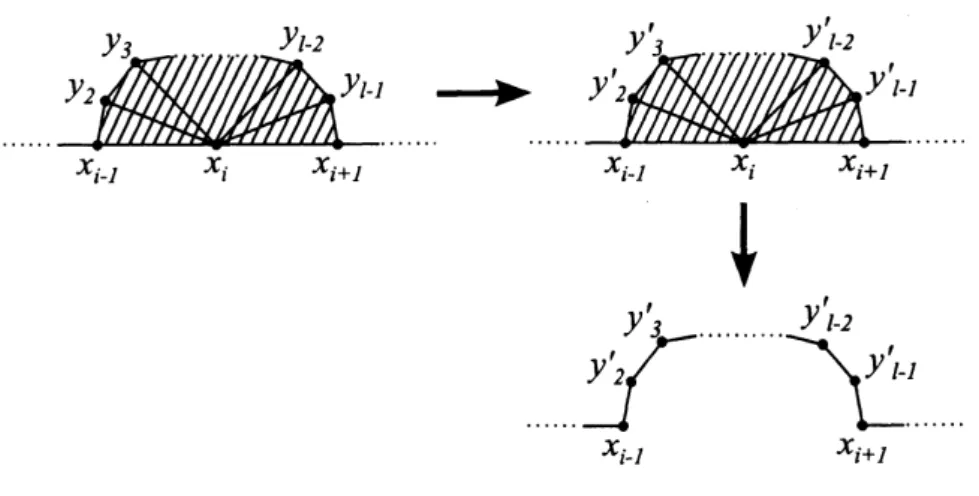
path $\{y_{j}, y_{l}, \{y_{j}, y_{j+1}\}|1\leq j\leq l-1\}$ on $1ink_{\Gamma_{2}\mathcal{B}_{n}(\mathbb{Z})}(x_{i})$ between $x_{i\pm 1}$ such that $y_{1}=x_{i-1}$
and $y_{l}=x_{i+1}$ (see Figure 1). Since $R_{\alpha}$ is odd and Rank$(y_{j})$ is even for each $y_{j}$, there exists
an integer $s_{j}\in \mathbb{Z}$ such that Rank$(y_{j}’)<R_{\alpha}$, where $y_{j}’=y_{j}+2s_{j}x_{i}$. We choose $s_{j}=0$ if
Rank$(y_{j})<R_{\alpha}$. Thenwehave that the path $\{y_{j}’, y_{l}’, \{y_{j}’, y_{j+1}’\}|1\leq j\leq l-1\}$ between $x_{i\pm 1}$ is
in$1ink_{\Gamma_{2}\mathcal{B}_{n}(\mathbb{Z})}(x_{i})$ (seeFigure1). Let$\alpha’=\alpha\cup\{y_{j}’, y_{l}’, \{y_{j}’, y_{j+1}’\}|1\leq j\leq l-1\}\backslash \{x_{i},$ $\{x_{i},$ $x_{i\pm 1}$
Then $\alpha’$ is homotopic to
$\alpha$ (see Figure 1). For all $x_{i}$ withRank$(x_{i})=R_{\alpha}$, applying the
same
operation, we conclude that $R_{\beta}<R_{\alpha}$, where $\beta$ is a resulting loop which is homotopicto $\alpha.$
Next, suppose that $R_{\alpha}$ is
even.
Then there exists $1\leq i\leq k$ such that Rank$(x_{i})=R_{\alpha}.$Since $R_{\alpha}$ is even, we have$x_{i}\not\equiv e_{n}$ mod2.
Remark A.5. Under the assumption $n\geq 4$, we may suppose all
of
following conditions.$oRank(x_{i\pm 1})<R_{\alpha},$
$\bullet x_{i\pm 1}\not\equiv e_{n}mod 2,$ $\bullet x_{i-1}\not\equiv x_{i+1}mod 2.$
FIGURE 1. The
case
$R_{\alpha}$ is odd.Proof.
If Rank$(x_{i-1})=R_{\alpha}$, then there exists a vertex $y\in 1ink_{\Gamma_{2}\mathcal{B}_{n}(Z)}(\{x_{i-1}, x_{i}\})$ such that$y\equiv e_{n}$ mod2 and Rank(y) $<R_{\alpha}$, since $R_{\alpha}$ is even and Rank(y) is odd. Let $\alpha’=\alpha\cup$
$\{y, \{x_{i-1}, y\}, \{y, x_{i}\}\}\backslash \{\{x_{i-1},$$x_{i}$ Then
$\alpha’$
is homotopic to $\alpha$. Hence, considering $\alpha’$
in placeof$\alpha$, we may suppose Rank$(x_{i-1})<R_{\alpha}$. Similarly, we may suppose Rank$(x_{i+1})<R_{\alpha}.$
If$x_{i-1}\equiv e_{n}$ mod2, then there exists avertex $y\in 1ink_{\Gamma_{2}B_{n}(\mathbb{Z})}(\{x_{i-1}, x_{i}\})$ such that $y\not\equiv e_{n}$
mod2 and Rank(y) $<Rank(x_{i-1})(<R_{\alpha})$, since Rank$(x_{i-1})$ is odd and Rank(y) is
even.
Let$\alpha’=\alpha\cup\{y, \{x_{i-1}, y\}, \{y, x_{i}\}\}\backslash \{\{x_{i-1},$$x_{i}$ Then
$\alpha’$ is homotopic to
$\alpha$
.
Hence, considering $\alpha’$ in placeof $\alpha$,
we
maysuppose Rank$(x_{i-1})<R_{\alpha}$ and $x_{i-1}\not\equiv e_{n}$ mod2. Similarly,we
maysuppose Rank$(x_{i+1})<R_{\alpha}$ and $x_{i+1}\not\equiv e_{n}$ mod2.
Suppose that Rank$(x_{i\pm 1})<R_{\alpha}$ and $x_{i\pm 1}\not\equiv e_{n}$ mod2. If $x_{i-1}\equiv x_{i+1}$ mod2, then there
exists a vertex $y\in 1ink_{\Gamma_{2}\mathcal{B}_{n}(Z)}(\{x_{i-1}, x_{i}\})$ such that $y\not\equiv x_{i+1},$$e_{n}$ mod2 and Rank$(y)\leq$
$Rank(x_{i-1})(<R_{\alpha})$, since $n\geq 4$. Let $\alpha’=\alpha\cup\{y, \{x_{i-1}, y\}, \{y, x_{i}\}\}\backslash \{\{x_{i-1},$$x_{i}$ Then
$\alpha’$ is
homotopic to$\alpha$
.
Hence, considering $\alpha’$ in place of $\alpha$, we may suppose that Rank$(x_{i\pm 1})<R_{\alpha},$$x_{i\pm 1}\not\equiv e_{n}mod 2andx_{i-1}\not\equiv x_{i+1}$ mod2. $\square$
We now suppose the conditions of the above remark. Suppose that $x_{i}\equiv e_{s},$ $x_{i-1}\equiv e_{t}$
and $x_{i+1}\equiv e_{u}$ mod2, where $s,$ $t$ and $u$ are mutually different and not equal to $n$. Then
there exists $A\in\Gamma_{2}(n)$ such that $Ax_{i}=e_{s},$ $Ax_{i-1}=e_{t}$ and Rank$(Ax_{i+1})=0$. In fact, since
$\{x_{i-1}, x_{i}\}$ is a 1-simplex in $\Gamma_{2}\mathcal{B}_{n}(\mathbb{Z})$, there is an extension $B\in\Gamma_{2}(n)$ of $\{x_{i-1}, x_{i}\}$. We write
$B^{-1}x_{i+1}= \sum_{j=1}^{n}a_{j}e_{j}$
.
It follows that there exist aneven
integer $b_{u}$ andan
odd integer $b_{n}$such that $a_{u}b_{n}-a_{n}b_{u}=gcd(a_{u\backslash }a_{n})$. Then
we
have that$(a_{n}/gcd(a_{u},a_{n})a_{u}/gcd(a_{u},a_{n}) b_{n}b_{u})^{-1}(\begin{array}{l}a_{u}a_{n}\end{array})=(gcd(a_{u}, a_{n})0)\cdot$
Let$C\in\Gamma_{2}(n)$ be thematrix whose $(u, u)$entryis$a_{u}/gcd(a_{u}, a_{n})$, $(n, u)$entryis$a_{n}/gcd(a_{u}, a_{n})$,
$(u, n)$ entryis$b_{u},$ $(n, n)$ entryis $b_{n}$, other diagonal entries
are
1 and other entries areO. Thenit follows that $Ax_{i}=e_{s},$ $Ax_{i-1}=e_{t}$ and Rank$(Ax_{i+1})=0$, where$A=C^{-1}B^{-1}.$
Since $\{e_{s}, Ax_{i+1}\}$ is a 1-simplex and Rank$(e_{s})=Rank(Ax_{i+1})=0$, by Lemma A.4,
we
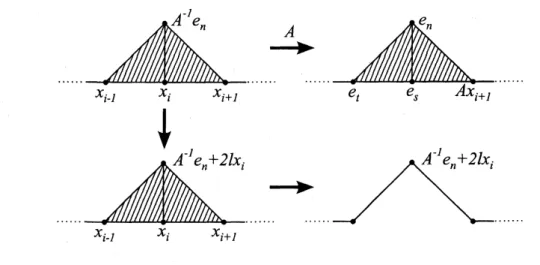
have that $\{e_{s}, Ax_{i+1}\}\in 1ink_{\Gamma_{2}\mathcal{B}_{n}(\mathbb{Z})}(e_{n})$. Namely, we have that $e_{n}\in 1ink_{\Gamma_{2}\mathcal{B}_{n}(\mathbb{Z})}(\{e_{s},$$Ax_{i+1}$In addition, it is clear that $e_{n}\in 1ink_{\Gamma_{2}\mathcal{B}_{n}(Z)}(\{e_{S},$$e_{t}$ Hence, we have that $A^{-1}e_{n}\in$
$1ink_{\Gamma_{2}\mathcal{B}_{n}(\mathbb{Z})}(\{x_{i}, x_{i\pm 1}\})$ (seeFigure 2). Then, there existsaninteger$l$ suchthat Rank$(x_{i}’)<R_{\alpha},$
where $x_{i}’=A^{-1}e_{n}+2lx_{i}$. We have also that $x_{i}’\in 1ink_{\Gamma_{2}\mathcal{B}_{n}(\mathbb{Z})}(\{x_{i}, x_{i\pm 1}\})$ (see Figure 2). Let
$\alpha’=\alpha\cup\{\{x_{i}’\}, \{x_{i}’, x_{i\pm 1}\}\}\backslash \{x_{i},$$\{x_{i},$ $x_{i\pm 1}$ Then $\alpha’$ is homotopic to $\alpha$ (see Figure 2).
Sim-ilar to the case $R_{\alpha}$ is odd, for all $x_{i}$ with Rank$(x_{i})=R_{\alpha}$, applying the same operation, we
FIGURE 2. The case $R_{\alpha}$ is even.
Repeating this operation until $R_{\alpha}=0$, we conclude that the loop $\alpha$ on $\Gamma_{2}\mathcal{B}_{n}(\mathbb{Z})$ is null
homotopic. Thus, $\Gamma_{2}\mathcal{B}_{n}(\mathbb{Z})$ is simplyconnected.
Acknowledgement. The author would like to express thanks to Susumu Hirose and
Masatoshi Sato for their valuable suggestions and useful comments.
REFERENCES
[1] K.S. Brown, Presentations for groups acting on simply connected complexes, J. Pure Appl. Algebra 32,
no. 1 (1984) 1-10.
[2] M. Day, A. Putman, Thecomplexof partial bases for$F_{n}$ andfinitegeneration of the Torelli subgroup of
$Aut(F_{n})$,Geom. Dedicate 164 (2013) 139-153.
[3] S.Gadgil, D. Pancholi,Homeomorphisms andthe homology of non-orientablesurfaces,Proc. Indian Acad.
Sci. (Math. Sci.) Vol. 115,No. 3 (2005) 251-257.
[4] S. Hirose, R. Kobayashi, inpreparation.
[5] D.J. Johnson, PresentationsofGroups, London Math. Soc. Stud.Texts 15 (1990).
[6] J.D. McCarthy, U. Pinkall, Representing homology automorphisms of nonorientable surfaces,
${\rm Max}$ Planc Inst. preprint MPI/SFB85-11, revised version written in 2004. Available at
http:$//www$
.
math.msu.$edu/\sim_{mccarthy}.$DEPARTMENT OF MATHEMATICS
FACULTY OF SCIENCEAND TECHNOLOGY
TOKYO UNIVERSITY OF SCIENCE
NODA, CHIBA, 278-8510, JAPAN