
メダカの産卵誘起と光の強さとの相関関係
5
0
0
全文
(2) Journal of Hokkaido University of Education (Section 11 B) Vol. 26, No. 2, February 1976. ^WmH±Wm (® 2 S|S B) ® 26^ ® 2^- Bgft 51 ^ 2 fl. Correlation between the Induction of Oviposition and Light Intensity in the Medaka, Oryzias latipes Hiroshi YOSHIOKA and Tokuu SHIMOGAWARA Biological Laboratory, Hakodate College, Hokkaido University of Education 040 Hakodate. / yij ^wm& a: ^<T)^ ? ^ omm ^ IN X • Tf"TJM ffii /& ^mmiiH±^s^?^^5. Introduction Under the natural daylight condition, the female medaka always lay eggs in the early morning (Egami, 1961; Yoshioka, 1962, 1963; Takano et al., 1974). However, if the light condition is properly modified, the time of oviposition may be changed (Robinson and Rugh, 1943). It has also been shown that, in fish subjected to a 12-hour light and a 12-hour dark period alternately, oviposition usually takes place immediately after the beginning of the light period (Egami, 1954). From these results, it seems highly probable that light is one of the most important factors concerning the induction of oviposition, and that mating behavior normally occurs when the fish of a pair recognize each other in the morning light. In order to get light on the present problem two serial experiments were carried out during the breeding season of the medaka.. Before proceeding further, the authors wish to express their gratitude to Emeritus Prof. Kiichiro Yamamoto for his kind advice and guidance during the the course of this study. The authors are also very grateful to Prof. Rinjiro Ohno for reading the manuscript. Experiments and Results. 1. Threshold intensity of light to induce the ovi.positi.on The present experiments were carried out in July 1970, at 17.5-25.5°C. The fish, which had been laying eggs early in the morning almost every day, were employed for the experiment. In the evening, pairs consisting of a male and a laying female were kept in each separate aquarium. set in the darkness by covering the aquaria with light-proof black box, until 4 a. m. the following morning. Then each group was exposed to the light of 1 lux, 5 lux, 10 lux, 100 lux and 300 lux, respectively. Immediately after the fish had been exposed to light, the occurrence of oviposition. (13).
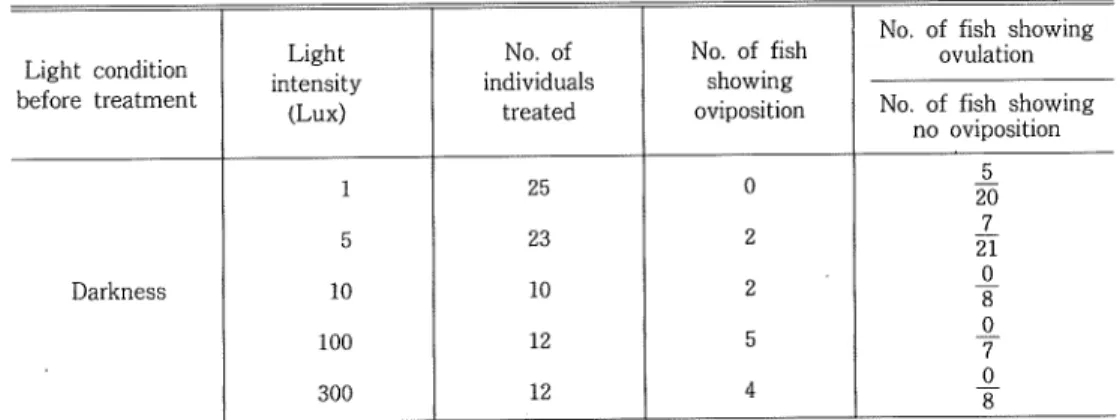
(3) 64. H. YOSHIOKA and T. SHIMOGAWARA. in females of each group was examined in 30 minutes. All the females which did not show oviposition were killed and their ovaries were quickly examined for the occurrence of ovulation. The results obtained from the present experiment are shown in Table 1. Table 1. The effects of changes of light intensity upon the oviposition of the medaka kept in darkness.. Light condition before treatment. Darkness. Light. No. of. No. of fish. treated. oviposition. 1. 25. 0. 5. 23. 2. 10. 10. 2. 100. 12. 5. 300. 12. 4. intensity. (Lux). individuals. showing. No. of fish showing ovulation No. of fish showing no oviposition. 5. 20. 7. 21 0 8 0. 7 0 8. No fish in the group exposed to the light of 1 lux exhibited oviposition. However, 5 of those fish showed the occurrence of ovulation. In the group exposed to the light of 5 lux, only 2 out of 23 showed oviposition, but ovulation was recognized in 7 of the remaining 21 females. In the groups subjected to the light of 10, 100 and 300 lux, all of the females which had ovulated eggs exhibited oviposition. No ovulation was observed in the females which did not show oviposition.. Table 1 shows that the light less than 5 lux is not enough to induce the oviposition of this species, even if ovulation has taken place in them. It seems likely that the threshold intensity of light to induce oviposition may be about 10 lux and the light intensity more than 10 lux is indispensable for the occurrence of oviposition in Oryzias latipes. 2. Effects of changes in light intensity on the induction of oviposition The experiments were carried out in August 1970, at 18.5-26.0° C. Adult females, which had been laying their eggs almost every morning, were used for the experiments. Fifty pairs, kept each in separate aquaria, were divided into three groups. Each group was kept under. conditions of light 5, 60 and 380 lux from 7 a. m. to 5 p. m. Thereafter, the fish exposed to the light of 5 lux were transferred to the condition of light of 360 lux, and those kept at the light intensities of 60 and 380 lux were transferred to the conditions of light of 5000 lux. Soon after the abrupt increase of light intensities had been given to the fish, the occurrence of oviposition was checked in 30 minutes and then all the females which did not show oviposition were killed in order to ascertain whether or not ovulation took place. The results obtained are presented in. Table 2. When 23 fish were transferred to the light condition of 360 lux from that of 5 lux, ovulation had taken place in 7 females, but oviposition was observed in only 3 females. Out of 10 fish removed from the light condition of 60 lux to that of 5000 lux, 2 females laid eggs, but the rest showed neither oviposition nor ovulation. In the fish transferred to the light 5000 lux from that. (14).
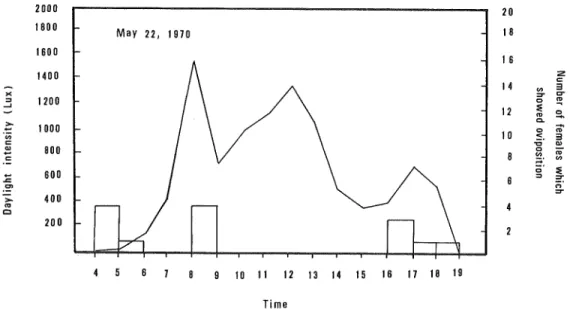
(4) 65. Correlation between the Induction of Oviposition and Light Intensity in the Medaka. Table 2. The effects of changes of light intensity upon the oviposition of the medaka kept in light condition.. Light. Light condition before treatment. intensity. (Lux). No. of. No. of fish. treated. oviposition. individuals. showing. 5. 360. 23. 3. 60. 5000. 10. 2. 380. 5000. 17. 0. No. of fish showing ovulation No. of fish showing no oviposition. 4. 20 0. 8. 0 17. of 380 lux neither ovulation nor oviposition had taken place. These results seem to indicate that an abrupt increase of light intensity may provoke mating behavior and the subsequent oviposition of Oryzias latipes which were kept under a certain light condition. Discussion. Under natural daylight conditions, oviposition in the medaka takes place most frequently at the earliest morning before sunrise (Fig. 1). From the above facts, it seems highly probable that light is one of the most important factors concerning the induction of oviposition in the medaka, and that mating behavior normally occurs when paired fish can recognize each other in the morning light. The present experiments also demonstrated that, in the medaka, the critical intensity of light essential for invoking mating behavior and for the induction of subsequent oviposition lies between 1 and 10 lux. On the other hand, oviposition of the medaka occurs not only in the early morning but also 20. 16 14 12 10 8. 4567. co 3-. 0. a> a.. g. "a. 0 w 0. 3 co. 0 ^ <D. 3. (U. w. s. 10 11 12 13 14 15 16 17 18 19 Time. Fig 1. The correlation between the change of light intensity and the time of oviposition of the medaka.. (15).
(5) 66 H. YOSHIOKA and T. SHIMOGAWARA. frequently in the evening or at sunset (Fig. 1). This phenomenon seems to have an intimate relation to the fact that the oviposition of the medaka with ovulated eggs could be induced by an abrupt increment of light intensity, even if the fish were kept under light conditions. This explains why oviposition frequently occurs in the evening. It occurs naturally that the light intensity increases rapidly by the glow of sunset.. Summary In laying females of Oryzias latipes kept separately in an aquarium during the summer months of 1970, the correlation between the induction of oviposition and light intensity was examined. The results obtained from two serial experiments are summarized as follows:. 1. The critical intensity of light essential for invoking mating behavior and for induction of subsequent oviposition lies between 1 and 10 lux. 2. Even if the fish are kept under light conditions, the oviposition of the medaka can be induced by an abrupt increment of light intensity. References. Egami, N. 1954. Effect of artificial photoperiodicity on time of oviposition in the fish, Oryzias latipes. Annot. Zool. Jap. 27 : 57-62.. Egami, N and M. Nambu 1961. Factors initiating mating behavior and oviposition in the fish, Oryzias.lafipes. J. Fac. Sci. Univ. Tokyo, Sec. IV, 9 : 263-278. Robinson, G. J. and R. Rugh 1943. The reproductive process of the fish, Oryzias latipes. Biol. Bull.84 : 115-125. Takano, K., S. Kasuga and S. Sato 1974. Daily reproductive cyle of the Medaka, Oryzias latipes under artificial photoperiod. Bull. Fac. Fish. Hokkaido Univ., 24 : 91-99. Yoshioka, H. 1962 Ontheeffectsof environmental factors upon the reproduction of fishes. 1. The effects of day-length on the reproduction of the Japanese Killifish, O^ws/fl(;'/)es. Bull. Fac. Fish. Hokkaido Univ., 13 : 123-136. Yoshioka, H. 1963. On the effects of environmental factors upon the reproduction of fishes. 2. Effects of short and long day-lengths on Oryzias laiipes during spawning season. Bull. Fac. Fish. Hokkaido Univ., 14 : 137-151.. (16).
(6)
図
関連したドキュメント
Standard domino tableaux have already been considered by many authors [33], [6], [34], [8], [1], but, to the best of our knowledge, the expression of the
A knowledge of the basic definitions and results concerning locally compact Hausdorff spaces and continuous function spaces on them is required as well as some basic properties
We show how the tau constant changes under graph oper- ations such as the deletion of an edge, the contraction of an edge into its end points, identifying any two vertices,
H ernández , Positive and free boundary solutions to singular nonlinear elliptic problems with absorption; An overview and open problems, in: Proceedings of the Variational
Keywords: Convex order ; Fréchet distribution ; Median ; Mittag-Leffler distribution ; Mittag- Leffler function ; Stable distribution ; Stochastic order.. AMS MSC 2010: Primary 60E05
More precisely, suppose that we want to solve a certain optimization problem, for example, minimization of a convex function under constraints (for an approach which considers
Inside this class, we identify a new subclass of Liouvillian integrable systems, under suitable conditions such Liouvillian integrable systems can have at most one limit cycle, and
This paper presents an investigation into the mechanics of this specific problem and develops an analytical approach that accounts for the effects of geometrical and material data on
