at a Top Global University
Paul Sevigny
1, Lance Stilp
2, Kent Jones
3, Abidemi Bankole
4 AbstractThis article reports on a year-long Faculty Initiative Project (FIP) aimed at reforming a Top Global Universityʼs English as a Foreign Language (EFL) Teaching Assistant (TA) program in Japan. The program features undergraduate TAs who are mostly English-basis international students at this dual-language university. The domestic students generally spend their first two years in the EFL program before moving on to their major coursework. In this study, we appraise five meso-level initiatives, which we hoped would improve the program. Some initiatives are managerial, and others are research initiatives that employ mixed methods including surveys, interviews, observations, focus groups, and TA evaluations. We first restructured organizational systems including scheduling and recruiting processes. Second, we created an advisory system so faculty and lead TAs could consult each other. Third, we increased TA training sessions with input from additional surveys and TA self-evaluations. Fourth, we conducted an observational study, which revealed the need to codify and move towards a structured task model for integrating TAs into course plans. Finally, we instituted a biennial, multi-stakeholder survey to allow for longer term quality assurance. Appraising the initiatives resulted in a new framework of quality factors based on sustainability, constructive alignment, and teacher/TA development. Five new meso-level principles also resulted from the appraisal that complement existing micro-level principles for managing TA programs.
Key terms: Language classroom teaching assistant (TA), Undergraduate TAs, English Medium Instruction, English as a Foreign Language, Quality Assurance, educational reform, Top Global Universities
1. Introduction
This paper reports on a multifaceted Faculty Initiative Project (FIP) aimed at restructuring an English language classroom TA program in Japan. Such initiatives can be carried out at three levels: the micro-level (classroom), meso-level (coordinator), and macro-level (upper administrator and above) (The Douglas Fir Group, 2016). This study focuses on meso-level initiatives to improve a TA program. We believe carrying out and appraising meso-level initiatives are necessary precursors to making impacts on student learning outcomes. We focused on making improvements to faculty development, stakeholder surveying, and community development, drawing on elements from an in-house Quality Assurance framework that was already in place (Blackwell, 2016). In this way, 1 Senior Lecturer, Ritsumeikan Asia Pacific University (APU), Beppu, Japan. Email: [email protected] 2 Senior Lecturer, Ritsumeikan Asia Pacific University (APU), Beppu, Japan. Email: [email protected] 3 Senior Lecturer, Ritsumeikan Asia Pacific University (APU), Beppu, Japan. Email: [email protected] 4 English Lecturer, Formerly Ritsumeikan Asia Pacific University, Beppu, Japan. Email: [email protected]
this study necessarily employs mixed methods (Johnson, Onwuegbuzie, & Turner, 2007) in our attempt to successfully appraise the restructuring of our TA program. The value of focusing on meso-level initiatives has been demonstrated recently with regard to the evaluation of blended learning programs (Gruba, Cardena-Claros, Suvorov, & Rick, 2016, pp. 65-84). Following Gruba et al.ʼs (2016) example, we provide additional space for contextualizing the study so readers can determine the extent to which our report might apply to their situation. This is important considering the various types of TAs on university campuses and the wide variety of program models in which they are employed. More specifically, the TA program in this study employs undergraduate students as English language program TAs.
In general, university Teaching Assistant (TA) programs utilizing undergraduate students can cost 10-30% less than those utilizing Graduate Assistants, while making deep impacts on learning and empowering TAs with teaching skills (Reges, 2003). Considering the rapid growth of English Medium of Instruction (EMI) programs in Japanese universities (Brown & Iyobe, 2014), there will be increasing numbers of international universities in a position to employ undergraduate students as English as a Foreign Language (EFL) classroom TAs. As yet, however, employing undergraduate student TAs in EFL programs has been somewhat experimental with policies, logistics, and funding sometimes preceding the educational principles that provide the foundation for constructing a learning community. In fact, while there are studies of TAs in L1 primary and secondary contexts (Webster, Blatchford, & Russell, 2013; Sharples, Webster, & Blatchford, 2015), there are no known studies of TA programs in EMI contexts where undergraduate students serve as language program TAs with the exception of Haswellʼs two studies (Haswell, 2017; Haswell, 2019) which focus on TA perceptions.
The FIP pursued five coordinator, or meso-level, initiatives simultaneously, addressing both managerial and research objectives. The initial impetus was to improve the organizational model of the program at the coordinator level by involving more teachers in reform efforts. As teachers joined the coordinating team, their interests and skills helped to shape five initiatives.
The resulting FIP aims included the following:
1. Restructuring organizational systems including scheduling and recruiting
2. Developing a TA advisory system to build community more effectively between lead teachers and lead TAs
3. Improving the TA training program
4. Observing how TAs were being utilized throughout our program and determining the types of activities TAs might best support
5. Creating a stakeholder satisfaction survey in order to determine if the students, TAs, and teachers were satisfied with the TA program after implementing the restructuring
Each of these initiatives are described in separate sections. Subsequently, the impact of the reforms and research initiatives are appraised, themes are synthesized into a program development framework, and principles are proposed for the meso level of university TA programs.
2. Situating the Study
Ritsumeikan Asia Pacific University (APU) is a dual-language university: about half the students (3,000) are international, English-basis students, and half are domestic, Japanese-basis students (also 3,000). Students of English and Japanese spend a large part of their first two years studying in mandatory language courses with very high expectations. Most domestic students at APU spend from one to four semesters enrolled in mandatory English courses in order to attain approximately a B1+ level qualification on the Common European Frame of Reference (CEFR) before taking English lecture courses required in their major areas of study.
The Japanese Ministry of Education, Culture, Sports, Science, and Technology (MEXT) launched the Top Global University (TGU) Project in 2014, and APU was recognized as being one of the top 25 for global traction (MEXT, 2014). As a TGU, APU started receiving special government funding, partly because of APUʼs dual-language design with undergraduate degrees offered in both Japanese and English. Hiring undergraduate students as English language classroom TAs was deemed important for supporting domestic (Japanese) students of English, and supporting the internationalization of the campus (Haswell, 2017). Hereafter, when we refer to the TA program, we are referring to the TA program that is part of the APU English program in the Center for Language Education.
2.1 TA Program Challenges
Starting in 2017, the new coordinators for the TA program identified several recurring issues while managing the program. Based on a survey in the fall of 2017 (Bankole, 2019), TAs were often unclear about their role in the language classroom, and teachers often expressed confusion about how to use them effectively. Turnover was high. In fact, only 50% of TAs continued from one semester to the next. Recruiting alone required a great deal of energy. Moreover, TAs were scheduled by the half-semester, with TA assignment changes happening after the seventh week of a 15-week semester, which necessitated more administrative support during midterms. Finally, deadlines involving recruiting, scheduling, training, and troubleshooting often occurred during the same critical time periods. In sum, sustainability challenges, and lack of sufficient administrative and development resources, were obstructing the TA program from achieving its full potential.
2.2 Stakeholders and Principles for Utilizing TAs
The main stakeholders in the English program are the domestic (Japanese national) students of English, the TAs, their cooperating teachers whose classes are assigned TAs, the program coordinators, and the academic office staff. In general, the goal of educational initiatives is to help stakeholders upgrade knowledge, hone skills, and replace unproductive attitudes and beliefs. Kim (1998) has described organizational learning as a process of uncovering the unofficial, individual mental models and then modifying unproductive mental models (assumptions and unsubstantiated beliefs) through more formal methods, such as crafting principled mission and goal statements and then creating Standardized Operating Procedures (SOPs) (pp. 44-54). To help identify more
productive mental models, it would help to review the most cited, extensive list of principles for TA programs (Sharples, Webster, & Blatchford, 2015), which comes from L1 primary and secondary school contexts. They have deduced seven key principles:
1. Avoid using TAs as informal teaching resources for low attaining pupils. 2. Use TAs to add value to what teachers do, not to replace them.
3. Use TAs to help pupils develop independent learning skills. 4. Ensure TAs are fully prepared for their role in the classroom. 5. Use TAs to deliver high quality one-to-one or small group support. 6. Adopt evidence-based interventions to support TAs in small groups.
7. Ensure explicit connections are made between intervention & classroom activity (p. 5). The principles above apply mainly to micro-level aspects of TA programs. That is, these principles apply to learners engaging with others in recurring contexts (The Douglas Fir Group, 2016, pp. 24-25). The aims of the FIP in this study, however, were developed for improving the TA program at the coordinator level. After reporting on the initiatives and evidence collected, we will attempt to appraise the initiativesʼ outcomes by creating a framework for developing TA program quality.
Five broad initiatives comprise the realization of the FIP, and these initiatives are described in the next section, including important assumptions, evidence gathered, and changes made to structures and processes in the program. The five initiatives are organizational restructuring, TA advisory system, TA training, classroom observation, and the multi-stakeholder survey.
3. Initiative 1: Organizational Restructuring
Before we could improve the English language TA program, we needed to reevaluate the main components of running it successfully each semester (Appendix A). Scheduling and recruiting were among the most pressing organizational aspects of the program because TAs could not be assigned without them.
3.1 TA Scheduling
English program TAs are assigned to visit general English courses (A-courses) that meet four times per week. The A-course objectives include listening, speaking, writing, and grammar. Each of the 50-60 English program TAs is assigned to one class and visits twice per week for the duration of the semester. Class sizes are limited to 25 students. Three main assumptions underpin the TA program model. First, the APU English TA program is thought to increase opportunity for L2 input and interaction with near-native speakers. Second, English program TAs are only allowed to work during scheduled class times. This condition assumes TAs are so well trained that moments before, during, and just after class are sufficient to plan for optimal TA performance. The third assumption is that we are a highly coordinated program, and therefore teachers may not opt out of having a TA.
This policy stems from the fact that domestic APU students choose APU for the opportunity to speak English with students from around the world.
Coordinators focused on improving scheduling variables. First, half-semester TA assignments were discontinued and replaced with full-semester assignments. This reduced administrative overhead during midterm break and created longer lasting relationships between the teacher, TA, and the students. Next, the coordinators reduced TA visit days to save budget for a new TA Leader position. In essence, the entire TA budget had been expended to maximize the number of TAs and visit days. Removing ineffective visit days from the calendar freed up resources for making other changes to the program. Standardized TA visit calendars required coordinators to align TA visits with lesson objectives and ensure that days without TAs would not occur at times TAs would be needed. A meso-level principle that emerged in this effort is that managing schedules and the underlying budget together improves sustainability and contributes to the overall program quality.
3.2 TA Recruiting
There were several assumptions and conditions operating regarding recruitment prior to the FIP. First, the office expected that TA candidates would be international, English-basis, undergraduate students, so Japanese-basis students did not apply. Additionally, TA candidates did not need to submit English proficiency scores. In practice, there was a rather informal application process without a detailed job description and without campus-wide announcements for garnering applicants. One last assumption was that the English TA program was a training platform for other leadership positions on campus. TAs were being lost to other leadership positions on campus, in addition to study abroad, heavy course loads, better part-time jobs, contracting problems, or because TAs were not reliable. By improving recruitment, we hoped to improve the quality of the TA pool. During the FIP, there were several changes made to TA recruiting systems. First, a highly detailed job description was created that aligned with criteria developed for rating TAs (Appendix B). The application process was formalized and advertised every semester for three weeks on the university internal web service. This greatly increased the number of applicants to between 80 and 90 per semester. Although the energy required to vet those applications and interviews increased, the retention rate also increased from 50% (2018) to 76% (2019). This increase suggests a second meso-level principle for TA programs—that effort expended toward improving recruiting high-quality TAs improves sustainability and the high-quality of the community overall.
Ultimately, the scheduling and recruiting processes influence the entire program. The 2018 FIP started a dialogue between stakeholders and led to a number of productive changes. The next section introduces the TA advisory initiative.
4. Initiative 2: TA Advisory System
In fall 2018, the TA advisory system was implemented to help improve the quality of the TA program. Two types of advisors were recruited within the TA program: Faculty Course
Representatives (Course Reps) and TA Leaders. Course Reps were recruited from each of the four courses where the TAs serve: Elementary, Pre-Intermediate, Intermediate, and Upper Intermediate. The Course Reps needed to be full-time faculty with aptitude for mentoring both teachers and TAs. TA Leaders chosen were the most highly rated TAs from the TA pool in the previous semester. Assigning top-rated TA Leaders to each of the four Faculty Course Representatives was one way to reward model faculty TA mentors. The TA advisory program has the following components:
1) Four Faculty Course Representatives - one from each English course in the standard track where TAs serve
2) Four TA leaders chosen from top TA performers 3) TA leader task training session
4) TA advisory board session 5) TA recruiting
The TA task training and advisory sessions afforded Course Reps and TA Leaders time to build community and guide improvements to the program. Advisors were expected to attend both of these sessions during the semester. Advisors often have a strong sense of the issues that faculty and TAs face and the experience to deal with them. They can disseminate this knowledge through both formal and informal channels. Because the advisors are in charge of one class in one English program course, they can respond to issues that faculty and TAs in that course level would face. Developing a TA assessment rubric was one of the first priorities for the TA advisory (Appendix B). Before the FIP, TAs were rated by faculty on a subjective one to ten scale, and opinions about TA issues were collected by survey with no individual feedback mechanism for TAs. In fall 2018, the new assessment was developed with input from the following stakeholders: English program deputy directors, level coordinators, English program faculty, and TA leaders. The result was a transparent performance rubric which served three purposes. First, it informed the job description and application process. Second, the rubric became the pre-midterm TA self-evaluation questionnaire, with additional space for qualitative reflections. Once collected, the findings were presented at the training advisory session, so that the midterm training could be planned according to the needs specified by TAs. Having a transparent, focused set of objectives allowed all teachers and TAs to align and focus their efforts in productive ways that also led to a quantitative TA rating that is both self-assessed and validated by the mentor teacher. Third, at the end of the semester, the teacher rated the TAʼs performance. These ratings add considerable value in terms of communicating a vision that is both transparent and made concrete by specific objectives. This is the third meso-level principle that emerged: create transparent performance objectives for TAs and align them with hiring, training, and evaluation.
In addition, the TA advisory system gave Course Reps and TA Leaders a chance to record and design innovative language tasks for the TA program. The first task identified was the standardization of speaking practice and assessment routines. Additionally, TA leaders were video recorded giving model introductions of themselves and their countries for students in different
levels of the English program. We also video recorded literature circles with TA Leaders and Course Reps in order to explore group discussion facilitation strategies.
Finally, each semester new TAs need to be recruited, and TA leaders support the process in several ways:
1. They vet applications together with faculty. 2. They support the interview process.
3. The top TA leaders help faculty rate candidates in interviews.
TA leaders offer valuable insights on applicants whom they may know and on cultural differences in how candidates from other countries present themselves. On the interview day, TA leaders serve as greeters in the waiting room where they collect test score reports, answer questions from candidates, and prepare candidates for next steps in the process of becoming TAs. Allocating these duties to TA leaders allows faculty to focus on interviewing and rating new applicants.
Developing a TA advisory system is inexpensive, and the added task training and advisory session are highly impactful. A fourth meso-level principle is evident: Consulting faculty and TA leaders simultaneously can improve quality. Providing advisors time outside class to reflect and build community improves commitment, communication, and constructive alignment for TAs and students. The next section will describe improvements to TA Training that were brought about through the leadership of the training coordinator and TA advisors.
5. Initiative 3: TA Training
The coordinators led the initiative to redesign TA training. Prior to structural changes, training occurred once, at the beginning of each semester. Its primary purpose was to inform TAs of their duties and administrative obligations. They were provided with information and participated in role-plays but had few opportunities to discuss or reflect on the TA role and what it embodies. Although TAs have a high level of English language ability, they were recruited with minimal prior experience and training. There was an unspoken expectation that TAs would learn on the job by being mentored by partner teachers. There was also an unspoken expectation that teachers would naturally be able to mentor their TA in the moments before and after class. Unfortunately, this has not been possible due to time constraints on the part of teachers and inexperience working with TAs.
In 1980, Carroll (1980) reviewed the literature on TA training and concluded that TA training, covering a broad range of teaching skills, significantly benefits TAs and students. Yet, presently, TAs still do not receive adequate training despite extensive research that reveals training benefits for TAs (Carroll, 1980; Romm, Gordon-Messer, & Kosinski-Collins, 2010; Weidert, Wendorf, Gurung, & Filz, 2012); Romm et al. (2010) note that “structured comprehensive TA training programs will enhance the learning experience for students enrolled in TA-facilitated courses” (p. 81). However, since institutions have multiple TA programs in a variety of disciplines and departments, TA training varies greatly in duration and content (Weidert et al., 2012). Therefore, Prieto and Altmaier (1994) as well as Shannon, Twale, and Moore (1998) stress hiring TAs with
adequate training and prior experience, or otherwise training and employing them for as long as possible. When possible, Shannon et al. (1998) recommend training that would develop TAsʼ teaching ability through supervision and feedback, in contrast to sessions which provide information on policies and procedures. These observations were taken into consideration in redesigning the new training program.
In the fall of 2017, a survey administered to TAs and teachers asked both groups about their need for further training. Results showed that 47% percent of TAs and 40% of teachers expressed a desire for more training (Bankole, 2019). Specifically, TAs wanted to learn how to interact with students better, so that they could help them improve in English and achieve their language goals. Furthermore, they wanted to be more integrated into lessons, and to have their strengths better utilized. Teachers also desired for TAs to interact more dynamically with students and to take more initiative in the classroom without waiting for directions. These concerns, as well as previously discussed findings from the literature, were used to reform TA training processes.
Faculty initiatives related to TA training started with increasing frequency of training sessions: from once a semester to twice every semester—once at the beginning of the semester and a second time after the term break to refocus for the second half of the semester. The first mid-term training session was introduced in spring semester 2018. Before this session and to coincide with the end of the first half of term, TAs were surveyed for feedback, and the results were used to tailor training to the needs of TAs. Offering training twice provides TAs greater opportunity to improve their work. Not only can they build up a larger repertoire of skills, but TAs have time to critically reflect on new knowledge, apply newly learned teaching approaches, and discuss their experiences in subsequent training sessions (Meadows, Olsen, Dimitrov, & Dawson, 2015).
Therefore, training after the implementation of reforms focused on familiarizing TAs with the various aspects of their position and provoking reflection on their contributions to the classroom. The different English classes and associated TA tasks were discussed. TAs were provided opportunities to engage in role-play and model tasks, and they subsequently received feedback from peers (including veteran TAs) and teachers present at the session. TAs worked in pairs to practice responding to the types of questions teachers might ask students. This demonstrated to new TAs the way in which students often learn in classes. Moreover, role plays and pair-work allowed TAs to practice, to put themselves in the place of students, and to attempt to understand the implications of various scenarios they might encounter in the classroom and how to deal with them. TAs could critique and learn from each other. Hence, practice, reflection, and discussion became the focus of training; correspondingly, an increased amount of time was spent on these elements. There was a shift from mainly instructive strategies, to a more experiential process. Reflection centered around expectations of TAs; the open discussion format, as well as the TA-teacher time, provided ample opportunities for TAs to voice concerns, seek clarifications, and receive feedback. Moreover, Jia and Bergerson (2008) highlighted the importance of having training specific to academic departmental needs, as well as TAsʼ different experiences. Therefore, post-structural changes resulted in greater emphasis on equipping TAs with pedagogical knowledge to help
improve their teaching skills. Training became better aligned with concerns specified by TAs and teachers in midterm surveys, which were administered before training and used to inform the midterm trainingʼs content.
6. Initiative 4: Observation Program
To determine the types of activities TAs might best support, coordinators initiated a series of classroom observations. The observations aimed to test whether the claim made by Sharples et al. (2015) that “TAs should be utilized in structured tasks” (p. 5) also applies to EFL university contexts. A goal of the observations was to ascertain the number and type of interactions between the TAs and students, and TAs and teachers, in order to inform both scheduling and training priorities.
The observers were eight teachers in the APU English program. In total, they conducted 15 observations in the classrooms of 15 different TAs and teachers. This section will focus on the results of two special types of classes observed, classified by the activities conducted within them:
receptive skill-based test preparation classes and speaking test preparation classes. These classes
made up eight of the 15 classes observed, the rest of which were regular classes that focused on unit and textbook material which showed mixed results.
Observers used a list of codes to describe the types of tasks they observed. They were instructed to count both the number and type of interactions they observed. These tasks included those listed in Table 1.
Table 1
Classroom Observation Coding System
Code Abbreviation Example
Structured interaction with Students SiS giving feedback about a studentʼs performance on a task
Structured interaction with the Teacher SiT modelling a task
Unstructured interaction with Students UiS talking to students about something not directly related to course work
Unstructured interaction with Teacher UiT greetings, general comments Non-Teaching interaction with Teacher NTiT taking attendance
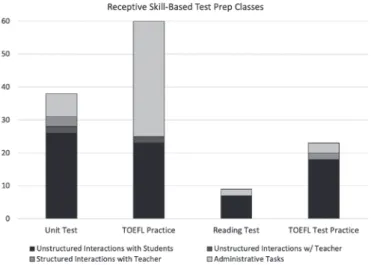
There was a clear connection found between the nature of the class and the type of interactions that took place. As shown below in Figure 1, virtually no structured interactions with students took place in receptive skill-based test preparation classes. The majority of interactions were either administrative tasks, such as homework and attendance checks, or unstructured interactions.
Figure 1. Receptive skill-based test preparation classes
Although receptive skill-based test preparation classes did not facilitate structured interactions, this does not imply that all test preparation classes did not benefit from a TAʼs presence.
In Figure 2, speaking test preparation classes yielded gains in structured interaction with students, though the interaction differed significantly between classes. In particular, the highest amount of structured interaction was achieved because the teacher gave the TA a leadership role, in which they were responsible for managing the practice time and giving feedback on student performance. Teachers who play the role of mentor, encouraging TAs to take on more responsibility in the class, also encourage more structured interaction between the TA and students.
The class in the right-hand column in Figure 2 used role-based literature circles to drive speaking test preparation practice (reading was no-stakes). Each week in this class the TA rotated discussion roles as did the students.
A relationship was found between the type of class and the level of structured TA involvement. Classes that focused on preparation for receptive skill-based tests do not seem to encourage structured interaction between TAs and students as much as speaking assessment practice and discussion activities. However, another factor that clearly emerges from the observations is that structured interactions are much more likely to occur in classes where the TAsʼ roles are clearly defined. Therefore, it is possible that more structured interactions could occur in receptive skill-based test preparation classes if TAs were given clearer roles for specified tasks.
These observations helped us gain insight into some of the ongoing challenges the TA program was facing. They shed light on both the types of tasks that led to an active and positive TA presence and the importance of giving TAs a clear idea of their roles within the classroom. This informed other important initiatives already discussed, such as the advisory meetings where Course Reps and TA Leaders worked on creating SOPs for TAs within key tasks.
7. Initiative 5: Multi-Stakeholder Satisfaction Survey
At the end of the spring semester (2019), a multi-stakeholder survey was administered to the three main stakeholders in the English TA program: students, TAs, and teachers. The surveys were administered one semester after the TA FIP restructuring had been completed. The assumption behind triangulating sources was that if there was agreement between stakeholders about specific program qualities then the evidence is more valid than for only one stakeholder. The stakeholder satisfaction survey was designed to capture a snapshot of the TA program in terms of knowledge, skills, and attitudes of students supported, and those of the TA or teacher, when referring to the perceptions of the stakeholder about their roles. It was also theorized that the TA retention rate from semesters previous to the FIP, as compared to the semester after the FIP, could be a potential indicator of increased satisfaction.
About 500 of the total 1,200 students in English classes responded to the survey regarding their satisfaction with the TA program. With regard to TAs, about 75% of the TAs (n=41) serving during the semester completed the survey. About 70% of teachers with TAs serving in their classes (n=25) responded to the survey. According to Fosnacht, Sarraf, Howe, and Peck (2007), who studied university survey response rates, the lower percentage rate for students would not result in response bias due to the large n size. Correspondingly, the smaller n size for TAs and teachers requires a larger representative sample. The 70% for such smaller samples has also been reported as acceptable by other sources (NYC Schools, 2020). The percentages of TAs in the pool at the end of spring 2019, and those who decided to stay in the pool for the fall of 2019, were also calculated to determine the retention rate.
Table 2
Student Perceptions (n=503)
1. The TA helped me with...
Speaking: 90% Writing: 47% Listening, Reading, & Study Skills: 40% 2. I was able to improve my skills with the help of the TA
Agree/Strongly Agree: 86% Disagree/Strongly Disagree: 3%
3. I would like to have a TA in my class next semester
Agree/Strongly Agree: 90% Disagree/Strongly Disagree: 1%
Table 3
TA Perceptions ( n=41)
1. I helped Ss with...
Speaking: 95% Writing: 75% Reading & Study Skills: 59% Listening: 48% 2. Students were able to improve skills with my help
Agree/Strongly Agree: 93% Disagree/Strongly Disagree: 0%
3. I would like to be a TA again next semester
Agree/Strongly Agree: 95% Disagree/Strongly Disagree: 5%
4. The expectations of the TA job are clear to me
Agree/Strongly Agree: 93% Disagree/Strongly Disagree: 0%
5. The job of the TA could be improved
Agree/Strongly Agree: 49% Disagree/Strongly Disagree: 0%
6. More training would help me as a TA
Table 4
Teacher Perceptions (n=25)
1. TA helped them with...
Speaking: 100% Writing: 64% Listening: 56% Study Skills: 48% Reading: 16% 2. Students were able to improve their skills with the help of the TA
Agree/Strongly Agree: 96% Disagree/Strongly Disagree: 0%
3. I would like to have a TA in class next semester
Agree/Strongly Agree: 88% Disagree/Strongly Disagree: 0%
4. Job description of TA could be improved
Agree/Strongly Agree: 28% Disagree/Strongly Disagree: 24%
5. More training could help me utilize TAs
Agree/Strongly Agree: 64% Disagree/Strongly Disagree: 0%
Notes:Neutral scores were left out, so some totals do not add to 100%
Strongly agree/agree and Strongly disagree/disagree conflated to one value
Overall, 90% of all stakeholders were satisfied with the program. Additionally, the English TA program retention rate increased from 50% to 76%. This is a dramatic increase in retention. In comparing results from Tables 2, 3, and 4, there was broad agreement between stakeholders regarding the following:
• TAs help with productive skills most perceptively.
• Study skills are an upcoming area for TAs to make significant contributions. • TAs help to improve learnersʼ skills.
• TA presence is strongly valued by all stakeholders. • TAs feel that the job expectations are clear to them.
The stakeholder survey provided a tool for accessing the perceptions and identifying potential avenues for ongoing improvement to the program, as well as a gauge for determining whether adequate attention is being paid to various aspects of the program.
8. Appraisal and Discussion
To appraise the FIP design, the next section considers overlapping strengths and non-overlapping weaknesses (Johnson, Onwuegbuzie, & Turner, 2007). The following appraisal also includes FIP design interactions with elements of the TA program (Kim, 1998). Thus, it is helpful to also appraise how policies, for example, interact with the results of the FIP, in order to determine next steps for improving the program.
8.1 Overlapping Strengths
The first overlapping strength was between the triangulated survey result, in which roughly 90% of all major stakeholders agree that studentsʼ skills can be improved with TAsʼ help, and the increase in retention of TAs from 50% to 76%. These results suggest the FIP was effective in improving the program overall. The second major overlapping strength for TAs was between our classroom observation result and Sharples et al.ʼs (2015) findings. Both support embedding TAs in small group interactions focused on structured tasks. The observation results from speaking classes support the inference that structured speaking task engagement is probably driving the stakeholder survey result showing that 90% of students, 95% of TAs, and all teachers believed that TAs impacted speaking skills. A third overlap regards Sharples et al.ʼs (2015) finding and our multi-stakeholder survey result, both of which identify study skills as a fruitful focus for TAs.
8.2 Overlapping Strengths and Weaknesses
In making sense of the FIP, some of the more mixed results warrant greater discussion of policies that have shaped the program over time. Consider two key policies:
1. All teachers in standard track ʻA-coursesʼ get a TA.
2. TAs can only be paid for the class period plus five minutes before and after class.
The first of these policies reflects the shared belief in the English program that as much as possible, students enrolled in different class sections of the same course deserve the same learning experience. While one underlying principle is a spirit of fairness, the policy creates a need for managing a large pool of TAs, who are mostly inexperienced undergraduate students. It should also be noted that while there is an underlying belief that students should have an equal experience regardless of course section, there are differing levels of faculty. Part-time, full-time, and tenured faculty have varying levels of training, power, and privilege in the program. Additionally, teachers have varying attitudes toward the TA program. Some teachers hear the policy as ʻAll teachers have
to work with a TAʼ while others interpret the policy as ʻAll teachers get to mentor a TAʼ. By
encouraging teachers to attend training workshops and serve as Course Reps, more stakeholders will learn to successfully utilize TAs.
The second policy that ʻTAs can only be paid for the class period plus five minutes before and after classʼ can be problematic for new teachers and new TAs. This policy does not appear to support Sharples et al.ʼs (2015) principle that ʻTAs should be fully prepared for their role in the classroomʼ (p. 5). Many educators and stakeholders familiar with other TA programs expect the teacher to meet with the TA outside class time in order to review the lesson plan and learn about their role(s) for the next class. The policy to only pay TAs during class time is aimed to protect teachersʼ boundaries. The result, however, has been that teachers do not communicate with TAs outside class, and TA Leaders report frustration that TAs are not well utilized by all teachers. Haswell (2019) also reports that the inconsistency of teacher attitudes and practices is an obstacle for TAs in Japanese universities (p. 34). Even if it were agreed that TAs can be paid for working with teachers outside of class, the fact remains that such meetings are tedious to track and verify.
Most language TAs are 18-20-years old, living in an L2 context, who are still learning how to submit detailed work records. These TAs would need to submit work records accounting for meetings in 15-minute increments. Verifying whether the meetings took place or not and whether they were reported correctly creates a great deal of administration for teachers and program coordinators. Thus, the policy protects administratorsʼ boundaries as well.
The short-term solution to this problem has been to establish SOPs for communication. Faculty work together with Course Reps to draft emails to welcome TAs and outline what will happen in the first few weeks of classes. Prioritizing asynchronous communication through official email promotes records of communication and allows the TA to refer back to information. Course Reps and TA Leaders can also supply templated messages that include SOPs for key tasks. By identifying policies that impact program management and interviewing stakeholders on their effects, program administrators can identify problems in balancing the three elements of sustainability, constructive alignment, and teacher development.
9. Toward a Framework for TA Program Development
In order to better understand the value of the FIPʼs initiatives and reforms, we attempted to categorize them. Three categories emerge from reading various studies of program evaluation (Gruba et al., 2016, p. 221). The broad categories identified include sustainability, constructive alignment, and faculty development. These categories were agreed upon among the members of the FIP and then the findings were summarized under the terms in Table 5.
Table 5
Summary of FIP outcomes by theme
Sustainability Constructive Alignment Faculty Development
1. Time is Money - Adjust scheduling to minimize TA visits on days when they are not needed. Reallocate time to training activities with lead faculty.
2. Recruit for Retention - Identifying qualifications and job elements, making a rigorous process that attracts better candidates. 3. Align transparent objectives in
hiring with training objectives and performance evaluation for TAs.
1. Define SOPs for TAs within key practice tasks that align with assessed skills.
2. Appoint Faculty Course Reps to develop SOPs for colleagues teaching the same course.
3. Train TAs in how to impact learning within SOPs.
1. Assign top TAs (TA Leaders) to Course Reps as a reward for their commitment to the TA program. 2. Train faculty to utilize TAs well
and invite them to TA training sessions.
3. Create a TA performance rubric to communicate expectations to all stakeholders.
4. Invite all stakeholders to advisory focus groups to develop a Community of Practice (Lave & Wenger, 1991, p.31).
5. Develop SOPs for improving Faculty/TA communication.
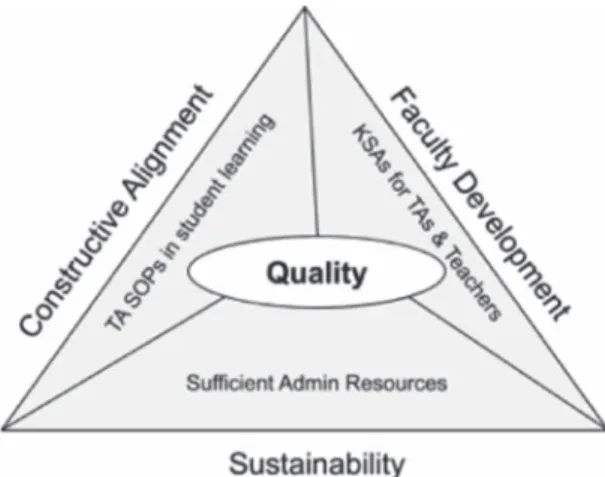
Next, in an attempt to create a model for future TA program development, these categories were organized into the framework in Figure 3. At the base, sustainability initiatives attempt to frame policies and manage resources to support administrators, coordinators, and teachers and
maximize benefits to learners. Constructive alignment initiatives attempt to move the program towards conditions in which TA performance could be aligned with student learning objectives (SLOs), and SOPs could demonstrably impact L2 learning outcomes. Faculty development initiatives were aimed at developing both faculty and TA knowledge, skills, and attitudes (KSAs). Additionally, the initiative reports also reveal categories of commitment and communication as key factors for driving program improvement. One final, fifth, meso-level principle can sum up these processes: Create a shared organizational model of the TA program that helps teachers and TAs to replace ineffective practices.
Figure 3. Quality Factors for TA Program Development
A logical next step is to develop SOPs for language TAs that build a repertoire of skills and strategies for engaging with students. While skills are assessed, specifications for how tasks are designed will be necessary for developing SOPs. This requires understanding of both skill development and task design in SLA (see DeKeyser, 2007, pp. 72-73). One of the most logical next steps is to record student performances with TAs present, and then without TAs present (cf. Blackwell, 2019). Analyzing the discourse of these task performances under both conditions will likely help to illustrate the micro-linguistic moves that TAs need to master in specific situations for supporting students in language learning. Such further research would also provide needed evidence to justify budget allocation and to help elucidate needs for TA and teacher training sessions.
10. Conclusion
The TA Program Restructuring FIP suggests that Sharples et al.ʼs (2015) principles for L1 contexts oftentimes apply to L2 university TA programs, including the program at APU. Their principles, however, were written for the micro level. This study revealed a framework of three connected meso-level considerations: sustainability, constructive alignment, and teacher/TA development. Reform initiatives will affect the inter-relationship of these three factors, as changes on one level will likely impact others. Successful TA programs, like other educational endeavors, depend upon the integration of efforts from all stakeholders. This study demonstrates the value of mixed method
research and advisory panels as methods for multifaceted reform. One limitation is that while our advisory included teachers, TAs, and coordinators, it could have benefited from the voices of academic office staff and, most importantly, students.
Additionally, reflection on this FIP has allowed us to propose five meso-level principles for improving TA program quality:
1. Manage schedules and budget together because they are interdependent. 2. Recruit professionally to attract top quality candidates.
3. Create transparent performance objectives for TAs.
4. Consult with faculty and TA leaders together in advisory meetings. 5. Create a shared organizational model by reviewing alternatives.
Finally, as more universities in EFL contexts develop EMI majors, universities with ample supply of undergraduate students who are native or near native in English will increase. These undergraduates need mentoring in terms of both administrative and pedagogical skills in order to become successful TAs. With the added benefits of video-conferencing and other forms of technology, the opportunity to mentor increases markedly. Our framework of quality factors can help guide meso-level and existing micro-level principles so that undergraduate TAs can consistently impact L2 classroom learning.
References
Bankole, A. (2019). Teaching assistants (TAs) in the English language classroom: successes and challenges. In (Eds. Roy, D., & Blake, J.) PanSig Journal 2019, 14-22. Blackwell, J. (2016). Towards a quality culture in language education. APU Journal of
Language Research, 1, 1-17. https://doi.org/10.34382/00011345
Blackwell, J. (2019). A text-based approach to developing speaking assessments. APU
Journal of Language Research, 4, 65-83. https://doi.org/10.34382/00011371
Blatchford, P., Russell, A., & Webster, R. (2012). Reassessing the impact of teaching
assistants: How research challenges practice and policy. Oxon, UK: Routledge.
Brown, H., & Iyobe, B. (2014). The growth of English medium instruction in Japan. In N. Sonda & A. Krause (Eds.), JALT2013 Conference Proceedings. Tokyo: JALT. Carroll, J.G. (1980). Effects of training programs for university teaching assistants: A review
of empirical research. The Journal of Higher Education, 51(2), 167-183. http://doi.org/10.1080/00221546.1980.11780043
Dekeyser, R. (2007). Practice in a second language: Perspectives from applied linguistics
and cognitive psychology. Cambridge, UK: Cambridge University Press. https://doi.
org/10.1017/CBO9780511667275
Fosnacht, K., Sarraf, S., Howe, E., & Peck, L. (2007). How important are high response rates for college surveys? The Review of Higher Education, 40(2), 245-265. http://doi. org/10.1353/rhe.2017.0003
e v a l u a t i o n . B a s i n g s t o k e , U K : P a l g r a v e M a c m i l l a n . h t t p s : / / d o i .
org/10.1057/9781137514370
Haswell, C. (2017). Personal and professional development for international students as TAs in Japanese universities. APU Journal of Language Research, 3, 60-71. https://doi. org//10.34382/00011363
Haswell, C. (2019). Teaching assistant programs utilizing international students in Japanese universities. Studies in Languages and Cultures, 43, 45-59. Retrieved from https://
catalog.lib.kyushu-u.ac.jp/opac_download_md/2534530/p045.pdf
Jia, C., & Bergerson, A. A. (2008). Understanding the international teaching assistant training program: A case study at a northwestern research university. International Education,
37(2), 77-98. Retrieved from https://trace.tennessee.edu/internationaleducation/vol37/
iss2/8
Johnson, R.B., Onwuegbuzie, A.J., & Turner, L. (2007). Toward a definition of mixed methods research. Journal of Mixed Methods Research, 1(2), 112-133. https://doi.org/10.1177/1558689806298224
Kim, D. (1998). The link between individual and organizational learning. In Klein, D. (Ed.),
The strategic management of intellectual capital. Boston, MA:
Butterworth-Heinemann, (pp. 41-62). https://doi.org/10.1016/b978-0-7506-9850-4.50006-3 Lave, J., & Wenger, E. (1991). Situated learning: Legitimate peripheral participation.
Cambridge: Cambridge University Press. https://doi.org/10.1017/CBO9780511815355 Meadows, K. N., Olsen, K. C., Dimitrov, N., & Dawson, D. L. (2015). Evaluating the
differential impact of teaching assistant training programs on international graduate student teaching. The Canadian Journal of Higher Education, 45(3), 34-55. https://doi. org/10.47678/cjhe.v45i3.187557
Ministry of Education, Culture, Sports, Science and Technology. (2014). Selection for the FY 2014 Top Global University Project [Press release]. Retrieved from http://www.mext. go.jp/b_menu/houdou/26/09/__icsFiles/afieldfile/2014/10/07/1352218_02.pdf
NYC Schools, (2020). Understanding school survey response rates. In Spotlight on NYC
Schools. The Research Alliance for NYC Schools. Retrieved from
https://research.steinhardt.nyu.edu/site/research_alliance/2017/11/29/understanding-school-survey-response-rates/#:~:text=Researchers%20commonly%20consider%20 a%20response,major%20group%20of%20respondents%20matters
Prieto, L. R., & Altmaier, E. M. (1994). The relationship of prior training and previous
teaching experience to self-efficacy among graduate teaching assistants. Research in
Higher Education, 35(4), 481-497. https://doi.org/10.1007/BF02496384
Reges, S. (2003). Using undergraduates as teaching assistants at a state university. ACM
SIGCSE Bulletin 35(1), 103-107. https://doi.org/10.1145/792548.611943
Romm, I., Gordon-Messer, S., & Kosinski-Collins, M. (2010). Educating young educators: A pedagogical internship for undergraduate teaching assistants. CBE—Life Sciences
Education, 9(2), 80-86. http://doi.org/10.1187/cbe.09-09-0060
Sharples, J., Webster, R., & Blatchford, P. (2015). Making best use of teaching assistants
guidance report. Education Endowment Foundation. Retrieved from
https://educationendowmentfoundation.org.uk/tools/guidance-reports/making-best-use-of-teaching-assistants/
Shannon, D. M., Twale, D. J., & Moore, M. S. (1998). TA teaching effectiveness: The impact of training and teaching experience. The Journal of Higher Education, 69(4), 440-466. http://doi.org/10.2307/2649274
The Douglas Fir Group. (2016). A transdisciplinary framework for SLA in a multilingual world. The Modern Language Journal, 100 (Supplement 2016), 19–47.
https://doi.org/10.1111/modl.12301
Webster, R., Blatchford, P., & Russell, A. (2013). Challenging and changing how schools use teaching assistants: Findings from the Effective Deployment of Teaching Assistants project. School Leadership & Management, 33(1), 78-96. https://doi.org/10.1080/13632 434.2012.724672
Weidert, J. M., Wendorf, A. R., Gurung, R. A. R., & Filz, T. (2012). A survey of graduate and undergraduate teaching assistants. College Teaching, 60(3), 95–103. https://doi.org/10.1 080/87567555.2011.637250
Acknowledgements
We would like to extend our gratitude to our faculty and all TAs for their dedication and enthusiasm. Thanks especially to James Blackwell, Chris Haswell, Hiroki Ohshiro, and the Gengo Team for their support and encouragement. Also, we would like to thank the two anonymous reviewers for their many insightful comments.
Appendix A: English Program TA System
Coordinator 1
1. Create all job descriptions and recruit staff
2. Recruit TAs, TA Leaders, Course representatives each semester 3. Liaise with academic office and all staff
4. Coordinate semester program calendar Coordinator 2
1. Create semester TA schedule in conjunction with English Program timetable
2. Liaise with overall coordinator, course level coordinators and academic office for placing TAs
3. Assist with TA Training and Interviews Coordinator 3
1. Produce two TA training workshops per semester
2. Lead TA reflection and TA performance rating surveys and report results 3. Revise TA training program
Faculty Course Representatives
- Attend training sessions, TA advisory sessions, and support interviews 1. Elementary Level Faculty
2. Pre-Intermediate Level Faculty 3. Intermediate Level Faculty 4. Upper-Intermediate Faculty
TA leaders - (one for Elementary, Pre-Intermediate, Intermediate, Upper-Intermediate) 1. Attend task trainings
2. Attend advisory sessions 3. Support recruiting days
Appendix B: TA Performance Evaluation Rubric
Course: Teacher: TA:
TA Rating Rubric
The purpose of rating TAs is to provide key feedback to TAs and to rank them. The grade should be discussed between the teacher and TA in accordance with the English Program procedures. The grade is used to prioritize TA assignments in the subsequent semester. These grades can also be accessed by teachers wishing to write recommendation letters for TAs by asking the TA coordinator.
Poor (1) Average (2) Good (3) Excellent (4)
Communication Skills Needs improvement in
more than one area appropriateness, or Lacks politeness, timeliness
Could be a little more polite, appropriate, or
timely
Polite, proactive communication online and
face-to-face Accent and grammar are
problematic for TA service Has salient accent or grammar issues but comprehensible
Could improve pronunciation/ grammar
slightly
Pronunciation and grammar is perfect. Japanese use is
inappropriate adequate for translationJapanese skill is not Japanese use could be more effective when needed Uses Japanese language effectively and appropriately Professionalism
Three or more absences: high maintenance with
admin
Absent once without advance notice, difficulty
with admin
Absent but with advance notice, occasional trouble
with admin
Never absent from class or trainings, and makes admin
easy Arrives late regularly Arrives slightly late once or
more Arrives exactly on time Always arrives early Does not know the studentsʼ
names and does not try to get to know them.
Knows all studentsʼ names
but does not use them. teacher/ students by nameAlmost always greets Always greets teacher and students by name Relational Skills & Attitude
Moody or hesitant to
interact with students awkwardness, but interactsHas occasional lows, or Mostly enthusiastic /engaged Enthusiastic, and engaged at all times Doesnʼt speak to students Speaks to students before /
after class when students initiate
Often speaks to students before class, during breaks,
and after
Always speaks to students before class, during breaks,
and after Feedback & Student Learning
Does not provide feedback
to teacher detailed feedback to teacher Does not often provide Provides some feedback to teacher about student learning/ behavior
Provides consistent, detailed feedback to teacher
about student learning/ behavior