Based on Deep Learning for Internet of Things
著者
Tang Fengxiao
学位授与機関
Tohoku University
学位授与番号
11301甲第18768号
A dissertation presented
by
Fengxiao Tang
submitted to
Tohoku University
in partial fulfillment of the requirements
for the degree of
Doctor of Philosophy
Supervisor: Professor Nei Kato
Department of Applied Information Sciences
Graduate School of Information Sciences
Tohoku University
Based on Deep Learning for Internet of Thing
A dissertation presented by
Fengxiao Tang
approved as to style and content by
Professor Nei Kato,
Graduate School of Information Sciences
Professor Xiao Zhou,
Graduate School of Information Sciences
Professor Takuo Suganuma,
Graduate School of Information Sciences
Associate Professor Zubair Md. Fadlullah,
Graduate School of Information Sciences
of Things (IoT), the large amount of network traffic flows and computing tasks become too heavy to be supported by the limited radio and traffic resources in the IoT. In this study, we analysis the resource limitation in the IoT, three corresponding resource allocation algorithms are proposed to manage the limited radio and traffic resources in IoT.
In the first proposal, the UAV-enabled IoT is proposed as the resource management platform. In the UAV-enabled IoT, the UAV-mounted flying base stations using both D2D and cellular connection is deployed as high dynamic edge computing server to pro-vide content sharing and delivery service to both IoT devices and central cloud server. Based on the UAV-enabled IoT, a anti-cooperation game based partially channel assign-ment (POC) algorithm referred to as ACPOCA is proposed to dynamically allocate POC to each link in the IoT. In our proposed game theory based AC-POCA, the device use only local information to play the game, and reach a steady state, uniqueness of which is verified through analysis. Also, the upper bound of AC-POCA (i.e., Price of Anarchy) is analytically evaluated, which is corroborated by simulation results. In addition, simula-tion results demonstrate the effectiveness of AC-POCA in terms of good throughput and low signaling overhead in a dynamic network environment.
After the AC-POCA is proposed, we further consider the radio resource allocation in the more real IoT environment with high dynamic changed traffic flows such as bursty traffic in the network. Such kind of high dynamics of traffic load make the conventional fixed channel assignment based radio allocation algorithm ineffective. Furthermore, con-sider the tremendous number of devices using various underlying protocols to connect in IoT. The Software Defined Networking (SDN) based IoT referred to as SDN-IoT is considered to deal with the heterogeneous resources and underlying protocols of IoT. In the vein, a Deep Learning based Partially Channel Assignment Algorithm, referred to as DLPOCA, is proposed to intelligently allocate channels to each link in the SDN-IoT network. In addition, to deal with the high dynamic bursty traffic, we further consider a deep learning based prediction method to estimate the future traffic in IoT. Then, the traffic prediction based novel intelligent channel assignment algorithm (TP-DLPOCA) is proposed, which can intelligently avoid potential congestion and quickly assign suitable channels in SDN-IoT. The simulation result demonstrates that our proposal significantly outperforms conventional channel assignment algorithms and ACPOCA in the high dy-namic network environment.
Finally, After the suitable radio resources are intelligently allocated to the links in the IoT, a deep learning based network traffic allocation algorithm is proposed to further optimize the network flows allocation in the IoT. In the proposal, we propose appropriate input and output characterizations of heterogeneous network traffic and propose a online
continuously learn from historical experiences to improve the allocation decision by itself. Also, simulation results are reported which demonstrate the encouraging performance of our proposed deep learning system compared to a benchmark routing strategies in terms of significantly better signaling overhead, throughput, and delay.
First and foremost, I would like to show my deepest gratitude to my supervisor, Prof. Nei Kato, for his continuous guidance, supervision, and warm support during my study in lab. His kindness, prudence and work of ethics have made my PhD period one of the best periods of my life. I am also grateful to my supervisor Dr. Zubair Md. Fadlullah, He is so kind and warm to guide me of both my essential research direction and fundamental in the PHD period.
Second, In particular, I would like to show my deepest gratitude to my family. Thanks for the selfless support from my parents and grandfather, also thanks for the helpful advises and guideline from my dear uncle.
This dissertation would not be possible without the helpful scholarship form the CSC. Grate Respect for their strong support that enabled me to pursue the challenging route during my doctoral years. Also give grate thankful to my college Bomin Mao and other co-others who cooperates with me during the research project.
Last but not least, I’ d like to thank all my friends, especially my roommate Yu Fang, for their encouragement and support.
Abstract i
Acknowledgments iii
1 Introduction 1
1.1 Background-The development and status of IoT . . . 1
1.2 Introduction of the resource allocation in IoT . . . 2
1.2.1 Considered UAV-anabled IoT and Anti-Coordination Game based dynamic POC Assignment algorithm (ACPOCA) . . . 2
1.2.2 Considered SDN-IoT and proposed Deep Learning based Partially Overlapping Channel Assignment (DLPOCA) . . . 5
1.2.3 The deep learning based network traffic allocation in SDN-IoT . . . 7
2 Overview of Resource allocation, game theory and deep learning in IoT 10 2.1 Introduction . . . 10
2.2 Overview of resource allocation in network . . . 11
2.3 Overview of channel assignment in wireless network . . . 12
2.3.1 Channel assignment in wireless network . . . 12
2.3.2 Partially overlapping channel assignment in wireless network . . . . 13
2.3.3 Channel assignment in IoT . . . 14
2.4 Overview of game theory in network . . . 15
2.5 Overview of deep learning in network . . . 16
2.6 Overview of deep learning in network traffic allocation . . . 17
2.7 Summary . . . 17
3 The Proposed Anti-Coordination Game based Channel Assignment 19 3.1 Network Model . . . 19
3.2 Interference model . . . 20
3.2.1 Problem Formulation . . . 22
3.2.2 Static topology . . . 26
3.3 Analysis on Unique Steady State . . . 29
3.4 Performance Evaluation . . . 31
3.4.1 Price of Anarchy (PoA) . . . 31
3.4.2 Simulation Results . . . 32
3.5 Summary . . . 35
4 Deep Learning Based Traffic load prediction 38 4.0.1 Network Model . . . 40
4.1 Deep learning model . . . 41
4.2 Traffic Load Prediction in Central Control System:CTP . . . 44
4.2.1 Data Collection Phase . . . 44
4.2.2 Training Phase . . . 45
4.2.3 Prediction and Accuracy Calculation Phase . . . 45
4.2.4 Online Training Phase . . . 46
4.3 Traffic Load Prediction in Semi-central Control System:S-CTP . . . 46
4.3.1 Data Collection Phase . . . 47
4.3.2 Training Phase . . . 47
4.4 Traffic Load Prediction in Distributed Control System:DTP . . . 48
4.5 Summary . . . 49
5 Proposed Deep Learning Based Partially Channel Assignment 50 5.1 Proposed Deep Learning Based Partially Channel Assignment . . . 51
5.1.1 Deep Learning based Channel Assignment . . . 52
5.1.1.1 Training Phase . . . 52
5.1.1.2 Dynamic Channel Assignment Phase . . . 54
5.1.2 Deep Learning based Channel Assignment jointed with Prediction . 55 5.2 Performance Evaluation . . . 56
5.2.1 Prediction Accuracy . . . 59
5.2.2 Performance of Deep Learning Based Channel Assignment . . . 60
5.2.3 Performance of the Joint Deep Learning Based Prediction and Chan-nel Assignment . . . 63
5.3 Summary . . . 65
6 Proposed Deep Learning Based Network Traffic Allocation 66 6.1 Problem Statement and Considered Deep Learning System . . . 67
6.2 Proposed Deep Learning Based Network Traffic Control Method . . . 70
6.2.1 Initial Phase . . . 70
6.2.2 Running Phase . . . 70
6.3 Performance Evaluation . . . 74 6.4 Conclusion . . . 77
7 Conclusion 80
7.1 Summary and Discussions . . . 80
Bibliography 82
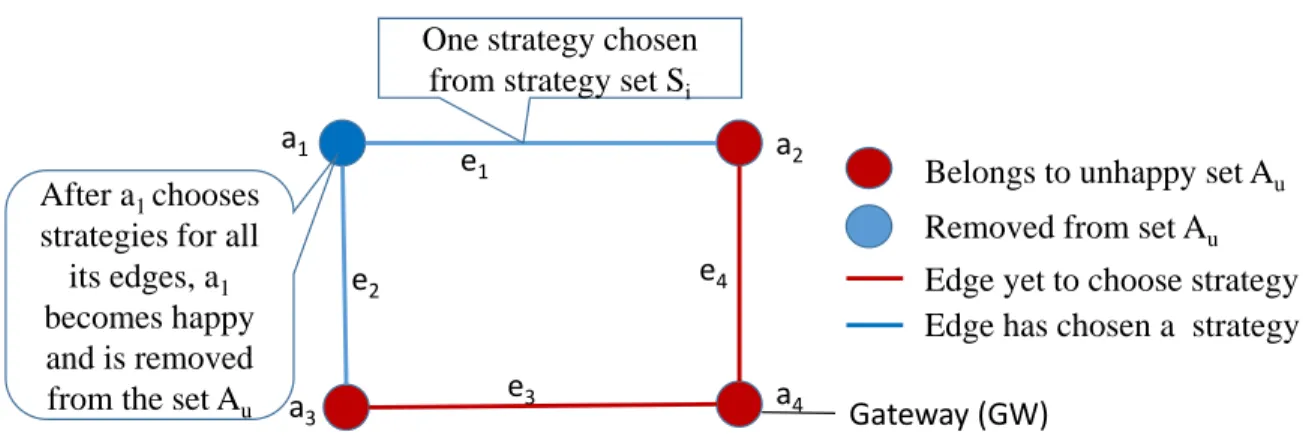
1.1 Considered UAV-enabled IoT architecture and the problem of using par-tially overlapping channels in the network. . . 3 1.2 The SDN-IoT architecture. . . 6 1.3 The considered SDN-IoT and deep learning based traffic allocation approach. 8 3.1 A simple, easy-to-understand illustration of the operation of the proposed
AC-POCA algorithm. The example comprises 4 nodes with 4 links in the proposed network. In this instance, node a1 is the player with the first initial order. So, it chooses channel assignment strategies on its links (edges) before the other players. . . 28 3.2 The utility function (UN ET) of AC-POCA algorithm demonstrating the
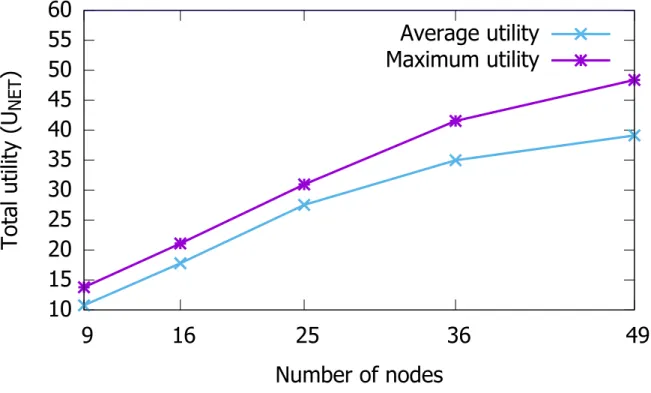
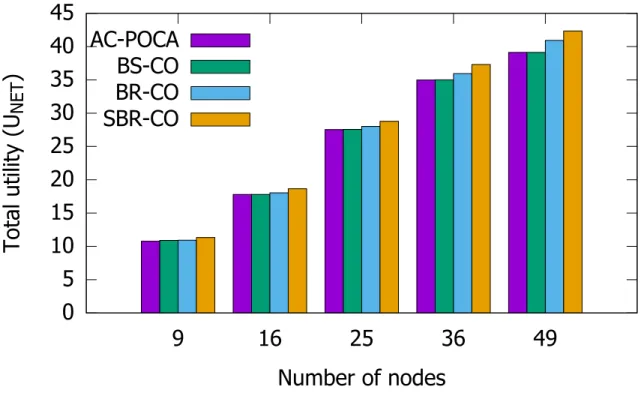
comparison of maximum and average utilities. . . 31 3.3 The utility function (UN ET) of AC-POCA compared with that of a
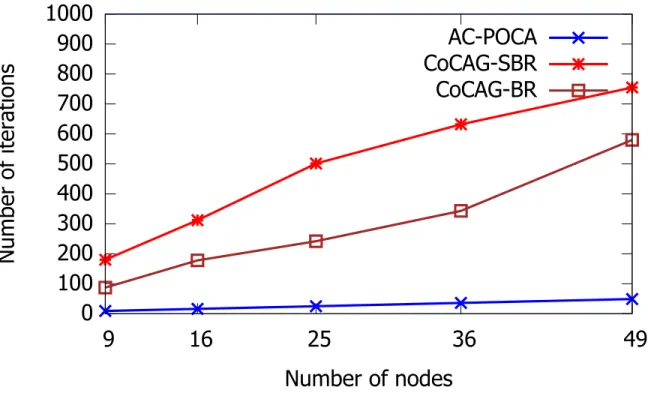
coop-erative game with three learning schemes. . . 32 3.4 Comparison of convergence time performance for the proposal (AC-POCA)
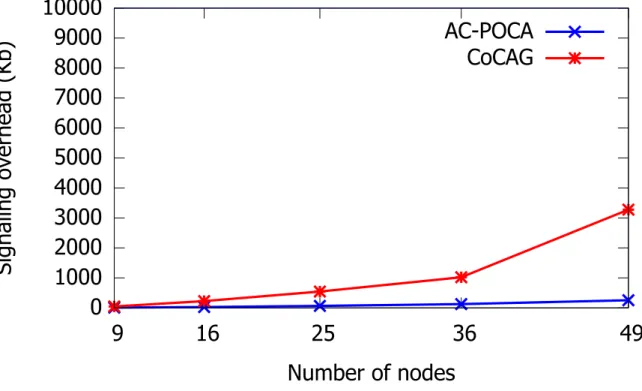
and conventional CoCAG algorithms with SBR and BR learning techniques. 34 3.5 Signaling overhead comparison for the proposed AC-POCA and
conven-tional CoCAG (SBR) methods. . . 35 3.6 Connectivity of network in terms of number of active links in case of the
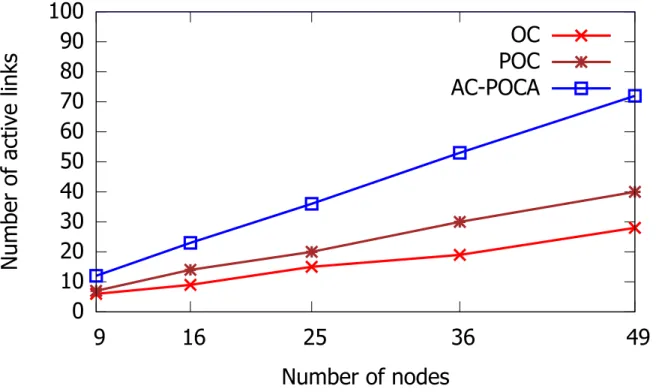
proposed AC-POCA, and conventional OC and POC methods. . . 36 3.7 Throughput comparison for the proposed AC-POCA and conventional CoCAG
(SBR) methods for the dynamic topology. . . 37 4.1 The problem of existing POC assignment algorithms and our research goal. 39 4.2 The employed deep learning structures. . . 42 4.3 The training and prediction phase in a semi-central control system. . . 46 5.1 The decision process comparison of the TP-DLPOCA and the conventional
game theory based POC assignment methods. . . 51 5.2 The integrated traffic pattern of different switches in the periodic intensive
case (EIC). . . 54 5.4 The performance comparison of the three kinds of proposed mechanisms
with different numbers of time slots and different lengths of the time slot. . 57 5.5 The performance comparison of the three kinds of proposed mechanisms
with different numbers of switches and different kinds of data generation method. . . 58 5.6 The accuracy with different configuration of learning structure. . . 61 5.7 The convergence compared with proposal and conventional algorithm. . . . 62 5.8 The throughput compared with proposed DLPOCA and conventional
al-gorithms. . . 63 5.9 The network performance comparison of the TP-DLPOCA, DLPOCA and
conventional algorithms in terms of throughput, packets loss rate in the situation of PIC. . . 64 6.1 Considered wireless network backbone and depicting our focused problem. 68 6.2 The flow chart of our proposed deep learning based network traffic control
method. . . 71 6.3 Our unique input characterization for the deep CNN. . . 72 6.4 Packet loss rate before and after the training phase of proposal. . . 74 6.5 The input traffic and performance comparison of our proposal and
conven-tional OSPF, IS-IS, and RIP of average delay . . . 76 6.6 Comparison of our proposal and conventional OSPF, IS-IS, and RIP in
3.1 Interference Range (IR). . . 21 3.2 Interference Vector. . . 21 3.3 I-Matrix. . . 22 3.4 Channel assignment using AC-POCA in the different links shown in Fig. 3.1
for different initial orders of the players. Among the 24 possible initial orders, only a few are listed as a simple example. . . 28 5.1 The configuration of PIC and EIC . . . 53 6.1 Considered features of the deep CNN. . . 73
AC-POCA Anti-Coordination based Partially Overlapping Channel Assignment AP Access Point
CNNs Convolutional Neural Networks
C-RAN(CRAN) Centralized, Cloud Computing-based Architecture For Radio Access Networks
CRNs cognitive radio networks CC Common Channel
CTP Traffic Load Prediction
CoCAG Cooperative Channel Assignment Game CPU Central Processing Unit
D2D Device-to-Device
DBMs Deep Boltzmann Machines DBA Deep Belief Architecture
DTP Distributed control Traffic load Prediction DBN Deep Belief Network
DLPOCA Deep Learning based Partially Overlapping Channel Assignment EIC Event Intensive Case
FDMA Frequency Division Multiple Access GPU Graphics processing unit
HC Hop Count
IS-IS Intermediate System to Intermediate System IF Interference Factor
IEEE Institute of Electrical & Electronics Engineers IoT Internet of Things
LSAs link-state advertisements MRMC Inter-Packet-Delay
MRMC Multi-Radio Multi-Channel MRF Markov Random Field
M2M Machine to Machine MEC Mobile-Edge Computing
NFV Distributed Dynamic Resource Allocation NFC Near Field Communication
NICs Network interface controllers NE Nash Equilibrium
NI Non-Interfering
OSPF Open Shortest Path Firs OC Overlapping Channel PoA Price of Anarchy
POCs Partially Overlapping Channels PIC Periodic Intensive Case
QoE Quality of Experience QoS Quality of Service
RIP Routing Information Protocol RFID Radio Frequency Identication
SDN Software Defined Networking SDN-IoT SDN enabled IoT
SP Shortest Path
SDRs Software Defined Routers
S-CTP Semi-Central control Traffic load Prediction SINR Signal-to-Interference-plus Noise Ratio
TP-DLPOCA Combined Traffic Prediction and DLPOCA TL Traffic Load
UAVs Unmanned Aerial Vehicles WLANs Wireless Local Area Networks WMN Wireless Mesh Network
WM Weight Matrix
Introduction
1.1
Background-The development and status of IoT
With the wide use of high speed internet, the physical objects embedded with electronics, software, sensors, actuators can easily connect to internet and construct as a big smart things driven network. Those smart network is commonly known as Internet of things (IoT) [1, 2, 3, 4] , and the physical objects are referred to as IoT devices. With the rapid development of internet, there are more than 200 billion IoT devices is expected to interconnected around the world in the next 3 years. [5]
With the IoT paradigm, the researchers envisions the scenario contains a large number of smart physical objects equipped with micro controllers, transceivers to collect data and communication with each other in our daily life. It is foreseeable that, those intelligent networks will integrate into our life and become an integral part of the Internet. [6]
As the rapid increase of IoT devices, there is an associated business market for both manusfacturers, network services providers, software developers and platform builders. The IoT devices and corresponding equipments are expected to reach 212 billions around 2020 [7]. Both the traffic flows and connected machines are grows fast in the past 10 years [8, 9], especially the M2M devices increased more than three times during 2017-2012 [10]. The applications of IoT are widely distributed in various areas, such as health-care, industry management, automation systems. In addition, the Navigant research report Shows global revenue from IoT and analytics for utilities market may Grow to $5.1 billion in 2028 [11]. moreover, the market of IoT application in smart city is estimated to continuous increase for nearly 16 billions per year in the future years. [12, 6]
The rapid growth of IoT in both industry and business fields emerges a big challenge and opportunity for researchers. The traditional network structures only consider the simple server and clients are no longer suitable for the new IoT system. the traditional Internet architecture needs to be revised to match the IoT challenges. For example, the tremendous number of objects swilling to connect to the Internet should be
consid-Radio Frequency Identication (RFID), Near Field Communication (NFC), Wireless Sen-sor Networks (WSN), Machine-to-Machine (M2M), Unmanned Aerial Vehicles (UAVs) communications. The complexity, possible limitations and heterogeneity of various IoT devices connected to the internet will require even more specic tools to manage them and to improve the performance of the whole network [13]. In such complex IoT environment, the requirement of communication QoS of devices is tremendously increasing with both the computational resource and radio resource of devices in IoT is limited. How to balance the increased QoS requirement and limited resources becomes critical problem.
1.2
Introduction of the resource allocation in IoT
The resource allocation algorithms are widely researched in traditional network, such as channel allocation in cellular network [14], network traffic allocation in wireless mesh network [15], computing resource offloading in mobile network [16] and energy resource allocation in WSN [17]. In the thesis, we mainly focus on the channel allocation and network traffic allocation.
1.2.1
Considered UAV-anabled IoT and Anti-Coordination Game
based dynamic POC Assignment algorithm (ACPOCA)
The cloud computing, as an novel internet-based computing platform, can provides shared processing resources computers and other devices on demand [16]. In traditional network, the cloud server is normally deployed as the center service to offload computing resources form distributed devices. Recently, the mobile-edge computing (MEC) has gained mo-mentum to expend the resource offloading tasks from the center cloud computing to the edge nodes in IoT [18]. Moreover, as another hot technique, Unmanned Aerial Vehicles (UAVs) have appeared as a promising candidate to be exploited as flying base stations [19] to quickly construct efficient and high Quality-of-Service (QoS) wireless networks even in remote and/or rural areas [20, 21]. Such kind of flying base stations can be deployed as high dynamic edge computing service provider in both traditional cellular network and the considered IoT. On the other hand, in IoT, the bandwidth and energy are limited at the content servers when multiple users aim to access the same content. This limitation results in increased resource waste and delay [22]. To address this issue, Device-to-Device (D2D) [23, 24, 25, 26] communication with caching emerged as a complementary solu-tion in IoT [27]. D2D communicasolu-tion reuses existing licensed spectrum resources to make under-laid transmission links, which can typically be deployed between smart devices [28], which is a widely used technique in IoT. Furthermore, UAVs, to exploit their earlier
Secondary D2D
links(reuse channels)
Primary cellular
links in IoT
IoT Devices
Congested CongestedThe UAV-anabled IoT: Could Partially Overlapping Channels
(PoCs) be used to improve network throughput?
How to assign channels to
the right links.
With the high dynamics of IoT, when
topology is changed, how to change channels?
New devices joins in
Device moves out
UAV (MEC)
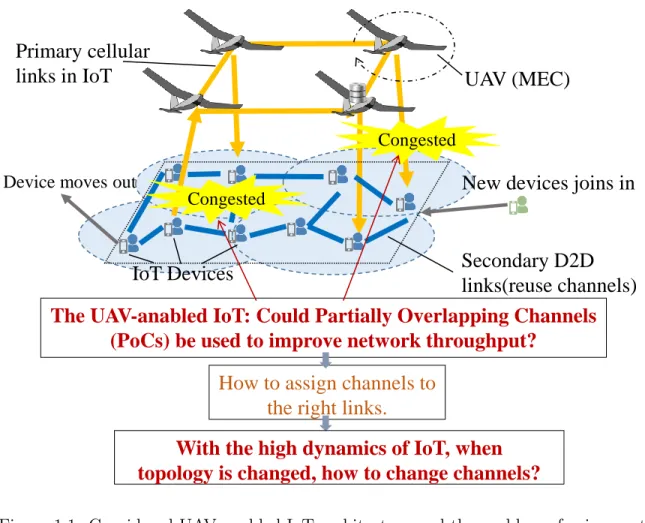
Figure 1.1: Considered UAV-enabled IoT architecture and the problem of using partially overlapping channels in the network.
mentioned flexibility to construct wireless communication networks in locations lacking adequate cellular infrastructure, have been used to establish D2D links with caching [20]. With such UAV-anabled D2D, the whole UAV base stations based MEC in IoT is referred to as UAV-enabled IoT. With the high dynamical ability of UAV, the infrastructure of the UAV-enabled IoT is not only used to offload computing but also can be flexibly changed to form a dynamic wireless network provider to meet the varying IoT user requirements. In this research, we first envision the UAV-enabled IoT whereby the primary links (i.e., downlink transmission) and secondary links (i.e., D2D underlink communication) are considered as complementary methods for content delivery to offer better performance compared to conventional content delivery approaches.
However, as demonstrated in Fig.1.1 in the proposed combined heterogeneous network, both primary and D2D links share the same spectrum whereby both the UAVs and IoT devices typically use multi-radio, multi-channel communications. The spectrum used by both primary and secondary links of the UAV-enabled IoT makes the channel resources limited in the entire network, and the nearby channels easily become overlapping. Such overlapping channels in the neighboring UAVs and IoT devices can cause severe
interfer-(overlapping) channels and the number of orthogonal channels is limited, the Partially Overlapping Channel (POC) can be a good solution to decrease interference and improve network throughput [29, 30, 31] .To maximize the channel resource utilization, POCs can be assigned to the UAVs and IoT devices. Researches demonstrated that proper assign-ment of POCs can efficiently avoid interference and improve the aggregate throughput of various communication networks. However, current POC algorithms mostly focus on the improvement of network performance after channel assignment, but lack the con-sideration of waste throughput due to the suspended transmission during the channel assignment process. With the high dynamics of the considered IoT, the assigned channels need to be frequently changed to adaptively adjust to the dynamically changed network traffic. This dynamic adjustment throws out a critical requirement for the quick process-ing of the channel assignment. Therefore, How to efficiently assign POCs to the nodes while minimizing interference is a critical problem. Based on the conventional channel assignment problem, by considering the mobility of UAVs and IoT devices, the network topology becomes highly dynamic, which means that the link state and interference range of each node may frequently change. However, conventional POCs assignment are typi-cally limited by complex and numerous iterations, which depends on the persistent global information and cause significantly long convergence time. Therefore, the existing POCs assignment in other communication networks may not applicable to the highly dynamic environment in the considered UAV-enabled IoT. This poses a further challenge to the channel assignment problem. In the first part of our research, based on the complex con-ditions in UAV-enabled IoT, I address those issues, and propose an Anti-Coordination Game [32] based dynamic POC Assignment algorithm, referred to as AC-POCA.
The contributions of the first part are as follows.
• I present a UAV-anabled IoT and justify the adopted network topology. Then, I analyze the new features of channels assignment problems in the proposed network. • According to the new features of the proposed network, I use the anti-coordination game to model the channel assignment problem in the considered network that uses local information and leads to quick convergence time.
• Based on the high mobility of the UAV-enabled IoT, the dynamic topology based POC assignment algorithm is further designed to deal with situations in which the network environment is dynamically changed.
• I prove the existence and uniqueness of the steady state in AC-POCA and demon-strate its superior performance over comparable methods in both mixed and dynamic environments.
1.2.2
Considered SDN-IoT and proposed Deep Learning based
Partially Overlapping Channel Assignment (DLPOCA)
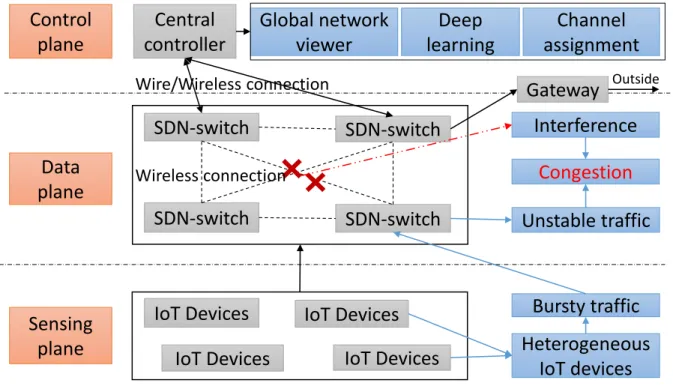
As the mentioned in the background, a big challenge of IoT is that the tremendous number of objects swilling to connect to the Internet should be considered in many underlying pro-tocols. If all IoT devices and corresponding communications are constructed in the same structure and protocols, the resources algorithms maybe easily designed, however, the real world IoT deployments are fundamentally heterogeneous. Software Defined Networking (SDN) [33, 34] is a famous technique used in the IoT to deal with the heterogeneous resources and structure [35] . In such SDN-IoT as depicted in Fig. 1.2, heterogeneous devices sense and collect data in the sensing plane, and then send the data to the gateway after integration through switches (i.e., routers) in the data plane. With SDN, the soft-ware enabled with resource allocation algorithm are commonly deployed upon the sensing plane of heterogeneous sensor devices. In such structure, the different underlying proto-cols no longer the bottleneck of designed resource allocation algorithm. However, with the increasing number of devices, the load of integrated traffic in switches may become significantly heavy, and multiple radio channels are needed to be evenly assigned to each link to balance the load [36, 37, 38].
To solve this problem, in the first part, an Anti-Coordination based POC Algorithm (ACPOCA) was proposed, which can efficiently reduce the iteration times of channel assignment process, and improve the network throughput. However, without a central controller, both the signaling and suspension time of the network are limited by the dis-tributed setting. Therefore, to address such challenges, in the second part, a deep learning based, intelligent POC assignment algorithm with the centralized SDN is proposed. The contributions of the deep learning based proposal can be explained in two aspects.
• First, with the central control paradigm of SDN, switches do not need to exchange their channel states anymore. All channel assignment processes can be carried out in the central controller. Thus, the signaling overhead of the network is significantly reduced.
• Second, since the deep learning approach can learn from previous channel assign-ment processes through training with the data collected from the existing channel assignment algorithms (e.g., ACPOCA), the channel assignment can be finished in just single iteration.
In summary, this approach, which we refer to as the Deep Learning based Partially Overlapping Channel Assignment (DLPOCA), can efficiently reduce the suspension time caused by channel assignment, and achieves almost non-suspending flows during the chan-nel assignment process.
SDN-switch
SDN-switch
SDN-switch
SDN-switch
Interference
Congestion
Unstable traffic
IoT Devices
IoT Devices
IoT Devices
IoT Devices
Heterogeneous
IoT devices
Bursty traffic
Data
plane
Sensing
plane
Control
plane
Central
controller
Global network
viewer
Deep
learning
Channel
assignment
Wireless connectionGateway
Outside Wire/Wireless connectionFigure 1.2: The SDN-IoT architecture.
Additionally, in existing channel assignment algorithms, as the most important base-line metric in the channel assignment, the traffic load is usually assumed to be continuous and stable. This means that the traffic load in the next time interval after the channel as-signment is similar to that in last time interval. However, the real traffic loads in practical networks are more complex and may suddenly change like a bursty traffic. Particularly in SDN-IoT, in the sensing plane of the SDN-IoT structure, the devices can be divided into three groups depending on the sensing mechanism: periodic sensing, event-driven sensing, and query-based sensing [39, 40, 41, 42]. For the periodic sensing devices, such as tem-perature, humidity and light sensing devices, they sense data and periodically integrate and transmit them to the central controller. Moreover, these devices may have different policies (e.g., sensing circle, volume of sensing data, and so forth). For example, a kind of temperature sensing device may collect 3kB temperature once in every 30s, another kind of humidity sensing device may collect 10kB humidity data once every 1 minute. Those different policies result in highly complex, periodically bursty distribution of the traffic load. For the event-driven and query-based sensing devices, the traffic load is also not con-sequent but explosively generated when a new event occurs or a query comes. The bursty traffic caused by the event-driven and query-based sensing device is more random and irregular than that generated by the periodic sensors. In the SDN-IoT network, with het-erogeneous resources, sensing devices can hardly cooperate with one another, making the switch impossible to know the real future traffic integrated by the heterogeneous sensors. Furthermore, besides the traffic generated by its connected sensing devices represented
as integrated traffic, each switch may also have to forward the traffic from other switches denoted as relayed traffic. In practical networks, the mixed traffic containing integrated and relayed traffic becomes more complex. Even though many existing researchers pro-posed some methods about traffic load prediction, most of them focused on the traffic changes in the long-term and did not consider the traffic load change caused by routing. Therefore, in the third part of our research, a deep learning based prediction and POCs assignment algorithm is proposed. contributions of the third part are separately outlined as follows.
• First, I use the powerful deep learning approach to predict the complex traffic, which can achieve above 90 percent accuracy and have a quick response time. (5ms<) • Second, I investigate the advantage of using the centralized SDN technique in the
deep learning based traffic load prediction in the IoT environment. In order to show the improvement of deep learning based traffic load prediction in SDN-IoT compare with conventional IoT, we respectively design three traffic load prediction algorithms to suit three different control systems (i.e., centralized SDN control system, semi-centralized control system and distributed control system). After designing those three different prediction methods, we further compare the prediction accuracy in those three different control systems. The result shows that, the prediction accuracy of centralized SDN based prediction is always better than those in the two other systems.
• Finally, with the centralized SDN control, we combine the deep learning based traf-fic prediction and partially overlapping channel assignment, that uses the predicted traffic load as the criterion to perform the intelligent channel assignment. Such proposed intelligent partially overlapping channel assignment, which we refer to as TP-DLPOCA, can efficiently increase the channel assignment accuracy and process-ing speed of channel assignment. The simulation results demonstrate that both the throughput and delay in the SDN-IoT with our proposal are better than those of the conventional algorithms.
1.2.3
The deep learning based network traffic allocation in
SDN-IoT
After the radio channels are intelligently assigned to each links in SDN-IoT. The potential routing paths from source node to destinations can be easily got. However, as we men-tioned above, with the traffic increase, the nodes in the certain routing path may suffer extremely high burden. Then, how can we allocate the traffic flow to suitable path to
S
1S
3 …S
2…
…
…
…
…
…
…
…
…
…
Switch
Metric type
T
im
e
In
te
rv
al
s
1
0
Input
Output
Traffic patterns, delay
values
<Match, Action>
Path update
request
Deep learning based traffic allocation
Controller
S
7S
4S
8S
5S
9S
6SDN-IoT
switch
SDN gateway
IoT devices
IoT devices
IoT devices
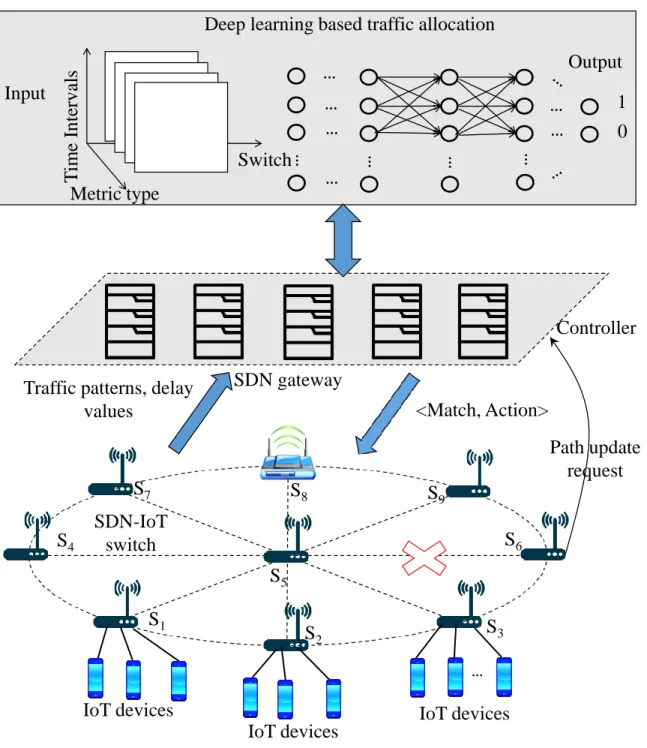
Figure 1.3: The considered SDN-IoT and deep learning based traffic allocation approach.
alleviate the network traffic burden? Current SDN enabled network still use conventional routing strategies which are commonly based on fixed rules [43], such as the Shortest Path (SP) algorithm. The problem of fixed rule-based routing protocols is that the same paths will be chosen when similar traffic patterns appear, even though these paths can result in traffic congestion according to previous experiences. Repetitions of the same fault lead to the unnecessary network performance deterioration. Moreover, the reactive manner utilized in conventional routing protocols, to update path after some link/switch failure, causes the unavoidable delay in a centralized control system [44]. Even we can
develop an intelligent routing strategy by adding the memory mechanism, many other latent problems still exist and new problems may appear due to the changing network situations. Therefore, it is extremely important to design an intelligent routing strategy which has the ability to learn from previous experiences and adapt itself to the changes. To address the aforementioned issues and considering the high computation resource equipped in the SDN-IoT controller, we propose a deep learning based intelligent rout-ing strategy for SDN-IoT demenstrated in Fig.1.3. Definitely speakrout-ing, we consider the network as an image and the different features of traffic patterns as different channels of pixels. Since the Convolutional Neural Networks (CNNs) are the most widely utilized architectures in the field of image classification, in this article, I utilize CNNs to analyze the network traffic patterns and make the routing decisions. Our proposal consists of two phases, the initial phase and the running phase. The contributions of our proposal can be summarized as follows.
• I propose online self-learning method in network. This method will continuously label real-time collected data to retrain the deep learning architectures. Therefore, the deep learning architectures can get adapted to the environmental changes. • To overcome the repeated mistakes caused by the fixed rule based routing algorithm,
I utilize the deep learning method to predict the traffic state in SDN-IoT. Definitely speaking, in the actual running phase, the central controller will monitor the network performance and utilize the real-time performance as the feedback of the routing decision to periodically retrain the CNNs. Thus, the proposed strategy can not only learn from previous experiences and proactively update the paths, but also adjust and improve itself to suit the new traffic situation.
Overview of Resource allocation,
game theory and deep learning in
IoT
2.1
Introduction
In IoT, the cellular communication and D2D communication are widely deployed in IoT as the underling technique to fast construct the feasible IoT. However, the related research works did not take into consideration the shortcoming of cellular infrastructure in remote, rural, or disaster-affected areas.
UAV based wireless networks recently emerged as an attractive technique for facili-tating public safety and military communications [45]. This is because the UAVs can be rapidly deployed as aerial base stations to form a flexible cellular network [19, 46]. In [20], the deployment of a UAV-based communication network over a given geographical area was analyzed. The analysis demonstrated the feasibility of deploying UAVs in D2D enabled cellular networks. While the UAVs equipped with reasonably large storage and computing ability can be considered as content-centric server nodes in the considered IoT network [47, 48], On the other hand, one of our earlier works in [45] demonstrated how emerging wireless networks aided by UAVs can become useful in enabling communications in ultra-dense environments in urban locations which might be the hot area in future IoT scenario. to the best of our knowledge, no previous work has investigated the importance of a combined UAV and D2D based network technology for supporting the network in IoT.
However, with the mixed using of UAV, D2D and UAV, the heterogeneous devices and underling protocol deployed in distributed manner may cause unpredictable error and conflict. In order to solve such problem in the complex IoT environment, The SDN-IoT
structure processed in centralized manner was first proposed by Qin at al. in 2014 [35] which incorporates and supports commands in a heterogeneous structure to optimize the SDN-IoT network. After the first SDN-IoT structure was proposed, many related works emerged. Sood et al [49] employed a multi-objective constraint to manage the layer resource in SDN-IoT. Ojo et al [13] presented a SDN-IoT architecture with Network Function Virtualization (NFV) implementation to address the new challenges of IoT. Nguyen et al [50] proposed a SDN-based IoT Mobile Edge Cloud Architecture to deploy diverse IoT services at the mobile edge.
With such SDN-IoT, as shown in Fig.1.2 the algorithm for network control and re-source allocation methods can be easily deployed in SDN central controller to manage the whole IoT. About resource allocation, there are many exist works detailed introduced in the next sections. In The remain sections, we first overview the existing studies about resource allocation in conventional networks in Sec.2.2. Then, in Sec.2.3, the related radio allocation namely channel assignment algorithms are introduced. In this section, we first survey the channel assignment in wireless network and then introduce the usage of new partially overlapping channels (POCs) in wireless network and IoT. After the channel as-signment, we simply introduced the research state about my employed techniques, game theory in network in Sec.2.4 and deep learning in network in Sec.2.5. Finally, the existing works about network traffic allocation are discussed in Sec.2.6
2.2
Overview of resource allocation in network
The network resource such as radio resources, computing resources, power resources are limited in the IoT. There are many resource allocation related researches, in this section, we introduce the research flow of resource allocation.
Ten years ago, the resource allocation algorithm is first proposed to deal with the limited resource utilization in cellular network. S.A. Grandhi et al., [51], gives resource allocation solution for cellular radio systems. In the research, a Distributed Dynamic Resource Allocation (DDRA) scheme based on local signal and interference measurements is proposed for multiuser radio networks. In [52] C.Curescu et al. presents a bandwidth allocation and admission control mechanism to be used in a radio network cell of a future generation telecommunication network. This approach is based on the time-aware utility to maximize the quality level of network. In the cellular network, the previous resource allocation algorithms are mostly just consider the user in the network directly connect to the base station, to improve it. M.Dohler et al. [53] proposed a FDMA-based regenerative multihop links based resource allocation method, and researchers in [54] proposed a relay and centralization based resource allocation algorithm. However, the resource limitation of the relay node are not fully considered in those researches. To address this issue, Y.
Li [55] proposed a relay station based integrated radio resource allocation algorithm which also take the resource limitation of relay station into consideration.
The resource allocation problem is widely studied in conventional cellular network, however, with the network technique developing, more complex heterogeneous network such as D2D and UAV communication enabled IoT have emerged. To conquer the chal-lenge, many researches are proposed. To model the complex network environment, R. Yin [56] and F. Wang [57] use game theory to model the resource allocation problem, the power and radio resource allocation algorithm is proposed correspondingly. D.H.Lee [58] considers the resource allocation solutions in both distributed and centralized control manner in the network. In [59], the authors jointly consider admission, power and radio resource allocation, and propose a tress stage resource allocation algorithm. Then, B. Zhou in [60] and M. Hasan in [61] consider the relay situation in the D2D enabled cel-lular network. Those above methods mainly consider single factors in the network, the researches [62], [63] and [64] further consider power consumption in both user and station, the solutions are suitable for heterogeneous networks. However, those methods lack con-sideration of multiple cellular and the interferences between different cellulars, Z. Zhou in [65] considers C-RAN and multiple cellular environment, proposes an energy-efficient resource allocation algorithm for D2D Communications network. Those resource alloca-tion methods widely research the balance of different types of resource in the network. However, all of those researches lack the focus on specific radio resource features, and there are no related resource allocation algorithm designed for SDN-IoT.
2.3
Overview of channel assignment in wireless
net-work
In this section, we give a preliminary of the specific channel resource allocation in wireless network. The radio channel allocation (i.e., assignment) is widely researched in conven-tional wireless network.
2.3.1
Channel assignment in wireless network
A. Raniwala et al. in [66] at first studies the channel assignment problem in multi-channel wireless mesh network and proposes that the multi-channel assignment problem can be treated as graph coloring problem [67] which is a NP-hard problem [68]. P. Kyasanur in [69] proposes a classical fixed channel assignment algorithm in the chennal multi-interface wireless network. This method uses stable channels to fit for static network, however, when the number of channels increases, the proposed NICs based interface model may not satisfy the limited resources. In [70], instead of fixed network topology, the
authors propose a topology channel based channel assignment algorithm. In this approach, the channel assignment scheme is based on the independent network traffic to enable flexible network topology. Even through the method is designed for flexible network, the channel assignment algorithm itself is not dynamic. In this vein, some dynamic channel assignment algorithms are proposed. The study in [71] shows a technique to allow the channel dynamic switch within significant shot time slot. With such kind of quick channel switch technique, A Raniwala et al. in [72] proposes traffic load based dynamic channel assignment algorithm. A spanning tree topology is used in this algorithm to leverage routing overload in the considered wireless network, both the neighbor-to-interface binding and neighbor-to-interface-to-channel binding are considered in this approach. In [73], the authors further consider the impact of traffic patterns and network connectivity of wireless links in network, a corresponding fixed channel assignment algorithm is proposed. The priority rank of all nodes in network is calculated as the main factor of this proposal. And the author first considers the nodes near the gateway with highest traffic load are allocated highest ranks in the algorithm. In addition, to consider more complex network environment, Zhou et al. [74] studies the radio allocation problem in channel multi-radio network, in this research, the authors focus on the minimal video distortion and resource fairness to improve channel utilization. All of those studies work on the non-overlapping (orthogonal) channels, however, in many cases, the application of partially overlapping channels gives much better performance in terms of both network throughput and QoS. In next part, I give a overview of partially overlapping channels in wireless network.
2.3.2
Partially overlapping channel assignment in wireless
net-work
in 2005, Mishra et.al [75, 30] first research the situation of using partially overlapping channels (POCs) in the network can improve the network performance. Bukkapatanam et al. [31] then gives a detailed analysis of usage of overlapping channels in backbone network. However, no corresponding POCs based assignment algorithm is proposed.
As the channel assignment algorithm is proved to be a NP-hard problem, In [76], a heuristic POCs assignment algorithm is proposed. However, in this approach, the net-work traffic is static and the traffic load in each node are not considered. P.D.F et.al [77] firstly consider the POCs assignment problem from the game theoretical perspective. With the definition of utility function of nodes (players) in network, the players auction is processed to make the total utility of network maximum. After it, the same authors further improve the game theory based POC assignment algorithm with cooperative game theory[29] and proved the existence of the steady state(Nash Equilibrium) in the POC
assignment algorithm (game). Besides, without employ game theory, there are some other POCs assignment studies, Y. Ding in [78] proposes a POC assignment algorithm based on unknown network traffic. Instead of conventional wireless network, P. Ciotrnae et.al [79] considers the POC problem in WI-FI communication, with the build test bed, both the in-terference model and SINR performance are detailed analysis. F. S. Bokhari [80] proposes a mixed POCs assignment algorithm in both centralized and distributed control manner. In summary, the related works widely study the POCs assignment in wireless networks, many heuristic algorithms are proposed to minimize the interference and improve the net-work throughput. However, as I know, no POCs assignment algorithm is proposed for the specific IoT environment. In next part, we investigate the channel assignment researches in IoT.
2.3.3
Channel assignment in IoT
The IoT is emerged as the famous network around the world recently, in terms of the new features and special heterogeneous structures in IoT, many novel channel assignment algorithms for IoT are proposed.
As the D2D is the main technique used in IoT, many researches work on the channel assignment in D2D Underlaying cellular network that I have introduced in section.2.3.1. Recently, in [81], Thong Huynh et.al further considered the joint downlink and uplink interfere problem in D2D Underlaying cellar network. N. ul Hasan [82] investigates the IoT scenario in 5G network. Based on the specific architecture and infrastructure, a QoS-aware channel assignment mechanism for smart building with heterogeneous IoT devices is proposed. Consider the channel assignment and network traffic allocation problem are not independent from each other. HyungWon Kim in [83] proposes a mixed channel assignment and routing algorithm which are suitable for event-driven video traffic in wireless IoT. Last year, in the study of [84], H. B. Salameh considers the cognitive radio networks (CRNs) in IoT, a time sensitive channel assignment approach under proactive jamming attacks is proposed to improve the network performance. In this approach, the security features of licensed users activities, fading conditions, and jamming attacks are jointly considered. The IoT relies on cellular network, and in order to connect to various IoT devices, the D2D connections are cooperated with cellular IoT. L. Zhao consideres the the interference graph in the cooperated D2D Cellular Networks in IoT and proposes a greedy based channel assignment algorithm. Those researches widely investigate channel assignment in IoT, however, none of them consider the partially overlapping channel can be used in IoT to improve the radio resource utility and network performance. In my thesis, the POC assignment in IoT by using game theory and deep learning is the main study objective.
2.4
Overview of game theory in network
As mentioned above, the channel assignment problem is a NP hard problem. Game theory, as a famous tool to provide near optimal solution to deal with NP hard problem, is widely used in economics area [85, 86]. In last decade, a lot of engineering issues are solved by researchers using game theoretical perspective. In the specific network area, the game theory based solutions are widely distributed in topics such as network traffic allocation [87, 88, 89], power resource allocation [90] and CRAN deployment [91]. Meshkati in [92] use non-cooperative game theory based algorithm to allocate power, traffic in network. In this research, the author consider the QoS level of user and let users to play the non-cooperative game to achieve the maximum utility in terms of energy and transmission delay. However, the channel assignment is not considered in this study, therefore, in [93], D. Niyato considers the radio allocation problem in network scenario which using IEEE 802.16-based multi-hop wireless mesh infrastructure for relaying traffic from IEEE 802.11 Wireless Local Area Networks (WLANs) based communications. In this study, both the bandwidth and admission are allocated by using game theory based auction process. In [94], Z. Zhao et.al use incompletely cooperative game theory to solve the channel assignment and system performance optimization problem in wireless mesh network.
The above methods use game theory to solve problems in network, however, none of them consider POC assignment. In [95] Y. Song considers the jointly power and channel resource allocation in access network. Furthermore, in [96], W. Yuan proposes a overlapping channel capacity optimization algorithm in WLAN based on game theory.
In [29], P.D.F et.al employ game theory concepts to model mesh routers as decision makers of a cooperative game. In the cooperative game, the interaction among all mesh routers can be classified as an identical interest game. In this proposal, a players nego-tiation based POC assignment algorithm is proved that can converge to a steady state (Nash Equilibrium). However, in the above approaches, they do not consider the effect of algorithm convergence time and how to adjust the algorithm to the highly dynamic net-work scenario. Furthermore, in the existing net-works, many channel assignment algorithms are based on the traffic loads of nodes without taking into account the situation of dy-namic traffic load. In the dydy-namic traffic load scenario, the traffic load of each load may change frequently which means that the channel assignment should be correspondingly changed also. In addition, the dynamic topology of the network was not considered by existing research works whereby the nodes may move frequently, which is the common case in IoT. In such a case, the distance between each node may dynamically change and the condition of the respective links change correspondingly. In other words, when the network topology changes, the channels should also be reassigned to cope with the new
topology. However, the long convergence time and need of global information make it difficult to reassign the channels frequently. Because both the dynamic traffic load and dynamic network topology exist in our considered combined UAV and D2D network, the existing works may not be applicable to such networks. Therefore, in my thesis, a new anti-coordination game based POC assignment algorithm in section. 3 and the further improved deep learning based POC assignment algorithm in section. 5 are proposed.
2.5
Overview of deep learning in network
The performance of deep learning has been significantly improved since Hinton et al. [97] proposed the greedy layer-wise training method to pre-train the deep belief architectures. As more layers in the structures can represent a more complex relationship between the input and output, deep learning has become an efficient tool to explore the unknown rela-tionships among a number of factors. Besides the academic research on its applications in image classification and nature language processing [98], various enterprises have adopted deep learning to promote their products and improve their services. For example, Apple’s ”Siri” utilized this technique to provide the best response to customers’ requests [99]. In the field of communication networks, researchers also attempt to adopt this technique to address the emerging network challenges. However, not many achievements have been made due to the difficulty in characterization of the deep learning structure’s input and output for defining networking problems [100, 101]. Wang et al. applied the deep learn-ing technique to find the features of the traffic flow data [102]. The results showed that their approach works well for protocol identification and anomalous protocol detection. In [101], He et al. present an efficient green resource allocation algorithm based on the deep reinforcement learning, which can achieve high Quality of Experience (QoE) perfor-mance. To meet the fast convergence requirement of the future backbone network, our earlier work [103] proposed a tensor based deep learning approach to solving the routing problem. We considered utilizing a tensor to arrange the multiple parameters related to routing performance and the simulation results evaluate the efficiency of the deep learn-ing strategy. deep learnlearn-ing based routlearn-ing strategy runnlearn-ing in GPU accelerated Software Defined Routers (SDRs) which can be widely deployed in SDN-IoT. That work demon-strated that the accuracy of the deep learning structure reaches as high as 95% and the GPU accelerated routers conducts the computation 100 times faster than the conventional routers. However, the performance of the deep learning structures in [102, 103] depends on the supervised training which needs a large quantity of data. However, all of above works not consider the channel assignment problem in wireless network especially in IoT. In my thesis, we consider the deep learning for both radio channel allocation and network traffic allocation. In the proposals, the network traffic patterns and corresponding
deci-sion data are used to train the proposed DBN and CNNs for the decideci-sion making of both the channel assignment and traffic routing. While the controller utilizes the deep neural networks to choose the channel and paths, the historical experiences are continuously collected and formatted as new training data.
2.6
Overview of deep learning in network traffic
al-location
Our earlier work in [100] envisioned the first proof-of-concept of using deep learning architectures for substantially improving the heterogeneous network traffic control. A deep learning system was proposed that can be trained in a supervised manner based on uniquely characterized inputs using traffic patterns at the edge routers of a wireless backbone network. However, the deep learning algorithm was trained upon a considered benchmark routing method, namely Open Shortest Path First (OSPF). The survey con-ducted in [104] demonstrated that there exist different deep learning architectures such as Deep Boltzmann Machines (DBMs), Deep CNNs, and so forth that could be exploited for network traffic control systems. However, the case study considered in that work also considered a baseline routing method for training the deep learning algorithm. Further-more, the work in [103] explored current Software Defined Router (SDR) architectures and demonstrated how the deep learning technique can be harnessed to compute the routing paths. The Graphics Processing Unit (GPU)-accelerated SDR enabling massively par-allel computing for the deep learning was shown to substantially improve the backbone network traffic control. However, similar to the afore-mentioned researches, this work also adopted a supervised deep learning system dependent on a conventional rule-based routing method. Therefore, how to design a new traffic allocation algorithm which is not depended on the existing labeled data and get rid of conventional routing protocol in SDN-IoT becomes a new challenge.
2.7
Summary
In this chapter, I first give a preliminary on the related works of resource allocation in conventional wireless network and the considered SDN-IoT. From the existing works, there are lack of methods to deal with the partially overlapping channels in IoT, and the conventional channel allocation methods only focus on the static scenario and not intelligent for dealing with the changing traffic and topology in the IoT. To address such issues, I introduce two powerful tools namely game theory and deep learning and survey the related applications of using the tools in network. Besides, I investigated the research
flow of deep learning used in network traffic resource allocation area. The proposed novel deep learning based traffic allocation algorithm is detailed described in chapter.6. With the overview of existing works, the weakness of past methods and the challenges of the resources allocation problem in IoT are emerged. In next chapter, we detailed model the considered system and formulate the radio resource allocation problems. The solutions for solving the problems are correspondingly proposed individually in next chapters.
The Proposed Anti-Coordination
Game based Channel Assignment
In this chapter, we detailed describe how to model the channel assignment problem in considered IoT and propose the corresponding anti-coordination game based channel as-signment algorithm.
To make the proposal clear, in this part, I firstly give the network model and channel interference model. By analyzing the models, the partially overlapping channel assignment problem is formulated as a game theory based utility maximization problem. Consider the complexity of the UAV-enabled IoT, we proposed the anti-coordination game based channel assignment algorithm referred as ACPOCA to solve the utility maximization problem in two steps. In the first step, we considered the topology of the network is fixed, the corresponding POC assignment solution are proposed in section. 3.2.2. Then, the full ACPOCA to handle the dynamic topology is proposed in section. 3.2.3. In section. 3.3, I clarify the existence and uniqueness of the steady state of our proposed algorithm. The simulation results are given and analyzed in section. 3.4.2.
3.1
Network Model
Consider the UAV-enabled IoT network as a three-dimensional topology. Also, consider the UAV and IoT Devices sharing the same channels. Therefore, in the remainder of the paper, we refer to both the UAVs and IoT devices as “nodes”. Let N denote the number of existing nodes in the system that are represented by the set, Aold = {a1, a2, . . . , aN}. Each node in the considered network is represented by its own features, i.e., latitude, longitude, and height. In contrast to the traditional wireless network, the considered IoT exhibits high flexibility, and nodes can move and be added or removed according to situational demands. If M nodes are added to the network, they are denoted by
B = {b1, b2, . . . , bM}. Therefore, the total nodes, in the considered system, are represented by A = Aold∪ B = {a1, a2, . . . , aN, aN +1, aN +2, . . . , aN +M}.
In order to transmit the IoT data, the nodes in our considered network are assumed to comprise 802.11 2.4 GHz links and multiple radios with up to 11 channels. As men-tioned earlier, both primary cellular and D2D links share those channels. However, the non-overlapping channels are limited (e.g., channels 1, 6, and 11). On the other hand, using overlapping channels in an arbitrary fashion results in severe interference and even-tually network congestion. In order to alleviate this problem and improve the aggregate throughput of the considered network, we aim to exploit POCs. Even though POCs can also interfere with each other, their interference range is significantly smaller than the typical overlapping channels [105]. Such reduced interference range of POCs enables an increased number of parallel transmissions, and, thus, leads to increased network capacity. The issue of assigning POCs can be considered to be an optimization problem in which the available communication channels need to be mapped to network interfaces for minimizing signal interference and maximizing the communication capacity. The inter-ference range is defined as the distance within which interinter-ference occurs. Furthermore, in a network having multi-channels connections, there are four different types of interfer-ences which should be addressed due to their influence of network capacity: co-channel interference, orthogonal channels interference, adjacent channels interference, and self in-terference [29]. Next, we present a model to describe these different types of inin-terferences.
3.2
Interference model
The Interference Matrix or “I-Matrix” method in [105] may be used to model the above-mentioned types of interferences in order to carry out appropriate channel assignment. I-Matrix employs a special matrix to record the interference of each node and determines whether the chosen channel is viable or not to a given link exploiting POC. In order to record the interference of each node, a metric called Interference Factor (IF ) is defined to measure the interference between channels. IF represents a ratio of geographical distance and interference range between two operating radios. fp,q expresses the effective spectral overlapping level between channels p and q.
The works in [106, 107] conducted experiments to measure fp,qunder real conditions for different channel separations. Here, we use the result of those works to construct Table 3.1, Here δ refers to the interference range for a channel separation between channels p and q, IR(δ) = |p − q| denotes the geographical interference distance between channels p and q. Now, let d refer to the distance between nodes operating with channels p and q. If the nodes use the same channel, d is set to zero. Then, fp,q is calculated in the following three cases respectively:
Table 3.1: Interference Range (IR).
δ 0 1 2 3 4 5
IR(δ) 132.6 90.8 75.9 46.9 32.1 0
1. fp,q= 0: when δ ≥ 5 or d > IR(δ).
When the nodes are assigned orthogonal channels or have enough distance to avoid interference, no interference occurs between the radios.
2. 1 < fp,q < ∞: when 0 ≤ δ < 5 and d ≤ IR(δ).
When overlapping interference occurs, the distance between the nodes is smaller than the interference range. In this case, IF should be a ratio proportional to the distance between the nodes. IF can be calculated as follows:
fp,q = IR(δ)/d. (3.1)
3. fp,q= ∞: when 0 ≤ δ < 5 and d = 0.
This happens because of the self interference problem. Hence, two overlapping chan-nels (δ < 5) are not viable to be assigned to the node due to their full interference. After we have modeled the interference factor of POC, we further use the Interference Vector and I-Matrix to measure the interference situation of each node.
Table 3.2: Interference Vector.
di Ch1 Ch2 Ch3 Ch4 Ch5 Ch6 Ch7 Ch8 Ch9 Ch10 Ch11
d3 f3,1 f3,2 f3,3 f3,4 f3,5 f3,6 f3,7 0 0 0 0
• Interference Vector: The Interference Vector is shown in Table 3.2 that is calculated based on all the IF s between one channel to all 11 channels. The table keeps track of the distance dp to the nearest assigned radio in channel p.
• I-Matrix: Each node updates its own Interference Vectors of all 11 channels, which form an I-Matrix according to Table 3.3. Also, the node updates I-matrix when any channel assignment is changed.
Based on the afore-mentioned network and interference models, we are now ready to formulate the research problem.
Table 3.3: I-Matrix. Ch di 1 2 3 4 5 6 7 8 9 10 11 1 d1 f1,1 f1,2 f1,3 f1,4 f1,5 0 0 0 0 0 0 2 d2 f2,1 f2,2 f2,3 f2,4 f2,5 f2,6 0 0 0 0 0 3 d3 f3,1 f3,2 f3,3 f3,4 f3,5 f3,6 f3,7 0 0 0 0 4 d4 f4,1 f4,2 f4,3 f4,4 f4,5 f4,6 f4,7 f4,8 0 0 0 5 d5 f5,1 f5,2 f5,3 f5,4 f5,5 f5,6 f5,7 f5,8 f5,9 0 0 6 d6 0 f6,2 f6,3 f6,4 f6,5 f6,6 f6,7 f6,8 f6,9 f6,10 0 7 d7 0 0 f7,3 f7,4 f7,5 f7,6 f7,7 f7,8 f7,9 f7,10 f7,11 8 d8 0 0 0 f8,4 f8,5 f8,6 f8,7 f8,8 f8,9 f8,10 f8,11 9 d9 0 0 0 0 f9,5 f9,6 f9,7 f9,8 f9,9 f9,10 f9,11 10 d10 0 0 0 0 0 f10,6 f10,7 f10,8 f10,9 f10,10 f10,11 11 d11 0 0 0 0 0 0 f11,7 f11,8 f11,9 f11,10 f11,11
3.2.1
Problem Formulation
Each node in the proposed network shown in Fig. 1.1 wants to be assigned a proper channel to maximize its throughput based on its own traffic demands. However, each node also wants its channel to be different from its neighboring node such that the interference is minimum. When the nodes improve their own connectivity through assignment of proper channels, the total connectivity will be improved also. However, this means that each node acts selfishly to obtain the best possible channel assignment. Without the help of a central controller (e.g., a ground station), the nodes need to use a distributed channel assignment procedure. In such a distributed scenario, the channel assignment problem can be represented by the properties of an anti-coordination game played by the nodes.
• Anti-Coordination Channel Assignment Game: Games such as the game of chicken and hawk-dove game in which players score the highest when they choose opposite strategies are called anti-coordination games. We use the Anti-Coordination game property that if and only if the strategy in the game has a total bandwagon, it satis-fies the interference property of the channel assignment model. In our network, each node is considered as a decision maker of the game, and the assignment of channel is considered as a strategy. Thus, we can model the interactions among nodes as an anti-coordination channel assignment game. The game has finite sets of nodes, referred to as players A = {a1, a2, . . . , aN} with a common strategy space S. In our work, we assign the channel(s) to a node’s (i.e., player’s) radios by its chosen strat-egy. We express the strategy of the ith player as si∈ S, si = {ki,1, . . . , ki,c, . . . , ki,|C|}, where ki,c is a binary value. When channel c is assigned to a player, we set ki,c to 1, and 0 otherwise. |C| refers to the number of channels for the channel set C. The Cartesian product of the players’ strategy vector is defined as the game profile of the network, Ψ = ×i∈Asi = s1× s2× · · · × sN. A game profile is composed of each strategy of every player. s−i means the strategy set chosen by all other players except player i.
• Player Utility: The objective of the game is to maximize the network throughput. However, in the anti-coordination game, a player only focuses on his utility. We define the utility of a player i as Mi. This utility can be a proportional measure of the connectivity of each node as shown in (3.2). Each link with channel q’s capacity is evaluated according to its interference factor, denoted by IFq. The link data rate R is used to measure the traffic load of the player (node). The importance of a player also depends on two topology control factors, h and k, which mean its hop count to the gateway (GW), and whether it can connect to the GW or not. Here, h and k are used to measure how efficiently these links connect to the gateway (GW). The work in [29] assumes that the utility is linearly proportional to the hop count h. However, that assumption has a shortcoming when the network is large whereby the utility of any node far away from the gateway decreases quite fast and finally approaches 0, and therefore, is eventually ignored in the next anti-coordination game. Hence, in this work, we adopt a natural logarithmic function ln (h + 2), where h + 2 is used to avoid the denominator of the utility function to become 0 and, this exhibits better performance in larger networks. k is set to 1 if the node can indirectly reach the GW, and 0 otherwise. Mi = k P q∈C R IFq+1 ln (h + 2) (3.2)
• Social Welfare: The social welfare means the total utility of the network. Each player has its utility function Ui(Ψ) dependent on its own strategy and other players’ strategies. Because we defined an anti-coordination game, the social welfare of the game, UN ET, can be represented as follows.
UN ET(Ψ) = Ui(Ψ) = X
i∈A
Mi, ∀i. (3.3)
By modeling the channel assignment as an anti-coordination game, we may use the game theoretical properties to guarantee optimized network performance. In such a game, the players will change their interdependent strategies in S to improve their utilities, which correspondingly improve the value of UN ET. Then, several important issues arise: (i) how the players play the game to improve the social welfare, (ii) whether they ever reach a consensus, or steady state, (iii) if the topology changes, how the game goes on to reach such a steady state, and (iv) how efficient this steady state performance would be. In the following section, we propose an algorithm to allow the nodes to play such a game and address the afore-mentioned issues by proving the existence of a steady state and evaluating its performance.
algo-rithm using game theoretic approach. In this vein, we first show that our formulated game is a potential game [108].
In our prior research in [29], if a game is in a state of Nash Equilibrium (NE) whereby the players arrive at an agreement, the game can be considered to be in a steady state. Strategy s∗ ∈ S is an NE if the game utility satisfies the following,
Ui(s∗) ≥ Ui(s
0
i, s−i) ∀ s
0
i ∈ Si, ∀i ∈ A. (3.4)
In our formulated game in Sec. 3.2.1, there exists a potential function P as follows, P (s0, s−i) − P (s 00 , s−i) = Ui(s 0 , s−i) − Ui(s 00 , s−i) ∀ i, s 0 , s00, (3.5)
where s0 and s00 stand for two arbitrary strategies. It is straightforward that the network utility function (3.3) itself is a potential function for the game. Hence, we have,
P = Ui(Ψ) = UN ET(Ψ), ∀i. (3.6)
Thus, our considered problem is a potential game. In potential games, the existence of NE can be proved. Also, such games have several useful properties. The first property is that the finite potential game possesses at least one pure strategy NE [108]. The second property is that All NEs are either local or global maximizers of the utility function [108]. The third property states that there are well-known learning schemes to reach these function maximizers such as best response and better response [109].
By these properties of a potential game, we can prove that our formulated game can reach a steady state, and all players will reach a consensus. Now, let us call a player ai unhappy, if ai can achieve better utility by changing its channel. Let Au indicate the set of unhappy players. We now run the learning schemes to make the unhappy player happy until no unhappy node exists, i.e., (Au = ∅). With potential and coordination games, learning schemes like best response, better response, smoothed better response, and perfect foresight response may be used to accomplish such goals. These learning schemes are described below.
• Best response: As expressed in (3.7), the player searches its entire strategy space and selects the one which yields the best outcome considering the other players’ strategies. This scheme provides fast convergence in polynomial time. In fact, in our game, the number of steps is equal to the number of connected links in network. On the other hand, it requires intensive processing that grows linearly according to the strategy space and has normal probability to get trapped in a local optimum.
rClst+1i = arg max s∈S