DNA 1 is no Longer a Constant Feature of the
Monopartite Begomovirus DNA β Complex
Causing Cotton Leaf Curl Disease in Pakistan
By
M.S. Shahid*
,**
and K.T. Natsuaki**
(Received February 19, 2013/Accepted April 19, 2013)
Summary:The association of begomoviruses with single stranded DNA satellites is a relatively recent
discovery. Typically the complex consists of a monopartite begomovirus (family Geminiviridae) and a small circular satellite, known as a betasatellite that modulates the symptoms induced by the helper virus. Invariably, at least for this complex in Asia, a third molecule, the satellite-like component known as DNA 1, was shown to be present previously in every field. This was certainly the case for the begomovirus betasatellite complex causing cotton leaf curl disease (CLCuD) across Pakistan and western India. By PCR mediated amplification, rolling circle amplification and Southern blot hybridization, we showed that for more recently collected samples, DNA 1 is no longer a constant companion of the CLCuD complex. Sequence analysis of two full-length DNA 1 molecules from 66 infected cotton samples collected in 2005/2006 and 2009/2010 indicated that the few satellite-like components present are typical of the earlier examples. The significance of these findings in relation to recent changes in the CLCuD complex is discussed.
Key words:Begomovirus, Bemisia tabaci, Cotton leaf curl disease, Rolling circle amplification
Introduction
A paradigm shift has occurred in the field of plant single stranded DNA (ssDNA) viruses during the last decade. Prior to 1999 it was generally accepted that the majority of begomoviruses (genus Begomovirus, family Geminiviridae) are bipartite ; their genomes consist of two components, the first (DNA A) encoding all viral factors required for DNA replication, control of gene ex-pression and encapsidation/insect transmission and the second (DNA B) encoding factors required for viral movement in host plants. Certainly in the New World (NW) this remains the case. A monopartite begomovirus, Tomato yellow leaf curl virus (TYLCV), occurring in the Caribbean and southern North America, has been intro-duced from the Old World (OW) during the 1990s (Mc
-Glashan et al., 1994 ; Polston et al., 1999). Prior to 2000
it is suggested that the majority of begomoviruses occur-ring in the OW also were bipartite, although a significant number of viruses lacking DNA B component had been identified. The change in our understanding of the
genetic make-up of begomoviruses came in 2000 trig-gered by the identification of satellites of begomoviruses (Briddon et al., 2003 ; Saunders et al., 2004). The
distri-bution of virus types now shows the monopartite bego-moviruses to outnumber the bipartite viruses, and the majority of the monopartite viruses has an association with the newly identified satellite known as betasatel-lites.
DNAβ (DNA betasatellites) molecules are symptom modulating ssDNA satellites associated with begomovi-ruses. DNAβ is approximately half the size of their helper begomoviruses encoding a single gene (βC1) that mediates all identified satellite functions including patho-genicity, overcoming host plant defenses through post transcriptional gene silencing and up regulation of virus DNA levels and possibly is also involved in virus move-ment in plants (Cui et al., 2005 ; Saeed et al., 2004 ;
Saunders et al., 2004 ; Saeed et al., 2007). In case of the
begomovirus betasatellite complexes causing cotton leaf curl disease (CLCuD), the βC1 gene has been shown to be the major symptom determinant that is responsible
* **
Department of Biosciences, COMSATS Institute of Information Technology, Sahiwal 57000, Pakistan
for the characteristic symptoms of the disease (Qazi et
al., 2007).
A further group of ssDNA molecules, known as DNA 1 was shown to be associated with begomoviruses that require a DNA betasatellite. In case of begomoviruses of the Indian subcontinent, all begomovirus betasatellite infected plants were shown also to contain this molecule. Only some viruses originating from the Far East, like Honeysuckle yellow vein virus (HYVV) and Eupatorium yellow vein virus (EuYVV) are not associated with DNA 1 molecules (Briddon et al., 2004). DNA 1 molecules are
satellite like, circular, ssDNA components approx. half the size of their helper begomoviruses and encode a sin-gle product ; a rolling circle replication initiator protein (the replication associated protein [Rep]) (Briddon et al.,
2003). Interestingly DNA 1 molecules are closely related to the Rep encoding components of a second family of ssDNA viruses, the nanoviruses, from which they are believed to have evolved following component capture (Mansoor et al., 1999 ; Saunders et al., 1999).
CLCuD is caused by a begomovirus betasatellite com-plex consisting of multiple distinct begomoviruses sup-ported by a single type of betasatellite (Mansoor et al.,
2003). The disease first appeared in the mid-1980s and was epidemic during the 1990s causing major losses to cotton production across Pakistan and western India. The introduction of resistant cotton varieties in the late 1990s restored production levels to their pre-epidemic levels. However, in 2002 a resistance breaking strain of the disease appeared and rapidly spread (Mansoor et al.,
2003 ; Mansoor et al., 2006). At this time there are only
tolerant cotton varieties available to farmers and losses are again high (Rahman et al., 2005). The objective of
this study was to isolate, identify and characterize DNA 1 from the cotton leaf curl disease complex in Punjab and Sindh provinces of Pakistan.
Materials and Methods
Sample collection and DNA extraction
A total of 66 leaf samples originating from Sindh and Punjab provinces, Pakistan, was collected in 2005/2006 and 2009/2010 from cotton plants with unambiguous symptoms of CLCuD. Nucleic acids were extracted from frozen leaf samples by the CTAB method (Doyle and
Doyle, 1990). Total nucleic acid extracts were suspended
in sterile distilled water and maintained at −20℃. All the experiments were conducted in Pakistan and only further analysis was conducted at Tokyo University of Agriculture, Japan.
PCR amplification and cloning
To assess the presence of DNA 1, DNA101/DNA102
universal primers were used to amplify the full-length begomovirus DNA 1 component (Bull et al., 2003). The
expected sizes of amplification products of DNA 1 were cloned into the pTZ57R/T using the InsT/Aclone kit (Fermentas, Vilnius, Lituania). The amplified product of expected size was cloned and sequenced entirely in both orientations using primer walking strategy commercially (Macrogen, Inc., Seoul, South Korea).
Southern hybridization
Total genomic DNA was isolated from cotton plants. Total nucleic acid (10 μg) was resolved in 1.5% agarose gel and run at 40 V (Biorad PowerPacTM) in TBE buffer
for 4 to 5 h. Gel was stained with 0.5 μg/mL ethidium bromide and DNA image was obtained under UV light in gel documentation apparatus (Eagle Eye-Stratagene). After electrophoresis the gel was treated with depurina-tion soludepurina-tion (0.25M HCl) for 15 min, denaturadepurina-tion soludepurina-tion (1.5M NaCl and 0.5M NaOH) for 30 min and neutralization solution (1M Tris [pH 7.4], 1.5M NaCl) for 30 min. The gel was rinsed briefly with distilled water between treat-ments and shaken moderately on platform shaker during each treatment. DNA in the gel was transferred to a nylon membrane(Hybond-Amersham Pharmacia Biotech, NJ, USA) in 10X SSC and sometimes in 5X SSC (1.5M NaCl and 150 mM sodium citrate) by capillary action. The DNA on the nylon membrane was crosslinked by UV irradiation (CL-1000 , UVP) at 120 mJ/cm2 energy.
The membrane was then rinsed in a solution containing 0.1X SSC, 0.5% (w/v) SDS at 65℃ for 45 min to remove residual agarose and transferred to nylon membranes (Hybond XL-Amersham Pharmacia. Biotech, NJ, USA). Before hybridization the membrane was treated with 0.2 ml/cm2 pre-hybridization solution (6X SSC, 5X
Den-hardt’s solution [0.1% (w/v) each of bovine serum albu-min, 0.5% (w/v) Ficoll (Mol. Wt. 〜400,000) and PVP (Mol. Wt. 〜40,000)], 50% (v/v) SDS) and 5 mg/mL sheared and denatured salmon sperm DNA at 42℃ for 2-4 h in a hy-bridizer (Hybaid, Midi Dual 14), to block non-specific binding sites. DNA 1 probes were prepared using a Bio-tin DecaLabel DNA Labelling kit (Fermentas, Vilnius, Lituania) according to the manufacturer’s instructions. Briefly, in a 1.5 mL microcentrifuge tube a 44 μL reaction mixture was prepared by adding 50-200 ng DNA tem-plate (usually purified PCR product), 10 μL decanucleotide in 5X reaction buffer and nuclease free water. The reac-tion mixture was vortexed briefly, centrifuged briefly in a microfuge to collect the contents at the bottom of the tube and incubated in a boiling water bath for 5-10 min. After incubation the tube was cooled on ice, briefly mi-crofuged and the contents of the tube were mixed with 5 μL biotin labelling mixture and 1 μL Klenow fragment
exo- (5 units) and incubated at 37℃ for 1 to 20 h. Reac-tion was stopped by adding 1 μL 0.5M EDTA [pH 8.0]. To prepare hybridization solution, the biotin labelled probe was denatured at 100℃ for 5 min, chilled on ice and mixed with pre-hybridization solution (25-100 ng/ mL).
After 2-4 hrs treatment, the pre-hybridization solution was discarded and the hybridization solution was added to the membrane (60 μL/cm2) and incubated overnight in
a hybridizer at 42℃. The following day the membrane was washed twice with 2X SSC/0.1% (w/v) SDS at room temperature for 10 min. The membrane was washed with 0.1X SSC/0.1% (w/v) SDS twice at 65℃ for 20 min. To detect the biotin-labelled DNA the membrane was washed in 30 mL Blocking/Washing Buffer (provided by the manufacturer) at room temperature. After 5 min the membrane was treated with 30 mL Blocking Solution for 30 min to block non- specific binding sites on the mem-brane. Streptavidin-AP conjugate was diluted in 20 mL Blocking Solution and the membrane was incubated in it for 30 min. The membrane was washed twice in 60 mL Blocking/Washing buffer for 15 min and incubated with 20 mL Detection Buffer for 10 min. Finally the membrane was treated with 10 mL freshly prepared Substrate Solu-tion at room temperature in the dark until blue-purple precipitate became visible. To stop the reaction, the sub-strate solution was discarded and the membrane was rinsed with water. The blot was immediately photo-graphed (Fig. 1) and the membrane was then air dried and stored.
Rolling circle amplification
To account for the possibility that DNA 1 are present in many plants but at levels below the detection thresh-old of PCR and Southern blot hybridization, we employed rolling circle amplification (RCA) using Φ29 polymerase (Fermentas, Vilnius, Lituania) to initially amplify all circu-lar DNA molecules present in 10 DNA extracts from CLCuD affected plants from Punjab and Sindh provinces of Pakistan (Haible et al., 2006). A high molecular
weight product was produced in all RCA reactions. Equal amounts of the amplification product were then digested with the restriction endonuclease PstI, run on an agarose gel, transferred to nitrocellulose and probed by Southern hybridization for the presence of DNA 1. Old DNA 1 probe (accession no. AJ132344) was used for radioactively labeling.
Sequencing
Two clones, shown to contain a 1.4 kb insert upon di-gestion with specific restriction enzyme were selected for further analysis. The plasmid DNA was purified
us-ing a GeneJET Plasmid Miniprep Kit (Fermentas, Vilnius, Lituania) and sequenced commercially (Macrogen, Inc., Seoul, South Korea). Sequence information was assem-bled using the SeqMan program of the Lasergene se-quence analysis package (DNAStar Inc., WI, USA). ORFs were predicted using ORF Finder run online (NCBI). Se-quence alignments and phylogenetic trees were con-structed using the neighbour joining algorithm of CLUSTAL X (Thompson et al., 1997). Phylogenetic
den-drograms were viewed, manipulated and printed using Treeview (Page, 1996).
Results and Discussion
Detection of DNA 1component by Southern hybrid-ization
DNA 1 was detected from 2 samples by PCR out of 66 cotton samples. They were cloned into the cloning vec-tor and were further confirmed by Southern hybridiza-tion using RCA amplified genomic DNA. Both DNA 1 have an arrangement that is typical of previously charac-terized DNA 1, containing a single ORF in the virion-sense similar to the replication-associated protein (Rep ; a rolling circle replication initiator protein of nanoviruses, an A-rich sequence (with 49% adenine content) and a predicted hairpin structure with the loop sequence TAGTATTAC typical of DNA 1.
Analysis of sequences
The complete sequences of two clones were deter-mined. These sequences are available in the databases under accession numbers AM711115 and AM711116, for the 2005 and 2006 samples respectively. The sequences of the DNA 1 are 1380 and 1374 nucleotides in length, for CLCuD DNA1-[PK:Shad:05] and CLCuD DNA1-[PK:Shad: 06], respectively. They have the typical arrangement of DNA 1 molecules described above with similarity to the origin of virion strand DNA replication of the geminivi-ruses and nanovigeminivi-ruses (Briddon et al., 2004 ; Mansoor et
al., 1999 ; Saunders and Stanley 1999). The stem
se-quences of the two molecules are distinct, being GCTCCGCCC and TGGCTCCGACC for the 2005 and 2006 isolates, respectively. Nevertheless, they fall into the groups of stem sequences (groups 1 and 2, respec-tively) shown previously to be present in DNA 1 mole-cules identified from CLCuD affected cotton on the sub-continent (Briddon et al., 2004). Sequence comparisons
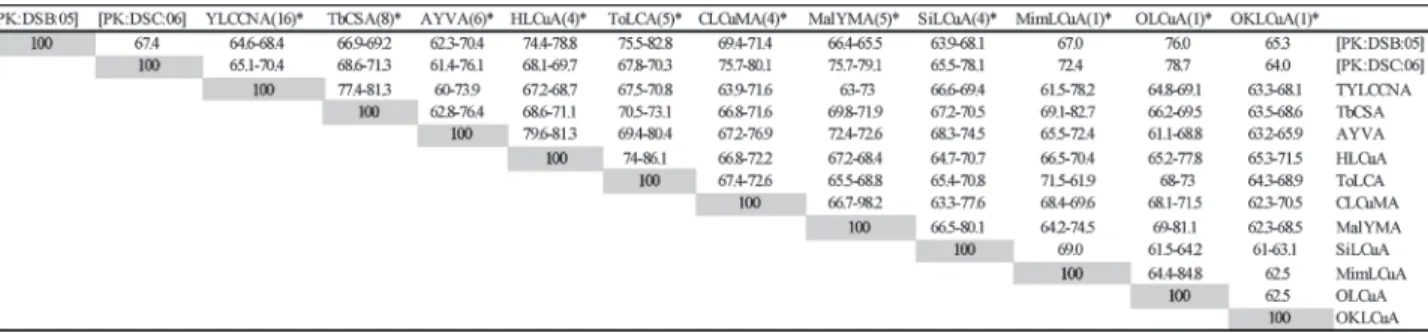
with all available DNA 1s in the databases showed that first DNA 1 has the highest nucleotide sequence identity (82.8%) with a DNA 1 isolated from tomato leaf curl disease affected tomato in Pakistan (accession no. AJ 512955), while the second showed the highest levels of nucleotide sequence identity (79.2%) to a DNA 1 isolated
from CLCuD affected cotton (AJ132344), the first such molecule to be identified (Mansoor et al., 1999) (Table 1).
Phylogenetic analysis
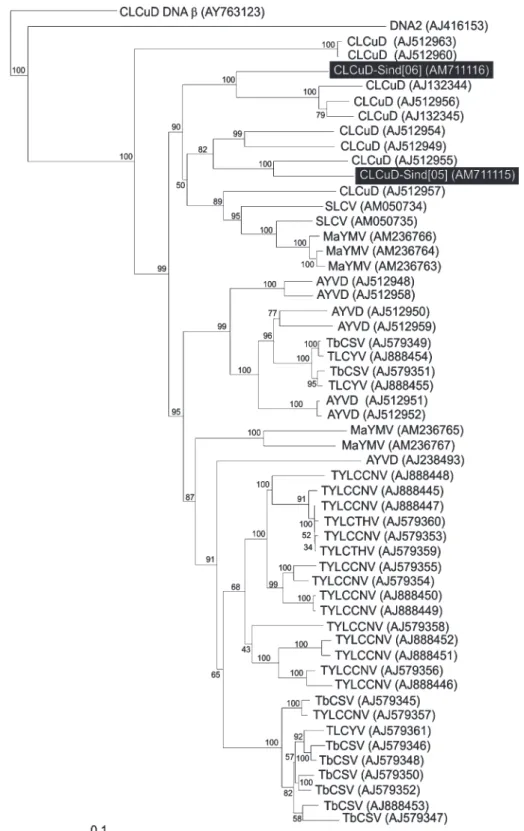
A phylogenetic analysis, based upon an alignment of the complete nucleotide sequences of the majority of pre-viously characterized DNA 1 molecules, is shown in Fig. 2.
This shows the two recently isolated CLCuD associat-ed DNA 1 molecules to segregate with DNA 1s previous-ly identified in association with the disease ; being most closely related to a DNA 1 isolated from tomato leaf curl disease (ToLCD) affected tomato (AJ512955) and a DNA 1 isolated from CLCuD affected cotton (AJ132344). The precise function of DNA 1 in begomovirus DNA β infections is not clear yet, although recent work has sug-gested some possibilities. The component is not required for infectivity or symptom induction (Mansoor et al.,
1999 ; Saunders and Stanley 1999, Wu and Zhou 2005).
Recent studies have shown that the A-rich region of DNA 1 does not effect its replication (Shahid et al., 2009).
Nev-ertheless, in previous analyses DNA 1 was invariably found associated with CLCuD and a number of other be-gomovirus DNA β complexes. This is suggestive of a useful, if not absolutely essential, contribution of the
sat-ellite like molecule to begomovirus DNA β complexes. Upon their first identification it was suggested that the function of DNA 1 may be to down regulate the severity of the symptoms caused by the complex, by mopping up cellular resources (Mansoor et al., 2000 ; Saunders and
Stanley 1999). Wu and Zhou (2005) demonstrated that
the presence of DNA 1 reduced virus DNA levels, but only in the absence of DNA β, although symptoms in both cases were attenuated at the early stages of tion. If DNA 1 acts as a “dampener” of the virus infec-tions, then we must assume that its dampening effect is no longer a requirement of the CLCuD complex present-ly in the fields in Pakistan.
The CLCuD complex has gone through a major change since the DNA 1 molecules were first identified. The previous strain of the disease, now known as the “Multan strain”, has been almost entirely displaced by the “Burewala strain”. This new strain is resistance breaking and able to infect cotton varieties derived from the germplasm LRA5166 and CP15/2 with resistance to the Multan strain (Rahman et al., 2005). The resurgence
has again led to major losses due to the disease in Paki-stan and the Burewala strain is now also present in western India. We have previously shown that the Burewala strain is associated with a recombinant DNA β, for the most part, consisting of sequences derived from the Multan strain betasatellite but with a small region of sequence within the satellite conserved region (SCR) de-rived from a ToLCD associated betasatellite (Amin et al.,
2006 ; Briddon et al., 2003). The significance of this
combination between cotton and tomato betasatellites re-mains unclear due to the fact that we have yet to under-stand the precise function of the SCR. More recently the begomovirus associated with the Burewala strain has been sequenced and also shown to be recombinant (Amrao et al., 2010).
The presence of DNA 1 in only a small number of plants indicates that, in contrast to earlier analyses, DNA 1 is no longer a constant feature of the CLCuD begomovirus betasatellite complex. It is likely that the changes in the
Table 1 The highest and the lowest percentage nucleotide sequence identities of the DNA1 isolated from cotton
with all available sequences of other DNA1 in the databases
Fig. 1 Southern blot of DNA extracts from CLCuD
affect-ed cotton plants probaffect-ed with a radioactively labelaffect-ed DNA 1 probe (accession no. AJ132344). Approx. 10 μg of DNA was loaded in each lane with the ex-ception of lane 1 which was loaded with approx. 5 ng of an undigested clone of DNA 1 (accession no. AJ132344) as a hybridization control.
Fig. 2 Neighbour-joining phylogenetic dendrogram based upon an alignment of the complete nucleotide
sequences of the majority of DNA 1 sequences available in the databases. Numbers at nodes indicate percentage bootstrap scores (1000 replicates). The database accession numbers of each DNA 1 are given in brackets. The DNA 1 is additionally labelled by the virus with which they are associated (where known) or the disease with which they are associated. The abbreviations used are Ageratum yellow vein virus (AYVV), Squash leaf curl virus (SLCV), Malvastrum yellow mosaic virus (MYVMV), Tobacco curly shoot virus (TbCSV), Tomato yellow leaf curl China virus (TYLCCNV), Tomato yellow leaf curl virus (TYLCV).
CLCuD complex that we have detailed here are also oc-curring in other begomovirus betasatellite complexes. Similarly a recent analysis of the ToLCD complex in Pakistan has been unable to consistently detect the DNA 1 component. The significance of these findings are un-clear. What it does indicate is that the situation with the begomovirus/DNA β complexes is far from stable, with major changes taking place in the prevalent viruses and the make-up of the constituent components of the com-plexes, particularly for CLCuD.
Acknowledgements
The first author would like to thank “Higher Education Commission” (HEC) of Pakistan for providing funds and National Institute for Biotechnology and Genetic Engi-neering (NIBGE) for producing the constructs. The authors also thank NODAI Research Institute (NRI), Tokyo University of Agriculture, Japan for the Grant in Aid in Advanced Research Project for further analysis.
References
1) Amin, I., Mansoor, S., Amrao, L., Hussain, M., Irum, S., Zafar, Y., Bull, S, E., and Briddon, R.W. (2006) Mobilisation into cotton and spread of a recombinant cotton leaf curl disease satellite. Arch Virol 151 : 2055-2065.
2) Amrao, L., Amin, I., Shahid, S., Briddon, R.W., Mansoor, S. (2010) Cotton leaf curl disease in resistant cotton is associ-ated with a single begomovirus that lacks an intact tran-scriptional activator protein. Virus Research 152 : 153-163. 3) Briddon, R.W., Bull, S.E., Amin, I., Idris, A.M., Mansoor, S.,
Bedford, I.D., Dhawan, P., Rishi, N., Siwatch, S.S., Abdel -Salam, A.M., Brown, J.K., Zafar, Y., and Markham, P.G. (2003) Diversity of DNA β : a satellite molecule associated with some monopartite begomoviruses. Virology 312 : 106-121.
4) Briddon, R.W., Bull, S.E., Amin, I., Mansoor, S., Bedford, I. D., Rishi, N., Siwatch, S.S., Zafar, M.Y., Abdel-Salam, A.M., and Markham, P.G. (2004) Diversity of DNA 1 ; a satellite-like molecule associated with monopartite begomovirus-DNA β complexes. Virology 324 : 462-474.
5) Bull, S.E., Briddon, R.W., and Markham, P.G. (2003) Univer-sal primers for the PCR-mediated amplification of DNA 1 : a satellite-like molecule associated with begomovirus-DNA β complexes. Mol. Biotechnol. 23 : 83-86.
6) Cui X., Li, G., Wang, D., Hu, D., and Zhou, X. (2005) A bego-movirus DNA β encoded protein binds DNA, functions as a suppressor of RNA silencing, and targets the cell nucleus. J. Virol. 79 : 10764-10775.
7) Doyle., J., J., Doyle., J., L., (1990) Isolation of plant DNA from fresh tissue. Focus 12 : 13-15.
8) Haible, D., Kober, S., and Jeske, H. (2006) Rolling circle am-plification revolutionizes diagnosis and genomics of gemi-niviruses. J. Virol. Methods 135 : 9-16.
9) Mansoor, S., Khan, S.H., Bashir, A., Saeed, M., Zafar, Y., Malik, K.A., Briddon, R.W., Stanley, J., and Markham, P.G. (1999) Identification of a novel circular single-stranded
DNA associated with cotton leaf curl disease in Pakistan. Virology 259 : 190-199.
10) Mansoor, S., Khan, S., H., Hussain, M., Zafar, Y., Pinner, M.S., Briddon, R.W., Stanley, J., and Markham, P.G. (2000) Association of a begomovirus and nanovirus-like molecule with Ageratum yellow vein disease in Pakistan. Plant Dis.
84 : 101.
11) Mansoor, S., Amin, I., Iram, S., Hussain, M., Zafar, Y., Malik, K.A., and Briddon, R.W. (2003) Breakdown of re-sistance in cotton to cotton leaf curl disease in Pakistan. Plant Pathol. 52 : 784.
12) Mansoor, S., Zafar, Y., and Briddon, R.W. (2006) Geminivi-rus disease complexes : the threat is spreading. Trends in Plant Sci. 11 : 209-212.
13) McGlashan, D., Polston, J.E., and Bois, D. (1994) Tomato yellow leaf curl virus in Jamaica. Plant Dis. 78 : 1219. 14) Page, R.D.M. (1996) TREEVIEW : An application to
dis-play phylogenetic trees on personal computers. Comput. Appl. Biosci. 12 : 357-358.
15) Polston, J.E., Mcgovern, R.J., and Brown, L.G. (1999) Intro-duction of tomato yellow leaf curl virus in Florida and im-plications for the spread of this and other geminiviruses of tomato. Plant Dis. 83 : 984-988.
16) Qazi, J., Amin, I., Mansoor, S., Iqbal, J., and Briddon, R.W. (2007) Contribution of the satellite encoded gene βC1 to cotton leaf curl disease symptoms. Virus Res. 128 : 135-139.
17) Rahman, M., Hussain, D., Malik, T.A., and Zafar, Y. (2005) Genetics of resistance against cotton leaf curl disease in Gossypium hirsutum. Plant Pathol. 54 : 764-772.
18) Saeed, M., Behjatnia, S.A., Mansoor, S., Zafar, Y., Hasnain, S., and Rezaian, M.A., (2004) A single complementary-sense transcript of a geminiviral DNA β satellite is deter-minant of pathogenicity. Mol. Plant-Microbe Interact. 18 : 7-14.
19) Saeed, S., M., Zafar, Y., Randles, J.W., and Rezaian, M.A. (2007) A monopartite begomovirus-associated DNA β sat-ellite substitutes for the DNA B of a bipartite begomovi-rus to permit systemic infection J. Gen. Virol. 88 : 2881-2889.
20) Saunders, K., and Stanley, J. (1999) A nanovirus-like com-ponent associated with yellow vein disease of Ageratum conyzoides : evidence for interfamilial recombination be-tween plant DNA viruses. Virology 264 : 142-152.
21) Saunders, K., Norman, A., Gucciardo, S., and Stanley, J. (2004) The DNA β satellite component associated with ag-eratum yellow vein disease encodes an essential pathoge-nicity protein (βC1). Virology 324 : 37-47.
22) Shahid, M.S., Ali, L., and Wajid, S. (2009) The function of the a-rich region of the alphasatellite associated with the cotton leaf curl disease in Pakistan. EurAsia J. of Bio-Sciences. 3 : 152-156.
23) Thompson, J.D., Gibson, T.J., Plewniak, F., Jeanmougin, F., and Higgins, D.G. (1997) The Clustal X windows interface ; flexible strategies for multiple sequence alignment aided by quality analysis tools. Nucleic Acids Res. 25 : 4876-4882.
24) Wu, P.J., and Zhou, X.P. (2005) Interaction between a nano-virus-like component and the Tobacco curly shoot virus/ satellite complex. Acta Bioch. Bio. Sin. 37 : 25-31.
パキスタンの cotton leaf curl disease の病原である
単一ゲノムタイプのベゴモウイルスと DNAβ
サテライト複合体において DNA 1 の
随伴は常には起きない
M.S. Shahid*
,**,夏秋啓子**
(平成 25 年 2 月 19 日受付/平成 25 年 4 月 19 日受理) 要約:ベゴモウイルスに 1 本鎖 DNA サテライトが付随することは比較的最近の発見であるが,これらの複 合体は単一ゲノムタイプのベゴモウイルス(ジェミニウイルス科)とベータサテライトと呼ばれる小さい環 状サテライトからなり,サテライトはヘルパーウイルスの病徴に関与する。アジアではこの複合体に,さら に 3 番目の DNA 1 として知られるサテライト様粒子が常に付随していることが示されており,パキスタン とインド西部に広まっている cotton leaf curl disease(CLCuD)の病原も,このような複合体からなってい るとされてきた。しかし,本研究において PCR 法による増殖,ローリングサークル法による増殖およびサ ザンブロットハイブリダイゼーションにより,近年採集した試料では DNA 1 は必ずしも CLCuD の病原複 合体に付随しないことを認めた。すなわち,2005/2006 採集および 2009/2010 採集の CLCuD 罹病ワタ 66 試料からは 2005/2006 採集の 2 試料のみが DNA 1 を付随しており,その全塩基配列を解析し,DNA 1 が 付随しない CLCuD 病原の発見について議論した。キーワード:ベゴモウイルス属,Bemisia tabaci,Cotton leaf curl 病,ローリングサークルアンプリフィケー
ション
* **
パキスタン COMSATS 情報技術研究所バイオサイエンス部門 東京農業大学国際食料情報学部国際農業開発学科