JAIST Repository
https://dspace.jaist.ac.jp/Title Exploring R&D Collaboration Network from the Japanese Functional Food Patent Applications
Author(s) パウィナー, ラリットノラセット; 宮崎, 久美子
Citation 年次学術大会講演要旨集, 31: 846-851
Issue Date 2016-11-05
Type Conference Paper
Text version publisher
URL http://hdl.handle.net/10119/13955
Rights
本著作物は研究・イノベーション学会の許可のもとに 掲載するものです。This material is posted here with permission of the Japan Society for Research Policy and Innovation Management.
2J16
Exploring R&D Collaboration Network from the Japanese Functional
Food Patent Applications
ラリットノラセット パウィナー、宮崎 久美子 (東京工業大学)
Abstract: This paper explores the R&D collaboration network in the functional food industry in Japan based on co-patenting and social analysis method. Networks of co-patenting were mapped in three consecutive periods from the beginning of functional food study until the recent. It was shown that underlying structure of technological knowledge, together with the kinds of partnerships have been shifting according to the change of industrial structure. Collaborations with a partner inside and outside industry is shown to be for different technological purpose.
1. Introduction
Functional food (FF) is a recent food trend which emerge from changing in human life-style and growth of ageing society. While it has opened up new market opportunities to food industry, it also gives new opportunities to firms from life-science sectors which used to be involving with food industry at the part of conducting R&D and suppling food ingredients. The roles of each actor in the supply chain have begun to blend. Food firms are conducting more R&D and life-science firms are manufacturing market-oriented products. In addition, there are collaborations between two sectors in FF development.
This paper will investigate how R&D collaborations were conducted in FF industry and it aims to answer how collaboration facilitate learning during FF development and how firms from different sectors exchange cross-sectoral technological knowledge by collaborative R&D.
2. Research Background
FF is food that contains extra substances that yield extra beneficial effects to human body, close to but not overlapping with the role of medicine (Martirosyan & Singh, 2015). It appears in the form of conventional food which can be consumed regularly for the health purpose, but neither replacing conventional food nor drugs. In Japan, FF is categorized in ʻFood with health claimʼ. All products have to pass the requirement in order to put a label of health claim on. Apart from food and beverage manufacturing, firms from pharmaceutical and chemical industries are also interested in FF market. Nevertheless, not every of them succeed in FF commercialization as several barriers exist. Development of FF is more complicated than conventional food products, as it requires technological and market capabilities from both life-science and manufacturing industries. Traditional firms might face an issue of inadequate capabilities to perform internal technological development and develop novel products.
their innovative strategies on searching for technological capabilities can be influenced by their cumulative knowledge (Henderson & Clark, 1990; Miyazaki, 1994), firms from food & beverage sector (F&B) and life-science sector would need to develop different strategies in order to develop capabilities that they lack. The collaborations can be in various forms and can occur with the same or different type of actor. Types of relationship might vary on different stage of new product development (Knudsen, 2007).However, there was no evidence of how the choice of collaborative R&Ds is affected by availability of diverse opportunities and whether cross-sectoral partnership and intra-sectoral partnership are for distinct technological purposes. The next sessions will explore these questions by investigating collaborative R&D in FF industry via Japanese patent applications.
3. Methodology and Data
3.1 Mapping network of R&D collaboration
One patent application can be filed by several assignees, who collaborate and “co-patent” their invention together. Incentives on R&D partnership might vary by both external and internal circumstances, i.e. change in availability of knowledge and technology and market structure leads to different preferences of partnership. To explore the dynamic of R&D collaboration, co-patenting networks in three periods: P1; 1988-1998, P2; 1999-2005 and P3; 2006-2014 are constructed and analyzed with social network analysis method. Three main groups of patent assignee are identified. Applicants from food & beverage industry are labeled as ʻF&Bʼ, from pharmaceutical and chemical industries are grouped into `Life-scienceʼ and public research institutes and university are ʻPRI&Uʼ. Relevant patents are further classified into 33 technological fields based on their international patent classification (IPC).
3.2 Data: Functional Food related Japanese Patent Applications
Patent applications from Japanese Patent Office (JPO) that fall into the following criteria are selected: 1) containing keywords related to functional food in its title, abstract or claims (Lalitnorasate & Miyazaki, 2014; Xie & Miyazaki, 2013), 2) applied by large Japanese firms from either F&B or Life-science industry. The resulted dataset contains 9,135 patent applications from 354 firms and 1,334 applications are identified to be containing more than one assignee, co-patented.
4. Results
From the FF co-patenting activities, three kinds of collaborations can be identified according to the type of partner - intra-sectoral, inter-sectoral and PRI&U. The first and second type are partnership that created among firms. While intra-sectoral collaboration involves firms that based in the same sector, inter-sectoral collaboration is a partnership of firms from different sectors. PRI&U refers to co-patent between private firms and public research institutes or university. All relationships are mapped in Figure 1. Each node represents each patent assignee and its size is proportional to the number of patent applications. Nodes that are connected are those that share the same patent right. Three kinds of actor are illustrated by different node colors, i.e. Life-science; blue, F&B; red, PRI&U; purple. Six kinds of relationship are found as reported in Figure 2.
Figure 1 Networks of FF Co-patents. Each node represents each patent applicant.
Figure 2 Compositions of Co-patenting pairs (L: Life-science firms, F: Food & Beverage firms, P: Public Research Institutes and University)
Contrary to a decreasing trend in inter-sectoral co-patenting activities, PRI&U has started to play a key role in the second period (P2, 1999-2005) and dominated the network of FF co-patents in the last period (P3, 2006-2014). To see a clearer picture of private firmsʼ collaborations, PRI&Us are removed from the network (Figure 3). Without PRI&U interference, networks become disconnected particularly in P3 regardless of similar number of assignees from the private sectors.
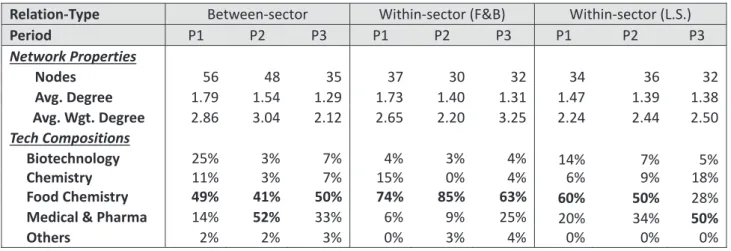
Table 1 reports the networksʼ properties and associated technological fields after removal of PRI&U actor. Average degree is an average number of edge per node, and the average-weighted-degree accounts strength of the relationship. Smaller average degree indicates that partnership is becoming more selective and average weighted degree indicates the strength of the level of collaboration. I.e. approximately one firm is connecting to only one firm, and launched around two patent applications if the average degree and average-weighted-degree equal to one and two respectively.
From the results, it can be interpreted that intra-sectoral collaboration was the most important collaborative activities in the beginning period (P1, 1988-1998) as they took up nearly half of the network. However, its importance was gradually decreasing by time, involving around one-third of the network in P3. Intra-sectoral partnership has also shown to be slightly decreasing but proportionally increasing comparing to inter-sectoral collaboration. Firms gradually become more selective on their partners as can be observed from a decrease in the average degree in all type of collaborations. While the strength of relationship in inter-sectoral collaboration is strongest in P2, collaboration between partners in the same sector was strongest in P3 in both F&B and Life-science.
Considering the technological trend which appeared in collaborative effort, it seemed that there were slight differences between each type of collaboration. In the inter-sectoral collaboration, an early trend emphasized on biotechnology and food chemistry, but the trend shifted into medical and pharmaceutical and food chemistry in the later period. Intra-sectoral collaborations in F&B and Life-science are shown to be for different purposes. Considering the technological composition in F&B sector, apart from food chemistry which is a main topic for FF, other important technological fields include chemistry and medical & pharmaceutical, which appeared to be important in the first period and third period respectively. This shift might be explained by, F&B firms sought existed knowledge about functional ingredients and how they can be fused into existing products in the beginning of FF, then they began to research on new compounds with medical properties or new possibilities from the existing projects. In the case of Life-science sector, in the later period food chemistry was no longer the most important field in the co-patenting activities, rather the focus was shifted to medical & pharmaceutical field and chemistry. It might be expected that by R&D collaboration, firms were able to shift their interests from utilizing existing knowledge on creating FF products into exploring new kinds of materials with novel physiological properties.
Figure 3 Networks of FF Co-patents among private firms
Table 1 Network properties and technological field compositions after removing PRI&U nodes.
Relation‐Type Between‐sector Within‐sector (F&B) Within‐sector (L.S.)
Period P1 P2 P3 P1 P2 P3 P1 P2 P3 Network Properties Nodes 56 48 35 37 30 32 34 36 32 Avg. Degree 1.79 1.54 1.29 1.73 1.40 1.31 1.47 1.39 1.38 Avg. Wgt. Degree 2.86 3.04 2.12 2.65 2.20 3.25 2.24 2.44 2.50 Tech Compositions Biotechnology 25% 3% 7% 4% 3% 4% 14% 7% 5% Chemistry 11% 3% 7% 15% 0% 4% 6% 9% 18% Food Chemistry 49% 41% 50% 74% 85% 63% 60% 50% 28% Medical & Pharma 14% 52% 33% 6% 9% 25% 20% 34% 50% Others 2% 2% 3% 0% 3% 4% 0% 0% 0%
patenting activities, has been shifting by time. While it was expected that complexity in FF development will increase incentives in the cross-sectoral R&D collaboration, empirical results reveal that inter-sectoral collaboration was highly important only in the beginning period of FF trend when knowledge availability and uncertainty is highest. The strength of partnership in the inter-sectoral collaboration was also declining whereas partnership in the intra-sectoral collaborative R&D was stronger. Further investigation on the technological trend in co-patenting activities showed that each type of collaboration was for different technological purpose which is also altering by time as external opportunities change.
Finally, even though it was less discussed in the results, the role of public research institutes and university seems to be increasingly significant in the FF development. They might be important partners that facilitate firms in acquiring novel scientific discoveries and bridge the gap of knowledge between sectors. 6. References
Henderson, R. M., & Clark, K. B. (1990). Architectural Innovation・: The Reconfiguration of Existing Product Technologies and the Failure of Established Firms. Administrative Science Quarterly, 35(1), 9‒30. Klevorick, A. K., Levin, R. C., Nelson, R., & J, S. G. W. (1995). On the sources and significance of
interindustry differences in technological opportunities. Reserach Policy, 24, 185‒205.
Knudsen, M. P. (2007). The Relative Importance of Interfirm Relationships and Knowledge Transfer for New Product Development Success. The Journal of Product Innovation Management, 24(May 2002), 117‒ 138.
Lalitnorasate, P., & Miyazaki, K. (2014). Core technological competence and knowledge accumulation in the functional food industry: An empirical study of Japanese food firms. In Management of Engineering & Technology (PICMET) (pp. 1072‒1081). 2014 Portland International Conference on.
Malerba, F. (2002). Sectoral systems of innovation and production. Research Policy. http://doi.org/10.1016/S0048-7333(01)00139-1
Martirosyan, D. M., & Singh, J. (2015). A New Definition for Functional Food by FFC: Creating Functional Food Products Using New Definition. In D. M. Martirosyan (Ed.), Introduction to functional food science (3rd ed.). USA: Food Science Publisher.
Miyazaki, K. (1994). Search, Learning and Accumulation of Technological Competences; The Case of Optoelectronics. Industrial and Corporate Change, 3(3), 631‒654.
Xie, Z., & Miyazaki, K. (2013). Evaluating the effectiveness of keyword search strategy for patent identification. World Patent Information, 35(1), 20‒30. http://doi.org/10.1016/j.wpi.2012.10.005