Japan Advanced Institute of Science and Technology
JAIST Repository
https://dspace.jaist.ac.jp/ Title CODE-SWAN Author(s) コイルー, アンワル Citation 科学研究費助成事業研究成果報告書: 1-6 Issue Date 2013-05-30Type Research Paper
Text version publisher
URL http://hdl.handle.net/10119/11369 Rights Description 研究種目:基盤研究(C), 研究期間:2010∼2012, 課題番号:22560367, 研究者番号:20535372, 研究分 野:無線通信、情報理論、ターボ原理、符号化, 科研 費の分科・細目:電気電子工学、通信・ネットワーク 工学
様式C-19
科学研究費助成事業(科学研究費補助金)研究成果報告書
平成25年 5 月 30 日現在
研究成果の概要(和文):本プロジェクトには、Multiple-Input Multiple-Output (MIMO)協力 ワイヤレスネットワーク において Slepian-Wolf (SW)レート領域と Multiple Access Channel (MAC)レート領域の両者の利点を融合させることを可能とする理論的基盤を構築するとともに、 漸近的にレート限界に迫る実用的なアルゴリズムを開発することにある。ターボ原理に基づく 繰り返し復号法において情報源の相関に対応した対数尤度比の更新式を組み込むことで達成で きることを示した。
研究成果の概要(英文):In this project, we have successfully estimate and exploit the source correlation in distributed cooperative wireless network to achieve close-limit Slepian-Wolf multiple access channel (SW-MAC) rate region theoretical performance. We found that point very close to (1,1) mutual information of the extrinsic information transfer (EXIT) chart can be reached easily by using memory-1 rate-1 doped accumulator, which make the error-floor invisible (below 10^-7). For broadband transmission, our multiple input multiple output (MIMO) turbo equalizer work very efficiently to approach a performance only about 1 dB away from the theoretical MIMO/SW-MAC limit. Our system also work well even when very simple memory-1 convolutional codes are used. The potential applications are for power limited wireless multi-hops and ad-hoc wireless network, sensor/monitoring networks, where sensor collect the correlated data and transmit it to a common destination (fusion center) with higher spectrum efficiency. The main publications of the project are on IEEE Transaction on Signal Processing, IEEE Communication Letters and some major IEEE international conferences.
交付決定額 (金額単位:円) 直接経費 間接経費 合 計 2010 年度 1,200,000 360,000 1,560,000 2011 年度 1,200,000 360,000 1,560,000 2012 年度 900,000 270,000 1,170,000 年度 年度 総 計 3,300,000 990,000 4,290,000 研究分野:無線通信、情報理論、ターボ原理、符号化 科研費の分科・細目:電気電子工学、通信・ネットワーク工学 キーワード:ターボ原理、EXIT解析、相関情報源、協調通信、リンク間相関、情報理論、 ターボ等化、ネットワーク符号 機関番号:13302 研究種目:基盤研究(C) 研究期間:2010~2012 課題番号:22560367 研究課題名(和文)CODE-SWAN
研究課題名(英文)COoperative DEcision making based on Slepian-Wolf/multiple Access wireless Networks
研究代表者
コイルー アンワル(Khoirul Anwar)
北陸先端科学技術大学院大学・情報研究科・助教 研究者番号:20535372
1.研究開始当初の背景
A lot of challenges have been made by the information theory community to find theoretical limit of the cooperative networks. However, many open problem are still left unsolved, for example, rate allocation in the region at which each terminal can transmit signal with arbitrarily low bit error probability in the cooperative network, assuming practical wireless network setup. (1) Correlated Source
The signal received by the relay (R) is highly correlated with the signal received by the destination (D) via the direct path (because the source (S) is the same), even though they are suffering from independent noise.
(2) Slepian-Wolf Rate Region
One of the significant findings in network information theory is the SW coding theorem, where the encoder independently compress the source at rate within the SW rate region (R_X>H(X), R_Y>(H(Y), R_X+R_Y>H(X,Y) [4], with R and H are coding rate and entropy/joint entropy of X and Y, respectively; the correlated sources at the receiver can still be recovered (with arbitrarily low error probability). (3) Practical Parameter Design
In practice, how the benefit of SW theory can be exploited in real systems has not yet been thoroughly known. When applying the SW theorem to relay systems, an open problem is how the transmission link parameters (including code parameters and modulation) should be optimally determined. This project focuses on this point by assuming single carrier (SC) signaling because of its low power consumption, which is suitable for eco-oriented societal trend in solving the global warming problem.
(4) Dual Problem
A dual problem to the SW correlated source coding is the multiple access channel (MAC). The received MAC signals (simultaneously transmitted) can be jointly decoded with arbitrarily small error probability as long as R_X <I(X;Z|Y), R_Y <I(Y;Z|X) and R_X+R_Y <I(X,Y;Z) are satisfied, where I(X;Y) is the mutual information between X and Y. This region
is called MAC region. However, how the beneficial supported by the MAC region can be exploited in practical systems has not yet been fully investigated. Furthermore, if the MIMO sources are correlated, developing signaling technique that can achieve the union of SW and MAC region, shall provide significant advantages for spectrum (by MAC) and power efficiencies (by SW) in practical wireless systems. 2.研究の目的
Our purpose is to develop future power-limited wireless networks and provide contributive solution to the Global warming related issues. However, addressing the non-technical issues is out of the scope of this project. The scope will be more on the network information theory bases, to innovate power-limited wireless technology which is required not only from the terminal life longevity but also from eco-driven society trend. For example, in sensor networks, the battery replacement of the massive sensors is almost impossible, and therefore, the technology itself has to be highly power efficient.
(1) Assumption
Throughout the project, it is assumed that conditions of the source and channel allow us to assume that the SW and MAC regions intersect each other (Fig. 2(d)) so that the optimization between correlated source and multiple access channel coding can be performed separately since with intersection on SW and MAC, R < C is hold. (2) The proposed Network Structure The correlation between the sources X and Y are assumed to be described by a correlated source model (CSM). This system model should apply to distributed source and channel coding, as well as wireless relaying Box function fc update the log-likelihood ratio (LLR) according to the CSM model of the source such as bit-flipping model (BFM), hidden Markov model (HMM), state space model (SSM), etc.
3.研究の方法
The proposed structure comprises of correlated source, separate encoder with puncturing and joint decoder, which holds novelty of the proposed MIMO detection /
equalization and vertical iterative turbo decoding technique. The project is then divided into 5 work packages (WP) for a total of 3 years and each WP has its own novelty. The methods for WP1-WP4 are based on the theoretical and computer simulation activities, while WP5 are based on the field experiment data to verify the effectiveness of the proposed design and optimization
(1) Work Packages (WPs)
WP1 introduced vertical iteration between the decoders so that decoders have strong error correction capability. WP2 evaluate the performance with bit flipping model under multipath-rich fading channel. WP3 and WP4 estimate and exploit the source correlation. WP5 verified the proposed CODE-SWAN technique in real fields. A series of field measurement data-based offline simulations are to be conducted using multidimensional channel sounding data.
(2) Monitoring and Evaluation
The progress and the direction of the project is assessed and monitored by a steering committee (SC). The SC members are Prof. Markku Juntti, University of Oulu, Finland for theoretical evaluation and Dr. Trio Adiono, Institut Teknologi Bandung, Indonesia for practical and low power wireless system design. The SC members independently evaluated (but not involve in) the project, and provide assessments in the SC meeting which is held once per year in Japan. The photo of SC Meeting 2011 is shown in Fig. 1.
Fig. 1 CODE-SWAN SC Meeting 2011 4.研究成果
The project developed two structures for different environments, i.e., narrow and broadband applications.
(1) Narrowband application
For this application, we consider single carrier signaling system where the channel is assumed to be single path block Rayleigh fading channel. The transceiver structure is shown in Fig. 2
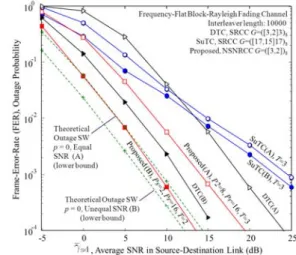
Fig. 2. The proposed transceiver for narrowband application (Image source: K. Anwar and T. Matsumoto, “Accumulator-assisted Distributed Turbo Codes for Relay Systems Exploiting Source-Relay Correlation”, IEEE Communications Letter, pp. 1-4, July 2012) The result is shown in Fig. 3. In this figure, it is shown that even the proposed structure uses very simple memory-1 convolutional code, the frame error rate (FER) performance is excellent (the best among the existing technique). This excellent performance is achieved by using doped accumulator and vertical iterations to exploit the source correlation.
Fig. 3. Frame error rate performance for the proposed system, where all channel encoders are very simple memory-1
convolutional codes (Image source: ibid Fig. 2).
(2) Broadband application
For the broadband application, we used well-known MIMO and turbo equalization based on frequency domain minimum mean square error (FD/MMSE), of which the computation complexity is low. The performance is evaluated under multipath rich block Rayleigh fading channels with 64-path components.
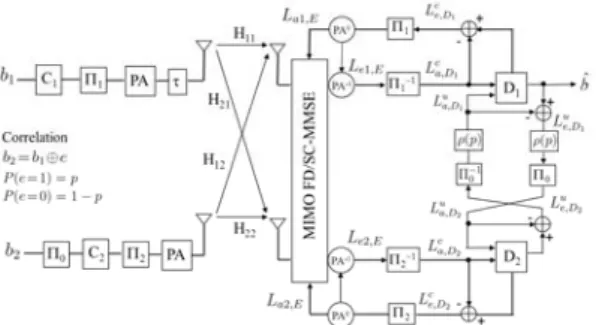
Fig. 4 shows the transceiver for broadband application of CODE-SWAN structure. In Fig. 6, we achieved close-limit performance in terms of average bit-error-rate (BER) performance.
Fig. 4. The proposed transceiver structure for broadband transmission. (image source: K. Anwar and T. Matsumoto, “Spatially Concatenated Codes with Turbo Equalization for Correlated Sources”, IEEE Transaction on Signal Processing, Vol.60, No.10, pp. 5572-5577, Oct. 2012).
Fig. 5. Average bit-error-rate (BER) performance of the proposed MIMO SW/MAC over multipath-rich block Rayleigh fading channel.(Image source: ibid. Fig.4)
5.主な発表論文等
(研究代表者、研究分担者及び連携研究者に は下線)
〔雑誌論文〕(計 15 件)
1. X. He, X. Zhou, K. Anwar and T. Matsumoto, “Estimation of Observation Error Probability in Wireless Sensor Networks”, IEEE Communications Letters,
DOI: 10.1109/LCOMM.2013.042313.130361, Accepted on March 2013 (Peer Reviewed). 2. A. Irawan, K. Anwar and T. Matsumoto, “Combining-after-Decoding Turbo Hybrid ARQ by Utilizing Doped-Accumulator”, IEEE Communications Letters,
DOI: 10.1109/LCOMM.2013.043013.130059, Accepted on March 2013 (Peer Reviewed). 3. M. A. M. Izhar, N. Fisal, X. Zhou, K. Anwar and T. Matsumoto "Exploitation of 2D binary source correlation using high rate codes", EURASIP Journal on Wireless Communications and Networking, Vol.2013:89,
(DOI:10.1186/1687-1499-2013-89), March 2013 (Peer Reviewed).
4. M. Cheng, K. Anwar and T. Matsumoto, "Outage Probability of Relay Strategy Allowing Intra-link Errors Utilizing Slepian-Wolf Theorem", EURASIP Journal on Advances in Signal Processing, No. 2013:34,
(DOI:10.1186/10.1186/1687-6180-2013-3 4), Feb. 2013, (Peer Reviewed) . 5. Y. Takano, K. Anwar and T. Matsumoto,
"Spectrally Efficient Frame Format-Aided Turbo Equalization with Channel Estimation", IEEE Transactions on Vehicular Technology, Vol. 62, No. 4, pp. 1635-1645,
(DOI: 10.1109/TVT.2012.2230659), May 2013 (Peer Reviewed).
6. K. Anwar and T. Matsumoto, “Spatially Concatenated Codes with Turbo Equalization for Correlated Sources”, IEEE Transaction on Signal Processing, Vol.60, No.10, pp. 5572-5577, (DOI: 10.1109/TSP.2012.2204259), Oct. 2012, (Peer Reviewed).
7. K. Anwar and T. Matsumoto, “Accumulator-assisted Distributed Turbo Codes for Relay Systems Exploiting Source-Relay Correlation”, IEEE Communications Letter, pp. 1-4, (DOI: 10.1109/LCOMM.2012.12.120629), July 2012 (Peer Reviewed).
8. M. Cheng, X. Zhou, K. Anwar and T. Matsumoto, "Simple Relay Systems with BICM-ID Allowing Intra-link Errors", IEICE Transaction on Communications, Vol. E95-B, No.12, pp. 3671--3678, (DOI:10.1587/transcom.E95.B.3671), Dec. 2012 (Peer Reviewed).
9. K. Anwar and T. Matsumoto, “Very Simple BICM-ID using Repetition Code and Extended Mapping with Doped Accumulator”, Wireless Personal Communications, Springer, (DOI: 10.1007/s11277-011-0397-1), June 2011, (Peer Reviewed).
10. X. Zhou, X. He, K. Anwar and T. Matsumoto, "GREAT-CEO: Large Scale Distributed Decision Making Technique for Wireless Chief Executive Officer Problems", IEICE Transaction on Communications (Invited Paper), Vol. E95-B, No. 12, pp.3654-3662,
(DOI:10.1587/transcom.E95.B.3654), Dec. 2012 (Peer Reviewed).
11. X. Zhou, M. Cheng, K. Anwar and T.Matsumoto, "Distributed Joint Source-Channel Coding for Relay Systems Exploiting Source-Relay Correlation and Source Memory", EURASIP Journal on Wireless Communications and Networking, Vol.2012:260,
(DOI:10.1186/1687-1499-2012-260), Aug. 2012 (Peer Reviewed).
12. A. Irawan, K. Anwar and T. Matsumoto, "Low-complexity Time-concatenated Turbo Equalization for Block Transmission: Part 3- Application to MIMO-OFDM", Wireless Personal Communications, Springer, (DOI: DOI 10.1007/s11277-012-0721-4), Vol. 70:769-783, June 2012 (Peer Reviewed).
13. K. Anwar and T. Matsumoto, "Low-complexity Time-concatenated Turbo Equalization for Block Transmission: Part 1 - The Concept", Wireless Personal Communications, Springer, (DOI: 10.1007/s11277-012-0563-0), March 2012 (Peer Reviewed).
14. K. Fukawa, S. Ormsub, A. Tolli, K. Anwar and T. Matsumoto, "EXIT-constrained BICM-ID Design using Extended Mapping", EURASIP Journal on Wireless Comm. and Networking, Vol. 2012, No. 1/40, (DOI: 10.1186/1687-1499-2012-40), Feb.
2012 (Peer Reviewed).
15. H. Zhou, K. Anwar and T. Matsumoto, "Low-complexity Time-concatenated Turbo Equalization for Block Transmission: Part 2 -- Application to SC-FDMA", Wireless Personal Communications, Springer, (DOI:10.1007/s11277-011-0409-1), Sept 2011 (Peer Reviewed). 〔学会発表〕(計 15 件)
1. X. Zhou, L. A. Osman, K. Anwar and T. Matsumoto, "Distributed Joint Source-Channel-Network Coding Exploiting Source Correlation for Multiple Access Relay Channel", IEEE European Wireless 2013, Guildford, UK, 16-18 April 2013 (Peer reviewed). 2. K. Anwar and T. Matsumoto, “Field
Measurement Data-based Performance Evaluation for Slepian-Wolf Relaying Systems”, 電子情報通信学会 全国大会, 岐阜、2013 年 03 月 18 日~2013 年 03 月 21 日 (Peer reviewed)。
3. M. Cheng, K. Anwar and T. Matsumoto, "On the Duality of Source and Channel Correlations: Slepian-Wolf Relaying Viewpoint", 13th IEEE International Conference on Communication Systems 2012 (ICCS), Singapore, 21-23 Nov. 2012, (Peer Reviewed).
4. X. He, X. Zhou, K. Anwar and T. Matsumoto, "Wireless Mesh Networks Allowing Intra-Link Errors: CEO Problem Viewpoint", 2012 International Symposium on Information Theory and its Applications (ISITA2012), Hawaii, USA, 28-31 Oct. 2012, (Peer Reviewed). 5. X. Zhou, K. Anwar and T. Matsumoto,
"EXIT Chart Based Joint Source-Channel Coding for Binary Markov Sources", IEEE Vehicular Technology Conference (VTC)-Fall 2012, Canada, 3-6 Sept. 2012 (Peer Reviewed).
6. M. Cheng, K. Anwar and T. Matsumoto, "Outage Analysis of Correlated Source Transmission in Block Rayleigh Fading Channels", IEEE Vehicular Technology Conference (VTC)-Fall 2012, Canada, 3-6 Sept. 2012 (Peer Reviewed).
7. K. Anwar and T. Matsumoto, “Three-way Relaying Systems Using Iterative Spatial Demapping”, The 7th International Symposium on Turbo Codes & Iterative Information Processing (ISTC), Goteborg, Sweden, 27-31 August 2012 (Peer Reviewed).
8. M. A. M. Izhar, N. Fisal, X. Zhou, K. Anwar and T. Matsumoto, "Utilization of 2-D Markov Source Correlation using Block Turbo Code", The 7th International Symposium on Turbo Codes & Iterative Information Processing (ISTC), Sweden, 27-31 August 2012, (Peer Reviewed).
9. K. Anwar and T. Matsumoto, “Iterative Spatial Demapping for Two Correlated Sources over Fading Multiple Access Channel”, IEEE Wireless Advanced (WiAd) 2012, London, UK, 25-27 June 2012 (Peer Reviewed).
10. X. Zhou, M. Cheng, K. Anwar and T. Matsumoto, "Distributed Joint Source-Channel Coding for Relay Systems Exploiting Spatial and Temporal Correlations", IEEE Wireless Advanced 2012, London, UK, 25-27 June 2012 (Peer Reviewed).
11. K. Anwar and T. Matsumoto, “Iterative Spatial Demapping for Two Correlated Sources with Power Control over Fading MAC”, The 75th IEEE Vehicular Technology Conference (VTC)-Spring 2012, Yokohama, Japan, 6-9 May 2012 (Peer Reviewed).
12. K. Anwar, "Turbo Equalization: Fundamental and Extension for Uplink SC-FDMA (4G) without Cyclic Prefix", The Third Annual Indonesian Scholars Conference in Taiwan, Hsinchu, Chung Hua University, 17-19 March 2012 (Peer Reviewed).
13. M. Cheng, A. Irawan, K. Anwar, and T. Matsumoto, "BICM-ID for Relay System Allowing Intra-link Errors and a Similarity Constellation to ARQ Schemes", Progress In Electromagnetic Research Symposium (PIERS) 2012, Kuala Lumpur, 27-30 March 2012 (Peer Reviewed).
14. Y. Takano, K. Anwar, and T. Matsumoto, "Performance of Turbo Equalization using Doped Accumulator with Channel Estimation", IEEE International Conference on Signal Processing and Communication Systems, Hawaii, USA, 12-14 Dec. 2011. (Peer Reviewed). 15. P. Lu, V. Tervo, K. Anwar, and T.
Matsumoto, "Low-Complexity Strategies for Multiple Access Relaying", IEEE VTC-Spring 2011, Budapest, Hungary, 15-18 May 2011. (Peer Reviewed). 〔図書〕(計 0 件) 〔産業財産権〕 ○出願状況(計 0 件) 名称: 発明者: 権利者: 種類: 番号: 出願年月日: 国内外の別: ○取得状況(計 0 件) 名称: 発明者: 権利者: 種類: 番号: 取得年月日: 国内外の別: 〔その他〕
Results of each year SC meeting and the project evaluation results are provided in the following website:
http://www.jaist.ac.jp/is/labs/matsumot o-lab/en/projects/code-swan.html 6.研究組織 (1)研究代表者 コイルー アンワル(Khoirul ANWAR) 北陸先端科学技術大学院大学・情報研究 科・助教 研究者番号:20535372 (2)研究分担者 松本 正 (Tadashi MATSUMOTO) 北陸先端科学技術大学院大学・情報科学研 究科・教授 研究者番号:40452114