The
canonical decompositions
of
some
family
of
compact orientable hyperbolic
3-manifolds
with
totally geodesic boundary
AKIRA
USHIJIMA
This article is a summary of [Us].
1
Introduction
D. B. A. Epstein and R. C. Penner proved in [EP] that every noncompact
complete hyperbolic manifold of finite volume admits a canonical $\mathrm{d}\mathrm{e}\mathrm{c}\mathrm{o}\mathrm{m}_{\mathrm{P}}+$
sition by ideal polyhedra.
S.
Kojima [Kol, Ko2] extended the result to thecase ofcomplete hyperbolicmanifolds of finite volume withnon-empty totally
geodesic boundary. In fact, he proved that such
a
manifold is decomposedby partially truncated polyhedra.
For each pair of integers $n$ and $k$ such that $n\geq 3,0\leq k\leq n-1$
and that the greatest
common
divisor $\mathrm{g}\mathrm{c}\mathrm{d}(n, 2-k)$ of $n$ and $2-k$ is 1,L. Paoluzzi and B. Zimmermann [PZ] constructed a compact orientable
hy-perbolic 3-manifold $M_{n,k}$ with totally geodesic boundary (a surface of genus
$n-1)$ by identifying several faces of a certain hyperbolic polyhedron $\prime \mathcal{P}_{n}$.
Our main purpose is to determine the canonical decomposition $D_{n,k}$ of $M_{n,k}$
(Theorem 2.2). This gives
an
alternative proof of the classificationtheo-rem of $M_{n,k}$ (Corollary 2.3), which was shown in [PZ], and to determine the
isometry group of $M_{n,k}$ (Theorem 2.4).
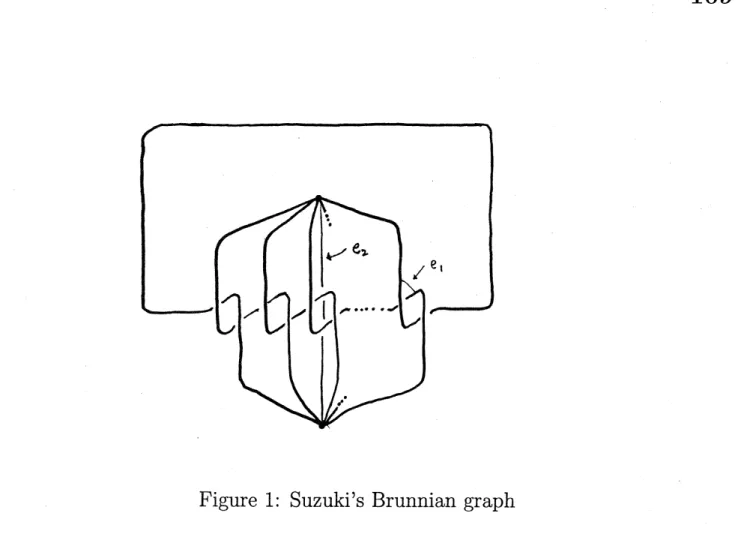
The manifold $M_{n,1}$ is homeomorphic to the exterior of Suzuki’s Brunnian
graph $\theta_{n}$ of order
$n$ (see [Sc, Su] and Figure 1). Hence, the results mentioned
above give an alternative proof of the non-triviality of $\theta_{n}$ and lead us to the
chirality of $\theta_{n}$ (Corollary 2.6). Furthermore, we determine the symmetry
groups of these graphs (Corollary 2.5).
S. Kinoshita and K. Wolcott [Wo] proved that $\theta_{3}$ is chiral in the 3-sphere
$\mathrm{S}^{3}$
Figure 1: Suzuki’s Brunnian graph
that preserves $\theta_{3}$
.
Fhrthermore,S.
Kinoshita proposed the following problem(see $[\mathrm{K}\mathrm{G}$, Problem 2.3]):
Problem 1.1 Let $F$ be the boundary
of
the regular neighborhoodof
$\theta_{3}$. Then,is the pair $(\mathrm{S}^{3}F)j$ chiral, $i.e.$, is it true that $\mathrm{S}^{3}$ does not
admit an
orientation-reversing homeomorphism which preserves the
surface
$F$?We give an affirmative answer to $\mathrm{t}$his
$’$ problem (Corollary 2.6).
Finally,
we
present some observation concerning the Heegaard splittingsof$M_{n,k}$ (Theorem 2.8), which supports the conjecture proposed by [Ad, ANS,
$\mathrm{S}\mathrm{W}]$
.
The author would like to thank Professor
K.
atsuo Kawakubo for hisen-couragement. The author also expresses his sincere gratitude to Professor
Makoto Sakuma for his helpful comments and advice. This paper grew out
of the discussion with him. The author would also like to thank Professor
Andrei Vesnin for his comments and advice, especially about the volume of
2
Statement of
results
Throughout this paper, $N(X)$ denotes the regular neighborhood of$X$, int$X$
denotes the interior of $X$ and $\partial X$ denotes the boundary of $X$.
First of all, we recall the topological construction of the manifold $M_{n,k}$.
We start with the polyhedron $CP_{n}$; it is a solid double pyramid (or a solid
double cone) whose base is a regular $n$-gon $\mathcal{G}_{n}$
.
Figure 3 shows the surfaceof $CP_{n}$ flattened out on the plane where the bottom cone point is at infinity.
We imagine that the solid occupies the half-space behind the page. We
identify the faces of $CP_{n}$ in pairs as indicated in Figure 3: for the fixed
integer $k$ such that $0\leq k\leq n-1$, the face $a_{i}b_{i+1}bi$ gets identified with the
face $c_{i+k}a_{i}+kci+k+1$ by a transformation (homeomorphisms of faces). These
identifications also induce those of the polyhedron $P_{n}$, where $P_{n}$ denotes the
polyhedron $C’P_{n}$ truncated at all vertices (see Figure 2), and
we
denote thisresulting identification space by $M_{n,k}$.
Figure 2: The truncated polyhedron $P_{6}$
We call a face of $P_{n}$ consisting the boundary of $M_{n,k}$ external (internal
otherwise); we also call an edge of an external face external (internal
other-wise). We note that the faces obtained by truncations
are
external and thatFigure 3: The identification of faces of$CP_{n}$
We assume that $\mathrm{g}\mathrm{c}\mathrm{d}(n, 2-k)=1$ in the following; then all edges (resp.
vertices) of$CP_{n}$ become identified to a single edge (resp. vertex). Now $M_{n,k}$
is a compact orientable 3-manifold whose boundary is a closed orientable
surface of genus $n-1$.
The following Theorem 2.1
wa.s
proved in [PZ] by using Andreev’stheo-rem;
Theorem 2.1 For each pair
of
integers $n$ and $k$ such that $n\geq 3,0\leq k\leq$$n-1$ and that $\mathrm{g}\mathrm{c}\mathrm{d}(n, 2-k)=1$, the
manifold
$M_{n,k}$ admits a hyperbolicstructure such that its boundary $\partial M_{n,k}$ is totally geodesic.
We note that (the mirror image of) $M_{3,1}$ is the hyperbolic manifold
con-structed by W. P. Thurston ([Th, Example 3.3.12]), and when $n=3$,
$\mathrm{V}\mathrm{o}\mathrm{l}(M_{3},k)=6.45198979\cdots$
.
This value coincides with the smallest volumeamong all compact hyperbolic 3-manifolds with totally geodesic boundary
shown by S. Kojima and Y. Miyamoto in [KM]. Determining the shape of
$P_{n}$ concretely, we give
a
brief review of a proof of this theorem in Section 4.of finite volume with non-empty totally geodesic boundary admits acanonical
decomposition by partially truncated polyhedra. It is isotopic to a dual to
the cut locus of the boundary. The cut locus is
a
subset in the manifoldwhich consists of the points that admit at least two distinct shortest paths
to the boundary. In Section 5, we prove Theorem 2.2 below, which is the
main theorem of this paper and describes the canonical decomposition of
$M_{n,k}$. This is the main theorem of this paper. To present Theorem 2.2, we
suppose $CP_{n}$ is in the Euclidean 3-space $\mathrm{R}^{3},$ $\mathcal{G}_{n}$ is on the x-y plane and that
two cone points are on the z-axis.
Theorem 2.2 The canonical decomposition$D_{n,k}$
of
themanifold
$M_{n,k}$, where$n\geq 3_{f}0\leq k\leq n-1$ and $\mathrm{g}\mathrm{c}\mathrm{d}(n, 2-k)=1_{f}$ is given
as
followsj(1) Suppose $n=3$. Let $\triangle_{0}$ and $\Delta_{1}$ be the truncated tetrahedra obtained
from
$P_{3}$ by cutting along the x-y plane. Then $D_{3,k}$ consistsof
$\triangle_{0}$ and $\triangle_{1}$.(2) Suppose $n=4$
.
Then $D_{4,k}$ consistsof
$P_{4}$.(3) Suppose $n\geq 5$. Let $\triangle_{0},$ $\triangle_{1},$
$\ldots$ ,
$\triangle_{n-1}$ be the truncated tetrahedra
ob-tained
from
$P_{n}$ by slicing byhalf
planes, eachof
which is bounded by the$z$-axis and contains
a
vertexof
$\mathcal{G}_{n}$. Then$D_{n,k}$ consistsof
$\triangle 0,$$\triangle 1,$$\ldots,$ $\triangle n-1$.
We give a shorten proof of this theorem in Section 5.
Using Theorem 2.2, we
can
solve the classification problem of $M_{n,k}$. Infact, by virtue of Mostow rigidity theorem (cf. [PZ, Proposition 2])
com-bined with the canonical decomposition, two manifolds $M_{n,k}$ and $M_{n’k’,)}$ are
homeomorphic (or equivalently, isometric) if and only if their canonical
de-compositions have the same combinatorial structures. Thus
we
can recoverthe following classification theorem of $M_{n,k}$ established by [PZ];
Corollary 2.3 The
manifold
$M_{n,k}$ and $M_{n’,k’}$ are homeomorphic (or$equiv-$
alently, isometric)
if
and onlyif
$n=n’$ and $k=k’$.Again using Theorem 2.2, we can also determine the isometry group of
$M_{n,k}$. Let $I_{Som}(M)n,k$ be the isometry group of $M_{n,k},$ $Aut(Dn,k)$ the
combi-natorial automorphism group of$D_{n,k}$ and $\mathcal{M}(M_{n,k})$ the mapping class group
of $M_{n,k}$, that is, the group consisting of the self-homeomorphisms of $M_{n,k}$
modulo isotopy. Again, by virtue of Mostow rigidity theorem combined with
the canonical decomposition, $\mathcal{M}(M_{n,k})\cong I_{Som}(Mn,k)\cong Aut(Dn,k)$. Thus,
$\mathrm{c}t$’ $n\approx+$
$\zeta \mathrm{t})$
$\mathrm{L}^{\mathrm{g}}3$
Theorem 2.4 For each pair
of
integers $n$ and $k$ such that $n\geq 3,0\leq$$k\leq n-1$ and that $\mathrm{g}\mathrm{c}\mathrm{d}(n, 2-k)=1_{f}Isom(Mn,k)$ (and hence $\mathcal{M}(M_{n,k})$) is
isomorphic to $D_{2n}$, where $D_{2n}$ is the dihedral group
of
order 2$n,$ $i.e,$.$D_{2n}=\langle t,$ $r|t^{n}=1,$ $r^{2}=1$, $rtrt=1\rangle$
Here, $t$ (resp. $r$) is induced by the $\frac{2\pi}{n}$-rotation
of
$\mathcal{G}_{n},$ $i.e_{f}.$ the $\frac{2\pi}{n}$-rotationof
$P_{n}$ around the geodesic arcjoining the top and the bottom cone points
of
$CP_{n,\coprod}$(resp. a
reflection
about a line through the origin and a vertexof
$\mathcal{G}_{n}$).A graph $G$ embedded in $\mathrm{S}^{3}$ is called a spatial$\theta$-curve (of order
$n$) if it has
two vertices and $n$ edges connecting one vertex to the other, and $G$ is said to
be trivial ifit is contained in a 2-sphere in $\mathrm{S}^{3}$.
S. Suzuki introduced a certain
family $\theta_{n}$ of spatial $\theta$-curves in [Su] (see Figure 1), which are called Suzuki$\mathrm{z}_{S}$
Brunnian graphs or the Suzuki’s $\theta_{n}$-curves (cf. [Sc]). These spatial $\theta$-curves
are
generalizations of Kinoshita’s theta-curve introduced in [Ki], and satisfythe following interesting property: $\theta_{n}$ is not trivial, though every proper
subgraph of $\theta_{n}$ is trivial. When $n\geq 3$, this property is obtained from the
fact that the handlebody does not admit a hyperbolic structure with totally
geodesic boundary. We note that this is an alternative proof of [Sc, Su].
It is shown in [Th, pp. 136-137] that the exterior $E(\theta_{3})=\mathrm{S}^{3}$ –int$N(\theta_{3})$
is homeomorphic to $M_{3,1}$. Using the
same
method,we
can see that theexterior $E(\theta_{n})$ of $\theta_{n}$ is homeomorphic to $M_{n,1}$. Since the the exterior $E(\theta_{n})$
of $\theta_{n}$ admits a hyperbolic structure such that its boundary $\partial N(\theta_{n})$ is totally
geodesic, in the same fashion as hyperbolic knots and links, we may say
that $\theta_{n}$ is a $‘(\mathrm{h}\mathrm{y}\mathrm{p}\mathrm{e}\mathrm{r}\mathrm{b}_{0}1\mathrm{i}_{\mathrm{C}}$” graph. Let $Sym(\mathrm{S}3, \theta n)$ be the symmetry group
of $(\mathrm{S}^{3}, \theta_{n})$, i.e., the group consisti’ng of the self-homeomorphisms of $(\mathrm{S}^{3}, \theta_{n})$
modulo pairwise isotopy. Using Theorem 2.4, we can determine $Sym(\mathrm{S}^{3}, \theta n)$;
Corollary 2.5 For each $n\geq 3_{f}Sym(S;, \theta_{n})\cong D_{2n}$. $\square$
A graph $G$ (resp. a surface $F$) in $\mathrm{S}^{3}$ is chiral if there does not exist an
orientation-reversing homeomorphism of $\mathrm{S}^{3}$ that fixes $G$ (resp. $F$). It has
been shown by S. Kinoshita and K. Wolcott [Wo] that $\theta_{3}$ is chiral.
Corol-lary 2.5 leads us to the following corollary, which generalizes this result and
also gives an affirmative answer to Problem 1.1 proposed by S. Kinoshita.
Corollary 2.6 Both the graph$\theta_{n}$ and the
surface
$\partial N(\theta_{n})$ are chiralfor
$every\square$ $n\geq 3$.
An unknotting tunnel for a compact 3-manifold $M$ is an arc, say $\tau$,
prop-erly embedded in $M$ such that $M$ –int$N(\tau)$ is a handlebody. Two
unknot-ting tunnels $\tau_{1}$ and $\tau_{2}$ for $M$
are
said to be isotopic (resp. homeomorphic),if there is an ambient isotopy (resp. homeomorphism) of $M$ carrying $\tau_{1}$ to
$\tau_{2}$. For a cusped hyperbolic 3-manifold, the following problem is proposed
by [Ad, ANS, $\mathrm{S}\mathrm{W}$]:
Problem 2.7 Is an unknotting tunnel
for
a
cusped hyperbolic3-manifold
isotopic to
a
vertical geodesic,or
even toan
edgeof
the canonicaldecompo-$s.i$
.tion? Is it short?
Here, a vertical geodesic is a geodesic which is perpendicular to the cusp at
each of its ends. This problemleads
us
to the followingnaturalgeneralization:is an unknotting tunnel for a compact hyperbolic 3-manifold isotopic to
a
vertical geodesic, or even to an edge of the canonical decomposition? Is it
short? Here, a vertical geodesic is a geodesic which is perpendicular to the
boundary at each of its ends. The following theorem gives the answer to this
problem for the manifold $M_{n,k}$. Let $e_{1}$ be the geodesic arc in $M_{n,k}$ induced by
internal edges of $P_{n}$, and $e_{2}$ the geodesic arc in $M_{n,k}$ induced by the geodesic
arc in $CP_{n}$ joining the top and the bottom cone points through its center.
Theorem 2.8 (1) The geodesic
arc
$e_{1}$ is the only unknotting tunnelfor
$M_{n,k}$ up to isotopy.
(2) The geodesic
arc
$e_{1}$ is the shortest vertical geodesic. $\square$The first statement of this theorem is proved by using [He, Main
The-orem 1.5], and the second one is obtained by evaluating the lengths like
Section 4.
3
Hyperbolic
geometry
We give a brief review of the Minkowski space $\mathrm{E}^{1,n}$. It is the real vector space
$\mathrm{R}^{n+1}$ with the inner product
$\langle x, y\rangle=-x_{0}y_{0}+x_{1}y_{\mathrm{L}}+\cdots+x_{n}y_{n_{\vee}}$. The set
$H^{+}=\{x\in \mathrm{E}^{1,n}|\langle x, x\rangle=-1, x_{0}>0\}$ forms the hyperboloid model (or the
Minkowski space model) of the hyperbolic $n$-space $\mathrm{H}^{n}$. A ray from the origin
in the positive light cone $L^{+}=\{x\in \mathrm{E}^{1,n}|\langle x, x\rangle=0, x_{0}>0\}$ corresponds
to a point on the ideal boundary of $\mathrm{H}^{n}$
.
The set ofsuch rays forms the sphereat infinity and we denote it by $\mathrm{S}_{\infty}^{n-1}$. Let $H_{s}=\{x\in \mathrm{E}^{1,n}|\langle x, x\rangle=1\}$ be
a hyperplane, and a hyperplane through the origin linear. Suppose $S$ is a
linear hyperplane which contains a time-like vector, and let $S^{+}$ be a half
space bounded by $S$. Then we can associate a unique unit vector $q\in H_{s}$
so that $\langle q, v\rangle\leq 0$ for arbitrary $v\in S^{+}$. This establishes a duality between
half spaces in $\mathrm{E}^{1,n}$ and points on
$H_{s}$.
Let us denote by II the projection from $\mathrm{E}^{1,n}$ to the compactification
of
the plane A $=\{x_{0}=1\}$, by adding the set of lines on $\{x_{0}=0\}$, along the
ray from the origin. The projection $\Pi$ is a homeomorphism on $H^{+}$ to the
open unit sphere $P^{n}$ on $\Lambda$, which is the projective model of $\mathrm{H}^{n}$, and $\partial P^{n}$
is canonically identified with $\mathrm{S}_{\infty}^{n-1}$. Then the projection II of $H_{s}$ to the
compactified space $\overline{\Lambda}$ becomes precisely a
$\mathrm{t}\mathrm{w}\mathrm{o}^{-}\mathrm{t}\mathrm{o}^{-}\mathrm{o}\mathrm{n}\mathrm{e}$map. Suppose a linear
hyperplane $S$ intersects $P^{n}$, then the dual vector $q\in H_{s}$ to the half space
$S^{+}$ is projected to a point on $\overline{\Lambda}$ so
that a cone from $\Pi(q)$ to $S\cap\partial P^{n}$ is
tangent to $\partial P^{n}$. Thus II $(S)=S\cap\Lambda$ becomes a polar hyperplane to II $(q)$.
The duality in $\mathrm{E}^{1,n}$ induces a duality between points on $\overline{\Lambda}-(P^{n}\cup\partial P^{n})$ and
polar hyperplanes in $\mathrm{t}\mathrm{w}\mathrm{o}^{-}\mathrm{t}\mathrm{o}^{-}\mathrm{o}\mathrm{n}\mathrm{e}$ manner.
Consider a compact Euclidean polyhedron $\mathcal{R}$ in A so that its vertices
lie outside $\partial P^{n}$ and that each edge meets $\partial P^{n}$. We can regard $\mathcal{R}\cap P^{n}$
as an ideal polyhedron in $\mathrm{H}^{n}$
.
For each vertex $v$ of $\mathcal{R}$, we have its polarhyperplane $L_{v}$ intersecting $P^{n}$. This plane intersects each face of$\mathcal{R}$ meeting
the vertex in question perpendicularly. buncating a neighborhood of each
vertex by a polar hyperplane, we get a polyhedron in $P^{n}$. We call it a
truncated polyhedron of $\mathcal{R}$.
4
Proof of Theorem
2.1
We want to realize $P_{n}$ as a hyperbolic polyhedron in the hyperbolic 3-space
$\mathrm{H}^{3}$ such that Poincare”s theorem on fundamental polyhedra ([Ma]) can be
applied realizing $M_{n,k}$ as a compact orientable hyperbolic 3-manifold with
totally geodesic boundary. To do this, we put $CP_{n}$ in $\mathrm{R}^{3}$ as follows: its
center sets at the origin, one of the vertices of $\mathcal{G}_{n}$ at $(r, 0,0)$ and the top
(resp. bottom) cone point of $CP_{n}$ at $(0,0, h)$ (resp. $(0,0,$ $-h)$).
We regard the interior of the unit ball $\mathrm{B}^{3}$ centered at the origin as the
projectivemodel $P^{3}$ of$\mathrm{H}^{3}$
.
Then$\partial \mathrm{B}^{3}=\mathrm{S}^{2}$ is the sphere at infinity $\partial P^{3}$ of$P^{3}$.Now
we
suppose that the vertices of$CP_{n}$ lie outside $\partial P^{3}$ andthat eachedge of$CP_{n}$ intersects $\partial P^{3}$ twice. Then we can truncate $CP_{n}$ and obtain a compact
truncated hyperbolic polyhedron $P_{n}$. The assumption that each edge of$CP_{n}$
half planes each of which is bounded by the $z$-axis and contains a vertex of
$\mathcal{G}_{n}$, we divide $P_{n}$ into $n$ mutually isometric truncated tetrahedra $Q_{n}$. Let
$A,$ $B,$ $\ldots$ be the vertices (or the points) of $Q_{n}$
as
in Figure 2. We denote by $l_{E}$ (AB) (resp. $l_{H}$ (AB)) the Euclidean (resp. hyperbolic) length of the line$AB$.
The identifying transformations of$P_{n}$ can be chosen as hyperbolic
isome-tries in $\mathrm{H}^{3}$
if and only if the following equation holds:
$l_{H}(BC)--\iota_{H}(DE)$ . (4.1)
Expressing $l_{H}(BC)$ and $\iota_{H}(DE)$ in $r,$ $h$ and $c_{n}$, we get the following relation;
$h=h_{n}(r)= \frac{r\sqrt{c_{n}^{2}r-22c_{n}+1}}{1-c_{n}r^{2}}$ .
If this condition is satisfied, $M_{n,k}$ has a structure of hyperbolic 3-cone
manifold. After this, we find the condition for $M_{n,k}$ to have a complete
hyperbolic structure.
For $M_{n,k}\mathrm{b}\mathrm{e}\mathrm{i}\mathrm{n}\mathrm{g}$hyperbolic 3-manifold, the angle alongthe single edge cycle
have to sum up to $2\pi$, so we get the following conditions:
$n\cross\alpha+2n\cross 2\beta=2\pi$
$\Leftrightarrow$ $\cos\alpha(2\cos^{2}2\beta-1)+2\sin\alpha$ sin2$\beta$ cos2$\beta-c_{n}=0$
.
(4.2)Expressing $\cos\alpha$ and $\cos\beta$ in $r$ and $c_{n}$, we get the following relation; if
$n=4$, then
$r=r(4)=\sqrt{4\sqrt{3}-5}$,
and if $n\neq 4$, then
where
$c_{n}$ $=$ $f_{1}(n)$ $=$ $f_{2}(n)$ $=$ $f_{3}(n)$ $=$
Thus weobtain $P_{n}$ satisfying two equations (4.1) and (4.2). By Poincar\’e’s
theorem
on
fundamental polyhedra (see [Ma]), we get the compact orientablehyperbolic 3-manifold $M_{n,k}$ with non-empty totally geodesic boundary by
gluing $P_{n}$ as above. We have thus completed the proofof Theorem 2.1. $\square$
5
The canonical decomposition
We first give a brief review of the canonical decomposition of a compact
hyperbolic $n$-manifold $M$ with non-empty $\mathrm{t}\mathrm{o}\underline{\mathrm{t}\mathrm{a}\mathrm{l}}\mathrm{l}\mathrm{y}$ geodesic boundary (cf.
[Kol, Ko2]$)$. We regard the universal cover $M$ of $M$ as a subset of the
hyperboloid model $H^{+}$
.
To each component of $\partial\overline{M}$,assign a label. To each
component of $\partial\overline{M}$
labeled by $\alpha$, we can associate a unique linear hyperplane
$S_{\alpha}$ in $\mathrm{E}^{1,n}$ including it. The positive half space $S_{\alpha}^{+}\mathrm{b}_{\mathrm{o}\mathrm{u}\mathrm{n}}\mathrm{d}\mathrm{e}\mathrm{d}$ by $S_{\alpha}$ will
be the side containing $\overline{M}.\overline{M}$ is identified with the intersection of $H^{+}$ and
$\bigcap_{\alpha}S_{\alpha}^{+}$. To each $S_{\alpha}$, we associate a dual space-like vector $b_{\alpha}\in H_{s}$ so that
$\langle b_{\alpha}, v\rangle\leq 0$ for all $v\in S_{\alpha}^{+}$
.
Let $A$ be the set of dual vectors $\{b_{\alpha}\}$ on $H_{s}$.Then $A$ is invariant under the action of the covering transformation group.
Let $\mathcal{H}_{A}$ be the closed convex hull of $A$ in $\mathrm{E}^{1,n}$. The projection $\Pi(\mathcal{H}_{A}\underline{)}\mathrm{c}\mathrm{o}\mathrm{n}-$
tains $P^{n}$ ($[\mathrm{K}\mathrm{o}1$, Lemma 4.3]), and the intersection of $\Pi(\mathcal{H}_{A})\underline{\mathrm{w}}\mathrm{i}\mathrm{t}\mathrm{h}\Pi(M)$ in
A defines a $\pi_{1}(M)$-equivariant polyhedral decomposition on $M$. It induces
a
truncated polyhedral decomposition of $M$ ($[\mathrm{K}\mathrm{o}1$, Theorem 4.8]), which wecall the canonical decomposition of $M$.
We now recall an intrinsic construction ofthe canonical decomposition of
$M$
.
The cut locus $C$ of $\partial\overline{M}$in $\overline{M}$
is
a
set of points in the interior of $\overline{M}$each
of which admits at least two disti,nct shortest paths to $\partial\overline{M}$. The
cut locus
$C$ admits
a
locally finite cell complex structure with respect to its canonicalstratification by number of shortest paths. To each vertex of $C$, assign a
label. To each vertex $v_{\beta}$ of $C$ labeled by
$\beta$, we associate the components of
$\partial\overline{M}$ closest to
$v_{\beta}$. Let
$A^{\beta}$ be the subset of $A$ which consists of dual points
to these closest components. Then there is a unique elliptic hyperplane $S_{\beta}$
so that $S_{\beta}\cap A=A^{\beta}$ and that $S_{\beta}$ is an $n$-dimensional face of $\mathcal{H}_{A}$. Let $\mathcal{H}^{\beta}$
be the closed
convex
hull of $A^{\beta}$, i.e., $\mathcal{H}^{\beta}=S_{\beta}\cap \mathcal{H}_{A}$, then the intersectionof $\Pi(\mathcal{H}^{\beta})$ with $\Pi(\overline{M})$ is a truncated polyhedron, which is a dual to $v_{\beta}$.
The family $\{\Pi(\mathcal{H}^{\beta}\cap\overline{M})\}_{\beta}$ defines a$\pi_{1}(M)$-equivariant truncated polyhedral
decomposition of$M$ and it coincides with the canonical decomposition of$M$.
Next, we give acondition for a given truncated polyhedral decomposition
$D$ of $M$ to be canonical. Let $\sigma$ be a ($n$-dimensional) truncated polyhedron
in $D$ and $\overline{\sigma}$ a lift of
$\sigma$ to $\overline{M}$
.
corresponding to the faces of $\overline{\sigma}$ each of which is included in . Let be
the
convex
hull of $\{v_{1}, v_{2}, \ldots , v_{k}\}$. We suppose the affine hull $A(\hat{\sigma})$ of $\hat{\sigma}$is an elliptic hyperplane
i.n
$\mathrm{E}^{1,n}$. Thenwe can
define the center $o(\overline{\sigma})$ of$\overline{\sigma}$ as follows: let
$p$ be the unit normal to $A(\hat{\sigma})$ in
$\mathrm{E}^{1,n}$, i.e., $\langle p,p\rangle=-1$
and $\langle p, x-y\rangle=0$ for arbitrary $x,$$y\in A(\hat{\sigma})$
.
Then $o(\overline{\sigma})=p\in H^{+}$.
Itshould be noted that $o(\overline{\sigma})$ is not necessarily contained in
$\overline{\sigma}$. If we choose a
coordinate of $\mathrm{E}^{1,n}$ so that $\hat{\sigma}$ lies in a horizontal plane
$x_{0}=$ constant, then
$p=$ $(1, 0, \ldots , 0)$. bom this fact,
we can see
that $o(\overline{\sigma})$ is characterized by theproperty that its hyperbolic distance from the linear hyperplanes dual to the unit vectors $v_{1},$ $v_{2},$ $\ldots$ ,$v_{k}$
are
equal. Thismeans
that $o(\overline{\sigma})$ corresponds toa vertex of the projective image of the cut locus $C$ in
case
$D$ is the canonicaldecomposition of $M$.
Proposition 5.1 Suppose a truncatedpolyhedral decomposition $D$
of
$M$sat-isfies
the following conditions:(1) The
affine
hull $A(\hat{\sigma})$of
$\hat{\sigma}$ corresponding toa
truncated polyhedron $\sigma$ in$D$ is an elliptic hyperplane in $\mathrm{E}^{1,n}$.
(2) $D$ is the coarsest truncated polyhedral decompositions among those
of
$M$ having the
same
truncated polyhedra.(3) The center $o(\overline{\sigma})$ lies in the interior
of
$\overline{\sigma}$
for
an arbitrary truncatedpolyhedron $\sigma$ in $D$.
Then $D$ is the canonical decomposition
of
$M$. $\square$The proof of this propositionis,the
same as
that of [$\mathrm{S}\mathrm{W},$ $\overline{\mathrm{P}}\mathrm{r}\mathrm{o}\mathrm{p}_{0}\mathrm{S}\mathrm{i}\mathrm{t}\mathrm{i}\mathrm{o}\mathrm{n}$ I.1.4]except for obvious modifications. We should note that there is a
error
in itsproof. The final equation should be read $t_{1}/t_{0}=(s_{0}-s)/(s_{1}-s)$
.
We prepare
some
notations to prove Theorem 2.2. Let $F_{1},$ $F_{2},$ $\ldots$ ,$\mathcal{F}_{n}$ bethe external faces of $P_{n}$, each of which is obtained by truncating $CP_{n}$ at a
vertex of $\mathcal{G}_{n}$, and $\mathcal{T}$ (resp. $B$) the external face obtained by truncating $CP_{n}$
at the top (resp. bottom)
cone
point. We denote by $\mathcal{L}_{n}$ the “cut locus ofthe external faces of $P_{n}$ in $P_{n}$”, that is, $\mathcal{L}_{n}$ is the set of points in $P_{n}$ each of
which admits at least two distinct shortest paths to its external faces. We
call the vertices of $\mathcal{L}_{n}$ in $\mathrm{i}\mathrm{n}\mathrm{t}P_{n}(‘ \mathrm{t}\mathrm{h}\mathrm{e}$ vertices of $\mathcal{L}_{n}$” To prove Theorem 2.2,
we need the following lemma
Lemma 5.2 The vertices
of
$\mathcal{L}_{n}$are as
follows:
(1)
If
$n=3_{f}$ then $\mathcal{L}_{3}$ has two vertices$v_{T}$ and $v_{B}$ on the $z$-axis. The vertex
$v_{T}$ (resp. $v_{B}$) has
four
shortestpaths tofour
externalfaces
$\mathcal{T}$ (resp. $B$),$\mathcal{F}_{1},$ $\mathcal{F}_{2}$ and $\mathcal{F}_{3}$ (see Figure 5).
(2)
If
$n=4$, then $\mathcal{L}_{4}$ has one vertex$v_{O}$ at the center
of
$P_{n}$. The vertex $v_{O}$has the shortest paths to all extemal
faces
(see Figure 6).(3)
If
$n\geq 5$, then $\mathcal{L}_{n}$ has $n$ vertices$v_{0},$ $v_{1},$ $\ldots$ ,$v_{n-1}$ on the x-y plane. The
vertex$v_{i}$ has
four
shortestpaths tofour
$extema\iota\backslash$faces
$\mathcal{T},$$B,$ $\mathcal{F}_{\dot{i}}$ and$\mathcal{F}_{i+1}$(mod $n$) (see Figure 7).
Proof of
Lemma 5.2. By the definition of the cut locus $\mathcal{L}_{n}$, we canunder-stand it as follows: let the external faces of $P_{n}$ expand at a constant speed
until they collide with themselves. Then the collision locus is equal to the
cut locus $\mathcal{L}_{n}$. Using this interpretation, we now determine $\mathcal{L}_{n}$. Case 1. $n=3$. Since
$r^{2}-h_{3}^{2}(r)= \frac{r^{2}(r^{2}-1)(r+44)}{(r^{2}+2)^{2}}>0$ ,
we have $r>h_{3}(r)$. This means that $l_{H}(OG)<l_{H}(oN)=\iota_{H}(os)$. By
the symmetry of $P_{3}$, when the external faces expand, first $\mathcal{F}_{1},$ $\mathcal{F}_{2}$ and $\mathcal{F}_{3}$
arrive at the center $O$ simultaneously. Hence, again by the symmetry of $P_{3}$,
a small neighborhood of $O$ in the $z$-axis is contained in
a
collision locus bythe external faces. Therefore $\mathcal{L}_{3}$ has precisely two vertices (Figure 5 shows
$\mathcal{L}_{3}$ restricted to $Q_{3}$). We have thus proved the case (1).
Case 2. $n=4$. Since $h_{4}(r)=r$, we have $l_{H}(oG)=l_{H}(oN)=l_{H}(os)$.
Hence $O$ is the unique vector of $\mathcal{L}_{4}$ (see Figure 6), and we have proved the
case (2).
Case 3. $n\geq 5$
.
Since$h_{n}(r)^{2}-r= \frac{c_{n}r^{2}(r^{2}-1)(2-C_{n}r^{2})}{(c_{n}r^{2}-1)2}2>0$ .
we have $h_{n}(r)>r$. This means that $l_{H}(OG)>l_{H}(oN)=\iota_{H}(os)$. This
inequality requires that, when the external faces expand, $\mathcal{T}$ and $B$
are
thefirst to arrive at the center $O$. Thus $\mathcal{L}_{n}$ has precisely $n$-vertices on the x-y
plane (see Figure 7), and we have proved the case (3).
Figure 5: $\mathcal{L}_{3}$ restricted to $Q_{3}$ Figure 6: $\mathcal{L}_{4}$ restricted to $Q_{4}$
Proof of
Theorem 2.2. Proposition 5.1 and Lemma 5.2 (1) show that thetruncated polyhedral decomposition obtained by cutting $P_{3}$ along the x-y
plane is the canonical decomposition $D_{3,k}$. In
case
$n=4$, Proposition5.1
andLemma 5.2 (2) shows that $D_{4,k}$ consists of $P_{4}$. In case $n\geq 5$, Proposition 5.1
and Lemma 5.2 (3) requires that we should slice $P_{n}$ by half planes, each of
which is bounded by the $z$-axis and includes a vertex of $\mathcal{G}_{n}$, to obtain
$D_{n,k\cdot\square }$
We have thus proved Theorem 2.2.
References
[Ad] Colin Adams, Unknotting tunnels in hyperbolic 3-manifolds,
Mathema-tische Annalen 302 (1995), 177-195.
[ANS] Hirotaka Akiyoshi, Yoshiyuki Nakagawa, and Makoto Sakuma,
Short-est vertical geodesics
of manifolds
obtained by hyperbolic Dehn surgeryon the Whitehead link, Proceedings of Knots 96, edited by Shin’ichi
Suzuki, World Scientific Publishing Co., 1997, 433-448.
[EP] D. B. A. Epstein and R. C. Penner, Euclidean decompositions
of
non-compact hyperbolic manifolds, Journal of Differential Geometry 27
(1988), 67-80.
[He] Daniel J. Heath, On
classifications of
Heegaard splittings, OsakaJour-nal of Mathematics 34 (1997), 497-523.
[Ki] Shin’ichi Kinoshita, Alexander polynomials as isotopy invar.iants, I,
Osaka Mathematical Journa110 (1958), 263-271.
[KG] Teruaki Kitano and Hiroshi Goda (editors), Teijigen Toporoji
Mondaish\^u (Japanese; Problems in Low-Dimensional Topology), 1996.
[Kol] Sadayoshi Kojima, Polyhedral decomposition
of
hyperbolicmanifolds
with boundary, On the Geometric Structure of Manifolds, edited by
Dong Pyo Chi, Proceedings of Workshops in Pure Mathematics,
Vol-ume 10, Part III (1990), 37-57.
[Ko2] Sadayoshi Kojima, Polyhedral decomposition
of
hyperbolic3-manifolds
with totally geodesic boundary, Aspects of Low Dimensional Manifolds,
edited by Y. Matsumoto and S. Morita, Advanced Studies in Pure
Mathematics 20 (1992), 93-112.
[KM] Sadayoshi Kojima and Yosuke Miyamoto, The smallest hyperbolic
3-manifolds
with totally geodesic boundary, Journalof DifferentialGeom-etry 34 (1991), 175-192.
[Ma] Bernard Maskit, Poincar\’etheorem
for
fundamental
polygons, Advancesin Mathematics 7 (1971), 219-230.
[PZ] Luisa Paoluzzi and Bruno Zimmermann, On a class
of
hyperbolic3-manifolds
and groups with one defining relation, Geometriae Dedicata60 (1996), 113-123.
[Ra] John G. Ratcliffe, Foundations
of
Hyperbolic Manifolds, GraduateTexts of Mathematics, 149, Springer-Verlag, 1994.
[SW] Makoto Sakuma and Jeffrey Weeks, Examples
of
canonicaldecomposi-tions
of
hyperbolic link complements, Japanese Journal of Mathematics21 (1995), 393-439.
[Sc] Martin Scharlemann, Some pictorial remarks
on
Suzuki’s Brunniangraph, Topology ’90, edited by Boris Apanasov, Walter D. Neumann,
Alan W. Reid and Laurent Siebenmann, Walter de Gruyter Verlag,
Berlin and New York, 1992,
351-354.
[Su] Shin’ichi Suzuki, Almost unknotted $\theta_{n}$
-curves
in the 3-sphere, KobeJournal of Mathematics 1 (1984), 19-22.
[Th] William P. Thurston, Three Dimensional Geometry and Topology,
Princeton Mathematical Series, 35, Princeton University Press, 1997.
[Us] Akira Ushijima, The canonical decompositions
of
some
familyof
com-pact orientable hyperbolic
3-manifolds
with totally geodesic boundary,preprint.
[Wo] Keith Wolcott, The knotting
of
thetacurues
and other graphs in $S^{3}$,Geometry and Topology: Manifolds, Varieties, and Knots, edited by
Clint McCrory and Theodore Shifrin, Lecture notes in pure and applied
mathematics, Volume 105, Marcel Dekker, inc., New York and Basel,
1987, 325-346.
DEPARTMENT OF MATHEMATICS, GRADUATE SCHOOL OF SCIENCE,
OSAKA UNIVERSITY, 1-1 MACHIKANEYAMA-CHO, TOYONAKA,
OSAKA 560-0043, JAPAN