Preliminary Report on the Mineralogical
Studies of Bottom Surface Sediments of
Kagoshima Bay
著者
CARRANZA Celestina U., TOMITA Katsutoshi, OKI
Kimihiko
journal or
publication title
鹿児島大学理学部紀要. 地学・生物学
volume
27
page range
23-40
別言語のタイトル
鹿児島湾の海底土の鉱物学的研究の予報
URL
http://hdl.handle.net/10232/6018
Studies of Bottom Surface Sediments of
Kagoshima Bay
著者
CARRANZA Celestina U., TOMITA Katsutoshi, OKI
Kimihiko
journal or
publication title
鹿児島大学理学部紀要. 地学・生物学
volume
27
page range
23-40
別言語のタイトル
鹿児島湾の海底土の鉱物学的研究の予報
URL
http://hdl.handle.net/10232/00001725
Rep. Fac. Sci., Kagoshima Univ. (Earth Sci. & BioL), No.27, 23-40, 1994
Preliminary Report on the Mineralogical Studies
●
of Bottom Surface Sediments of Kagoshima Bay
Celestina U. Carranza*, Katsutoshi Tomita* and Kimihiko OKI5
(Received September 5, 1994)
Abstract
●
Results of X-ray diffraction analysis on samples from Kagoshima Bay are pre-sented in this paper as preliminary findings on the mineralogical studies on its
bot-●
torn surface. The clay mineral components detected are 10 A-halloysite, kaolinite, smectite and illite. Feldspar, quartz, cristobalite, calcite, gypsum and halite are the non-clay minerals observed. The distributions of these minerals vary in each of the●
three areas, the bay-mouth, the central, and the bay-head. The common clay mineral, however is the lOÅ-halloysite observed to be present in all areas of the bay.
Introduction
Early investigations on Kagoshima Bay (Hayasaka, et al, 1976a; Hayasaka, et al, 1976b; Oki and Hayasaka, 1978; Oki 1989) were mainly aimed at the geological and paleontologi-cal aspects of the area. Separate studies were also made on submarine topography and bot-tom sediments of the three (3) different parts to which the bay is characteristically divided. In the most recent work of Oki ( 1989),textural characteristics of the bottom sediments is cited indicating that clays are the principal components in the sediments. In the bottom sediment data, clay mineralogical analysis and clay mineral distribution are, however, lack-ing to warrant full account on the mineralogical aspect of the area.
●
From the materials provided from the bay samples of Oki ( 1989), this present study at-tempts to investigate the mineralogical characteristics and the clay mineral distribution m the surface sediments of the bay. Like all other mineralogical studies on bays, the basic ob-jective is to conduct qualitative and quantitative analysis to identify and delineate mineral distribution, respectively. In this paper however, only the XRD results of the bulk and clay sized fraction analysis are presented as preliminary findings. Results in this paper are inter-estmg chiefly because they describe sediments of the three areas of the bay which vary in environmental conditions.
Institute of Earth Sciences, Faculty of Science, Kagoshima Univ., 1-21-35 Korimoto, Kagoshima-shi 890Japan.
The study area
Geographic Location
Kagoshima Bay is situated in the central part of Kagoshima Prefecture, between
longi-●
tudes 130 06′ to 131012′Eandlatitudes 30-59′ and 32011′N (Fig. 1).The bay displays a ●
sigmoidal shape with surface area measuring about 1,875km.
Fig. 1. Location Map of Kagoshima Bay.
The bay is bordered by Hokusatsu area in the north, Satsuma Peninsula in the south-west, and the Osumi Penmsulain the southeast. North central part of the bay lies Sakurajima, a volcanic island which is connected to the northern part of the Osumi Peninsula. This volcanic island geographically divides the central and the head area of the bay.
General Geology
Preliminary Report on the Mineralogical Studies of Bottom Surface Sediments of Kagoshima Bay 25
The Mesozoic and Paleogene Sedimentary rocks are called the Shimanto Group and the Nichinan Group, respectively. These are composed mostly of sandstone and shale which consist the basement of the area.
Granitic rocks that intruded into the basement rocks.
The Neogene and Quaternary volcanic rocks and pyroclastic flow deposits.
Several late Quaternay pyroclastic flow deposite which resulted to the formation of camera and the interbedded marine strata.
The volcanic and pyroclastic flow rocks erupted from the volcanoes of Kirishima, Sakurajima and Ibusuki. Activities of which volcanoes started in the late Pleistocene and continues up to the Recent period.
Local Geology
Kagoshima Bay is generally underlain by volcanic and pyroclastic flow deposits. It was proposed by Matumoto ( 1943), based on his detailed studies on topographic
fea-tures and pyroclastic flow deposits around the bay, that there exist two gigantic calderas,
●
namely: Ata Caldera at the bay mouth area and Aira Caldera at the bay head area. This pro-posal has led further to the assumption that the bay is genetically related to the caldera for-mation. Another proposal of Hayasaka and Oki (1977) and Hayasaka (1987) and Oki et al ( 1990) attributed the formation of the bay to a graben which runs from the bay mouth to-wards the north of about 110 km distance.
Several volcanoes (Kirishima, Sakurajima, Kaimondake) and calderas (Kakuto, Aira, Ata, Kikai) are aligned along this so called "Kagoshima Graben".
The present topography of the bay is assumed to have been formed after the subsi-dence of the bay mouth-Ata Caldera and the bay head-Aira Caldera areas. The volcanic is-land Sakurajima is situated in the south rim of Aira Caldera that divides the bay into the central and head areas. North of bay head arealies the Wakamiko Proto-Caldera wherein many fumaroles are sporadically distributed at the bottom.
Characteristic Features of Kagoshima Bay
Several reports by Hayasakaetal (1974, 1976a, 1976b) and Oki and Hayasaka (1983) have considered 3 portions of Kagoshima Bay which were divided based on its bathymetric features. It is divided into the following: the bay-head, the central and the bay-mouth areas (Fig.2).
a) The Bay-Head Area. The bay-head area is located north of Sakurajima island. This area is further divided into the following two portions: the western half which has a rather flat bottom topography, while the eastern half shows a rather complex features. The sea wa-ter in this area rapidly decreases in PH value as the depth increases from loom depth, and this suggests the occurrence of an acidic water mass below the loom depth. The genesis of the acidic water can be explained by the component of the carbon dioxide of the gases coレ Iected directly from fumaroles by submersible (Kagoshima Prefectural Government, 1978). Perfect dissolving of carbon dioxide in water on the way from the fumaroles must have
]・E⊂ H35 130、30 E 13 0*401E 130'50'E
Fig. 2. Map showing the sampling locations and the three divisions of Kagoshima Bay.
- sampling locations
occured since no carbon dioxide was detected from gases collected from bubbles at the sea surface. Current movements in the bay-head area are generally weak. The salinity of the surface layer in the area is strikingly low, particularly in summertime at which the rainy
●
season permits considerably large volume of water to flow into the bay-head area from the rivers (Oki, 1989). Lowering of salinity in the west Sakurajima passage and the bay-head area is thought to be the dilution of surface water by the fresh water supplied as rain and from rivers flowing into this area.
(b). The Central Area. The central portion of the bay occupies the widest area among the three areas. It represents a basin like topography at about 230m deep (Oki, 1989). According to Sakurai and Maeda (1980) and Nozawa and Saisho (1980), the salinity of
Preliminary Report on the Mineralogical Studies of Bottom Surface Sediments of Kagoshima Bay 27
water in this area is higher on the east side (the Osumi Peninsula side) than on the west side (the Satsuma Peninsula side), due to the effect of the Kuroshio current which increases
●
particularly in summer.
c). The Bay-Mouth Area. The bay-mouth represents a channel topography that con-nects the open sea and the central part of the bay. The east side of this channel is bounded by a steep slope representing the underwater extension of the sloping surface of a huge granite body on the Osumi Peninsula, while the west side slope of the channel goes up to the submarine terrace, about 0-20 meter in depth, developed along the coast of Ibusuki City in the southeastern end of Satsuma Peninsula (Oki, 1987).
Data for the past five years of Sakurai and Maeda ( 1980) estimated the surface current
in central and bay-mouth areas of the bay to be based on the distribution pattern of the sur-face temperature, salinity, and transparency.
Judging from the submarine topography and sediment distribution, Oki (1989) as-sumed that predominant surface current flows northward along the Osumi peninsula, and flows back southward along Satsuma Peninsula. Similar current directions are suggested to occur in the central area.
Methodology
Grab samples of the upper 3 cm of the surface sediments were collected using gravity sampler. Sampling was carried out by Oki (1989) during the study of the Ecological
Analysis of Benthonic Foramineras of Kagoshima Bay.
Samples are analysed through XRD, SEM, DTA and IR methods. For X-ray diffraction analysis (XRD), the 89 samples are divided into two split sample analysis. The first sample split is airdried and powdered for bulk mineral identification. The second group is the clay fractions (<2 microns) which are separated by sedimentation technique based on settling velocities. Oriented samples are prepared for clay mineral identification. Mount of this clay
fractions are prepared by pipetting about lOml of a well dispersed sample onto a membrane through a suction. Untreated and glycolated samples are subjected to the Rigaku (GEIGERFLEX) X-ray diffractometer (30kV, 15mA) scanned at an interval 200/min.
Results and discussions
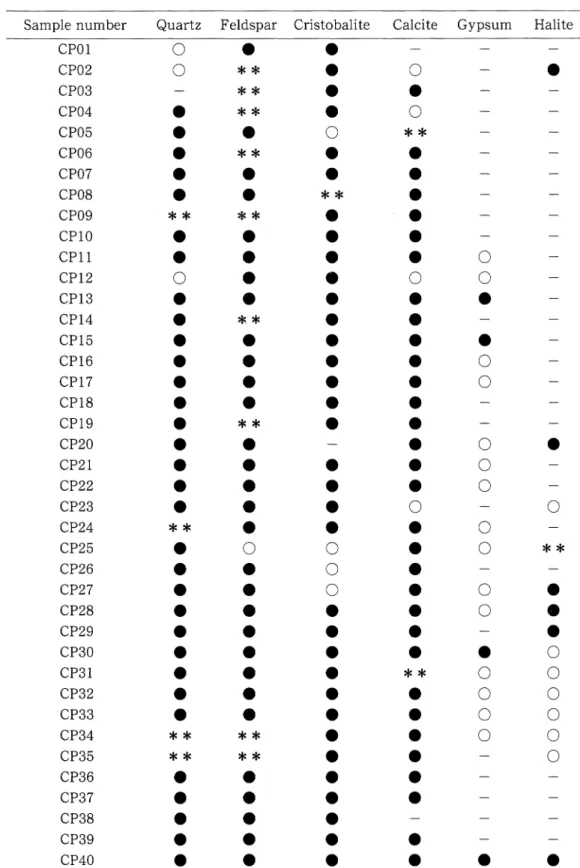
Identification of the minerals in this report is based upon X-ray diffraction charactens-tics of oriented aggregates and their response to glycolation. Among the non-clay minerals identified present in the bay, feldspar is predominant in all samples, along with quartz, cristobahte, calcite and gypsum. Quartz is readily recognized by an intense reflection at 3.34A and cristobalite which yields a strong reflections at 4.05A. Calcite is observed pre-sent in head and central areas while gypsum is common in central area but prevails in the mouth area. The strongest and most easily identified reflections of these two minerals are 3.03Å peak for calcite and 7.61A for gypsum. The 2.82Å peak of halite mineral is
distinctively observed in the samples from the mouth area.
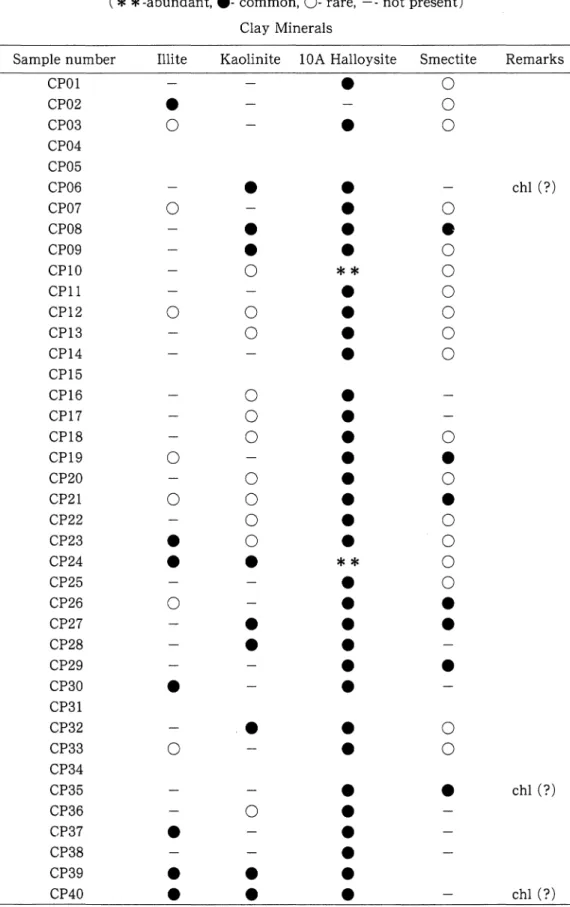
The clay components of the bay are lOÅ-halloysite, Kaolinite, illite and smectite. 14
0
A peak observed is assigned to chlorite, but supplementary methods of identification on this minerals are yet to be employed for confirmation. The distribution of clay minerals in
Kagoshima bay can be considered erratic, but dominant of which is the lOÅ-halloysite. Most of the sediment samples contain the same mineral species, though relative
propor-tions of the different species very from sample to sample. 10Å-halloysite is predominantly present in most of the samples. Other clay fractions common in most of the samples are kaolmite, illite and montmorillonite. Identification of these minerals are discussed below:
10 20 30 40
DEGREE 20(CuKα)
Fig. 3a. X-diffraction patterns of bulk samples from bay-mouth area, (gyp-gypsum, Q-quartz, cri-cristobalite, F-feldspar, Cal-calcite, Hal-halite)
Preliminary Report on the Mineralogical Studies of Bottom Surface Sediments of Kagoshima Bay 29
Fig. 3b. X-diffraction patterns of bulk samples from central area, (gyp-gypsum, Q-quartz, en-cristobalite, F-feldspar, Caトcalcite, Hal-halite)
「
10 20 30 40 DEGREE 20 CuKα)
Fig. 3c. X-diffraction patterns of bulk samples from bay-head area, (gyp-gypsum, Q-quartz, cn-cristobalite, F-feldspar, Cal-calcite)
⋮',J /'i'
10 15
MA14
*v*.w^ MAOl10 15
DEGREE 20(CuKォ
Fig. 4a. X-ray diffraction patterns of clay samples bay-mouth area. a. oriented samples b. with ethylene glycol
(M-smectite, 10ÅH-10A halloysite, Kao-kaolinite, Mトmixed layer mineral)
Preliminary Report on the Mineralogical Studies of Bottom Surface Sediments of Kagoshima Bay 31 10.16A
型w^ x>,
・㌦V ヽ′り小 Iルー叫l・l^小邑潤へvBm^Bz
10 15
Ctl >v^v CP35-叫へ〈Jレ∨*- C P28
〟∧恥入CP25
10 15
DEGREE 20(CuKα)
Fig. 4b. X-ray diffraction patterns of clay samples central area. a. oriented samples b. with ethylene glycol
32 Celestina U. CARRANZA, Katsutoshi TOMITA and Kimihiko OKI
JI
- ft . _ _ __10 15
▲ l ▲10 15
DEGREE 28(CuKα)
Fig. 4c. X-ray diffraction patterns of clay samples bay-head area. a. oriented samples b. with ethylene glycol
Preliminary Report on the Mineralogical Studies of Bottom Surface Sediments of Kagoshima Bay 33
Kaolinite and lOÅ halloysite
lOA-halloysite mineral is identified in the untreated sample from the lOA peak which
shifted to llA upon glyeolation (Fig. 4). 10A is the dominant clay mineral in the
Kagoshima bay sediments. It is generally observed present in all the 3 areas of the bay. The lOA-halloysite is derived from the widely distributed weathered pyroclastic flow deposits in Kagoshima. 10A-halloysite is a common clay observed in weathered pyroclastic flow de-posits (Tomita and Onishi, 1976).
The 7A reflection in the untreated and glycolated samples are considered to be due to kaolinite. This mineral is observed to be evident in the bay-head area. The kaolinite miner-als are known to occur as constituents of sediments. In the studies of Oimuna (1969) and Aoki et al ( 1975) on recent marine sediments around Japan islands, kaolinite occurs widely as a minor constituent. In Kagoshima bay, kaolinite in bottom声ediments is probably de-rived from altered rocks related to the young volcanic activities in the area. It has been re-ported (Muraoka, 1951) that kaolinite associated with quartz, cristobalite or alunite is found in Ibusuki area, southeast of Kagoshima bay.
Smectite and illite
Smectite mineral shows 15.2A peak for untreated samples and expands to 17.4 upon glyeolation (Fig. 4). Smectite and Illite are less common at bay mouth and central areas. Their predominance in the bay head area can be interpreted as a transported mineral by the inflowing rivers from which the area receives relatively large amount of run-off during
●
summer season. These two minerals are rarely present in the central portion. Since this pre-sent study concerns only the bottom surface sediments, the subject of diagenesis is at this point, not considered. Though the occurrence of smectite with illite mineral would show some evidence that smectite might have undergone diffusion and transformation, following the fact pointed out by Dietz (1941) that the development of illite on the sea floor is carried out by the alteration of montmonllonite from source material being transported to the sea.
Calcite
Calcite is identified in the samples from the strong 3.03A peak. Its occurrence in the bay is predominant in the central and the bay head areas. Almost all the samples through-out the central area show varying amounts of calcite from one sample to another. The widespead presence of calcite indicates that the area has been a favorable condition for its
●
precipitation.
At the bay-head area, on the other hand, calcite appears only at the center and north-eastern side. The absence of this mineral in some parts particularly the seatern section is as-sumed to be closely related to the acidic water caused by the fumarohc activities in the eastern half of the area. It is well known for calcium carbonates to be easily dissolved m
acidic solution and this fact can be correlated to the results on the studies of Oki and Hayasaka ( 1983) that the absence of calcareous forarfiinferas in some part of the bay-head area is assumed to be related to the development of acidic water mass caused by fumarohc activities.
The conspicuous absence of calcite in the mouth area obviously indicates environ-mental conditions that does not permit calcite formation or precipitation. This bay-mouth portion is characterized with strong currents, and serve as the channel between open sea and the bay's central portion. There is this occurrence of the current rip identified by Hoshino (1952) and Sakamoto (1982), that the flowing northward current on the eastern side of the bay mouth area allow quick sedimentation and flocculation of culloid materials. This active flowing conditions is not favorable for precipitation and/or concentration for
●
calcite mineral that explains its absence in this portion.
Gypsum
Characteristic strong peak at 7.62Å is attributed to gypsum (Fig. 3a, b, c). the results of the XRD analysis show that this mineral, like halite, occur mostly m the mouth area but rarely present in the central area. Only one sample from the bay head area was found to contain this mineral in minimal amount.
The distribution of gypsum gives clue to the possible source (s) of the mineral. Gypsum is an evaporite mineral which when saturated will undergo precipitation. Although in places where gypsum occur in the bay area posses the favorable environment for its precipitation, the reported occurrence of this mineral in the southeastern section of Kagoshima (Ibusuki City) that may have been exposed to weathering to possibly supply sediment to the bay could not be neglected. In the bay head area, it was observed that acidic hydrothermal liquids are coming up from bottom, and many bubbles are observed on the sea surface. Under this conditions, gypsum is easily formed mostly in big crystals.
Halite
Halite mineral is detected at 2.82Å peak in samples from the bay mouth and central ar-eas. These 2 areas are considered saline portions which give no doubt for the occurrence of halite. The variation of solubility of salts with temperature is called upon to explain crystal-lization of halite at the bottom of the brine basin (Mineral Society of America, 1979), that is evident particularly in the central portion of Kagoshima bay. There are 2 factors to con-sider in evaluating halite minerals'crystallization: (1) that crystallization ultimately de-pends upon evaporation and change of temperature that may shift the time and place of crystallization; (2) the amount of salt precipitated depends on the difference of solubility at 2 temperatures, not solubility itself. These factors are considerably important to the halite crystallization in Kagoshima bay, but the number 2 factor seems to be more evident than the first. In observations today in most temperate interior basins where there is range of
Preliminary Report on the Mineralogical Studies of Bottom Surface Sediments of Kagoshima Bay 35
●
summer-winter temperature, the brine saturated in summer may precipitate in the winter
(Mineral Society of America, 1979).
The presence of gypsum in places where halite is present also propose an assumption that halite mineral precipitated after gypsum. Halite mineral, after sample collection may have probably crystallized in the laboratory
Table la. List of Minerals present m Kagoshima Bay Bay-Mouth Area
( * *-abundant, - common, 〇一rare, -- not present) MINERAL CONSTITUENTS
Samplenumber Quartz Feldspar Cnstobalite Calcite Gypsum Halite
MA-01 MA-02 MA-03 MA-04 MA-05 MA-06 MA-07 MA-08 MA-09 MA・10 MA-ll MA-12 MA-13 MA-14 MA-15 MA-16 MA・17 MA-18 MA-19 MA-20 MA-21 MA-22 MA-23 MA-24
●
︼
●
⋮
⋮
I
⋮
I
I
⋮
●
●
⋮
●
⋮
⋮
⋮
●
⋮
⋮
⋮
**I I ⋮●l
I l●○●⋮⋮l
一一 I I I I一 I一I
I
I
I
Table lb. List of Minerals present in Kagoshima Bay Central Area
* *-abundant, #- common, ○- rare, -- not present) MINERAL CONSTITUENTS
Samplenumber Quartz Feldspar Cristobalite Calcite Gypsum Halite
l
●
二
〇
I
⋮
I
〇
〇
〇
〇
〇
〇
(
●i O O● f ●〇〇一l O O O l 〇〇一〇〇 f ●0000 7
l
○
●
○
⋮
○
○
⋮
○
●
●
⋮
〇
〇
〇
CPOI O ●
CP02 0 * *
**⋮
●
⋮
●
●
⋮
⋮
⋮
○
⋮
⋮
⋮
●
●
○
⋮
⋮
⋮
CP03 CP04 CP05 CP06 CP07 CP08 CP09 CPIO cpii CP12 CP13 CP14 CP15 CP16 CP17 CP18 CP19 CP20 CP21 CP22 CP23 CP24 CP25 CP26 CP27 CP28 CP29 CP30 CP31 CP32 CP33 CP34 CP35 CP36 CP37 CP38 CP39 CP40Preliminary Report on the Mineralogical Studies of Bottom Surface Sediments of Kagoshima Bay 37
Table lc. List of Minerals present in Kagoshima Bay Bay-Head Area
* *-abundant, - common, ○- rare, -- not present) MINERAL CONSTITUENTS
Samplenumber Quartz Feldspar Cristobalite Calcite Gypsum Halite
HAOI HAO2 HA03 HA04 HA05 HA06 HA07 HA08 HA09 HAIO HAll HA12 HA13 HA14 HA15 HA16 HA17 HA18 HA19
●⋮●●●⋮●●○○●⋮〇〇〇〇○○●
** ** ** ** ** ** **1TTTT
●●●⋮⋮●⋮⋮○●●○
[IIIIIIIJ
* *Table 2a. List of Clay Minerals Present in Kagoshima Bay. Bay-Mouth Area
( * *-abundant, - common, ○- rare, -- not present) Clay Minerals
Sample number Illite Kaolinite lOA Halloysite Smectite Remarks MA-01 MA-02 MA-03 MA-04 MA-05 MA-06 MA-07 MA-08 MA-09 MA-10 MA-ll MA-12 MA-13 MA-14 MA-15 MA-16 MA-17 MA-18 MA-19 MA-20 MA-21 MA-22 MA-23 MA-24
⋮
○
●
l
● ●一 ○ 一 〇 一 ●●●●⋮⋮
〇 〇 一 〇 ● ●I
chl (?)
Table 2b. List of Clay Minerals Present m Kagoshima Bay. Central Area
( * *-abundant, - common, 〇一rare, -- not present) Clay Minerals
Sample number Illite Kaolinite lOA Halloysite Smectite Remarks CPOI CP02 CP03 0 CP04 CP05 CP06 CP07 CP08 CP09 CPIO cpii CP12 CP13 CP14 CP15 CP16 CP17 CP18 CP19 CP20 CP21 CP22 CP23 CP24 CP25 CP26 CP27 CP28 CP29 CP30 CP31 CP32 CP33 CP34 CP35 CP36 CP37 CP38 CP39 CP40 一 〇 一 l 一 〇 一 L 一 一 一 〇 一 〇 I I O I I I O I I
I O I O O 1 000 1 0000 I I I I
一 〇 一 一 ● ● ● 一 ●〇
〇
〇
一
〇
●
〇
〇
〇
〇
〇
〇
一
一
〇
●
○
●
〇
〇
〇
〇
I
I
O
O
I
I
I
し l H 一 つ ・ , l H 川 l U 1 h C chl (?) chl (?)Preliminary Report on the Mineralogical Studies of Bottom Surface Sediments of Kagoshima Bay 39
Table 2c. List of Clay Minerals Present m Kagoshima Bay. Bay-Head Area
* *-abundant, #- common, ○- rare, -- not present) Clay Minerals
Sample number Illite Kaolinite lOA Halloysite Smectite Remarks
HAOI HA02 HA03 HA04 HA05 HA06 HA07 HA08 HA09 HAIO HAH HA12 HA13 HAH HA15 HA16 HA17 HA18 HA19
●○
●
⋮
○
I
I
I 〇一
I I 〇一I
○
●
○
⋮
I
I
⋮
=
●
︼
O I I O ! ! I I
F n u し っ ・ ・ つ -ノートLU ir° = H = h h C C AcknowledgementWe thank the staff of the Institute of Earth Sciences, Faculty of Science, Kagoshima University for the use of their laboratory instruments. Special thanks als('to Mr. E. John Carranza for his encouragement and valuable comments on this report.
References
Aoki, S., Oinuma, K. and Kobayashi, K. 1975. Study of clay minerals in recent marine sedi-ments. Contributions to Clay Mineralogy, Dedicated to Professor Toshio Sudo on the occa-sion of his retirement, 161-166.
Dietz, R. S. 1941. Clay Minerals in Recent Sediments. Ph. D. thesis, Univ. of Illinois.
Hayasaka, S. 1987. Geological structure of Kagoshima Bay, South Kyushu, Japan: Monograph 33, Assoc. Geol. Collab. Japan, 225-233.
Hayasaka, S. and Oki, k. 1971. Geological considerations on the subsurface data from the deep wells drilled in Kagoshima City, South Kyushu, Japan. Rep. Fac. Sci, Kagoshima Univ. (Earth Sci & Biol.) 4, 15-29.
Bay, south Kyushu, Japan. Part II -Submarine topography and bottom sediments of the bay-mouth area. Rep. Fac. Sci, Kagoshtma Univ., No. 9, 21-52.
Hayasaka, S., Oki, K., Otsuka, H. and Higashikawa, S. 1976a. Geological study on Kagoshima Bay, south Kyushu, Japan. Part IE-Submarine topography and bottom sediments of the bay-head area. Rep. Fac. ScL, Kagoshima Univ., No. 9, 21-52.
Hayasaka, S., Otsuka, H., Oki, K. and Higashikawa, S. 1974. Submarine topography and bot-torn sediments off the coast of Ibusuki, Kagoshima Prefecture. Rep. Fac. Set, Kagoshtma Univ. (Earth Sci & BioL ), 7, 23-26.
Holser, W. T. 1979. Marine Minerals, Reviews in Mineralogy, Mineralogical Society of America, Vol. 6, 230-239.
Hoshmo, M. 1952. On the muddy sediments of the continental shelf adjacent to Japan.Jour. Geol Soc. Japan, 58 677), 41-53.
Kagoshima Prefectural Government. 1978. Reports on the environment study in relation to
●
mercury in Kagoshima Bay. 38.
Matumoto, T. 1943. The four gigantic caldera volcanoes of Kyushu. Jap. Jour. Geol. and Geogγ., 19, Special No.,ト57.
Muraoka, M. 1951. Bull. Geol. Survey. Japan. 2, 74.
\
Nozawa, K. and Saisho, T. 1980二Plankton of Kagoshima Bay. Marine Sci Monthly, 12 (9),
654-672.
Oinuma, K. 1969. The Clays of Japan. Geol. Surv. of Japan. 149-154.
Oki, K. 1989. Ecological analysis of benthonic foraminifers in Kagoshima Bay, South Kyushu, Japan. South Pacific Study, Vol. 10, No. 1.
Oki, K. and Hayasaka, S. 1978. Geological study of Kagoshima Bay, South Kyushu, Japan. Part IV-A note on the peculiar mode of occurrence of foraminifers in the bottom sedi-ments of the Bay-head area.Rep. Fac. ScL, Kagoshima Univ. {Earth Sci & Biol. ), ll, 1-1 1. Oki, K. and Hayasaka, S. 1983. Submarine topography and bottom sediments of Kagoshima
Bay.Bull Coast Oceanogr., 21 (1), 1-10.
Oki, K., Funatsu, F. and Hayasaka, S. 1990. Geology of the southern part of Kagoshima City with special reference to the relationship between the Izaku and the Terukuni pyroclastic flows (in Japanese with English abstract). Prof Yukitoshi Urashima Commemoration Volume on the Occasion of his retirement. 125-133
Sakamoto, W. 1982. Detritus-roles of suspended and bottom sediment on coastal marine ecosystem. Marine Sci Monthly, 14 (8), 377-394.
Sakurai, M. and Maeda, A. 1980. Tachometry in the Bay mouth area. Bull Coast. Oceanogr., 18 (1),45-51.
Sudo, T. and Shimoda, S. 1978. Development in Sedimentology 26: Clays and Clay Minerals of Japan. Elsevier Scientific Pub. Co..
Tomita, K., Horie, S. and Kawano, M. 1992. Mineralogical composition of the upper 800m of l,400m sediments core samples from Lake Biwa.Jour. Min. Pet Econ. GeoL, 87, 481-490.
Tomita, K. and Omishi, K. 1976. Clay minerals in Shirasu "especially from the collapse knowledge of the shirasu cliff. Jour, of Clay Sci. Soc. of Japan. 16, 54-62.