Institutional Development of Capital Markets
in Nine Asian Economies
著者
Nakagawa Rika
権利
Copyrights 日本貿易振興機構(ジェトロ)アジア
経済研究所 / Institute of Developing
Economies, Japan External Trade Organization
(IDE-JETRO) http://www.ide.go.jp
journal or
publication title
IDE Discussion Paper
volume
112
year
2007-07-01
INSTITUTE OF DEVELOPING ECONOMIES
IDE Discussion Papers are preliminary materials circulated to stimulate discussions and critical comments
Keywords: Capital Market, East Asia, Southeast Asia JEL classification: G18, N20, N65
* Research Fellow, Technological Innovation and Economic Growth Studies Group,
IDE DISCUSSION PAPER No. 112
Institutional Development of Capital
Markets in Nine Asian Economies
Rika NAKAGAWA*
July 2007
Abstract
This paper is conducting a comparative analysis of the development of securities markets in nine Asian economies: Korea, Taiwan, Hong Kong, Singapore, Malaysia, Thailand, Indonesia, the Philippines, and China. This study focuses on two aspects: the history and institutional development of securities market, such as legal systems, payment systems, etc. From the analyses, this paper reveals several common features of the development of securities markets in nine Asian economies. First, most economies had an informal capital market in the early period of their history. Second, the background of the foundation of their official markets was influenced by experiences of colonization. Third, most governments recognized the importance of the capital market for economic development and had a positive attitude in promoting the market. Fourth, statistics clearly showed that most economies experienced several booms in their capital market from the late 1980s.
The Institute of Developing Economies (IDE) is a semigovernmental, nonpartisan, nonprofit research institute, founded in 1958. The Institute merged with the Japan External Trade Organization (JETRO) on July 1, 1998.
The Institute conducts basic and comprehensive studies on economic and related affairs in all developing countries and regions, including Asia, the Middle East, Africa, Latin America, Oceania, and Eastern Europe.
The views expressed in this publication are those of the author(s). Publication does not imply endorsement by the Institute of Developing Economies of any of the views expressed within.
INSTITUTE OF DEVELOPING ECONOMIES (IDE), JETRO 3-2-2, WAKABA,MIHAMA-KU,CHIBA-SHI
CHIBA 261-8545, JAPAN
I n s t i t u t i o n a l D e v e l o p m en t o f C a p i t a l M a r ke t s
i n N i n e A s i a n Eco n o m i es
1Rika Nakagawa
Introduction
Securities markets in the nine Asian economies are relatively young compared to those of the U.S. and the U.K. Among them, the Hong Kong Securities Market, established in 1891, is the oldest. In 1990, the youngest market was founded in China. Other markets were set up from the late 1920s to the early 1960s. Informal exchanges, however, started far before the establishment of the stock exchanges.
The purpose of this paper is to present a comparative analysis of the development of securities markets in Asian economies focusing on the history of securities markets of nine economies: Hong Kong, Indonesia, the Philippines, Singapore, Malaysia, Korea, Taiwan, Thailand, and China. In addition, this paper analyzes the development processes of each securities market through statistical data regarding the number of listed companies and the capitalization of these markets.
The paper consists of three sections. The first section describes the history of capital markets of nine Asian economies. The second section observes processes of the development of each market in terms of the number of listed companies and the market capitalization. The last section is concluding remarks.
1. History of Securities Markets in Nine Asian Economies
The first section reviews the development of securities markets in nine Asian economies in order of their history.
2
1-1. Hong Kong2
In Hong Kong, securities were informally traded in the early nineteenth century. The formal stock exchange, named the Association of Stockbrokers, was established in 1891. In 1914, this association changed its name to the Hong Kong Stock Exchange. In 1921, Hong Kong formed the second stock exchange, the Hong Kong Stockbrokers’ Association. In 1947, these two stock exchanges were merged and incorporated as the Hong Kong Stock Exchange Ltd.
Security trading was not very active until 1950, because most business entities raised capital through bank loans rather than in the capital market. This changed, however, in the 1960s due to an economic boom which attracted foreign funds. The government’s “laissez-faire” policy along with the favorable economic situation caused the development of a securities market in Hong Kong. The government established three other stock exchanges: the Far East Exchange in 1967, the Kam Ngan Stock Exchange in 1971, and the Kowloon Stock Exchange in 1972.
Although the “laissez-faire” approach contributed greatly to the expansion of the capital market in Hong Kong, it had a negative impact on the market when oil prices fell suddenly in 1973 and 1979. These events resulted in outflows of foreign capital from Hong Kong and stock prices fell sharply. The Hong Kong government realized that regulations and a supervisory institution should be introduced for a sound market. In 1974, the government enacted the Securities Ordinance and established the Office of the Commissioner for Securities as the supervisory authority.
In 1976, the Hong Kong government launched a futures market. Following this, in 1979, the government opened their securities market for foreign brokers. In addition to this, the government promoted a consolidation of four stock exchanges, the Hong Kong Stock Exchange, Far East Exchange, Kam Ngan Stock Exchange and Kowloon
Stock Exchange, in order to foster an efficient and effective stock exchange. This consolidation led to the introduction of an automatic trading system.
The government efforts triggered inflows of large amounts of foreign funds. In 1987, the Hang Seng stock index reached its highest point, 3,949. The market boom, however, soon ended when the Dow Jones Industrial Average fell sharply on October 19, 19873. The stock market crash had a great impact on the Hong Kong stock market: the Hang Seng Index fell more than 40%. This experience made Hong Kong realize the need for further reform for market stabilization. In 1989, the government enacted the Securities and Futures Commission Ordinance and established a supervisory organization, the Securities and Futures Commission. Moreover, the government set up listing requirements and a disclosure system4. In 1989, the Hong Kong Securities Clearing Company Limited was incorporated and a central clearing and settlement system was launched. Due to these improvements, the Hong Kong securities market has developed well.
The Hong Kong stock market is now one of the most developed markets. However, it was affected by the currency crisis of 1997. This was another opportunity for the government to reform the market. First, for market diversification, they allowed a venture market, the Growth Enterprise Market. Second, for a comprehensive stock market reform, they reorganized the stock exchange and founded a holding company, the Hong Kong Exchanges and Clearing Limited (HKEx), which was an amalgamation of the Stock Exchange of Hong Kong Limited, the Hong Kong Futures Exchange Limited, and the Hong Kong Securities Clearing Company Limited5.
1-2. Indonesia6
Informal trading of shares in Indonesia started in the late 19th century. As in other Asian economies, the history of the stock exchange was affected by the colonizing
4
country; in the case of Indonesia, the colonizing country was the Netherlands. Because the Dutch government aimed to develop the plantation industry, in 1912 the Dutch opened a formal dealing space in Jakarta7. The official exchange supported the financing activities of Dutch-owned companies.
In 1925, two other stock exchanges were opened, in Surabaya and Selaman respectively. These markets played an important role, but they were merged with the Jakarta Stock Exchange (JSE) in 1939. In 1940 the JSE closed because of the Second World War and activities completely stopped.
In 1952, the JSE reopened; however, it closed again in 1958 for economic and political reasons. The inflation rate had reached a high level, and this resulted in loss of confidence in financial assets and the Indonesian currency. In addition, in 1958, the Indonesian government enforced Nationalization Law No. 86 and nationalized Dutch-owned private companies. This measure caused the Dutch to leave the country. Because the Dutch had dominated the market, the market did not function after they left Indonesia.
In 1967, President Suharuto set out to reconstruct the capital market. First in 1968, the central bank organized a taskforce to discuss development policies of the market and draw up policy suggestions. As a result of the discussion, in 1976 the government established the Capital Market Supervisory Agency (BAPEPAM) and a state-owned unit trust company, PT. Danareksa, to promote the capital market. Next year, public offering of new shares was carried out.
As the capital market functioned, the government implemented several policies to increase share trading. A set of policies for capital market development announced by the government in 1987 was composed of four programs: simplifying issuance and trading procedures of stocks and bonds; reducing registration fees; abandoning regulation of price changes; arranging special measures for unlisted companies which
did not comply with minimum requirements to list on the market.
In 1988, the government announced additional policies. First, the income tax rate for interest on savings was set the same as the dividend tax rate8. The purpose of this measure was to make financial assets shift from banks to securities market and to mobilize domestic savings. Second, foreign stockbrokers were allowed to establish offices for providing the private sector with investment opportunities. In addition, privately-owned stock exchanges were permitted in cities other than Jakarta9.
In the 1990s, the government accelerated implementation of their plan. In 1990, the BAPEPAM was restructured and privatized. In order to modernize, the country founded a settlement company in 1992. In 1993, the government encouraged the establishment of a rating agency. In 1995, an automatic matching system started operation. Like many other Asian countries, Indonesia was severely affected by the Asian Crisis. However, at this time they remain committed to developing their market further.
1-3. The Philippines10
The Philippines’ securities market started in the 1920s under the control of the United States. In 1927, Americans involved in business in the Philippines organized a formal securities market in Manila. In those days, there were no regulatory and supervisory institutions in the country. In October 1936, the colonial government enacted the Securities Act, which was based on the 1934 Securities and Exchange Act of the US.
In 1963, another securities market, the Makati Stock Exchange, was opened. The listed companies, however, were entirely the same as those of the Manila Stock Exchange. The Philippine market worked under a dual-listing system.
6
because of the discovery of natural resources, such as gold, copper and oil. However, the boom in the stock exchanges did not last long. There were two main reasons. One was that the government of President Ferdinand Edralin Marcos was politically unstable. The other was that the world economy fell into a slump and foreign investments into the country decreased.
The Philippine government organized a study group to investigate reasons for economic stagnation and the underdevelopment of a capital market. The result presented at the Capital Market Development Conference in 1988 revealed several problems to be solved in the Philippine market. First, the number of listed companies was small. Second, most dealings in the stock market were in blue-chip stocks11. Third, there was no tax incentive in the market, such as a deduction of dividend tax, business tax or stump duties. The conference suggested some policy implications, also. Based on the recommendations, the government began to modernize the market. First of all, in 1992, the Manila Stock Exchange was consolidated with the Makati Stock Exchange and renamed the Philippine Stock Exchange. A central depository system was implemented in 1995. Seven years later, the Securities Clearing Corporation of the Philippines was established. Thus, in the case of the Philippines, modernization of the securities market began only in the 1990s although the market itself originated in the 1920s.
1-4. Singapore12
Security dealings in Singapore were started in the late nineteenth century by multinational corporations of Great Britain. In 1910, the peninsula experienced a rubber boom and this made the stock market active. These trading activities were informal, so the government never controlled the market. However, when the stock market crash occurred in the U.S. in 1929, the government became aware of the need for appropriate trading rules, supervision, and a legal framework for investor protection.
In 1930, the government formed the Singapore Stockbrokers Association and allowed them to deal in securities on a formal basis. In 1938, brokers from the Malay Peninsula joined the association, and the organization was renamed the Malaysia Stockbrokers Association. In 1960, another trading space, the Malayan Stock Exchange, was opened in Kuala Lumpur, Malaysia. Stock exchanges in Singapore and Malaysia functioned as a single market even after Singapore’s independence in 1965. In 1973, Singapore separated her stock exchange from the Kuala Lumpur Stock Exchange, and enacted the Securities Industry Act in order to support and develop the securities industry.
For the development of the securities industry, the government focused on internationalization of the market. For example, in December 1983, they set up a futures trading room, the Singapore International Monetary Exchange (SIMEX), for attracting foreign capital. The government’s strategy contributed greatly to the development of an international financial center13.
In the mid-1980s, the country introduced new regulations with respect to the securities industry and the capital market. One episode, the bankruptcy of Pan-Electric Industries in 1985, made the government realize the importance of appropriate rules, a monitoring system, and regulations regarding the stock broking industry. First, the government amended the Securities Industry Act. As a result of the revision, members of the stock broking industry were required to be incorporated and to increase their capital to solidify their financial position. In addition, the role of monitoring entity changed from the Singapore Stock Exchange to the Singapore Monetary Authority and the Authority was responsible for determining the ceiling of the margin with regard to share dealings with a margin.
These comprehensive reforms fostered a strong and stable capital market that was not affected by the stock price crash of 1987; Singapore’s market was stable during the
terminated the single market policy. The KLSE, however, had a close link with the SES until 199015.
In the 1980s and the 1990s, Malaysia implemented a plan for modernization and diversification of their capital market. For example, in 1984, a computer settlement system was introduced. Two years later, index trading was launched. In 1988, a second board was established. Then, in 1989, an automatic matching system was launched. Next year, the Central Depository System was introduced. Along with these modernization and diversification policies, the Malaysian government determined a minimum requirement of capital for stockbrokers in order to strengthen the industry. Under the requirement, stockbrokers must commit their business with capital of more than 20 million ringgit. In 1993, the government established a regulatory body of the securities market, the Securities Commission. To further the policy of diversification, a futures market was set up in 1995.
The capital market in Malaysia enjoyed expansion due to the above-mentioned policies and inflows of foreign capital. The country, however, was severely affected by the Asian Currency Crisis of 1997. In particular, the crisis put the stock market and the foreign exchange market into great confusion and resulted in stock prices and the foreign exchange rate falling sharply. The government insisted that one of the causes of the confusion was a foreign board, namely the Central Limit Order Book International (CLOB International) in Singapore16, because many of the Malaysian shares had been traded in the international over-the-counter market (CLOB International). Therefore, in September 1998, the government issued a prohibition on dealing Malaysian shares in the market.
As the economy recovered, Malaysia promoted reform of the capital market. The purpose of this reform was to make the market more competitive and attractive in the global financial market. For this purpose, the government announced the Capital Market
10
Master Plan in February 2001. Based on this plan, Malaysia is moving toward a more sophisticated securities market.
1-6 Korea17
In Korea, a capital market for the issuance of new securities, so-called the primary market, started in 1899. In 1905, government bonds were issued for the first time. In the early days, however, shares and government bonds were only issued privately for investors, there was no buying or selling of securities in the markets. In 1911, Japanese colonists established a dealers association for securities. This association formed a semi-official stock exchange and traded corporate shares under certain rules18. The association, however, did not last long due to defaults in settlement of securities trading. After the closure of the association, another stock exchange was formed in 1930; however, it was closed in 1945.
The new history of the Korean securities market began in 1956. The Korean government set up an official stock exchange, the Daehan Stock Exchange, with only 12 listed companies. During the early stage of the stock exchange, the main activity was dealing in government bonds. Since the 1960s, the Korean government has implemented several measures in order to develop a capital market. First, in 1962, the government enacted the Securities and Exchange Act19. Second, in November 1968, the Law on Fostering the Capital Market was enacted. Third, under the law, the government provided listed companies with tax incentives. Fourth, in January 1973, the government enacted the Public Corporation Inducement Act. The government forced government-linked companies to list on the KSE and issue their shares in the market. Owing to these policies, the number of listed companies in the KSE increased to 189 in 1975.
infrastructure. In December 1974, two institutions were organized in order that settlement and trading would occur efficiently and effectively. One was the Korea Securities Depository, which provided investors with an automatic trading and settlement system. The other was the Korea Securities Computer Corporation, which facilitated modernization of the securities industry20. In 1977, the government set up two authorities, the Securities and Exchange Commission and the Securities Supervisory Board. These organizations were expected to decide trading rules, listing requirements, and supervise the capital market. The market infrastructure of the Korean securities market developed rapidly.
In the 1980s, the Korean capital market faced new challenges: internationalization and liberalization. The government gradually liberalized and opened their stock market to foreign investors. In 1981, the government executed three deregulation policies: the deregulation of interest rate on corporate bonds, permission for beneficiary certificates for foreign investors, the establishment of International Investment Trusts. In 1983, the KSE introduced the Korea Composite Stock Price Index for diversifying investment products. In 1984, Korea Funds listed on the New York Stock Exchange; this enabled the Korean companies to raise money in the overseas market. In 1985, rules and regulations for issuing securities denominated in foreign currencies were relaxed. It became easier for Korean companies to issue their securities in foreign currency. In the 1990s, further liberalization measures were implemented. In 1990, Korean residents were permitted to buy and sell overseas convertible bonds in an over-the-counter market. In addition, with certain restrictions, foreign investors were allowed to obtain shares in Korean companies. This was for the purpose of obtaining foreign direct investments from abroad. In 1992, the government relaxed restrictions on portfolio investments from abroad. Along with these policies, the government recognized the importance of introducing some means for managing risk. In 1990, the
12
government introduced derivative markets for transactions in futures and options. Thus, Korea facilitated liberalization of the securities market through gradual approaches; these steps along with economic development increased inflows of foreign capital.
In 1997, the Korean economy was severely affected by sharp currency depreciation as a result of the Asian Currency Crisis. The government requested the International Monetary Fund (IMF) to lend money for economic recovery. As a result, the country must follow IMF policies, the so-called the IMF conditionality, to reconstruct the economy. Reform of the securities markets was included in the conditionality. Under IMF policies, the government executed further means of liberalization and modernization of the capital market. First, in April 1998, the government restructured the regulatory authorities and established the Financial Supervisory Commission. In May, rules and regulations concerning portfolio investments by foreigners were abolished. Regarding modernization of the markets, the government introduced the Electronic Communications Network in December 2001. The crisis had a negative impact on the Korean economy and securities market; however, it promoted market reform. The Korean securities market wishes to develop further and to become a foreign-investors-friendly market.
1-7. Taiwan R.O.C.21
Securities trading in Taiwan R.O.C. started on an informal basis in 1953, when the Taiwanese government launched a land reform program. The securities traded at that time were shares of state-owned enterprises. Under the program, the government acquired land from large landowners and allocated it to farmers. As compensation, the government distributed shares of state owned enterprises and landowners began to deal those shares among themselves. According to Harrison (1991), more than 200 companies joined this informal market22.
As the trading became active, the government found that they needed a formal securities market with certain rules and regulations for dealing. In 1959, the government formed a study team for a formal market. In September 1960, the Securities and Exchange Commission was organized and, in November 1961, the Taiwan Stock Exchange Corporation was founded. In 1968, the Securities and Exchange Law, which is based on the US Act of 1934, was enacted23.
In the 1970s, the Taiwanese economy expanded, resulting in the rapid development of the capital market. However, the oil shocks in 1973 and 1979 caused a depression in the economy.
During the 1980s, the Taiwanese authority embarked on economic reform policies, including the implementation of several policies for opening their capital market to foreign investors. First, in 1982, the government announced that Taiwan would accept portfolio investments from foreign investors and Chinese living overseas. This liberalization program consisted of three steps. As the first step, the Taiwanese companies would collect funds from foreigners and overseas Chinese through an international trust fund. Next, Taiwan would allow overseas institutional investors to join the capital market in Taiwan. Finally, overseas individual investors would be accepted in the securities market.
In accordance with these steps, in 1983, the government established an international trust fund, the Taiwan Fund, listed on the New York Stock Exchange. In May 1988, the Securities and Exchange Law was amended and it allowed the industry of local stock brokers to be more open to foreign brokers. Foreign stock brokers were able to hold shares of local stock brokers in Taiwan. The next year, overseas securities companies were allowed to establish branches in Taiwan. As the next step, in 1990, foreign institutional investors were accepted in the securities market with certain conditions24. Regarding asset management companies, more than five years must have
14
passed since they began operations. They must also have had the experience of investing more than five billion US dollars in global markets.
Along with internationalization of the market, Taiwan promoted modernization of the stock exchange system. First, in 1986, the Taiwan Stock Exchange (TSE) introduced an automatic trading system25. Second, in the early 1990s, a futures market was set up. This resulted in the reorganization of the Securities and Exchange Commission, the name of which was changed in 1997 to the Securities and Futures Bureau. In 2002, the legal infrastructure was upgraded and a law for protection of investors was introduced. In 2003, Taiwan started a warrant market and index trading in order to diversify financial products.
1-8. Thailand26
The first securities market in Thailand was opened in 1962. Whereas stock exchanges in many other Asian economies were established by government, the Bangkok Stock Exchange (BSE) was privately owned. At first, stock trading was active; however the volume of trading decreased. As a result, in the early 1970s, the BSE closed. After the closure of the stock exchange, the Thai government became aware of the importance of the securities market for corporate finance. Therefore, the government implemented policies to promote the capital market27.
The government’s action was accelerated by a report published by the World Bank in 1969. The Thai government invited a study group from the World Bank for a joint study. The results of the study were published as “A Capital Market in Thailand” in 1970. This was an important bible for the development of the securities market in the country.
Based on the report, in 1972 the Thai government first amended the Announcement of the Executive Council No. 58 on the Control of Commercial
Undertakings Affecting Public Safety and Welfare making the government responsible for regulation and supervision of the market. Next, in 1974, the government enacted the Securities Exchange of Thailand Act (BE2517) and established the Securities Exchange of Thailand. These Acts promulgated by the government supported the building of a basic infrastructure of the capital market.
In the late 1980s, the Thai economy experienced a boom which contributed to the development of the market. The government did not strictly control the trading space, so a large amount of foreign capital flowed into the Thai stock market28. The Thai securities market achieved remarkable development due to the government’s commitment to developing the market and to the foreign capital.
The late 1980s and the 1990s were a period for modernization of the market. In 1988, the government prepared for a central settlement system. In 1991, an automatic matching system, the Automated System for the Stock Exchange of Thailand, was introduced. The next year, the Securities and Exchange Act (BE2535) was enforced and the Securities and Exchange Commission was established.
In 1997, Thailand faced severe pressure on its exchange rate against the US dollar. The currency crisis resulted from a sudden outflow of foreign capital. This affected not only the exchange rate but also stock prices. In response, the government deregulated stock price regulation29. In addition, they executed policies for economic recovery under the IMF’s supervision.
As the economy recovered, the government set up a securities market for small- and medium-sized enterprises, which can issue shares and bonds. Thailand is now on the road to further development of its securities market.
1-9. China P.R.C.30
16
economies because their system has been a planned economy. Before the Communist Revolution, the government had opened securities markets in Beijing, Shanghai, and Tianjin in order to meet government expenditures. In the process of developing a planned economy, however, the role of securities markets declined and in 1958, China’s capital market disappeared.
In 1981 government bonds were again issued in the country. This resulted from economic reforms by the government. In rural areas, the government’s purchasing prices of agricultural products were raised. This increased the government’s fiscal deficit. To cover the deficit, it was necessary for the government to issue bonds. In addition, the government permitted farmers in rural areas to establish small business companies that were unrelated to farming. The government could not provide financial support because it was facing fiscal deficit and thus allowed the companies to issue corporate debt securities to finance themselves. In cities, companies issued bonds for financing their activities without governmental permission and started the public offering of shares in 1984. Taking these circumstances in rural and city areas into account, the government permitted companies to issue shares and bonds, subject to the consent of the People’s Bank of China31.
China has changed itseconomic system from a planned to a market economy. The country speeded up the process in the 1990s with many state-owned enterprises being privatized. These companies needed a market to finance them and the government recognized the need for a capital market. Therefore, in 1990 and 1991, the government established stock exchanges in Shanghai and Shenzhen respectively.
Market infrastructures, such as supervisory organizations and rules and regulations of the market, were set up quickly. In August 1990, the Securities Trading Automated Quotations System was introduced. This system made it possible for securities companies and unit trust companies to collect price information and execute
trading and settlement through telephone circuits. Moreover in 1992, the State Council Securities Commission and the China Securities Regulatory Commission was founded for market supervision32.
Since 2000, the Chinese economy has attracted foreign investor interest due to its economic expansion. In 2003, the country responded to circumstances with deregulation of portfolio investments from abroad. As a first step, institutional investors were permitted to participate in A Shares trading33.
Thus, in China, the securities market has just started to develop since its establishment in the early 1990s.
2. The Development of Securities Markets in the Nine Asian Economies
This section provides other viewpoints for understanding the development processes of capital markets in the targeted economies. In particular, the author focuses on the number of listed companies and market capitalization.
2-1. The Number of Listed Companies
Table 1 shows the number of listed companies in each country. Among them, the fastest growth has occurred in China although China’s capital market opened only in 1991. In the beginning year, only fourteen companies were listed on the stock exchange34. From 1992 to 1994, the number increased from 52 to 291. From 1995 to 1997, the number jumped from 323 to 764. In 2000, there were more than 1,000 companies. This pace has been the fastest among the economies, as shown in Table 1. Hong Kong and Malaysia have recorded a remarkable increase in the number of listed companies. In the case of Hong Kong, in 1993 450 companies were listed on the market and, by 2003, this had increased by 579 companies. This figure reveals that Hong Kong’s capital market has been active. The Malaysian capital market has also
18
developed at a fast pace. In 1980, 182 companies were listed on the market. The number has increased as shown in Table 1. It is worthy of note that from 1990 to 1997 the number increased by more than 10%; for example, 12.4% in 1990, 13.8% in 1991, and 14.0% in 1997. Table 1 also notes that the number grew at a slow pace until 1990 but its pace became fast after 1990. After the Asian crisis, the number increased at a slow pace again. As of 2003, 897 companies are listed on the securities market in Malaysia. In the case of Taiwan R.O.C., in 1980, 102 companies were listed on the market. In 1987, this number increased to 140. From 1988 to 1996, listed companies increased by more than 10%, in 1988, 163 companies began to trade. In 1996, the number was 382 companies. Thus, the listing boom in Taiwan began a little earlier than that of Malaysia. As of 2003, 669 companies were participating in dealing shares in the Taiwanese capital market.
In Singapore, in 1989, the number of listed companies was 347; however, this dropped to 188 in 1990. One reason is that in that year Malaysia decided to delist Malaysian companies from the Singapore market. In 1991 and 1992, the number of listed companies rose to 202 and 217 respectively. In 1993, the number edged down to 178 companies. There was a noteworthy increase in 1997. The number of listed companies increased by 35.9%, from 223 to 303. Following that, the number increased every year, except in 2001. As of 2003, 475 listed companies were taking part in the securities market in Singapore.
In the case of Korea, Thailand, Indonesia, and the Philippines, each trend shows different features from the trends of the other targeted economies. In the case of Korea, the number has increased; however the pace has been slow. From 1998 to 2002, the rate of increase decreased. In 1998, 352 companies issued shares and traded; however, from 1981 to 1983, the number diminished, to 343 in 1981, 334 in 1982, 328 in 1983. Following that, many Korean companies were listed. It was remarkable that in 1988 and
1989 the listed enterprises increased to 502 and 626 respectively; the rates of increase were 29.0% and 24.7%. In 1997, the number reached 776, which was the peak. Since then, the number has continued to decrease due to the Asian Crisis.
Table 1. Number of Listed Companies
Hong Kong Indonesia Philippines Singapore Malaysia Korea Taiwan Thailand China
1980 n.a. n.a. 195 n.a. 182 352 102 77
--1981 n.a. n.a. 190 n.a. 187 343 107 80
--1982 n.a. n.a. 200 n.a. 194 334 113 81
--1983 n.a. n.a. 208 n.a. 204 328 119 88
--1984 n.a. n.a. 149 n.a. 217 336 123 96
--1985 n.a. 24 138 n.a. 222 342 127 100 --1986 n.a. 24 130 n.a. 223 355 130 98 --1987 n.a. 24 138 n.a. 232 389 140 125 --1988 n.a. 24 141 n.a. 238 502 163 141 --1989 n.a. 51 144 347 251 626 181 175 --1990 n.a. 125 153 188 282 669 199 214 --1991 n.a. 141 161 202 321 686 221 276 14 1992 n.a. 155 170 217 369 688 256 305 52 1993 450 174 180 178 410 693 285 347 183 1994 519 216 189 240 478 699 313 389 291 1995 518 238 205 212 529 721 347 416 323 1996 561 253 216 223 621 760 382 454 540 1997 671 282 221 303 708 776 404 431 764 1998 693 288 221 321 736 748 437 418 853 1999 717 277 225 355 757 725 462 392 950 2000 779 290 229 418 795 704 531 381 1,086 2001 857 316 231 386 809 689 584 449 1,160 2002 968 331 234 434 865 683 638 391 1,235 2003 1,029 333 234 475 897 684 669 405 1,296
Notes: n.a.=not available.
Sources: International Financial Corporation, Emerging Stock Markets Factbook, various issues, Standard & Poor’s (2004) Global
Stock Markets Factbook 2004, Monetary Authority of Singapore (1994) Monthly Statistical Bulletin, Vol. 15, No. 6.
The trend of the number of listed companies in Thailand was very similar to that of Korea. In 1980, only 77 companies participated in the stock market. The number increased, but until 1986 the pace was very slow. In 1987, the number of companies reached 125, an increase of 27.6% compared to the previous year. Until 1994, the rate of increase remained more than 10%; it was sometimes more than 20%. In 1994 389 listed companies were listed; in 1996 454 companies were on the Thai capital market but the Asian Crisis hit the country and severely affected the capital market. From 1997 to 2002,
20
the number decreased from 431 companies in 1997 to 391 companies in 2002. The development processes of Indonesia and the Philippines have been very slow
and the number of listed companies has expanded at a slow pace. From 1985 to 1988, other Asian economies enjoyed rapid expansion of securities markets, whereas Indonesia had only 24 listed companies during the same period. In 1989, the number doubled to 51 companies; however, this was the smallest number among the nine Asian economies. In the next year, 141 companies achieved listing. Until 1997, the country permitted more than fifteen companies to list on the stock market and in 1997, 282 companies participated in the market. In 1999, the number decreased to 277 from 288 the previous year. After that, the Indonesian capital market expanded in terms of the number of listed companies. In 2003, 333 companies issued their stocks and were trading in the market.
Like Indonesia, the Philippine capital market developed slowly. In 1980, 195 companies were allowed to list on the stock market; however, the next year, the number decreased to 190 companies. Although the number increased to 200 in 1982
and 208 in 1983, it fell to 149 in 1984. Until 1986, the number continued to decrease. In 1987, 138 companies achieved listing in the market, an increase of 6.2%. The rate of increase in the number of listed companies in the other Asian economies reached more than 10% from the late 1980s to the early 1990s; nevertheless, the rate of the Philippines has been only one digit: from 1% to 8.5%. In 2003, 234 companies were listed on the market, this was the smallest number in the Asian market.
2-2. Market Capitalization
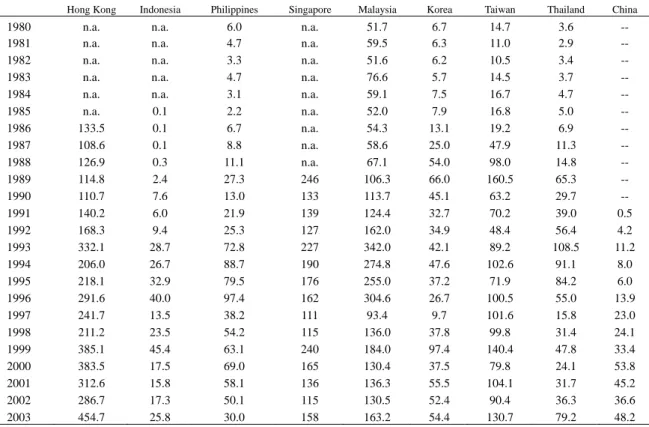
The other important indicator to understand the extent of development of a capital market is market capitalization, the aggregate market value of issued shares. Table 2 shows market capitalization to GDP in each economy. As shown in the table, the indices
of Hong Kong, Malaysia, Singapore, and Taiwan R.O.C. are far greater than 100%. This implies that a large amount of money, both domestic and foreign capital, has been invested in the capital market, and the market capitalization of these countries is more than their gross domestic product. It is remarkable that the figures of all four economies increased from 1992 to 1993 and from 1998 to 1999. In particular, among the four economies, the indices of Hong Kong and Malaysia were outstanding; after 1989, they were consistently more than 100%. From 1992 to 1993, they doubled:168.3 to 332.1 in Hong Kong and 162.0 to 342.0 in Malaysia. There seemed to be a bubble economy in these economies. In the next year, the two economies experienced a sharp decline in the indices; however, they were still above 200%. The period from 1998 to 1999 was when each country recovered from the Asian Crisis of 1997.
Table 2 reveals that the markets of Korea, Thailand, the Philippines, Indonesia, and China were relatively small as compared to the aforesaid four economies. In 1993,only Thailand recorded an index over 100%. The common feature of these countries is that they experienced a boom in the capital market three times. The first boom started in 1986 and ended in 1989. The second was from 1991 to 1993 or 1994. The countries, except China, experienced a serious slump in the market in 1997 due to the Asian Crisis, and recovered from 1997 to 1999. From Table 2, it is obvious that the capital market in Taiwan R.O.C. and China survived the Asian Currency Crisis. As one reason, it is said that these economies did not open their capital account completely and controlled inflows of foreign capital. The crisis resulted from sudden outflows of foreign capital from the emerging Asian markets; therefore, this seems to be an important key for understanding the reason.
22
Table 2. Ratio of Market Capitalization to GDP (%)
Hong Kong Indonesia Philippines Singapore Malaysia Korea Taiwan Thailand China
1980 n.a. n.a. 6.0 n.a. 51.7 6.7 14.7 3.6
--1981 n.a. n.a. 4.7 n.a. 59.5 6.3 11.0 2.9
--1982 n.a. n.a. 3.3 n.a. 51.6 6.2 10.5 3.4
--1983 n.a. n.a. 4.7 n.a. 76.6 5.7 14.5 3.7
--1984 n.a. n.a. 3.1 n.a. 59.1 7.5 16.7 4.7
--1985 n.a. 0.1 2.2 n.a. 52.0 7.9 16.8 5.0 --1986 133.5 0.1 6.7 n.a. 54.3 13.1 19.2 6.9 --1987 108.6 0.1 8.8 n.a. 58.6 25.0 47.9 11.3 --1988 126.9 0.3 11.1 n.a. 67.1 54.0 98.0 14.8 --1989 114.8 2.4 27.3 246 106.3 66.0 160.5 65.3 --1990 110.7 7.6 13.0 133 113.7 45.1 63.2 29.7 --1991 140.2 6.0 21.9 139 124.4 32.7 70.2 39.0 0.5 1992 168.3 9.4 25.3 127 162.0 34.9 48.4 56.4 4.2 1993 332.1 28.7 72.8 227 342.0 42.1 89.2 108.5 11.2 1994 206.0 26.7 88.7 190 274.8 47.6 102.6 91.1 8.0 1995 218.1 32.9 79.5 176 255.0 37.2 71.9 84.2 6.0 1996 291.6 40.0 97.4 162 304.6 26.7 100.5 55.0 13.9 1997 241.7 13.5 38.2 111 93.4 9.7 101.6 15.8 23.0 1998 211.2 23.5 54.2 115 136.0 37.8 99.8 31.4 24.1 1999 385.1 45.4 63.1 240 184.0 97.4 140.4 47.8 33.4 2000 383.5 17.5 69.0 165 130.4 37.5 79.8 24.1 53.8 2001 312.6 15.8 58.1 136 136.3 55.5 104.1 31.7 45.2 2002 286.7 17.3 50.1 115 130.5 52.4 90.4 36.3 36.6 2003 454.7 25.8 30.0 158 163.2 54.4 130.7 79.2 48.2
Notes: n.a.=not available.
Sources: International Financial Corporation, Emerging Stock Markets Factbook, various issues, Standard & Poor’s (2004) Global
Stock Markets Factbook 2004, Monetary Authority of Singapore (1994) Monthly Statistical Bulletin, Vol. 15, No. 6.
3. Concluding Remarks: Features of the Development of Securities Markets
This paper has revealed several features of the development of securities markets in nine Asian economies in terms of the history and figures of each market. First, most economies had an informal capital market in the early period of their history. Second, the background of the foundation of their official markets was influenced by experiences of colonization. Third, most governments recognized the importance of the capital market for development and had a positive attitude in promoting the market. Fourth, statistics clearly showed that most economies experienced several booms in their capital market from the late 1980s. Some economies were affected by the currency crisis of 1997, while some others were not affected. In order to prevent future damage in
a similar situation, a further investigation of why some economies were not damaged by the crisis is needed.
Notes
1
This paper was modified in accordance with comments of participants at The 2007 Japan Associate of Interdisciplinary Arts and Sciences Conference held on July 7, 2007.
2
See the Hong Kong Exchanges and Clearing Limited (http://www.hkex.com.hk) and the Securities and Futures Commission (http://www.hksfc.org.hk).
3
This event is called Black Monday.
4
These market reforms were executed under a report written by Mr. Ian Hay Davison and his review committee. See Matthew Harrison, Asia-Pacific Securities Markets (Hong Kong, 1991), 238.
5
The HKEx listed on the Stock Exchange in June 2000.
6
see the Capital Market Supervisory Agency (BAPEPAM) (http://www.bapepam.go.id).
7
This was the fourth exchange established in Asia.
8
See Japan Asia Investment Co., Ltd., Asia no Shoken Shijo to Kabushiki Kokain (Public Stock
Offering System in Asian Securities Market) (Tokyo, 1994), 137.
9
In July 1989, one private stock exchange was established in Surabaya.
10
See the Philippine Stock Exchange, Inc. (http://www.pse.org.ph) and the Securities and Exchange Commission (http://www.sec.gov.ph).
11
A blue-chip stock is one that is considered a high quality investment involving a small risk because it is issued by a large stable corporation or nationally known company, such as IBM in the U.S. and Toyota in Japan.
12
See the Singapore Exchange (http://www.ses.com.sg).
13
Investors could deal in Malaysian shares on the Singapore Stock Exchange (SES), because shares were allowed to be listed on both markets. The SES was more sophisticated and deregulated, so not only Singapore citizens but also foreign investors traded Malaysian shares in the SES. This contributed to the development of the market in Singapore. In Singapore, many small investors traded Malaysian securities through over-the-counter transactions, the Central Limit Order Book (CLOB). Dealings in Malaysian shares in the CLOB sometimes had a great impact on stock prices in Malaysia. In 1990, in order to avoid influence from the CLOB, the Malaysian government instructed to delist companies from the SES. Following this, in 1990 the Singapore government set up a foreign board, named CLOB International, where shares of foreign companies were able to be listed. Therefore, many Malaysian companies listed their shares on the CLOB International. In
24
other words, many Malaysian shares were traded in Singapore even after Malaysian shares were delisted.
14
See the Bursa Malaysia (http://www.bursamalaysia.com).
15
See note 4.
16
See note 13.
17
See the Korea Stock Exchange (http://www.kse.or.kr) and the Financial Supervisory Service (http://english.fss.or.kr).
18
See Kim, Chul-In and Tatsumi Ken-ichi, “Kankoku Shoken Shijo no Shikumi to Keii (On Korean Security Markets),” Journal of the Department of Economics, IIIXIII (1996), 17-44.
19
The Daehan Stock Exchange changed its name to the Korea Stock Exchange (KSE) due to the Act.
20
Both institutions have continued up to the present.
21
See the Taiwan Stock Exchange Corporation (http://www.tse.com.tw) and the Securities and Futures Bureau, Financial Supervisory Commission, Executive Yuan, R.O.C.
(http://www.sfc.gov.tw/intro_index.asp).
22
See Matthew Harrison, Asia-Pacific Securities Markets (Hong Kong, 1991), 189.
23
See Matthew Harrison, Asia-Pacific Securities Markets (Hong Kong, 1991), 189.
24
For example, in the case of multi-national banks, their international ranks in terms of gross assets must be within the top 500. In addition, the total amount of their investment must be more than three billion US dollars in securities in global markets. For insurance companies, more than 10 years must have passed since they started business. Furthermore, the total amount of their investment must be more than five billion US dollars in securities in overseas markets.
25
The automation program of the trading system was fully completed in 1993.
26
See the Stock Exchange of Thailand (http://www.set.or.th) and the Securities and Exchange Commission, Thailand (http://www.sec.or.th).
27
The development policies for the securities market were carried out during a period of the Second National Economic and Social Development Plan (1967-1971).
28
Due to this, the government decided to open another stock market for foreign investors in 1987.
29
Before the deregulation, stock prices had been allowed to change within a range of 10% from the closing price, however, the deregulation allowed changes within a range of 30% from the closing price.
30
See the Shanghai Stock Exchange (http://www.sse.com.cn), the Shenzhen Stock Exchange (http://www.szse.cn). See also Japan Securities Research Institute, Zusetsu Chugoku, Hong Kong
no Shoken Shijo (Securities Markets in China and Hong Kong) (Tokyo, 1996).
31
32
In April 1998, these two authorities consolidated.
33
Along with this measure, domestic investors, who have sufficient foreign currency, were able to trade B Shares in 2001. There are several kinds of shares in China. A Shares are issued in Renminbi for domestic investors. B Shares are issued in foreign currencies for foreign investors. In the Shanghai Stock Exchange, B Shares are issued in US dollars, whereas the Shenzhen Stock Exchange issues B Shares in Hong Kong dollars. P Shares are stocks in companies that are 100% privately owned. H Shares are issued in the Hong Kong Stock Exchange, S Shares are issued in Singapore. N Shares are issued in the New York Stock Exchange, L Shares are issued in London.
34
The figure is the total number of companies listed on the Shanghai Stock Exchange and Shenzhen Stock Exchange.