Title
Theory of Regional Venture Business −Based on the
experience of venture support work in Okinawa̶
Author(s)
YOSHIKAWA, Hiroya
Citation
沖縄大学法経学部紀要 = Okinawa University JOURNAL
OF LAW & ECONOMICS(4): 1-19
Issue Date
2004-03-31
URL
http://hdl.handle.net/20.500.12001/6029
[Article]
Theory of Regional Venture Business
—Based on the experience of venture support work in Okinawa—
Hiroya YOSHIKAWA Contents(Strategy and Competitiveness)
I. Okinawa Neo-lndustry / Enterprise Theory 1. Strategic Business Fields
2. Importance of Activity Fields Strategy -Core competence, Value chain-3. Regional Distinction Strategy -Management resource in Okinawa-4. Proposals and Issues of Okinawa Neo-lndustrial Classification
<To be continued)
(Creative Power and Spontaneousness)
n. Strategies for New Businesses and Profit-making (Information Technology Era)
IE. Potential of the Regional Enterprises Utilizing IT and Digital Technology I. Okinawa Neo-lndustry / Enterprise Theory
1. Strategic Business Fields (1) Necessity of Industry Domain
These days some particular industries in Okinawa have achieved rapid growth but others seem to be still struggling to follow their success. Actually, the others are falling down in the business. Okinawa economy in this several years could not make the most of chances, and it lacks to have driving force for Okinawa industries as a whole.
These realities should be considered with the whole economy and industry polices in Okinawa and "A Grand Design" of Industry Domains is necessary. Until now, Okinawa has lacked "A Grand Design" for industry domains.
Now it is recognized that the strategic decision of the business field is critical when you start or promote your business.
Once Japanese film industry enjoyed its prosperity but it declined because it stuck to film. It could not cope with the rapid change of media. On the other hand, Hollywood companies started working with multimedia and now they are not just a film makers but
Theory of Regional Venture Business Based on the experience of venture support work in Okinawa
-also entertainment companies.
Another example is Central Pacific Railway Company. Once it gained much profit and it is well know that Stanford University was founded with personal assets of its president Leland Stanford. However the company also failed to cope with diversification of transpor tation.
One example of success is Hankyu Railway Company. The Company considered the people around its railroads as potential customers and expanded its business to residential development, amusement park development, and management of department stores at rail road terminals. Kobayashi Ichizo, the founder of Hankyu Railroad Company, started Hankyu department store and Takarazuka Girls operetta troupe.
These examples both in Japan and in the U.S. show characteristics of industry do main and its importance. Now, I introduce the idea of regional industry domain (hereafter domain).
® Even though regional industries are always changing their business field with diversifications, focused domain is always necessary. It is like a main string for a kite. If industries do not have focused domain, they will be kite whose main strings is cut and so they will go anywhere. Industries should have their business field on fo cused domain with considering regional identity. In the case of Okinawa, Identities for determination of domain are Southern culture, longevity and geographical advantage for trade.
® By having focused domain, it will be much easier to clarify what kind of management resources, such as human resources, materials, money supply, and information should be accumulated. So to decide right focused domain, you need to consider regional and original factors such as locating, weather, natural environment, history, tradition, technology and so on. It is good idea to use these regional factors to make regional business more original and different from business in other areas.
(3) Based on the focused domain, you can make "business portfolio" and "(enterprise sec tion) activity fields". Business portfolio provides plan for industrial structure in Okinawa. The plan includes what kind of business should be placed great weight on and the relationship and combination of businesses.
"Activity fields" (refer to Figure-3) is to determine which part of the production proc ess you will take as your business. The process includes planning, production, and so on. River is a good metaphor for the process. Planning is up stream part and distri bution is downstream part. If a product is only for Okinawa region, you can have whole logistics that is whole process of business, in Okinawa. If you target at Japanese market, you cannot find enough raw materials in Okinawa. Then you need to plan which part of activity fields should be carried out in Okinawa, considering ad vantages and disadvantages.
Business portfolio shows relationship of production and customers like a web and it is the last part of activity fields.
(2) Strategic Business Fields
What is an appropriate industry domain?
First of all, an appropriate domain is future-oriented. It gives a dream to people and it has image of business expansion. Secondly, a domain should be original and different from other regions' ones. It also should be easy to understand. Thirdly, a domain should fit to the culture in a region. A domain needs clear relationship with people's job in the region and it needs to fit to culture, sense and feelings of people of the region.
Here are three important factors to form an appropriate domain.
(D Selection of market and customer is a first important factor. In other words, it is a decision of what you sell and whom you sell. For example, you can chose people who like Okinawa and Southern islands, as customers and chose niche market of Okinawa featured products as a market.
® Roles and function of your business in a region are the second important factor. What kind of role does your business play in the region? If you want to play a role to con nect Okinawa with mainland Japan and with Asian areas, trade will be an appropri ate domain for your business.
(D Business recourses such as natural resources, technology and human resources are the third factor. It is good idea to form a domain that can maximize advantage of these resources. In the case of Okinawa, you can have an appropriate domain related to bio logical resources, health, and longevity. These resources are Okinawa's abundant re
sources.
As you see in the Figure 1, an appropriate domain is decides with considering both three points related to people and three factors related to regional resources.
These days, industries in developed countries need to consider not only (1 (worldwide
optimum supply and (2)efficient manufacturing but also (3)function and development of manufacture and service, and also originality in a region. It is the case in Okinawa indus tries, too.
So far, in industrialized society, companies have been trying profit through division of labor and specialization. Efficiency and cost reduction were the most important values. Industries in the mainland Japan are good examples. However, the more market gets ma tured, the more changes occur in the business field. Now divers, customer-made, and origi nal products have more values than mass-produced goods. Regional originality and special information make a product much more attractive to people in all over the world.
In this stream, Okinawa in not disadvantageous anymore. Even its market consists of 1.3 million people and even it has little resources, Okinawa has own natural environment
Theory of Regional Venture Business Based on the experience of venture support work in Okinawa
-and original culture. It means that Okinawa industries can make difference -and that they can add values to their products. Utilizing regional resources and culture, Okinawa ob tains much more opportunities for business. Globalization of economy also helps Okinawa to play a role of a gate to other countries. Okinawa is not a periphery anymore.
Considering these changes of industrial structure, I focused on the characteristics of Okinawa industry and on the method to differentiate Okinawa's products from products of other regions. Then I reached to classify resources and advantages in Okinawa into three categories.
First of all, Okinawa has geographical advantage. It is close to the mainland Japan and to other Asian areas such as China and Taiwan. Secondly, Okinawa has natural re sources. In Japan, Okinawa is the only place which belongs to subtropical area and natu ral resources such as coral are much more abundant that in the mainland Japan. Thirdly, Okinawa has its own history and culture. The history and culture of Okinawa also make human resources more creative. That is why it is possible to make special product related to Okinawa culture and to create niche markets.
We also need to consider characteristics of markets. When you utilize these advan tages and resources to add values to regional products, characteristics of markets are worth considering. For example, scale of the market in the mainland Japan is widely dif ferent than one in Okinawa. Logistics of products and strategy of merchandizing in Okinawa are not directly applicable to the market in the mainland Japan.
I classified characteristics of markets into three categories. There are neighboring Asian markets, the mainland Japan markets, and niche markets. Niche markets are spe cialized and featured markets. The category includes niche markets both in Asia and in Japan.
Figure 1 Determination of Industry Domain in a Region (Business Fields)
Market •Customer (production market) Role • Function (Activity fields) Management Technology Human Resources ( management resources)
planning for future business expansion
originality in a region
culture in a region
(3) Suggestion of Three New Industries
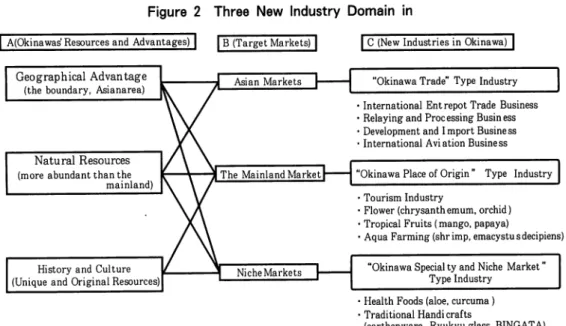
As you see in Figure 2, the relationship between both resources and advantages and target markets suggests three new industry domains in Okinawa.
The figure also shows new classification of industries. The Existing classification of industries such as the primary industries, the secondary industries, and the tertiary in dustries is based on the view of industrial society. It focused on material values and on
the level of industrialization. But today, markets become more matured and information and ideas have special value.
New classification is necessary to estimate new values and to figure our "proper tar get market" according to "Market value-added principle".
Combination of resource/advantage (A in Figure 2) and target markets (B in Figure
2) leads potential new industries (C in Figure 2). In other words, resource/advantage and markets decide domains.
"Okinawa Trade" type industry is based on geographical advantage and it targets both Japanese markets and Asian markets. The industry carries its process of production and distribution internationally. Imicom, Inc. imports parts of personal computer from Taiwan and assembles them in Okinawa.
"Okinawa Place of Origin" type industry utilizes abundant natural resources to differ entiate its products from ones in mainland Japan. By having certain market share, the in dustry can take the initiative. Okinawa sells 75% of Chrysanthemum for the equinoctial
week in Japan and it is the main producing center.
Figure 2 Three New Industry Domain in
A(Okinawas Resources and Advantages) | | B (Target Markets)] | C (New Industries in Okinawa) |
Geographical Advantage
(the boundary, Asianarea)
Natural Resources
(more abundant than the mainland)
History and Culture
(Unique and Original Resources)
Asian Markets "Okinawa Trade" Type Industry ■ International Entrepot Trade Business ■ Relaying and Processing Business ■ Development and Import Business ■ International Aviation Business
The Mainland Market |
1 "Okinawa Place of Origin" Type Industry |
• Tourism Industry■ Flower (chrysanth emum, orchid) • Tropical Fruits (mango, papaya)
• Aqua Farming (shrimp, emacystusdecipiens)
Niche Markets "Okinawa Special ty and Niche Market"Type Industry • Health Foods (aloe, curcuma)
• Traditional Handi crafts
(earthenware, Ryukyu glass, BINGATA) • Foods (Okinawa muddle, awamori-liquor) • Entertainment (Okinawa dance and songs)
Theory of Regional Venture Business —Based on the experience of venture support work in Okinawa—
Even market share, including both Japanese and Asian markets share, is not so large, "Okinawa Specialty and Niche Market" type industry which is based on Okinawa's own culture, history and human resources has real potential to obtain "Okinawa fans". Health foods such as curcuma and aloe vela, with the brand name of Okinawa, sell 140 billion yen annually.
"Okinawa Policy-Strategy" type industry is not on Figure 2 (new industry domains in Okinawa). Because of the technological development, computer software industries and digital contents industries have promising potential with proper governmental policies and business strategies.
Many call centers (telephone customer service center) have been set up in Okinawa and they will provide 4,000 employments.
These are the four potential industries targeting markets outside Okinawa. This clas sification is based on management styles and target markets not on technology and pro duction. This new approach can be called industry type approach.
Businesses in figure 2(c) are examples of business portfolio. Business portfolio shows combination of goods or group of goods. Not only analyzing each products and each mar ket singly, but it also provide combination of money trees (profitable business) and money-needed trees (potential business). I showed portfolio in figure 2, and portfolio is often discussed in management strategy. So I do not go into details here.
2. Importance of Activity Fields Strategy -Core competence, Value
chain-The next issue is activity fields. One production including services reaches a customer through the process showed in figure 3. The process starts with research and planning, and ends with after-sales service (service on goods sold to customers). River stream is a good metaphor for activity fields. It shows (1) which part of the process you are going to take as business and (2) which part should be carried by other companies in other regions. I named these two decisions as logistics strategy.
I will explain the importance of logistics strategy with examples in Okinawa. Ryukyu glass industry had carries all the business process in Okinawa when the glass products are local souvenirs. The products got popular because of the hand-made beauty and unique taste. It sold over one billion yen and formed one niche market in a whole country. Now six companies of ryukyu glass in Okinawa formed a union and carry the process from purchase of raw material (@ in figure 3) to production (® in figure 3) in Vietnam. More than half of the products are made in Vietnam.
The company Kumesen Syuzo, located in Naha city, had produced Awamori-Liquor with Thai rice and Indica rice. It established new brand with Japonica rice grown in Ulanhot in Inner Mongolia. Now the activity fields from purchase of raw material to ex amination is carried out in Ulanhot.
Figure 3 Activity Fields (Enterprise Section)
(3)
Purchase of raw materials Production Wholesale business ServiceTaiyo no Hana, a union for flower production moved its process of young plants growing to Indonesia. Now Okinawa is main producing center in Japan for chrysanthe
mum.
By moving the part that consume time and labor to Indonesia, now the union dis perses risks and play a important role as a main producer with providing chrysanthemum stably.
These companies and unions transfer some parts of business process to abroad and as a result it minimizes production cost. But the most important was not the matter of cost. Strategy for unique and stable was the most important key to success. Ryukyu glass com panies have high regard for hand-made taste, liqueur union made new brand with new or ganic rice, and the flower union as a main producer in Japan recognized its responsibility to provide chrysanthemums stably.
Okinawa's market has only 1.3 million people and production sites are so large in Okinawa. High labor cost there leads high production cost. But Okinawa is close to Southeast Asia where low cost labor and resources are accumulated. Considering these conditions, industry categories in figure 2 and strategies are necessary for business expan sion from local market to national or world market.
These issues are closely related to the management theories of "out-sourcing" and "core-competence".
3. Regional Distinction Strategy -Management resource in
Okinawa-Regional management resource can be location, natural environment, culture, corpora tions, administration, human resources, capital, industries, industrial accumulations, and so on. What is Okinawa's advantage among these resources? It is important to clarify ad vantages in the region, Okinawa. The advantages make difference from products from other areas. They are the key to form Okinawa new industries.
7Theory of Regional Venture Business Based on the experience of venture support work in Okinawa
-By classifying management resources, we can figure out characteristics and structure of advantages. However person, goods, and money are often used to analyze corporative
activities, I introduced tow axes "Flexible-Fixed" and "Broad-Local" in figure 4 to classify
resources.
First axis is "flexible and fixed". It shows how easy to obtain a resource from other areas. Some of the most fixed resources are location, weather, history, tradition, culture and so forth. Even these resources are not absolutely fixed when you look at them in terms of management.
For example, subtropical weather, a resource in Okinawa, can be substituted by green
house when you think about flower production (see "Okinawa place of Origin" type indus try in figure 2). When you think about "Okinawa Trade" type industry (in figure 2),
meaning of location can be different.
Companies and human resources should be looked carefully to determine "flexible" or "fixed". You can invite general companies and raw labor to your region easily so they are flexible. On the other hand, artisan or regional companies that has cultural background in the region are hard to be transported from other region to your region so they are fixed resources.
Even though some resources are considered as fixed, they are not absolutely fixed.
Some resources can be transported by paying money. On the contrary, brand image and popularity are difficult to be transported. Okinawa has image of "longevity, healthy, and
ecology" and "unique culture and tradition". These invisible informational resources usually fixed to the region. You cannot obtain the invisible resources just by paying money.
Figure 4 Recourses for Okinawa Industries Management Resources in Okinawa
Broad
C
> Local
•h
i
Short term Capital Long term Capital Local Capital Ingredients (Common) Human Resources (General) Companies Ingredients (Local) Human Resources (Local) ,ocal Companies Administration (System) Social Capital ndustry Accumulation Natural Environment.i
Administration (Local) Subtropical Weather Geo graphical Advan tages Coral Environment Okinawa People's personality Ecology, Health, Long Life Culture in Organization Okinawa Culture Okinawa History — 8 —Moreover these images are accumulated through long time and hard to establish in short period. In these respects, image and culture have different characteristics from other re
sources.
The other axis is "broad and local". The broadest resource is money. By paying
money, you can obtain every thing that is sold in market.
Not as broad as money, general companies and raw labor can be utilized in broad
area. On the contrary, regional companies and artisans are not broad but local.
Accumulated informational resources also show strong characteristics of "local". Management method, technologies, organizational culture, human characteristics are closely related to the region. Image and brand name are also local. These methods and im
ages related to culture are rarely moved to other regions.
In conclusion, invisible informational resource has the most advantageous among man
agement resources. You cannot move invisible informational resource and the resources are only valuable to the region. ©You cannot buy invisible informational resources. You should make your own in your own region. ©It take much time to accumulate the re sources. And (Dall companies and industries can use the resources. The invisible informa tional resources are common goods for everyone in the region. So by using the invisible informational resources, it is easy to differentiate your products from ones in other areas. Okinawa has nationwide images such as "island surrounded by emerald green sea and silver sand" and "longevity and healthy". How to maintain and to promote these good im
ages are the keys to success for business in Okinawa.
4. Proposals and Issues of Okinawa Neo-lndustrial Classification
According to the Okinawa Neo-lndustrial Classification proposed in 1. (3), I would like to introduce existing enterprises in Okinawa and mention issues of these enterprises.
1) The Okinawa trade type industry
a. Introduction of Trade Type Venture businesses
I will introduce you the concept of Trade Type Industry with some examples in Okinawa. Some business might be too small to be referred as a venture business but they are based on important advantages of Trade Type Industry. They also utilize a course for container ship between Amoi and Okinawa. Now in Okinawa, many trade type venture businesses are formed and I am sure that these businesses are highly suggestive.
I also introduce trade type industry broadly from the distribution industry to the production industry.
(An interviewed person, organization he belongs to, and his managerial position are
Theory of Regional Venture Business -Based on the experience of venture support work in
Okinawa-referred after the mark £O
(1) Development of Ryukyu glass targeting market in mainland Japan ?& Ryukyu Glass Kyodo Kumiai (Ryukyu glass Cooperative)
The Chairman of the Board Morifuku Inamine
The Cooperative consists of six glass craft companies in Okinawa. They are selling products to the mainland Japan. However their production scale is not large enough to meet demands because they are handmade.
The cooperative members did not want mechanization of the production process be cause the handmade taste was critical. In reality, production in Okinawa could not meet demands and high labor cost surely leads financial difficulties.
Nine years ago, the cooperative started research in Thailand, Vietnam and China. Now a production site in Vietnam is under construction. In Vietnam there are abundant raw material. Transfer of skill to Vietnam lowers production cost. It makes possible to provide daily glass product with reasonable price. As I talked, to make good glass product for daily life was the original purpose of Ryukyu glass.
(2) High-value-added-processing and import of gravestone S& Ryukyu Memorial Park President Tokuo Yashiro
Mr. Yashiro was grown in Okinawa and he had experience of graveyard planning and gravestone processing in Osaka. He thought that style of graveyard in Okinawa should be improved. Even Okinawa has limited area, just one Okinawa-style grave need large area. You also need remake a grave because an Okinawa-style grave is made of cement. So he introduced style that is mixture of Okinawa-style and the mainland-style. He used granite stone instead of cement to make gravestone state and perpetual. At the time he had the plan, it was almost impossible to fine craftsman who could make curved surfaces on stone. Even if he found the craftsman, wage for him would be so high.
He finally found Quanzhou city, Fujian in China. The place has been worldwide pro duction center of stones and only 80 km away from Amoi. So it is easy to import stone product to Okinawa via Amon. He found the factory where processing with sophisticated technique is possible, and he also trained the craftsman over there.
Now he supplies processed stone not only to Okinawa but also to the mainland. (3) Awamori-liquor production with Mongolian organic rice
^Kumesen Syuzou (Kumesen Brewery) President Masayuki Taira
Mr. Taira was attracted by organic japonica rice and tried to make awamori-require, Okinawa special require, from the rice. He set a factory up in Ulanhot, Inner Mongolia. Almost all workers there were Mongolian people, who knew few of Awamori. So he
spared much time to teach them how to make Awamori. He continued teaching and made tasty Awamori-require named "Kyoten".
The most difficult part was to develop transport products from Ulanhot to Okinawa. When the course between Amoi and Okinawa was established, he brought products form Ulanhot to Dalian and brought to Tianjin. Then the products could reach Amoi via Dalian and Tianjin. Establishment of this route, Ulanhot-Dalian-Tianjin-Amoi-Naha, made Awamori production in Mongolia possible. A part of this route is shared with Okinawa Skigahara Stone Company.
He thought he did not stick to Thailand rice too much. Even introduction of Mongolian rice was a kind of endeavor, but he was sure organic japonica rice was also good for Awamori-require. In general, Awamori-require is expensive then existing require in the mainland, but price of "Kyoten" is reasonable enough to compete with the mainland require. So he is now targeting markets in the mainland.
(4) Production of personal computers with importing parts from Taiwan ^Imicom, Inc. President Taigen Kim
The company is trying to sell personal computers to China and Russia via the course between Okinawa and Amoi. Parts for personal computer is low-priced in Taiwan. So the company import parts form Taiwan and assemble them in Okinawa.
The president was an engineer working for the U.S. computer maker and sent for the U.S. base in Okinawa. He liked Okinawa and did not want to leave. When Okinawa was given back to the Japanese government, he started to sell IBM compatible machine to the U.S. army. Now he uses Intel's CPU and other parts made in Taiwan and in the U.S. as well as parts made in Japan to make the best and the lowest-priced personal computers. Its one full range of personal computer costs 290 thousand yen and it is 100 thousand yen (in 2000) cheaper than the same model by the mainland personal computer makers. Last July, the company moved to free trade zone and started full-fledged production. Last year it did trial run and sold 100 million yen and established service centers for maintenance and after-purchase service. It cooperated with two of three major computer companies in Taiwan, FIC and Acer, with the goal of 300 million yen selling for the first year and 50 billion yen selling for in 5 years' time. (Unfortunately, the production is currently sus pended.)
(5) Import motorcycle engine parts from China, assemble in Okinawa, and export to Southeast Asia
SKSpeed Industries Factory Assistant Manger Jun Arakawa
The Speed Industries Corporation is located in free trade zone in Nakagusuku-wan bay area. The company assembles engines for motorcycles and exports to Southeast Asia.
Theory of Regional Venture Business —Based on the experience of venture support work in Okinawa—
The company decided to locate in Okinawa for two reasons. Firstly, Okinawa has free trade zone that is unique in Japan. Secondly Okinawa is close to China where engine parts are produced and to Southeast Asia such as Vietnam where the assembled motorcy cles sell.
Today there are four motorcycle companies but they are producing over lOOOcc en gines for recreation. Their motorcycles are very good auto bikes but expensive and not good for unpaved roads in Southeast Asian countries. Motorcycles produced in Japan are not appropriate for developing countries.
So the Speed Industries Corporation produces motorcycles for peoples' basic transpor tation. Once Japanese motorcycle company, HONDA produced SuperCab for peoples' daily use. Now the Speed Industries Corporation is aiming at the daily motorcycle market and export products to Southeast Asian countries.
Current situation in Southeast Asia is the same as situation at the time HONDA made SuperCab in Japan. The Speed Industries Company set production of Second SuperCab as its goal. It imports engine parts form China and makes low-priced motorcy cles.
Speed Indeustries Business Model Structurej&chsme .^J§w ^
Source: Speed Industries Corporate Guide
I will explain the company's business model and its method. The company adopts the production method that Japanese motorcycle companies established. It buys parts with global optimum purchase strategy. The strategy is to look for the lowest priced material or parts that meet company's requirements in all over the world. The company is target ing at niche market.
The company in Okinawa can find defects when whole engine is assembled. If any
defect is found, the company redesigns an engine and order new parts for new engine. Sometime it needs to complete a trial product for details. This is the important role of the company and this method makes low-priced and sophisticated motorcycles. Precision parts such as baskets, plagues, and bolts are made in Japan and almost all the other parts are imported from China. Finally they are assembled to be completed motorcycle.
However, currently the Speed Industry has a very tight game, since Vietnam has raised its import taxes and established a limit of import goods.
b. The concept of Trade Type Industry and Companies What is the production in Trade Type Industry?
You might feel a difference between your concept of production center and one I ex plained with examples of six companies because all six companies do not use material or natural resource obtained in Okinawa. They do not actually make any product from ma terial. They import material and parts, and manufacture them. Are they still referred as regional industries? The answer is "yes".
A production center is not a place only where a whole production is carried out but also where management skills are accumulated. A place where methods for production are accumulated is a production center according to the new concept.
A production center does not have to have a whole production process in the region but it should have some important functions. Firstly, it has a system to know customers demands based on marketing research and sales experiences. Secondly, it examined the products and transports them to customers. Thirdly, it obtains markets' share and estab lishes a brand name. A production center must have these functions as its prowess.
Let me give you one plain example of a production center. As some of you already know, Shizuoka prefecture in Japan is famous for tea production. The tea of Hachijyu-Hachi-ya is very popular. Hachijyu-Hachijyu-Hachi-ya means the eighty-eighth day from the begin ning of spring that is May 1st in Japan. The tea of Hachijyu-Hachi-ya means first plucked tea. But actually, 60% of the tea is made in Taiwan, 10% is made in Okinawa and Kagoshima, and the rest is made in Shizuoka.
In Shizuoka it is impossible to produce tea stably in the beginning of May because it usually not worm enough to pluck tea. So companies in Shizuoka imports tealeaves from Southern areas and blend them in order to match consumers' tastes in all over Japan. Even tealeaves made in Shizuoka are less than half, companies in Shizuoka has method for marketing, transporting, examining, and blending. The blended tea is sold as "tea of Hachijyu-Hachi-ya" and the tea dose establish the brand name.
Another example is a case of coral products and the case is a little different form the case of tea. Now you can find corals only in the sea near Okinawa. Corals are taken in Okinawa and transported to Shikoku region. In the market of Shikoku, corals are graded,
Theory of Regional Venture Business —Based on the experience of venture support work in Okinawa—
and companies there process corals and bring them back to Okinawa. Then coral products are sold for travelers in Okinawa.
These example clearly show that marketing, grating, processing and transporting are essential roles of a industry center. More matured markets become, more various values emerge. Variations of products, speed of supply, and information on customers' demand make a big difference in markets. Information technology and information management system generate new values and these new values are emphasized than material values. You can say these changes, in other words, as transformation from economy of scale to economy of scope.
The companies I introduced do not use raw material in the region. They mainly proc ess the product in other regions. Focusing on this point, those companies sometimes re ferred as "a maker without a factory" Now it is hard to innovate the very new goods. With the fractionation of markets, products need to have various values and to match cus tomers' taste. It is important to put your own new values into products when you are selling similar material goods to ones other people are selling. The value added process is called "editing type production" and an example for it is Benetton that sells casual goods in Italy.
2) Okinawa place of origin type of industry
-Formation of main producing center in
Okinawa-Okinawa has not had a main producing center for the nationwide market. It might because Okinawa has not been well organized. Now Okinawa has comparative advantages on weather, environment, and resource and it can form "Okinawa Place of Origin" type in dustry as you see in figure 2. But small chrysanthemum is the only product that Okinawa has 70% to 80% share in the national market. (Exact market share is 87%) Okinawa affects the price of the small chrysanthemum because it is the main producing center. Okinawa does sell ukon (turmeric) and mango but these are products for niche market.
Goya (Bitter Cucumber) was not so famous to people in the mainland Japan but now it is getting popular because of the effort of Okinawa people. Analyzing this Goya case, I would like to explain the strategy to expand production and to form a main producing
center.
Until 1991, the cultivation area was around 200ha and the crop was around 3,500t a year even the numbers are slightly different from each year they are almost the same amount.
(See figure 5)
In 1993, both the crop and cultivation area increased rapidly. That is because Fl new breed Murubushi was introduced in 1993. In 1995, Shiokaze was also introduced. These
Figure 5 Cultivation Area and the Crop of bitter cucumber (Goya) 2000 1990 91 92 93 94 95 96 97 400 ha 100
new breeds are well harvested compared to existing breeds. Murubushi produced 40% more than existing breeds and Shiokaze produced 85% more.
Because the market in Okinawa is small, increase of the crop leads excess of supply and decline of price. So far, over 3,000t of Goya production has decreased the price. This kind of excess of supply was common in Okinawa and formers change their product to well-priced products whenever the excess happens. This is why Okinawa had been unable to be a main producing center.
But the case of Goya was different from other common cases. Farmers actively adver tised their products to people outside Okinawa and supplied twice than the previous year to areas outside Okinawa. The increase of supply to areas outside Okinawa restrained the supply inside Okinawa even the whole production increased. (Price elasticity of Nigauri is -0.6. Production increased 10% but the price only decreased 6%.) In 1997, May 8 was set as Day of Goya and Goya have been advertised both in Okinawa and Tokyo to expand the market.
In 1993, Goya coordination committee was established with cooperation of Okinawa prefecture government and agricultural associations. The committee makes plans for culti vation area and for the crop every year and the plan increased annual supply gradually to prevent steep fall in the Goya market.
In the result, a farmer earns 1.7 million yen for 10 are of Murubushi per year and 2.3 million yen for 10 are of Shiokaze. It means that a farmer earns 18.000 yen a day if he or she grows Murubushi and 24.000 yen if he or she grows Shiokaze.
These amounts of earning are much enough to give farmers incentive to continue Goya production. The numbers of farmers also increased. Then Okinawa can be a main producing center and can provide stable supply responsibly.
Theory of Regional Venture Business -Based on the experience of venture support work in
Okinawa-This case should be studied as a succeeded model. I am not sure that planners such as National Federation of Agricultural Co-operative Associations, Okinawa Economy-Agriculture Association recognize this success as a whole by themselves.
The method to create a main producing center used in this case can be applied to not only agricultural products but also to fishery products and to industrial products. Supply should fit to demands of consumers and mediators. Time, quantity, quality, stan dard are the most important factors when you supply products. Considering these factors, producers in Okinawa should be well organized and motivated with reasonable earnings.
Strategy for nationwide products and niche market products are different (See figure 2) To form a main producing center for nationwide product, producers need to be well or ganized even though the people in Okinawa is not good at organizing and to make niche market product, individual creativity is much more important than organizing.
For both products, it is meaningful to establish "Okinawa organization for standardi zation" to examine quality of product and to standard them. The organization should pro vide stable Okinawa brand and also after selling services.
3) The Okinawa specialty and niche market type industry a. The Position of National Products and Niche Market Products
Okinawa is the only sub-tropical region in Japan and because it is separated from the Japanese mainland, there are many unique products. These products are referred to as niche-market products and are considered to be distinct from other regular domestically competitive products. As such a place like Okinawa is far from markets of mass consump tion, the fact that transportation fees are very high, and the fact that both population and the economic scale of Okinawa is not so large, it is not suitable for mass production. Thus, strategically speaking, aiming for niche-market products as a tactic is desirable.
Furthermore, products that compete on the national level must be products that have an absolute competitive advantage over those on the Japanese mainland. For example, the mainland is a clement region and Okinawa is a sub-tropical one. Natural conditions and differences in temperature can be used for competitiveness. As Figure 6 concretely shows, tropical fruits and vegetables such as bitter gourd and mango are able to be made into vi able products. When compared with both the entire domestic market and imported goods, it is vital that the product is competitive in terms of both quality and price.
At the same time, as long as they are unique, niche-market products can be somewhat more expensive, as they can only be produced in Okinawa. This is a point of competitive ness. However, the scale of production for niche-market products is still too small and, to put it bluntly, they often are seen as being limited to very specific clientele and/or as
Figure 6 The Position of National Products and Niche-Market Products Product
National Product
Niche-market Product
Competitiveness
Quality and Price When compared with National products, is it cheap and of high quality?
Value-added
OK if somewhat pricey as long as it is unique
Specific Industry in Okinawa • Flowers (Chrysanthemum, or chids)
• Tropical fruits (Bitter Gourd, Mango)
• Aqua Farming (Kuruma Prawns, Nemacystus decipiens)
• Health food products • Traditional crafts
• Entertainment (music industry)
souvenirs from Okinawa.
b. From a Niche Market to a National Market -Product Branding and Diversification-What kind of strategy then can make these very limited and special products become products for the entire domestic market? Let me attempt to speak concretely on the mat
ter.
I will use Venture Takayasu Ltd., which manufactures natural salt (nuchimaasu, or "the salt of life"), and which I personally support, as an example.
Until recently, the sale of table salt was monopolized and sold by the Japanese gov ernment. The manufacturing process used salt water and employed the so-called ion-exchange membrane method, which meant that the salt was very pure (Sodium Chloride of more than 99.0%). President Takayasu took advantage of the abolition of this monopoly and began selling salt based on a newly thought-out manufacturing process. Takayasu was originally an engineer and his idea began when he obtained a patent for a certain method of producing salt.
Takayasu started off as an engineer. The method (for manufacturing salt) that he came up with is known as the "room temperature-based flash open-air crystallization method." He obtained a patent for this method and that's how things began. Using this method, salt water is directly infused into a mist generator. Mist forms and is pumped into a 40°C~~50°C room. While the mist precipitates, the water evaporates, and salt and other minerals precipitate and accumulate. This is then collected and turned into the prod uct. Unfortunately, when compared with regular salt, the price is twentyofold.
Theory of Regional Venture Business -Based on the experience of venture support work in
Okinawa-Generally, the reason salt has been said to be bad for human body is because only-Sodium Chloride was consumed. The plentiful natural minerals contained in salt are neces sary for the human body. This was used as the selling point. Research to find medical
confirmation of this is also being carried out.
WORLD RECORDS
CERTIFICATE
In order to concretely point out this selling point they took a shot at the Guinness Book of World Records and were recognized as having the world's most mineral-rich salt.
By the way, I, along with the mayor of Gushikawa, personally wrote the recommenda tion letter for Guinness.
At first, this salt was seen as being inter esting but expensive. Thus, it wasn't used as an everyday salt, but was often purchased as a souvenir by tourists who came to Okinawa. Once it was recorded in the Guinness Book, however, product-recognition level grew to a na tional level and sales increased. We also were successful in getting national manufacturers to use our salt in snack foods for children (potato chips, etc.).
Currently, production is delayed and is being used on an experimental basis on
seasonal and regional levels.
For health reasons, snack foods cannot be recommended for children, but this product was such that it had the image of being "junk food" and met children's needs. This is be cause of the high content of salt, which (in this case) is actually good for human body. This a bit of an extreme way of putting it, but it is possible to change the position of a food product from being seen as junk food to being considered a health food. This plan and the use of the salt was accepted and sales rapidly increased. Using this as a case study, I would like to talk about moving from a niche-product market to a national one.
Source: JICA-Net Okinawa Neo-lndustrial Theory (CD-Rom) Figure 7 From a Niche-Market Product to a National Market
Currently, most Okinawan products fit into Area IV in Figure 7: souvenirs aimed at tourists. Getting recorded in the Guinness Book or creating a sensation through national television broadcasts, for example, is one method for moving to Area I and creating national product branding (VI—>• I in Figure 7).
Development of new product
Nationalization
National product branding
o
I
0
7Z W 3 B. Regional UniquenessPosition of Unique Okinawan Products
Aimed at tourists
Aimed at highly specific target
group
Another method is to have an existing nationally recognized product (or developing a product that would appeal on the national level) take advantage of the specific nature of a special Okinawan product (flavor, function, etc.) and increase the value of the original prod uct (IV—> II in Figure 7). These are two methods. In the case of this current study, we em ployed both.