グアテマラ共和国
首都圏水環境保全能力強化
プロジェクト
終了時評価調査
報 告 書
平成 21 年 8 月
(2009 年)
独立行政法人 国際協力機構
地球環境部
環境JR
09-165
グアテマラ共和国
首都圏水環境保全能力強化
プロジェクト
終了時評価調査
報 告 書
平成 21 年 8 月
(2009 年)
独立行政法人 国際協力機構
地球環境部
目 次
現地状況写真 略語表 終了時評価調査結果要約表(和文、英文) 第1 章 終了時評価調査の概要 ... 1-1 1-1 終了時評価調査団派遣の目的 ... 1-1 1-2 合同評価調査団の構成 ... 1-1 1-3 派遣期間・調査日程 ... 1-1 1-4 終了時評価の方法 ... 1-3 第2 章 プロジェクトの概要 ... 2-1 2-1 プロジェクト実施の背景 ... 2-1 2-2 プロジェクトの概要 ... 2-1 2-3 プロジェクト実施体制の特徴 ... 2-1 第3 章 プロジェクトの実績と現状 ... 3-1 3-1 投入の実績 ... 3-1 3-1-1 日本側の投入 ... 3-1 3-1-2 「グ」国側の投入 ... 3-2 3-2 活動の実績 ... 3-2 3-3 成果の達成度 ... 3-8 3-4 プロジェクト目標の達成状況 ... 3-12 3-5 上位目標の達成見込み ... 3-13 3-6 プロジェクトの実施プロセス ... 3-14 第4 章 評価5 項目による評価結果 ... 4-1 4-1 妥当性(Relevance) ... 4-1 4-1-1 「グ」国の開発政策との整合性 ... 4-1 4-1-2 ターゲットグループのニーズ ... 4-1 4-1-3 日本の政策との整合性 ... 4-1 4-1-4 アプローチの適切性 ... 4-1 4-1-5 日本の技術の優位性 ... 4-2 4-2 有効性(Effectiveness) ... 4-2 4-2-1 プロジェクト目標の達成見込み ... 4-2 4-2-2 各成果の貢献度 ... 4-2 4-2-3 プロジェクト目標達成の阻害要因 ... 4-3 4-3 効率性(Efficiency) ... 4-3 4-3-1 日本側の投入 ... 4-44-3-2 「グ」国側の投入... 4-4 4-3-3 プロジェクト運営管理体制 ... 4-4 4-4 インパクト(Impact) ... 4-4 4-4-1 プラスのインパクト... 4-4 4-4-2 マイナスのインパクト ... 4-5 4-5 自立発展性(Sustainability) ... 4-5 第5 章 結論 ... 5-1 第6 章 提言及び教訓 ... 6-1 6-1 提言 ... 6-1 6-2 教訓 ... 6-1 6-2-1 ステークホルダーの当初からの巻き込み ... 6-1 6-2-2 CP の動機付け向上の工夫 ... 6-1 6-2-3 法的強制力の強化... 6-1 添付資料 1 終了時評価調査ミニッツ(西文本文のみ) 2 主要面談者リスト 3 PDM3 4 PO3 5 日本側投入実績 5-1 日本側投入実績 - 専門家派遣実績 5-2 日本側投入実績 - 研修員の受入実績 5-3 日本側投入実績 - 供与機材実績及び利用状況 5-4 日本側投入実績 - 携行機材実績及び利用状況 5-5 日本側投入実績 - その他の機材実績及び利用状況 5-6 日本側投入実績 - ローカルコスト負担実績 6 グアテマラ側投入実績 6-1 CP リスト 6-2 プロジェクト実施経費 7 評価グリッド(終了時評価用) 8 CP に対する質問票 9 専門家に対する質問票 10 ワークショップ概要 11 ワークショップ発表資料 12 指標関連のデータ 12-1 キャパシティアセスメントのチェックリストおよび結果 12-2 排水規制関係機関へのアンケート調査結果 12-3 一般住民への電話インタビュー調査結果 12-4 自治体に対する質問票による調査結果
13 第 12 回合同調整委員会(JCC)ミニッツ(英文・西文) 14 現地視察概要
図表リスト
表 1-1 「グ」国側合同評価調査メンバー ... 1-1 表 1-2 日本側合同評価調査メンバー ... 1-1 表 1-3 調査日程 ... 1-2 表 1-4 評価 5 項目の視点 ... 1-3 表 2-1 TWG の構成 ... 2-2 表 3-1 専門家派遣実績 ... 3-1 表 3-2 ローカルコスト負担実績 ... 3-2 表 3-3 プロジェクト活動の状況 ... 3-3 表 3-4 成果 0 の達成度 ... 3-9 表 3-5 成果 1 の達成度 ... 3-9 表 3-6 成果 2 の達成度 ...3-10 表 3-7 成果 3 の達成度 ... 3-11 表 3-8 成果 4 の達成度 ...3-12 表 3-9 プロジェクト目標の達成度 ...3-12 表 3-10 上位目標の達成見込み ...3-13 図 4-1 グアテマラ国首都圏水環境能力強化プロジェクト実施概念図 ... 4-3現地状況写真(1/2)
評価ワークショップの様子 供与されたモニタリング車両 供与された吸光光度計 環境天然資源省副大臣との協議 保健省副大臣との意見交換 水内閣コーディネーター (Ms. Elisa Colom)表敬 工場の排水のサンプリングの様子 採取した排水現地状況写真(2/2)
Textiles del Pacifico 社の工場の様子 Textiles del Pacifico 社の排水施設
(原水槽)の中の活性汚泥 アマティトラン湖 (エアレーション装置が設置されている) アマティトラン湖内の防止ネットに ホテイアオイが繁殖 湖岸に残るアオコ アマティトラン湖に注ぐ ビジャロボス川の様子 (工場排水、生活排水等で汚染されている) 鎌田団長による終了時評価調査結果概要発表 ミニッツサイン後
略 語 表
略語 英語名称 日本語名称
A AMSA Authority for the Sustainable Management of the Watershed and the Lake Amatitlan
アマティトラン湖持続的管理局
ANACAFE Guatemalan Coffee Association グアテマラコーヒー協会
ASOREMA Association of Environmental NGOs in Guatemala
グアテマラNGO 連合
B BOD Biochemical Oxygen Demand 生物化学的酸素要求量
C CACIF Coordinators Committee for the Association of Agriculture, Commerce, Industry and Finance
グアテマラ企業連合会 CAFTA-DR Central America United States Free Trade
Agreement-Dominican Republic
中米ドミニカ共和国自由貿易協定
CGP+L Guatemalan Center of Cleaner Production グアテマラクリーナープロダクションセ
ンター
CNA National Water Commission メキシコ国家水委員会
COMACIF Environmental Management Commission of CACIF グアテマラ企業連合会の環境管理委員会
CONAF National Forestry Corporation チリ森林公社
CTUA Water Use Technology Center 水利用技術センター
CP Counterpart Personnel カウンターパート
E EMPAGUA Guatemala Municipal Water Supply Corporation グアテマラ市水公社
EPA Environmental Protection Agency 米国 環境保護庁
ERIS Regional School of Sanitation Engineering and Water Resources, University of San Carlos of Guatemala
サン・カルロス大学工学部 衛生・水資 源工学コース
ESD Education for Sustainable Development 持続可能な開発のための教育
G GTQ Guatemalan Quetzal グアテマラケッツアル
I IARNA Agriculture, Natural Resources and Environment Institute
農業・天然資源・環境研究所
IDB Inter-American Development Bank 米州開発銀行
IMTA Mexican Institute of Water Technology, Mexico メキシコ国水工研究所
INA National Water Institution 国家水委員会
INFOM National Institute of Municipal Development 地方自治体振興庁
J JCC Joint Coordination Committee 合同調整委員会
JICA Japan International Cooperation Agency 国際協力機構
L LBNS National Health Laboratory 国立保健試験所
M MAGA Ministry of Agriculture, Livestock, and Nourishment 農業・畜産・食糧省
MARN Ministry of Environment and Natural Resources 環境・天然資源省
MAVDT Ministry of Environment, Housing and Territorial Development
コロンビア環境・住宅・土地開発省
MIMEDE Model of Incentives for Improvement of Performance
in Integrated Management of Industrial Wastewater in the Metropolitan Area
首都圏での産業排水の統合的管理実施状 況の改善のための奨励策
MINEDUC Ministry of Education 教育省
MSPAS Ministry of Health 保健社会支援省
N NGO Non-governmental Organization 非政府組織
P PCM Project Cycle Management プロジェクト・サイクル・マネジメント
PDM Project Design Matrix プロジェクト・デザイン・マトリックス
PO Plan of Operation 実行計画
R R/D Record of Discussions 討議議事録
S SEGEPLAN General Secretariat of Economic Planning 経済計画総局
SIA Unit of Environmental Information System 環境情報システム部
SS Suspended Solid 浮遊物質量
T TOR Terms of Reference 業務指示書
TWG Technical Working Group テクニカルワーキンググループ
略語 英語名称 日本語名称
USAC San Carlos University サン・カルロス大学
USAID The United States Agency for International Development
米国国際開発庁
終了時評価調査結果要約表(和文)
1. 案件の概要 国名:グアテマラ共和国 案件名:首都圏水環境保全能力強化プロジェクト 分野:環境問題 援助形態:技術協力プロジェクト 所轄部署:JICA 地球環境部水資源・防災グループ 水資源第二課 協力金額(評価時点):3.1 億円 協力期間 (R/D): 2006.3~2009.9 (延長):2009.9~2009.12 (F/U):- 先方関係機関:グアテマラ国環境・天然資源省(MARN)、 保健省(MSPAS) 日本側協力機関:愛知県環境部 他の関連協力:なし 1-1 協力の背景と概要 グアテマラ国政府は国内の深刻な水質汚染問題を認識しており、アマティトラン湖の浄化、国レベルで の水環境保全・改善を優先課題に含めている。同国においては2000 年に設立された MARN が水環境管理 に係わる政策の立案、および執行を行う権限/権能を有している。 グアテマラ国首都圏の水質汚染を防止・改善するには、汚染原因である生活排水、工場排水、農業関連 排水等に対して適切な対策を講じるべく水環境を保全・改善する包括的な行政機能が必要とされており、 また、そのためには同国水環境管理の中心的政府機関であるMARN の能力・体制強化が求められていた。 このため2004 年、我が国に対し MARN の能力・体制強化に係る技術協力の要請があり、事前調査を経て、 2005 年 12 月に討議議事録(R/D)が締結された。 2006 年 5 月に水域の汚染レベルを低下させることを目的とし、「排水の放流と再利用及び汚泥処理を含 む政府合意236-2006」が施行され、本プロジェクト期間の中で排水規制が実施され始めた。このような 状況の中、2008 年 3 月に中間評価を実施した。今般、プロジェクトが終了するにあたり、2009 年上半期 における新型インフルエンザによる専門家派遣の遅れを補うための3 ヶ月の延長を想定した上で、プロジ ェクト目標の達成見込みや更なる延長の必要性等を確認するため、終了時評価調査を行った。 1-2 協力内容 本プロジェクトは、水質汚染の深刻なグアテマラ国の水環境管理の中心的政府機関であるMARN を拠 点として、政策形成能力強化、排水規制、水環境情報整備、水環境教育・普及という課題に関する能力・ 体制強化を行うものである。 (1) 上位目標:首都圏における水環境保全行政が強化される。 (2) プロジェクト目標:MARN の水環境保全の排水規制実施能力が強化される。 (3) 成果 成果0:プロジェクトの実施体制が整う。 成果1:排水規制の効果的施行のための戦略策定能力が強化される。 成果2:排水規制のモニタリング、評価、フォローアップの体制が確立される。 成果3:水環境情報の整備・管理のための持続的体制が確立される。 成果4:自治体、アマティトラン湖持続的管理局(AMSA)、教育省、その他の政府、非政府関係機関な どの関係機関との連携に基づき、排水規制に係わる普及啓発および水環境に関する環境教育が 強化される。(4) 投入(評価時点) 日本側:専門家派遣 7 名(70.83 人/月)、機材供与 10,025.7 千円 研修員受入 18 名、ローカルコスト負担 52,056 千円 相手国側:カウンターパート配置 17 名、執務スペース提供 ローカルコスト負担 3,146,780 グアテマラケッツアル(GTQ) 2. 評価調査団の概要 調査者 総括(団長):鎌田 寛子(JICA 国際協力専門員) 排水規制:大村 啓(愛知県環境部資源循環推進課 課長補佐) 協力企画:野吾 奈穂子(JICA 地球環境部環境管理グループ環境管理第二課調査役) 評価分析:小笠原 暁(株式会社 VSOC コンサルタントグループ) スペイン語通訳:石井 裕子(財団法人 日本国際協力センター) 調査期間 2009 年 7 月 20 日-2009 年 8 月 9 日 評価種類:終了時評価 3. 評価結果の概要 3-1 実績の確認 (1) プロジェクト目標の達成度について 【プロジェクト目標】:MARN の水環境保全の排水規制実施能力が強化される。 指標1: 排水規制に関するキャパシティアセスメントの結果が 2006 年 11 月の 1.08 点から 2009 年 9 月の3.5 点に改善される。 2009 年 7 月に集計された 3 回目のキャパシティアセスメントの結果は、3.63 点であり目標値であ る3.5 点を上回っている。指標 1 は達成されている。 指標2: MARN の認知度が改善される:①排水規制関係機関における MARN に対する評価が 2008 年 5 月~6 月に設定されたベースラインと比べて 2009 年 9 月までに向上する②電話インタビュ ー調査におけるMARN に対する認知度が一般住民において 2009 年 9 月に 50%に達する。 2008 年 7 月から 9 月に排水規制関係機関にアンケートを実施し、MARN の評価は 9.96 点であっ た。2009 年 5 月から 8 月に実施された同様の調査では MARN の評価は 13.09 点であり、ベースライ ンと比べて向上している。2009 年 7 月で 47%の一般住民が電話インタビューにおいて MARN につ いて知っていると回答している。目標値は50%であり指標 2 はほぼ達成されている。 指標3: 水資源流域部の職員数が 2006 年 7 月の 8 人から 2009 年 9 月の 16 人に増える。 最新のデータ(2009 月 7 月末)によると水資源流域部の職員は 18 人である。目標値は 16 人であ り指標3 は達成されている。 指標4: 2008 年以降 MARN と自治体、その他のアクターとの間で 2 つの協力合意が結ばれる。 MARN-教育省(MINEDUC)の水環境教育に関する合意書、2008 年 1 月に MARN-MSPAS の排水 分析に関する合意書及び MARN-アマティトラン湖持続的管理局(AMSA)の水質に関する情報共有 のための合意書が締結され、これらの合意書は関係機関間の連携を強化した。自治体との合意書に関 しては、MARN-グアテマラ市水公社(EMPAGUA)の第 1 次ドラフトが作成されている。指標 4 は 達成されている。 以上のことから、プロジェト目標は、概ね達成されているといえる。 (2) 成果の達成度について
【成果0】(プロジェクトの準備)プロジェクトの実施体制が整う。 指標0-1: PDM および PO の修正が完了する。 指標0-2: テクニカルワーキンググループ(TWG)体制が確立する。 2006 年 7 月にプロジェクト・デザイン・マトリックス(PDM)1、実行計画(PO)1 が作成され、 第1 年次よりテクニカルワーキンググループ(TWG)体制が確立し、活動中である。 従って、成果0 は達成されている。 【成果1】(政策形成能力)排水規制の効果的施行のための戦略作成能力が強化される。 指標1-1: 2007 年 12 月までに排水規制の効果的施行のための戦略案(自治体のための財政的枠組み、 自治体としての連携、工場のためのインセンティブ、環境基準作成の手順)が提案される。 指標1-2: 上記 4 戦略案に関する大臣の承認が得られる。 指標1-3: 上記 4 戦略案が関係機関に対して公表される。 指標1-4: すくなくとも上記戦略案のうち1つが公式なものとして承認される。 指標1-5: 2009 年 9 月までに尐なくとも 2 名の CP が排水規制施行の戦略作成の一連のプロセス(調 査・分析・企画・調整)を独自に実施できるようになる。 排水規制の効果的な施行のための戦略(自治体のための財政的枠組み、自治体としての連携、工場 のためのインセンティブ、環境基準作成の手順)案を2008 月 1 月までに作成した。政権交代を受け て2008 年 1 月 22 日に新大臣に対し上記 4 戦略案を提出するとともに、同年 2 月 21 日の排水規制 に関するフォーラムにおいて概略を発表した。 2009 年 3 月 5 日、MARN 大臣は 200 以上の工場、社会団体、その他関係機関が参加した開会式を もって、首都圏での産業排水の統合的管理実施状況の改善のための奨励策「MIMEDE」プロジェクト を始動させた。 第4 年次に「サンタカタリーナピヌラ市及びグアテマラ市の水環境教育の普及のためのコミュニテ ィリーダーを通じた社会参加戦略」に関する2 つの提案が作成された。第 5 年次には、以上の戦略案 についてMARN 内外のワークショップ開催を予定し、関係者の意見を求める予定である。 排水規制施行の戦略策定の一連のプロセス(調査・分析・企画・調整)を経験し、独自に実施でき る人数は尐なくとも2 名である。 以上により、プロジェクトの進捗状況によれば、成果1 はほぼ達成されている。 【成果2】(排水規制)排水規制のモニタリング、評価、フォローアップの体制が確立される。 指標2-1: 2006 年 11 月まで水質分析のための合理的方法が調査される。 指標2-2: 2009 年 9 月までに排水モニタリングのマニュアルが活用される。 指標2-3: 2009 年 9 月までに法的プロセスのガイドラインが作成される。 指標2-4: 2007 年 5 月までに工場、農産加工工場の工場インベントリーが作成される 指標2-5: 2009 年 8 月までに 400 の工場・農産加工工場の排水のサンプリング、水質分析が行われる (パイロットプロジェクトで2008 年の 4 月までに 200、MARN で 200)。 指標2-6: 2009 年 9 月までにすくなくとも 3 名の CP が排水規制実施のための一連の技術プロセスを 実施することができるようになる。
水質モニタリングを実施するために、MSPAS のラボラトリを選定し、MARN、MSPAS、JICA 間 で協定を結んだ。現在ではMSPAS ラボの担当者 2 名と MARN が雇用した人員 2 名により水質分析 が実施されている。プロジェクトではカウンターパート(CP)と共に排水モニタリングマニュアル のドラフトを 2007 年 6 月初旬に完成させている。排水規制に基づく一般マニュアル(Manual General)のベースとして活用され、2008 年 1 月に省庁合意 105-2008 として正式に公表された。現 在マニュアルを活用して排水モニタリングが第5 年次においても継続されている。 法的プロセスのガイドラインの最終版は、排水規制の改訂が承認されれば、利用可能となる。対象 地区の工場インベントリーは2007 年 4 月に完成している。 パイロットプロジェクトとして、2007 年 7 月から 2008 年 6 月までに 200 事業所に対して排水の モニタリング、水質分析が行われた。その後、2009 年 7 月までに MARN は 150 の事業所に対して排 水モニタリングを行った。プロジェクトが終了するまでに目標値である200 事業所は達成される見込 みである。 なお、指標2-6 で言及されている「排水規制実施のための一連の技術プロセスの実施」については、 残る約 4 ヶ月間で全体の業務の流れを把握し監督することができる体制を整備することを提案する こととした。 以上により、成果2 については、指標の達成状況によれば、プロジェクト終了までに達成されると判断 される。 【成果3】(水環境情報整備)水環境情報の整備・管理のための持続的体制が確立される。 指標3-1: MAGA からデジタル地図が収集される。 指標3-2: AMSA から水質モニタリングデータが継続的に収集される。 指標3-3: 2008 年 9 月までに水環境データベースが整備される。 指標3-4: 2009 年 9 月までに MARN による水環境データベースへのアクセスが 100 件に達する。 指標3-5: 2009 年 9 月までに、継続的に 3 名の MARN 職員がデータベース更新ができるようになる。 2007 年 5 月に農業・畜産・食糧省(MAGA)からデジタル地図が収集され、AMSA から水質モニ タリングデータが継続的に収集されている。2009 年 2 月に MARN と AMSA は水質情報の共有に 関する協定を結び、これを通じて両機関の連携が強化された。2008 年 3 月までに作成されたプロト タイプデータベースをフルスケールデータベースに拡張し、2008 年 7 月に拡張作業は終了した。そ の後不具合が生じ第5 年次に現地再委託契約で修理・改修がなされている。 アクセスカウンターが設置され、2009 年 6 月 30 日時点で 1,683 件のアクセスを記録している。専 門家の評価によるとデータベース更新ができるMARN 職員の数は 3 名を超えている。 以上により、成果3 については概ね達成されている。 【成果4】(水環境教育・普及)自治体、AMSA、教育省、その他の政府、非政府関係機関などの関係機関 との連携に基づき、排水規制に係わる普及啓発および水環境に関する環境教育が強化される。 指標4-1: 排水規制に対する知識が自治体、工場、住民の間で、2006 年 11 月の 15%から 2009 年 9 月の30%に改善される。 指標4-2: 排水規制の普及のためのマテリアルが 2007 年 3 月までに開発される。 指標4-3: 中学校での水環境教育教材が 2007 年 12 月までに開発される。
指標4-4: 2008 年 9 月までに(CP が)中学校教師 30 人を対象にトレーナー訓練を実施できるように なる。 指標4-5: 上記の訓練された中学校教師のうち、尐なくとも 10 名の教師がそれぞれ 10 名の他の教師 にトレーナー訓練を実施できるようになる。 排水規制に対する認知度は徐々に上昇しており、プロジェクト実施期間中にこの指標は達成される 見込みである。普及啓発マテリアル、環境教育教材、テキストを作成した。中学生向け水環境教育教 材であるテキスト(マニュアル)とビデオは 2008 年 2 月に完成した。水環境教育ワークショップ (トレーナーズトレーニング)が計3 回実施され、受講人数は約 40 人であった。2008 年 4 月~5 月 にかけて26 人の訓練を受けた教師により、22 回の訓練ワークショップが実施されている。訓練ワー クショップの総受講人数は532 人となっている。 以上により、成果4 については達成されている。 3-2 評価結果の要約 (1) 妥当性 本プロジェクトは、妥当性は概ね高いといえる。 2008 年 1 月に発足したコロン現政権は、環境問題(特に水資源)、貧困問題、先住民の問題を重点分野 として掲げている。水資源は重要分野として認識されており、副大統領府直属のハイレベル組織として水 内閣が設立された。これらのことから本プロジェクトは、グアテマラ国の開発政策との整合性を確保して いるといえる。対グアテマラ国JICA 国別事業実施計画によると、環境管理は援助重点分野のひとつであ る「持続的経済開発における課題分野」に取り上げられており、本プロジェクトは日本の援助政策との整 合性を確保しているといえる。 (2) 有効性 終了時にはプロジェクト目標を達成するであろうことから、本プロジェクトの有効性は高い。 計画された活動は概ね予定通り実施され、プロジェクトは順調に進展している。プロジェクト目標は、 評価指標上はプロジェクト終了時には達成されていると判断される。 各成果は相互に密接に関連しながらプロジェクト目標達成に向けて貢献しており、排水規制の実施に関 するMARN の組織能力の強化がほぼ達成されていると評価できる。 (3) 効率性 本プロジェクトは以下の理由から、効率性は大変高いといえる。 日本側の投入は専門家派遣、CP 研修、機材供与、ローカルコスト負担ともに概ね計画通りの投入が実 施された。プロジェクトの後半では得られた知識・技術を現場で活かすことで、移転された技術が確実に 定着し始めている。供与された機材は順調に稼動し、CP によって効果的に活用されていることが確認さ れており、活動の推進に貢献している。 グアテマラ国側の投入は、第5 年次は予算額が増額され、プロジェクト活動の完了は確約されている。 加えて、月例定例会開催によりプロジェクト運営管理体制の改善が図られ、効果をあげている。 (4) インパクト グアテマラ国の国家開発計画等で、水環境の保全・改善を同国の社会・環境開発の重要課題とする政策が
変わらず、排水規制にかかる制裁/罰則規定が適用されれば、上位目標は達成の見込みはある。 また、環境教育活動で開発した教材は関係者から高い評価を得ている。中間評価以降、対象の9 自治体 において普及啓発ワークショップ及び中学校教師を対象にトレーナーズトレーニングを実施しており、排 水規制や環境問題への認識の向上に貢献している。情報共有化に関する合意を締結した AMSA では、本 プロジェクトで作成したデータベースを参考に独自のものを作成中である。本プロジェクトの広報手法を 参考にして環境教育のためのラジオスポットを作成したNGO もある。 経済面については、現時点で本プロジェクトによる経済面へのインパクトの発現は認められない。 現行の排水規制では、段階的に目標を達成することになっているが、事業所がそれを遵守しない場合、 環境、健康、財政面において負のインパクトが見られるであろう。 (5) 自立発展性 自立発展性については、政策面では大変高く、組織面・技術面では改善傾向にあるが、財政面では依然 十分とはいえない。グアテマラ国側にとって更なる組織強化が必要である。 財政面では、2009 年度は省予算が前年と比較して 2.4 倍(41.4 百万 GTQ から 98.2 百万 GTQ)に増額 されているが、依然として十分とはいえない。今後排水規制実施に関する活動に予算が優先的に確保され るように注視していく必要がある。 また、技術面での自立発展性を担保するために、データ入力担当のCP を 1 名採用し、排水の評価・モ ニタリングのための内部チェック体制を整備する旨の提案がMARN 側からなされた。以上より、今後、 技術面での自立発展性は確保される見込みである。 3-3 効果発現に貢献した要因 月例定例会開催によりプロジェクト運営管理体制の改善が図られ、プロジェクト実施に効果をあげてい る。 3-4 問題点及び問題を惹起した要因 職員の異動、水質の評価・管理・フォローアップを遂行するための財源の不足、政治的外部要因などが存 在し、効果的な排水モニタリングを行うことができなかったが、2008 年より活動は順調に進められてい る。 3-5 結論 評価5 項目に基づいた結果に関しては、妥当性、有効性、効率性、インパクトは良好であり、評価指標 に基づき、新型インフルエンザの影響による遅延を補うための3 ヶ月の延長により、プロジェクト目標は 適正に達成されることが予想される。 しかしながら、自立発展性に関しては、グアテマラ国政府が排水規制活動を継続するために必要な年間 予算の確保に向けての努力を引き続き継続することが必要である。また、排水規制の実施のプロセスに関 わる内部チェックシステムを強化することが必要である。 3-6 提言(当該プロジェクトに関する具体的な措置、提案、助言) プロジェクト残り期間における、まだ終了していない活動の着実な実施 自治体や産業セクターを含む関係機関との密接な関係の維持 日本人専門家による排水規制見直しの動きのフォロー 排水規制を適切に実施するための一連の技術プロセスを把握し、監督する体制の整備 データベースシステムの修復及び改善 MARN 職員の雇用形態が、年間契約から終身雇用契約に移行中である努力が認識されており、プロ ジェクト活動実施に必要なCP の配置
3-7 教訓(当該プロジェクトから導き出された他の類似プロジェクトの発掘・形成、実施、運営管理 に参考となる事柄) (1) ステークホルダーの当初からの巻き込み 今回のプロジェクトでは、排水規制実施が1 つの鍵となっていたが、産業界もプロジェクトの計画段階 から参画させることが必須である。 (2) CP の動機付け向上の工夫 政策、計画の作成や施設設計など、実際のモノ作りに関わっていくことにより、CP の興味も増し、意 欲を引き出すことが期待できる。 (3) 法的強制力の強化 工場側は、排水規制を受けることを拒否する傾向が強い。工場の排水規制については、インセンティブ とペナルティの両方を使い分けることが有効である。例えば、優良工場を表彰することはインセンティブ として効果的と思われる一方で、悪質な工場に対し具体的な法的制裁を課することも検討すべきである。 また、工場側との信頼関係を醸成することも重要である。 以 上
終了時評価調査結果要約表(英文)
I. Outline of the Project
Country:Republic of Guatemala Project title:Capacity Development of Water
Environment Conservation in the Metropolitan Area of Guatemala
Issue/Sector:Environment Cooperation scheme:Technical Cooperation
Division in charge:Water Resources
Management Division II, Water Resources and Disaster Management Group, Global
Environment Department
Total cost: JPY 309million.
Period of Cooperation
(R/D): 2006.3~2009.9
(Extension):2009.9~2009.12 (F/U):-
Partner Country’s Implementing Organization:Ministry of Environment and Natural Resources (MARN), Ministry of Public Health (MSPAS)
Supporting Organization in Japan:Department of the Environment, Aichi Prefectural Government
Related Cooperation:Nil 1-1 Background of the Project
The Government of Guatemala recognized the presence of serious water pollution problems, and the Government perceived the purification of Amatitilán Lake and the conservation and improvement of water environment at the national level as the high-priority challenges. The Ministry of Environment and Natural Resources (hereinafter referred to as "MARN") was founded in 2000 and owns the authority/function to formulate and enforce relevant policies on water environment management.
In order to prevent and to mitigate the water pollution in the metropolitan area, it is required an administrative entity with integral functions that can conserve and improve water environment for appropriate measures against pollution sources such as domestic wastewater, industrial wastewater and agriculture wastewater. Besides, the capacity and institutional development of MARN that is supposed to play a central role of water environment management in the country has been required. Coping with such a circumstance, MARN officially requested a technical assistance project on capacity and institutional development of MARN to the Government of Japan. Through ex-ante study, Record of Discussion for the Project was concluded in December 2005.
In May 2006, “Governmental Agreement 236-2006: Regulation for the Wastewater Discharge and Reuse and Sludge Disposition” was executed, aiming at mitigating water pollution level, and MARN started to implement wastewater discharge control actions during the project implementation period. Under such a circumstance, the mid-term evaluation was carried out in March 2008. Upon the termination of the Project, terminal evaluation was carried out to confirm the probability of the achievement of project purpose and necessity of additional extension of the duration other than 3 months extension to compensate the delay caused by H1N1 outbreak.
1-2 Project Overview
(1)Overall Goal
Public policy and regulation on water environment conservation in the metropolitan area is strengthened.
(2)Project Purpose
MARN's implementation capacity of public policy and regulations for water environment conservation in the Metropolitan Area is reinforced.
(3)Outputs
<Output 0>
The framework for project implementation is established. <Output 1>
Strategy formulation capacity for effective enforcement of the wastewater regulation is reinforced. <Output 2>
The bases to facilitate the implementation of wastewater regulation are reinforced. <Output 3>
Sustainable system of compilation and administration for water environmental information is established.
<Output 4>
Environmental education and dissemination related to the wastewater regulation is strengthened by MARN, in collaboration with related organizations.
(4)Inputs
Japanese side:Experts 7 Experts (70.83M/M), Equipment JPY 10,025,700. Trainees Received 18Trainees, Local Cost JPY 52,056,000. Guatemalan Side:Counterparts (CPs) 17CPs, Provision of office space,
Local Cost GTQ 3,146,780. II. Evaluation Team
Members of Evaluation Team
Team Leader: Hiroko KAMATA (Senior Advisor, JICA)
Water Discharge Control: Kei OMURA (Deputy Director, Department of the
Environment Recycling and Waste Management Division, Aichi Prefectural Government)
Cooperation Planning: Naoko YAGO (Senior Program Officer, Environmental
Management Division II, Global Environment Department, JICA)
Evaluation and Analysis: Akira OGASAWARA (Consultant Group, VSOC Co., Ltd.)
Interpreter: Hiroko ISHII (Japan International Cooperation Center (JICE))
Period of
Evaluation
20/7/ 2009~ 9/ 8/ 2009 Type of Evaluation:Terminal Evaluation
III. Results of Evaluation 3-1 Measurement of Results (1) Project Purpose
The result of the third capacity assessment conducted in June 2009 is 3.63 points and it passed the target figure, 3.5 points. Indicator 1 is achieved.
The Project carried out questionnaire survey for relevant stakeholders of wastewater discharge control from June to September in 2008 to measure the estimation of MARN, and estimation of MARN was 9.96 points (baseline result). The Project also carried out the similar survey from May to August 2009, and the estimation of MARN is 13.09 points. The estimation of MARN has been improved, compared with the baseline result. 47% of residents who responded in a telephone interview knew about MARN, which passes the target figure, 50%. Indicator 2 is almost achieved.
The latest data (as of June 2009) shows that the number of staffs in Unit of Water Resources and Water Shed (URHC) is 18. Target number is 16 staffs thus Indicator 3 is achieved.
MARN concluded a technical agreement on water and environment education with Ministry of Education (MINEDUC) in January 2008 and it also concluded technical agreements with MSPAS and Authority for the Sustainable Management of the Watershed and the Lake Amatitlan (AMSA) on wastewater analysis and information sharing, which strengthens the relationship between MARN and relevant institutions. As with agreements with municipalities, the first draft MARN- Guatemala Municipal Water Supply Corporation (EPAGUA) of Municipality of Guatemala is being prepared. Indicator 4 is achieved
As described above, the Project purpose is achieved. (2) Output 0
Project Design Matrix (PDM)1 and Plan of Operation (PO)1 were completed in June 2007 and Technical Working Group (TWG) structure was established in the first year of implementation and operated in action. Therefore, Output 0 is achieved.
(3) Output 1
The Project has formulated strategies draft for effective enforcement of the wastewater regulation (financial frameworks for municipalities, collaboration mechanism with municipalities, incentives for industries, and procedures of setup of environmental standards for water bodies) by January 2008. In response to the shift of political power, the Project handed in the strategies draft to the new Minister on January 22, 2008, and announced its outline at the forum on wastewater discharge control on February 21, 2008.
On March 5, 2009, Minster of Environment and Natural Resources announced to launch MIMEDE (Model of Incentives for Improvement of Performance in Integrated Management of Industrial Wastewater in the Metropolitan Area) project in the opening ceremony, where as many as 200 guests from enterprises, social organizations, and the relevant institutions were invited.
At least two (2) MARN staffs have experienced and are able to implement a series of process (study, analysis, planning, and coordination) for formulating strategies for the execution of wastewater regulation.
In the fourth year of implementation, two suggestions of “Strategy through involvement of community leaders for the dissemination of environmental education focusing on water resources in the municipalities of Santa Catarina Pinula and Guatemala” were drafted.
In the fifth year of implementation, the Project will held workshops on the suggested strategies inside and outside of MARN to collect comments and suggestions from relevant stakeholders.
As described above, the Outcome 1, according to the achievement of progress of the project activities, is almost achieved.
(4) Output 2
The Project determined to select MSPAS laboratory (LBNS) for the execution of water quality monitoring, and MARN, MSPAS and JICA concluded a technical agreement. Currently, two laboratory engineers from MSPAS and the other two employed by MARN work together to execute water quality analysis. The Project finished drafting wastewater manuals with Counterpart Personnel (CPs) for wastewater monitoring in the beginning of June 2007. They are utilized as the basis for general manual in accordance with wastewater regulation. After finishing the general manual draft, MARN officially unveiled it in January 2008 as Governmental Agreement 2008-105. The general manuals are being utilized and MARN staffs continue to execute wastewater monitoring with them in the fifth year of implementation.
The final draft of legal guidance for the implementation of the wastewater regulation will be available for use if the revision of wastewater regulation is officially approved.
An inventory of industrial effluents for the target municipalities was completed in April 2007.
The Project executed monitoring and quality analysis of wastewater for 200 enterprises from July 2007 to June 2008 as a pilot project. After the pilot project, MARN has executed by itself monitoring and quality analysis of wastewater for the other 150 enterprises by July 2009. MARN will certainly pass the target of 200 enterprises by the time of project termination.
As with “To execute a series of technical process with regard to the implementation of wastewater regulation” referred to in the indicator 2-6, as a result of discussion between CPs and the evaluation team, MARN proposed that it establish the supervision system for a series of the entire technical process with regard to the implementation of wastewater regulation for the remaining four months.
As described above, the Outcome 2, according to the achievement by indicators, will be achieved at the time of the termination of the Project.
(5) Output 3
MARN collected the digital map data from Ministry of Agriculture, Livestock, and Nourishment (MAGA) and is continuously collecting the data on wastewater monitoring from AMSA. MARN concluded a technical agreement with MARN on information sharing on water quality, and strengthened the relationship between the two institutions through the agreement. MARN has expanded its database system on water environmental information to a full-scale database system. System expansion work was finished in June 2008. MARN is repairing and improving its database system in the fifth year after the defects in the system were detected. The number of MARN staffs who are able to update the database by themselves is more than three, according to the evaluation from Japanese experts.
Access counter was installed in the database and 1,683 access hits recorded as of June 30, 2009. As described above, the Outcome 3 is achieved.
(6) Output 4
Awareness of wastewater discharge control is gradually increased; the indicator on awareness of wastewater regulation will be achieved during the project implementation period. Dissemination material and environmental education tools are developed by the Project. Three workshops for water environmental education (trainers’ training) were held and about 40 participants joined the workshops.
From April to May 2008, 26 teachers who received training sessions carried out a total of 22 training workshops. The number of participants for the training workshops is amounted to 532 teachers.
As described above, the Outcome 4 is achieved. (7) Overall Goal
There is perspective that the overall goal of the Project will be achieved if the Government of Guatemala maintains conservation and improvement of water environment-oriented policy for social and environmental development of Guatemala and applies penalty/penal regulation with regards to wastewater regulation.
3-2 Summary of Evaluation Results (1) Relevance
The relevance of the Project is generally high.
The Colom Administration, established in January 2008, has advocated environmental issues (in particular water resources), poverty issues, and indigenous people as priority areas. Water resources are recognized as the one of the priority areas and the Government established Water Cabinet, a high-level institution under the direct control of Vice-president Office. The Project maintains the consistency with Guatemalan development policy/strategy. According to JICA’s plan for country-specific program implementation of Guatemala, environmental management is referred to as target theme for sustainable development, one of the priority areas for development assistance. Thus the Project also maintains the consistency with Japanese development assistance policy/strategy.
(2) Effectiveness
The project purpose will be achieved at the time of the Project termination; effectiveness of the Project is high.
Planned activities are implemented nearly as scheduled, and the Project sees smooth progress. The Project purpose is judged to be achieved according to evaluation by indicators.
Each output produced contributes to the achievement of the Project purpose, interacting mutually one another. It is evaluated that the capacity development of MARN with regards to execution of wastewater discharge control is almost accomplished.
(3) Efficiency
The efficiency of the Project is significantly high based on the description below.
Inputs from the Japanese side were implemented nearly as scheduled. In the latter half of the implementation of the Project, CPs began to apply transferred technologies for practical works and they
are certainly disseminated and adopted. Equipment provided by the Project is confirmed to be in good operation and utilized by CPs effectively, which contributes to the progress of project activities.
As with inputs from the Guatemalan side, the ministerial budget is increased and all of the remaining project activities are promised to be completed. In addition to those, holding monthly inter-group meetings improves the operation and management system for the Project.
(4) Impact
There is perspective that the overall goal of the Project will be achieved if the Government of Guatemala maintains conservation and improvement of water environment-oriented policy for social and environmental development of Guatemala and applies penalty/penal regulation with regards to wastewater regulation.
The textbook used for environment education activities developed by the Project is highly reputed by relevant stakeholders. Since the mid-term evaluation, at the target nine municipalities, the Project has held dissemination workshops and trainers’ training sessions for junior high schools teachers, which contributes to the improvement in awareness for wastewater discharge control and environmental issues. AMSA, which concluded a technical agreement with MARN on information sharing, is developing an original database system, taking account of the database system created by the Project.
An NGO is creating short radio programs for environmental education, taking account of the publicity methods adopted by the Project.
There is no negative economic impact at the time of final evaluation.
The current wastewater regulations set goals in a gradual way, but if companies will not comply with it, negative environmental, health or financial impact would be found.
(5) Sustainability
As for sustainability, sustainability in terms of policy is remarkably high, institutional and technical sustainability is being improved and financial sustainability is not still sufficient. It is evaluated that further institutional development is necessary for the Guatemalan side.
Financially, ministerial budget secured for 2009 is 2.4 times (41.4 million GTQ to 98.2 million GTQ) as much as that for 2008. The increase in budget is still not sufficient. From now on, it is necessary for the Project to observe the execution of budget so that the Ministry may give priority to securing its budget for wastewater discharge control activities. Also, so as to secure technical sustainability, MARN suggested hiring one personnel in charge of data input and reinforce audit system for evaluation and wastewater monitoring. Technical sustainability is expected to be secured according to the MARN’s suggestion and increase in budget.
3-3 Factors Promoting Sustainability and Impact
Holding monthly inter-group meetings improves the operation and management system for the Project implementation.
3-4 Factors Inhibiting Sustainability and Impact
analysis and management, and political external factors, the Project did not sometimes execute effective wastewater monitoring activities. However, the Project has smoothly executed wastewater monitoring activities since 2008.
3-5 Conclusion
According to the evaluation results based on the Five Evaluation Criteria, relevance, effectiveness, efficiency and impact have made significant progress and it is expected that the Project purpose will be achieved properly after 3 months extension of project duration to compensate the delay caused by H1N1 outbreak. However, as for sustainability of the Project, the Government of Guatemala still needs to maintain securing budget for wastewater discharge control. In addition to that, it is necessary to strengthen the audit system for the implementation process with regards to wastewater discharge control.
3-6 Recommendations
To carry out the unfinished activities described in the latest PO.
To maintain the close relationships with the relevant institutions including municipalities and the
industrial sector.
To follow the revision process of the wastewater regulation assisted by the Japanese experts.
To establish the supervision system that allows to capture and to supervise the whole technical work
process to execute wastewater regulation properly.
To restore and to improve the database system.
To assign necessary number of CPs to execute the activities, in line with MARN’s current efforts to
shift the employment contracts of its staffs from an annual base to a full-time permanent contract. 3-7 Lessons Learned
(1) Integration of stakeholders from the initial stage
Execution of wastewater discharge control is one of the key elements of the Project. It is necessary to involve the industrial sector from the initial stage of the Project formation.
(2) Efforts to motivate CPs
It is effective to provide MARN staffs with opportunities to get involved with practical work including policy formulation and planning, facility designing, which may interest them and may raise their motivation (3) Imposition of legal penalties
On the industry side, enterprises tend to be against the application of the wastewater regulation. It is effective to make use of provision of incentives and imposition of penalties so as to execute wastewater discharge control. Awarding excellent enterprises is recognized as an effective incentive; on the other hand, it is worthwhile considering imposing concrete legal penalties against pernicious enterprises. Also, it is indispensable to establish a trustworthy relationship with the industrial sector.
第
1章
終了時評価調査の概要
1-1 終了時評価調査団派遣の目的 終了時評価調査団派遣の目的は以下の通り。 (1) プロジェクトが終了するにあたり、プロジェクト・デザイン・マトリックス(PDM)及び活 動計画(PO)に基づき、プロジェクトの投入実績、計画達成度を調査・確認する。 (2) 評価 5 項目(妥当性、有効性、効率性、インパクト、自立発展性)の観点から評価を行う。 (3) 評価に基づき、終了時までの対応方針等について提言を行うとともに、類似の技術協力案件へ の教訓を抽出する。 (4) グアテマラ国(以下「グ」国)側から本プロジェクトの後継案件について言及があった場合、 要請内容を確認し、本年度(平成21 年度)要望調査で取り上げる際の事前検討資料として、 本邦へ持ち帰ることとする。 1-2 合同評価調査団の構成 合同評価調査団の構成は以下の通り。「グ」国側、日本側に分けて示す。 表 1-1 「グ」国側合同評価調査メンバー 1 Nadia Mijangos 環境・天然資源省 (MARN)Coordinator, Unit of Water Resources and Water Shed(URHC)
2 Ricardo Serrano MARN Legal Advisor, URHC
3 Henry Sep MARN Economic Project Advisor, URHC 4 Francisca Cárdenas Morán MARN Unit of International Cooperation
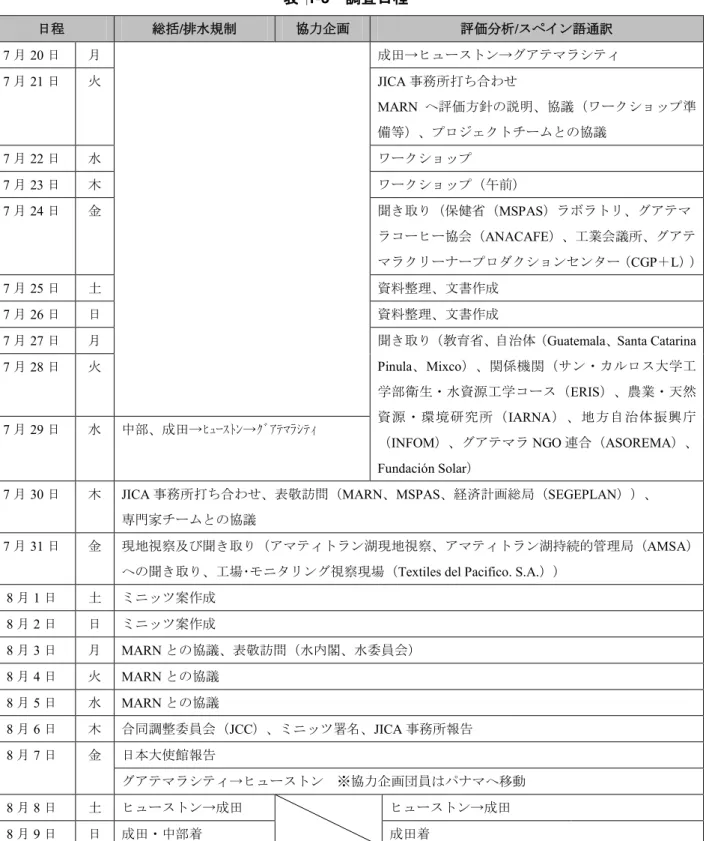
表 1-2 日本側合同評価調査メンバー 1 鎌田 寛子 総括(団長) JICA 国際協力専門員 2 大村 啓 排水規制 愛知県環境部資源循環推進課 課長補佐 3 野吾 奈穂子 協力企画 JICA 地球環境部環境管理グループ環境管理第二課 調査役 4 小笠原 暁 評価分析 株式会社 VSOC コンサルタントグループ 5 石井 裕子 スペイン語通訳 財団法人 日本国際協力センター(JICE) 1-3 派遣期間・調査日程 終了時評価調査団の派遣期間は、2009 年 7 月 20 日から 8 月 9 日までの 21 日間であった。調査日 程は以下の通りである。
表 1-3 調査日程 日程 総括/排水規制 協力企画 評価分析/スペイン語通訳 7 月 20 日 月 成田→ヒューストン→グアテマラシティ 7 月 21 日 火 JICA 事務所打ち合わせ MARN へ評価方針の説明、協議(ワークショップ準 備等)、プロジェクトチームとの協議 7 月 22 日 水 ワークショップ 7 月 23 日 木 ワークショップ(午前) 7 月 24 日 金 聞き取り(保健省(MSPAS)ラボラトリ、グアテマ ラコーヒー協会(ANACAFE)、工業会議所、グアテ マラクリーナープロダクションセンター(CGP+L)) 7 月 25 日 土 資料整理、文書作成 7 月 26 日 日 資料整理、文書作成 7 月 27 日 月 聞き取り(教育省、自治体(Guatemala、Santa Catarina Pinula、Mixco)、関係機関(サン・カルロス大学工 学部衛生・水資源工学コース(ERIS)、農業・天然 資源・環境研究所(IARNA)、地方自治体振興庁
(INFOM)、グアテマラ NGO 連合(ASOREMA)、
Fundación Solar) 7 月 28 日 火 7 月 29 日 水 中部、成田→ヒューストン→グアテマラシティ 7 月 30 日 木 JICA 事務所打ち合わせ、表敬訪問(MARN、MSPAS、経済計画総局(SEGEPLAN))、 専門家チームとの協議 7 月 31 日 金 現地視察及び聞き取り(アマティトラン湖現地視察、アマティトラン湖持続的管理局(AMSA)
への聞き取り、工場・モニタリング視察現場(Textiles del Pacifico. S.A.))
8 月 1 日 土 ミニッツ案作成 8 月 2 日 日 ミニッツ案作成 8 月 3 日 月 MARN との協議、表敬訪問(水内閣、水委員会) 8 月 4 日 火 MARN との協議 8 月 5 日 水 MARN との協議 8 月 6 日 木 合同調整委員会(JCC)、ミニッツ署名、JICA 事務所報告 8 月 7 日 金 日本大使館報告 グアテマラシティ→ヒューストン ※協力企画団員はパナマへ移動 8 月 8 日 土 ヒューストン→成田 ヒューストン→成田 8 月 9 日 日 成田・中部着 成田着
1-4 終了時評価の方法 終了時評価調査団は、事前にプロジェクト専門家およびカウンターパート(CP)に対して質問票 によるアンケート調査を実施した。評価調査団は、プロジェクト専門家やCP と共にその他関係機関 へのインタビューを実施し、参加型ワークショップを開催し、各ワーキンググループの活動状況の報 告、各ワーキンググループが抱えている問題、成果等に関する情報収集を行った。そして、これらの 収集した情報、データを分析し、日本側、「グ」国側が合同で評価を行った。 調査団はこれらの現地調査で得られた情報を分析し、プロジェクト・サイクル・マネジメント (PCM)の評価手法に則って評価 5 項目の観点から評価を行った。PCM 手法による評価は、1)プロ ジェクトの諸要素を論理的に配置したPDM に基づいた評価のデザイン、2)プロジェクトの実績を中 心とした必要情報の収集、3)プロジェクトの実績と現状および、「妥当性」、「有効性」、「効率性」、「イ ンパクト」、「自立発展性」の5 つの評価の視点(評価 5 項目)からの収集データの分析、4)分析結果 からの提言・教訓の抽出及び報告、という流れになっている。 評価5 項目の視点の詳細は下表の通りである。 表 1-4 評価 5 項目の視点 項目 視点 妥当性 評価時点における、プロジェクト目標、上位目標の妥当性につき、「グ」国政府の政 策、MARN や受益者(地方自治体、産業界、NGO、市民等)のニーズ、日本の援助 政策との整合性の観点から整合しているかどうか 有効性 プロジェクトの「成果」の達成の度合い、およびそれが「プロジェクト目標」の達成 度にどの程度結びついているか 効率性 プロジェクトの「投入」から生み出される「成果」の程度は、タイミング、質、量等 の観点から妥当であったかどうか インパクト プロジェクトが実施されたことにより生じるプラス・マイナスの波及効果(当初予定 されていない効果も含む) 自立発展性 協力終了後、プロジェクトによってもたらされた成果や開発効果が持続されるか、あ るいは拡大されていく可能性があるかどうかを予想するための、組織的側面、財政的 側面、技術的側面から実施機関の自立発展性の見込み
第
2章
プロジェクトの概要
2-1 プロジェクト実施の背景 「グ」国の社会・経済の中心である首都圏(含む9 市、人口約 210 万人、面積約 1,100 ㎢)は市中 心地区を通る分水嶺によって北部のモタグア川流域(カリブ海へ流下)と南部のマリア・リンダ川流 域(アマティトラン湖を経由して太平洋へ流下)に分かれている。首都圏からの排水は生活排水・工 業排水・農業排水のいずれもほぼ未処理で放流されており、いずれの水域も汚染が深刻化している。 また、首都圏居住者の保養観光地であるアマティトラン湖(湖水面積約16 ㎢)も南部汚水の流入に より汚染が進んでおり、透明度の低下やホテイアオイの異常繁殖など既に深刻な富栄養化現象を呈し ている。 2004 年1月時点で、「グ」国政府は国内の深刻な水質汚染問題を認識しており、アマティトラン湖 の浄化、国レベルでの水環境保全・改善を優先課題に含めていた。同国においては2000 年に設立さ れたMARN が水環境管理に係わる政策の立案、および執行を行う権限/権能を有している。 「グ」国首都圏の水質汚染を防止・改善するには、汚染原因である生活排水、工場排水、農業関連 排水等に対して適切な対策を講じるべく水環境を保全・改善する包括的な行政機能が必要とされてお り、また、そのためには同国水環境管理の中心的政府機関であるMARN の能力・体制強化が求めら れていた。このため2004 年、「グ」国より我が国に対し MARN の能力・体制強化に係る技術協力の 要請があり、事前調査を経て、2005 年 12 月に討議議事録(R/D)が締結された。 水域の汚染レベルを低下させることを目的に、2006 年 5 月に「排水の放流と再利用及び汚泥処理 を含む政府合意236-2006」が施行され、本プロジェクト期間の中で排水規制が実施され始めた。 2-2 プロジェクトの概要 (1) 上位目標 首都圏における水環境保全行政が強化される。 (2) プロジェクト目標 MARN の水環境保全の排水規制実施能力が強化される。 (3) 成果 0) プロジェクトの実施体制が整う。 1) 排水規制の効果的施行のための戦略作成能力が強化される。 2) 排水規制のモニタリング、評価、フォローアップの体制が確立される。 3) 水環境情報の整備・管理のための持続的体制が確立される。 4) 自治体、AMSA、教育省、その他の政府、非政府関係機関などの関係機関との連携に基づき、 排水規制に係わる普及・啓発および水環境に関する環境教育が強化される。 2-3 プロジェクト実施体制の特徴 本プロジェクトは「グ」国のMARN を拠点として政策形成能力強化、排水規制、水環境情報整備、 水環境教育・普及という課題に対して支援するデザインになっている。それぞれ課題別に編成されたテクニカルワーキンググループ(TWG)によって展開されている。 表 2-1 TWG の構成 成果 グループ名 活動分野 構成メンバーの所属部 1 TWG1 政策形成能力 政策戦略部、法務執行部、水資源流域部 2 TWG2 排水規制 環境管理局、水資源流域部、MSPAS ラボラトリ 3 TWG3 水環境情報整備 環境情報システム部、水資源流域部 4 TWG4 水環境教育・普及 組織強化社会参加局、水資源流域部、広報・儀典部
第
3章
プロジェクトの実績と現状
本プロジェクトは、「グ」国首都圏を対象に、排水規制管轄機関であるMARN の水資源保全能力の 強化を目指している。ステージ1(最初の 0.5 年間)とステージ 2(3 年間)に分けて実施され、ステ ージ1 とステージ 2 の間には 2 ヶ月間の国内準備期間が設けられた。ステージ 1 のプロジェクトの準 備期間に産出された成果を成果0 としている。 3-1 投入の実績 日本側、「グ」国側の投入は、質、量、タイミングに関して、概ね計画通り実施されている。 3-1-1 日本側の投入 (1) 専門家派遣 終了時評価実施時点で、7 名の専門家が以下の分野で技術移転を行い、投入合計は 70.83 人月で あった。なお、専門家派遣詳細は、添付資料5-1 を参照されたい。 表 3-1 専門家派遣実績 指導分野 業務期間(投入人月) 1 総括/水環境保全政策・立案 20.97 2 水質管理/排水規制・水質モニタリング 19.00 3 水質分析・施設管理/水環境情報整備 5.07 4 汚濁源対策(工場排水・廃棄物等) 1.00 5 PCM/環境教育 6.13 6 連携調整推進/組織運営管理 11.73 7 環境教育普及活動支援/研修計画 6.93 合計 70.83 注)業務期間は2009 年 12 月までの予定分も計上している。 (2) CP 研修 本プロジェクトの枠内において2006 年度に 8 名の CP がメキシコ国家水委員会(CNA)やコロ ンビア環境・住宅・土地開発省(MAVDT)で研修を受けた。続いて、2007 年度には 4 名の CP がメキシコ国水工研究所(IMTA)の研修を受けた。 2008 年 11 月に、MARN の前副大臣とグアテマラコーヒー協会の代表が、日本の排水の統合的 管理を習得するため、愛知県、水俣市を訪問した。 JICA のその他のプログラムにより MARN の職員の技術的能力が強化された。2005 年から現在 に至るまで、MARN の CP 及びその他の職員が、排水の処理システムに関する技術セミナーをア ルゼンチンで受講した。また、2008 年度には、1 名の CP がチリ森林公社(CONAF)における研 修に参加した。その他3 名が日本で研修を受けた。2009 年度には、日本での研修に 1 名の CP の 参加が予定されている。 以上の詳細については、添付資料5-2 を参照されたい。(3) 資機材 これまでに設置された機材はすべて順調に稼動している状況である。金額は供与機材 7,193.2 千円、携行機材580.6 千円、その他の機材として 2,251.9 千円となっており、合計は 10,025.7 千円 である。詳細は添付資料5-3、5-4、5-5 を参照されたい。 (4) 現地活動費 第4 年次(2008 年度)までの現地活動費の総額は 52,056 千円(4,671.30 千グアテマラケッツア ル(GTQ))であり、概ね計画通り活用されている。第 5 年次の現地活動費(計画)は 4,790 千円 (429.84 千 GTQ)であり、合計は 56,846 千円(5,101.13 千 GTQ)である。詳細は添付資料 5-6 を参照されたい。 表 3-2 ローカルコスト負担実績 年度 2005 2006 2007 2008 2009 合計 経費総額(千円) 3,055 13,230 26,410 9,361 4,790 56,846 GTQ 換算金額(千 GTQ) 274.14 1,187.21 2,369.93 840.02 429.84 5,101.13 注)2009 年度に関しては 2009 年度業務実施契約金額のうち該当経費を提示している。 外国為替換算レート 1GTQ= 11.14380 円(2009 年 7 月 14 日付け)として計算 3-1-2 「グ」国側の投入 (1) CP の配置 「グ」国側から実施協議調査時点で19 名が CP として選定され、中間評価時点において 15 名 が活動していた。2006 年にフルタイムの人員が配置された。終了時評価時点の CP の人数は 14 名であるが、17 名に増やす旨の提案が「グ」国側よりあり、調査団はこれを了承した。現在半数 のCP が正規雇用であり、2010 年 1 月までに残りの CP が正規雇用になる予定である。詳細は添 付資料6-1 を参照されたい。 (2) 執務施設の貸与 「グ」国側より、MARN の施設内に執務スペースとして日本人専門家執務室が提供され、良好 な執務環境が確保されている。CP とのコミュニケーションも容易に行われ、プロジェクト活動実 施に大変効果的である。 (3) 予算の配分 プロジェクト活動費として、3,146,780GTQ(36,073 千円)1が「グ」国側からすでに投入され、 いずれも計画通りに活用された2。詳細は添付資料 6-2 を参照されたい(「グ」国の会計年度は 1 月~12 月、2009 年 7 月 31 日付け外国為替換算レート 1GTQ= 11.46259 円)。 3-2 活動の実績 プロジェクトの実施当初は政治的な外部条件が存在し、モニタリング活動や技術評価調査が効果的 に実施できなかった。しかしながら、2008 年以降、これらのプロジェクト活動は順調に進められて きた。 1 外国為替レート参照 http://www.oanda.com/convert/classic 2 本プロジェクトの投入には含まれていないが、排水規制マニュアルや法的ガイドライン案作成などに、USAID 等の 資金を活用するなど、他ドナーの資金を活用したこともある。