
実数値遺伝的アルゴリズムのための優性方向優先探索
4
0
0
全文
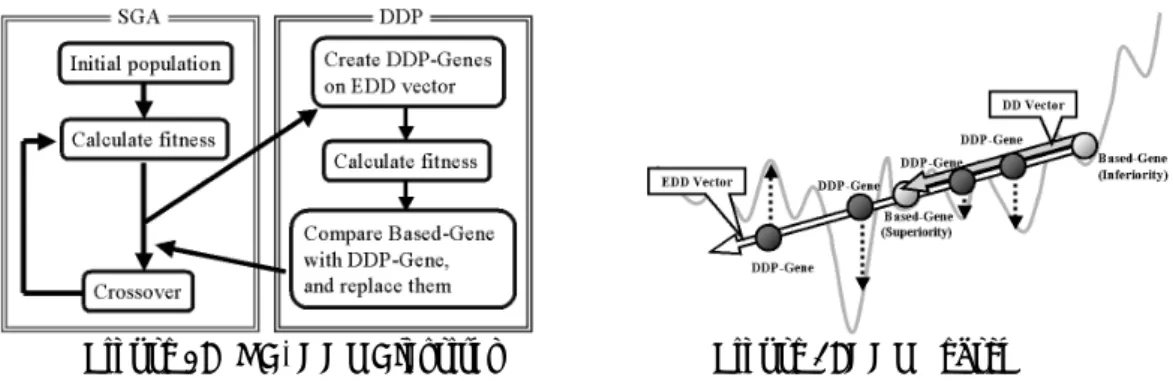
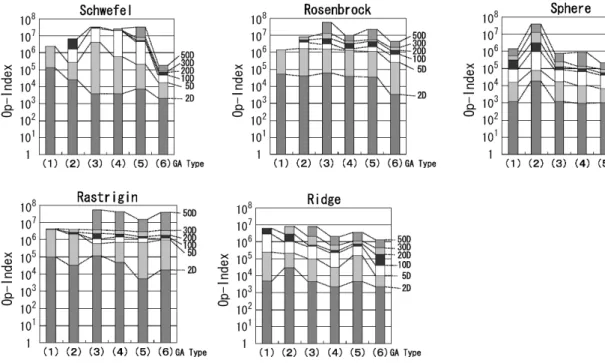
(2) z z z z. (superiority). Extend t-fold (t: Extended Ratio, Ex-Ratio) the length of the DD Vector from inferior B-Gene, resulting in calculating an extended dominant direction vector (EDD Vector). Create m sets of new genes (DDP-Gene) at random positions on the EDD Vector. If the fitness of the most superior DDP-Gene is lower than the inferior B-Gene, replace them. And return the two B-Genes to population. Repeat the operations above k times (k: DDP Frequency) per generation.. Assuming that the DD Vector corresponds well to the inclination of a fitness function, it is likely to predict that a local maximum exists in the direction of the DD Vector. This method can be applied to optimization problems where it is hard to calculate the differential values analytically or numerically. The DDP search algorithm is expected to show high performance in unimodal functions, because it is basically derived from a slant method. In multimodal functions, however, it would be hard to find a local maximum in the direction. Thus, we create multiple DDP-genes randomly on an EDD Vector. Combination of DDP with conventional GAs enables us to search wide areas by crossover GAs and local areas by DDP, simultaneously. Users are able to control the area searched by changing the Ex-Ratio to avoid a rapid fall into an intrigue local maximum. In order to characterize the performance of DDP, computational complexity (CC-Value) of DDP is defined as follows, CC-Value of DDP = DDP-Gene × DDP Frequency Generation 3. DDP application to mathematical optimization 3-1. Benchmark function We carried out computer simulation to optimizing five benchmark functions (Sphere, Rastringin, Ridge, Schwefel, Rosenbrock) in order to characterize the performance of DDP. The dimension of each function is 2,5,10. 3-2. Optimization performance of SGA+DPP We applied DDP to those functions in order to test the performance and compared it with SGA and MGG. Detailed GA condition is shown in Table 1 and Table 2. Table 1: DDP Parameter Setting GA Type (1) SGA (2) MGG (3) SGA+MGG (4) SGA+MGG (5) SGA+MGG (6) SGA+MGG. B-Gene Select Random-Random Elite-Random Random-Random Elite-Random. Ex-Ratio t=1 t=1 t=2 t=2. Table 2: GA Parameter Setting Number of Genes: 100 genes Crossover: UNDX Max CC-Value: 500000 times DDP Frequency: 1-20 per generation Number of DDP-Gene: 1-20 per generation Experiment frequency: 20 trials each. In most of the cases, CC-Value and Success Ratio are taken as the trade off. Then, we define an Optimization Index (Op-Index) with the following equations. Op-Index evaluates them inclusively. CC-Value = Genes × Generations Op-Index = CC-Value × Success Ratio The efficient optimization shows low values of both CC value and Op-Index. Result in each benchmark function is shown in Figure 3. DDP parameter setting is that the number of DDP-Gene is 5 and the DDP Frequency is 5 per generations. In each condition of DDP, GA Type (6) showed high optimization performance. Because the direction of a DD Vector can face more precisely to the direction to a maximum. In many conditions, the addition of DPP provided higher performance than SGA and MGG+UNDX.. 2 −10−.
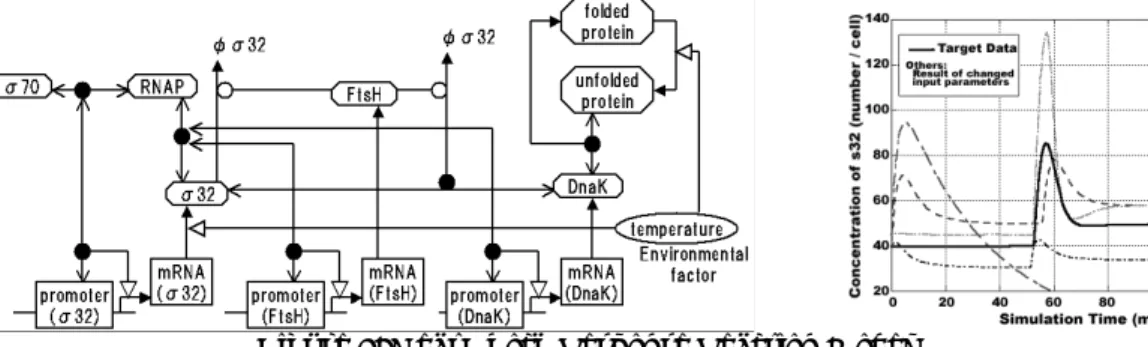
(3) Figure 3: DDP parameter setting and Op-Index 3.3. Parameter dependence of DDP The parameters that users determine in DDP are the DDP Frequency and the number of DDP-genes per generation. We measured the Op-Index, varying the values of these two parameters, as shown in Table 3. When the number of DDP-genes was over 15 and the DDP Frequency was over 15, the Success Ratio decreased and the Op-Index increased, as shown in Figure 4. On the other hand, when the DDP Frequency was from 1 to 15 and the number of DDP-genes was from 1 to 15, the optimization performance was high regardless the values of the DDP parameters, showing a high feasibility for us to determine the DDP parameters.. Table 3: GA Parameter Setting GA Type: (6) DDP Frequency: 1-20 per generation Number of DDP-Gene: 1-20 per generation Experiment frequency: 20 trials each. Figure 4: DDP parameter and Op-Index (Rastrigin 10D) 4. DDP application to gene regulatory network simulation 4-1. Heat shock response We try to optimize the kinetic parameters of the E. coli heat shock response, which is a gene regulatory network, as shown in Figure 5. Heat shock response is a system to refold and degrade. 3 −11−.
(4) heat-denatured proteins in order to prevent cell death. Heat shock response consists of multiple components and interactions among them. Time series data of some molecular components have been reported, but the values of many kinetic parameters remains to be elucidated. Using DDP, we optimize nine kinetic parameters that express the protein binding interactions to reproduce the dynamic behavior of σ32, DnaK, and FtsH proteins.. Figure 5: Heat Shock Response Reaction Model 4-2. Optimization performance In order to demonstrate optimization performance of DDP, we compared SGA, MGG+UNDX, and SGA+DDP. Each GA condition is shown in Table 4. Figure 6 indicates the result of the Op-Index. In both end conditions, GA Type (6) (selecting Elite Random, t=2) shows higher performance than others, because DDP-Genes search the area around the EDD Vector, where a maximum may exist. Table 4: GA Parameter Setting Number of Genes: 100 genes Crossover: UNDX Max CC-Value: 500000 times DDP Frequency: 1-10 per generation Number of DDP-Gene: 1-10 per generation Experiment frequency: 20 trials each Fitness = {Mean Squared Error(σ32)}-1 GA END CONDITION 1: Fitness>10-5 GA END CONDITION 2: Fitness>10-4. Figure 6: Op-Index in Heat Shock Simulation (DDP Frequency: 6, Number of DDP-Gene: 6). 5. Conclusions GA+DDP algorithm greatly enhances optimizing not only several benchmark functions but also the gene regulatory network. The DDP algorithm can be applied to fitness functions where it is hard to calculate the differential values analytically or numerically. A conventional GA, which converges the population by mutation and crossover, searches for the global space, and the DDP method accelerates the search for a local maximum by generating DDP vectors. DDP is a method that accelerates the convergence to a local maximum with a high Success Ratio and with a small CC-Value. DDP has another advantage in the feasibility that it is pretty easy to determine the values of the key control parameters. Reference [1] Davis, L. Genetic Algorithms in Search, Optimization, and Machine Learning. Van Nostrand Reinhold, New York, 1990. [2] Hiroyasu, T., Miki, M., Minami, Y., Tanimura, Y. Global Optimal-point Search of Hybrid Genetic Algorithms Using Gradient Method. Proceedings of the 5th Technical Session on Mathematical Modeling and Problem Solving, pp.57-64, 2000. −12− 4 -E.
(5)
図
関連したドキュメント
Topological methods, used in proving the existence of solutions to boundary value problems, such as: the continuation method of Gaines and Mawhin [5], [6]; or the topological
In this paper, we use the reproducing kernel Hilbert space method (RKHSM) for solving a boundary value problem for the second order Bratu’s differential equation.. Convergence
In view of the existence of traveling wavefronts for both the nonlocal monos- table equation (1.1) and the bistable non-local delayed diffusion equation [20], it is then expected
In recent years, singular second order ordinary differential equations with dependence on the first order derivative have been studied extensively, see for example [1-8] and
Kayode, “Maximal order multiderivative collocation method for direct solu- tion of fourth order initial value problems of ordinary differential equations,” Journal of the
Nagumo introduced the method of upper and lower solutions in the study of second order differential equations with boundary conditions, in particular for Dirichlet problems.. Then
Variational iteration method is a powerful and efficient technique in finding exact and approximate solutions for one-dimensional fractional hyperbolic partial differential equations..
In this paper, we have proposed a modified Tikhonov regularization method to identify an unknown source term and unknown initial condition in a class of inverse boundary value
