
Analysis of Social Networking Service for Education among Young Generation: A case study of Nepalese Youth Community
4
0
0
全文
(2) IPSJ SIG Technical Report. Table 1. The top 10 social networking services by market share in 2012 by Experian Hitwise Rank Website Visits Per Share 1 Facebook 62.89% 2 YouTube 19.80% 3 Twitter 1.85% 4 Yahoo! Answers 0.87% 5 Pinterest.com 1.27% 6 Linkedin 0.84% 7 Tagged 0.69% 8 Google+ 1.35% 9 MySpace 0.35% 10 Instagram 0.43% Social networking technologies are monumental in scope. The numbers, while growing exponentially, are unquestionably impressive The data shows in the table 1, Facebook hold a 62.89% market share, followed by YouTube (19.80%), and Twitter and Google+ Answers each at around 1% [8] (Experian Hitwise, 2012). According to the Facebook Guide for Educators: Facebook can provide students with the opportunity to effectively present their ideas, lead online discussions, and collaborate. In addition, Facebook can help you as an educator, to tap into the digital learning styles of your students. For example, it can facilitate student-to student collaboration and provide innovative ways for you to involve students in your subject matter. We also believe that Facebook can be a powerful tool to help you connect with your colleagues, share educational content, and enhance communication among teachers, parents and students [9]. It can be assumed such SNS like Facebook can be an import medium of sharing and receiving information regarding education among different circles of friend.. 3. Case study in Nepal Nepal is an underdeveloped country in South Asian region, where about one-quarter of its population living below the poverty line. Due to political turmoil and unstable government for several decades, the nation’s economic development has been directly affected, whereas approximately 71% of total population are dependent on traditional farming and 40% of total population are still illiterate [ 10 ]. In particular, the unemployment rate for youth (aged 15-24) has risen in urban areas, from 13.0% in 2008, similarly 1,700 people every month migrate to foreign countries, very first to India, Gulf regions, Malaysia or other Asian countries for seek the job [11]. As well as many Nepali traveling abroad to study are influenced in their choice of destination by host country immigration and workplace laws, as often they need supplemental income to help fund their education and, due to a lack of jobs in Nepal, are looking for post-graduation employment opportunities as routes to future careers [ 12 ]. According to UNESCO institute of. ⓒ 2015 Information Processing Society of Japan. Vol.2015-DC-100 No.1 2015/12/1. statistic there were over 24000 Nepalese student studying overseas in 2010 [13]. However, Nepal has taken a big leap in the sectors of advance communication technology in recent years. According to population census 2010-2011, Nepal currently consists of 26.5 million people whereas 84% have direct access to telephone, among those Telephone users 74.33% are using mobile phone. As well as there are all 75 district has available the access of internet whereas 28.92% of country’s population are using internet via computer, laptop, tablet and smart phone etc. [14]. Along with the development of communication technology in Nepal, ICT education has been expansion as compulsory education throughout the country. To approach among each people of the nation, ICT education has been included in school education as an important course, and different private organisations or institutions have been providing training and courses for those who do not have computer and internet courses in their academic education. In spite of remarkable development on ICT education in most of the cities and metropolitans, majority of rural areas are out reach of the education and ICT as well. However, in rural school courses has been included the computer and internet subject theoretically, due to the particular reasons such as lack of appropriate budget, geographical difficulties and lack of proper infrastructure, most of the rural school could not able to provide the adequate computer and internet services to their student. In the previous research of particular village, it is found that, most of the student of grade 6, 7 and 8 can explain the definition of internet, computer parts and program but they had never experienced to use the computer in real life. Internet has been expanded to some of the rural areas of Nepal because of which the youth of those regions are accessing or aware of the most common visited social sites like Facebook, Twitter, Youtube, Google as communication or social network. Most of the people in urban areas use Facebook, Twitter, Google+, Youtube, and other Nepalese networking sites. Recently there are 18,97,840 Facebook users in Nepal which is 6.56% of total population and these users are mostly from the age group 18 to 24. The user ratio is increasing day by day [13]. Generally, people use SNS like Facebook, Tweeter to connect and interact with friends, families or meeting new people. People also use Facebook to express emotions, behaviours, daily routines and information. Thus Facebook and twitter are famous networking service among all other SNS. However, Facebook, Twitter, LinkedIn, Google+ etc. are also been used for other purpose such as business advertisement, journalism, publishing and introduction for different organisations. In Nepal, 70% journalists frequently visit SNS sites for sharing information and 64% of them visit Facebook and twitter in search of information, ideas for news report or articles and finding source for advertisement [13]. Observing the above situation of young people, the people from age group of 15-25 will be taken as research sample in the study. In Nepal there is a big difference in number of users and as using intensions between the users from urban areas and the users from rural areas. Likewise, the big numbers of the youth. 2.
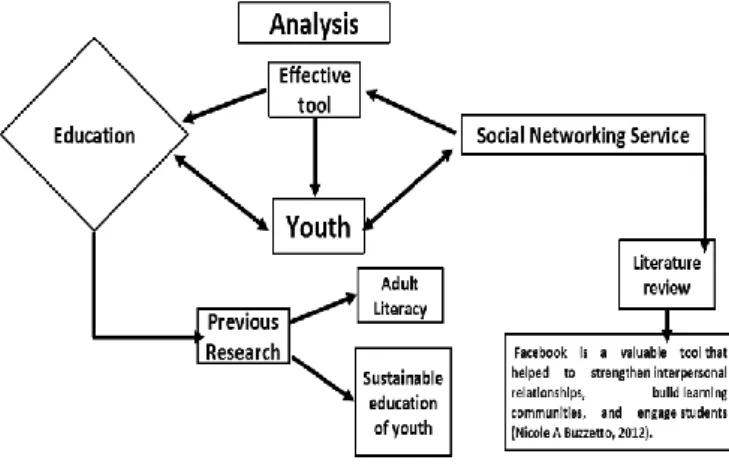
(3) IPSJ SIG Technical Report. are living in other countries than the situation of users can be different, therefore to consider the differences of users by the number and intension, the research area is selected in 3 different areas: Rural, Urban, and Living abroad.. 4. Research Objectives The Objectives of this study are to explore the prevalence of SNS among younger generation considering the effect to their education that is based on literature reviews, research question, background and context of research. Research objectives are included the following: 1. 2. 3.. To analyze social networking service and its effect on education among younger generation. To analyze SNS as an effective tool to enhance educational environment. To promote SNS’s advantages on education through information diffusion.. It has been expected that the research will support to improve the quality of education among the youth, and the education development is prioritized as the goal of the study.. Figure 1. Research framework In Figure 1, this study has three main factors: analysis (SNS, education tool for the youth), Literature review and previous research. The previous research means the research conducted in the master degree research of the author. In that research, the objectives were designed to focus in two aspects of social network analysis. They are: 1. Adult literacy 2. Sustainable education of the youth. Vol.2015-DC-100 No.1 2015/12/1. have been raised regarding social communication networks in different time. Especially, along with the development of ICT in the youth, they have been investing most of their time in virtual social network rather than creative social activities or responsibility toward society. User spend 700 billion minutes in total per month on Facebook [5]. SNS is a technology and software tools to facilitate communication and interaction between users. Most of the people from schools and colleges are using SNS for social activities like sending friend requests, chatting, sharing daily activities and personal behaviours (love affair, sadness, aggression etc), uploading pictures or videos and commenting on them and to others similar activities. Users are indulging and participating on social subjects like political issues, movies, artists etc. they use these tools to share online ideas, documents, photos, videos, and favourite websites actually almost anything [15]. Buzzetto[1] illustrates that users consider Facebook as a valuable tool helping to strengthen interpersonal relationships, building learning communication and engaging students. Among the mass of users, many have a perception of SNS as the form of entertainment, less likely people are using such tools as an educational purpose specially the youth users. However, users have been adopting the updated information through these tools because of the nature of sharing information, uploading contents, receiving other’s uploaded societal contents and messages. Such performance influences positive and negative on the intellectual development of the youth. In the educational way; younger people can discuss about their subject difficulties and problem with their close friends or friends circle regarding similar education faculty or different faculty. It can be presuming that such behaviour of group discussion can be obtained from the different views to help their subject difficulties by the opinion and comments of different people. To concern the advantage of SNS in education, to promote SNS awareness to use in appropriate way among young people to enhance educational environment is another objective of this study. It has been expected that the research will support to create an education oriented SNS environment among young people in the near future. To make the research context clear and simpler, the framework is prepared in figure 2.. Adult literacy was focused in the previous research, in which sustainable education of the youth was focused as research content.. 5. Research Context Such social networking services are trying to connect people around the globe in one network, whereas in the other hand people are departing from the near real society, some issues. ⓒ 2015 Information Processing Society of Japan. Figure 2. Framework of research context. 3.
(4) Vol.2015-DC-100 No.1 2015/12/1. IPSJ SIG Technical Report. According to Figure 2, the youth are taken as the research sample (age of 15-24). There has been quantitative improvement on education in Nepal but there are dissatisfactory results regarding qualitative education. Therefore, to be noted the factors; ‘increased ratio of SNS users, user’s intension to use such popular networking services and SNS use for educational purpose’, SNS will be analyze as an effective tool to enhance educational environment among youth. Based on the literature reviews some questions are prepared in hypothetical way to simplify the objective of the research.. 7. Future research This research proposal is based on the previous literature research. This research will be focused on quantitative and qualitative data. During research due to relational analysis and contents are web-oriented, so relative software will be used for data analysis which is a part of study. To complete the research and for practical study, hypothetical survey questions are being processed. The survey questionnaire is designing in three different patterns: Rural, Urban and Living abroad.. References 1. 2.. How SNS has been affecting in daily lives of younger generation? How can SNS become an important resource tool for the education?. 6. Literature review Interpersonal relationships build learning communities and engage student, Buzzetto’s research [1] explored the efficacy of social networking systems as instructional tool by examining the use of Facebook in courses at US Mid-Atlantic minority-serving University by examining student perception as well as by analyzing content. Buzzetto [1] found that students perceive to use of Facebook positively as a tool to enhance communications, community building and engagement however, educators do not want to see social networking services replace course management systems like blackboard. In [1], their findings it should encourage college faculty to adopt the use of social networking services as part of the teaching and learning process with a specific focus on building learning communities and increasing student engagement. At the same time, the research finding encourage faculty should continue their use of traditional learning management systems using SNS simply as means of augmenting instruction. According to Buzzetto findings [1], the traditional teaching (blackboard), learning and social network service learning were compared. From the comparison of two different methods of teaching and learning it has been found out the both learning methods are equally important on education. However, the literature doesn’t found the clear analysis that SNS can be an effective tool for teaching and learning method. The literature research has not been seen to be focused on the increasing ratio of user as an important factor. It shows that Education oriented analysis has not been focused under user intention toward SNS. In the research of Filiz [5], the University’s instructors have been surveyed as research sample, and Facebook has been examined as SNS tool. It has been found out that the literature research has analyzed only the instructor’s whether they have been using SNS as an educational tool. However, it has not clarified whether SNS can be effective tool for education and the negativity or the weak aspects of SNS user intention are also neglected. Although this research proposal has prepared base on different literature research, this study will try to include those areas of content where literature research has not been found so clearly.. ⓒ 2015 Information Processing Society of Japan. 1) Nicole A. Buzzetto-More, (2012). Social Networking in Undergraduate Education. Interdisciplinary Journal of Information, Knowledge, and Management. Special Section on Social Networking, Teaching, and Learning. Volume 7. 2) Preeti Srivastava, (2012). Social Networking & Its Impact on Education-System in Contemporary Era. Volume 1, No.2. International Journal of Information Technology Infrastructure. http://warse.org/pdfs/ijiti02122012.pdf. 3) Aine Dunne, Margaret-Anne Lawlor, Jennifer Rowley, (2010). Young People’s Use of Online Social Networking Sites: a Uses and Gratifications Perspective. Dublin Institute of Technology ARROW@DIT. 4) Berry Wellman, (1996). An Electronic Group is Virtually a Social Network. Center for Urban and Community Studies. 5) Filiz Tiryakioglu, Funda Erzurum, (2011). Use of Social Networks as an Education Tool. Contemporary Technology. 6) Gail Salaway, Judith Borreson Caruso, Mark R. Nelson, (2008). The ECAR Study of Undergraduate Students and Information Technology. Volume 8, 2008. 7) Facebook, (2010). Newsroom: Company info fact sheet. Facebook. 8) Experian Hitwise, (2012). Top 10 social networking sites by market share of visits. http://www.dreamgrow.com/top-10-social-networking-sites-by-market-s hare-of-visits-september-2012/ 9) Fogg, L.,Phillips, L., Baird, M.& Fogg, B., (2011). Facebook for educators. Retrieved 10/6/11 from http://www.facebook.com/safety/attachment/Facebook%20for%20Educ ators.pdf 10) Literacy Mapping Study Team, (2013). Literacy Status in Nepal (Literacy rate by age group 5), UNESCO Kathmandu. 11) International Labour Organization, (2014). Nepal Labour Market Update. http://www.ilo.org/wcmsp5/groups/public/---asia/---ro-bangkok/---ilo-ka thmandu/documents/publication/wcms_322446.pdf 12) World Education News and Reviews, (2013). Academic Mobility and the Education System of Nepal. http://wenr.wes.org/2013/03/wenr-march-2013-academic-mobility-and-t he-education-system-of-nepal/ 13) Chalaune Ankala, Pokhrel Rabin, (2012). Social Media in Journalism: Facebook. BMCJ-434. 14) Management Information System, (2014). Nepal Communication Authority. Vol.109, Issue 61th. file:///C:/Users/Sakhila%20Thapa/Downloads/NTA-MIS-81.pdf 15) Sunitha Kuppuswamy, P.B. Shankar Narayan (2010). The Impact of Social Networking Websites on the Education of Youth. International Journal of Virtual Communities and Social Networking, 2(1).. 4.
(5)
図
関連したドキュメント
Time series plots of the linear combinations of the cointegrating vector via the Johansen Method and RBC procedure respectively for the spot and forward data..
We show that a discrete fixed point theorem of Eilenberg is equivalent to the restriction of the contraction principle to the class of non-Archimedean bounded metric spaces.. We
One may think that, if matrix subjects can be reactivated due to similarity-based reactivation, the distant NOM and DAKE-NOM conditions should show
Amount of Remuneration, etc. The Company does not pay to Directors who concurrently serve as Executive Officer the remuneration paid to Directors. Therefore, “Number of Persons”
If you disclose confidential Company information through social media or networking sites, delete your posting immediately and report the disclosure to your manager or supervisor,
In our opinion, the financial statements referred to above present fairly, in all material respects, the consolidated financial position of The Tokyo Electric Power
• Mirrors, window lift, doors switches, door lock, HVAC motors, control panel, engine sensors, engine cooling fan, seat positioning motors, seat switches, wiper control,
The constitution of theory containing hot-sector generation will be forced to take a form of mosaic of quantum field theory, because that generations are expected to
