Title
Methacrylate-based Diol Monolithic Stationary Phase for the
Separation of Polar and Non-Polar Compounds in Capillary
Liquid Chromatography( 本文(Fulltext) )
Author(s)
LINDA, Roza; LIM, Lee Wah; TAKEUCHI, Toyohide
Citation
[Analytical sciences : the international journal of the Japan
Society for Analytical Chemistry] vol.[29] no.[6] p.[631]-[635]
Issue Date
2013-06-10
Rights
The Japan Society for Analytical Chemistry (公益社団法人日本
分析化学会)
Version
出版社版 (publisher version) postprint
URL
http://hdl.handle.net/20.500.12099/53407
Introduction
Polymer-based monolithic columns have gained increasing attention in capillary liquid chromatography (LC) and common capillary electrochromatography since they were first prepared in the early 1990s.1 Monolithic columns possess various advantages, such as simple preparation and wide selection of monomers available with different functional groups, easy control of permeability, no need to prepare frits, and moderate phase ratios. Monolithic columns are often prepared by polymerization of functional monomers for generation of the chromatographic interaction sites, via in situ polymerization with a cross-linking agent, monomers and some porogens in a capillary tube. The polymerization conditions can hardly be changed because each variation of the solvent composition has a significant effect on the structure of the resulting materials.2,3
Hydrophilic interaction liquid chromatography (HILIC) uses polar stationary phases and allows the use of aqueous mobile phases, which is a useful alternative and rival technique to reverse-phase LC (RPLC) for separating polar compounds.4,5 Recently, HILIC monolithic columns have attracted increasing attention. The application of monolithic columns in the HILIC mode has been studied for capillary LC, and it was successfully used for carbohydrates,6,7 proteins,8,9 nucleosides,9,10 phenols and vitamin C,11 and some small polar analytes.12
The methacrylate-based polymers are one of the most widely researched monoliths. Methacrylates are the most popular among polymer chemistries used as separation media.13,14 There are several advantages associated with methacrylate-based
monoliths, including high stability even under extreme pH conditions, fast and simple preparation, a wide selection of monomers available with wide ranging polarities, and easy functionalization when using glycidyl methacrylate (GMA) as the monomer. The epoxy group in GMA can be further modified and they have been processed successfully as the stationary phase for the separation of various compounds.13–16
In this research, we synthesized monolithic capillary columns by using GMA and poly(ethylene glycol) dimethacrylate (PEGDMA). PEGDMA is a reactive crosslinker that provides good flexibility, physiological inactivity, low toxicity, and stability under many chemical conditions. The linked alkyl end-groups provide hydrophobic interaction sites and the poly(ethylene glycol) (PEG) groups provide a mildly hydrophilic matrix.17 After hydrolysis of the epoxide functionalities with acid,18 diol groups were formed at the surface of the polymeric skeleton and thus monolithic HPLC separation media was obtained. The composition of the polymerization mixture was optimized and the separation ability was investigated. The physical properties of the monolithic column, such as permeability and mechanical stability were characterized. The poly(GMA-PEGDMA) monolith capillary columns were applied to the determination and separation of polar compounds such as phenol compounds and phthalic acids. The poly(GMA-PEGDMA) monolith capillary columns with varying compositions of monomer were also used as the stationary phase for the separation of non-polar compounds polycyclic aromatic hydrocarbons (PAHs). PAHs are carcinogenic compounds and exist in a wide range of environmental matrices, and they are normally analyzed with RPLC methods using silica-based C18 packed columns.
2013 © The Japan Society for Analytical Chemistry
† To whom correspondence should be addressed. E-mail: [email protected]
Methacrylate-based Diol Monolithic Stationary Phase for the
Separation of Polar and Non-Polar Compounds in Capillary
Liquid Chromatography
Roza L
INDA,*
,**
†Lee Wah L
IM,* and Toyohide T
AKEUCHI*
* Department of Chemistry, Faculty of Engineering, Gifu University, 1-1 Yanagido, Gifu 501–1193, Japan
** Department of Chemistry Education, Faculty of Education, Riau University, Kampus Binawidya Km 12.5
Pekanbaru 28131, Indonesia
A monolithic capillary column prepared with glycidyl methacrylate (GMA) and poly(ethylene glycol) dimethacrylate (PEGDMA) was investigated and used in capillary liquid chromatography. The polymer monolith was synthesized in the presence of methanol and decanol as the biporogenic solvents by in situ polymerization of GMA and PEGDMA, and the optimum composition of monomer and porogen was investigated. After polymerization, glycidyl groups were hydrolyzed with sulfuric acid to produce diol groups at the surface of the porous monolith via epoxy-ring-opening. The GMA content in the polymerization mixture affected the hydrophilicity of the monolith. The separation capability was evaluated by separation of phenol compounds, phthalic acids, and polycyclic aromatic hydrocarbons. The poly(GMA-PEGDMA) monolithic capillary column exhibited satisfactory stability.
Experimental
Apparatus
For LC separations the eluent was supplied by an L. TEX-8301 Micro Feeder (L. TEX Corp., Tokyo, Japan) equipped with an MS-GAN 050 gas-tight syringe (0.5 mL; Ito, Fuji, Japan). A Model M435 micro injection valve (Upchurch Scientific, Oak Harbor, WA) with an injection volume of 0.2 μL, was used as the injector. A UV-970 UV-Vis detector (Jasco, Tokyo, Japan) was operated at 254 or 220 nm and all of the data were collected by a CDS data processor (LASOFT, Chiba, Japan). The inlet pressure was monitored by an L. TEX-8150 pressure sensor (L. TEX).
Reagents and chemicals
3-(trimethoxysilyl)propyl methacrylate, PEGDMA and 1-decanol were purchased from Tokyo Chemical Industry (Tokyo, Japan). GMA (97% pure), phthalic acid, pyrocathecol, uracil, toluene, naphthalene, fluorene, anthracene, fluoranthene, pyrene, and benzo[a]pyrene were obtained from Nacalai Tesque (Kyoto, Japan). 2,2′-Azobis(isobutyronitrile) (AIBN), methanol, ethanol, acetonitrile, sulfuric acid, salicylic acid, isophthalic acid, phenol, and pyrogallol were obtained from Wako Pure Chemical Industries (Osaka, Japan). All other reagents and solvents were of the highest grade commercially available and were used without further purification. The water used for sample and mobile phase preparation was purified with a Milli-Q deionization system (Nihon Millipore Kogyo, Tokyo, Japan).
Preparation of poly(GMA-PEGDMA) monolithic capillary column
The poly(GMA-PEGDMA) monolith was prepared by the one-step polymerization method, in which the polymerization was initiated by thermal treatment of the mixtures of GMA as the functional monomer, PEGDMA as the crosslinker, methanol and decanol as the binary porogenic solvents and AIBN as the initiator. In the present study, the polymer monolith was in situ synthesized in a fused-silica capillary (150 × 0.32 mm i.d.). Firstly, the inner surface of the capillary was derivatized with 3-(trimethoxysilyl)propyl methacrylate which makes it possible to anchor the polymer to the wall, and then dried with N2.8 Subsequently, the polymerization mixture was completely mixed by vortexing and ultrasonication to form a homogeneous solution. The various compositions of the polymerization mixture investigated in this study are shown in Table 1. In addition to these compositions shown in Table 1, we also
prepared poly(GMA-PEGDMA) containing less GMA, i.e. 2% GMA, whith the porogen content of 70%.
Finally, the capillary was immediately sealed with a teflon tube and the polymerization took place in a water bath at 60°C for 20 h. After polymerization, the capillary was washed with acetonitrile to eliminate the unreacted porogenic solvents and other soluble compounds. The resulting monolithic capillary was then flushed with 0.2 mol/L sulfuric acid solution at room temperature or at elevated temperatures (40 and 60°C) for 2 h to open the epoxide groups in order to form diols at the surface of the polymeric skeleton.18 Then, the prepared poly(GMA-PEGDMA) monolithic capillary was used for evaluation.
Results and Discussion
Column characterization
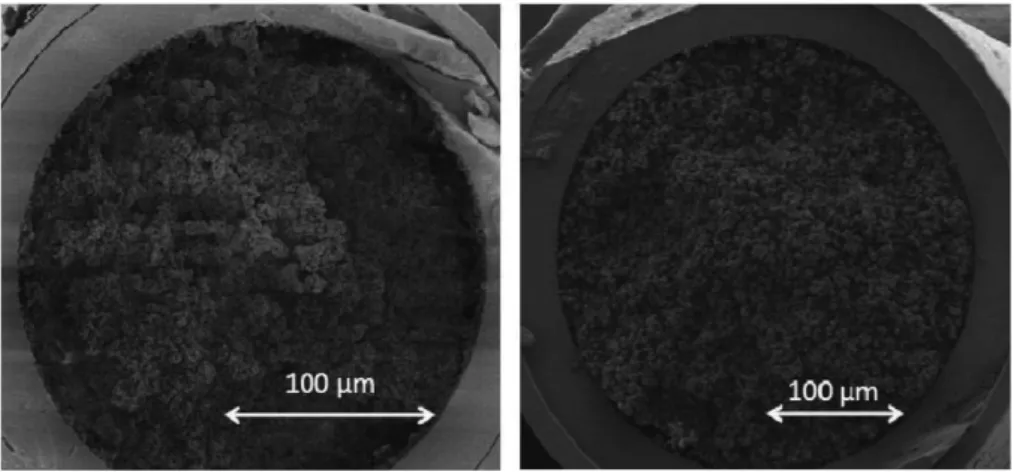
It is known that even minor changes to the composition of the polymerization mixture affect the performance of a methacrylate-based monolithic column.12,19 After the ring-opening reaction, the poly(GMA-PEGDMA) monolith possesses diol groups at the surface of the polymer skeleton, which contribute to the hydrophilicity of the column, and the composition of GMA contained in the polymer will affect the hydrophilic properties of the stationary phase. Poly(GMA-PEGDMA) monoliths with different GMA content were prepared and evaluated. Firstly, the ratio of the monomer to the crosslinker (GMA:PEGDMA) was varied by keeping the same porogen content, while the GMA composition was varied from 6 to 16% (v/v). In order to investigate the morphology and the hydrophilic properties of the prepared monoliths, scanning electron microscope (SEM) and LC were used. Figure 1 displays SEM photos of the poly(GMA-PEGDMA) monoliths prepared by 6 and 12% (v/v) GMA, respectively. Although both of the photos show fullpacked monoliths it can be seen the through pores in the polymer skeletons are highly interconnected, forming a porous network of channels. And it can also be observed that the monolith is attached tightly to the inner-wall of the capillary. The skeleton of the monolith approximately ranged 0.5 – 1 and 2 – 3 μm for monolith content 6% GMA and 12% GMA, respectively.
It was found that increasing the GMA content, i.e. decreased PEGDMA content, improved the permeability of the columns. When the GMA content increased from 6 to 12% (v/v), the permeability increased from 4.04 × 10⁻¹⁰ to 4.35 × 10⁻¹⁰ cm2 (Table 1). The content of GMA also affected the column efficiency. Increasing GMA up to 12% (v/v) increases the column efficiency to around 18000 theoretical plates per meter
Table 1 Effect of different compositions of the polymerization mixture on the permeability of the column Column Porogen, % (v/v) % (v/v)GMA, PEGDMA, % (v/v) Nmax
(plates/m) Ka, permeability 10–10 (cm2) kb, uracil Condition of opening epoxy reaction A B C D E F G H 68 68 68 68 73 78 68 68 6 8 12 16 12 12 12 12 26 24 20 16 15 10 20 20 6000 6800 18000 17000 18000 22000 13000 12000 4.04 4.27 4.35 2.76 4.16 4.03 5.16 5.26 0.52 0.51 0.81 0.48 0.39 0.31 0.80 1.06 RT, 2 h RT, 2 h RT, 2 h RT, 2 h RT, 2 h RT, 2 h 40°C, 2 h 60°C, 2 h a. K = (μL/Δp)η, where η is the viscosity of acetonitrile,21 L the column length (15 cm in this case), μ the solvent linear velocity, and Δp the
at a flow rate of 3 μL/min. When the content of GMA was increased to 16% (v/v), the permeability and efficiency of the column deteriorated. Therefore, the GMA fraction was kept constant at 12% (v/v) in further experiments. The ratio of the porogen to the monomer content was also evaluated. When the porogen weight fraction increased from 68 to 78%, the column efficiency increased from ca. 18000 to 22000 theoretical plates per meter. In common monolith polymer columns, increase of porogen will increase the permeability of monolith, however on the present monolith the permeability decreased slightly with increasing ratio of the porogens. The reason for this is not certain, unfortunately.
The effect of the reaction temperature for opening epoxy groups using sulfuric acid was also investigated. Higher temperatures i.e. 40 and 60°C, could improve the permeability of column, but efficiency deteriorated. This may due to the fact that higher temperatures were not suitable for the epoxy-ring-opening reaction on this column, and the amount of diols on the surface of the monolith decreased. Therefore, 68% porogen weight fraction and 12% GMA were chosen as the polymerization conditions, while room temperature was chosen for the epoxy-opening reaction in further experiments.
Linear relationships between the back pressure and the flow rate are clearly demonstrated, showing good mechanical stability of the monolith. It should be noted that higher flow rate could be applied to the column. When the flow rate was 6 μL/min, the back pressure was 1.9 MPa for the column C.
Chromatographic properties
In order to investigate the HILIC mode properties of the present column, uracil and toluene were used as test compounds, where acetonitrile with variant concentration from 50 to 98% were used as the mobile phase. Figure 2 illustrates the retention time of uracil and toluene as a function of acetonitrile concentration in the mobile phase for the column C (150 × 0.32 mm i.d.). The retention time of uracil, which is a polar compound, increased when the concentration of acetonitrile increased from 50 to 98% in the mobile phase, whereas the retention time of toluene, a non-polar compound, decreased with increasing concentration of acetonitrile. At lower concentrations of acetonitrile, uracil elutes before toluene whereas it elutes after toluene at higher concentrations of acetonitrile, showing dual retention capability works for polar and non-polar compounds. Commonly, the critical compositions of the mobile phases corresponding to the transition from the
HILIC to the RP mode were around 70% acetonitrile in water. The separation of polar analytes, such as phenols and amides, was commonly performed with more than 90% acetonitrile content in the mobile phase to achieve good retention.20 The critical value of the poly(GMA-PEGDMA) monoliths stationary phase was gained when the content of acetonitrile in the mobile phase exceeded 90%, and for separation of phenols we used 98% acetonitrile as mobile phase. This result indicated that this monolith still has low hydrophilicity.
In the hydrophilic mode, the retention factor (k) of uracil was influenced by the composition of GMA. When the GMA content increased from 6 to 12% (v/v), k increased from 0.52 to 0.81, and decreased for 16% GMA (Table 1). Since the poly(GMA-PEGDMA) monolith possesses diol groups at the surface of the polymer skeleton, it is expected to show separation ability towards polar compounds due to the specific interactions such as dipole–dipole and hydrogen bonding interactions.
The prepared monolithic column was evaluated by the
Fig. 1 Scanning electron microscopy images of the poly(GMA-PEGDMA) monolithic capillary columns. (A) 6% GMA, (B) 12% GMA.
2.00 4.00 6.00 8.00 10.00 12.00 30 40 50 60 70 80 90 100 Retention time / min Conc. of acetonitrile / % Toluene Uracil
Fig. 2 Retention times of uracil and toluene as a function of acetonitrile concentration in the mobile phase. Column, monolithic
poly(GMA-PEGDMA), 12% GMA (150 × 0.32 mm i.d.); mobile
phase, acetonitrile–water mixtures; flow rate, 3 μL/min; wavelength of UV detection, 254 nm; analytes, 0.1% (w/v) each of uracil and toluene; injection volume, 0.2 μL.
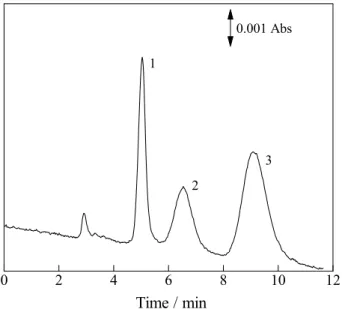
separation of polar compounds which are neutral and weakly acidic aromatic compounds. Phenols are one of the major categories of environmental pollutant. The separation of three phenols was investigated on the 12% GMA monolith under an isocratic elution condition. A typical chromatogram is shown in Fig. 3. It can be seen that the separation of three compounds was completed in 8 min, and it is shown that pyrocathecol has better separation efficiency compared to the others. Weak organic acids such as salicylic acid, phthalic acid and isophthalic acid could also be separated using the same column. The chromatogram is shown in Fig. 4. Using 98% acetonitrile as the
mobile phase, three compounds could be separated completely. Since the poly(GMA-PEGDMA) monolith 12% GMA showing dual retention capability works for polar and non-polar compounds, depending on the concentration of acetonitrile contained in the mobile phase, the separation of PAHs was investigated on the present column. Figure 5 shows the separation of six typical PAHs by using the developed monolithic capillary column with isocratic elution using 70% acetonitrile as the mobile phase. Six PAHs were separated completely in reasonable time.
On the other hand, the monoliths prepared from 2% GMA showed hydrophobic property. Polar compounds could not be retained on the 2% GMA column. It is expected that low GMA content in the monolith results in fewer diol groups at the
0 2 4 6 8 10 12 14 0.001 Abs 1 2 3
Time / min
Fig. 3 Separation of phenols. Column, monolithic
poly(GMA-PEGDMA), 12% GMA (150 × 0.32 mm i.d.); mobile phase
acetonitrile–water (98:2); flow rate, 3 μL/min; wavelength of UV detection, 254 nm; analytes, 0.1% (w/v) each of phenol (1), pyrocathecol (2) and pyrogallol (3); injection volume, 0.2 μL.
0
2
4
6
8
10
12
0.001 Abs 1 2 3Time / min
Fig. 4 Chromatogram of aromatic acids. Column, monolithic
poly(GMA-PEGDMA), 12% GMA (150 × 0.32 mm i.d.); mobile
phase, acetonitrile–water (98:2); flow rate, 3 μL/min; wavelength of UV detection, 220 nm; analytes, 0.1 % (w/v) each of salicylic acid (1), phthalic acid (2) and isophthalic acid (3); injection volume, 0.2 μL.
0 2 4 6 8 10 12 14 16 18 20 22 24
0.005 Abs 1 2 3 4 5 6Time / min
Fig. 5 Chromatogram of the separation of PAHs. Column, monolithic poly(GMA-PEGDMA), 12% GMA (150 × 0.32 mm i.d.); mobile phase, acetonitrile–water (70:30); flow rate, 3 μL/min; wavelength of UV detection, 254 nm; analytes, 0.1% (w/v) each of naphthalene (1), fluorene (2), anthracene (3), fluoranthene (4), pyrene (5), benzo[a]pyrene (6); injection volume, 0.2 μL.
60
65
70
0
0.2
0.4
0.6
0.8
1
1.2
1 2 3 4 5 6Conc. of acetonitrile / %
Log
k
Fig. 6 Effect of the acetonitrile concentration in mobile phase on the retention of PAHs. Column, monolithic poly(GMA-PEGDMA), 2% GMA (270 × 0.32 mm i.d.); mobile phase, acetonitrile–water; other operating conditions as in Fig. 5.
surface of the polymer skeleton. The hydrophobicity of monoliths was also believed due to the high methyl groups content in the alkyl end-groups of the PEGDMA. The poly(GMA-PEGDMA) monolith with 2% GMA was evaluated by using the separation of PAHs. Using acetonitrile-water as the mobile phase, the six PAHs were separated completely. The effect of the acetonitrile concentration in the mobile phase on the retention of PAHs was investigated. As shown in Fig. 6, decreasing acetonitrile content in the mobile phase increases the retention time of PAHs. It is also found that the poly(GMA-PEGDMA) monolith with 2% GMA shows good mechanical stability. The back pressure of the latter column as a function of the flow rate of the mobile phase has a linear relationship. When the flow rate was 6 μL/min, the back pressure was 2.6 MPa for the column of 27 cm in length. It shows that higher flow rates can be applied to the column.
Conclusions
A polymethacrylate-based diol monolithic column based on the copolymerization of GMA and PEGDMA in the presence of porogens was prepared and successfully used as the stationary phase in the HILIC mode. The poly(GMA-PEGDMA) monoliths possess diol groups at the surface of the porous monolith that ascribed to hydrophilicity of the monolith. Increasing the GMA content in the polymerization mixture increased hydrophilicity. Phenols, phthalic acid and PAHs were retained on the stationary phases using acetonitrile-water mixtures as the mobile phase.
However, the higher hydrophilicity of the monolith still remains a challenging task due to the fact that separation of polar compounds still needs higher concentrations of acetonitrile as the mobile phase. Nevertheless, this monolithic capillary column exhibited satisfactory stability with sufficient separation efficiency for both polar and non-polar compounds.
References
1. T. B. Tennikova, B. G. Belenkii, and F. Svec, J. Liq.
Chromatogr. 1990, 13, 63.
2. F. Svec and J. M. J. Fréchet, Anal. Chem., 1992, 64, 820. 3. F. Svec and J. M. J. Fréchet, Chem. Mater., 1995, 7, 707. 4. A. J. Alpert, J. Chromatogr., 1990, 499, 177.
5. Z. J. Jiang, N. W. Smith, P. D. Ferguson, and M. R. Taylor,
Anal. Chem., 2007, 79, 1243.
6. T. Ikegami, K. Horie, N. Saad, K. Hosoya, O. Fiehn, and N. Tanaka, Anal. Bioanal. Chem., 2008, 391, 2533.
7. J. Lin, S. F. Liu, X. C. Lin, and Z. H. Xie, J. Chromatogr.,
A, 2011, 1218, 4671.
8. Y. Li, H. D. Tolley, and M. L. Lee, J. Chromatogr., A, 2010,
1217, 8181.
9. M. A. Jaoude and J. Randon, Anal. Bioanal. Chem., 2011,
400, 1241.
10. Z. J. Jiang, N. W. Smith, P. D. Ferguson, and M. R. Taylor,
J. Sep. Sci., 2009, 32, 2544.
11. Z. Liu, Y. Peng, T. Wang, G. Yuan, Q. Zhang, J. Guo, and Z. Jiang, J. Sep. Sci., 2013, 36, 262.
12. P. Jandera, J. Urban, V. Skerikova, P. Langmaier, R. Kubickova, and J. Planeta, J. Chromatogr., A, 2010, 1217, 22.
13. D. Lee, F. Svec, and J. M. J. Fréchet, J. Chromatogr., A, 2004, 1051, 53.
14. Y. Ueki, T. Umemura, Y. Iwashita, T. Odake, H. Haraguchi, and K. Tsunoda, J. Chromatogr., A, 2006, 1106, 106. 15. F. Svec, E. C. Peters, D. Sykora, and J. M. J. Fréchet, J.
Chromatogr., A, 2000, 887, 3.
16. M. M. Dittmann, K. Masuch, and G. Rozing, J. Chromatogr.,
A, 2000, 887, 209.
17. Y. Li, H. D. Tolley, and M. L. Lee, J. Chromatogr., A, 2010,
1217, 4934.
18. Y. Wen and Y. Q. Feng, J. Chromatogr., A, 2007, 1160, 90. 19. J. Urban and P. Jandera, J. Sep. Sci., 2008, 31, 2521. 20. X. Wang, H. Lu, X. Lin, and Z. Xie, J. Chromatogr., A,
2008, 1190, 365.
21. L. R. Snyder, J. J. Kirkland, and J. W. Dolan, “Introduction
to Modern Liquid Chromatography”, 3rd ed., 2010, Willey, New Jersey, 884.