Different Types of Corrective Feedback
on Japanese University Students Writing
Julia Mika Kawamoto
松 山 大 学
言語文化研究 第 巻第 号(抜刷) 年 月
Matsuyama University Studies in Language and Literature
on Japanese University Students Writing
Julia Mika Kawamoto
Introduction
This study explores how English language teachers provide corrective feedback on L writing in an English as a Foreign Language(EFL)classroom. Although there is a growing body of empirical research on how effective providing effective grammar correction would result in improving accuracy in students’ writing, there are difficulties for teachers to focus on a specific form or forms particularly with low -level non-English major university students. The aspect of teachers providing written feedback is examined below.
Form-focused instruction(FFI)
Form-focused instruction(hereafter referred to as FFI) originated from communicative language teaching(CLT)where form- and meaning-focused(MFI) instruction do not sacrifice meaning in content(Ellis, ; Park, ). FFI and MFI differ from each other in that where the former draws the student’s attention to linguistic form, i. e., grammar and lexicon, and the latter focuses on the content of communication. Spada( )defined that FFI is“any pedagogical effort which is used to draw the students’ attention to language form either implicitly or explicitly. This can include the direct teaching of language(e. g. through grammatical rules)
and/or reactions to students’ errors(e. g. corrective feedback)”(Spada, , p. ). FFI consists of either focus-on-forms(Long, ) where the language features are preplanned and practiced(e. g. Translation Method)or focus-on-form (Long, , ; Long & Robinson, )where there is an attempt to draw the students’ attention to the language features or errors incidentally by keeping focus on meaning or communication(Spada & Lightbown, ). According to Spada and Lightbown( ), there are two kinds of FFI, isolated and integrated . Isolated FFI is where the teacher is focused on a particular form or forms without communicative usage, but the teacher presents the form before or after the task activity, which is also referred to as explicit FFI(Ellis, ; Nguyen et al., ). In integrated or incidental(Loewen, ; Alcón, )FFI, the student is given meaning-focused activities. For FFI in this study, I will refer to the latter type of instruction.
FFI is based on the belief that acquisition does not occur strictly on form-based or meaning-based instruction alone(Doughty & Williams, ). According to Doughty and Williams( ), there are three models for the integration of form and meaning in target language(L )instruction that teachers need to keep in mind during their lessons, namely that they :
.need to be brief when presenting forms through feedback(Lightbown, ; Ammar & Spada, ).
.need to give the students time and practice to fully automatize procedural knowledge(DeKeyser, ; Jensen, ).
.need to continuously integrate form and meaning(Lightbown, ; Saraceni, ).
FFI in this study will refer to all three models, since they are set within the confines of this study.
FFI in writing
Research involving teaching in written feedback has provided strong support for the assertion that FFI in writing benefits students in the classroom(e. g., Ferris et al., ). Through appropriate FFI in numerous studies, students’ performance in L improves more than that of those who receive no feedback(e. g., Bitchener & Knoch, ; Evans et al., ).
Nevertheless, Truscott’s( )indictment that feedback is not effective has sparked much debate, discussion, and research on written feedback in the target language. His line of reasoning shows that there are overwhelming problems when )there is research evidence that indicates providing grammar correction is ineffective ; and ) which in turn may lead to “significant harmful effects” (Truscott, , p. ). Therefore, Truscott feels that oral error correction
should be avoided. Although other researchers(i. e., Bitchener, et al., ; Bruton, ; Ferris, )disagree with Truscott’s extreme negative views, the potential difficulties of FFI need to be acknowledged particularly in FFI studies.
In the past twenty-five years, a number of second language acquisition(SLA) researchers have strongly supported the idea that teachers should provide written feedback. While the results of these studies have shown that FFI is effective, but the question remains which effective written corrective feedback would be beneficial to students(Bitchener & Knoch, ; Hyland & Hyland, ). In fact, Hartshorn et al.( )strongly claim that“the time has come to reframe the written corrective feedback(WCF) debate to focus less on whether WCF is effective and more on how to use WCF to help students learn to write more accurately” (pgs. − ). With regard to the problems with its employment in actual
teaching, there many studies dealing with the provisions of written feedback ; however, much of the research have shown limited effectiveness in terms of
the students in a particular classroom setting(Bruton, ; Evans, Hartshorn, McCollum, & Wolfersberger, ).
Among studies dealing with the written feedback issue of FFI, two studies are referred to. The first is a study conducted by Bitchener( )comparing the type of explicit feedback for four groups : group received a direct feedback indicating the targeted errors(articles), and written and oral feedback explanation(which consists of a mini-lesson); group received a directed feedback indicating the targeted errors and written explanation ; group received a directed feedback indicating the targeted errors ; and group received no feedback. From the findings, he found that the groups who received any sort of feedback outperformed on accuracy than those who received no feedback.
The second is a study by Montgomery and Baker( ), which examined how teachers provide their use of feedback in the writing classes. They found that the teachers gave little feedback on organization, but concentrated mostly on grammar and mechanics. In addition, even though teachers in the study claim that there are students who need more feedback than others, they noticed that it was not clear why those students received those comments. The results of the two studies above imply that there is a certain teacher and environmental factor that affects the implementation on written FFI in their classroom.
Purpose of the study
The aim of the study is to examine the tendency(form- and/or meaning-based instruction)which teachers are inclined to focus on their written feedback. The question that my researcher partner here in Matsuyama University, Maki Fujimoto, and I asked whether FFI is applicable for all teachers.
questions were asked :
)Were teachers able to merge both instructional foci(form- and meaning-based instruction)?
)Were there any NEST(native-English speaking teacher)/ NNEST(non-native-English speaking teacher)and/or gender factors ?
)Were there any differences between the teachers in terms of beliefs in providing feedback ?
Methodology
This section presents the present study undertaken in order to achieve in answering the research questions above. Data were collected in October of university teachers.
Instrument
This study was conducted using a three-part questionnaire for the teachers to examine : )whether they were able to focus on a specific form, in this case the tense forms(see Appendix A); )whether they understood the content of the given student essay ; and )their profiles and beliefs regarding grammar instruction (see Appendix B).
Participants
There were university teachers which included female NNESTs, male NNESTs, female NESTs, and male NESTs. All had more than five years of university teaching experience in Japan. For the students, there were Japanese university students. Teacher and student participation was voluntary and anonymous.
Results
This section explores the answers to the three research questions that were presented above. The first section will assess the data based on the analysis outcome of the coding system mentioned below for the first part of the teachers’ questionnaire. The second section will present whether the teachers understand the student’s message in his/her essay. Finally the results of the last section will be shown to look at teachers’ beliefs in grammar instruction.
Teacher feedback
Ms. Fujimoto and I together analyzed the data to identify the types of teacher feedback using the codes below based on Hedge’s( )taxonomy :
WW : Wrong Word T : Tense errors SP : Spelling
? : I don’t know what you are trying to say. Art : Articles
P : Prepositions
O : Others(that are not on the list, but if you feel feedback is necessary. Please write down what you would correct.)
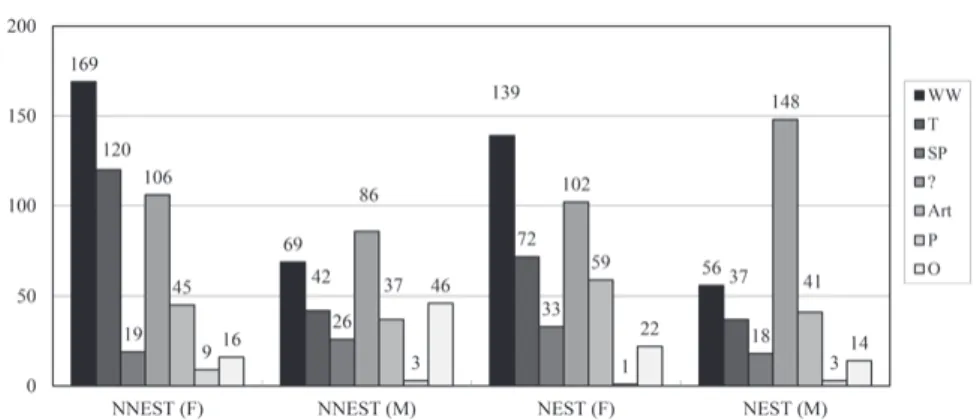
Figure shows the graph of whether or not teachers were able to focus on grammatical forms. As we can see, there seems to be a teacher difference among the four groups. In terms of focusing on tense errors, the female NNESTs( ) were the highest followed by the female NESTs( ), next the male NNESTs ( ), and lastly the male NESTs( ). Both male groups focused the most on
trying to understand the student’s message( −NNESTs and −NESTs).
Teacher understanding the content
Five sentences/phrases from the student’s essay were chosen in order to see if the teachers understood what the student was attempting to express in her essay. They are shown below :
Q ). . . to play football to such a part seriously.
Q ). . . the thought was the environment that was not rewarded. Q )Seniors who lost a provocation challenge a game.
Q )The name of a poor brain is Taro.
Q )The passion minus number figure senior of John is absorbed in football steadily.
The teachers were asked whether they would correct the sentence. If their answer was ‘no’, then they were asked to choose from the following reasons :
Figure : Teachers focus on forms
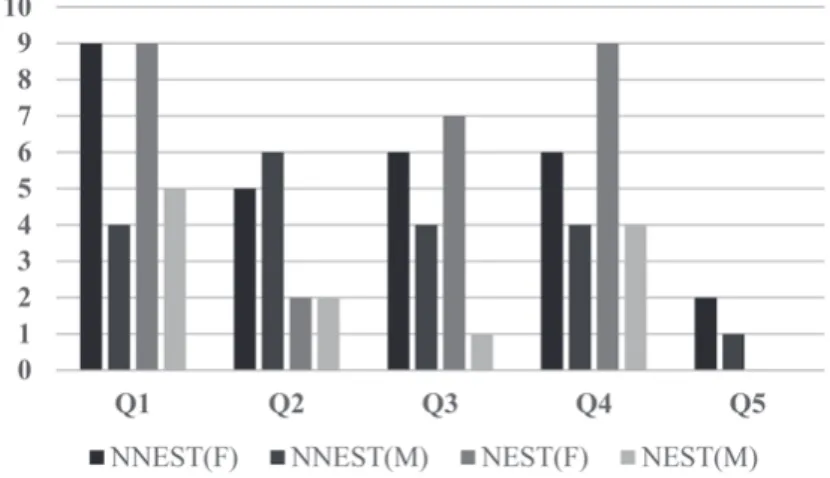
Figure : Teachers answered“Yes”
a)They can understand what the students is trying to write ; b)They completely cannot understand what the student has written ; c)Other reasons.
Figure below is a graph showing the percentage of teachers who understood the chosen sentence/phrases. It appears that there were differences in all four groups as to whether they can understand the student’s message.
Both female groups, nine teachers in each group answered that they understood Q . Next was the male NESTs group( teachers), then the male NNESTs group ( ). For Q , six of the male NNESTs answered“Yes”, then five teachers in the female NNESTs, and two teachers in both the NESTs groups understood the student’s message. Seven teachers out of the sixteen in the female NESTs group answered“Yes”to Q , six female NNESTs, four male NNESTs, and one male NEST indicating that they understood the student. In the female NNESTs group,
nine of the teachers understood the student, six female NNESTs, four male NNESTs, and four male NNESTs. Finally, two female NNESTs and one male NNEST answered“Yes.”
Figure is a graph chart of teachers who did not understand Q and their reasons. First, the seven female NNESTs who answered“No”felt that they could not completely understand the student and three felt there were other reasons for not being able to correct the student’s message. Second, two of the male NNESTs indicated that they would correct the student’s writing since they understood what she was trying to say. However, ten of the teachers would not correct the students, since they did not understand the student. One teacher had other reasons not to correct the student. Third, in the female NESTs group, three teachers said they would correct the student, three would not, and one answered ‘others’. Lastly, in the male NESTs group, there were three teachers who would correct the student’s writing, eight who did not understand, and one who had other reasons.
Figure : Teachers answered“No”and their reasons for Q
Figure : Teachers answered“No”and their reasons for Q
Figure below is a chart of teachers who answered“No”and their reasons for Q . Two of the female NNESTs would correct student’s errors, however, six of them would not since they did not completely understand the message. Two of them would not correct the students for other reasons. As for the male NNESTs, four would provide written feedback, whereas five of them did not understand, and one would not for other reasons. In the female NESTs group, two of the teachers understood the student’s message, ten teachers did not understand the student, and two would not provide corrections for different reasons. Finally, in the male NESTs group, one teacher would give feedback, and teachers would not.
Figure is the graph of teachers who answered“No”and their reasons for Q . Two of the female NNESTs answered that they would correct this sentence. Six of them did not understand the student, and three had other reasons not to provide written feedback. In the male NNESTs group, four of the teachers confirmed they would correct the student, eight teachers said they would not, and one had other
Figure : Teachers answered“No”and their reasons for Q
reasons not to correct. Two teachers in the female NESTs group said they would provide feedback, six would not, and one would not for other reasons. In the last group, one male NEST would give corrections, and would not.
For Q in Figure below, two of the female NNESTs marked that they would provide written correction. Six of the teachers said they would not, and two indicated that there are other reasons for not correcting the student. Of the male NNESTs, four out of the teachers said that they would correct the student, but seven would not. One felt there were other reasons why he would not provide feedback. Two of the female NESTs indicated that they understood the sentence, whereas four did not. One had other reasons. Lastly, in the male NESTs group, two answered they would provide written feedback, and would not.
Figure : Teachers answered“No”and their reasons for Q
Ms. Fujimoto and I found that for Q , shown in Figure below, one of the female NNESTs would correct the sentence. Eight teachers did not completely understand the sentence, and four had other reasons not to correct it. Of the male NNESTs, would not give corrections, since they did not understand the student. One gave other reasons not to provide written feedback. We also found that two of the female NESTs understood the sentence, did not understand, and one had other reasons not to correct the sentence. In the male NESTs group, only one understood the student’s message while did not.
Figure : Teachers answered“No”and their reasons for Q
NNEST(F) NNEST(M) NEST(F) NEST(M)
a b c a b c a b c a b c Q Q Q Q Q Total
Table : Total of whether or not providing feedback
Table displays the frequency of whether or not teacher would provide written feedback or not. From the table, we can see that the male NNESTs would provide more written feedback to the student compared to other groups. The male NESTs group would not give corrections. This by no means shows that the male NESTs are strict or that they grade harshly on students’ papers. A generalization of the results should be made with caution.
Discussion
First research questionThe answer to the first research question is discussed in this subsection. The first research question asked whether teachers were able to merge both form- and meaning-based instruction. In terms of the types of form-feedback, the teachers were not able to focus on a particular grammar point. Also there were concerns about the content of the student’s essay. This could be interpreted that it was difficult for the teachers to focus their attention on form.
In addition, teachers may have been cognitively loaded while correcting the essay. According to Gagné, Yekovich, & Yekovich( ), people can only retain a limited amount of information, and when they try to do several mental tasks at the same time, their performance deteriorates. In the case for the teachers in this study, they had to simultaneously : )read the essay ; )try to understand it ; ) identify the errors ; )decide which feedback to provide ; )figure out the correct form ; and finally )write down the feedback. As a result, teachers have difficulty focusing their attention on students’ grammar and written message.
Second research question
The second research question examined if there were any NEST/NNEST and/or gender factors. The findings indicated that this was not the case. Comparing the teachers in all four groups, the results showed that there were no NEST/NNEST and gender factors. Further explanations will require not only an assessment of teachers’ current practices in providing feedback, but how they developed and changed over time.
Third research question
The third research question examined whether there were any differences between the teachers in terms of beliefs in providing feedback. From the surveys about their beliefs(see Appendix B), we can see that out of the female NNESTs provide grammar and organizational feedback. Some felt that accuracy and fluency were important as well. In the male NNESTs group, eight out of the focus on grammar and organization. One felt that feedback helped his students in order to motivate them improving their writing. Two teachers underlined the errors and have students figure out the correct answer. One teacher had students which was difficult for him to provide any sort of feedback, either form- or meaning-based. All female NESTs give their students written feedback in order for them to notice their errors and improve their accuracy. Of their male counterparts, only two do not provide feedback. One teacher claims that his students do not care, while the other did not give an answer.
Implications
The results of the survey indicate that the female NNESTs were able to focus on a particular grammar point, in this case the tense forms. The reason for this could be that most of the teachers in this group currently teach or have taught high school students, and were able to determine what is relevant for students in terms of grammar points for the entrance exams.
The teachers in the study provided some suggestions as to how to correct students’ errors. They said that teachers should start small in the beginning so that the students would not be overwhelmed or frustrated with their writing. One teacher suggested that making a rubric would make it easier for the teachers to provide grades and writing assignment can be scaffolded. One way to motivate
students is to give them encouraging comments on improvement or content. Another way is to meet the students face-to-face to check on content. Others use model essays to give some kind of template as to what a ‘good’ paper should be. Some of the teachers do peer-feedback, whereas others prefer not to.
In July , Ms. Fujimoto interviewed the author’s students in her writing class about how they felt about teacher feedback in the class. Generally, the students prefer to receive comments and grammar corrections from the teachers. They wanted their teacher to write down examples of phrases and expressions that would be useful in writing. They also expressed that peer-feedback poses problems due to the lower reliability of their partner’s accuracy.
Limitations
This study has some important issues that need to be addressed in order to improve future studies. This is a small-scale study with only to teachers in each group. Second, the student essay given in the survey should have been modified or more systematic in order to determine whether or not teachers would or would not focus on specific error or errors. Another limitation was that the researchers did not use other possible essays that were written by students in other levels.
Final remarks
The findings in this study have some important points. First, there were teacher differences in two factors – NEST/NNEST and gender. Second, it is revealed that FFI is not“a teaching method for every language teacher”(Iwai & Kawamoto, , p. ). Finally, in order for teachers to provide effective
form-and meaning-based feedback, they may need thorough training form-and/or more teaching experience. However, Guénette( )claims that teachers need to be aware that “there is no ‘corrective feedback recipe’(Guenette, , p. ). In fact, teachers must not lose sight of the fact that second language acquisition is a slow, gradual, and often arduous process, and that corrective feedback is a method that teachers can provide to help students improve their accuracy.
Acknowledgement
Maki Fujimoto and I would like to thank the teachers and students who participated in our study. We would also like to thank Christine Takaguchi for her help proofreading and productive comments to improve this paper.
Funding
This study was supported by the − Special Research Fund from Matsuyama University under the author’s name.
References
Alcón, E.( ). Incidental focus on form, noticing and vocabulary learning in the EFL classroom. International Journal of English Studies, , − .
Ammar, A., & Spada, N.( ). One size fits all ? Recasts, prompts, and L learning. Studies in Second Language Acquisition, , − .
Bitchener, J.( ). Evidence in support of written corrective feedback. Journal of Second Language Writing, , − .
Bitchener, J., & Knoch, U.( ). The relative effectiveness of different types of direct written corrective feedback. System, , − .
Bitchener, J., Young, S., & Cameron, D.( ). The effect of different types of corrective feedback on ESL student writing. Journal of Second Language Writing, , − . Bruton, A.( ). Designing research into the effects of grammar correction in L writing : Not
so straightforward. Journal of Second Language Writing, , − . on Japanese University Students’ Writing
Bruton, A.( ). Improving accuracy is not the only reason for writing and even if it were. System, , − .
DeKeyser, R.( ). Beyond focus on form : Cognitive perspectives on learning and practicing second language grammar. In C. Doughty & J. Williams(Eds.), Focus on form in classroom second language acquisition(pp. − ). New York : Cambridge University Press.
Doughty, C., & Williams,( ). Issues and terminology. In C. Doughty & J. Williams(Eds.), Focus on form in classroom second language acquisition(pp. − ). Cambridge : Cambridge University Press.
Ellis, R.( ). Form-focused instruction ad second language learning. Malden : Blackwell Publishers.
Ellis, R.( ). Explicit form-focused instruction and second language acquisition. In B. Spolsky & F. M. Hult(Eds.), The Handbook of Educational Linguistics(pp. − ). Malden : Blackwell Publishing.
Evans, N. W., Hartshorn, K. J., & Strong-Krause, D.( ). The efficacy of dynamic written corrective feedback for university-matriculated ESL learners. System, , − .
Ferris, D. R.( ). The“grammar correction”debate in L writing : Where are we, and where do we go from here ?(and what do we do in the meaning...?). Journal of Second Language Writing, , − .
Ferris, D. R., Liu, H., Sinha, A., & Senna, M.( ). Written corrective feedback for individual L writers. Journal of Second Language Writing, , − .
Gagné, E. D., Yekovich, C. W., & Yekovich, F. R.( ). The cognitive psychology of schooling learning. New York, NY : HarperCollins College Publishers.
Guénette, D.( ). Is feedback pedagogically correct ? Research design issues in studies of feedback on writing. Journal of Second Language Writing, , − .
Hartshorn, K. J., Evans, N. W., Merrill, P. F., Sudweeks, R. R., Strong-Krause, D., & Anderson, N. J.( ). Effects of dynamic corrective feedback on ESL writing accuracy. TESOL Quarterly, , − .
Hedge, T.( ). Teaching and Learning in the Language Classroom. Oxford : Oxford University Press.
Hyland, K., & Hyland, F.( ). Feedback in Second Language Writing. Cambridge : Cambridge University Press.
Iwai, C., & Kawamoto, J.( ). Factors affecting teachers’ feedback. In A. Stewart(Ed.), JALT Conference Proceedings. Tokyo : JALT.
Jensen, J. C.( ). Skill acquisition and second language teaching. Kinki University Department of Language Education Journal , , − .
Williams(Eds.). Focus on form in classroom second language acquisition(pp. − ). Cambridge : Cambridge University Press.
Loewen, S.( ). Uptake in incidental focus on form in meaning-focused ESL lessons. Language Learning, , − .
Long, M. H.( ). Instructed interlanguage development. In L. Beebe(Ed.). Issues in Second Language Acquisition : Multiple Perspectives. New York : Newbury House.
Long, M. H.( ). Focus on form : A design feature in language teaching methodology. In K. DeBot, R. Ginsberge, & C. Kramsch(Eds.), Foreign language research in cross-cultural perspective(pp. − ). Amsterdam : John Benjamins Publishing.
Long, M. H., & Robinson, P.( ). Focus on form : Theory, research, and practice. In C. Doughty & J. Williams(Eds.). Focus on form in classroom second language acquisition(pp.
− ). Cambridge : Cambridge University Press.
Montgomery, J. L., & Baker, W.( ). Teacher-written feedback : Student perceptions, teacher self-assessment, and actual teacher performance. Journal of Second Writing, , − . Nguyen, T. T. M., Pham, T. H., & Pham, M. T.( ). The relative effects of explicit and
implicit form-focused instruction on the development of L pragmatic competence. Journal of Pragmatics, , − .
Park, J. K.( ). The effects of forms and meaning-focused instruction on ESL learners’ phonological acquisition.(Unpublished doctoral dissertation). University of Pennsylvania, Philadelphia, Pennsylvania.
Saraceni, M.( ). Meaningful form : transitivity and intentionality. ELT Journal , , − . Spada, N.( ). Form-focussed instruction and second language acquisition : A review of
classroom and laboratory research. Language Teaching, , − .
Spada, N., & Lightbown, P.( ). Form-focused instruction : Isolated or integrated ? TESOL Quarterly, , − .
Truscott, J.( ). What’s wrong with oral grammar correction ? Canadian Modern Language Review, , − .
Appendix A
Coding System : Please use the following codes for grammatical feedback on page : WW : Wrong Word
T : Tense errors SP : Spelling Mistake
? : I don’t know what you are trying to say. Art : Articles
P : Preposition
O : Others(that are not on the list, but you feel feedback is necessary. Please write down what you would correct)
Example : Bruce Willis a WW
not famous actor.
Student Essay :
There is very popular American football club in the Pacific University. This is because the famous reason is not because it is strong and is a bad group. There was person what wanted① to play football to such a part seriously. The member who did not have the supervisor quarreled, and ② the thought was the environment that was not rewarded. One thing short Shinnyu member appeared there. He was not at all a body suitable for football. When he made up his mind to enter the district, seniors were angry very much. Because if a person doing it seriously enters, influence appears to oneself and is annoying. I called it, and the child was added to a senior after school. “Do you think that you can play football with you sach small body ?” As a senior made a fool, he said. “Play if you think that it is impossible.” I watched the Shinnyu member whom I provoked with confidentness, and one said. “Let’s leave such a guy”“I do not say one to one ! I win with five to one !” The Shinnyu member said. ③ Seniors who lost a
provocation challenge a game. A strong kick enters as soon as it begins. The person who looked covers the eyes. “It is not football. It is bullying”curious spectators say. However, he go to the next defense in a start. He dodge the senior whom he waited for smoothly. Seniors did not get a motion about an instant. However, the last defense got a punch in a face. I hold down a face and crouch down. “Our victory. Give up the joining a club !” The senior says. “Wait ! I make then game.” I say for the vexation that defense was exchanged, “Now you are talking !” Shinnyu menber laughs with a spear yes.... The game is − . It was Shinnyu menber to have won ! The name of the child is John. John says to seniors. “I will play football. It is a promise.” ④ The name of a poor brain is Taro. Taro was the person who wanted to play football. Taro went home, it was not easily separated from a head that defense was skipped. It was unbearable that it was regrettable he came, and to have done a crushing defeat to a one partner. The Pacific University football club was created in the way. I began it and became the district. ⑤ The passion minus number figure senior of John is absorbed in football steadily. It became strong whenever their repeated an exercise, a game. The football club having a sing of the national conventio participation kept being already at a loss. The eyes of the circumference changed, and themselves grew up very much above all.
Appendix B
University teaching experience : .Do you teach English writing ?
Yes(If yes, please answer through .) No
.How many years have you been teaching and teaching writing ?
Teaching Teaching writing
.How many writing classes are you currently teaching ?
.How many students are in each class ? Also what level are they ?
stclass students level
nd
class students level
rdclass students level
th
class students level
thclass students level
th
class students level
.Do you do peer feedback in your writing classes ? Yes No (If yes, please answer number )
.When do you do peer feedback ? Feedback
.Do you normally provide written feedback on students’ essays and/or writing ? a)Yes No (If yes, please answer . If no, please answer .)
. a )If yes, what are the reasons ? Briefly explain.
b)What do you mainly focus on ? Grammar / Content / Organization and why?
.If no, what are the reasons ? Briefly explain.
.What advice would you give for someone who will start teaching a writing class in terms of correcting papers ?
To what extent do you agree with the following statement ?
Strongly Disagree
Disagree Agree Strongly agree A.There is no need for teachers to provide
feedback on student error in writing. B.It is teacher’s job to locate errors and provide
grammar corrections for students.
C.It is teacher’s job to locate meaning errors and correct the error if possible.
D.It is teacher’s job to correct both grammatical and meaningful errors.
E.Students should learn to locate and correct their own errors.
Please circle the most appropriate box for each statement.