64
DOI: http://dx.doi.org/10.14246/irspsd.4.1_64
Copyright@SPSD Press from 2010, SPSD Press, Kanazawa
Study of Performance Assessment for Urban Renewal Project in Taipei City
Kuan-Hua Huang1*, Jen-Te Pai1 and Jen-Hua Liu1
1 Department of Land Economics, National Chengchi University
* Corresponding Author, Email: [email protected] Received 4 May, 2015; Accepted 29 August, 2015
Key words: Urban renewal, Performance assessment, DEA
Abstract: When the city develops to a certain extent, the city will have some problem of aging. In order to solve this problem, the governments carry out "urban renewal" policies to cope with it. Urban renewal makes the urban land to reuse with the urban planning, the urban function to recovery, the life to improve, and to raise the public Interest. The Taiwan Government has published the
“Urban Renewal Act” and “Bulk Reward for Urban Renewal” since 1998 to promote the urban renewal policies and civil participation. Taipei, though, is the earliest and the most experienced city in Taiwan which has already conducted 221 urban renewal projects so far, neither the projects themselves can present the specific interests created nor the government can assess the effectiveness of them. In recent years, a Data Envelopment Analysis (DEA) method is widely used in various fields. Because the process of urban renewal involves a variety of input and output factors, the relationship between them can be regarded as a major project for performance assessment. This study, therefore, categorizes the urban renewal projects in Taipei City as a decision making unit. The influential factors were further determined and divided into environmental, economic and social dimensions. Following this, the DEA method was used to evaluate the efficiency of urban renewal projects. Finally the outcomes of evaluation can be used as an approach for government and developers to propose an efficient urban renewal project.
1. INTRODUCTION
After rapid development from the 1970s, urban areas in Taiwan are gradually faced with traffic congestion, deficiency in public facilities, deteriorating environmental quality, and slum buildings. Under these urban decay phenomena, urban renewal is regarded as an effective strategy to resolve urban aging and achieves the objectives of economic, environmental and social dimension for the city. The Taiwan Government has encouraged civil participation in urban renewal through measures such as “Urban Renewal Act” and “Bulk Reward for Urban Renewal” since 1998, which attempts to deliver urban renewal policies that meet the public demand.
Moreover, the Government also intended to attract funds, human resource and executive power of the private-sector, which further accelerates the urban renewal process, and thereby to improve urban aging and enhance urban functions effectively.
Whitford and Ennos et al. (Whitford and Ennos et al. 2001) and Kao and Huang et al. (Kao and Huang et al. 2003) suggested that in response to the
environmental impacts from social-economic growth, the process of urban development must reduce environmental damage and excessive use of resources, thereby improving urban development efficiency. According to the Urban Renewal Portal for Construction and Planning Agency, Ministry of the Interior, the statistic data show that there are 221 urban renewal projects approved in Taipei City as of February 2014. Taipei is the area that owns the most experiences of urban renewal in Taiwan. Nonetheless, the aforementioned approved urban renewal projects do not specifically present the effectiveness that the projects intend to achieve. In addition, the investment funds, endeavouring of bulk rewards for urban renewal and the degree of economic, social and environmental improvements also lack objective evaluation methods. Consequently, both the developers and the government fail to effectively control whether or not the renewal projects chosen result in effective resource use and meet the expected objectives of urban renewal.
To incorporate the effectiveness of urban renewal into the project, Friedly (Friedly,1969) proposed that the performance of urban renewal can be evaluated through establishing urban renewal indicators and be estimated based on a cost-benefit analysis. Hence, this study attempts to analyse the actual effect of urban renewal projects in Taipei based on data envelopment analysis and discusses whether the input resources are utilized effectively with respect to the economic, environmental and social dimensions. The study expects to assess the input and output efficiency under the limited urban renewal resources. The result can further be regarded as a reference for choosing further urban renewal projects and adjustment on urban renewal policies.
1.1 Urban Renewal
1.1.1 Context of Urban Renewal
The change of environmental quality in neighbourhoods will inevitably draw value changes of neighbourhood properties (Schall,1971). The purpose of urban renewal aims to improve the urban environment, which consequently affects the environmental quality outside of the renewal area.
Urban renewal can eliminate inferior quality of buildings and transform negative externality into positive ones which further increases the property value. The Taipei City Government started to promote urban renewal in the promulgation of “Taipei City Urban Renewal Implementation” in 1983.
However, not until the approval and implementation of the “Urban Renewal Act” in 1998 did the public sectors and private sectors engage in a series of activities. The public sectors emphasize how to make urban land more developed through land use planning. On the contrary, the private-sector focuses on the profit of the real estate market (Lan and Lai et al., 2008).
Hence, urban renewal is an investing behaviour for the private sectors, which involves real estate market fluctuation, cost fluctuation, renewal schedule, revenue generation and other risks. The government is required to provide incentives such as bulk rewards and subsidies in order to promote urban renewal through the power of private sectors. After 2000, measures of the bulk reward and availability of preferential funds were incorporated into the urban renewal policies which aim to encourage the private sectors investing in urban renewal while the government serves as a coordinator and supervisor. Namely, the private sectors invest in and bear the cost while the
public sectors give bulk reward to urban renewal projects through the review mechanism.
1.1.2 Benefits of Urban Renewal
As provided in Article I of the Urban Renewal Act, the purpose of urban renewal is to promote the planned redevelopment and use of urban land, renovate urban functions, improve the living environment and increase the public interest. Huang (Huang, 1984) and Shih (Shih, 1997) indicated that the purposes of urban renewal can be categorized into four dimensions while each purpose is correlated with mutual impact, including: (1) Essential purpose: Improve living environment and public facilities, eliminate public safety problems resulting from slum areas, increase residential supply and renew urban functions; (2) Economic purpose: Revitalize economics by attracting investors, create employment opportunities, increase tax revenue and improve financial structure of local government and efficiency of public investment; (3) Social purpose: Provide employment opportunities, improve living quality of low-income residents, eliminate the social issues derived from poverty and fulfil principles of social fairness; (4) Political purpose:
Highlight the outcome of government policies, improve urban competitiveness, recall community awareness in residents, and promote public participation. Carmon (Carmon, 1999) further indicated that benefits created by urban renewal can be categorized into the following: (1) preventing disadvantaged groups from segregation; (2) taking consideration of economic development and social justice; (3) progressive and soft solutions; (4) promoting public-private cooperation; (5) different areas adopting differentiated processing methods and other strategies. Wu (Wu, 2001) suggested that urban renewal aims to improve urban functions and living quality. The areas of urban renewal units will gather for the homogeneity of urban functions and further result in the centralized effect of spatial distribution. The literature mentioned above show that the purpose (or benefit) of urban renewal is to improve the essential environment, stimulating economic development, and takes consideration of social public interests. Hence, this study classifies the outcome of urban renewal projects into economic, environmental and social dimensions, which attempts to select quantitative indicators from the urban renewal process.
1.2 Performance Assessment
All the organizations have business goals and require some information to determine if the organizations are progressing on the right track.
Performance assessment refers to the systematic process where an organization intends to accomplish certain goals, plans how to accomplish the goals and assesses whether or not the organization has accomplished the goals. Drucker (Drucker, 1998) defined performance assessment as the management function in essence. Performance assessment helps understand the degree of execution of the project and determines corrective countermeasures when the project deviates from the planned direction. The establishment of an assessment system will guide the action takers in decision making and behaviours prior or during the activities, thereby reconciling the objectives endeavoured and the organizational goals.
Szilagyi (Szilagyi, 1984) defined performance as the composition of two factors, namely efficiency and effectiveness; where effectiveness refers to the level of goal accomplishment while efficiency refers to the output/input
ratio for measurement. In sum, performance assessment can be regarded as a mechanism of establishing certain standards and control for organizations to accomplish their goals, and is an economically efficient method that emphasizes expenditure review, productivity increase and reduction of waste of resources. Such methods will help decision-makers understand in-depth how to improve decisions and comply with the establishment of project goals. Hence, this study intends to assess the performance of urban renewal projects in Taipei City. Some common performance assessment methods include Ratio Analysis, Regression Analysis and Data Envelopment Analysis (DEA) (Thanassoulis, 1993); Thanassoulis and Boussofiane et al (Thanassoulis and Boussofiane et al., 1996); Sun (Sun, 2004). The characteristics, context, pros and cons of each method are discussed as follows:
(1) Ratio Analysis
Thanassoulis and Boussofiane et al (Thanassoulis and Boussofiane et al., 1996) proposed ratio analysis as a more traditional assessment method. The production efficiency derived from ratio analysis method is biased towards single-use elements and neglects the contribution of other input elements, which will easily result in decision errors and resource waste. The difficulty in measuring efficiency when taking into consideration multiple inputs and outputs lies in the lack of universal standards of output comparisons. The drawbacks of the method are described as follows: (1) Sole performance of the relationship between single input and single output. (2) It is difficult to obtain the overall performance from the decision making unit when measuring all performance indicators on the different performance levels. (3) It is difficult to formulate efficiency standards and the efficiency could not be confirmed for different units. (4) The use of multiple variables requires use of weights while the weighted ratios in variables could be more subjective and lack objective basis.
(2) Regression Analysis
Regression analysis is an ex-post analysis method that objectively determines the weighted relationships between input and output factors;
nonetheless its main limitation lies in its inability to process multiple outputs. However, land use planning is so complex that the feasibility of such analysis is constrained due to the massive factors (output) that should be considered. Furthermore, the result of regression analysis emphasizes the overall conditions of the majority, which will neglect the specific conditions of individuals. The drawbacks of the method are described as follows: (1) Sole performance of the central trend of regression without identifying between efficient variables and inefficient variables. (2) Only one output is permitted to be evaluated. (3) The result is an average performance of efficiency value rather than the best relative performance. (4) The coefficient value of the independent variables could not be compared.
(3) Data Envelopment Analysis (DEA)
Data Envelopment Analysis refers to a linear programming-based method, a relative efficiency method that measures Decision Making Units (DMU) with multiple inputs and multiple outputs (Thanassoulis, 1993).
DEA applies a production boundary as the foundation of efficiency measurement and yields the production boundary using mathematical models without presetting the nonparametric approach of production functions. DEA can explicitly identify the relative inefficient units and is substantially more precise than the traditional regression analysis. Another advantage of DEA is that the boundary value and the objective standard are
less likely affected by the correlation between inputs and outputs or the influence from multicollinearity (Thanassoulis, 1993).
(4) Comparison of Assessment Method
Ratio analysis can only be used to assess the relationship between single input and single output. Regression analysis estimates the function relation between multiple inputs and a single output. DEA can concurrently take the efficiency relationship between multiple inputs and multiple outputs into consideration. In addition, DEA does not need default weights for input or output. Due to the aforementioned advantages, DEA is considered to be the most feasible and easiest method for assessing relative efficiency, particularly for the environment of multiple inputs and outputs. In recent years, a number of studies related to environmental efficiency assessment identified DEA as a more appropriate analysis method (Barnes, 2006;
Bosetti and Buchner, 2009). Because the multiple inputs and multiple outputs of urban renewal projects are attributed to different measurement units, which are in compliance with the DEA characteristics, this study assesses the objects using the DEA method.
1.3 Urban Renewal Performance Assessment
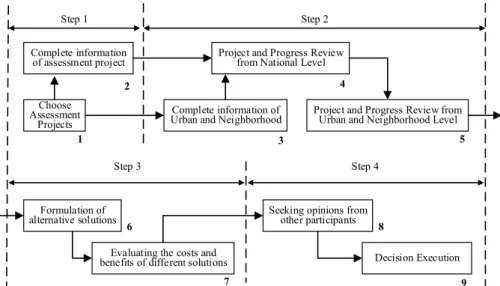
U.S. real estate research companies and other related urban departments suggested the purpose, types, process, and discussion of urban renewal projects in “Evaluating local urban renewal projects: a simplified manual” in 1975. The purpose of assessment is to change current urban conditions, review the fees required for renewal projects, determine the bodies of urban renewal, and assess the effectiveness of the renewal project. Additionally, Figure 1 shows the Urban Renewal Project Assessment Flowchart. The first step is to choose assessment projects, influence factors and further search the relevant information. The second step requires complete information of macro urban and neighbourhood areas to examine the urban renewal projects under the different levels and experience from the state, city to the neighbourhood. In the third step, multiple alternatives are designed to evaluate the “cost and benefits” of the solution in order to validate the feasibility of a project. Finally, multi-cooperation and decision making needs to be carried out to formulate relevant action plans.
Complete information of assessment project
Choose Assessment
Projects
Complete information of Urban and Neighborhood
Project and Progress Review from National Level
Project and Progress Review from Urban and Neighborhood Level
Step 1 Step 2
Step 3 Step 4
Formulation of alternative solutions
Evaluating the costs and benefits of different solutions
Seeking opinions from other participants
Decision Execution 1
2
3
4
5
9 8
7 6
Figure 1. Urban renewal project assessment flowchart
Chang (Chang, 2000) suggested that the context of urban redevelopment consists of characteristics in essential environment, social, economic and political dimensions. The study developed a systematic framework with 12 objectives and 36 indicators via the Delphi technique and used the Fuzzy Hierarchical Analysis method to attain the weights of the framework. The results show that the assessment indicator of the economic dimension weighs the highest, followed by the environmental dimension, the social dimension, and finally the political dimension. Lum and Sim et al. (Lum and Sim et al., 2004) analysed the government policies advocated in Singapore and found that an urban renewal strategy could cause unpredicted and opposite results, i.e. the omission of environmental characteristics and acceleration of economic decay. Hence, the advocacy of urban renewal policies not only needs to assess policy effectiveness but also confront adverse impacts. Lee and Chan (Lee and Chan, 2008) assessed urban renewal in Hong Kong by questionnaire survey and a Delphi Hierarchical Analysis. The study proposed the key factors for urban renewal projects from the dimensions of sustainable development, i.e. economic, social and environmental dimensions, and attained the urban renewal performance assessment system.
Chou (Chou, 2009) established a hypothesis and used the urban renewal projects in Taipei City to examine whether the property complexity, market value and government measures will influence the completion time of urban renewal. The regression analysis method was used and the variables considered in the study includes the number of squatter houses, post-renewal property value and bulk reward ratio etc. It is one of the few studies that use a quantitative method to examine the effectiveness of urban renewal.
Urban renewal is becoming the primary market for land development in Taiwan. Though the majority of academic research has emphasized on the discussions of policies and legal systems, few studies have examined the performance of urban renewal from the perspective of investment in renewal resources. This study therefore adopts the DEA method for multiple decisions by using various urban renewal units with multiple inputs and outputs to assess the performance of urban renewal. The application of the DEA based performance assessment method on the feasibility of urban renewal development can be used for calibration of an urban development strategy and as reference tools for the government in review of decisions to approve bulk rewards for urban renewal projects.
2. RESEARCH DESIGN
2.1 Objects
The study comprised the 221 urban renewal projects approved by Taipei City between November 1998 and February 2014 from the Urban Renewal Portal of Construction and Planning Agency, Ministry of the Interior (CPAMI). However, due to the limited number of right transfer projects implemented and incomplete data, 79 Decision Making Units (DMU) were applied with DEA after screening and deducting. It is worthy to mention that according to the empirical rules on DEA use proposed by Golany and Roll (Golany and Roll, 1989), the number of DMU assessed should at least be twice the sum of the inputs and outputs. Because the study selects 11 input
and output variables and the number of the valid DMUs with complete data are 79, the aforementioned empirical rule was therefore satisfied.
2.2 Method
Urban renewal is a decision issue that comprises multiple objectives of mutual conflicts. The government has to take multiple objectives into consideration currently including the variables of economic, environmental and social dimensions. Hence, the study suggests that the renewal agency of the government should concurrently take its expected objectives and reasonable profit for the developer into consideration during the review process. Based on the characteristic mentioned above, the DEA method which Charnes and Cooper (Charnes and Cooper, 1978) established is suitable for the performance measurement of the multi-input and multi- output urban renewal projects. This study thus applies a CCR(Charnes- Cooper-Rhodes) model and BCC(Banker-Charnes-Cooper) model in DEA as the efficiency measurement models. Using those models to determine DMU corresponding point lies efficient frontier above. Because CCR point on the efficient frontier means technology not only effective, but also the scale efficiency.
CCR model merely yields a total efficiency value and lacks the complete information. Hence, the study applied the BCC model to divide the total efficiency value into pure technical efficiency and scale efficiency. The information can be further used by the government to suggest the developer to adjust the direction and input extent of resources on the review phase.
Moreover, the study used the efficiency values of different units derived from DEA to carry out the sensitivity analysis which aims to understand the impact of increase or decrease of input factors on relative efficiency.
With regards to input and output oriented model configuration, this study evaluates the efficiency by using “Input Orientation” and “Standard model”
(Banker, 1984) mainly because the input variables can be better controlled during the urban renewal process. Excessive inputs can be adjusted downward to increase execution performance. On the other hand, the efficiency of urban renewal aimed at the current output level and how to get input costs can be minimized. Therefore, it is more applicable to apply input oriented evaluation of efficiency.
2.3 Selection of Performance Assessment Indicators
To effectively control assessment factors that could possibly affect urban renewal development, any relevant factors that affect the performance of DMU should be extensively listed in the assessing factors at the beginning when defining the influential assessment factors. These factors consist of controllable and non-controllable environmental factors while the screened input and output factors must be able to explain the impact of each factor on efficiency logistically. Hence, the relationship between factors can undergo analysis of correlation for validation.
2.3.1 Preliminary Output Screening
To promote the planned redevelopment and use of urban land, the legislative purposes of Urban Renewal Act, with an explicit definition in Article I, are to revitalize urban function, improve living environments and
increase public interests. This study classifies the aforementioned three objectives into economic, environmental and social dimensions as the assessment standard based on the content of the literature review. Regarding the output factor, the post-renewal value of real estate is used as the proxy variable of the economic dimension, and the open space and sidewalk created by urban renewal projects is used for the proxy variable of the environmental dimension. Finally, the area provided for the public facilities and resident relocation is used as the proxy of the social dimension (Table 1).
2.3.2 Preliminary Input Screening
According to the selection principles of the DEA indicator, input factors refer to the resources that contribute to the output. For the developers, factors that affect the willingness to invest include base conditions, property condition and development profits. This study uses eight types of influential factors as the input variables which includes land area of renewal unit, ratio of public land area in renewal unit, floor area ratio, proportion of the agreed owner to participate in urban renewal, construction costs of buildings, urban renewal schedule, management techniques and bulk reward for urban renewal project given by the government (Table 1).
2.4 Relevant Analysis
The application of the DEA model requires a positive correlation between the selected inputs and outputs to comply with the isotonicity requirement. Pearson correlation emphasizes on processing the linear correlation between two random variables. Hence the study applies Pearson’s correlation analysis method to validate the final selection of input and output factors. This study discovers that all the factors reach a positive correlation, among which the area of renewal units is positively associated with the social dimension with a highly significant value. It implies that the greater the land area of renewal units is, the more likely the existing residents can be well relocated.
2.5 Input / Output Selection
Table 1 shows the determined input and output variables of the DMU in this study after the Pearson’s Correlation Analysis. The meaning of each variable to urban renewal projects were described as follows.
Table 1. Input and output variables of the DEA
Variable Definition Unit
Input
Base Condition
1. Land area Area of renewal unit m2
2. Public land ratio Ratio of public land area in renewal unit %
3. Development intensity Floor area ratio %
Input of Developer
4. Integration degree Proportion of the agreed owner to
participate in urban renewal %
5. Construction costs Construction costs of buildings Million NT$
6. Urban renewal schedule time required for renewal Year 7. Management techniques* Management costs indicated in project Million NT$
Input of Government
8. Ratio of renewal reward Bulk reward approved by government %
Variable Definition Unit Output
Economic Dimension
1. Post-renewal value Real estate value after renewal Million NT$
Environmental Dimension
2. Open space and Sidewalk Area of open space and sidewalk created m2 Social Dimension
3. Public facilities and residents relocation **
Area provided for public facilities and
relocation use m2
* The profit that should be obtained by implementer due to the creativity proposed, management techniques and risk taking; where higher profit implies greater input and higher renewal efficiency.
** Social welfare facilities for community use, including activities’ center, libraries and so on, as well as the relocation area provided for the current residents.
3. EMPIRICAL RESULTS
3.1 Relative Efficiency Analysis
The overall efficiency of the urban renewal projects is derived from the CCR model. The average efficiency value of DMUs is 0.99. There are 64 urban renewal projects with a total efficiency value of 1, which accounts for 84% of the total DMUs population. Norman and Stocker (Norman and Stocker, 1991) specify this kind of DMU as the “Robustly Efficient Units”.
The total technical efficiency, pure technical efficiency and scale efficiency of the projects are 1, which suggests the full utilization of inputs by these projects without waste. The appropriate scale will contribute to the maximum output for economy, environment and society. The aforementioned urban renewal projects with efficiency values of 1 are distributed as following: 1 projects in Wanhua District, 2 projects in Shilin District and Datong District respectively, 3 projects in Beitou District, 5 projects in Xinyi District and Neihu District respectively, 6 projects in Daan District and Zhongzheng District respectively, 7 projects in Zhongshan District and Songshan District respectively, 8 projects in Nangang District, and 12 projects in Wenshan District. As for the other kind of DMU proposed by Norman and Stocker (Norman and Stocker, 1991), the total efficiency values which are less than 0.9 are defined as Distinctly Inefficient Units.
There are 3 projects with a relatively low total efficiency value of 0.89 on average and the distribution of these projects are mainly located in Datong District and Xinyi District.
Table 2 compares the base characteristics of the urban renewal units between the efficient DMUs and inefficient DMUs. This study shows that DMUs with high efficiency have greater land area, which accompanies a higher floor area ratio than inefficient DMUs. Nonetheless, the public land ratio shows no difference between the two kinds of DMU. The result indicates that the renewal unit with a greater land area, higher floor area ratio has more likelihood to execute an efficient urban renewal project while the proportion of the public land area of the renewal unit does not have direct impact on the efficiency of urban renewal execution.
Table 2. Comparison table of the DMU on base characteristics Unit characteristics
(unit)
Efficiency classification
Robust efficiency Distinct inefficiency Administrative district Focusing on Wenshan district Focusing on Datong district
Unit characteristics (unit)
Efficiency classification
Robust efficiency Distinct inefficiency
Land area (m2) 3,321 3,092
Public land ratio (%) 0.2 0
Development intensity (%) 333 326
In the urban renewal process, the developer invests in integration, construction, time and management techniques while the government induces the private-sector to implement an urban renewal project and put into other resources through bulk reward. This study compares the input characteristics between the efficient DMUs and inefficient DMUs. Table 3 shows that DMUs with higher efficiency feature higher investment in building cost and higher bulk reward approved by government. In other words, higher costs invest in building construction and higher bulk reward will create more efficiency of urban renewal. On the other hand, a higher proportion of the agreed owners to participate in urban renewal and higher costs in management techniques do not necessarily result in urban renewal with high efficiency. As Chung Wen (Chung, 2012) pointed out, developers must be able to reduce integration costs to increase profit. Finally, the renewal schedule of the project with high efficiency is six years, which is three years shorter than those with low efficiency on average. The result indicated that the longer the schedule of the urban renewal is, the lower the performance will be.
Table 3. Comparison table of the DMU on input characteristics Unit characteristics
(unit)
Efficiency Classification
Robust efficiency Distinct inefficiency
Integration degree (%) 64 67
Construction costs (million NT$) 970 906
Urban renewal schedule (year) 6 9
Management techniques (million NT$) 193 263
Ratio of renewal reward (%) 42 35
For the benefit created by urban renewal in the economic, environmental and social dimensions, Table 4 shows that DMUs with higher efficiency will generate a higher output than those generated by the DMUs with lower efficiency. The result indicates that urban renewal projects with higher performance can better create overall benefits of urban renewal.
Table 4. Comparison table of the DMU on output characteristics Unit characteristics
(unit)
Efficiency Classification
Robust efficiency Distinct inefficiency
Post-renewal value (Million NTD) 2,861 2,679
Open space and Sidewalk (m2) 858 729
Public facilities and residents relocation
(m2) 850 790
3.2 Slack Variable Analysis (SVA)
For the DMUs with an overall technical efficiency value of less than 1, this study further conducts the Slack Variable Analysis to understand the improvement amount between inputs and outputs of the inefficient urban renewal projects. Because the BCC model used in this study is input oriented, if the improvement direction shows on the input side, the amount of inputs should be reduced; on the contrary, if the improvement direction shows on the output side, the amount of outputs should be increased. The improvement ratio of the inputs and output is categorized in Table 5.
Table 5 shows that among the input variables, public land ratio shows the greatest extent of input reduction, followed by the reduction in integration degree, urban renewal schedule and management techniques. The result suggests that to achieve relative efficiency and shorten the overall renewal schedule, it is better to choose a renewal unit with small public land and avoid consuming excessive costs on integration and management techniques, which is usually the typical type of increased marginal cost, to pursue the high integration degree and low risk.
With regards to output variables, the improvement factor first focuses on the social dimension, followed by the environmental dimension and eventually the economic dimension. The result shows that the renewal results should strengthen the output of the social dimension and environmental dimension to meet the objectives of public interests and improvement of the living environment. This result is similar to Hemphill, Berry and McGreal (Hemphill et al., 2004), whose study found measurable indicators of sustainable urban renewal. That urban renewal should focus on social factors, community and conservation of natural resources.
Table 5. Improvement ratio of the inputs and output.
Category Improvement
direction Variables Improvement ratio
(%)
Input Reduce
Land Area 0.31
Public Land Ratio 34.9
Development Intensity 0.49
Integration Degree 4.72
Construction Costs 0.68
Urban Renewal Schedule 4.12
Management Techniques 3.17
Ratio of Renewal Reward 1.97
Output Increase
Post-Renewal Value 0.58
Open Space and Sidewalk 3.75
Public Facilities and Residents’ Relocation 6.13
3.3 Sensitivity Analysis
The study conducts a sensitivity analysis to explore the influences of the increase or decrease in input on relative efficiency. Because the study uses the input oriented approach for the performance assessment, the sensitivity analysis is conducted from the aspect of input dimensions and explores the changes of the efficiency ratio. Table 6 shows that the deletion of individual factors will not change the overall efficiency substantially in general.
However, deletion of the development intensity (floor area ratio), bulk reward and land area will lead to lower efficiency values. The result implies that the original conditions of urban renewal units, i.e. the floor area ratio and land area, are more sensitive than other variables. In addition, endeavouring to receive a bulk reward in the urban renewal process is also sensitive to the renewal outcome. The three variables are therefore regarded as the major factors affecting urban renewal benefits, which helps developers to decide whether to carry out renewal projects and endeavour to receive a bulk reward. Governments can use this type of bulk reward of public resources to create and ensure profit for private investment (McGuirk, et al., 1996).
Table 6. Sensitivity analysis of input variables
Deleted variable Ratio change (%) Total Average Efficiency value
No Deletion 0 0.99
Land Area 2 0.98
Public Land Ratio 0 0.99
Development Intensity 4 0.96
Integration Degree 0 0.99
Construction Costs 0 0.99
Urban Renewal Schedule 0 0.99
Management Techniques 0 0.99
Ratio of Renewal Reward 3 0.97
4. CONCLUSION AND SUGGESTIONS
4.1 Conclusion
This study explores the correlation between input resources and output benefits of urban renewal by using 79 valid samples of urban renewal projects in Taipei City. The DEA method is used to establish the performance assessment model and the efficiency value is derived, which not only allows the developer to evaluate the feasibility of urban renewal development, but also uses the reference tools for the government to review the amount of bulk rewards for the urban renewal projects. The conclusion of the study is drawn as follows:
(1) This study finds that compared with inefficient DMUs, the highly efficient DMUs feature greater land area, higher floor area ratio, higher investment of construction costs, and endeavouring for higher bulk rewards. In addition, the result of sensitivity analysis also supports that land area, floor area ratio and bulk reward are sensitive factors that affect efficiency. The aforementioned result indicated that the urban renewal unit with greater land area and higher floor area ratio, plus proper input of construction costs and endeavouring of bulk reward during the urban renewal process is more likely to result in an efficient urban renewal project.
(2) With regards to the output of urban renewal benefits, the study finds that the efficient urban renewal project tends to have a higher output value for the economic, environmental and social dimensions, which indicates that there is a positive correlation between the execution performance and the overall benefits created by urban renewal. In cases where the developer inputs resources effectively, they will be able to increase the value of real estate, the quality of open space, sidewalk, and public facilities as well as the relocation of current residents, which further promotes public interests.
(3) The improving factors of the inefficient urban renewal projects include the reduction of the public land ratio, integration degree and urban renewal schedule, which suggests that it is better to choose an urban renewal unit with small public land and avoid consuming excessive integration costs to shorten the overall renewal schedule. Additionally, the output of the social and environmental dimensions should be increased first to reach the relative efficiency.
4.2 Suggestions
This study proposes the following suggestions to promote the execution performance of urban renewal from the perspective of developer and government agencies.
(1) From the view point of the private sector, to enhance intensity of development and increase the benefit of urban renewal, developers may choose a base with larger land area and higher floor area ratio when defining the renewal units or assessing whether to carry out the renewal development. Nonetheless, excessively high public land ratio and integration degree could decrease the implementation power of the developer and increase the time cost respectively, which further results in decline of the execution efficiency of the renewal projects.
(2) From the view point of the government, though bulk reward will increase developers’ intentions to invest in urban renewal, the study finds that the benefits of bulk reward on the environmental and social dimensions are insignificant, but increase the post-renewal value of real estate significantly. Hence, it is suggested that the approval of bulk rewards should emphasize on the environmental and social dimensions with specific and clear mechanisms, which makes the developer provide the equivalent open space, public facilities, sidewalk, and relocation of existing residents.
(3) It is suggested that future studies may apply the Tobit regression model to conduct an analysis based on the efficiency value yielded from the DEA and explore the influence of each input factor on the efficiency value. In addition, future studies are suggested to further provide support for the literature on social costs of urban renewal, property structure, and public-private collaborative development with more exact description.
REFERENCES
Banker RD (1984). “Estimating Most Productive Scale Size Using Data Envelopment Analysis.” EJOR 17(1): 35-44.
Barnes, A. P. (2006), “Does Multi-functionality Affect Technical Efficiency? A Non- parametric Analysis of the Scottish Dairy Industry”, Journal of Environmental Management, 80 (4), 287-294.
Bosetti, V. and Buchner, B. (2009), “Data Envelopment Analysis of Different Climate Policy Scenarios”, Ecological Economics, 68(5), 1340-1354.
Charnes A, Cooper W, Rhodes E. (1978). “Measuring the Efficiency of Decision Making Units ” . European Journal of Operational Research, ( 2) : 429- 444.
Carmon N. (1999), “Three Generation of Urban Renewal Policies: Analysis and Policy Implications”, Geoforum, 30(2), 145-158.
Chang, L. L. (2000), Construction on Evaluation Indicators for Urban Redevelopment, PhD degree thesis, Department of Land Economics, National Chengchi University (In Chinese).
Chou, C. P. (2009), Model Analysis on Cost-Benefit and Economic Evaluation of Urban Renewal, master degree thesis, Department of Accounting, Soochow University (In Chinese).
Chung Wen Hung. (2012). Using Data Envelopment Analysis to Evaluate Government-led Urban Renewal Projects Prioritization .Department of Civil and Construction Engineering. Taiwan TECH. (In Chinese).
Drucker, P. F. (1998), Harvard Business Review on Measuring Corporate Performance (Kao, T. S., Trans.), Commonwealth Publishing, Taipei (In Chinese).
Friedly, P. H. (1969), “Welfare Indicators for Pub1ic Facility Investments in Urban Renewal Areas”, Socio-Economic Planning Sciences, 3(4), 291-314.
Golany, B. and Roll, Y. (1989), “An Application Procedure for DEA”, Omega, 17(3), 237- 250.
Huang, C. E. (1984), Study of Urban Renewal, He-Bing Publishing, Taipei (In Chinese).
Hemphill, L., Berry, J., & McGreal, S. (2004). “An indicator-based approach to measuring sustainable urban regeneration performance: Part 1, conceptual foundations and 94 methodological framework”. Urban Studies, 41(4), 725-755
Kao, C., Huang, S. N., Sueyoshi, T. (2003), Management Performance Evaluation: DEA, Hua Tai Publishing, Taipei.
Lan, I. C., Lai, S. K., Xue, M. S. and Tsai, M. Y. (2008), “An Exploration of Designating Taipei's Urban Redevelopment Areas: A Perspective from Transaction Cost and Uncertainties”, Journal of Public Affairs Review, 9(2) 27-54.
Lee, G. K. L. and Chan, E. H. W. (2008), “Factors Affecting Urban Renewal in High-Density City: Case Study of Hong Kong”, Journal of Urban Planning and Development, 134 (3), 140-148.
Lum, S. K., Sim, L. L., Malone-Lee, L.C. (2004), “Market-led Policy Measures for Urban Redevelopment in Singapore”, Land Use Policy, 21(1), 1-19.
McGuirk, P.M, Winchester, H.P.M. and Dunn, K.M. (1996) “Entrepreneurial Approaches to Urban Decline”, Environment and Planning A, Vol.28, pp.1815-1841.
Norman, M. and Stoker, B. (1991), Data Envelopment Analysis: the Assessment of Performance, Wiley, New York.
Real Estate Research Corporation (1975), Evaluating Local Urban Renewal Projects: A Simplified Manual, University of Michigan Library, Michigan.
Schall, L. D. (1971), “A Note on Externalities and Property Valuation”, Journal of Regional Science, 11(1), 101-105.
Shih, H. C. (1997), Urban Planning, Capital Publishing, Hsinchu (In Chinese).
Sun, S. (2004), Data Envelopment Analysis: Theory and Applications, Yang Chih Book Co.
Ltd., Taipei.
Szilagyi, A. D. (1984), Management and Performance, Scott Foresman, USA.
Thanassoulis, E. (1993), “A Comparison of Regression Analysis and Data Envelopment Analysis as Alternative Methods for Performance Assessments”, Journal of the Operational Research Society, 44 (11), 1129-1144.
Thanassoulis, E., Boussofiane, A., and Dyson, R.G. (1996), “A Comparison of Data Envelopment Analysis and Ratio Analysis as Tools for Performance Assessment”, Omega, 24 (3), 229-244.
Whitford, V., Ennos, A. R. and Handley, J. F. (2001), “City Form and Natural Process- Indicators for the Ecological Performance of Urban Areas and Their Application to Merseyside, UK”, Landscape and Urban Planning, 57 (2), 91-103.
Wu, C. W. (2001), A Study on the Impact of the Benefit of Public Facilities with the Bonus of Floor in Urban Renewal Statute, master degree thesis, Department of Urban Planning, National Cheng Kung University (In Chinese).