岩手医科大学 審 査 学 位 論 文
(博 士)
129
I
.IntroductionIn Japan the number of suicide completers increased abruptly in 1998 . Since then, more than 30 , 000 people have committed suicide every year. According to international
comparative data on suicidal mortality rates published by the World Health Organization (WHO), Japan, at a high level of 24 . 4 , ranks 8th highest in the world (10th for males and 3 rd for females) and 2 nd among developed
Characteristics of suicide completers presenting to an emergency care centre in Japan:
A comparison with suicide survivors
Rumiko S
ato 1), Kotaro O
tsuka 1), 2), Hikaru N
akamura 2), Sayaka I
wato 1), Jin E
ndo 1), Ayumi M
izugai 1), Toshinari M
ita 1),
Takehito Y
ambe 1), Shigeatsu E
ndo 3)and Akio S
akai 1) 1) Department of Neuropsychiatry, School of Medicine,Iwate Medical University, Morioka, Japan
2) Department of Disaster and Community Psychiatry, School of Medicine, Iwate Medical University, Morioka, Japan
3) Department of Critical Care Medicine, School of Medicine, Iwate Medical University, Morioka, Japan
(Received on January 16, 2014 & Accepted on February 7, 2014)
To identify the characteristics of suicide completers, we examined a total of 1 , 193 suicide attempters presenting to Iwate Prefectural Advanced Critical Care and Emergency Centre during the 8 years from April 1 , 2002 . Investigational indices were compared between the completer group of 114 subjects and the survivor group of 1079 subjects. To identify factors associated with the outcomes of suicide attempts, a multivariate logistic regression analysis was performed.
In the completer group, males accounted for a higher percentage, and the age distribution was bimodal, in the 50 s and 20 s age deciles. As for diagnoses, mood disorders and unknown diagnoses
were prevalent. Individuals with no past suicide attempts were the majority. The individuals in this group tended to use serious methods of attempt such as hanging or jumping from heights and die in their initial suicide attempt. Cases of unknown motive predominated, and the most prevalent reason for suicide in cases with a known motive was pain due to illness. Unknown motives and low gobal assessment scale (GAS) scores were identified as factors associated with suicide commitment.
It is important to assess the global severity ratings for individuals from their standard of living status and social adaptation and to estimate their risk of suicide.
Abstract
Key words: suicide, completed suicide, attempted suicide, emergency medical care, suicide prevention measures
Rumiko Sato, et al.
130
countries, behind only Russia.
In response to this situation, the Japanese government enacted the Basic Act on Suicide Prevention in 2006 and made in 2007 a cabinet decision to take comprehensive measures to prevent suicide. Although the basic policy is to clarify the actual status of suicides in the nation, other than police statistics, no extensive surveys on suicide completers have been conducted to date, with only isolated reports from emergency care centres.
Asukai has also noted that suicide survivors using serious means in their attempt have characteristics similar to those of suicide completers
1), and suicide prevention measures based on investigations of the former population are being implemented. However, it is of course the case that Japan today clearly requires detailed studies of suicide completers themselves.
We compared suicide completers and survivors transported to an emergency care centre to characterize the former population and to identify factors associated with suicide completion.
II
.Materials and methodsThe subjects of the present study were selected from among 1 , 934 patients in psychiatric emergencies transported to the Iwate Prefectural Advanced Critical Care and Emergency Centre during the 8 years from April 1, 2002 to March 31, 2010. Among this group, 1 , 193 cases fulfilling at least one of four diagnostic criteria for suicide according to Kishi et al. (Kishi et al., 2000 )
2 )were extracted for the study population, specifically
3 )
: the patient's own statement
1 ), a suicide note or advance notice from the patient
4 ),
existence of an eyewitness of the suicide event
5), determination by a legal authority or by autopsy
2).
The investigational indices examined included age group, gender, "mental and behavioural disorders" as identified in the International Statistical Classification of Diseases and Related Health Problems 10 th Revision ("ICD- 10 diagnosis"), lifetime history of prior suicide attempts, history of within- 1 -year suicide attempts, method of attempt, attempt motive, availability of ambulatory psychiatric treatment, availability of adviser, cohabitation status, employment status, number of educational years, global assessment scale scores (GAS)
6 ), and life change units (LCU) on the Holmes social readjustment rating scale (Holmes, 1978)
7). Evaluations and diagnoses concerning the various investigational indices were conducted under the supervision of a senior psychiatrist (designated psychiatrist) by eight emergency psychiatrists or on-call psychiatrists in the Department of Psychiatry of Iwate Medical University Hospital.
The study population was divided into two groups: those who committed suicide (completer group of 114 subjects) and those who survived (survivor group of 1 , 079 subjects). Data on the indices mentioned above were compared between the two groups.
To determine the statistical significance of
differences, the chi-square test was used
for ratio data and the t-test for numerical
figures. To identify factors associated
with the outcomes of suicide attempts, a
multivariate logistic regression analysis
was performed with the outcome of suicide
attempt as a dependent variable ( 1 assigned
to completed suicide, 0 for survival) and the investigational indices as explanatory variables. In determining the ICD-10 diagnosis, F 5 (behavioural syndromes associated with physiological disturbances and physical factors), F7 (mental retardation), F8 (disorders of psychological development), F9 (behavioural and emotional disorders with onset usually occurring in childhood and adolescence), physical disease, and unknown diagnoses were all treated as "other." Statistical analyses were performed using SPSS 20.0 J for Windows. In all statistical tests, the significance level was set at less than 5 %, and significance levels were indicated as numerical figures.
Data allowing personal identification were omitted. Care was also taken to protect personal information in the processes of data management and processing. The present study was approved by the Institutional Review Board of Iwate Medical University.
III
.Results1.Background factors (Table 1, Table 4) In the completer group, the male ratio and the mean age were significantly higher than in the survivor group. A significant difference was also found in age group distribution, with the completer group predominated by cases in the 50 s, 20 s, and 70 s age cohorts in that order, and a bimodal distribution in the 50 s and 20 s age cohorts. The number of educational years was significantly lower in the completer group than in the survivor group. Significant differences were also found in the distributions of lifetime suicide attempts and history of within-1-year suicide attempts, with a higher proportion of history-positive cases in the survivor group.
2.Method, motive, LCU score, ICD-10 diagnosis, GAS score, etc. (Table 2, Table 4)
A significant difference between the two groups was found in the distribution of methods of suicide attempts. In the completer group, the proportion of serious methods such as hanging, jumping from heights, poison, gas, and burning was higher than in the survivor group. A significant difference was also observed in the distribution of suicide motives between the two groups, with higher proportions of unknown motives and disease pain in the completer group, and higher proportions of domestic and family problems, multifaceted problems, and personal relationship issues in the survivor group. A significant difference was also found between the two groups in the distribution of ICD- 10 diagnoses at the time of examination, with higher proportions of F 3 (mood disorders), unknown diagnoses, and F2 (schizophrenia) in that order in the completer group, and higher proportions of F 3 , F 4 (neurotic disorders/
stress-related disorders and somatoform disorders), and F 2 in that order in the survivor group. In the mean score on the global assessment scale (GAS), the completer group had a significantly lower value.
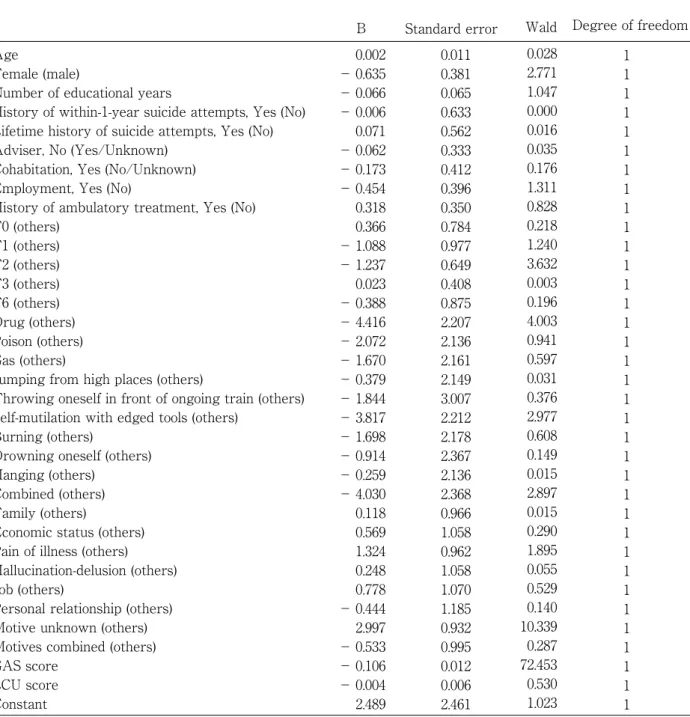
3.Factors associated with the outcomes of suicide attempts (Table 3, Table 4)
To identify factors associated with suicide
commitment in patients with suicide attempts
transferred to the emergency care centre, a
logistic regression analysis was performed
with suicide commitment as a dependent
variable and the various investigational indices
as explanatory variables. Regarding the
method of suicide attempt, the odds ratio of
suicide commitment was 0.012 for the use of a drug compared with other methods (p=0.045), and 20 . 033 for unknown motive compared with other motives (p= 0 . 001 ). The odds ratio of suicide commitment was 0.899 for an increment of 1 point in GAS score (p<0.001).
IV
.Discussion1.Background factors
The higher percentage of males in the completer group reflects recent trends in Japan as a whole. According to the Status of Suicides in 2011 announced by the National Police Agency of the Cabinet Office of Japan,
132 Rumiko Sato, et al.
Table 1. Comparative background data on suicide attempters presenting to the Iwate Prefectural Advanced Critical Care and Emergency Centre
Gender Mean age ± SD Age group
Number of educational years ± SD Lifetime history of suicide attempts
History of within-1-year suicide attempts
Psychiatric treatment
Advisor
Cohabitation
Employment
p-value
<0.001
<0.001
<0.001 0.042
<0.001
<0.001
0.336
0.515
0.752
0.935 χ² test: p<0.05
All attempters N=1193 478(40.1%) 715(59.9%) 40.74 ± 17.91
89(7.5%) 318(26.7%) 245(20.5%) 166(13.9%) 189(15.8%) 81(6.8%) 105(8.8%) 11.57 ± 2.44
488(40.9%) 653(54.7%) 52(4.4%) 281(23.6%) 866(64.9%) 46(3.9%) 592(49.6%)
6(0.5%) 5(0.4%) 582(48.8%)
8(0.7%) 423(35.5%) 708(59.3%) 62(5.2%) 958(80.3%) 221(18.5%) 13(1.1%)
1(0.1%) 429(36.0%) 737(61.8%) 27(2.3%)
Completers N=114 74(64.9%) 40(35.1%) 48.61 ± 19.28
4(3.5%) 20(17.5%) 16(14.0%) 16(14.0%) 25(21.9%) 14(12.3%) 19(16.7%) 11.12 ± 2.92
28(24.6%) 52(45.6%) 34(29.8%) 17(14.9%) 74(64.4%) 22(20.2%) 51(44.7%)
0(0%) 0(0%) 61(53.5%)
2(1.8%) 35(30.7%) 72(63.2%) 7(6.1%) 88(77.2%) 24(21.1%) 2(1.8%)
0(0%) 42(36.8%) 69(60.5%) 3(2.6%)
Survivors N=1079 404(37.4%) 675(62.6%) 39.91 ± 17.56
85(7.9%) 298(27.6%) 229(21.2%) 150(13.9%) 164(15.2%) 67(6.2%) 86(8.0%) 11.61 ± 2.39
460(42.6%) 601(55.7%) 18(1.7%) 264(24.5%) 797(73.4%) 17(2.1%) 541(50.1%)
6(0.6%) 5(0.5%) 521(48.3%)
6(0.6%) 388(36.0%) 636(58.9%) 55(5.1%) 870(80.6%) 197(18.3%) 11(1.0%)
1(0.1%) 387(35.9%) 668(61.9%) 24(2.2%) Male (%)
Female (%) (years) 10s (%) 20s (%) 30s (%) 40s (%) 50s (%) 60s (%) 70s (%) (years) Yes (%) No (%) Unknown (%) Yes (%) No (%) Unknown (%) Ambulatory (%) Interrupted (%) Hospitalized (%) No (%) Unknown (%) Yes (%) No (%) Unknown (%) Yes (%) No (%) Unknown (%) Yes (%) No (%) Unknown (%) Other (stay in care facility) (%)
20 , 955 males and 9 , 696 females committed suicide in Japan in 2011, the number of males roughly doubling the number of females
8). An epidemiological survey in Japan reported a higher suicide attempt ratio for females
9 ). In the present study as well, females, at 59.9%, accounted for a higher percentage of the
entire study population of suicide attempters.
However, the completer group had a higher male percentage, at 64 . 9 %, and the survivor group had a higher female percentage, at 62.6%; the difference between the two groups was statistically significant. The higher suicide completion rate for males is attributable to the
Table 2. Methods of attempt, motives, LCU scores, ICD-10 diagnoses, and GAS scores
Method
Motive
LCU score
Mean GAS score
p-value
<0.001
<0.001 0.293
<0.001
<0.001 χ² test: p<0.05
All attempters N=1193 566(47.4%)
116(9.7%) 76(6.4%) 77(6.5%) 5(0.4%) 147(12.3%)
33(2.8%) 19(1.6%) 82(6.9%) 66(5.5%) 6(0.5%) 249(20.9%)
80(6.7%) 142(11.9%)
99(8.3%) 104(8.7%) 169(14.2%) 42(3.5%) 189(15.8%)
107(9.0%) 12(1.0%) 40.84 ± 29.95
32(2.7%) 40(3.4%) 153(12.8%) 454(38.1%) 350(29.3%) 4(0.3%) 71(6.0%) 17(1.4%) 2(0.2%) 3(0.3%) 2(0.2%) 65(5.5%) 33.79 ± 19.68
Completers N=114 4(3.5%) 17(14.9%)
11(9.6%) 24(21.1%)
1(0.9%) 3(2.6%) 9(7.9%) 3(2.6%) 40(35.1%)
1(0.9%) 1(0.9%) 10(8.8%)
7(6.1%) 22(19.3%)
8(7.0%) 7(6.1%) 2(1.8%) 3(2.6%) 8(7.0%) 47(41.2%)
0(0%) 43.65 ± 21.70
5(4.4%) 3(2.6%) 13(11.4%) 43(37.7%) 5(4.4%) 1(0.9%) 5(4.4%) 0(0%) 0(0%) 0(0%) 2(1.8%) 37(32.9%) 7.61 ± 14.64
Survivors N=1079 562(52.1%)
99(9.2%) 65(6.0%) 53(4.9%) 4(0.4%) 144(13.3%)
24(2.2%) 16(1.5%) 42(3.9%) 65(6.0%) 5(0.5%) 239(22.2%)
73(6.8%) 120(11.1%)
91(8.4%) 97(9.0%) 167(15.5%)
39(3.6%) 181(16.8%)
60(5.6%) 12(1.1%) 40.55 ± 30.68
27(2.5%) 37(3.4%) 140(13.0%) 411(38.1%) 345(32.0%) 3(0.3%) 66(6.1%) 17(1.6%) 2(0.2%) 3(0.3%) 0(0%) 28(2.7%) 36.56 ± 18.05 Drug (%)
Poison (%) Gas (%) Jumping from high places (%) Self-mutilation with edged tools (%) Burning (%) Drowning oneself (%) Hanging (%) Combined (%) Others (%) Family (%) Economic status (%) Pain of illness (%) Hallucination-delusion (%) Job (%) Personal relationship (%) Others (%) Combined (%) Unknown (%) School issues (%)
F0 (%) F1 (%) F2 (%) F3 (%) F4 (%) F5 (%) F6 (%) F7 (%) F8 (%) F9 (%) Physical disease (%) Diagnosis unknown (%) ICD diagnosis at time of arrival
Throwing oneself in front of ongoing train (%)
Rumiko Sato, et al.
134
fact that they are more likely to be exposed to social stress than females, and that females are thought to have a biological background for better impulse control.
As for age group distribution, the 50s have traditionally been considered an important age group, but the present study demonstrated
that suicides in the 20 s group, are not negligible. The survivor group, on the other hand, had high percentages of women in their 20s or 30s, which is consistent with relevant results that have been reported so far.
To date, study results have been presented showing that more than 40% of suicide com-
Table 3. Analysis of factors associated with outcomes of suicide attempts
Age
Female (male)
Number of educational years
History of within-1-year suicide attempts, Yes (No) Lifetime history of suicide attempts, Yes (No) Adviser, No (Yes/Unknown)
Cohabitation, Yes (No/Unknown) Employment, Yes (No)
History of ambulatory treatment, Yes (No) F0 (others)
F1 (others) F2 (others) F3 (others) F6 (others) Drug (others) Poison (others) Gas (others)
Jumping from high places (others)
Throwing oneself in front of ongoing train (others) Self-mutilation with edged tools (others)
Burning (others)
Drowning oneself (others) Hanging (others)
Combined (others) Family (others)
Economic status (others) Pain of illness (others) Hallucination-delusion (others) Job (others)
Personal relationship (others) Motive unknown (others) Motives combined (others) GAS score
LCU score Constant
B 0.002
− 0.635
− 0.066
− 0.006 0.071
− 0.062
− 0.173
− 0.454 0.318 0.366
− 1.088
− 1.237 0.023
− 0.388
− 4.416
− 2.072
− 1.670
− 0.379
− 1.844
− 3.817
− 1.698
− 0.914
− 0.259
− 4.030 0.118 0.569 1.324 0.248 0.778
− 0.444 2.997
− 0.533
− 0.106
− 0.004 2.489
Degree of freedom 0.011
0.381 0.065 0.633 0.562 0.333 0.412 0.396 0.350 0.784 0.977 0.649 0.408 0.875 2.207 2.136 2.161 2.149 3.007 2.212 2.178 2.367 2.136 2.368 0.966 1.058 0.962 1.058 1.070 1.185 0.932 0.995 0.012 0.006 2.461
Wald 0.028 2.771 1.047 0.000 0.016 0.035 0.176 1.311 0.828 0.218 1.240 3.632 0.003 0.196 4.003 0.941 0.597 0.031 0.376 2.977 0.608 0.149 0.015 2.897 0.015 0.290 1.895 0.055 0.529 0.140 10.339 0.287 72.453 0.530 1.023
1 1 1 1 1 1 1 1 1 1 1 1 1 1 1 1 1 1 1 1 1 1 1 1 1 1 1 1 1 1 1 1 1 1 1 Standard error
pleters had a history of suicide attempts
10, 11). In contrast, the present study revealed a higher prevalence of a history of suicide attempts in the survivor group. However, individuals with a history of suicide attempts have been suggested to be likely to repeat attempts; a report is available showing that
10 - 20 % of individuals with a past history of suicide attempts would commit suicide in the future, accounting for about 50 % of all suicide completions
12). Another report showed that more than 80 % of individuals who died after repeated, incomplete suicide attempts died after changing their means of attempt
13 ). A survivor group is of course a population of likely suicide completers.
Prudent clinical care is required for the survivor group in the present study.
Years of education was lower for the completer group. A prior study comparing suicide attempters using severe methods and those using mild methods revealed a slightly longer educational history in the mild method group
14). These findings suggest that skills acquired through education may be important for mental health-related issues and appropriate stress coping.
2.Methods
A significant difference was observed in the distribution of methods of suicide attempt between the completer group and the survivor group: 52 . 1 % of the subjects in the survivor group attempted suicide using a drug. The relevant literature includes a report that half of suicide attempt survivors transferred to emergency care centres used overdoses of psychotropics for their attempts
15 ). In our study, multivariate analysis also identified attempted suicide by drug as a variable that distinguished suicide completion and non- completion.
In other words, the previously mentioned sex discrepancy in the completer group may be regarded as a lower level of suicide completion due to selection of non-lethal methods
16). Conversely, another report showed
p<0.05 Exp (B)
1.002 0.530 0.936 0.994 1.073 0.940 0.841 0.635 1.375 1.442 0.337 0.290 1.024 0.679 0.012 0.126 0.188 0.685 0.158 0.022 0.183 0.401 0.772 0.018 1.125 1.767 3.758 1.281 2.178 0.641 20.033
0.587 0.899 0.996 12.049
Lower 0.981 0.251 0.824 0.287 0.356 0.489 0.375 0.292 0.692 0.310 0.050 0.081 0.460 0.122 0.000 0.002 0.003 0.010 0.000 0.000 0.003 0.004 0.012 0.000 0.169 0.222 0.570 0.161 0.268 0.063 3.223 0.083 0.878 0.984
Upper 1.023 1.119 1.063 3.436 3.231 1.807 1.887 1.381 2.730 6.700 2.286 1.036 2.277 3.774 0.914 8.282 12.999 46.168 57.423 1.681 13.080 41.482 50.775 1.842 7.466 14.042 24.761 10.200 17.724 6.548 124.519
4.124 0.922 1.008
p-value 0.866 0.096 0.306 0.992 0.900 0.853 0.675 0.252 0.363 0.641 0.265 0.057 0.954 0.658 0.045 0.332 0.440 0.860 0.540 0.084 0.436 0.699 0.903 0.089 0.903 0.591 0.169 0.815 0.467 0.708 0.001 0.592
<0.001 0.467 0.312 Confidence interval
136 Rumiko Sato, et al.
that males and elderly subjects tended to use more serious methods to attempt suicide
17). Males are reportedly more likely to behave oppositionally, impulsively, and aggressively in the face of problems to be solved
18 ). Depending on circumstances, females can be susceptible to repeated depressive states from various, sometimes minor life events in daily life
19). There are apparently many cases where repeated exposure to life events combined with weak stress-coping mechanisms leads to repetitive suicidal behaviour
20).
3. Motives
According to the Japanese National Police Agency statistical survey on suicides
4 ), 30 % of suicide completers leave a suicide note, and the cause/motive was stated in 73.4% (in 2011).
In the completer group, "unknown" was the most prevalent motive ( 41 . 2 %), followed by pain of illness ( 19 . 3 %) and family problems (8.8%). In the case of a suicide completer, no information is available from the completer, with his or her family or accompanying persons being the only source of information.
Therefore, if the patient has no history of ambulatory treatment in a department of
psychiatry, and the family is also unaware of the situation of the patient, the investigator can only depend on the limited information available at the time of examination at the emergency care centre, with a diagnosis and suicide motive remaining unknown in many cases. The current situation is also one of unavoidable major difficulty in collecting information in an emergency setting immediately after arrival at an emergency care centre.
However, at the emergency care facility where the present study took place, psychiatrists are involved in the patient care from the outset and converse with persons close to the patient in almost all cases of suicide attempts. Therefore, the mode of data collection in the present study was similar to the psychological autopsy approach in its broader sense, covering the psychosocial background and details of the psychiatric treatment the patient was receiving.
Therefore, the relatively large group with unknown motives might include a considerable number of cases where it was actually difficult to identify the cause and motive. If this is true, we might also conclude that this opacity
Table 4. Comparison of suicide completers and survivors
Gender Age groups
Number of educational years ICD diagnosis
Motive Method
Lifetime history of suicide attempts History of within-1-year suicide attempts GAS score
LCU score
Completers Male 50s, 20s
Low F3, unknown Unknown, pain of illness Hanging, jumping from high places
A few A few Low High
Survivors Female 20s, 30s High F3, F4
Family, personal relationship Drug, self-mutilation with edged tools
Many Many High
Low
of motives is an essential element in the phenomenon of suicide completion.
In any case, the problem of unknown motive cannot be solved without an extensive approach to psychological autopsy by interview to hear details of the daily life of the suicide completer from persons with some relation to the individual during their life (family, acquaintances, colleagues, etc.). In Japan, a pilot study of psychological autopsy by Kawakami et al. showed that the incidence of depression at the time of death and the frequency of past suicide attempts were high among suicide completers
21).
4.Diagnoses
In the completer group, F 3 was the most frequent diagnosis, followed by "unknown", each of which accounted for more than 30%.
In the survivor group, F 3 accounted for more than 30 %, followed by F 4 and F 2 in that order. In both groups, individuals with an established diagnosis accounted for the majority. In the entire study population of suicide attempters, F2, F3, and F4 together accounted for more than 50%.
The finding that F3 was the most prevalent diagnosis for the suicide completers studied is consistent with past reports. Also, a prior study pointed out that depression and other psychiatric disorder represented a risk factor for suicide
22). Other studies showed that more than 90% of suicide completers were suffering from some psychiatric disorder at the time of attempted suicide
2 ), and that psychiatric disorders were present in more than 80 % of attempted suicide survivors transferred to emergency care centres
23). A WHO survey on psychological autopsy of suicide completers in Europe and the US revealed mood
disorders (30.2%) to be the most prevalent of psychiatric diagnoses, followed by substance- related disorders ( 17 . 6 %), schizophrenia ( 14 . 1 %), personality disorders ( 13 . 0 %), organic psychiatric disorders ( 6 . 3 %), anxiety disorders/somatoform disorders ( 4 . 8 %), and adjustment disorders ( 2 . 3 %)
24 ). A study of psychological autopsy in the US also identified mood disorders as the most prevalent diagnosis among both males and females
9 ). Barraclough et al. investigated the families of 100 suicide completers, reporting 93 % of the completers to be sufferers of psychiatric disorders and 85 % to have depression or alcohol dependence
3).
In Japan, Cho ( 1996 ) performed psycho- logical autopsy on 93 suicide completers transferred to an emergency medical centre and reported on their diagnoses.
Depressive disorders were diagnosed in 48%, schizophrenic disorders in 26 %, disorders due to use of psychogenic agents in 6 %, no psychiatric disorders in 2 %, and unknown diagnosis in 20 %
25 ). Our previous study of suicide survivors also investigated a total of 1 , 348 suicide survivors transported to Iwate Medical University Hospital.
Established diagnoses were mood disorders ( 31 . 0 %), stress-related disorders ( 34 . 6 %), schizophrenia ( 12 . 5 %), personality disorders ( 10 . 2 %), symptomatic/organic psychiatric disorders ( 2 . 6 %), psychiatric disorders due to psychogenic agents ( 3 . 5 %), and others (5.6%)
20).
In the current study, however, the per- centage of unknown diagnoses was high, at 32.9%, and the report of Cho also showed that 20 % of subjects had an unknown diagnosis.
In this regard, the same difficulty exists as in
138 Rumiko Sato, et al.
the identification of a suicide motive. In the Japanese forensic system for postmortem autopsy, matters such as the outpatient psychiatric treatment status and diagnosis of the deceased are determined by police and medical examiners on the basis of information obtained from persons close to the deceased.
In addition, no adequate system exists allowing for subsequent extensive psychological autopsy. No unified management is available for consultation at medical institutions, and there are limitations on acquiring information on, for example, the history of outpatient treatment. There are also cases in which family or other persons accompanying the patient at the time of transport are not fully aware of the status of the individual. These facts should also be reflected as unknown aspects of other investigational indices.
5. Predictors of suicide and global severity ratings
To date many authors have pointed out the difficulty in predicting suicide. For example, Heinirich
26 )studied 351 suicide completers at 10 state hospitals in Rhineland-Palatinate, Germany between 1971 and 1983 , and their report conspicuously demonstrates the difficulty in suicide prediction. Past history of suicide attempts was regarded as a predictor of suicidal behavior since it was found in 61%
of the subjects, but the report stated that it was extremely difficult to predict individual cases of suicide reliably.
Jarosz has sounded the alarm on efforts to categorize the causes of suicides using a statistical table of suicide-related factors (family problems, personal relationships, disease, etc.) because of the lack of uniformity of sources of suicidal information due to
cultural differences and the disparate nature of personal motives for self-destruction in advanced society. The author concluded that self-destruction involves multifactorial reasons, and that it is impossible to predict the effects of different associations
27).
However, global severity ratings, typically those on the GAS, used in the present study, may play a key role in the assessment of suicidal risk. Michel interviewed the families of suicide completers and individuals close to suicide survivors and reported that suicide completers and suicide survivors using severe methods of attempt had severer depressive symptoms than did suicide attempters using mild methods
28 ). Assuming even that the psychological status of such individuals was unknown or that it was difficult for people around them to realize their condition, it seems possible to some extent to understand the suicidal risk of the individual on the basis of their standard of living and social adjustment level.
Our previous studies of suicide attempts had shown that irrespective of sex and age group, the incidence of suicide attempts using dangerous methods tended to decrease with increasing GAS score, demonstrating social adjustment level to be a factor associated with occurrence of suicide. It was also found that in addition to sex and age, overall mental health and social adjustment levels that transcend disease entity and other categorizations can be predictors of occurrence of dangerous suicide attempts
13 ). These tendencies were supported by the present study in that the risk for becoming a suicide completer was found to increase with decreasing GAS score.
With these findings in mind, it is of
paramount importance to assess global severity ratings appropriately and to estimate suicide completion risk on the basis of the ratings.
Deterioration of mental health is intimately associated with the development of psychiatric disorders. It has also been reported that many subjects with some psychiatric disorder did not receive psychiatric treatment
4 , 29 ). In the present study, it is estimated that a small but non-negligible number of suicide completers had not consulted a psychiatrist. In Japan, promotion of suicide prevention measures is led by the Cabinet Office and the Ministry of Health, Labour and Welfare, including efforts for nurturing gatekeepers, awareness-raising education for primary care physicians, and limitation on access to methods of suicide attempt
30 ). Future suicide prevention efforts must focus on preventing suicide attempts in
the young, as well as on drug abuse (overdose use of psychotropics), the major cause of suicide attempts.
6. Limitation
This study is not a comparative study of suicide completers as a whole; the study population excludes suicide completers who were not transported to any emergency care centre.
Acknowledgements
The authors would like to thank the medical staff in the Department of Neuropsychiatry at Iwate Medical University for their cooperation in conducting this study, and the members of the Department of Emergency Medicine at Iwate Medical University for their guidance and teaching at the tertiary emergency care center.
Conflict of interest: The authors have no conflict of interest to declare.
References 1) Asukai N: Suicide and mental disorders.
Psychiatry Clin Neurosci 49, 91–97, 1995.
2) Kishi Y, Hosaka T and Kurosawa H: Case care for suicide attempters in emergency medical center. J Clin Exp Med 194, 555 –559, 2000:
3) Arsenault-Lapierre G, Kim C and Turecki G:
Psychiatric diagnoses in 3275 suicides : a meta- analysis. BMC Psychiatry 4, 37, 1994.
4) Barraclough B, Bunch J, Nelson B, et al.:A hundred cases of suicide: clinical aspects. Brit J Psychiat 125, 355-373, 1974.
5) Cavanagh JT, Carson AJ, Sharpe M, et al.:
Psychological autopsy studies of suicide: a systematic review. Psychol Med 33, 395-405, 2003.
6) Endicott J, Spitzer RL, Fleiss JL, et al.: The global assessment scale: a procedure for measuring overall severity of psychiatric disturbances. Arch Gen Psychiat 33, 766-771, 1976.
7) Holmes TH: Life situations, emotions, and disease. Psychosomatics 19, 747-754, 1978.
8) National Police Agency: Statistics of suicide victims in Japan in 2011, National Police Agency.
Japan, 2012 ( in Japanese.).
9) Ono Y, Kawakami N, Nakane Y, et al.: Prevalence of and risk factors for suicide-related outcomes in the World Health Organization World Mental Health Surveys Japan. Psychiatry Clin Neurosci 62, 442–449, 2008.
10) Isometsa ET and Lonnqvist JK: Suicide attempts preceding completed suicide. Br J Psychiatry 173, 531-535, 1998.
11) Suominen K, Isometsä E and Heilä H, et al.:
General Hospital suicides: A psychological autpsy study in Finland. Gen Hosp Psychiatry 24, 412- 416, 2002.
12) Stern TA, Lagomasino IT and Hackett TP:
Suicidal patients, Masachusetts General Hospital Handbook of General Hospital Psychiatry, 4th ed, Mosby-Year Book, St Louis, 1997.
13) Owens D, Horrocks J and House A: Fatal and non-fatal repetition of self -harm: Systemic review. Br J Psychiatry 181, 193-199, 2002,
14) Endo J, Otsuka K, Yoshida T, et al.: On factors related to risk to life in attempted suicides:
comparison between absolutely and relatively dangerous suicides in emergency & critical care center. Emergency Psychiatry 12, 60–73, 2009.
15) Michel K, Ballinari P, Bille-Brahe U, et al.:
Methods used for parasuicide : Results of the WHO/EURO Multicentre Study on Parasuicide.
Soc Psychiatry Psychiatr Epidemiol 35, 156-163, 2000.
16) Jacobs DG, Margaret Brewer RN and Klein- Benheim M: An overview and recommended protocol. In "The Harvard medical school guide to suicide assessment and intervention", eds by pp. 3-39, Jossey-Bass A Wiley Company, San Francisco, 1999.
17) Spicer RS, MPH and Ted R Miller: Suicide Acts in 8 States : Incidence and case fatality rates by demographics and method. Am J Public Health 90, 1885-1891, 2000.
18) Takahashi Y: Suicide risk: Clinical assessment and risk intervention, new enlarged revision, Kongo Shuppan, Tokyo, 2006.
19) Yambe T, Otsuka K, Hoshi K, et al.: Comparison of suicidal persons by gender and age group. J Iwate Med Assoc 60, 89–103, 2008.
20) Kudo K, Otsuka K, Jin Endo, et al.: Study of the outcome of suicide attempts: characteristics of hospitalization in a psychiatric ward group, critical care center group, and nonhospitalized group. BMC Psychiatry 10, 4, 2009.
21) Kawakami N: Research on suicide prevention based on trends, 2006 Health Labor Sciences
Research Project, Research on Psychiatric and Neurological Diseases and Mental Health, Tokyo, 2006.
22) Hawton K and van Heeringen K: Suicide. Lanet 373, 1372-1381, 2009.
23) Yamada T, Kawanishi C, Hasegawa H, et al.:
Psyachiatric assessment of suicide attempters in Japan : a pilot study at a critical emergency unit in an urban area. BMC Psychiatry 7, 64, 2007.
24) Takahashi Y: Epidemiology of suicide in Japan : For physicians and health care professionals,1st ed, pp. 303–308, Japan Scientific Societies Press, Tokyo, 2006.
25) Cho Y: Mental retardation and seeking diagnosis action in suicide performed persons. Jpn Med J (Nihon Iji Shinpo) 3789, 37–40, 1996.
26) Heinrich K: Zur Problematik der Vorhersagbarkeit von Suiziden stationär behandelter psychiatrischer
Patienten : Untersuchung anhand von 351 Selbsttötungen. Clin Psychiat 33, 883–890, 1991.
27) Jarosz M: Suicide, 1st ed, Samobojstwa, Warszawa, 1997.
28) Michel K: Suicide risk factors: a comparison of suicide attempters with suicide completers. Brit J Psychiat 150, 78-82, 1987.
29) Robins E, Murphy GE, Wilkinson RH, et al.:
Some clinical considerations in the prevention of suicide based on a study of 134 successful suicidies. Am J Public Health 49, 888-899, 1959.
30) Mann JJ, Apter A, Bertolote J, et al.: Suicide prevention strategies : a systematic review.
JAMA 294, 2064-2074, 2005.
Rumiko Sato, et al.
140
141
日本における救急搬送された自殺既遂者の特質について:
自殺未遂者との比較に基づく考察
佐藤瑠美子
1),大塚耕太郎
1),2),中村 光
2), 岩戸清香
1),遠藤 仁
1),水谷歩未
1),三田俊成
1),
山家健仁
1),遠藤重厚
3),酒井明夫
1)1)岩手医科大学医学部,神経精神科学講座
2)岩手医科大学医学部,災害・地域精神医学講座
3)岩手医科大学医学部,救急医学講座
(Received on January 16, 2014 & Accepted on February 7, 2014)
本研究では自殺既遂者群の特性を明らかにすること を目的として,2002 年 4 月 1 日から 8 年間に岩手県 高度救命救急センターに搬送された自殺企図者 1193 名を自殺既遂群(114 名)と未遂群(1079 名)に区分 し,調査項目を 2 群間で比較検討した.また,自殺企 図の転帰に関連する因子を抽出する目的で多重ロジス ティック回帰分析を行った.
既遂群では男性が多く,年齢は 50 代と 20 代の二峰 性であり,診断分布では気分障害と不明が多く,自殺
企図の既往のない者が多くを占め,縊頚・飛び降りな どの重篤な手段を用いて初回の自殺企図で死に至ると いう傾向が認められた.動機が不明な例が最多で,理 由の判明しているものの中では病苦が最も多かった.
既遂と関連する因子は不明な動機,GAS の低値であっ た.
生活水準や社会的適応のレベルから全般的重症度を 評価し,本人の自殺リスクを類推することが重要と考 えられた.
要旨