Integration of Process Analysis and Decision-Making Tools for the Sustainability Improvements in Raw Rubber Manufacture
(天然ゴム製造における持続可能性改善のための プロセス分析と意思決定ツールの統合)
January, 2019
Doctor of Philosophy (Engineering)
Dunuwila Mudiyanselage Pasan Tharuka Dunuwila
Toyohashi University of Technology
別紙4-1(課程博士(英文))
Date of Submission(month day,year): January 10, 2019 Department
Environmental and Life Sciences
Student ID Number D 123430 Supervisors
HIROYUKI DAIMON TATSUO OGUCHI Applicant’s name Dunuwila Mudiyanselage Pasan
Tharuka Dunuwila
Abstract ( Doctor )
Title of Thesis
Integration of Process Analysis and Decision-Making Tools for the Sustainability Improvements in Raw Rubber Manufacture
(天然ゴム製造における持続可能性改善のためのプロセス分析と 意思決定ツールの統合)
Approx. 800 words
Raw rubber manufacture is an industry mainly based in developing countries in South and South East Asia. It has been a prominent source which brings foreign revenue to such countries. Reported as material-, energy-, and labor-intensive, this industry has been confronted with high cost of manufacture, low cost efficiency and various environmental issues. Therefore, the main aim of my research has been addressing these issues through improving raw rubber manufacture to have less material and monetary losses, environmental and negative social impacts. Manufacturing major raw rubber products of crepe rubber, concentrated latex, and ribbed smoked sheets in Sri Lanka has been subjected to this research.
Firstly, crepe rubber and ribbed smoked sheet manufacture were analyzed using a novel method to reach the aim. This method deployed: 1) material flow analysis (MFA), material flow cost accounting (MFCA) and environmental life cycle assessment (ELCA) to quantify material flows and waste, monetary losses, and greenhouses gas (GHG) emissions, 2) Pareto and what-if analyses, information from field interviews and literature to develop improvement options; and 3) re-execution of MFA, MFCA and ELCA to foresee the degree of improvement. Simple cost benefit analysis was also employed to know the financial feasibility of improvement options. In terms of crepe rubber manufacture, water and chemical use found to be the factors affecting monetary losses whereas electricity had been a key driver of GHG emissions. While monetary losses were found negligible in ribbed smoked sheet manufacture, firewood use had been a major factor affecting GHG emissions. Based on field interviews and literature, viable improvement options were developed; for instance, installing water reuse system, re- determining dry rubber content and installing solar panels were proposed for reducing water, chemicals and electricity, respectively in crepe rubber manufacture. To reduce firewood use in ribbed smoked sheet manufacture, an efficient smoke house consuming less firewood was proposed. Improvement options were foreseen to be saving water, chemical, energy and firewood to give remarkable financial and environmental benefits for both manufacturing lines. Meanwhile, the simple cost benefit analysis indicated that all improvement options were financially feasible.
Secondly, the previous method was further modified to be applied to concentrated latex manufacture. Discounted cash flow analysis (DCFA) and greenhouse gas payback time (GPBT) were integrated in this regard for a detailed economic and environmental feasibility assessment. Novel loss reduction efficiency (LRE) index was also introduced to measure overall efficiency of improvement options. Rubber losses and chemical consumption were found to be main factors affecting monetary losses whereas electricity consumption was identified as a key driver of GHG emissions. Similar to previous research, applicable improvement options were proposed based on field interviews and literature. Extending sedimentation time during the addition of chemicals and installi ng
trap tank were amongst the improvement options proposed for reducing chemicals and rubber loss, respectively. Installing inverters and solar panels were proposed to lower electricity consumption to alleviate GHG emissions. Results were promising as large proportion of monetary losses and environmental impacts were foreseen to be lowered by the proposed improvement options. As per DCFA and GPBT, proposed improvement options were found to be economically and environmentally feasible. Novel LRE index was proven to be effective as it could identified installing trap tank as the best option of all.
Not scrutinizing social impacts of natural rubber manufacture was a major lacuna in both methods; hence, thirdly, we tried performing a social life cycle assessment (SLCA).
SLCA is a relatively new discipline and has no designated method or framework published yet. Therefore, a new method based on Analytic Hierarchical Process (AHP) was developed for conducting SLCA. Quantifiability of negative and positive social impacts, and foreseeability of the improvement in social aspect were the key features of this method. This method was used to scrutinize the social impact of workers at a raw rubber factory in Sri Lanka. Results claimed that health and safety, and social benefit/social security of workers were affected thereby jeopardizing working conditions, and health and safety of the country or area. Proposing countermeasures for the identified issues, the extent to which the said aspects can be improved was clarified.
Table of Contents
CHAPTER 1 General Introduction
1.1 Background ... 1 1.2 Literature Review ... 3
CHAPTER 2 Financial and Environmental Sustainability in Terms of Process Analysis and Decision-Making Tools: A Study of Crepe
Rubber Manufacture
2.1 Introduction ... 9 2.2. Crepe Rubber Manufacturing Process ... 12 2.3. Materials and Methodology ... 14
2.3.1. Goal Definition
2.3.2. Quantification of Materials Involved (Step 1) 2.3.2.1. System Definition
2.3.2.2. Functional Unit 2.3.2.3. Data Collection
2.3.2.4. Material Flow Analysis (MFA)
2.3.2.5. Material Flow Cost Accounting (MFCA) 2.3.2.6. Life Cycle Assessment (LCA)
2.3.3. Proposal of Improvement Options (Step 2) 2.3.4. Improvement Option Validation (Step 3)
2.4. Results and Discussion ... 20 2.4.1. Quantification of Materials Involved (Step 1)
2.4.2. Impacts of the Proposal of Improvement Options (Step 2) 2.4.2.1. Reduction in Freshwater Use (Option-1)
2.4.2.2. Reduction in Chemical Use (Option-2) 2.4.2.3. Reduction in Electricity (Option-3) 2.4.3. Validation of Improvement Options (Step 3)
2.4.3.1. Reduction in Freshwater Use by Recirculation (Option-1) 2.4.3.2. Reduction in Chemical Use (Option-2)
2.4.3.3. Reduction in Electricity (Option-3)
2.4.3.4. Application of Option-1, -2, and -3 (Combined Scenario)
2.5. Conclusions ... 34 2.5.1. General Implications
2.5.2. Managerial Implications 2.5.3. Limitation and Future Research
CHAPTER 3 Financial and Environmental Sustainability in Terms of Process Analysis and Decision-Making Tools: A Study of Ribbed
Smoked Sheet Manufacture
3.1 Background ... 41 3.2 RSS Manufacture ... 42
3.3 Materials and Methods ... 42 3.3.1 Goal Definition
3.3.2 Step-1
3.3.2.1 System Definition 3.3.2.2 Functional Unit 3.3.2.3 Data Collection 3.3.2.4 Material Flow Analysis
3.3.2.5 Material Flow Cost Accounting 3.3.2.6 Life Cycle Assessment
3.3.3 Step-2 3.3.4 Step-3
3.4 Results and Discussion ... 44 3.4.1 Results of Step-1
4.4.2 Results of Step-2 3.4.3 Results of Step-3
3.5 Conclusions ... 49
CHAPTER 4 Further Improving Financial and Environmental Sustainability in Terms of Process Analysis and Decision-Making Tools Integrated in a Method Based on Continuous Improvement Concept: A Case Study with a Crepe Rubber Factory in Sri Lanka
4.1. Introduction ... 52 4.2. Crepe Rubber Manufacture ... 54 4.3. Materials and Methods ... 57
4.3.1. Goal and Scope Definition 4.3.2. Functional Unit
4.3.3. Data Collection 4.3.4. Analysis Phase
4.3.4.1. Theory of Material Flow Analysis (MFA)
4.3.4.2. Theory of Material Flow Cost Accounting (MFCA) 4.3.4.3. Theory of Life Cycle Assessment (LCA)
4.3.5. Identification Phase
4.3.6. Improvement Analysis Phase
4.4. Results and Discussion ... 61 4.4.1. Results of Analysis Phase
4.4.2. Results of Identification Phase
4.4.3. Results of Improvement Analysis Phase
4.4.4. Importance of the Findings to Natural Rubber Sector 4.4.5. Pros and Cons of Methodical Hierarchy
4.5. Conclusions ... 74
CHAPTER 5 Improving Financial and Environmental Sustainability
by Combining Process Analysis Tools with Pareto, What-if, Economic
and Environmental Feasibility Analyses: A Study of Concentrated
Latex Manufacture
5.1 Introduction ... 78 5.2. Concentrated Latex Manufacture ... 80 5.3. Methodology ... 81
5.3.1. Goal Definition 5.3.2. Step 1: Quantification
5.3.2.1. System Definition 5.3.2.2. Functional Unit
5.3.2.3. Data Collection and Compilation
5.3.2.4. Definition of Material Flow Analysis (MFA)
5.3.2.5. Definition of Material Flow Cost Accounting (MFCA) 5.3.2.6. Definition of Life Cycle Assessment (LCA)
5.3.3. Step 2: Proposal of Improvement Options
5.3.4. Step 3: Improvement Potential Validation; a Scenario Analysis
5.4. Results ... 87 5.4.1. Results of Step 1 (Quantification of Material Flows, Economic Losses and GHG Emissions)
5.4.2. Results of Step 2 (Proposal of Improvement Options) 5.4.2.1. Installing Advanced Trap Tank to Factory A
5.4.2.2. Extending Sedimentation Time of Factory A, B and C 5.4.2.3. Installing Inverters and Solar Panels to Factory A, B and C 5.4.3. Results of Step 3 (Improvement Potential Validation)
5.4.3.1. Option-1: Installing Advanced Trap Tank to Factory A
5.4.3.2. Option-2: Extending Sedimentation Time of Factory A, B and C 5.4.3.3. Option-3: Installing Inverters and Solar Panels to Factory A, B and C 5.4.3.4. Combined Scenario (Applying all Options)
5.5. Discussion ... 94 5.5.1. Limitations and Future Works
5.6. Conclusions ... 97
CHAPTER 6 Social Life Cycle Assessment in Raw Rubber Manufacture
6.1 Introduction ... 103 6.2. Overview of Crepe Rubber manufacture ... 106 6.3. Materials and Methods ... 107
6.3.1. Goal, system boundary and functional unit definition 6.3.2. Data Collection
6.3.3. Social Life Cycle Assessment 6.3.3.1. Step 1: Model formation 6.3.3.2. Step 2: Life Cycle Inventory
6.3.3.3. Step 3: Life Cycle Impact Assessment 6.3.3.4. Step 4: Interpretation
6.4. Results and Discussion ... 115 6.4.1. Results of Step 1 (Model Formation)
6.4.2. Results of Step 2 (Life Cycle Inventory)
6.4.3. Results of Step 3 (Life Cycle Impact Assessment) 6.4.4. Results of Step 4 (Interpretation)
6.5. Conclusions ... 121
CHAPTER 7 General Conclusions ... 126
List of Publications ... 128
Acknowledgement ... 130
1
CHAPTER 1 General Introduction
1.1 Background
Raw rubber processing (also called natural or primary rubber processing) plays a critical role in the rubber product manufacturing sector by providing raw rubber in the required form. In Sri Lanka, the rubber sector ranked as the third largest foreign exchange earner with its exports contributing 122,074 million rupees (824 million USD) to the foreign exchange revenue in 2014 [1][2]. Furthermore, this sector has been a source of 300,000 direct and indirect job opportunities to Sri Lankans [3].
Fig. 1.1 outlines the journey of rubber products; Once latex is collected from rubber trees, it is processed into primary products, referred to as raw rubber, that are then utilized in different manufacturing industries to be reprocessed into value-added rubber products.
Raw rubber products such as crepe rubber, concentrated latex, and ribbed smoked sheets (RSS) have been the principal raw materials of many value-added or secondary rubber products. Crepe rubber is in the form of pale yellow crinkled sheets and is high in purity;
therefore, is used for shoe soles, medical and surgical items. Concentrated latex is in the liquid form and contains ca. 60% dry rubber acquired through centrifugation, i.e., separation of preserved field latex into two fractions; one containing ca. 60% dry rubber and other containing ca. 4-6% dry rubber. Concentrated latex is used for manufacturing dipped goods such as surgical gloves, condoms, infant pacifiers, etc. RSS are patterned brown sheets having a high tensile strength, low heat build-up and resilience; hence, it is used in producing tires, tubes, hoses and footwear.
Production of raw rubber is a labor-, energy-, and material-intensive process, where a significant amount of electricity and thermal energy, fresh water, firewood, and chemicals are used at different stages of the manufacturing process (please refer to Fig.
1.2 for several snapshots within a crepe rubber factory) [4]. Electricity is mainly used in heavy-duty machinery, pumping water, wastewater treatment, and factory lighting.
Meanwhile, thermal energy is used for rubber drying and is generated by firewood burning.
Fresh water is an important material consumption factor. Water is essential for washing, factory cleaning, dilution of chemicals and field latex, and even for cooling machinery.
Fig. 1.1. Journey of rubber products.
2
Furthermore, various chemicals including sodium bisulfite, acids (e.g., formic and sulfuric acid), bleaching agents, diammonium hydrogen phosphate, tetramethylthiuram disulfide and zinc oxide, and ammonia are used in manufacturing different raw rubber products [5][6][7][8]. Great deal of labor is required in raw rubber manufacture [5]; For instance, in crepe rubber manufacture, rubber feeding to machinery and adjusting rollers are done manually. Wet rubber laces are required to be back-carried to drying tower for drying after milling. Cleaning rubber sheets and visual grading are done by bare eyes; hence, are tiresome and laborious. Some tedious tasks are done by the workers in concentrated latex factories as well; cleaning tanks, bowsers and centrifuge bowls, and skim rubber processing are some of them. RSS manufacture require less labor compared to the preceding manufacturing lines where the laborious parts of which are milling (N.B. milling is done by hand-operated rollers which require a lot of effort in pressing RSS to the required form) and smoke-drying (i.e., drying RSS using smoke of rubberwood; this may take three to four days under frequent and thorough supervisions and inspections).
Raw rubber processing is confronted by low productivity, cost-ineffectiveness, and rising production costs [9][10]. Lack of material and energy efficiency, higher degree of wastes and losses, and rising cost of raw materials could be the main drivers of these challenges. Furthermore, raw rubber processing contributes to numerous environmental problems such as acidic wastewater discharge, obnoxious caused by rubber particles and chemicals, and greenhouse gas (GHG) emissions [11][12]. Meanwhile, societal issues are also evident; impaired working conditions, low wages and societal status, and pollution- created community unrests can be listed as a few of them [13]. Most of the workers in raw rubber sector are from poor and low educational backgrounds and so lack the knowledge about labor laws and policies; hence, they have been prone to labor exploitations in factories [13].
Fig. 1.2. Snapshots of a crepe rubber factory. (a) A female worker is doing visual-grading of crepe rubber, (b) A female worker operates a heavy-duty machinery called smooth roller, and (c and d) heavy-duty roller mills which require a lot of electricity, and fresh water for cleansing rubber and cooling.
3
1.2 Literature Review
Several initiatives have been taken to develop and apply some suitable strategies to address the issues concerned. In view of providing an economical solution for wastewater treatment, Kudaligama et al. [14] proposed and tested a cost-effective wastewater treatment plant. Deploying a water reuse facility at a Thai rubber factory, Leong et al. [15] studied on the reduction in water and treatment costs. Meanwhile, with the aim of resolving high firewood consumption in crepe rubber processing, Siriwardena et al. [16] tested four solar powered drying tower systems and a roof integrated solar air heater-storage system had been the most effective. Also, Rathnayake et al. [17] proposed a single day smoke dryer for RSS production and tested it applying to a factory in Sri Lanka. New system succeeded in drying RSS within a single day without compromising the standard quality of dried RSS. In addition, shortening of drying period had reduced cost of production as it saved firewood and the labor for handling. Tillekeratne [18] also investigated how to reduce the cost of production in a crepe rubber processing factory and found that processing unfractionated and unbleached crepe rubber had been the most effective in this regard, as it avoided the cost for the bleaching agent and saved extra labor cost associated with the removal of yellow fraction. Quantifying the material and monetary losses incurred in concentrated latex and block rubber production in Thailand, Department of Industrial Works [19]
provided cleaner technology options that could be effective in reducing the observed losses.
In view of reducing the pollution associated with natural rubber processing, in- plant pollution control guidelines and wastewater discharge standards have already been established by central environmental authority of Sri Lanka [20][21]. Also, several studies have used life cycle assessment (LCA; also referred to as environmental life cycle assessment (ELCA)) based approaches to quantify and mitigate the environmental impacts (i.e., emissions) associated with overall natural rubber production process. For instance, Jawjit et al. [7] quantified the GHG emissions associated with the production of RSS, block rubber, and concentrated latex in Thailand.
This study highlighted that fertilizer and energy use were the leading sources of GHG emissions in Thai natural rubber industry and such emissions could be reduced switching from synthetic fertilizer to animal manure, shifting from fossil fuels to renewable energy, and by energy and fertilizer efficiency improvement. Meanwhile, Jawjit et al [8], investigated the environmental performance of concentrated latex production in Thailand with use of LCA and proposed technically and practically viable cleaner technology options for improving the efficiency in consuming energy (i.e., electricity and fossil fuel), ammonia, and diammonium phosphate. GHG emissions in crepe rubber processing have also been appraised stressing the importance of using renewable energy [22]. Taking a different approach, Musikavong et al. [23] quantified the consumptive water use and water scarcity footprint of RSS production in different provinces of Thailand with an ultimate goal of preserving water resources. Whilst No records were found on social impact quantifications of raw rubber manufacture, several survey-based studies tried to assess the social impact of rubber estate workers [24][25].
4
All previous studies have taken only a partial approach by investigating either the economic or the environmental aspect of the raw rubber manufacture. There have been no studies on the efficiency of the entire manufacturing process nor social impact incurred by raw rubber manufacture. Therefore, this study aims to develop a sustainable manufacturing process in raw rubber processing industry using four novel methodical hierarchies that could be adopted by any other industry. First three methods were based on the process analysis tools of material flow analysis (MFA), material flow cost accounting (MFCA), and ELCA. Unlike previous studies (i.e., Ulhasanah et al [26], Nakano et al. [27], and Schaltegger et al. [28]) that combined MFA, MFCA, and ELCA, the present study took another step further by integrating Pareto, What-if, simple cost benefit, and discounted cash flow analyses into the said methodologies. Further, they propose a concrete framework for conducting and continuing an improvement process at a facility for efficient management. In view of knowing to social impact of raw rubber manufacture, fourth method is proposed for conducting a social life cycle assessment (SLCA). Unlike the SLCA methods published in literature (e.g., Hosseinijou et al. [29], Manik et al. [30],Franze et al.
[31], Yıldız-Geyhan et al. [32], Prasara-A et al. [33], etc.), it could appraise both positive and negative social impacts of a manufacture and foresee the degree of improvement of its social dimension in numerical terms.
These methods are deployed across crepe rubber, concentrated latex and ribbed smoked sheets manufacturing lines in Sri Lanka (Please refer to forthcoming chapters for more details on these manufacturing lines). Sri Lanka holds a significant position in the world rubber manufacture as it ranks the eighth and sixth largest producer and exporter of rubber respectively [4][5]. Being renowned for its high-quality rubber, Sri Lanka currently holds ca. 125,645 ha of rubber land area which is ca. 2% of its size [6]. Rubber industry is the second major crop-based industry in island and had brought 25.6 million USD of foreign revenue in the year of 2016 by merely exporting raw rubber products [4].
Moreover, rubber industry provides over 300,000 job opportunities to Sri Lankans across various professions and walks of life as mentioned earlier.
Fig. 1.3 outlines the structure of the thesis tendering the essence of each chapter.
Chapter 1 had been dedicated for providing a brief overview of the followings: 1) raw rubber manufacture and its issues, 2) literature addressed these issues; and 3) lacunas of literature which motivated us to do this research project. In the next chapter (Chapter 2), we introduce our first novel method which integrates MFA, MFCA, ELCA, and Pareto, What- if and simple cost benefit analyses to improve financial and environmental sustainability of crepe rubber manufacture. Four crepe rubber factories have been subjected to this research. The same method is applied to RSS manufacture in Chapter 3. The required data were extracted from three RSS factories in Sri Lanka. In Chapter 4 we try to further elevate financial and environmental sustainability in crepe rubber manufacture deploying our second novel method (N.B. this method is an enhanced version of the first method by adding continuous improvement concept). This time only one factory was subjected for the analysis. In Chapter 5 we further enhance our second method to formulate a third novel method. Here, the simple cost benefit analysis in previous methods is replaced with discounted cash flow analysis and greenhouse gas payback time and novel loss reduction
5
efficiency index to extract more information on financial and environmental feasibility, and overall efficiency of improvement options. So far, financial and environmental sustainability of raw rubber manufacture had been the focus; hence, we scrutinize social sustainability of raw rubber manufacture in Chapter 6. Novel method for SLCA is formulated and applied to a crepe rubber factory in Sri Lanka, in this regard. Chapter 7 concludes the thesis with highlighting the followings: 1) main findings in each chapter and their importance to raw rubber manufacture, 2) possible barriers that may hinder improvement procedures discussed herein; and 3) avenues for future research in rubber sector as whole.
6
Fig. 1.3. Outline of the thesis. MFA, MFCA, ELCA, SLCA, DCFA, GPBT and LRE index refer to material flow analysis, material flow accounting, environmental life cycle assessment, social life cycle assessment, discounted cash flow analysis, greenhouse gas pay beck time, and loss reduction efficiency index, respectively. Alpha (α) stands for Pareto, What-if and cost benefit analyses integrated in first method.
7 References
[1] Malysian Rubber Board, “NATURAL RUBBER STATISTICS 2016,” 2016. [Online].
Available: http://www.lgm.gov.my/nrstat/nrstats.pdf. [Accessed: 27-Oct-2017].
[2] 2017 Population Reference Bureau, “2017 World Population Data Sheet,” 2017.
[Online]. Available: http://www.prb.org/pdf17/2017_World_Population.pdf.
[Accessed: 27-Oct-2017].
[3] Sri Lanka Export Development Board (EDB), “The Natural Rubber Industry in Sri Lanka,” 2015. [Online]. Available: http://www.srilankabusiness.com/blog/sri- lanka-natural-rubber-industry.html. [Accessed: 27-Jul-2016].
[4] The Ministry of Plantation Industries, “Annual Performance Report,” 2015.
[5] Rubber Research Institute of Sri Lanka, Handbook of rubber. 2003.
[6] Sri Lanka Export Development Board, “Industry capability report Sri Lanka rubber products sector,” 2016.
[7] W. Jawjit, C. Kroeze, and S. Rattanapan, “Greenhouse gas emissions from rubber industry in Thailand,” J. Clean. Prod., vol. 18, no. 5, pp. 403–411, Mar. 2010.
[8] W. Jawjit, P. Pavasant, and C. Kroeze, “Evaluating environmental performance of concentrated latex production in Thailand,” J. Clean. Prod., vol. 98, pp. 84–91, Jul.
2015.
[9] J. Cecil and P. Mitchell, “Processing of Natural Rubber,” 2005. [Online]. Available:
http://ecoport.org/ep?SearchType=earticleView&earticleId=644&page=4363.
[Accessed: 09-Nov-2016].
[10] S. Peiris, “Experiences of cleaner production implementation in rubber industry and potential for future in Sri Lanka,” 1997.
[11] UNESCAP, “Country Study on Sri Lanka using Global Value Chain Analysis: The industrial rubber and electronic products sectors,” 2011.
[12] P. Tekasakul and S. Tekasakul, “Environmental Problems Related to Natural Rubber Production in Thailand,” J. Aerosol Res, vol. 21, no. 2, pp. 122–129, 2006.
[13] J. Edirisinghe, “Community Pressure and Environmental Compliance: Case of Rubber Processing in Sri Lanka,” J. Environ. Prof. Sri Lanka, vol. 1, no. 1, Jan. 2013.
[14] V. S. Kudaligama, W. M. Thurul, and J. Yapa, “Possibility of treating rubber factory wastewater in biological reactors using media with low specific surface area,” J.
Rubber Res. Inst. Sri Lanka, vol. 88, pp. 22–29, 2007.
[15] S. T. Leong, S. Muttamara, and P. Laortanakul, “Reutilization of wastewater in a rubber-based processing factory: a case study in Southern Thailand,” Resour.
Conserv. Recycl., vol. 37, no. 2, pp. 159–172, 2003.
[16] S. Siriwardena, “Proposed solar drying systems for crepe rubber drying,” Bull.
Rubber Res. Inst. Sri Lanka, vol. 51, pp. 50–60, 2010.
[17] W. G. I. U. Rathnayake, “Efficiency study of a single day smoke dryer,” 2011.
[18] L. M. K. Tillekeratne, “Dartonfield crepe rubber factory receives ISO 9002 certification,” Bull. Rubber Res. Inst. Sri Lanka, vol. 29, no. 1999, pp. 30–32, 1999.
[19] Department of Industrial Works (DIW), “Industrial sector code of practice for
8
pollution prevention (cleaner technology),” 2001.
[20] Central Environmental Authority (CEA), Industrial pollution control guidelines, No.1-Natural Rubber Industry, First edit. Central Environmental Authority, 1992.
[21] Central Environmental Authority (CEA), “Services,” 2013. [Online]. Available:
http://www.cea.lk/web/index.php/en/services. [Accessed: 14-Dec-2016].
[22] P. R. Kumara, E. S. Munasinghe, V. H. L. Rodrigo, and A. S. Karunaratna, “Carbon Footprint of Rubber/Sugarcane Intercropping System in Sri Lanka: A Case Study,”
Procedia Food Sci., vol. 6, pp. 298–302, 2016.
[23] C. Musikavong, “Water scarcity footprint of products from cooperative and large rubber sheet factories in southern Thailand,” J. Clean. Prod., vol. 134, pp. 574–582, 2016.
[24] P. Bengtsen, “DanWatch 2013 - Behind the rubber label,” 1997.
[25] S.P. Nissanka, “Cumulative Impact Assessment on Soil, Water, Workers, and Neighboring Community of the Estates of Lalan Rubbers Pvt. Ltd,” 2013.
[26] N. Ulhasanah and N. Goto, “Preliminary Design of Eco-City by Using Industrial Symbiosis and Waste Co-Processing Based on MFA, LCA, and MFCA of Cement Industry in Indonesia,” Int. J. Environ. Sci. Dev., pp. 553–561, 2012.
[27] K. Nakano and M. Hirao, “Collaborative activity with business partners for improvement of product environmental performance using LCA,” J. Clean. Prod., vol. 19, no. 11, pp. 1189–1197, 2011.
[28] S. Schaltegger, T. Viere, and D. Zvezdov, “Tapping environmental accounting potentials of beer brewing: Information needs for successful cleaner production,”
J. Clean. Prod., vol. 29, pp. 1–10, 2012.
[29] S. A. Hosseinijou, S. Mansour, and M. A. Shirazi, “Social life cycle assessment for material selection: a case study of building materials,” Int. J. Life Cycle Assess., vol.
19, no. 3, pp. 620–645, 2014.
[30] Y. Manik, J. Leahy, and A. Halog, “Social life cycle assessment of palm oil biodiesel:
a case study in Jambi Province of Indonesia,” Int. J. Life Cycle Assess., vol. 18, no. 7, pp. 1386–1392, 2013.
[31] J. Franze and A. Ciroth, “A comparison of cut roses from Ecuador and the Netherlands,” Int. J. Life Cycle Assess., vol. 16, no. 4, pp. 366–379, 2011.
[32] E. Yıldız-Geyhan, G. A. Altun-Çiftçioğlu, and M. A. N. Kadırgan, “Social life cycle assessment of different packaging waste collection system,” Resour. Conserv.
Recycl., vol. 124, pp. 1–12, 2017.
[33] J. Prasara-A and S. H. Gheewala, “Applying Social Life Cycle Assessment in the Thai Sugar Industry: Challenges from the field,” J. Clean. Prod., vol. 172, pp. 335–346, 2018.
9
CHAPTER 2 Financial and Environmental Sustainability in Terms of Process Analysis and Decision-Making Tools: A Study of Crepe Rubber Manufacture
2.1 Introduction
The natural rubber (NR) industry plays a critical role in the economies of many developing countries, particularly in Asia where 92% of world`s NR produced [1]. NR industry in Sri Lanka is the third largest export earner of the country [2]. In 2014, NR exports contributed LKR 122,074 million (USD 824 million) to Sri Lanka’s foreign exchange revenue [3] accounting for about 8% of the total annual export value [4].
Furthermore, the NR sector has provided over 300,000 direct and indirect employments to Sri Lankans across various walks of life [5].
In NR production, rubber trees are tapped to collect fresh latex which is then processed into primary rubber products named as raw rubber [e.g., crepe rubber, concentrated latex, ribbed smoked sheets (RSSs)]. Subsequently, these raw rubber types are reprocessed into secondary rubber products (value-added rubber products) such as tires, tubes, gloves and condoms [6]. Of the raw rubber types, crepe rubber is considered to be the purest form of natural rubber available in the market [7]. Sri Lanka is the world`s leading crepe rubber producer for the international market with a production of about 46,502 MT per year, which is about 31% of the overall rubber production in the country [8]. Crepe rubber acts as a foundation of many pharmaceutical and surgical items which are in contact with human body [7][9].
Being a long-term tree crop, rubber cultivation is considered as an environmental friendly process with low tech involved. A rubber tree fixes about 1 MT of CO2 in its 30 year economic lifespan and even resource poor farmers could cultivate rubber in tropical climates [10]. In Sri Lanka and elsewhere, processing of latex to RSS is mostly done in small scale within the farmland. Crepe rubber manufacturing in Sri Lanka is done in factories built over 50 years ago, hence considered as a labor-, energy-, and material-intensive process in present day context. Compared to other categories of raw rubber, a considerable extent of skilled labor is involved in the processing of crepe rubber [7]. A large amount of electricity is needed to run the heavy-duty machinery used for milling, water pumping, wastewater treatment, and factory lighting.
Furthermore, heat energy generated from firewood is used to dry crepe laces in drying towers. Fresh water is one of the key material inputs in crepe rubber manufacturing. It is mainly used to dilute the latex and chemicals, to wash crepe sheets during milling, to avoid heat build in machinery and for their cleaning. In different stages of crepe rubber manufacturing, chemicals are used as preservatives, bleaching agents, and coagulants [7] [11].
On this background, crepe rubber processing suffers from low level of labor productivity, lack of cost effectiveness and rising cost of manufacture [12][13][14][15].
10
Obviously, these issues are connected with low level of efficiencies in material, labor and energy use, high degree of waste and losses and rise in cost of all inputs.
Furthermore, high level of water use and effluent discharge in crepe rubber manufacturing would create environmental issues, if not addressed properly.
Discharge of untreated rubber factory effluent to the environment may lead to water pollution, malodor and crop damage whilst high level of water consumption would result in intensified depletion of adjacent water resources [16]. Other environmental issues related to crepe rubber production include emissions that occur from heavy electricity and firewood use [17][18]. Nevertheless, crepe rubber production in the country should continue to meet the international demand and to maintain the in- country economy. Therefore, it has become vital to develop and implement sustainable production strategies in crepe rubber production for its long-term existence.
For providing a cost-efficient solution to high firewood consumption, Siriwardena et al. [19] investigated four solar powered drying tower systems for the crepe rubber drying process and concluded that a roof integrated solar air heater-storage system is effective in this regard. Also, Tillekeratne [20] highlighted the steps taken by the Rubber Research Institute of Sri Lanka (RRISL) to minimize the cost involved in Sri Lankan crepe rubber manufacturing. Production of unfractionated and unbleached crepe rubber has been identified as an effective means in this regard due to avoidance of cost for the bleaching agent and saving on extra labor associated with the removal of the yellow fraction. Furthermore, RRISL has introduced a low-cost biological wastewater treatment system for rubber factory effluent and this has already been installed in many Sri Lankan crepe rubber factories [21]. Applying Covered Activated Ditch type reactors, Kudaligama et al. [22] tried to minimize the cost associated with a biological wastewater treatment system. Also, Kudaligama et al. [23] had investigated how nitrogen and other chemicals in the effluent affect the efficiency of wastewater treatment plants installed in crepe rubber factories. Based on a water sample analysis, Gamaralalage et al. [24] assessed the effectiveness of available wastewater treatment plants in Sri Lankan NR sector. Identifying that the wastewater discharged from crepe rubber factories still contains harmful nitrate-nitrogen concentrations though being treated, the necessity of cost effective and efficient de-nitrification process in order to convert nitrate-nitrogen into nitrogen gas was stressed. Nevertheless, strict guidelines and standards have already been imposed by the central governmental authority of Sri Lanka to reduce the pollution level associated with the wastewater of crepe rubber factories [25]. Meanwhile, Peiris [12] reported some steps taken by a crepe rubber factory to reduce cost of production and to improve the quality of product, i.e., crepe rubber. Training on factory upkeep and the 5S concept had been effective in motivating the employees to reduce wastewater and keep the workplace clean while enhancing profits. In an attempt to quantify GHG emissions associated with crepe rubber manufacturing, Kumara et al. [18] identified the electricity consumed by machinery as a prominent factor and noted that replacing such energy requirements with the electricity from renewable energy sources could be a sensible move toward curbing
11
GHG emissions. However, no studies on process analysis of crepe rubber manufacture have been reported.
Though have not so far been used in the raw rubber manufacturing, various process analysis techniques have been developed and deployed to assess the performance efficiencies under different segments in the sustainability. In particular, Material Flow Analyses (MFA) and Material Flow Cost Accounting (MFCA) deal with the economic aspects whilst Life Cycle Analyses (LCA) extend the above two analyses to cover the environmental aspects of the sustainability. For instance, MFA and MFCA have been applied for Cassava processing [26], meat processing [27], textile production [28] and wood products manufacturing in Thailand [29], micro-brewery [30] and paper manufacturing in South Africa [31], and small medium scaled enterprises (SMEs) in Malaysia [32]. In all these studies, reduction in wastes and improvement in cost efficiency have been focused pinpointing the deficiencies in respective processes and ultimately enhancing profits. Nevertheless, the combine use of MFA, MFCA, and LCA have been limited to few studies. Ulhasanah et al. [33] used this combination to evaluate the environmental and economic performances in cement production of Indonesia. As a result, a new design for economically viable and less polluting cement production system was proposed. Nakano et al. [34] developed a supply chain collaboration model for enhancing improvement activity of product environmental performance of which the above-mentioned tools were in its process analysis stage.
Further, Schaltegger et al. [35] used MFA, 1MFCA, and LCA to identify the process deficiencies in a beer brewing facility in Vietnam against an equivalent facility in Germany. Overall, the use of the said tools had confined to appraising the current environmental and economic situation of the respective processes in all these studies;
however, there are some lacunas in assessing the financial worthiness of proposed changes in the systems.
Techniques like cost-benefit analyses are used to determine the worthiness of an investment against the financial returns [36]. For instance, Doorasamy [31] integrated cost-benefit analyses with MFCA to identify the payback period of the boiler-related modifications proposed for a paper manufacturing company in South Africa. Also, a technique like Pareto analysis can be used to distinguish the key tasks having significant impact on the ultimate effect [29]. For instance, it has been used with MFCA to select the key loss cost factors in a meat processing factory [27], a textile factory [28], and a wood products manufacturing company [29] in Thailand. Similarly, one-way sensitivity analysis (what-if analysis) can be deployed to identify the most sensitive factors affecting the outputs [37], hence can be used in combination of MFA [38]. However, the application of these techniques had been constrained to either MFA or MFCA missing out the environmental aspects.
Despite the above approaches to assess the overall efficiencies in production models, all previous studies on crepe rubber manufacture have been confined to a partial approach dealing only with either single or few issues neglecting others (e.g., either an economic or environmental aspect). No studies to date have simultaneously evaluated the material consumption, wastes, losses and environmental burdens of the
12
entire crepe rubber manufacturing process for identifying their economic and environmental hotspots. Although rubber cultivation is obviously an environmentally beneficial process having negative CO2 emission, such importance cannot be highlighted with no proper knowledge on the sustainability in raw rubber processing.
Therefore, an assessment on the financial and environmental sustainability in the manufacturing process of crepe rubber was the focus in this study using the techniques of MFA, MFCA and LCA in view of improving the current manufacturing process to be more cost-efficient and environmentally friendly. Rather than merely combining MFA, MFCA, and LCA, we used integrated approach combining Pareto and what-if analyses with these techniques to identify the economic and environmental hotspots of the system for an efficient management. Further, we extended the combined use of MFA, MFCA, and LCA with cost benefit analyses to predicate the degree of improvement with financial feasibility when the identified hotspots are addressed. Since the ultimate target is only to develop energy efficient, less polluting and financially more viable process for manufacturing of crepe rubber, social aspects of the sustainability were not in the focus. More specifically, the study firstly aims to quantify all resources used, wastes, mass flows, monetary losses, and Green House Gases (GHG) emissions in the current crepe rubber manufacturing system and secondly, to identify potential options for improvements in the system and finally, to quantify the impacts of such improvements in terms of financial and environmental attributes.
2.2. Crepe Rubber Manufacturing Process
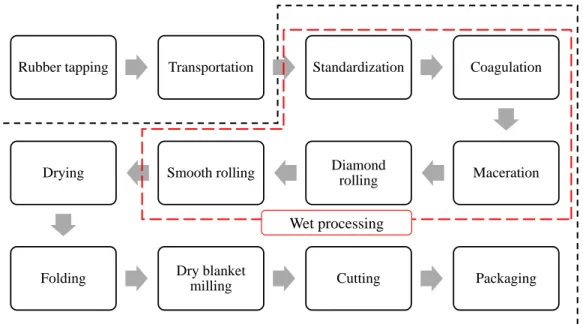
The crepe rubber manufacturing process is illustrated in the flow chart shown in Fig. 2.1. Details of key steps are given below.
Rubber latex collection (Rubber tapping & Transportation)
With periodically made incisions on the bark of the rubber tree, white-colored field latex is collected firstly into the cups hanged on the tree close to the incision and then to buckets. Before transportation to the factory, sodium sulfite is added as an anticoagulant to preserve the latex.
Standardization
Sooner the field latex arrives at a factory, be its dry rubber content (DRC) measured. Then, the latex is sent to bulking tanks, to which sodium bisulfate and water are added as a preservative and a diluent, respectively, considering the DRC value. The white and yellow fractions are extracted because of partial coagulation.
The yellow fraction is 10% of the DRC [7]. After fractionation, the white fraction is passed to settling tanks where coagulation occurs. However, the yellow fraction is sent directly to the mill for initial processing and then drying.
13 Coagulation
At this stage, formic acid (coagulant) and a bleaching agent are added to the white fraction. Moreover, some water is added to dilute the chemicals for consistent dispersion within the white fraction. The mixture is left for some time to coagulate and then is removed in cube-like pieces.
Milling
During milling, pieces of the coagulum are passed through a series of two roller mills to produce thin rubber laces. Firstly, coagulum is directed to a mill with two horizontally grooved rollers called macerator. Secondly, the macerated pieces are sent through a mill with two diamond grooved rollers to get thin rubber sheets as output. Finally, these sheets are passed through two smooth rollers to get rubber laces with minimum perforations.
Drying
Milled laces are carried over to a drying tower and left for 3 to 4 days for drying.
Radiators that circulate boiled water generate the warm air in the drying tower.
Rubber wood is used in furnaces to boil the water.
Folding
Dried laces are folded into stacks that weigh 25 kg. Before folding, the quality of laces is checked and pieces of dirt that affect the quality of the final produce (crepe) are removed.
Dry blanket milling
In this process, the 25 kg stacks are passed through a set of two horizontally grooved rollers twice to shape the rubber into a blanket form.
Cutting
During cutting, the blankets are trimmed into a buyer-specified rectangular- shaped size. Furthermore, dirt removal is performed again on the trimmed rubber.
The output after this stage is deemed crepe rubber.
Packing
In this stage, the crepe rubber is graded via simple visual assessment by the workers and then packed into 25 kg or 50 kg bundles. In most factories, only the highest quality grade, 1X, is packed using low-density polyethylene (LDPE) films whereas inferior grades are tightened with 1 or 2 rubber strips of the same grade.
14
2.3. Materials and Methodology
2.3.1. Goal Definition
The study comprised three steps to meet the objectives: (1) investigation of the current manufacturing process through quantification of the material consumption and waste, monetary losses, and GHG emissions, (2) identification of problems and proposal of the most feasible improvement options and, (3) validation of improvement potentials.
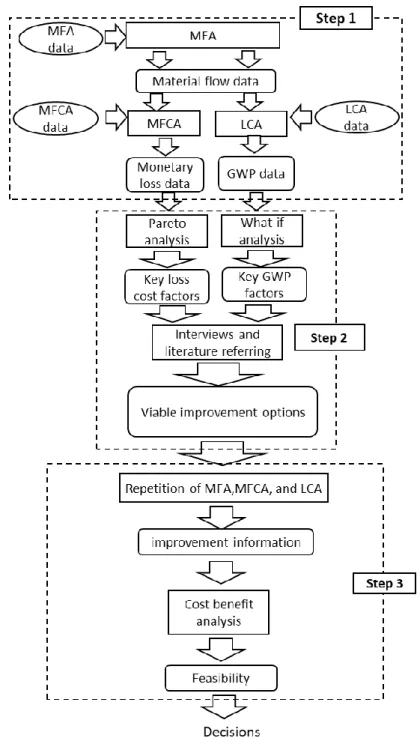
Basic steps and how various tools and techniques were integrated in the study are illustrated in the Fig. 2.2. Furthermore, it offers an insight into the data inputs required by each tool or technique and the corresponding outputs. If briefly explained, in the step 1, MFA was initially conducted in an audited factory to get material flow data. Then, based on MFA data, MFCA and LCA were conducted to assess the monetary loss and Global Warming Potential (GWP) in terms of GHG emissions, respectively. In step 2, such information was used to identify key loss cost and GWP factors via Pareto and what-if analysis, respectively. Also, we referred to field interviews and literature to identify easily reducible factors as well as viable improvement options. In step 3, the improvement potentials of such options were quantified in isolation and collectively by running MFA, MFCA, and LCA. Thereafter, we deployed a cost benefit analysis to get an insight into the
Rubber tapping Transportation Standardization Coagulation
Maceration Diamond
rolling Smooth rolling
Drying
Folding Dry blanket
milling Cutting Packaging
Wet processing
Fig. 2.1. Crepe rubber manufacturing process with the system boundaries; red dashed line for wet processing activities and black dashed line for the overall study boundary.
15
feasibility of the adoption improvement of options. Further details on the tools and techniques used under different steps are given in the following sections.
2.3.2. Quantification of Materials Involved (Step 1)
In this step, we employed MFA, MFCA, and LCA to quantify material consumption and waste, monetary losses, and GHG emissions, respectively.
Fig. 2.2. Overview of the research methodology. Ovals depict the raw data inputs while the rounded rectangles denote the outputs. Rectangles represents the tools and techniques used. Codes MFA, MFCA, and LCA denote material flow analysis, material flow cost accounting, and life cycle assessment, respectively.
16 2.3.2.1. System Definition
The system boundary that determined the unit processes included or excluded of this study, is demonstrated in Fig. 2.1. Activities carried out in rubber cultivations remained outside the system boundary, for the reason of their high level of temporal and spatial variability that demands separate study. In addition, the rubber tree had been identified as a source of carbon fixation [10]. To be more specific, net CO2 emissions from plantations remain negative in general even after the CO2 emissions bound with fertilizer consumption and latex transportation are included (for more details please refer to results and discussions section). Despite the sustainability of rubber cultivation, the system efficiency of crepe rubber manufacturing of which vast amounts of materials and energy are in use, are unknown, hence, was the sole focus of this study. Therefore for handling the in-plant assessment in crepe rubber factories, we used a gate-to-gate system boundary in deploying MFA, MFCA, and LCA as demarcated by a black perforated line in Fig. 2.1. This boundary covers all activities starting from the field latex entering from the gate of the factory to the dispatch of the final product from the factory gate. Specifically, it covered from the “standardization” to the “packaging”. In MFCA, we combined standardization, coagulation, maceration, diamond rolling, and smooth rolling into one processing unit named as “Quantity center No. 1” (QC1) to make calculations less complicated, and labeled this conglomerate as “wet processing.” Rest of activities were separated into another five processing units named as quantity centers 2-6 for drying (QC2), folding (QC3), dry blanket milling (QC4), cutting (QC5) and packaging (QC6), respectively. For LCA calculations, we considered external activities such as electricity generation, chemical production, and LDPE manufacturing.
2.3.2.2. Functional Unit
All the parameters used in MFA, MFCA, and LCA for both production lines were evaluated considering a functional unit of 1 MT of dry rubber input. In the case of MFA, we considered wet weight for latex containing 1 metric ton (MT) of dry rubber.
2.3.2.3. Data Collection
Data were collected by visiting four crepe rubber factories (factories A, B, C, and D) in Sri Lanka, all of which belonged to the three major rubber producing districts namely, Kalutara, Kegalle, and Ratnapura.In total, these districts account for about 75% of the total rubber land area in Sri Lanka. Assessments on the use of water, electricity, LDPE and rubber throughputs were taken as onsite measurements. Ash content of the rubber wood was determined through a laboratory analysis of a wood sample. Information on dry rubber content (DRC), chemical use, and rubber losses were collected from factory logbooks and through interviews carried out with factory workers, officers, and managers.
Cost data on field latex, chemicals, labor, and LDPE films were extracted from factory accounts. Meanwhile, the unit cost for electricity was taken referring to the home page of the Ceylon Electricity Board. Further, costs involved in machinery depreciation and maintenance were collected via interviews with factory officials. Nevertheless, data required for MFCA and LCA in factory B could not be collected because its operations were abandoned due to the insufficient availability of latex during the study period. Therefore,
17
the MFCA and LCA analyses were based entirely on data from factories A, C, and D.
However, all factories had similar production capacities, processes, and general practices, except water supplies. In factories A and B, water was pumped using the gravity whereas C and D used electric water pumps.
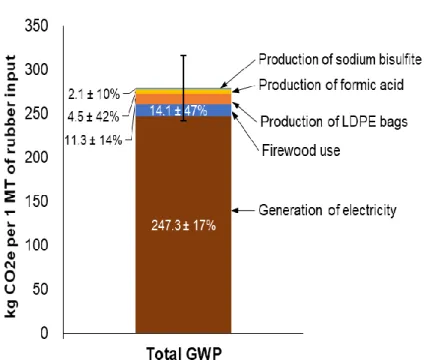
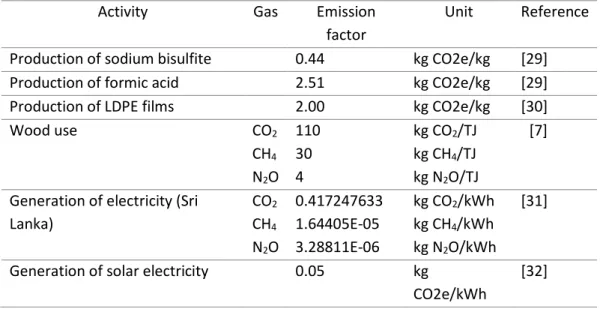
Emission factors required for LCA calculations were obtained from literature and are summarized in Table 2.1. Having no previous studies and data, the emission levels of bleaching agent and wastewater treatment plant were considered as zero.
Table 2.1 Emission factors used in GWP calculations. Code LDPE refers to low-density polyethylene.
2.3.2.4. Material Flow Analysis (MFA)
MFA is a systematic assessment of the flows and stocks of material within a system, defined in a space and time [38]. When MFA is applied to a manufacturing system, it quantifies the mass flow of materials to locate and examine inputs, partitioning, stocks, outputs, and significant sources of waste materials in the factory [42]. MFA follows the mass balance principle: input mass is equal to output mass [26].
For MFA analyses, STAN 2.5 software [43] was used to work on uncertainties in the input-output data or flows and e!Sankey software [44] to develop Sankey diagrams.
Initially, an MFA diagram was constructed for each factory using STAN 2.5 and then, all MFA diagrams were combined into a common material flow diagram where all the flow values were aggregated using mean ± relative standard deviation (RSD). Finally, a Sankey diagram (Fig. 2.3) was constructed with e!Sankey software with flow values in common MFA model.
2.3.2.5. Material Flow Cost Accounting (MFCA)
MFCA is an environmental management accounting tool that simultaneously involves the enhancement of economy and reduction of environmental impact [45][46].
MFCA quantifies the flows and stocks of materials in a production line in both physical and monetary units and provides information on costs associated with both products and material losses (e.g., waste, air emissions, wastewater) of which the organization is unaware [46]. In other words, MFCA makes physical and monetary losses at each process Activity Gas Emission factor Unit Reference
Production of sodium bisulfite 0.44 kg CO2e [39]
Production of formic acid 2.51 kg CO2e [39]
Production of LDPE films 2.00 kg CO2e [40]
Wood use
CO2
CH4
N2O 110 30 4
kgCO2/TJ kgCH4/TJ kgN2O/TJ
[6]
Generation of electricity (Sri Lanka) CO2
CH4
N2O
0.417247633 1.64405E-05 3.28811E-06
kgCO2/kWh kgCH4/kWh kgN2O/kWh
[41]
18
visible in numbers, thereby helping the organization in identifying problems and recognizing the necessity for improvements.
In MFCA, cost quantification was based on two types of product costs: positive product cost and negative product cost. Positive product cost represented the cost that was put into the finished product whereas negative product cost denoted the monetary value of wasted or recycled items (e.g., material losses, gaseous emissions, wastewater) [47]. The calculation process was conducted under four categories of cost information, i.e., material cost, system cost, energy cost, and waste treatment cost, by allocating them to the product (positive product costs) and waste flows (negative product costs or loss costs) in MFA [48]. Herein, the input material, system and energy costs were multiplied by the percent of material loss by weight in each processing unit or QC per 1 MT of rubber input to gain negative material, system and energy costs, respectively. However, waste management costs were solely allocated to negative product costs [26][48].
Furthermore, MFCA considered three types of materials for its calculations [49]; 1.
Raw materials, 2. Auxiliary materials, 3. Operating materials. Raw materials were the main source of the end product, whereas auxiliary materials were the materials added to raw materials to produce end products. Operating materials were the materials that were essential to produce end products but completely wasted as wastewater or emissions after processing (e.g., water for machinery cooling).
In the analyses, a cost flow model was prepared for each factory and all such cost flow models were combined into one by aggregating each flow value to represent mean
± RSD using Excel software. Then, the final MFCA diagram (Fig. 2.4) was constructed using e!sankey software with the values generated in the combined model.
2.3.2.6. Life Cycle Assessment (LCA)
LCA is a tool that measures the overall environmental burden of products and services to promote a better understanding of possible environmental impacts [50]. It is a systematic assessment that follows a certain framework (e.g. ISO 14001, CML) based on a functional unit and a system boundary determined according to a goal and a system definition [50][51]. Most common areas that many LCA studies focus on are global warming potential (GWP), acidification, eutrophication, ozone layer depletion, and human toxicity [52]. However having no sufficient data, only the GWP index was used in this study by assessing the extent that crepe rubber processing contributes to global warming through emitting GHGs. To calculate GWP, we followed a model mentioned in Jawjit et al. [6] or we simply multiplied the conversion factor observed in “kg CO2e per unit” by the level of activity. Due to unavailability of emission factors for bleaching agent manufacture and wastewater treatment in crepe rubber processing, we had to consider the effect of them to be negligible. As the firewood was from the rubber trees that were replanted, CO2 emissions incurred by firewood burning also had to be excluded from overall emissions [6]. The data compiling and GWP model calculations were carried out using Excel spreadsheets. First, activity based GWPs and the total GWP in each factory were quantified. Then, those GWPs were compiled to determine the mean values and RSDs that represent the overall crepe rubber production system in Sri Lanka.