N agasaki University Island SDGs Pr oject
Activity Report 2019
Goto City / Photography by HAMAMOTO Sho, Local Vitalization Cooperator
Contents
1. Introduction 2
1-1. Organizational Structure of the Island SDGs Project 4 2. Activities in Each Field of the Nagasaki University Island SDGs Project 6
2-1. Medical Care 6
2-2. Education 10
2-3. Infrastructure 14
2-4. Regional Promotion 19
2-5. Fisheries 22
3. SDGs Promotion Activities by the Island SDGs 25 4. Partnerships and Projects Towards Solving Problems 27
4-1. Domestic 27
4-2. Overseas (Scotland) 28
4-3. New Projects in Collaboration with the Islands 29
5. SDGs Achievements Towards 2030 30
6. Related Documents 33
6-1. Basic Information on Scotland, the Highlands and the Islands 33 6-2. Public Transportation in Remote Areas
– New Initiatives in Japan and Overseas 35
6-3. About Geoparks 41
1. Introduction
The United Nations SDGs (Sustainable Development Goals) launched in 2016, address various goals globally, advocating a ‘Leave No One Behind’ policy. The statement ‘Leave No One Behind’ means that, in order to achieve the sustainable developments that the SDGs aim for, ultimately to achieve true world peace and stability, there must not be any people ‘Left Behind’ either socially or locally.
Nagasaki is a prefecture that has longed for peace since losing everything after the atomic bombing in 1945, but it also has the advancing social problems that are within Japan, and the world, today.
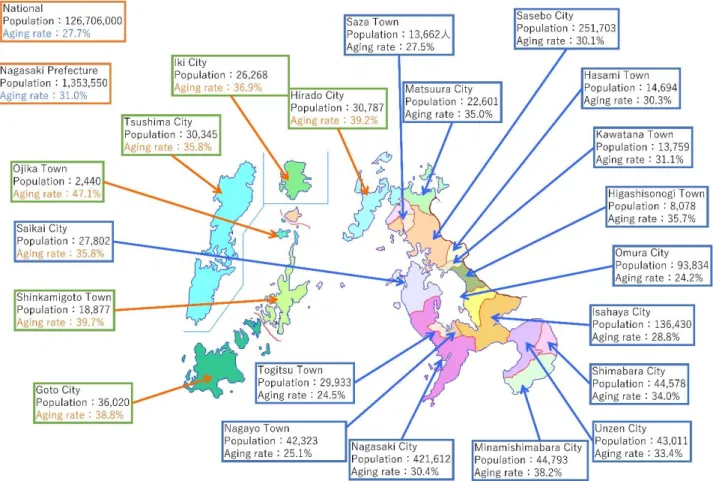
That is, an aging society and population outflow. The table 1-1 shows the advancement of the world’s aging populations but whilst Japan currently has the most advanced aging population, most regions in the world are expected to be in a similar situation as Japan within the next 30 to 60 years. Within Japan, the world’s most aging society, Nagasaki has many islands with an aging rate of around 10%
higher than the national average (see the next diagram), and the outflow of the population on these islands is serious. Geographically, Nagasaki is the prefecture with the largest number of islands in Japan, and also has many remote areas on the mainland, so it can be said that Nagasaki is the most
‘Easily Left Behind’ area in Japan.
Table1-1 The ratio of old-age to working age (the ratio of the population aged 65 and over to the population between the ages of 20 and 64) according to the OECD (Organization for Economic Co-operation and Development). The figures for Japan and each country in 2020 are highlighted in yellow. The red figures are the countries where the ratio of old-age to working -age is more than 50%. Japan is the only country in 2020, but it is predicted that by 2050 and 2080 many countries will be more than 50%.
See https://www.oecd.org/publications/oecd-pensions-at-a-glance-19991363.htm PDF, page 174 for the original text.
Table 6.2. Demographic old-age to working-age ratio: Historical and projected values, 1950-2080
1950 1960 1990 2020 2050 2080 1950 1960 1990 2020 2050 2080
OECD members
Australia 14.0 16.0 18.8 27.7 41.6 49.4 New Zealand 16.3 17.0 19.5 28.3 43.8 57.5
Austria 17.3 21.0 24.3 31.3 56.0 60.2 Norw ay 16.0 19.8 28.5 29.6 43.4 53.4
Belgium 18.1 20.3 24.8 33.1 51.3 56.8 Poland 9.4 10.5 17.3 30.5 60.3 68.6
Canada 14.0 15.1 18.4 29.8 44.9 54.0 Portugal 13.0 14.8 23.9 38.6 71.4 72.3
Chile 7.2 7.9 10.9 19.7 44.6 67.5 Slov ak Republic 11.9 12.6 18.2 26.5 54.6 58.1
Czech Republic 13.9 16.3 22.0 33.8 55.9 52.8 Slov enia 12.5 13.7 17.3 34.7 65.0 60.7
Denmark 15.6 19.0 25.9 34.9 44.6 52.4 Spain 12.8 14.6 23.1 32.8 78.4 74.4
Estonia 19.3 17.7 19.7 34.9 54.9 63.2 Sw eden 16.8 20.2 30.9 35.9 45.5 53.4
Finland 11.9 13.5 22.0 40.1 51.4 65.0 Sw itzerland 15.8 17.6 23.6 31.3 54.4 56.7
France 19.5 20.8 24.0 37.3 54.5 62.2 Turkey 6.5 7.0 9.4 15.2 37.0 58.2
Germany 16.2 19.1 23.5 36.5 58.1 59.5 United Kingdom 17.9 20.2 26.9 32.0 47.1 55.1
Greece 12.4 12.2 22.9 37.8 75.0 79.7 United States 14.2 17.3 21.6 28.4 40.4 51.1
Hungary 13.2 15.5 22.9 33.4 52.6 55.4 OECD 13.9 15.5 20.6 31.2 53.4 60.8
Iceland 14.1 16.4 19.0 26.6 46.2 64.5
Ireland 20.9 22.8 21.6 25.0 50.6 60.0
Israel 7.1 9.1 17.8 23.9 31.3 39.9 Argentina 7.5 10.1 17.3 20.2 30.3 45.5
Italy 14.3 16.4 24.3 39.5 74.4 79.6 Brazil 6.5 7.1 8.4 15.5 39.5 63.7
Japan 9.9 10.4 19.3 52.0 80.7 82.9 China 8.5 7.6 10.2 18.5 47.5 60.6
Korea 6.3 7.6 8.9 23.6 78.8 94.6 India 6.4 6.4 7.9 11.3 22.5 40.8
Latv ia 18.1 17.7 19.9 35.5 53.0 49.9 Indonesia 8.6 7.6 7.7 10.6 27.3 41.0
Lithuania 17.5 14.0 18.4 34.7 55.7 55.7 Russian Federation 8.7 10.5 17.2 25.3 41.7 41.9
Lux embourg 15.8 17.6 21.1 22.3 43.8 50.1 Saudi Arabia 7.5 8.4 6.1 5.3 28.2 44.8
Mex ico 8.0 8.3 9.6 13.2 28.9 50.9 South Africa 8.5 8.4 8.7 9.6 17.4 26.8
Netherlands 13.9 16.8 20.6 34.3 53.3 62.2 EU28 14.7 16.2 21.8 33.5 56.3 61.7
Note: The deomographic old age to w orking age ratio is defined as the number of individuals aged 65 and over per 100 people of w orking age defind as those aged betw een 20 and 64.
Source: United Nations, Department of Economic and Social Affairs (2019), World Population Prospects 2019, Online Edition (for future periods: medium-variant forecast).
Nagasaki University, based in Nagasaki, is a comprehensive university with fields such as Medicine, Education, Engineering, Fisheries, Environment, Economics and Global Humanities, and has the philosophy of ‘Creating science that supports the peace of the earth, thereby contributing to the harmonious development of society’. Prior to the SDGs, as a local university, each field had separately been conducting research and educational activities on islands and in remote areas, but in November 2018 the university became aware of the SDGs and the university as a whole launched partnerships with local governments, corporations, NPOs and citizens groups, leading to the start of the ‘Island SDGs Project’ to tackle the issue of island sustainability comprehensively. In this project, based on dialogue with the islands and remote areas we will gather knowledge for maintaining the local community, and share and comment on problem solutions in collaboration with overseas island and remote areas. This report summarizes the activities of the Island SDGs Project so far and future activities.
Table 1-2 Population and aging ratio of Nagasaki Prefecture, cities and towns as of October 2017 (ratio of population aged 65 or over to population). Nagasaki Prefecture has a higher aging rate than the national average, but it can be seen that the aging rate of the islands in Nagasaki Prefecture is about 10% higher.
This diagram is taken from Professor Takahiro Maeda’s presentation in the first Nagasaki University Islands and SDGs Symposium (the data is based on Nagasaki Prefecture’s Transferred Population Survey published by Nagasaki Prefecture, estimated population by age, city and town).
1-1. Organizational Structure of the Island SDGs Project
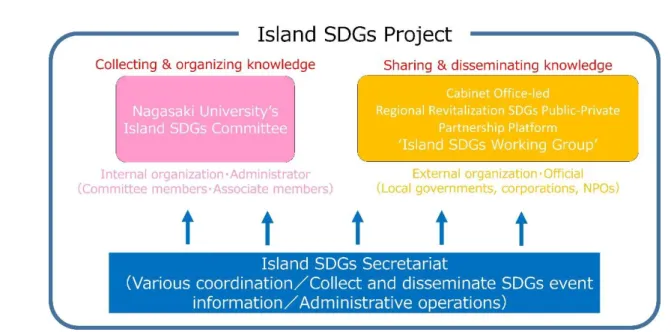
Table 1-3 Organizational structure of the Island SDGs Project
The Island SDGs Project is managed by the ‘Island SDGs Committee’ established within Nagasaki University and the ‘Island SDGs Working Group’ of the Cabinet Office’s Regional Revitalization SDGs Public-Private Partnership Platform (Diagram 1-3). The Island SDGs Committee is made up of committee members involved in decision-making and associate members who are actually engaged in activities on remote islands and in remote areas, whilst collaborating with overseas collecting and organizing knowledge (see 4-2). The Island SDGs Working Group is the forum where the Island SDGs Project collaborates with local governments, corporations, NPOs, etc., on islands and in remote areas to share and disseminate the knowledge collected and organized by the Island SDGs Committee. Various coordination and administrative operations related to the Island SDGs Committee and the Island SDGs Working Group are performed by the Island SDGs Secretariat at Nagasaki University. As of February 2020, the members of each organization are as follows (honorifics omitted).
Nagasaki University SDGs Committee/Committee Members (Decision makers: 6) - NAGAYASU Takeshi (Trustee in charge of Research and International Affaires)
- MATSUDA Hiroshi (Director of the Infrastructure Lifetime-Extending Maintenance Research Center, Dean of the School of Engineering and the Graduate School of Engineering)
- NAGATA Yasuhiro (Director of the Comprehensive Community Care Education Center) - NAKAMURA Norio (Vice-President in charge of Regional Education Collaboration)
- SOYANO Kiyoshi (Deputy Director of the Organization for Marine Science and Technology) - AKAISHI Takatsugu (Trustee in charge of Social Collaboration and Student Affairs)
Nagasaki University SDGs Committee/Associate Members (Participants, Island Activities: 10) - NISHIHARA Gregory Naoki (East China Sea Environmental Resources Research Center) - IKEDA Ko (General Support Center for Regional Education)
- KAGABU Makoto (Faculty of Environmental Science)
- YAMAMOTO Ikuo (Vice-President in Charge of Industry University Collaboration) - SAITSU Yumiko (School of Global Humanities and Social Sciences)
- YASUTAKE Atsuko (School of Engineering) - NISHIKAWA Takafumi (School of Engineering)
- MAEDA Takahiro (Director of the Collaboration Center for Community Medicine) - SHIMOKAWA Isao (School of Medicine)
- FUJIKI Takashi (Faculty of Education)
Island SDGs Working Group Members (4 Municipalities)
- NAKAMURA Masashi (Nagasaki Prefecture, Planning Promotion Division, Community Development Promotion Section, Remote Island Promotion Group)
- NAKASHIMA Yasunori (Goto City, General Affairs Planning Division, Policy Planning Section, Policy Planning Group)
- IGA Tsuyoshi (Shinkamigoto Town, General Policy Division, Policy Promotion Group) - SHINOZAKI Michihiro (Iki City, General Affairs Division, SDGs Future Section, SDGs
Future Group)
Island SDGs Secretariat
(Various coordination, information gathering and dissemination, administrative operations: 2) - FUJINO Tadanori (Office for Global Relations)
- YAMAURA Kimiyo (Office for Global Relations)
2. Activities in Each Field of Nagasaki University’s Island SDGs Project
Nagasaki University is engaged in the following activities with regard to medical care, education, infrastructure, regional promotion, and fisheries, on islands and in remote areas, with a focus on maintaining the local community.
2-1. Medical Care
How to Protect the Health of People on the Islands? (Related to SDGs 3)
~ Activities Involving Society ~
The relationship between Nagasaki University and the medical care on remote islands is deep and since its opening the University has had a long history of involvement. Over the years it has been producing human resources that support remote island medical care, such as more than 50 years ago it conducted a filariasis survey in Matsushima, Sakai City. In fiscal 2004, Nagasaki Prefecture and Goto City launched the first local government donation course ‘Remote Islands and Remote Areas Medical Science Course’ at Nagasaki University, in order to enhance research and education on regional medicine and support for medical treatment. The ‘Remote Islands Medical Research Institute’ was opened at the same time as the start of the course in Goto Central Hospital, Nagasaki Prefecture, supporting various activities as an important activity foothold on remote islands.
As part of these activities, special medical examinations are conducted along with health checkups (Basic Health Survey for Residents), sponsored by the local governments to protect the health of the people on the islands. If the patient wishes, they can undergo special checkups for diseases such as dental disease, osteoporosis, rheumatoid arthritis, frail or hardening of the arteries (arteriosclerosis).
For 3 years special medical examinations have been carried out in all districts of Goto City.
Faculty members and students participating in Goto City health checkups and special medical examinations.
~ Research Activities ~
In order to protect the health of the people of the islands, not just for now but also in the future, it is important to nurture future medical professionals. On remote islands in Nagasaki Prefecture, practical community medicine education is being conducted with the cooperation of many facilities and organizations related to the local health care system, such as hospitals, clinics, social welfare facilities, home-visit nursing stations and the government.
Nagasaki University Faculty of Medicine has been providing community medicine education (medical and health training for remote islands) for all medical students since fiscal 2004 as part of clinical training on remote islands in Nagasaki Prefecture. Staying for a week in Tsushima, Iki, Kamigoto and Shimogoto, students learn comprehensive community medicine and care for facilities and professional organizations involved in community health, medical care, welfare and nursing care. Since fiscal 2006, medical students from other universities have been accepted for this training, and in addition co-training with the Faculty of Pharmaceutical Sciences and the Faculty of Dentistry was introduced, which has now evolved into a comprehensive community health professional education program that transcends universities and faculties and is still developing. Furthermore, a joint educational program with Nagasaki Junshin Catholic University, which trains welfare human resources, was added, in order to enhance the quality of specializes fields and deepen the understanding of comprehensive community care systems through hands-on experience in remote island and remote area medical treatment, and to deepen understanding of nursing care and welfare, we aim to nurture medical professionals with nursing and welfare perspectives.
Also, every August the ‘Nagasaki Community Medicine Seminar’ is held in Goto City. Continuing from its predecessor, the ‘Nagasaki Family Medical Intensive Seminar’, which began in 2006, in 2019 it reached its 13th year. Students from Nagasaki Junshin Catholic University have also participated since 2016, while conducting fieldwork and group discussions with perspectives different from medical care and welfare, they competitively aim to be active in the fields of future comprehensive community care, primary care, homecare and general medical care.
As a research activity, based on data obtained from specific medical examinations, cohort studies are conducted to track specific diseases such as fractures, myocardial infarction, stroke and uveitis.
Long-term tracking of those who cooperated with the research is conducted, also epidemiological research on whether-or-not mainly lifestyle-related diseases develop, and what the factors related to the development are. If common characteristics and risk factors are found in people who develop the disease, it may be used to prevent future cases.
Under faculty member guidance, medical students participate in the
program. International students also learn about the field of community medicine.
~ As a University, for Society ~
In Goto City, Goto City, Goto Pharmacists Association and Nagasaki University Remote Islands and Remote Areas Medical Research Institute collaborated and introduced an electronic system,
‘Okusuri Net’ (Pharmaceutical Network), in 2013 to share the dispensing information of its citizens.
With the usual medicine handbooks, patients can forget to put the drug information stickers in them, and when not carrying them at the time of an emergency, it has been pointed out that prescription dispensing information is not accurately conveyed to medical personnel.
All drug dispensing pharmacies in Goto City participate in the ‘Okusuri Net’ (Pharmaceutical Network), which has made the network accessible to all citizens. The information is automatically registered from each dispensing pharmacy, so there is no need for the patient to manage it. Even when not carrying one’s medical handbook, as long as consent to share information has been given, Goto City can check the dispensing history at any pharmacy. Since accurate medication information can be given to medical professionals, safe and secure medication instruction can be received. In addition, the network also integrates local monitoring information (emergency contacts, family structure, hospital visits, shopping, etc.), which can be useful in emergencies. Also, the network data is converted to cloud computing and remote backup is performed, making it easy to recover in a disaster.
The date accumulated on the ‘Okusuri Net’ (Pharmaceutical Network) is also used for influenza prevention measures. Specifically, by extracting patients who have been prescribed anti-influenza drugs based on the dispensing information on the Pharmaceutical Network, it is possible to grasp the influenza outbreak status in real time by region and age group. During the influenza season, physicians and pharmacists, as well as schools and facilities where outbreaks are likely to occur, are promptly given daily dispensing information to promote care support and awareness of prevention.
The Pharmaceutical Network system was developed by Medical-i Inc., which provides the Cloud type electronic medical service ‘ippo Dispensing Chart’.
~ Location / Base ~
Base: Goto City – Remote Island Medical Research Institute (2 resident faculty members), Institute of Preventive Medicine Science (2 resident faculty members)
Activity Area: Goto City, Shinkamigoto Town, Ojika Town, Iki City, Tsushima City, Hirado City
~ Central People / Structure ~
- MAEDA Takahiro, Professor (Graduate School of Biomedical Science, Remote Islands and Remote Areas Medical Science Course)
- NAGATA Yasuhiro, Professor (Graduate School of Biomedical Science, Center for Comprehensive Community Care Education)
~ Number of Participants / Period ~
Medical staff from Nagasaki University constantly visit the remote islands (Goto City, Shinkamigoto Town, Iki City, Tsushima City), and together with faculty and students, around 200 people visit the remote islands every year.
~ Partnership or Funding ~
- Goto City, National Health Insurance Section - Shinkamigoto Town, Health Insurance Section - Iki City, Health Section / Health Promotion Section
- Tsushima City, Health Promotion Department Health Promotion Section - Hirado City, Civil Life Department Health Insurance Section
- Nagasaki Prefecture, Health and Welfare Department - Medical-I, Inc.
2-2. Education
Providing High-Quality Education Suited to Local Characteristics (Related to SDGs 4)
~ Activities Involving Society ~
The General Support Center for Regional Education dispatches faculty members using mobile science cars, as requested and desired, so that the university faculty members can contribute in various places in Nagasaki and in the remote areas. Faculty members from each faculty and graduate school at Nagasaki University conduct experiments and lectures, such as advanced science, that cannot be experienced in everyday classes. Starting from 2011 and up until 2019, it was implemented in various places including Kamigoto Town, Ojika Town, Hirado City, Saikai City and Minamishimabara City.
The science car of Nagasaki University.
Almost continuously in operation! Goto City Board of Education consultation on its satellite office. From the left: Mr. Ikeda, Deputy Head of the General Support Center for Regional Education; Mr.
Miyamoto, Director of Goto City Board of Education; Prof.
Nakamura, Head of the General Support Center for Regional Education
In addition, as part of regional career selection support, the ‘Rikejo Seminar (Seminar for female science students)’ has been held for the past 7 years with the support of Japan Science and Technology (JST).
Science students on the islands are unable to hear about seniors, who are their role models and active members of society, which is an obstacle to making concrete plans for their futures. At the General Support Center for Regional Education, lectures were invited utilizing the University’s network, and an opportunity for female science students to learn about potential careers was also held at Goto High School.
Rikejo Seminar (Seminar for female science students) held at Nagasaki Prefectural Goto High School (August 1st, 2018)
In 2019, Goto City and Matuura City, the Board of Education set up local coorinators (satellite Offices) to collaborate with the General Support Center for Regional Education, and providing antennas for educational support systems with awareness of local issues.
~ Educational Activities ~
At the Nagasaki University Faculty of Education, having had a strong interest in remote island education since 2016 and to develop human resources to support future education on remote islands and in remote areas, a remote island education recommendation frame has been established for those who strongly wish to take a teaching job at a remote island elementary school in Nagasaki after graduating. In addition, for students enrolled in the remote island recommendation frame (those who wish to take the following programs in elementary school education courses), we have launched the ‘Remote Island Education Program’ with the aim of training teachers with the qualities of remote island rearing. In this program students will gain a broad knowledge on remote island education in the first year, and in the second and third years students will learn about the knowledge of effective lesson development utilizing ICT, necessary for remote islands and remote areas. In the third year, a 4-week educational training session is held in a compound class at an elementary school attached to Nagasaki University. Students conclude this program in the fourth year, in addition to the subjects related to the making of compound classes, to experience education on remote islands and in remote areas for actual connection with the schools, ‘Remote Island and Remote Area Training’
is carried out. In this way, the learning at university is a foundation, and with practical training at attached elementary schools on remote islands and in remote areas, the aim is to train teachers for remote islands to a higher standard of excellence.
of cumulative experiential learning in the Faculty of Education, and is currently being conducted in cooperation with elementary and junior high schools in Goto City, Shinkamigoto Town, Minamishimabara City and Hirado City. These educational efforts on remote islands and in remote areas have led to collaboration with the Board of Education and educational sites, and to an understanding of remote island education recommendation frames and remote island education programs.
Remote island and remote area training held at
Hamanoura Elementary School in Shinkamigoto Town in October, 2019. Hamanoura Elementary School has been accepting internships from Nagasaki University Faculty of Education since 2004.
Observing the guidance of the 5th and 6th grade compound class
Teaching practice of a compound class held at an elementary school attached to Nagasaki University (1st and 2nd grade class)
5th and 6th grade class
~ As a University, for Society ~
The aforesaid remote island education program had its fourth year in the fiscal 2019, and all fourth year students who entered the remote island recommendation frame found employment in the educational field. It is highly expected that one will become a key person supporting future island education by making use of what one learned on this program. While making efforts for this future, the Faculty of Education focuses on developing teachers who can succeed on remote islands and in remote areas, and the General Support Center for Regional Education, through support with attention to every detail**, engages in fostering leaders who enrich the area, while in addition to the above we are conducting various other projects.
* Introduced in the Ministry of Education, Culture, Sports, Science and Technology’s ‘Good Practice in Reformation of Teacher Training’, PDF 8th page.
** In 2019, the Center Head, Mr. Nakamura gave advice on foreign language education at elementary schools on remote islands and in remote areas, held in Matsuura City (October) and Shinkamigoto Town (November). Professor Matsumoto, of the Faculty of Education, also provided support for Science education in Matsuura City (November).
~ Location / Base ~
Goto City, Shinkamigoto Town*, Minamishimabara City, Hirado City, Matsuura City*
(*Satellite Office installation)
~ Structure ~
- Remote Island Education Program Support Section
- Cumulative Experiential Learning Implementation Section - Cumulative Experiential Learning Student Section
- NAKAMURA Norio, Professor (General Support Center for Regional Education) - IKEDA Koh, Professor (General Support Center for Regional Education)
~ Participant numbers / Period ~
Remote island and remote area training (cumulative experiential learning)
Currently about 50-70 students participate each year in a total of 15-20 elementary and junior high schools in Goto, Shinkamigoto, Minamishimabara and Hirado.
Satellite office
1 person each from the Board of Education in Matsuura City and Goto City.
Science Car Lab
Ongoing plans for around 60 plans each year since 2011 (around 8 of these are conducted on remote islands and in remote areas). Every year around 20 Nagasaki University faculty members collaborate. The aim is for around 4,000 people (of which 400 people are intended for remote islands and remote areas).
Rikejo Seminar (Seminar for female science students)
Implemented around 7 projects every year since 2013 (2019 was the final year). Each year, around 30 people from within and without the University collaborated.
~ Partnership / Funding ~
- Japan Science and Technology Agency (JST): Support program for Science course selection for female junior and senior high school students.
- Shinkamigoto Town Board of Education - Goto City Board of Education
- Hirado City Board of Education
- Minamishimabara City Board of Education - Matsuura City Board of Education
2-3. Infrastructure
Supporting the Basis of Local Life by Extending the Life of Infrastructure (Related to SDGs 11)
~ Activities Involving Society ~
Despite many technology innovations and telecommunications, the devastation of infrastructure that is the foundation of human life is steadily progressing in Japan. In Nagasaki Prefecture, churches and many tourist resources are scattered on remote islands and in remote areas, but bridges and harbors that connect them are aging. There are many challenges, such as the aging of technicians and the severe financing of the prefecture’s construction and maintenance costs.
In January 2007, Nagasaki University’s School of Engineering established the ‘Infrastructures Lifetime-Extending Maintenance Research Center’ in collaboration with Nagasaki Prefecture, municipalities within the prefecture, and local corporations. This center conducts a training project, called ‘Michimori (Road Guardian)’, to foster human resources for community regeneration.
‘Michimori’ is aimed at local government officials, private corporations, NPOs, and local residents in the prefecture, and develops human resources who are involved in the regeneration and longevity of the infrastructure that is the foundation of ‘Machi-okoshi (Community Revitalization)’. People with public qualifications related to infrastructure can acquire basic and applied knowledge according to their level, and ordinary citizens (such as volunteers and protection organizations) can acquire knowledge and skills such as routinely observing and inspecting roads and bridges.
The maintenance and management of infrastructure requires various technologies, such as surveys, diagnostics, and specific advanced technologies. However, there are limitations for the specialists who keep constant vigil over a large prefecture, checking the condition of the infrastructure.
Therefore, if the status of the infrastructure seen in everyday life is checked for cracks and crevices, and when there is something wrong the university or prefectural government is contacted, then the experts can rush to the scene and check. Students who take this course will be able to detect such anomalies in the infrastructure. The sooner an anomaly is detected, the lower the maintenance costs will be.
~ History of the ‘Infrastructures Lifetime-Expanding Maintenance Research Center’ ~
These efforts are also being used to maintain the infrastructures on remote islands and in remote areas. The ‘Michimori (Road Guardian)’ training project has also been implemented on remote islands such as Goto City, Shinkamigoto Town, Tsushima City and Iki City, where people from many districts have been certified as Road Guardians, and maintenance is being carried out in accordance with the geographical conditions.
In Iki City and Shinkamigoto Town, certified Road Guardians are doing volunteer activities through the subcommittee of the ‘Michimori Training Unit Association’, such as road monitoring (road abnormality inspections and cleaning activities) and cleaning curve mirrors. In Goto City, they participate in direct inspections of the bridges and tunnels of Nagasaki Prefecture.
The efforts of the ‘Infrastructures Lifetime-Extending Maintenance Research Center’ are also reflected in the policies of local governments and the Japanese government. In January 2015,
‘Michimori (Road Guardian)’ was registered with the Ministry of Land, Infrastructure, Transport and Tourism as ‘a private qualification to ensure the maintenance and renewal of social capital’, and in a bid conducted by Nagasaki Prefecture and the Ministry of Land Infrastructure, Transport and Tourism Kyushu Regional Development Bureau, it became a qualification for evaluating technicians.
Also, in 2014, the development and implementation of cutting-edge technologies such as infrastructure inspection, diagnosis, repair, information and communications, and robots began under the Cross-ministerial Strategic Innovation Promotion Program (SIP) ‘Infrastructure Maintenance Management, Renovation and Management’ project of the Japan Science and Technology Agency (JST). Since 2016, community demonstration experiments have been carried out
in order to utilize these research results locally. Even in Nagasaki Prefecture, together with the Road Guardians, we are conducting demonstration tests of infrastructure inspection technology (11 university research groups in the Kyushu and Yamaguchi regions are participating).
Table 2-1 Prefectural distribution of the number of certified Michimori (Road Guardians) by district as of the end of March 2019
Left Road monitoring activities in Shinkamigoto Town Right Curve mirror cleaning activity in Iki City
‘Michimori Training Course’ in Tsushima City. It includes lectures, seminars and practical training courses.
Furthermore in 2018, utilizing the SIP’s research results and to further expand public and private research development, the Cabinet Office started the ‘Public/Private R&D Investment Strategy Expansion PrograM (PRISM)’. As one of the themes in the first fiscal year of Reiwa ‘Innovative Construction and Infrastructure Maintenance, Disaster Prevention and Mitigation Technology’ was established, and Nagasaki University, Tohoku University, and Akita University are conducting joint research in order to consider the construction and cooperation of databases in infrastructure and management. This integrates local governments and national databases and aims to build a platform for sharing infrastructure maintenance data among stakeholders. Nagasaki University collaborates with Nagasaki Prefectural Government, Tohoku University with Shimane Prefectural Government, and Akita University with Akita Prefectural Government, and requests data provision and makes adjustments.
Within Nagasaki Prefecture, Nagasaki University and the Public Works Department of Nagasaki Prefectural Government are working on building a platform that integrates data on roads, tunnels, slopes, ports and rivers, etc., using data from the government of Nagasaki City, Goto City and Shinkamigoto Town. Not only infrastructure maintenance but also data such as disaster prevention information will be used.
~ As a University, for Society ~
There are these statements, ‘Infrastructure is “A big business necessary for humans to live a human life”(Nanami Shiono, ‘The Story Of The Roman People, Volume 10’, Shinchosha Publishing Co., Ltd., and “Mobility is a matter of personal freedom, social participation, and richness. It is an important prerequisite for economic growth. The infrastructure required for this is high-quality transportation infrastructure.” (Hisakazu Oishi, former Chief Technology Officer of the Ministry of Land, Infrastructure, Transport and Tourism, ACe (Architecture & Civil Engineering Journal), Column ‘Kagen Jouyo’, 2013 German Three-Party Agreement document)’. While this awareness of infrastructure is common throughout the world, efforts are being made to extend Japan’s knowledge of infrastructure maintenance and management to developing countries. In particular, a ‘Bridge Maintenance Training Course’ for learning about bridge maintenance is held at Nagasaki University through Japan International Cooperation Agency (JICA). The Infrastructures Lifetime- Extending Maintenance Research Center is working with people both in Japan and overseas to develop human resources who can work together to solve issues.
Assoc. Prof. Takafumi Nishikawa discusses with participants from around the world during the Japan International Cooperation Agency’s (JICA’s) ‘Bridge Maintenance Training Course’
~ Place / Base ~
Goto City, Shinkamigoto Town, Tsushima City, Iki City
~ Central People / Structure ~
- MATSUDA Hiroshi, Professor (School of Engineering, Director of the Infrastructures Lifetime-Extending maintenance Research Center)
- YAMASHITA Takahiko, Professor (School of Engineering, Vice-Director of the Infrastructures Lifetime-Extending Maintenance Research Center)
- NAKAMURA Shozo, Professor (School of Engineering, Vice-Director of the Infrastructures Lifetime-Extending Maintenance Research Center)
~ Participant Scale / Period ~
Michimori (Road Guardian) Training Course participants: 158 participants in 2019, 128 participants certified.
- Road Conservation Department, Land Development Division, Miyazaki Prefecture - Goto City
- Shinkamigoto Town - Tsushima City - Iki City
<Academia>
- Gifu University - Niigata University - Ehime University - Yamaguchi University
- National Institute of Technology, Maizuru College
- University of Miyazaki - Kansai University
<Industry>
- Yoshikawa Civil Engineering Consultants Ltd.
- Jotaki Corporation
- Asahi Consultant Co., Ltd.
- Aso Corporation
- Mitsubishi Hitachi Power Systems Inspection Technologies, Ltd.
- Kiso-Jiban Consultants Co., Ltd.
- Repair One-Stop Sytem - Nippon Koei Co., Ltd.
- Zenken Co., Ltd.
- Chuo Consultants Co., Ltd.
- Ueno Planning Ltd.
- BMC Co., Ltd.
- West Nippon Expressway Co., Ltd.
- Japan Prestressed Concrete Contractors Association - Oshima Shipbuilding Co., Ltd.
- Japan Bridge Association - Ueda Memorial Foundation
High-speed ferry to Fukue Island (Nagasaki Port)
2-4. Regional Promotion
Creating Projects That Rejuvenate Local Communities
~ Activities Involving Society ~
In 2018 Nagasaki University started an ‘Entrepreneur Development Project’ with remote islands and remote areas as the fields. This project aimed to start a new business in two years, considering projects to help volunteer students from Nagasaki University solve local issues, where the participating students work with local businesses and act while receiving advice from consultation experts and financial institutions related to regional revitalization. The first year, fiscal 2018*, was spent on opening community cafes using vacant houses in Goto City, conducting tours of Narushima Island, watching over the elderly, and starting a business by developing Dressing for Goto Udon noodle, and in the second year 2019**, conducting activities for entrepreneurship in Higashisonogi Town, based on roadside rest area, whale meat, and Edo Period style post stations (Shukuba).
*Goto Entrepreneur Development Project: 15 students (Faculties of: Medicine, Economics, Environmental Science, and Engineering)
** Higashisonogi Entrepreneur Development Project: 12 students (Faculties of: Global Humanities and Social Sciences, Education, Economics, Environmental Science, and Fisheries)
2019 team. Interview on current and future plans with the manager at the roadside rest area ‘Sonogi- no-sho’.
One of the activities of the 2018 project team. A meeting with the Goto City Chamber of Commerce to utilize vacant houses in the Miiraku Settlement in Goto City.
~ Educational Activities ~
The General Support Center for Regional Education conducts a Glocal Human Resource Development Program, and the students who participate in the program also produce ideas for community development. In 2019, the project presented a poster at the JTB ‘University Student Tourism Community Development Contest’ and proposed an event of ‘matchmaking’ for the promotion of sightseeing in Shinkamigoto Town. In addition, to contribute to community development, Nagasaki University students provided opinions as external participants in response to Nagasaki Prefecture’s ‘Challenge 2020’ (a prefectural government comprehensive plan formulated every 5 years).
Also, the ‘Future Creation Center’ was established in 2015 in the Faculty of Economics in order to promote regional revitalization, social contribution, and the development of practical business skills.
Here, business- architect and practical seminar courses are held. Business-architects learn about local businesses and local issues from the 2nd year, and from the 3rd year there is a program of
by offshore wind power in Goto City and activities to promote the branding of the Black Long Spine Urchin (Diadema setosumin) in Iki City. In addition, some students plan to hold a health festival to raise the health awareness of citizens with lifestyle-related diseases.
Nagasaki University students’ presentation at the 2019 JTB ‘University Student Tourism Community
Development Contest’
A scene at Goto Citizen Electric Power. In the center is Professor Nishimura (Faculty of Economics), who conducts the seminar.
~ As a University, for Society ~
We collaborate closely with private companies that are the leaders of local industries, to try to solve real issues so that the people can continue to live rich lives in the community. Through these activities, we connect with the local people, and are also involved in developing human resources who can work to solve issues.
~ Place / Base ~
Goto City, Shinkamigoto Town, Narushima, Iki City, Higashisonogi Town
~ Central People / Structure ~
- AKAISHI Takatsugu, Trustee (Faculty of Economics) - NISHIMURA Nomuhiko, Professor (Faculty of Economics)
- TSURUSAKI Kasuyoshi, Associate Professor (Faculty of Economics)
- NAKAMURA Norio, Professor (General Support Center for Regional Education) - IKEDA Ko, Professor (General Support Center for Regional Education)
~ Participant Scale / Period ~
Entrepreneur Development Program: 15 participants in 2018, 12 participants in 2019
~ Partnership / Funding ~
< Business >
- Ikiiki Goto Co. Ltd. (2018 - ) - MEDIAWEB Co., Ltd. (2018 - ) - narushi...plus-one (2018 - )
- Sonogi Geiniku (whalemeat) Co. Ltd. (2019 - ) - Sonogi-no-shou Co. Ltd. (2019 - )
- Saito Shukuba (2019 - ) - BOLBOP Inc.
- Omura-wan Corporation - matataki Co., Ltd.
- Nippon Biodiesel Fuel co., ltd.
- Lequio Power Technology Corp.
< Government >
- Goto City Office (2018 - )
- Mr. NAKAYAMA Yuichi, Higashisonogi Town Office (2019 - ) - Miiraku Wakkamon Kai (Young Men’s Association) (2018 - )
- Mr. HAYASHIDA Ryuji, Nagasaki Prefectural Planning Promotion Department, Community Improvement Promotion Division
- Nagasaki Prefectural Planning Promotion Department, Policy Planning Division - Industrial Labor Department, Youth Retention Divition
< Finance >
- Japan Finance Corporation - 18th Bank
- Shinwa Bank
- Nishi-Nippon City Bank
2-5. Fisheries
How to Protect the Richness of the Islands’ Sea. (Related to SDGs 14)
~ Activities Involving Society ~
In order to regenerate the seaweed beds, with the idea that it is important to create seaweed beds with citizen participation so that not only the fishermen but also the locals know about rocky-shore denudation, Associate Professor Nishihara of the Organization for Marine Science and Technology together with the cooperation of Shinkamigoto Town introduced the importance of the seaweed bed ecosystem to Arikawa Junior High School students, having them culture juvenile seaweeds and make plantations in the sea as an activity of their laboratory.
Associate Professor NISHIHARA introduces the importance
of seaweed beds Seaweed (Sargassum macrocarpum) culture set
~ Research activities ~
What should we do to prevent the rocky-shore denudation from spreading any further? Associate Professor Nishihara’s Laboratory of Aquatic Plant Ecology is conducting research to ascertain the difference between places where rocky-shore denudation is advancing and the seaweed beds are thriving and where seaweed beds do not regenerate, even on the same island. In addition, with the cooperation of the Ojika Island town office, a method for more effectively planting the juvenile seweeds to regenerate and conseve the seaweed beds is being inspected at Mushima, a secondary remote island. A part of the materials used for the research (Moasis) is provided by Kyowa Concrete Industry Co. Ltd.
Environmental observation equipment installed
underwater. What is the difference between where algae thrive and where they don’t?!
Data collection on Mushima, a secondary remote island of Ojika Town
Kyowa Concrete Industry Co. Ltd. Provides the foundation (Moasis) used in conducting experiments in the sea
~ As a university, for society ~
Not only diving to do research, but also doing what we can as divers. Besides research, the Laboratory of Aquatic Plant Ecology conducts underwater cleaning activities at Arikawa Bay in Shinkamigoto Town, bringing up the sunken garbage.
Some of the garbage raised in the August, 2018 cleaning
activity Students from the Laboratory of Aquatic Plant Ecology
performing cleaning activities
~ Location / Base ~
Ojika Town, Mushima / Shinkamigoto Town, Arikawa (with bases)
~ Central People / Structure ~
Associate Professor NISHIHARA Naoki (Organization for Marine Science and Technology)
~ Participant Scale / Period ~
Research activities are conducted by around 10 people, and basically, they go to Shinkamigoto and Ojika (Mushima) every month for a survey.
Approximately 50 junior high school students participate in culturing juvenile seaweed.
~ Partnership / Funding ~ - Pew Marine Fellow
A fellowship awarded by Pew Charitable Trusts of the United States of America. This fellowship is awarded to individuals and organizations that conduct outstanding research and educational activities to protect and conserve the marine environment and marine life.
To date, 164 people from 38 counties, mainly marine ecosystem experts, have been chosen.
In 2018, Associate Professor Nishihara was the third Japanese person to be selected (the support system is for 3 years, until 2021).
- Shinkamigoto Town, Comprehensive Policy Division - Ojika Town Office, Industrial Promotion Division - Kyowa Concrete Industry Co. Ltd.
- Nagasaki Prefectural Fisheries Department, Resource management Division (Seaweed bed recovery comprehensive promotion project in 2018)
3. SDGs Promotion Activities by the Island SDGs
In the fiscal 2019, the following SDGs promotion activities were carried out by the Island SDGs.
Propagation ‘What are SDGs? ~The background, the essence and the current situation~’
On June 26th, 2019, Assistant Professor Fujino of the Island SDGs Secretariat introduced SDGs to government officials under the above title at Shinkamigoto Town Office.
Deployment Participated in a working group organized by the Japan Science and Technology Agency (JST) for the collaboration of local industries, academia, governments and society.
In July 2019, the Japan Science and Technology Agency (JST) has connected regional issues and solutions based on science and technology (seeds) toward the development of comprehensive and sustainable regional development using the SDGs as the common language. In July 2019, the Island SDGs participated in a working group that was established to build opportunities for stakeholders to co-create solutions to the issues.
Deployment Participated in the General Assembly of the Regional Revitalization SDGs Public-Private Partnership Platform
On August 26th, 2019, staff member Ms. Yamaura of the Island SDGs Secretariat introduced Nagasaki University’s ‘Island SDGs Working Group’ at the above event.
Deployment Participated in the working group of the ALL Kyushu SDGs Network
In October 2019, Kitakyushu City, Iki City, and Oguni Town of Kumamoto Prefecture, which were each selected as future cuties for SDGs in Kyushu, participated in a working group which was established with the aim of revitalizing SDGs initiatives in Kyushu.
Propagation ‘Corporate Management and Local Government Management Driven by SDGs’
On November 6th, 2019, under the above title sponsored by the Kyushu Bureau of Economy, Trade and Industry, Assistant Professor Fujino of the Island SDGs Secretariat served as a panelist for SDGs at Universities at the Kyushu SDGs Management Promotion Forum*, and a discussion was held with participants on Nagasaki University’s Island SDGs Project. On the same day, a collection of examples of Kyushu SDGs initiatives were distributed, and the Island SDGs of Nagasaki
University were also posted in it.
(https://www.kyushu.meti.go.jp/seisaku/kyosoryoku/sdgs/2019jirei_24_nagasakiuniv.pdf)
* http://www.kerc.or.jp/seminar/2019/10/116sdgs.html
Propagation Commentary on SDGs published in Nagasaki Shimbun (Newspaper)
On page 14 of the Nagasaki Shimbun on February 20th, 2020, Assistant Professor Fujino of the
Left SDGs Introduction presentation at Shinkamigoto Town Office on June 26th, 2019.
Right Introduction of the Island SDGs at the Kyushu SDGs Management Promotion Forum on November 26th, 2019.
ORC’s DHC-8-201 landed at Tsushima (Bombardier Inc.)
4. Partnerships and Projects Towards Solving Problems
4-1. Domestic
Nagasaki University, which implements the Island SDGs, signed agreements on cooperation with Nagasaki Prefecture in 2009, and with Goto City, Shinkamigoto Town, Ojika Town, Hirado City and Tsushima City in 2010. The agreement states that the University agrees to connect and cooperate with the Island Municipalities in (1) Promotion of remote island areas and community development, (2) Development of human resources that generate vitality in remote island areas, (3) Childcare and education in remote island areas, (4) Improvement of medical care and living in remote island areas, and (5) Other matters necessary to achieve the purpose of the agreement.
In 2018, we reconfirmed with these municipalities about the above-mentioned connection and cooperation in the Island SDGs Project with a focus on SDGs, and shared this with the Planning and Promotion Department of the Nagasaki Prefectural Government (Community Development Promotion Division, Remote Island Promotion Group). Currently, Nagasaki Prefecture, Iki City, Goto City, and Shinkamigoto Town are participating in the Island SDGs Working Group set up by the Cabinet Office’s Regional Revitalization SDGs Public-Private Partnership Platform.
On February 6th, 2020, Iki City and Goto City officials held the first Island SDGs Working Group meeting with WEB participation. Although many people on remote islands and in remote areas wish to reside as long as possible in the areas they are accustomed to, considering that there are many cases where immigration has been forced because various needs such as medical care are not met, the Island SDGs Committee stated that setting up ‘Support for the Desire to Continue Residing’ was a major goal of the Island SDGs Project toward 2030, and after discussion with local government officials, it was determined.
4-2. Overseas (Scotland)
As a country working on solving similar issues on remote islands and in remote areas as in Japan, in November 2019, we visited Scotland and observed their current state to the solution.
In the visit to Scotland in November 2019, we visited The University of Highlands and Islands, a university that is central to the islands and the Highlands (name of the northern area of Scotland where there is a lot of high ground), at the same university, the Centre for Health Science (the Division of Rural Health and Wellbeing, which deals with medical care in remote areas), the Centre for Remote & Rural Studies (which conducts cultural and sociological studies of local and remote areas), the Royal College of Physicians of Edinburgh, and the Scottish Government’s Cabinet Secretary for Culture, Tourism and External Affairs. At each place we visited, we introduced the challenges of Nagasaki’s Island SDGs Project, confirming the similarity of geographical and social conditions with Scotland, and agreed to exchange information in the future.
Left Arctic Policy Officer Mr. Francesco Bertold. Right Immigration Policy Officer Ms. Rachel Sunderland.
Then in February 2020, we received contact from Mr. Francesco Bertold, Arctic Policy Officer, who was interviewed in November 2019, and Ms. Erica Clarkson, Scottish Island Policy Officer, and additional information on the questions requested by the island municipality was provided.
Mr. Francesco Bertold proposed that, as the Arctic Circle Forum, which is held annually in Iceland, will this year be held in Tokyo (November 21st to 23rd, 2020), 1-2 themes each be presented by the Scottish Government and Nagasaki University’s Island SDGs Project, to present the islands of Scotland and Japan’s best practice, and the islanders’ empowerment. It is planned to be held as an Island SDGs Project, regulating the themes and presenters with the cooperation of the Scottish Government.
4-3. New Projects in Collaboration with the Islands (Adopted Project)
■ Construction of Remote Island and Remote Area Medical Support Model Supporting the Desire to Continue Residing
Japan Science and Technology Agency (JST) announced in 2019 that the SDGs-aware ‘Co- creative R&D Program for Achieving SDGs’ would be launched. In response, Professor Takahiro Maeda, a member of the Island SDGs Committee, used drones and applied for a program under the above theme that solves the problem of medical services, concentrating on the transfer of medicine to remote islands and remote areas, and it was adopted. This program is conducted by public institutions such as Goto Medical Association, Goto Pharmacists Association, Goto Central Hospital, Goto Public Health Center, and Nagasaki Prefecture’s Pharmaceutical Administration Office, and private companies such as IBM Japan Ltd., ANA Holdings Inc., Medical-i Inc., Yamashita Medical Instruments Co., Ltd, and Nagasaki Medical Central Laboratory Ltd., working together to achieve the project goals.
■ Construction of a Garbage Drifting Diagnostic System Using Satellites and Drones
In 2019, the Nippon Foundation, Japan Advanced Science and Technology Organization for education, human-resource and research (JASTO), and Leave a Nest Co., Ltd. launched ‘Project Ikkaku’, which creates the flow of socially implementing the ‘Business of Reducing Marine Garbage’. Regarding the distribution and type information of the sea garbage, and using satellites, drones and fixed point observation devices, Professor Ikuo Yamamoto, an Associate Member of the Island SDGs Project, participated in the team that developed the marine garbage diagnostic system, which is capable of long-term and comprehensive observation and detailed analysis. In 2020, Tsushima City plans to start developing a marine garbage diagnostic system.
5. SDGs Achievements Towards 2030
As described in 4-1., as an Island SDGs Project, the Island SDGs Working Group, established on February 6th, 2020 within the Cabinet Office’s Regional Revitalization SDGs Public-Private Partnership Platform, has decided that the main goal of the Island SDGs Project is ‘Support for the Desire to Continue Residing’. In response to this goal, we want to contribute to solving the issues and sustainable development (SDGs) of the world’s islands and remote areas facing aging and declining birthrates by modeling the best practices while incorporating world knowledge and transmitting this information to the world.
Scheduled Measures in 2020
■ Gathering and Analyzing Information on Solving Issues on Islands and in Remote Areas Around the World
As mentioned in 4-2. we collected and analyzed information on efforts to solve issues on islands and in remote areas in Scotland, which have the same issues as those on remote islands and in remote areas in Japan. We will continue to collaborate with Scotland, collect relevant information from around the world, and provide feedback to Japanese remote islands and remote areas.
International events focusing on remote islands and remote areas are as follows:
RETHINKING REMOTE 2020 CONFERENCE (Scotland)
To be held from April 30th to May 1st, 2020. This symposium focuses on introducing innovative and practical technologies for medical care in remote and rural areas.
The 9th Asian Ministerial Conference on Disaster Risk Reduction (AMCDRR, Australia) To be held from June 29th to July 2nd, 2020. This is an annual conference on discussing disaster prevention, but this year’s event will be held in Australia and the issue of disaster prevention on SIDS (Small Islands Developing States) in the Pacific Ocean will be highlighted.
Arctic Circle Japan Forum (Tokyo)
To be held from November 21st to 23rd, 2020. The Arctic Circle Forum will be held in Tokyo where all organizations (governments, organizations, companies, universities, think tanks, citizens) will participate and discuss the future of the Arctic Circle, which has many remote islands and remote areas. A request from the Scottish government for a joint presentation was made and the content is currently under consideration.
Mountains 2020 (Cabo Verde)
To be held from November 23rd to 27th, 2020. A comprehensive discussion between academia, government, industry and NGO participants on how to address threats and challenges for sustainable development in mountainous areas and islands with poor access to traffic. The themes to be covered are as follows.
- Climate risks assessment and responses - Biodiversity
- Geodiversity - Protected areas - Demographic changes - Farming and forestry - Nature-based solutions
- Energy efficiency and sustainability - Sustainable processes and products - Inter and transdisciplinary research - Socio-ecological systems
- Governance systems - Sustainable tourism - Effective transport systems
- Achieving the Sustainable Development Goals - Development Goals
■ Application for Solving Community Issues Through Science Technology Innovation (DESIGN-i) (Ministry of Education, Culture, Sports, Science and Technology (MEXT))
In order to build a new base for residing in Shinkamigoto Town of the Goto Islands and achieve stable and sustainable development for the residents, it is planned to apply to the above project under the theme ‘Residing with the Blessing of the Island ~ An Attempt to Revitalize the Area Through Ocean Ecotourism ~). As the title suggests, this is a project of Nagasaki University and Shinkamigoto Town, where the local people and the young people are engaged in ocean ecotourism with a background of fishery industries, nature and world cultural heritage (hidden Christian-related heritage), which are the strengths of Shnkamigoto Town. The aim is to establish a system within 3 years. Although our application in 2019 was not chosen, we aim to be chosen in 2020.
■ Professor Hiroshi Matsuda’s Application for a Successive PRISM Project (Public/Private R&D Investment Strategic Expansion PrograM )
In the fiscal 2019 Cabinet Office’s Public/Private R&D Investment Strategic Expansion PrograM, Professor Matsuda, a member of the Island SDGs Project Committee, was involved in innovative construction and infrastructure maintenance and management technology. In the fiscal 2020, he plans to apply for a remote island promotion x social infrastructure project that links data between Goto City and Shinkamigoto Town.
■ Holding of the 2nd ‘Island and SDGs Symposium’
The 1st Nagasaki University ‘Island and SDGs Symposium’ was held in November 2018, to discuss Nagasaki University’s island-related issues and initiatives with local government officials. With the theme narrowed in 2020, a symposium will be held in the autumn to discuss the vision and modeling for ‘Building a Sustainable Future for the Islands’ which is important for achieving the SDGs.
A ferry ‘Taiko’ heading for Ojika Island
6. Related Documents
6-1. Basic Information on Scotland, the Highlands and Islands Region
According to statistics from 2011, Scotland’s total population is approx. 5.3 million, of which about 2% reside on 96 inhabited remote islands.
In the southern region of Scotland, there are large cities such as Edinburgh (482,000 people, 2011), Glasgow (598,000 people, 2011), and Aberdeen (207,000 people, 2011). The northern region, on the other hand, occupies half the area of Scotland but has many hills, highlands and islands and according to 2018 statistics, the population is 469,000 making it the least densely populated region in Europe.
The region in the north with many hills and highlands is called the Highlands and Islands. From 2011 to 2018, Scotland’s total population growth rate was 2.6%, while the Highlands and Islands was 0.5%. The population of the Highlands and Islands over the age of 65 was 23% in 2018 (19%
whole of Scotland), up by 19% from 2008 (16% whole of Scotland), and is expected to be 31% in 2040 (25% whole of Scotland).
Table 6-1 England and Scotland Table 6-2 Scotland and the Highlands and Islands region
The outflow of youth in the Highlands and Islands is a significant issue, but the Scottish Government’s development agency Highlands and Islands Enterprise (HIE)’s survey of the behavior and attitude (aspirations) of young people between the ages of 15 and 30 showed that the percentage of young people determined to continue residing in the region was 55%, up from 43% in the 2015 survey. 3 out of 5 (59%) of the young people who leave the region also think that they will make a U- turn to the region at some point in time. 2 out of 3 (64%), who think they want to work in the Highlands and Islands in the future, say that some economic and social conditions need to be in place to be able to do so. The top 4 economic conditions are good income, quality work, low living expenses, and career development opportunities. The top 3 social conditions are quality of life, affordable housing, and access to quality healthcare*.
* There are 3 Island Government Councils, ①Shetland ②Orkney and ③Comhairle nan Eilean Siar (Western Islands).
The 3 councils agreed to launch a campaign for the future of the islands in 2013, entitled ‘Our Islands Our Future Campaign’, and took it to the central government. This led to the approval of The Island Act, which reflects the voices of residents, in 2018, and the setup of The National Island Plan in 2019. The implementation of these backed policies appears to be behind the high percentage of young people who ae determined to stay in the region, and the Island SDGs Committee is currently compiling information.
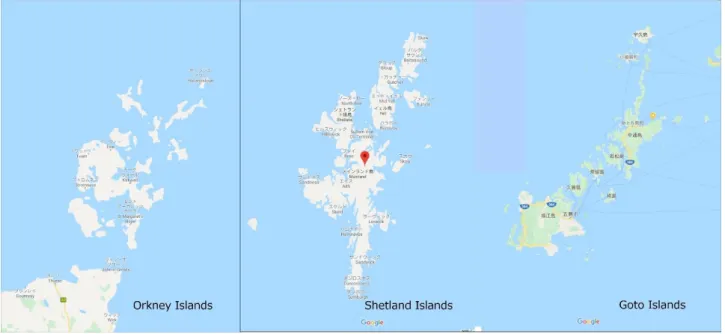
Table 6-3 Comparison of the Orkney, Shetland, and Goto Islands to the same scale
6-2. Public Transportation in Remote Areas – New Initiatives in Japan and Overseas
~ Overview ~
With a request from Shinkamigoto Town for a survey on new initiatives to public transportation in depopulated remote areas overseas, we made a summary of the situation of public transportation in remote areas with small populations, mainly through a survey of initiatives in Scandinavia. As an attempt to replace (or supplement) conventional public transportation such as route buses, we introduce a new style Demand-responsive Transport system. The examples of recent initiatives in remote areas of Japan we pick up on are, ① ’Community Car Sharing’ with donated vehicles from the Japan Car Sharing Association (NPO) in Ishinomaki City, Iwate Prefecture (activity that uses cars together within the same neighborhood), ② ‘Yakuburu’ (NPO), a private car transport network in Yabu City, Hyogo Prefecture, and ③ a courier service that uses route buses (Yamato Transport Co., Ltd.)
~ Traffic Situation in Kamigoto Town ~
According to ‘ The Plan for Maintaining Local Communities in Specified Remote Inhabited Regions of Nagasaki Prefecture’ (Nagasaki Prefecture, 2017; revised in 2019) ‘II By Region 3 Goto Islands Region’, one of the transportation problems in the Goto Islands, where Kamigoto Town is located, is that gasoline prices are higher than the mainland and that public transportation such as route buses, with a lack of routes and services, means that activities that involve travel, even commuting to work and school, have to rely on private cars that consume gasoline. [Nagasaki Prefecture 2019]
~ Public Transportation Situation in Remote Areas (OECD Countries) ~
According to a survey on public transportation compiled by the Organization for Economic Co- operation and Development (OECD), the characteristics of public transportation in remote areas are,
① It is expensive due to the long travel distance and few passengers, and ② It is a transportation system used by people without access to a private car. (Leiren and Skollerud 2015) This is very different from the role of public transportation in cities, where people use public transportation instead of private cars to reduce traffic congestion, environmental pollution and greenhouse gas emissions.
The most notable findings from the Norwegian Government’s public transportation survey were that, [Leiren Skollerud, 2015, p.66]
Elderly people living in remote areas are worried about how to maintain the activities they used to do when they can’t drive any more.
There are two types of travel opportunities that should be secured by public transportation, a) morning services to the city center (trade route) and b) evening services to get to evening meetings and events in town.
The amount of subsidies granted to the elderly by the Norwegian Government as part of the ’Transfer Services for the Disabled’ is small compared to the actual needs of the elderly to travel. For this reason, the elderly must make use of taxis and rely on transportation by family and friends to compensate for the lack of transportation.