KEIEI TO KEIZAI, Vol.86 No.3, December 2006 169
Corporate Social Responsibility: Benefit, Current Status and Future Trend
Sarwar U. AHMED t Shigeru UCHIDA
:j:Abstract
The objective of this paper is to review the current status and future trend of corporate social responsibility concept practiced by companies.
In doing so, the term corporate social responsibility is defined with the regulations governing it. Then the benefits of performing· such respon- sibilities are elaborated. Finally, the role of the public sector is dis- cussed in assisting the business firms for practicing social responsibility.
The examination of various available literatures revealed that, investing in social responsibility activities pays the firm in terms of improved brand image, skilled and motivated employees, better risk management etc. Finally, this paper concluded that, social responsibility compliance and stockholders value are not mutually exclusive tasks, rather they compensate each other in achieving the ultimate goal ofsustainable eco- nomic development.
Keywords: corporate social responsibility, global instrument, . benefits, public sector
1. Introduction
Corporate social responsibility (CSR) has developed into a widely recog- nized topic for business firms. But the question as to whether and how they
t Sarwar U. Ahmed: Research Associate, Faculty of Engineering, Nagasaki University
:j: Shigeru Uchida: Professor, Faculty of Economics, Nagasaki University
170 KEIEI TO KEIZAI
should practice CSR is still vague and widely debated. There are also few models that show the positive relation between investment. in CSR and benefits to the company. However, gradually governments and various global instruments are imposing CSR standards on companies to follow.
Hence, in near future companies would not be able to decline CSR activities.
Thus, it is high time for business firms to assess the cost and benefits of in- vesting in CSR activities. Accordingly, this paper reviews the meaning, regulations, benefits and future trend of CSR activities. The results of this study are expected to provide a baseline for initiating a future study on the impact of practicing corporate social responsibility by banks.
CSR of financial intermediaries has been played very important role both in the economy and society. In the decade of 1960s, CSR of manufacturing enterprises particularly those of heavy industries caught certain attentions of people for coping with public nuisance and environmental destructions. A few economists and managerial scientists such as Mishan (1969) who is known by exploring amenity right and others, Rome Club and Meadows et al. (1972) giving us consideration about limit and implementation of economic growth to harmonize environmental conditions, and others have conducted relevant researches.
This might be the first era of researching CSR. This line of studies on en- vironmental sciences involving environment economics or environment management has widely been tackled by scientists in many fields to develop methodologies and practices of keeping the earth and global environments in appropriately sustainable conditions.
Since 1990, we have observed the second trend of investigating CSR.
Some interesting topics have been presented even for revitalization of deve-
loped economies such as optimal settlement of governance status among
Corporate SoCial Responsibility: Benefit, Current Status and Future Trend 171
stakeholders, corporate citizenship, business ethics, corporate culture, and so forth.
2. Corporate Social Responsibility (CSR)
Corporate social responsibility, as the name implies, refers to the respon- sibility of the company to the society or community. This term is defined by the World Business Council for Sustainable Development (WBSD, 2002) as
"the commitment of business to contribute to sustainable economic de- velopment, working with employees, their families, the local community and society at large to improve their quality of life." Thus CSR refers to the responsibility of the business firms to improve the relationships among the stakeholders, which includes customers, investors, employees, local com- munity and the society. Figure 1 depicts the role that CSR activities play in achieving the ultimate goal of sustainable economic development for the stakeholders.
3. Current Global Instruments for CSR
Presently, there are several "global instruments" which provide code or
standard to guide international business regarding non-financial perfor-
mance, i.e., corporate social responsibility, namely, GECD Guidelines for
Multinational Enterprises, Caux Principles for Business, Global Reporting
Initiative, Global Sullivan Principles, Principles for Global Corporate
Responsibility: Benchmarks, Social Accountability 8000 (SA8000), UN
Global Compact. The objective of these guidelines is to develop internation-
ally agreed principles to reduce misunderstanding and promote assurance
172 . KEIEI TO KEIZAI
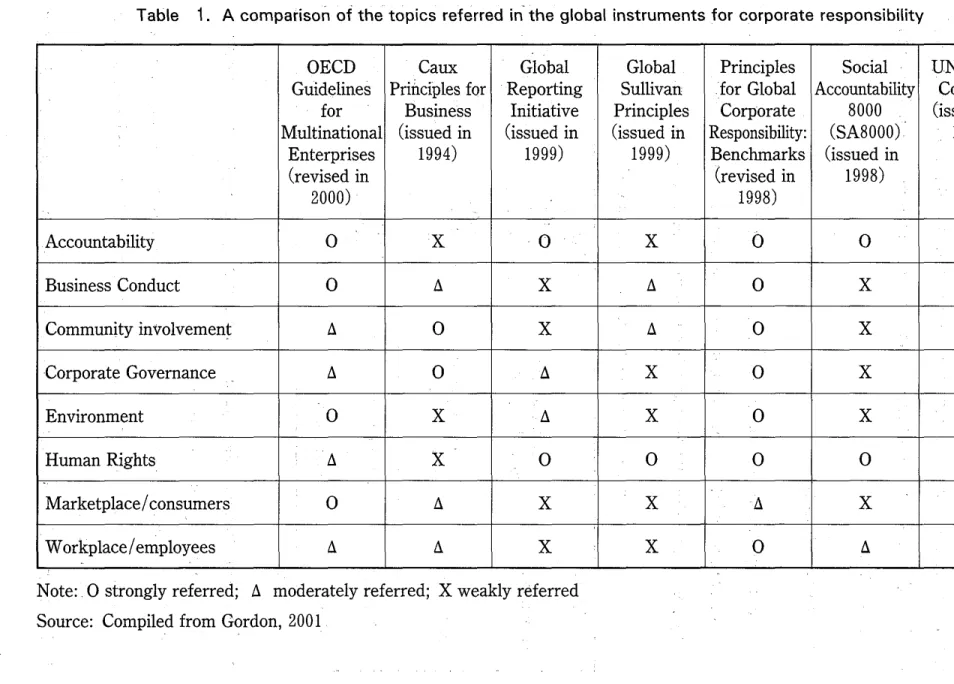
among business, labor and societyas a whole (Gordon, 2001). Acompari- son of these instruments in reference to the corporate {'ocial responsibility is shown in Table 1. From the table we can see that, Principles for Global Cor- porate Responsibility: Benchmarks and OECD Guidelines for Multinational Enterprises covers the CSR topics more widely compared to the other global instruments.
4. Does Corporate Social Responsibility Pay?
The question whether practicing social responsibility benefits the business firm is a subject of debate among the researchers. There are two contrasting views with respect to the objective of the firms: Adam Smith and Milton Friedman argue that the companies are solely responsible. to their owners and their social responsibility is to make profit (CPD, 2002) .On the other hand, socia-political maximalists relate that social responsibility of a compa- ny is unlimited and the objective of profit maximization should come next.
The opinion of these economic arguments has different goals for a firm, but they have one thing in common, which is they considered social responsibili- ty and shareholders value as mutually exclusive. Still now to many firms the benefits of practicing social responsibility are not clear. Thus the lack of wil- lingness on the· part of. many firms to develop concrete corporate social responsibility program indicates that, these activities are costly and problematic with no obvious benefit for the firm (Murry and Vogel, 1997).
However if we consider another viewpoint the stockholders value and so-
cial responsibility are not mutually exclusive, rather they compensate each
other. A business firm which aims at maximizing stockholders value should
also invest in performing social re-sponsibility by increasing accountability
Table 1. A comparison of the topics referred in'the global instruments for corporate responsibility
OECD Caux Global Global Principles Social UN Global
Guidelines Principles fQr Reporting Sullivan for Global Accountability Compact for Business Initiative Principles Corporate 8000 (issued in Multinational (issued in (issued in (issued in Responsibility: (SA8000)- 1999)
Enterprises 1994) 1999) 1999) Benchmarks (issued in
(revised in (revised in 1998)
2000) 1998)
Accountability 0 X -0 X 0 0 6.
Business Conduct 0 !1 X !1 0 X X
Community involvement !1 0 X !1 0 X X
Corporate Governance !1 0 !1 X 0 X X
Environment 0 X !1 X 0 X X
Human Rights !1 X 0 0 0 0 !1
Marketplace/consumers 0 !1 X X !1 X X
Workplace/employees !1 !1 X X 0 !1 X
Note:.0 strongly referred; !1 moderately referred; X weakly referred Source: Compiled from Gordon, 2001
(")
.a ~
Vlo()
....
e:..e
o~::l'"
q" g
t:O~
~
(")
c
~
Vl
~
'"
§
0-
~
~
[
>-' --.:J C'-'
174 KEIEI TO KEIZAI
and transparency. Thus a firm can satisfy both the goal of making profits and performing social responsibility. Among others the benefits which a bus- iness firm can expect to receive from exercising social responsibility might be divided into direct (short-term) and indirect (long-term) benefits and are explained below.
4 . 1
Direct Benefitsa) Practicing· corporate social responsibility increases accountability and transparency of the firm, which in turn results in better risk management by restricting the management from opting hidden risky transactions.
Table 2 Public sector roles in enforce CSR
Roles Activities
Command and Regulators Legal and
Mandating
control legislation and fiscal penalties inspectorates and rewards
Creating Capacity
Facilitating Enabling legislation incentives building
Funding support Raising Stimulating
awareness markets
Partnering Combining resources Stakeholder
Dialogue engagement
Endorsing Political support Publicity
. and praise Source: Fox et al., 2002
b) This also increases the image of the company through good publicity in the community and the society.
c) Fulfilling social responsibility ensures the welfare of the employees and .their development and guarantees the continued flow of skilled and moti-
vated workforce.
d) Firms investing in exercising social responsibility are also valued highly
Table 3 Long-term strategic benefits form practicing corporate social responsibility
Centrality Specificity Proactivity Voluntarism Visibility Value created
Philanthropic Computer Accustom new Community Customer
contributions donations to users to firm's support loyalty
schools by products vs computer mfrs. competitors
Engineering research fellowships
Employee benefits Health New or Employee Internal: Productivity
Day care uncommon loyalty and Employee gains
Flex-time benefits Higher morale loyalty and
employee loyalty morale
Environment New products Patent or Learning curve Positive Public relations New products management (health, safety, ' ,
innovation edge advantage relations with and/or or markets e.g., green
pollution) . Process in product or regulations marketing
innovation process advantage
development
.Political activity Favorable New business Pre-positioning New product or
(PAC, lobby or information change in opportunities if for changes in geographic
independent or industry) economic and pre-positioned to regulations market
social regulations take advantage of opportunities
new rules
Product or service related Product Patent or Environmental First-to-market New product on characteristics, innovations reformulation innovation edge scanning to or leadership new markets
or processes e.g. 'green' first-to-market create edge benefits Edge in
Improved brand loyalty in design or meeting
design, e.g., fue product ideas emergency
efficiency needs
New products, e.g., airbags Source: Burke and Logsdon (1996)
,a
(1~
CIloD.
e:.
~
{I)
'0o
::l
{I)
~
~
t;:j
'"~
~
I
CIl~
{I)
~p..
~
~
l
...
--'J 01
176 KEIEI TO KEIZAI
by the market indicators in terms of non-financial indicators.
4.
2
Indirect BenefitsAlso there are various indirect and long-term benefits. Burke and Logsdon (1996) elaborated the long-run strategic payoffs from CSR. These are ex- plained through Table 3.
5. Role of Public Sector in Strengthening CSR
In the current state where the benefits of CSR activities are not still clear to the business
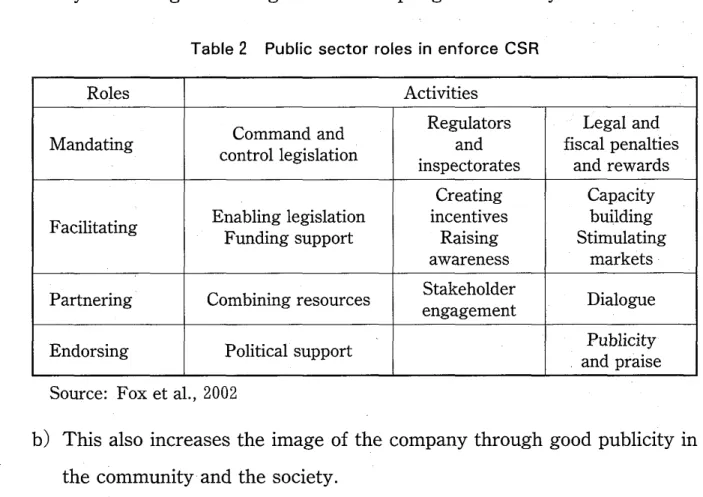
firms~government of each country can play an important role through the public sector. Government can assist in building an 'enabling environment', which would create a policy environment encouraging busi- ness firms to minimize environmental and social costs and maximizing eco- nomic gains (Fox et aI., 2002).· In this regard, the public sector can play four roles, e.g., mandating, facilitating, partnering, and endorsing the cor- porate social responsibility themes to the business firms (see Table 2.for de- tails) .
6. Concluding Remarks
The main objective of this study is to assess the current status and future trend 'of corporate social responsibility practiced by the business firms. In doing so this paper presented a part of the literature survey. The findings of the study might be summarized and concluded as follows:
(1)
Whether or not the business firms recognize the benefits, performing
corporate social responsibility is becoming an inevitable task for the
Corporate Social Responsibility: Benefit, Current Status and Future Trend 177
companies due to the increasing enforcement of both national and global instruments.
(2) However, practicing social responsibility brings both short and long- term benefits to the business firms in this ever increasing era of cor- porate image and globalization.
(3) Investing in social responsibility and maximizing shareholders value is not a contrasting task. They both are two sides· of the same coin and lead to the same objective of improving the quality of life and eventually sustainable economic development.
(4) In addition to the benefit driven motivation form the companies to perform social responsibility, public sector should act as catalyst in mandating, facilitating, partnering and endorsing business firms in performing social responsibility.
Though there might be quite a few literatures about CSR of financial serv- ices industries both in first and second periods, we could recognize that some of them would have their own basic features or worthy points common to manufacturing or other industries to be surveyed here in this paper. Final- ly this study is just a baseline survey for grasping the concept of corporate social responsibility. Our next objective is to expand the concept to banks and study the corporate responsibility of banks by initiating both theoretical and empirical analysis.
References
Burke, L. and Logsdon J.M. (1996) How corporate social responsibility pays off, Long Range Planning, 29-4, pp. 495-502.
CPD (Center for Policy Dialogue) (2002) Corporate responsibility practices in Bangladesh:
results from a benchmark study, Paper No.IS.
178 KEIEI TO KEIZAI
Fox, T., Ward, H. and Howard, B. (2002) Public sector roles in strengthening corporate so- cial responsibility: a baseline study, Corporate Responsibility for Environment and De- velopment Programme, International Institute for Environment and Dev:elopment
(lIED) .
Gordon, K. (2001) The OECD guidelines and other cooperate responsibility instruments: a comparison, OECD Working Papers on International Investment, 2001/5, OECD Publishing.
Meadows, D.H., D.L.Meadows, ].Randers and W.W.Behrens ill (1972) The Limits to growth: a report for the Club of Rome's project on the predicament of mankind, Universe Book **~j\~~!*i:~ WRJt*0)~JU1~
:
0-'"'<" . :J'77'r
A~O):I1tmJ v~- LJJ 5'./j'"1' -t-YF:tl:,
19721j:.Mishan, E.].(1969) Growth: the price we pay, Staples Press. 1'ftHf&mA!*i:~
WM;ttfRJt*O)1tfrIlU
:!fi~i!iItL 19721j:.
Murry, K.B. and Vogel, C.M. (1997) Using a hierarchy-of-effects approach to gauge the ef- fectiveness of corporate social responsibility to. generate goodwill toward the firm:
financial versus nonfinancial impacts,Journal of Business Research, 38, pp. 141-159.
WBSD (World Business Council for Sustainable Development) (2002) The Business Case for Sustainable Development, Geneva.